
Hometown

Untold Stories

A simple man’s jump into history

By Bill Fields

To my memory, still keen though he has been gone 40 years, Dad wasn’t big on sit-down discussions of serious matters. If, in the early 1970s, we had been wearing Fitbits instead of Timexes, they would have shown considerable steps taken during our “Facts of Life” conversation as we paced around the house one afternoon, each doing his best to speak of anything but the birds and the bees.

We got through that talk, fragmented though it might have been, despite our mutual reluctance. That was not the case when it came to my father’s military service, memories of which were as off limits to me as the bottle of Canadian Club stashed in the far reaches of a kitchen cabinet.

The hard stuff of war had come years earlier as my father, a corporal in the 161st Parachute Engineer Company, fought in the Pacific theater in 1944-45. Like so many others, William E. Fields had been plucked from an ordinary life — in his case, a long-haul truck driver transporting produce from his hometown of Jackson Springs to locales along the Eastern Seaboard — to do extraordinary things in the Allied war effort.

In 2020, the 75th anniversary of the end of World War II, plenty of stories will be told about men and women who never wanted to talk about themselves or what they went through.
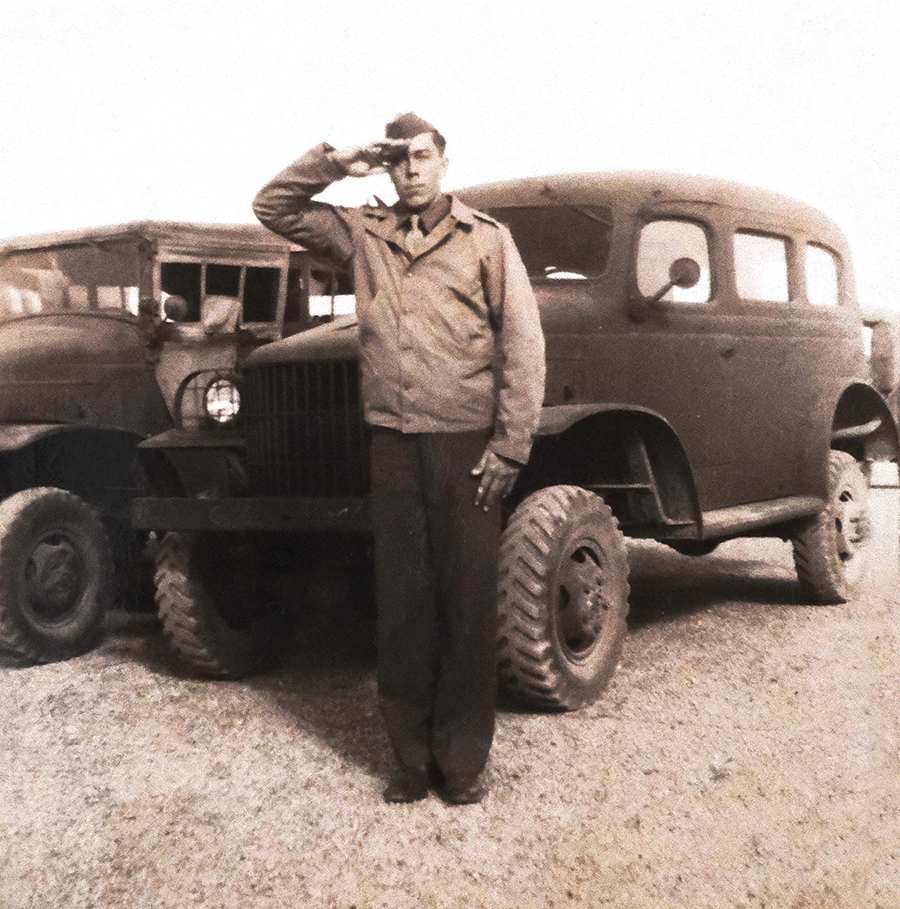
Dad was inducted Oct. 15, 1942, in Fort Bragg. By the spring of ’44, he had his wings, a wife and a will. My parents’ first child was due that November, by which time Dad was about 9,000 miles from home. An assistant unit foreman, second in command of a squad of parachute engineers, my father directed combat and demolitions work, and helped erect barriers and traps against the enemy.

His unit of airborne engineers was attached to the 503rd Parachute Regimental Combat Team. After fighting in the New Guinea and Luzon campaigns, Corregidor was next as the United States sought to reclaim the rocky island in Manila Bay overtaken by Japanese forces in 1942.

“The airborne landing was one of the most — if not the most — daring, unusual and successful in the history of airborne operations,” authors James and William Belote wrote in Corregidor: Saga of a Fortress, of the Feb. 16, 1945 operation involving 2,065 paratroopers descending from C-47s only 400 feet above a tiny landing zone on a windy morning. The first time I watched a Pathé newsreel film of the jump, the jeopardy of the troops became very real.

I’ve wondered if my mother, in North Carolina with her infant daughter, Dianne, read this Associated Press account published Feb. 18 in the Charlotte Observer and papers across the country: “Plane after plane dropped 10-man teams, some beyond the cliffs, some in rocky ravines but the majority on the ‘topside’ where they were to the rear of enemy guns pointing out to the China Sea. The ’chutists carried full equipment.”

Dad wasn’t in the majority and became one of hundreds of casualties when he landed on uneven terrain, shattering his right ankle. After a long recuperation, he would recover to walk without a limp but was plagued the rest of his life by tropical ulcer or “jungle rot” on the joint and varicose veins in his right calf.

As I found out just recently from an older cousin to whom Dad once confided a decade after the war, getting badly hurt was only part of his Corregidor story. Wounded and alone after being blown off course, he had to hide in a crater covered by his parachute to avoid being seen by Japanese troops before eventually being rescued and evacuated by comrades. It would be two months before he returned to the United States, and September until he was discharged from a convalescent hospital in Virginia with $144.14 and a Purple Heart that cost much more than that.

On Feb. 16, I will be thinking a lot about an ordinary man and the stories he wouldn’t share.  PS

Southern Pines native Bill Fields, who writes about golf and other things, moved north in 1986 but hasn’t lost his accent.

Hometown

Period Pieces

Vintage cameras can yield vintage shots

By Bill Fields

I’ve decided I’m going to start a new decade with an old camera.

In fact, multiple vintage cameras. I’ve had them for a while as the only thing I really collect aside from a meager stash of old signature golf balls bearing the names of pros you probably haven’t heard of.

But, after a couple of false starts the last few years, I’ve made a commitment to use them regularly in 2020, the challenges of airport X-rays and film loading be damned. (I’m writing this with a view of some stray bits of film leader, the end game of a practice run with a bottom-loading screw-mount Leica.)

Still, it was great fun to take my 1937 Leica IId to the top of the Arc de Triomphe on a trip to Paris in late 2018, where it stood out in a sea of selfie sticks and smartphones. I’ve shot film sporadically over the last two decades, from an 85-year-old leatherette Kodak Brownie to a brand-new plastic Holga and any number of models in between.

An image I made with that Brownie about a decade ago on a beach not far from home is one my favorites. A handheld exposure at dusk, it includes two swimmers, one appearing as a sea serpentlike apparition, the mood enhanced by a bit of motion and the late hour of the day. My satisfaction with the photo is no doubt also influenced by the vagaries of the camera itself, a basic design that wasn’t foolproof in its heyday, much less now. I sure didn’t know what I had when I looked through the cloudy viewfinder and clicked the shutter that evening.

I thought about a one-camera/one-lens approach to 2020, a popular method for simplifying one’s photographic mission. One of my very old Leicas with a collapsible Elmar 50mm f/3.5 lens will likely see the most duty, but I’m going to mix things up by utilizing an Olympus OM-1n from the 1970s and probably the box camera as well. I noticed recently that a couple of places even still sell 110-format film, meaning that I could put my first camera, a Kodak Pocket Instamatic 20 model, in the rotation. What I’m sure of, though, is my vow to have a film camera with me.

I don’t know my way around a darkroom, so I won’t be souping my own film or making my own prints, yet I am energized by the prospects of the photographs I will be producing. Budget alone will force me to pick my spots and compose carefully. I may develop specific themes or it could turn out more random. It will be fun — I think — to experience the hopeful anxiety between shooting and having the film developed as I experienced in shooting golf professionally for more than a decade in the 1980s and 1990s.

One of the most vivid memories of my work life is picking up my slides at a New York City lab on the Monday after the 1987 Masters and quickly going through boxes to find the one containing Larry Mize’s winning shot and celebration. Dinner tasted a lot better once I realized I had the moment in focus and it was properly exposed, no gimme in a less-automated era.

My career won’t depend on what I shoot on film in 2020. In a way, it’s akin to playing golf with hickory shafts or persimmon clubheads — a different game than today’s way. Vintage cameras can be beautiful objects even if they’re just sitting on a shelf. Using them can be rewarding. To consider who before me might have shot with them — and where — is a fascination, and there is romance in film that isn’t in a memory card.

My friend Martin Axon has printed for many renowned photographers and is a master of the platinum process. In 2013, I did an essay about Hy Peskin’s famous image of Ben Hogan at the 1950 U.S. Open. Axon has printed the iconic shot.

“When you hold someone’s negative,” Axon told me then, “you go, ‘This was the actual moment,’ because you know the film was there at that moment in time.”

Here’s hoping negatives will be a positive in 2020.  PS

Southern Pines native Bill Fields, who writes about golf and other things, moved north in 1986 but hasn’t lost his accent.

Hometown

Treasures Under the Tree

The beginning of a beautiful friendship

By Bill Fields

There was an episode of The Waltons titled “The Best Christmas” in which mother Olivia is determined to have the merriest of holidays even without sipping a drop of the Baldwin sisters’ white lightning. She wanted her large brood all together for perhaps the last time, but her plans went awry because of a snowstorm, downed tree, car-in-a-pond and other misfortunes.

That show aired in 1976, but my best Christmas — still Santa-believing division — occurred seven years earlier.

As the turbulent 1960s came to a close, for me, a sports-loving 10-year-old, a door opened to what became my favorite sport and, to a larger degree, my life.

Up to that point I had batted around golf balls with a Kroydon putter and a Wilson 5-iron I talked my parents into buying on separate visits to the Sky City High Point. Those implements, though, didn’t make me a golfer like the ones I saw playing around town and on television or read about in the paper. In my mind, I needed a set of clubs for that to be so.

For my parents, those were tiring months leading up to Christmas 1969, because I brought up my desire for a set of golf clubs many times. A Mom and Dad with more Scrooge in them might have denied me, but they weren’t built that way.

Presents from Santa Claus weren’t wrapped in the Fields household, so when I came into the living room on Christmas morning and glimpsed something long and red on the floor with shiny things sticking out the top, I squealed with joy.

It was a Spalding “Tournament” starter set including a rectangular vinyl bag. The driver and 3-wood were made of “Persimmonite,” the Naugahyde of wooden clubs, and guarded by black covers. The irons were Nos. 3, 5, 7 and 9. There was a blade putter, which upon use and research I would discover was a cross between a club you’d find on a miniature-golf counter and Spalding’s venerable “Cash-In” model.

The clubs had Palmer’s signature on them — Johnny, not Arnold. I didn’t know who Johnny Palmer was, but his handwriting was neat, and since his name adorned a set that sold for about half of my dad’s weekly pay, he must be somebody special.

The grips were tacky rubber and the whole kit oozed opportunity. I removed each club out of the bag, took a grip — all fingers on the handle, having not discovered the overlapping style — and waggled above the carpet. Mom had a wide cautionary streak, but on this happy occasion I don’t think she warned me once about breaking a vase or marring the ceiling.

Frank Beard was the leading money winner on tour that year, but I don’t think his season was better than mine, thanks to the acquisition of my Spaldings.

Later on, I learned that John Cornelius Palmer Jr. was a fellow North Carolinian, born in 1918 in tiny Eldorado, the same birthplace as my grandfather Henderson. Johnny grew up in Badin and was one of the finest golfers to come out of the Old North State, winning seven times on the PGA Tour between 1946 and 1954. Twenty years before I found his name under our tree, Palmer finished second in the PGA Championship, tied for fourth at the Masters, and also was in the top-10 at the U.S. Open.

I used the Johnny Palmers for a couple of years, as my love for the game deepened, until graduating to a full set of used MacGregors purchased from Frank, a retiree I played with at Knollwood Fairways. The starter set was passed along to my father and subsequently to my brother-in-law Bob, an infrequent golfer.

The Spalding driver has been in my possession throughout adulthood. Only recently has the gang been back together, sans 3-wood, my sister digging the four irons out of a basement where her late husband had stored them, and shipping them from Oklahoma. I reclaimed the putter and bag when we cleaned out Mom’s house. I waggle them occasionally, the grips having slickened and hardened over time. The bag also holds my MacGregor woods, clubheads made of the real thing.

This fall I bought my first fresh sticks in about a decade. I was reminded there is nothing like a glossy new golf club, empty of errors and full of hope. But there is nothing like an old one either, especially when the nicks and scuffs are yours on a starter set that fulfilled its mission.  PS

Southern Pines native Bill Fields, who writes about golf and other things, moved north in 1986 but hasn’t lost his accent.

Hometown

Fallback Position

Saving a season of discontent

By Bill Fields

As the Washington Redskins dropped their fourth straight game in the early stages of another lousy NFL season on the same weekend my alma mater North Carolina came heartbreakingly close to beating Clemson, I had one thought: Thank goodness for Ohio State.

There is no way that sentence could have come from my keyboard prior to 2013, when I started dating Ohio-born Jen, whose sporting interests start and end with Buckeye football. They were her parents’ favorite and quickly became her team, too. Jen keeps track of the Buckeyes like a meteorologist watching a hurricane, then, when college football season is over, contentedly returns to reading, cooking or needlepoint.

Since Ohio State wins regularly, it wasn’t a hard sell for me to become a fan, because who wants scoreboards making them sad several months a year? Washington has had only nine winning seasons since 1991, and although things are looking up for the Tar Heels with the return of coach Mack Brown, he is not a miracle worker.

I’m not going to abandon my NFL favorite despite their owner or their nickname, both of which are problematic. I have rooted for Washington since Sonny Jurgensen was passing to Charley Taylor and still have the Sonny-signed 8×10 I sent away for. I had NFL bed sheets, a Redskins toboggan and jacket, and was glued to the television every time they played.

During my childhood of fandom, Washington didn’t have a winning record until I was 10. But the Jurgensen-led offense could always move the ball, as evidenced in a 72-41 victory over the New York Giants in 1966, the 115 total points still an NFL regular season record.

I remember well the joy of the 1983 Super Bowl, when Washington finally won the big one. I drove to Charlotte to watch the game with my friends Brad and Lynne, Brad having grown up in the D.C. area and been a long-suffering fan like me. Washington was Super Bowl champion again in 1988 and 1992. In that decade I was well rewarded for many years of football futility, but recently, with the wayward team management, those highlight memories seem very distant.

The Tar Heels played some of their finest football when I was in school at Chapel Hill, no surprise given their roster included Lawrence Taylor on defense and Kelvin Bryant on offense. Although I was typing for The Daily Tar Heel, which ruled out face paint or a flask in Kenan Stadium, those were heady days. In 1980, when UNC was 7-0 and traveled to perennially good Oklahoma, there hardly had been a bigger Carolina football game.

Alas, the Dick Crum-coached Tar Heels were humbled, 41-7, but there was so much interest in the contest I was able to string for a couple of newspapers and make a few bucks to spend at the Porthole and He’s Not Here. Carolina won the rest of its games that season, concluding with a victory over Texas in the Bluebonnet Bowl, the only time I was in the Astrodome.

After meeting Jen, I soon discovered that despite her longtime allegiance she had never attended an Ohio State game at “The Shoe.” We remedied that in 2016, driving to Columbus to watch OSU play Bowling Green State University. Jen was like Ned Beatty’s character in Rudy, finally going to a Notre Dame game after many seasons of watching on TV. Our seats were way up high, but the Buckeyes and The Best Damn Band in the Land were great, and so was the weather, gloriously warm and sunny. Final score: Ohio State 77, Bowling Green 10.

The Buckeyes were scoring plenty of points in their early games this season, guided by quarterback Justin Fields, whose name makes their games even more fun for this fan. Come the Saturday after Thanksgiving, Jen and I will be in front of a television for Ohio State-Michigan. It’ll never be Carolina-Duke hoops for me, but I’m happy “The Game” is at least a little bit my game too.  PS

Southern Pines native Bill Fields, who writes about golf and other things, moved north in 1986 but hasn’t lost his accent.

Hometown

Unhooked

Avoiding a real drag at dawn

By Bill Fields

Walking through the Atlanta airport to my departure gate for an early morning flight late this summer, I trailed a couple of passengers who took a hard right into a glass-doored room with rows of seats. I didn’t understand their detour until I glimpsed someone settled in with a cigarette, the smoke headed upward toward a powerful vent in an attempt to mitigate the odor.

I checked later, and there are more places at Hartsfield-Jackson International for animals to go to the bathroom than for their owners to have a cigarette.

Smoking is an increasingly lonely and expensive — at my local convenience store, a pack ranges from $7.99 to $11.10 — proposition in the United States. Less than 15 percent of the population is lighting up compared with about four out of 10 Americans half a century ago, not long after the surgeon general first warned of the health risks. Chick-peas grow and solar panels collect the sun’s energy in many places where tobacco once grew.

I’ve smoked cigarettes — probably not a carton in total, right after I graduated from college — but thankfully never got hooked and, growing up in North Carolina when I did, that probably put me in the minority. Going to tour the R.J. Reynolds plant in Winston-Salem was as natural an outing as a trip to a museum in Raleigh or the battleship in Wilmington. We were very proud the Christmas we gave Dad, a Salem man, a kit to roll his own cigarettes. He was less enthusiastic, and Dad never missed a week of purchasing his carton of Salems from the Big Star (for about half the cost of what a single pack runs today).

It is hard for me to picture Dad without a cigarette. He smoked at least two packs a day most of his adult life. He didn’t want a shirt unless it had a pocket to store his smokes — even his T-shirts were so designed. He smoked inside, outside and when he was driving, fishing or playing golf. He had lighters inscribed with his initials.

I don’t know if he agreed with the Salem advertising that the brand had “a taste as soft and fresh as springtime,” but he was thoroughly hooked until he was diagnosed with a smoking-related cancer and had surgery. Dad only lived a little more than a year after that operation. He never smoked again, though, and after he quit came to realize how offensive the habit was.

Given that even doctors endorsed smoking when Dad started as a teenager in the late 1930s, and that cigarettes were part of a soldier’s standard kit during World War II, it’s not hard to see how so many people in his generation got hooked.

As I tried to discourage a young friend of mine from smoking recently, I thought about my father’s life and death, and of those smokers in the airport, who ought to know better, taking a drag at dawn and counting the minutes until they could have another cigarette.

I’m lucky that I quit before I ever really started, unhappy with how smoking made me feel and my clothes smell, beyond what had become indisputable health hazards. The stale scent was so different from what I remembered from a decade earlier when Dad took me to a tobacco warehouse in Fairmont, where the sweetly powerful and appealing aroma of the cured product was more distinct than the auctioneer’s rapid delivery.

I bought my last pack of Salems almost 40 years ago. It was a short smoking experiment, not quite as abbreviated as when I tried chewing tobacco for one inning during a college intramural softball game. As I attempted to manage the chaw, I felt as if I were getting greener than the sparse, end-of-semester grass on which we were playing. I was in left field and out of my league. My first purchase of Red Man was my last.  PS

Southern Pines native Bill Fields, who writes about golf and other things, moved north in 1986 but hasn’t lost his accent.

Hometown

Matchless

Low mileage, one owner, gently used

By Bill Fields

My ’66 Mustang needs a paint job, and the wheels are wobbly on my ’62 Ferrari. But compared with my ’63 Vauxhall Estate Car, whose windows are broken and back hatch is missing, the first two vehicles are looking good.

Now, I’m not really a car collector. I’m not even a real collector of these 1:64 scale miniatures that had so many of us hoping we had 49 cents in our pocket — approximately two visits from the tooth fairy — for a purchase years ago. My dozen were rescued from the corner of a closet where they had been garaged for a long time.

Lots of things shout “child of the ’60s,” but does any toy do it better than a Matchbox car?

As the advertising copy said: “For boys and girls of all ages . . . built of pressure die-cast metal by English craftsmen . . . nothing to assemble, ready to use . . . colorful nontoxic baked enamel finish, authentic in every detail.”

I’m glad I never snacked on my vehicles, just in case, but the Matchbox Series did have a lot going for it. Detroit might not have ever been usurped as a car capital if its workmanship had been as fine as that in the toys manufactured in England by Lesney Products.

Although small enough to fit in a child’s hand, some of the models consisted of more than 100 parts. They were finely assembled, with details that mirrored the real thing. Automakers on both sides of the Atlantic, happy with the publicity, shared specifications with the toy company that allowed for great authenticity in the replicas.

As a kid who loved small things — a pocket magnetic checkers set, tiny stapler, mini-football helmet pencil sharpener, miniature golf — Matchbox cars were right in my wheelhouse.

Lesney began after World War II in London, a collaboration of friends and military veterans Leslie Smith and Rodney Smith, who used syllables from each of their first names as the company moniker. Toys weren’t the focus of the die-cast business until another man, Jack Odell, joined the original partners.

The Matchbox brand sprouted from Odell’s initial Lilliputian design — a brass steamroller he built in 1952 for his daughter that met her school’s edict that students couldn’t bring toys larger than a matchbox. Odell and Leslie Smith started producing their line of vehicles in 1953, Rodney Smith having sold out to his partners two years earlier. Their first design was a miniature gilded coach for the coronation of Queen Elizabeth II, a hot seller that was followed by a bulldozer, fire engine and, in 1954, Lesney’s first car, an MG.

Lesney was producing more than a million vehicles a week by the early 1960s as Matchbox cars were being sold in great numbers all over the world. “We produce more Rolls-Royces in a single day,” Odell told The New York Times, “than the Rolls-Royce company has made in its entire history.”

My fanciest Matchbox model is a ’64 Lincoln Continental, sea-foam green, whose trunk was just big enough to hold a piece of candy corn. I like my oldest model, a ’61 gray and red “Bedford Tipper” truck that I probably was given before I was old enough to really bang it around, which could explain why it looks as if it just came off the lot.

I was well-equipped for emergency response, owning a ’62 ambulance, ’65 wrecker and ’66 firetruck, its removable plastic ladder on the roof and ready to rescue someone trapped on the second story. There are versions of the Dodge Wreck Truck that make them a rare and valuable collectible because of a manufacturing quirk, but mine is run-of-the-mill and a little sad, its tow hook gone. I’ll blame the snapped-off part on my nephews, who were playing with my little cars on visits to their grandparents about the time I was getting my driver’s license.

New generation, same old fun.  PS

Southern Pines native Bill Fields, who writes about golf and other things, moved north in 1986 but hasn’t lost his accent.

Hometown

The Gift of Years

A farewell to Mother Fields

By Bill Fields

When I saw that a voicemail from one of my sisters had landed in the middle of the night, I didn’t have to call her back to know what had happened.

Our mother’s long, largely happy and healthy life had come to an end less than two months from her 96th birthday. The day we laid Juanita Henderson Fields to rest was sunny and warm, much different from our father’s burial on a chilly spring forenoon nearly 40 years ago, when it was hard to tell the tears from the rain.

Different weather seemed appropriate, because a life that is over at 95 is not the same as a life cut short at 59. That gift of years also was our present.

How lucky I was to be able to go home for so long — much longer than most folks can — to East New Jersey Avenue and those familiar rooms and all those memories, of cookouts and penny poker games, giddy Christmas mornings and sunny Easter afternoons, looking for dyed eggs in the yard, one inevitably hidden in a hydrangea.

My sisters always called her “Mother,” and she was “Mom” to me. After becoming a grandmother, in the early 1970s, she also was “Mother Fields.” That sounded like a gospel singer on tour through the South, but it fit. By any name, she was a good wife, mother, daughter, sibling, aunt and friend. She was good, in the broadest definition of that short word. Someone who came by the funeral home called her classy. Mom was that too, along with being well-dressed, sneaky-funny, generous and, especially in her last decade, stubborn as a tight jar lid.

I’m convinced part of Mom’s stubbornness to leave her home, to stay a couple of innings too long there, was rooted in her desire for us to have that home to return to as long as possible because it was something she could do for us. Once we had finally gotten her into assisted living, we had to tackle cleaning out the house. By the end of that week, our backs were sore but our souls were full, having gotten to explore Mom’s life as we dealt with the many possessions.

We found out our mother really, really liked clothes. We discovered she was Most Improved in the Tar Heel Bowlerettes in the 1964-65 season, wearing the white and green shirt of Citizens Bank. We found autograph books and a West End High School diploma, in the days when she was a raven-haired beauty, and a steno pad of tender notes Dad wrote to her as he recovered from an operation that temporarily stilled his voice.

She let us learn from our mistakes when we were kids, and she respected our decisions when we were adults — even those she didn’t agree with. The older I’ve gotten, the more I’ve appreciated that aspect of her parenting because not all mothers are that way.

Women had just gotten the right to vote a few years before Mom was born in Jackson Springs. She lived through the Great Depression, a world war, profound technological and societal change. About half of her life was lived in a segregated South. But in 2008, when she was recuperating from a back injury and was allowed to vote curbside from a car I was driving, I got to see her vote for our country’s first African-American president. Eight years later, she voted for a woman for the same office.

I got Mom an iPad for Christmas when she was 90, and teaching her the basics wasn’t easy. Despite the steep learning curve, she got the hang of it well enough to check email and check The Pilot’s website, although she still bought a print edition downtown on Sundays as long as she was able. Smartphones amazed her the most, all the things those tiny devices can do.

As private as she was, I think Mom might be happy I used mine to slyly record a voice memo of a conversation with her in December of 2016. According to the wizard inside the phone, it’s 10 minutes and 33 seconds long. One day, I’ll listen to it.  PS

Southern Pines native Bill Fields, who writes about golf and other things, moved north in 1986 but hasn’t lost his accent.

Hometown

Beach Time

Skee-Ball, rafts and sandy feet

By Bill Fields

During a Southern childhood, “the beach” can be one syllable, just as “milk” can be two, the former taking its pronunciation from attitude, not accent.

In my case, I hurried to say it because I couldn’t wait to get there. Once the races — in Charlotte and Indianapolis — were over on Memorial Day weekend, the countdown would begin to whatever summer week or extended weekend had been designated for vacation.

Years before Bruce Springsteen sang of his Highway 9, we traveled South Carolina’s version through the rural coastal plain, the little towns we passed en route — Lake View, Nichols, Green Sea, Loris and Longs — populating the two-lane road like charms on a dime-store bracelet.

A few hours after setting out from Moore County, following hot dog and bathroom pit stops, we would near the coastline. We made a sport of who could see the water first, usually after cresting a gentle hill into Ocean Drive, the sighting a prelude of fun to come.

Ocean Drive was our go-to destination many summers. Some of the best weeks were spent at a cottage a couple of blocks inland, a gentle walk to the strand even with an inflatable raft on my back. The house, which we rented from another Southern Pines family, had a screened-in porch between the kitchen/den on one side and bedrooms on the other. It got bonus points for also being a short stroll from Hoskins Restaurant, whose fried seafood and hushpuppies defined the category.

If not the Daniels’s rental house, we stayed in one of Ocean Drive’s beachfront family-owned motels, falling asleep to the sound of surf or the whir of a window air conditioner, the manufactured cool a blessing on days we stayed in the sun too long and needed something to augment a generous application of Noxzema.

Looking for a bargain, Dad twice failed badly with our lodging arrangements, locating us in a tired and musty trailer in Windy Hill once and another time in a forlorn Carolina Beach cottage whose beds were sized for elves. He made up nicely for those mistakes, though, arranging the last several trips of my teenage years for us to stay at the Christina, a tidy motel across the street from the Cherry Grove Pier.

Wherever we stayed — the motels sadly all long since razed for condo construction — other  vacation ingredients were as constant as a bottle of Coppertone and its scent of leisure. We played Putt-Putt, Bingo and Skee-Ball, ate Painter’s ice cream and Krispy Kreme doughnuts, and rode a Ferris wheel whose safety bar never seemed that safe.

We used beach chairs that marked our thighs with the imprint of the nylon webbing if we sat too long. Cherry snow cones purchased from a strand vendor were refreshment in the heat. Dad invariably floated too far out in the surf for Mom’s comfort, distracting her from a Family Circle as she intently watched him bob beyond the breakers. But he loved the ocean as much as I did, the salt water soothing to a skin condition on his left foot contracted during the war that flared up every so often.

I didn’t have to twist Dad’s arm to get him to fish at the beach — each of us equipped with lightweight Zebcos better suited for a farm pond — but he didn’t yield easily to buying bloodworms over shrimp for bait, despite their effectiveness in attracting spot, croaker or whiting. Regardless of what we were casting off a pier, Dad and I were minor players compared with the serious fishermen at the far end going for king mackerel or shark with rigs out of The American Sportsman.

I loved it when I got old enough to be allowed to go out on a pier at night, alone, whether or not I had my fishing gear. Sitting on a bench away from the glare of a pole-mounted light wondering about the folks who carved their initials in the worn wood, there was a mystery that made it seem I wasn’t just in another state but another world.

Way too soon, in a sandy, sad car, with some trinkets purchased at the Gay Dolphin and won at the arcade, we would head home, vacation over until next time. Dad didn’t usually dawdle on the road, but on those return trips it seemed he worked in an extra stop, intent on making the beach last a little longer.  PS

Southern Pines native Bill Fields, who writes about golf and other things, moved north in 1986 but hasn’t lost his accent.

Hometown

A Sweet Ride

On the road to the big 6-0

By Bill Fields

During a hectic season of business travel — I’ve been to Florida so much I think convenience stores everywhere stock flip-flops — it hasn’t hit me yet but I’m sure it will.

My birthday will arrive and I’ll feel like one of those fast cars in a 1970s commercial — zero to 60 before you can believe it.

It shouldn’t feel like a surprise, because what they tell you is true: The older you get, the more the calendar seems like it’s on speed.

I remember the friends, balloons and food from 50. I can give you the birdies and bogeys from a round of golf on my 40th birthday. Even the festivities of number 18 are clear, despite a couple too many newly legal beverages.

Veteran tip: Do not accept the offer of late-night Champagne from a well-meaning classmate celebrating a milestone of her own with friends — who came into the world on a May day at St. Joseph’s while I was being born at Moore Memorial — after draining the beer taps in the 28387. Happy Birthday, Beth Huntley, wherever you are. I forgive you.

I also forgive author Fred Kaplan for omitting my birth in his book, 1959: The Year Everything Changed, published a decade ago. After all, there was a lot going on — the Space Race was on the first lap, and the Cold War was getting hot. Two months before I was born, Texas Instruments introduced the solid integrated circuit, the microchip. When I was four months old, International Business Machines unveiled the modern computer.

As Kaplan writes, lots of wheels in different parts of society began turning rapidly in 1959, setting the stage for dramatic shifts in the 1960s and beyond. My arrival was upheaval aplenty for my family, a big deal even though I weighed in at canned-ham size, a shade over 5 pounds, when Dr. Michael Pishko delivered me into a changing world. The attending nurse was Mrs. Luna Black, mother of sons Clyde and Marcus with whom I went through school.

Mom saved my hospital baby ID bracelet that kept me from going home to Robbins or Raeford. It looks like a crafts project created by a patient someone who likes tiny things, with itty-bitty blue beads and my last name in white beads, on a short string that will just circle my ring finger now.

My sisters were 12 1/2 and 14 1/2 years old at the time, with Johnny Mathis and Bobby Darin 45s to spin and wool skirts to sew. But from the moment my father came into the Southern Pines school cafeteria to give them the big news after my 10:42 a.m. birth on May 25, Sadie and Dianne loved me and cared for me, even when they would have rather been downtown with their pals having a fountain Coke at the drug store on Broad Street.

I might have gotten to 60 without the support of my family and friends, but it would have been a harder ride with less joy, a journey I don’t wish to contemplate. I’m lucky to have my mother still, even though seeing her diminished is hard. Yet I miss my dad, who didn’t quite make it to 60, and wonder what more years would have given him — and us.

Would he have ever talked about the war? What would he have thought about New York City? Would he have liked craft beer? Late in his life, when they were finally empty nesters, Mom told me, Dad talked of an RV in retirement, of seeing more of the country. When I’ve ventured to a new state — 48 now, lacking only North Dakota and Alaska — each trip has been at least a little bit for him, the man who finally got a son.

On this birthday, more than most, he will be a candle that can’t be blown out. PS

Southern Pines native Bill Fields, who writes about golf and other things, moved north in 1986 but hasn’t lost his accent.

Hometown

Tasty Days

A sweet trip down cola lane

By Bill Fields

Like many people, I’m trying not to drink many soft drinks these days. I have an occasional Coke Zero at a Sunday matinee. Earlier this year, while on the mend from a stomach bug, I don’t think I’ve had any ginger ale that tasted better. On a recent business trip south of the border, I sampled a Mexican soda of the variety I’ve observed in coolers, but not consumed, from my favorite neighborhood haunt that has the world’s best breakfast burritos.

These are diversions from the water norm, tap or sparkling, but it wasn’t always that way.

I saw a social media post recently about “113 Things ’60s Kids Did That Would Horrify Us Now.” OK, it wasn’t quite that many, but you get the point: We’re basically lucky to have survived childhood because we played unsupervised, rode without being seat-belted or helmeted, and walked to school alone. 

Among the things we also did was drink soft drinks, and I was among the guilty. A pie chart of my childhood beverages would be sweet — and not only because of the iced tea and orange juice that augmented all the milk I drank at supper.

Certainly, drinks were smaller back then. It didn’t make much sense to guzzle a 6 1/2-ounce Coke, because it wouldn’t last very long. A 10-ounce bottle of Pepsi seemed big. Splurging for a 12-ounce fountain drink at the drug store was an event. When quart-size colas with resealable caps started appearing on the Big Star shelves, they marked a massive step in carbonation evolution, a hint of Big Gulps to come.

I was a cola kid raised without strong allegiance to either of the behemoth bottlers. It was as if Carolina and Duke are both good schools, and Democrats and Republicans are both good people. I occasionally joined the RC Cola camp, that flavor being a favorite on comic-book runs to the Ideal Market on May Street.

For a succession of beach vacations, to the justifiable annoyance of other family members, I was obsessed with a brand called Topp Cola sold at the grocery store on Ocean Drive that was not available in the Sandhills. There are pictures of me posing on the Strand with a Topp can looking as happy as if I’d just hit for the cycle in a Little League game.

I moved on from my Topp phase, with other tastes taking its place. If Dad was in the mood for something stronger than beer during the holidays and had stocked some Collins Mixer, I pestered him until he let me have some of the bubbly lemon-juice soda. Wink was like an explosion of grapefruit flavor, and when he kept that around as a mixer I’d sneak a sip of that too.

Yoo-hoo always seemed like a poor imitation of chocolate milk, but I’d get one from a drink machine on a gas station bathroom stop. I was equally indifferent about Cheerwine, despite its North Carolina roots. It tried its hardest as a cherry soda, but if I was going that flavor route, I preferred a fountain cherry Coke or a cherry Sno-Cone.

TruAde was the best, though. Trademarked 80 years ago, the orange soft drink stood out from everything else because it was pasteurized and non-carbonated. It tasted so smooth and so good because it contained orange juice concentrate, which was the reason for the special processing. The temptation was to chug a 7-ounce bottle. But I savored every sip when I got one when Dad took me fishing at a local pond or ordered me a TruAde when he stopped for a late-afternoon beer at a tavern downtown on Connecticut Avenue and let me tag along once in a while.

Five years ago, driving through Cheraw, South Carolina, en route to Southern Pines, I stopped at a convenience store for something to drink. In the beverage cooler was a name I hadn’t seen for decades — TruAde. It felt like coming upon a Topp Cola at the beach in 1968.

This TruAde was in a 20-ounce plastic bottle, and unfortunately the packaging wasn’t the only thing that had changed from the TruAde of my youth. I drank about a fourth of it and threw the rest away, realizing I would have to be content with a sweet memory.  PS

Southern Pines native Bill Fields, who writes about golf and other things, moved north in 1986 but hasn’t lost his accent.