From the Archives

FROM THE ARCHIVES

The Sandhills Fair

By Audrey Moriarty

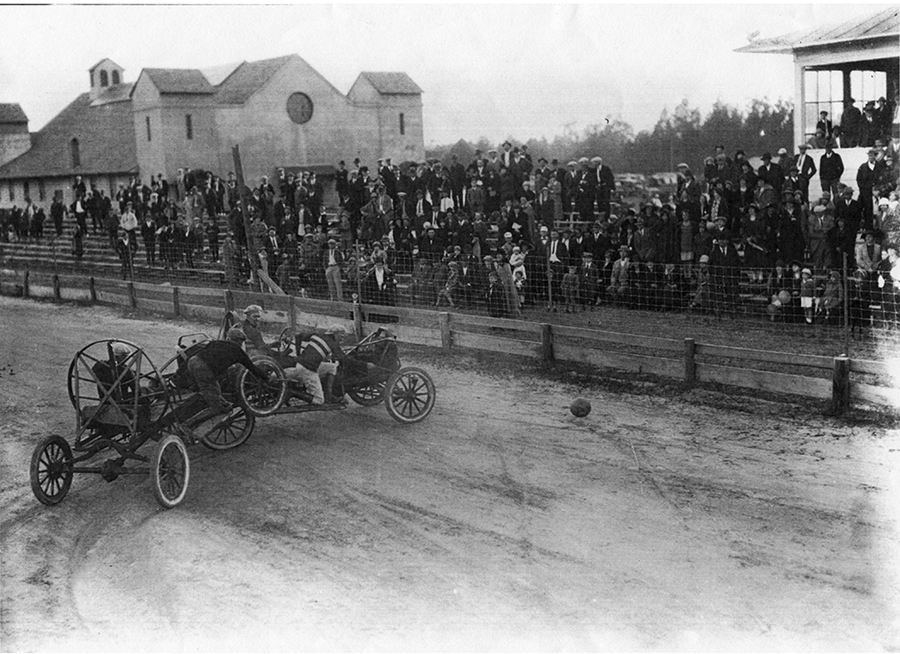
First held in October of 1914, the Sandhills Fair was sponsored by the Sandhills Board of Trade and the Sandhills Farmers Association. There was sewing, knitting, canning, gardening, woodworking and animal husbandry, all highlighting the work of nearby farms. After the first several years, it was held at the Fair Barn and Harness Track, where a large grandstand was built to accommodate crowds of as many as 3,000 spectators. The Pinehurst Outlook said the fair required “nothing more than a smile for admission” and “was a fair without a midway and doesn’t need one.”

One of the more popular activities was “auto polo,” invented around 1910 by Ralph “Pappy” Hankinson, a Ford dealer from Topeka, Kansas, hoping to increase his sales. Patterned after equestrian polo, matches featured four cars with two players per car: a driver and a “mallet man.” The cars were generally stripped-down Model Ts with no tops, doors or windshields. A regulation-sized basketball was used, although some venues manufactured even larger polo balls. The driver and mallet man had to guide the ball into a 5-foot-tall goal. The mallet men — and, periodically, the driver — were frequently ejected from the vehicle resulting in cuts, broken bones or being run over. Later, the cars were equipped with primitive roll bars above the driver.

The sport caught on in the U.S. but internationally it was viewed with caution and skepticism, being christened “a lunatic game.” Auto polo drew large crowds, but enthusiasm waned during the late 1920s due to the cost of the vehicles and the ensuing necessary repairs.  PS

Audrey Moriarty is the Library Services and Archives director for the village of Pinehurst.

From the Archives

FROM THE ARCHIVES

The March King

By Audrey Moriarty

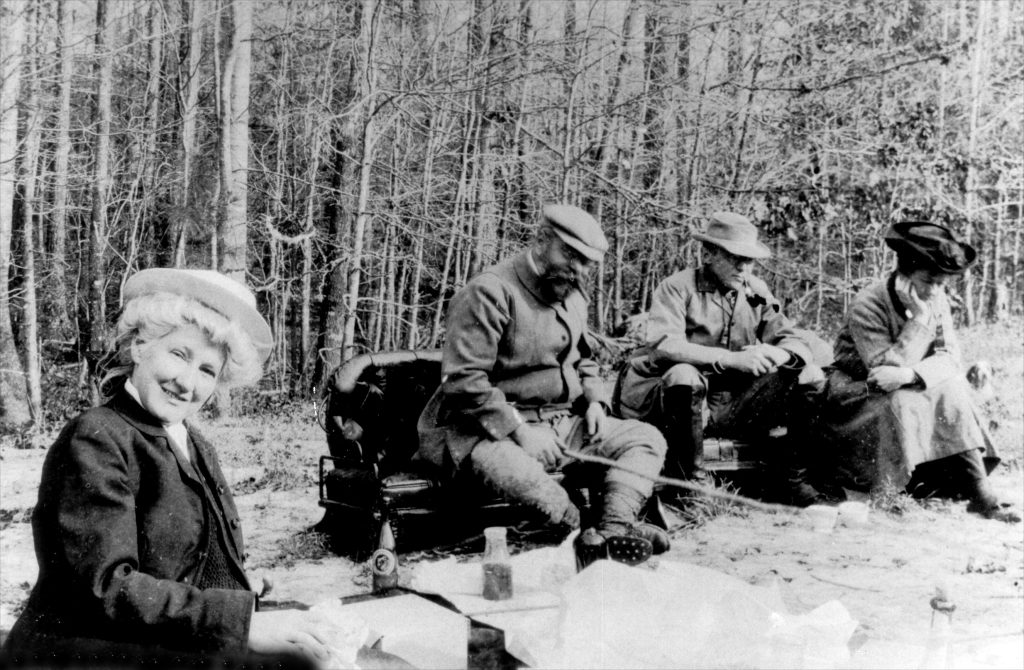
John Philip Sousa, recognized throughout the world as the March King, was a frequent visitor to Pinehurst and his friend Leonard Tufts. The composer of America’s beloved military marches was not, however, coming for the golf. In an early attempt at the game up North, an eyewitness report described Sousa’s numerous lost balls, two broken windows, the need for more than one forecaddie (he called them “Hook” and “Slice”) to keep track of his wildly errant shots, and “driving through two estimable ladies who happened to be playing on a neighboring fairway.” He was quoted as saying that he “would play golf once he was too old for any other physical activity.”

The 17th director of the U.S. Marine Band — and the first to record it on a phonograph — Sousa was the composer of “Stars and Stripes Forever,” “Semper Fidelis,” “The Liberty Bell” (oddly, the theme song for Monty Python’s Flying Circus) and over 130 other known marches. He came to Pinehurst for something far different than golf: He wanted to shoot trap at the Pinehurst Gun Club.

Sousa began shooting in 1906 and would become part owner of a 2,000-acre preserve near the village, though he considered the killing of animals for sport “wicked.” When an English minister read that Sousa had bagged a “number of pigeons,” he wrote a letter to him asking that he repent from the “murderous practice.” Sousa responded by sending a number of broken clay targets and suggesting that the minister broil them before eating.

When in Pinehurst, he and his wife, Jane, stayed at the Holly Inn, where they were well-liked. The Pinehurst Outlook described him as having a genial personality, a keen appreciation of humor and a natural gift for storytelling.

Sousa loved trap shooting and believed that “like love, trapshooting levels all ranks.” In 1919 he was the top shooter of the three-man Navy team in an Army vs. Navy competition in Pinehurst. He is in the Trap Shooting Hall of Fame, with a registered 35,000 targets. Sousa said, “ . . . that just about the sweetest music to me is when I call ‘pull,’ the old gun barks, and the referee, in perfect key, announces, ‘Dead.’”

Sousa’s last visit to Pinehurst was in1929. Three years later, on March 5, 1932, he conducted “Stars and Stripes Forever” while rehearsing for a concert in Reading, Pennsylvania, and died early the next morning at the age of 77.