Fox Tails

A fresh pair of eyes sees a theme

Story and Illustrations by Romey Petite

After the pines, it was the first thing I noticed. They’re everywhere you go.

Foxes.

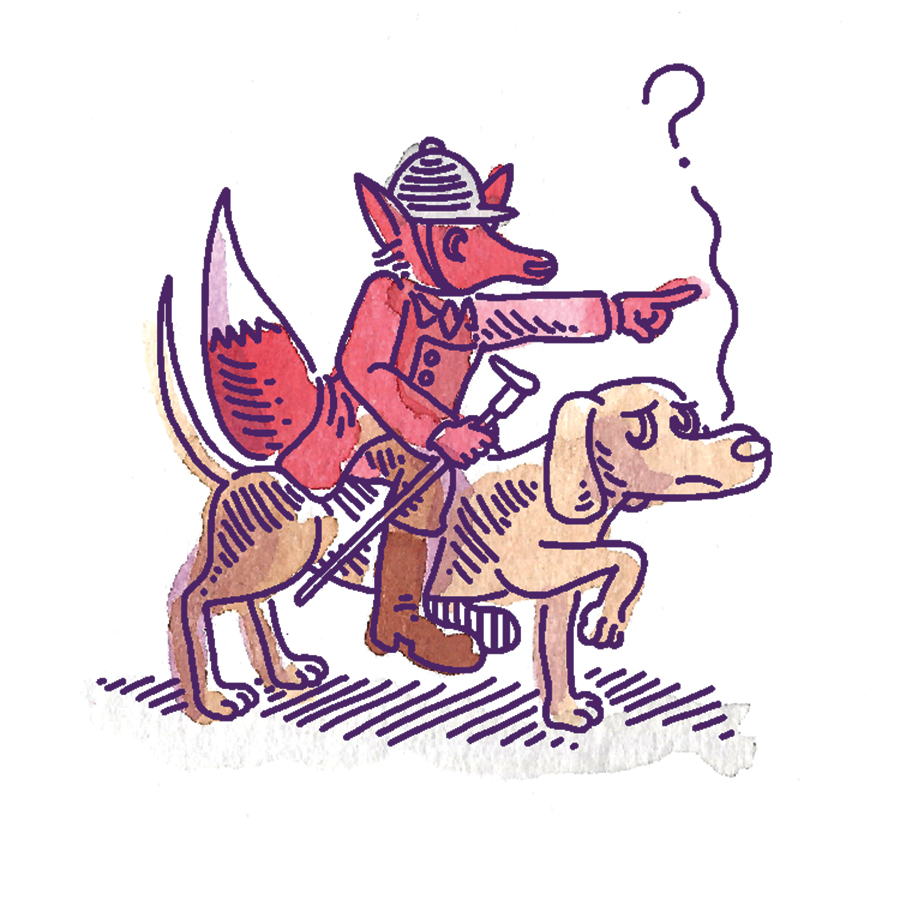
You find them on signs, mailboxes and in murals. I’ve seen them in shops, too, just like the auspicious calico bobtail figurines found in Japanese restaurants. Even one particularly amusing hood ornament featured a fox in a wolf-in-sheep’s clothing scenario. He was dressed as a hunter, complete with riding hat, sitting astride the back of a hound, giving chase, seemingly to himself. The hound was quite confused.

You can find the word “fox” fossilized in the names of the street signs and subdivisions from Fox Hollow, to Foxfire Road, and Fox Creek.

For a stranger, it’s a bit surreal.

In the short while I’ve been here, a little over seven months, I’ve had as many nature sightings as tourists see fleur-de-lis in my native New Orleans. I’m a city boy — give me time. The novelty will wear off.

In the late summer, I was taken with the evening sounds of a neighboring catbird, one that trilled each day in the hour or so between 4 and 5 o’clock.

One winter morning, on my stroll to work, I found the lawns and pines crowded with robins. I removed my headphones to take in the soundtrack on Massachusetts Avenue.

From the comfort of my girlfriend’s family’s dining room, I glimpsed a rabbit going about its business. Its ears were darting around in the direction of the glass window as if the little creature could hear us. I was sure of this: He knew we were there, but he could not see us.

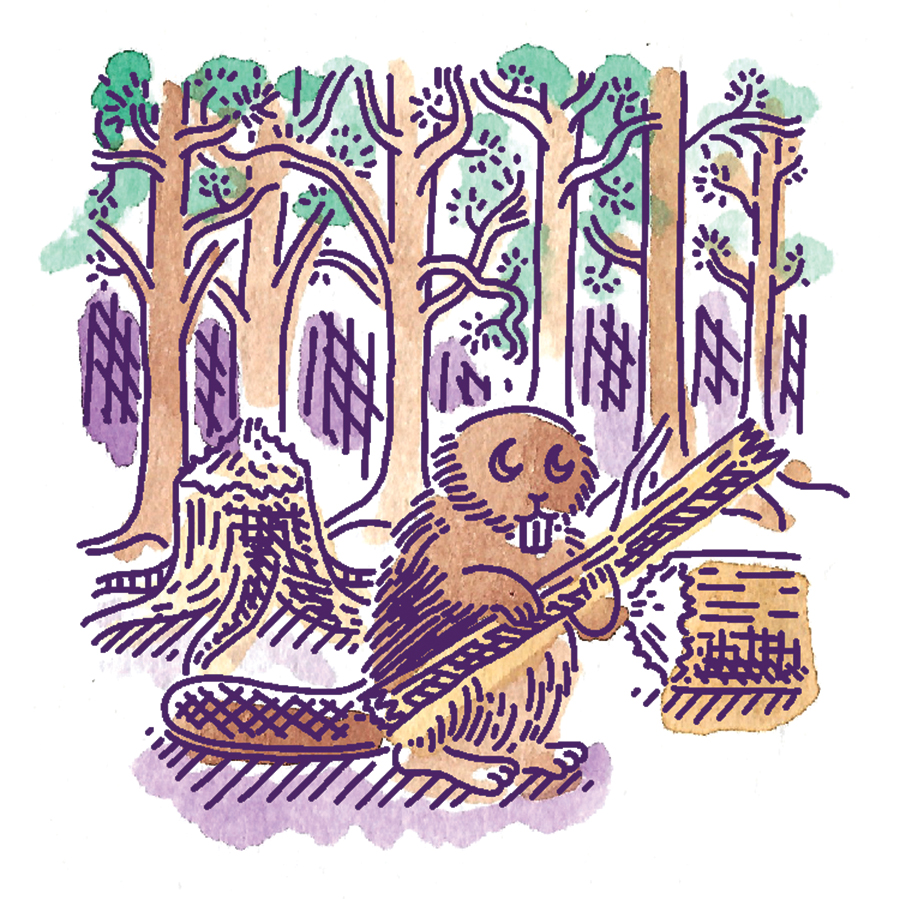
I’ve stumbled on the telltale signs of a beaver’s handiwork at the reservoir — a downed tree and woodchips — while turtles bobbed like apples just beneath the surface and waterfowl glided along.

I’ve counted two crows mobbing a Cooper’s hawk. I remember thinking of something I’d read about crows — that they are very wise with a terrific memory capable of recalling anyone, human or otherwise, that do them a bad turn. That hawk would do well not to show himself again.

And yet, not a real fox to be found. Not yet.

In time, I’ve accepted foxes as a kind of Sandhills totem. But why? I kept looking for an explanation. Or a story.

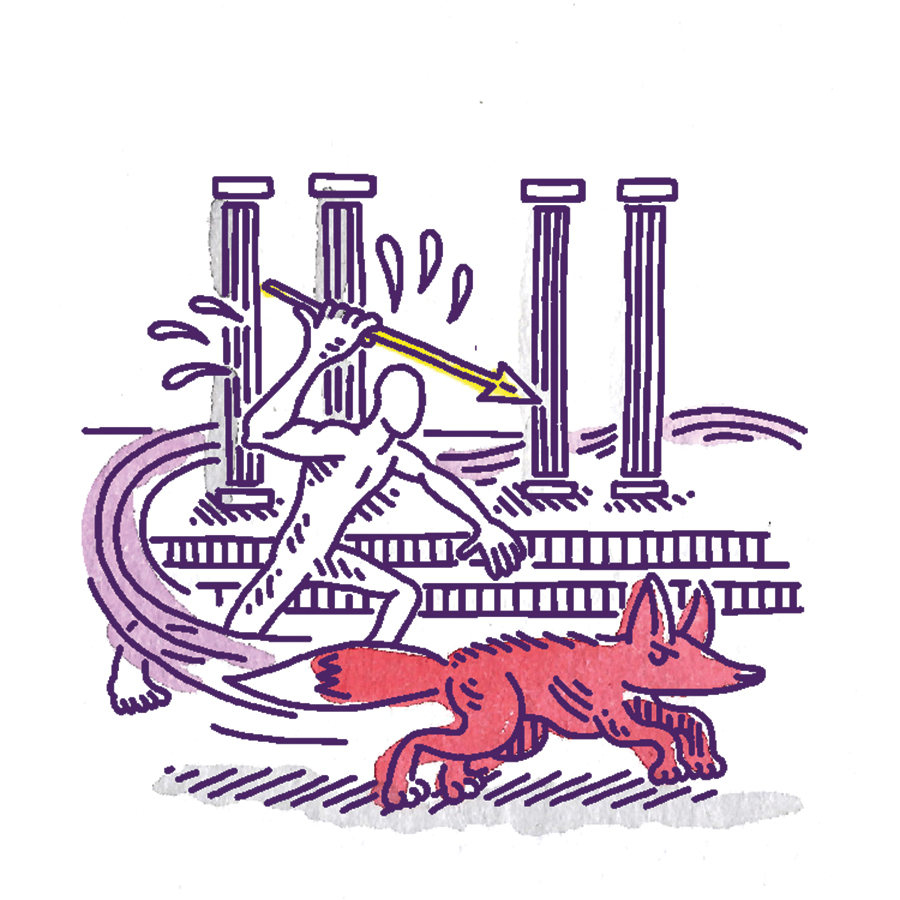
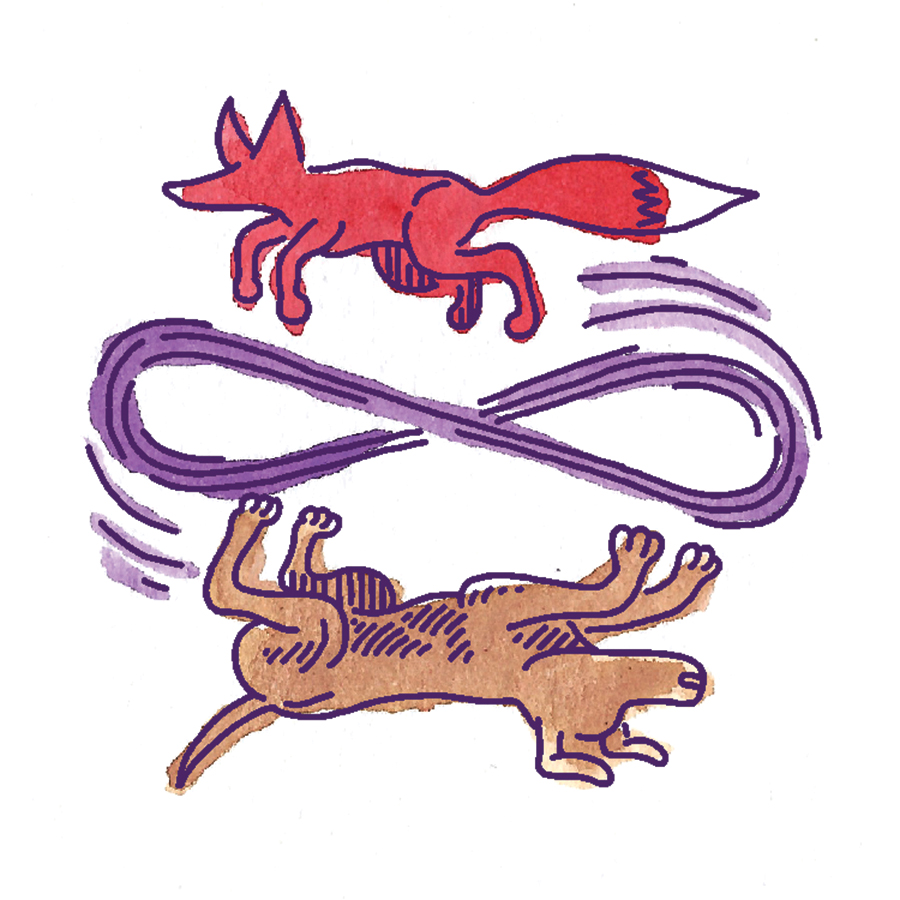
There is an ancient Greek myth of a fox sent by the gods to punish Thebes, the city where Oedipus became king. She devoured chickens, sheep and children. No one was safe. People hid in their homes from the blur of a beast that left a whirlwind in her wake. So terrifying was this vixen and so elusive she could neither be caught nor felled. Not even, at first, by the mightiest of generals, Amphitryon.

Had this place harbored such history?

Not exactly.

If you visited New Orleans, you’d notice our recurring symbols. We flaunt them. From the trundling streetcars, to the uncanny carnival masks, to the cheap plastic beads hanging from the oak trees intermingled with Spanish moss, to the ubiquitous symbol of the Bourbon Dynasty — adopted by the Creole colonials for their own purposes.

Perhaps it’s in my blood, but as an expatriate from a city that celebrates its ties to France (and mainland Europe), there was nothing more unfamiliar to me than the spiritual fervor in the air during the annual Blessing of the Hounds. Particularly the men in red coats — sorry, hunting pink — on horseback.

I grew up with stories of Br’er Rabbit. They gave me an affinity for tricksters, the characters that foxes often embody in folktales. Naturally, I couldn’t help feeling for the poor fox in this predicament — chased, cornered. I was comforted beforehand by an assurance from a hobbyist foxhunter that these days the hounds mostly chase coyote. Ah. Coyote — a trickster of yet another mythos.

Strangers tend to notice the things locals no longer see. So, what became of the vixen-vexed town of Thebes and its tormentor, the fox?

At first, Amphitryon cursed his luck. He knew he’d been given an impossible task. He would grow old and die before he’d manage to catch that fox on his own. So the wise general decided he wouldn’t waste his time. There were more important battles to be fought and won.

A special hound was bred and summoned, a hound worthy of this task, one who would give chase for as long as it would take. Laelaps was his name, and he was let loose to bark, snarl, and spring at the heels of the fox.

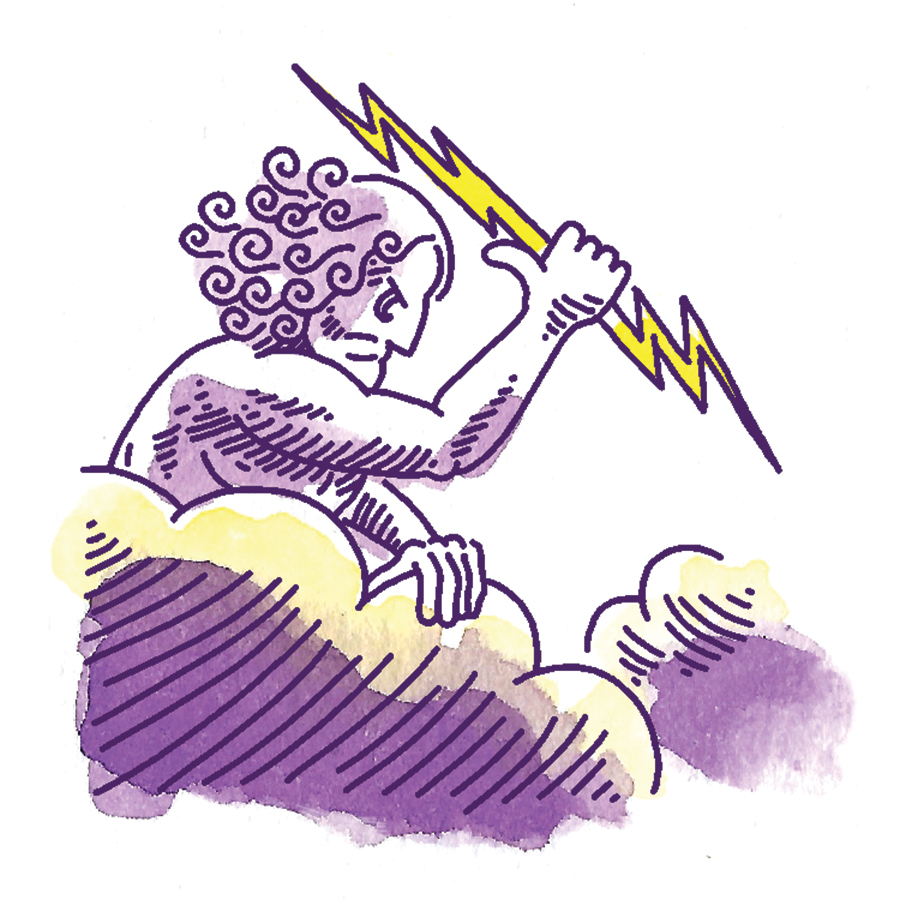
This tireless thief was chased by the relentless pursuer until, once again, the gods intervened, offering mercy to mortals. Zeus placed both monsters in the sky forming Canis Major (the hound) and Canis Minor (the fox).

It is hard to leave New Orleans. It spoils you with good food, with good music, with a culture not found anywhere else in America. Sold to the United States by Napoleon who needed money to fight the British, it’s a European city on this side of the pond, with African and Caribbean cultures mixed into the gumbo crockpot.

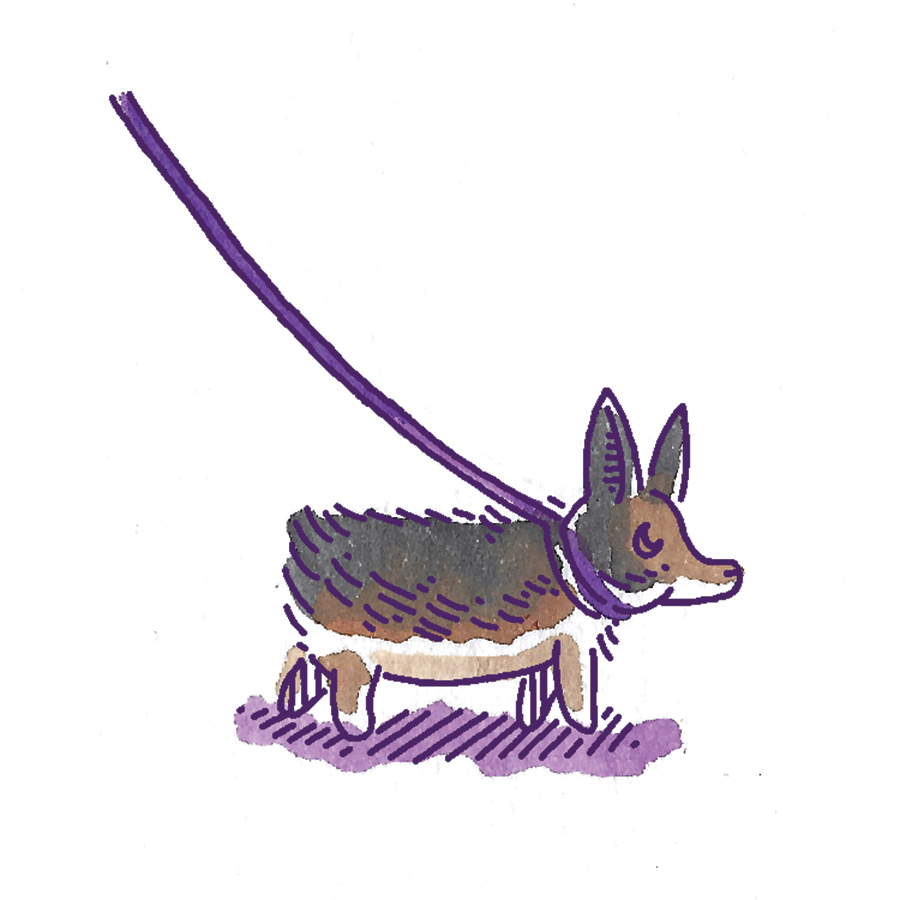
Some nights, walking a fox-eared Corgi, I look up as the stars give chase to one another in the sky. Through the pines, and far from the city lights, I can see the constellations considerably better from here. PS

Romey Petite is a writer and illustrator, a recent New Orleans transplant and a contributor to our Bookshelf column. He can be contacted at romeypetite@gmail.com

Golf’s Quiet Man

How the Sandhills jump-started the Hall of Fame career of Julius Boros

By Bill Case    Photographs from the Tufts Archives

It was a great perk for a bean counter who relished playing golf. Instead of enduring the foul weather months in Hartford, Connecticut, running numbers for the trucking company that employed him as its accountant, Julius Boros got to spend much of that time in 1948 on a golf course in North Carolina’s Sandhills. It wasn’t wholly a lark. There was a bit of daily bookkeeping to do at Southern Pines Country Club, which his boss and frequent golf partner, Mike Sherman, had purchased from the town of Southern Pines two years before. But once that chore was accomplished, Sherman encouraged Boros to play all the golf he wanted.

When Boros asked permission to lay off work the first week of November to compete in a big tournament on Pinehurst’s famed No. 2 course, Sherman happily agreed. At the time, the North and South Open was, if not a major championship, one of the big ones. It seemed unlikely that the amateur Boros, scarcely known outside his home state, would make much of a showing, but cutting his teeth against players like Sam Snead would presumably provide a learning experience if nothing else.

On the Sunday prior to the North and South, Frank “Pop” Cosgrove and wife Maisie, the lessee-operators of the Mid Pines Inn and Golf Club, scheduled a one-day pro-am event on its Donald Ross-designed course. Many North and South entrants, including Snead and Johnny Palmer, signed up figuring that the outing (not to mention the money) would serve as a good tune-up for the main event. Boros wrangled an invite, too.

The Cosgroves’ 20-year-old daughter, Ann “Buttons” Cosgrove — her father thought her cute as one — had assumed responsibility for organizing the event. Buttons, an excellent player herself, invited 30 other equally accomplished female amateurs to play along with the male stars. One of the young women was three-time Ohio Amateur champion Peggy Kirk (Bell), who often palled around with Buttons and her two sisters, Jean and Louise. Peggy spent so much time at Mid Pines it seemed like she owned the place. Later, of course, she did.

Boros, 28 years old and single, attracted the attention of the effervescent Buttons when he worked his way around Mid Pines error-free and carded the day’s low round of 67. With the likes of Snead in the field, Buttons had not contemplated that an amateur would wind up as the day’s medalist. After scurrying about, she produced a spare golf bag from the pro shop to award to the amused accountant.

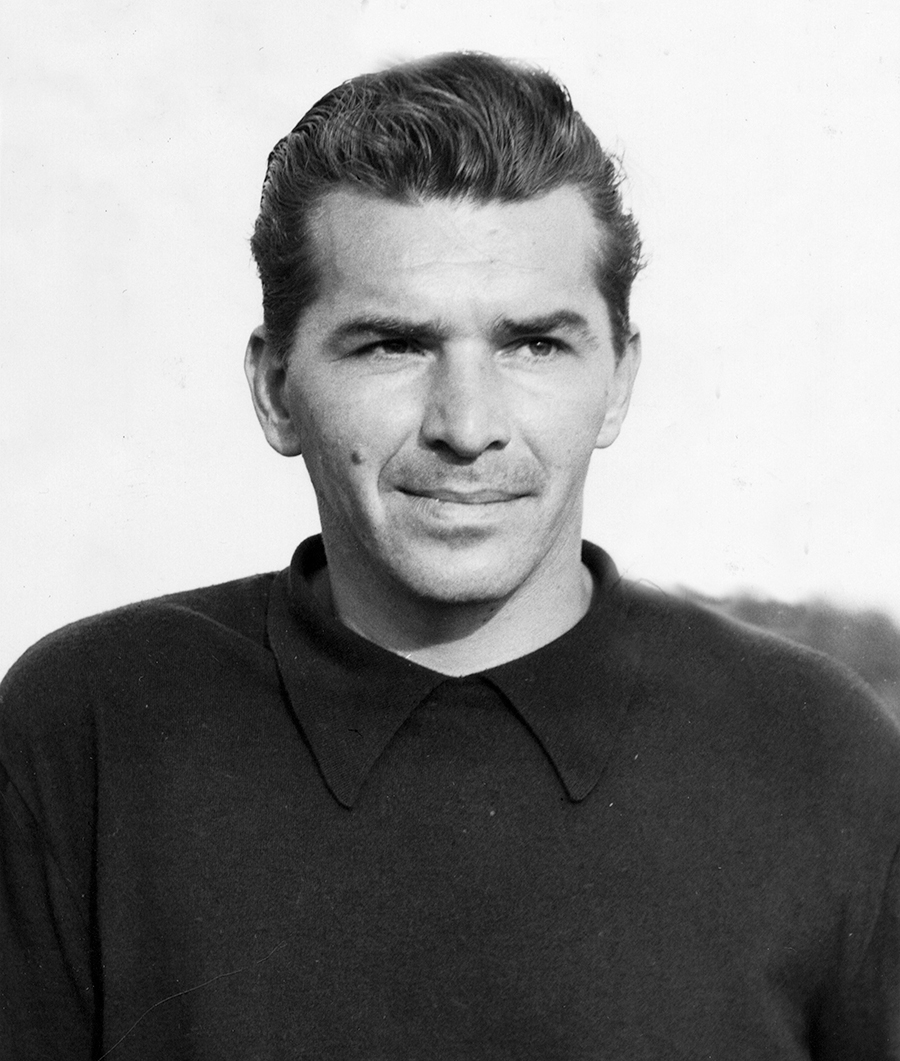
Boros’ showing at Mid Pines was a perfect springboard two days later at the North and South. Playing quickly, always without practice swings, escaping bunkers using a Spalding 9-iron rather than a conventional sand wedge, Boros’ stellar 68 gave him the first round lead. Only bogeys at the 10th and 17th in the final round prevented him from matching Toney Penna’s winning score of three under par 285. The unheralded amateur’s stunning runner-up finish, tying the great Snead, brought him national attention. One scribe, noting Boros’ husky build and jet-black hair, likened his appearance to boxing great Jack Dempsey, a sport Boros enjoyed as a youth. He had the hands of a powerful puncher to prove it, with fingers as thick as smoked sausages, but a grip as gentle as a tea party.

One of six children of immigrant Hungarian parents, Boros grew up adjacent to the 10th hole of Fairfield, Connecticut’s, Greenfield Hill Country Club. Hopping the fence with his brothers, Lance and Frank, to sneak in some unauthorized golf, the young Boros learned to play fast, developing his trademark rhythmic tempo. When he confided to his parents he wanted to play golf for a living, his Old World father scoffed, “Learn to use your brain, not your back.” After high school, Boros went to work for the Aluminum Company of America and, at the start of World War II, became a medic in the Army Air Corps. He joked that he “fought the war as a laboratory technician” in Biloxi, Mississippi, mostly golfing with the top brass.

After his discharge in 1945, Boros studied accounting for a year at Bridgeport Junior College, then met Sherman, who took him under his wing. As Sherman’s young protégé, Boros directed the employees and handled the financial matters of his boss’s far-flung enterprises. “I had become a businessman, almost overnight,” Boros marveled. Despite his wondrous showing in his first North and South Open, Boros wasn’t yet ready to give up his day job. He was, however, fully prepared to stay in touch with Buttons. Peggy Kirk Bell once recalled that, “Jay (one of Boros’ many nicknames that included Big Jules, Big Julie, Bear and Moose) was a very quiet man, very shy, he said very little. But Buttons was crazy about him. She’d say, ‘Let’s go over to Southern Pines Country Club and see Jay.’”

Both Buttons and Boros acquitted themselves well on the golf course in 1949. Buttons won an important invitational event in Charlotte, and Boros led all qualifiers for the U.S. Amateur, ultimately reaching the quarterfinals, earning him an invitation to the 1950 Masters tournament. In November 1949, Boros returned to Pinehurst No. 2 for the North and South. He finished 17th despite not having his best stuff, a signal to Boros he could prosper in the pro ranks.

Boros gave conflicting accounts of what finally prompted him to turn pro. He told one reporter he pulled the trigger after viewing a driving snowstorm outside his Hartford office window. He also wrote that the encouragement from a few friends at a tournament was all he needed. But Peggy Bell claimed it was Buttons who did the pushing, even asking Snead to convince him. There may well be truth to all three versions. In any event, Boros turned pro on Dec. 15, 1949.
Several Hartford friends interested in backing Boros financially suggested he have Tommy Armour, recognized as golf’s pre-eminent instructor, take a look at his swing. Boros reluctantly agreed. It didn’t go well. Armour’s suggested modifications resulted in repeated shanks by his distressed, self-taught pupil, and Boros declined to return for a second session, spending the next couple of weeks unlearning Armour’s advice.

An arcane rule requiring a six-month waiting period before newly minted pros could accept prize money in tour events meant Boros had time on his hands. He and Buttons competed together in a mixed event at Dubsdread in Orlando, Florida, in March. After that, the Pinehurst Outlook reported that Cosgrove and a Mid Pines friend, Mae Murray, were motoring to Georgia to play in the Titleholders Championship, a major women’s tournament at the Augusta Country Club. According to the Outlook, they were not alone. “The two girls were accompanied by Julius Boros, who recently turned pro. He plans to sharpen his game at the Augusta National course for the forthcoming Masters tournament.” On May 15, 1950, Boros and Buttons were married in Southern Pines’ St. Anthony’s Catholic Church in a double ceremony with Buttons’ sister, Louise, and her new husband, William Weldon.

Boros played a bit part in the legend of Ben Hogan’s comeback in the 1950 U.S. Open at Merion Golf Club. Firing a sensational 68 in the first round, Boros led after 45 holes but finished the third round with a lackluster 77, ruining his chances. Though overtaken by history, his T-9 finish was a remarkable achievement for a first-timer. Two weeks later, Buttons stormed through her preliminary matches and into the final of the Massachusetts Women’s Amateur against another Mid Pines golfing cohort, Ruth Woodward. With her husband rooting her on, Mrs. Boros sprung the upset, winning 2 and 1.

At the end of the PGA’s six-month waiting period, Boros hit the tour in earnest, buttressed in part by steady paychecks coming in from Mid Pines when the Cosgroves put their son-in-law on the payroll as an assistant to tour mainstay, Johnny Bulla. By year end, Bulla had moved on and Boros became the club’s head professional, though his consistent tour earnings meant he never would spend much time behind the pro shop counter. Eventually, younger brother Ernie and nephew, Jimmy Boros, performed that role.

Early in 1951 Buttons learned she was pregnant. Boros acquitted himself well again in the U.S. Open, this time at devilishly difficult Oakland Hills, a course that winner Ben Hogan labeled a “monster.” Boros was the lone competitor not to shoot a round over 74 and his T-4 finish raised the eyebrows of those who wondered if his play at Merion had been a one-off.

With the baby due in September, Buttons assured her husband she was doing fine and that he should play in the Empire State Open instead of pacing the floor of a maternity ward. Things weren’t fine. When Boros heard there were complications, he raced to St. Elizabeth’s Hospital in Boston. Buttons had suffered a cerebral hemorrhage while giving birth to a healthy son, Jay Nicholas (Nick) Boros, and died the following day.

His wife’s death, “really shook him up,” says Boros’ brother, Ernie. But Julius kept his pain to himself. Two-time major champion Doug Ford traveled with Boros countless hours, coast to coast, during the ’50s. Quiet as a church mouse anyway, Ford says Boros never spoke to him about losing Buttons, nor did Boros mention it in any of several books. Nick, now in his mid-60s, says his father never discussed the death of his mother.

If Boros was to continue on tour, he needed to find caregivers for his newborn son. Pop and Maisie Cosgrove offered to help raise the boy. Nick would rotate with his grandparents between the Cosgrove homes in North Carolina and Massachusetts for the next three years. Following a two month hiatus after the loss of his wife, Boros played a home game in Pinehurst at the North and South Open. Showing little rust, he finished six shots behind Tommy Bolt in the event’s final edition.
While he continued to be a solid money winner, there were skeptics who wondered whether Boros, with his laconic mien and idiosyncratic swing, had the right stuff to win. His goal for the 1952 U.S. Open at Northwood Club in sweltering Dallas was simple — four rounds of par golf. Midway through, he was two shots over his mark but just four behind George Fazio and Hogan, seeking his third consecutive U.S. Open crown. Many assumed Connecticut native Boros would fade in the oppressive 98-degree heat of Saturday’s 36-hole final. Instead, it was the Texan Hogan who wilted. Boros’ morning round of 68 put him in front at level par. He was three shots clear when he reached Northbrook’s par-3 12th hole but he found the bunker, failed to get out with his second and ambled away unhappily with a devastating double-bogey. “I could see the deep concern on the face of my brother Ernie who was walking silently with me,” wrote Boros. But, playing with the demeanor of a man nonchalantly swinging at dandelions, he negotiated the last six holes in even par, to win the U.S. Open by four over Porky Oliver. His first tour victory had come in America’s national championship. Hogan remarked at the trophy presentation that the former accountant’s play struck him as “magical.”

Hogan wasn’t alone. When Doug Ford, now 94, was recently asked whether he had been surprised he replied, “I was. But he wasn’t. He was a very confident player.” Besides, says Ford, “he did it with my clubs.” Wilson Sporting Goods had been courting Ford to join its elite staff of players and sent him a set of its clubs. When he failed to come to terms with the company, Ford re-gifted the sticks to his buddy. Ultimately, it was Boros who signed on, becoming a valued member of the Wilson staff.

Later that summer Boros added another title in the World Championship of Golf at Tam O’ Shanter just outside Chicago. The $25,000 winner’s purse was many-fold the largest on the PGA Tour. His successes resulted in a small brouhaha. The PGA had another mysterious rule preventing its members from entering the PGA Championship until they had served a five-year apprenticeship. Desperate to have the Open champion in its field, PGA officials announced that Boros could play even though he was considered an “apprentice” member. A few of his peers complained of favoritism. When he learned of the objections, Boros declined the opportunity to compete, opting to preserve collegiality. “I’d rather wait my regular turn,” he said. “I want all the PGA members to be my friends.” He would have to settle for being the leading money winner and the 1952 Player of the Year.

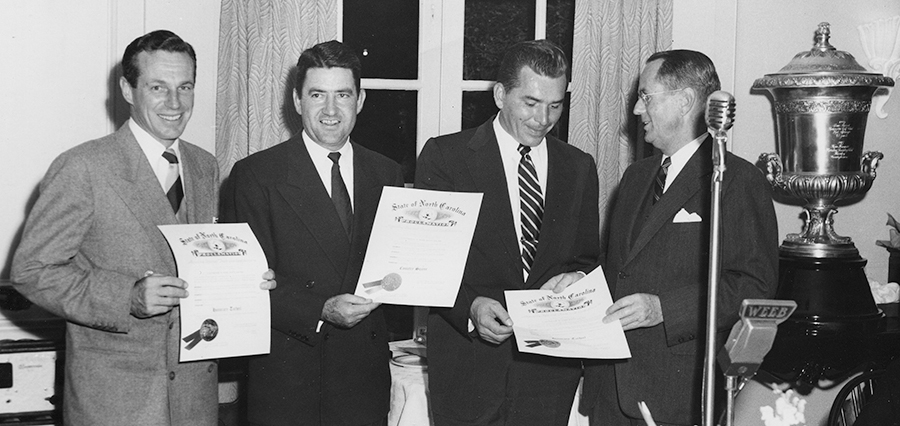
The Cosgroves hosted a big bash celebration in Boros’ honor, including a 54-hole tournament at Mid Pines. At the banquet afterward, Snead spun country yarns and heaped high praise on “Moose.” Pinehurst’s Richard Tufts paid tribute to the other North Carolinians who’d had banner years: Harvie Ward won the British Amateur; Dick Chapman the French Amateur; and Johnny Palmer the Canadian Open. If Boros, who abhorred
public speaking more than four-putting, spoke at all, it was not noted in the newspaper.

In 1953, the Cosgroves and Boros entered into a real estate partnership that resulted in Warren “Bullet” Bell and wife Peggy becoming owners of the Pine Needles golf course, across Midland Road from Mid Pines. The Cosgroves and Boros pooled $30,000 and the Bells $20,000 to purchase the deteriorated facility from the Catholic diocese. Two years later, the Cosgroves, looking to raise sufficient cash to buy Mid Pines, which had come on the market, negotiated the sale of their share in Pine Needles to the Bells. Boros, though not a participant in the purchase of Mid Pines, agreed to liquidate his Pine Needles interest also. Despite doubling his investment in just two years, Boros later expressed regrets. Noting the Bells’ success, he often remarked to Nick, “I never should have sold my share of Pine Needles.”

A year later, Boros met the woman who would become his second wife, Armen Boyle, a blonde flight attendant and the daughter of a Bayside, New York, club pro. Extroverted, gregarious and funny, she and Boros eloped to Aiken, South Carolina, after a whirlwind three-date courtship. Boros’ choice for a honeymoon may have left a little to be desired. “Can you believe it?” Armen says, laughing. “We went to Mid Pines.”

They settled in Florida with 3-year-old Nick in tow. While Boros continued his association with Mid Pines, he spent most of his time off the tour with his family in Fort Lauderdale, where the lakes and nearby Everglades provided ample opportunity to indulge his passion for fishing.

The family expanded quickly. Over a 10-year period, Armen gave birth to six children: Joy, Julius, Jr., Gary, Gay, Guy, and Jody. Including Nick, there were seven young Boros mouths to feed. Boros’ second triumph in the World Championship of Golf in 1955 brought home an unheard of $50,000. Exhibitions for the champion arranged by the tournament’s promoter extraordinaire, George May, paid an additional $50,000. Boros’ successes allowed Armen to pack up the kids in the family station wagon to spend parts of each summer following their father on tour.

Nick recalls those family travels fondly. By the time he entered his teens, he had become a good junior golfer, often showing up on the practice green alongside the pros. Arnold Palmer would putt for quarters against the young Boros. Getting the line on various putts before The King’s arrival, Nick won his share. “How much did we win today?” his father would ask. All the children developed into excellent golfers though their father rarely provided instruction. Nick would occasionally ask for help but his father, a firm believer in finding one’s own way, customarily responded, “Keep swinging. You’ll figure it out.”
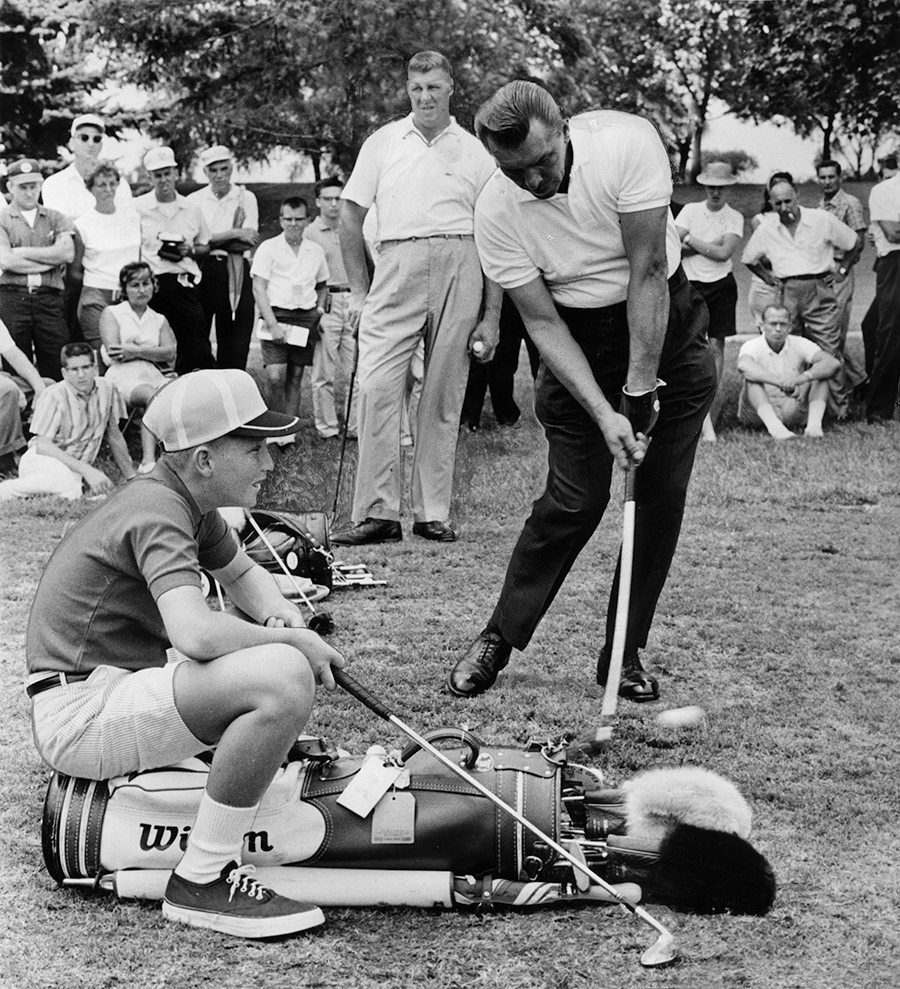
After turning 40, Boros’ career appeared on the wane. The Big Three — Arnold Palmer, Gary Player and Jack Nicklaus — weren’t leaving much space in the winner’s circle in the early ’60s. Boros was shut out for nearly three years. His putting, never great, had fallen off. But sometimes help comes from unexpected sources. In a May, 1963 pro-am at Pompano Beach, two amateur partners noticed Boros abruptly picking up his putter and moving his body during the stroke. He resorted to a more compact motion and a widened stance and, suddenly, everything clicked.

In May, he bested Gary Player by four shots to win the Colonial National Invitational. Three weeks later he won the Buick Open. Boros arrived for the U.S. Open at The Country Club in Brookline, Massachusetts, flush with confidence. Consistently high winds made scoring exceptionally difficult. Boros joked that, “most of the cards looked like they had been turned in for the 1913 National Open.” No player either equaled or broke the par of 71 in the final two rounds. With his revitalized putting, Boros salvaged more pars than most and finished 72 holes tied with Arnold Palmer and Jacky Cupit with scores of 293.

In Monday’s 18-hole playoff, buoyed by several wonderful wedge recoveries, Boros took command with a 33 on the front nine. His final round of 70 beat Cupit by three and Palmer by six. “Poker-faced, laconic, a bit on the dour side, he is an efficient rather than an arresting golfer,” wrote Herbert Warren Wind in The New Yorker, “but his colleagues have long respected the smooth, relaxed tempo of his swing and his penchant for being at his best in the big, rich tournaments.” At age 43, Boros had become the oldest player to win the Open, and for the second time he would be named Player of the Year.

Television and Arnold Palmer had transformed pro golf into a hot commodity and, with his victory, Boros found himself in high demand. His Dean Martin-like relaxed approach charmed the golfing public. The fact that he liked to fish just as much as golf added to his laid-back persona. Though so detesting public speaking that he repeatedly turned down the captaincy of America’s Ryder Cup team, Boros was comfortable enough in front of a camera to host a television show. Outdoors with Liberty Mutual ran for 28 episodes showcasing Boros fishing all over the world. Nick remembers his father finagling a special permit to fish along Alligator Alley while it was under construction. Boros took full advantage. “You just about caught a bass with every cast,” Nick says. “Dad would bring home barrels of fish and stock the lakes around home.”

After his second victory in the National Open, Boros continued to win assorted tour events, including three victories in 1967. When he arrived in San Antonio for the 1968 PGA Championship at Pecan Valley Golf Club, the steaming heat was reminiscent of the ’52 U.S. Open in Dallas. Staving off Palmer’s charge, Boros won the championship with the same 281 score he had shot at Northwood 16 years earlier. Now 48, he assumed the mantle of oldest major champion in golf history — a status he still holds. To ward off the heat, Boros donned a structured baseball-style hat bearing the Amana logo. Soon the Cedar Rapids, Iowa, company began offering tour pros $50 per tournament to wear Amana hats, and many did. Unwittingly, Boros had sparked revolutions in style and advertising, and he maintained a close relationship with Amana and its founder and president, George Foerstner, the rest of his life.
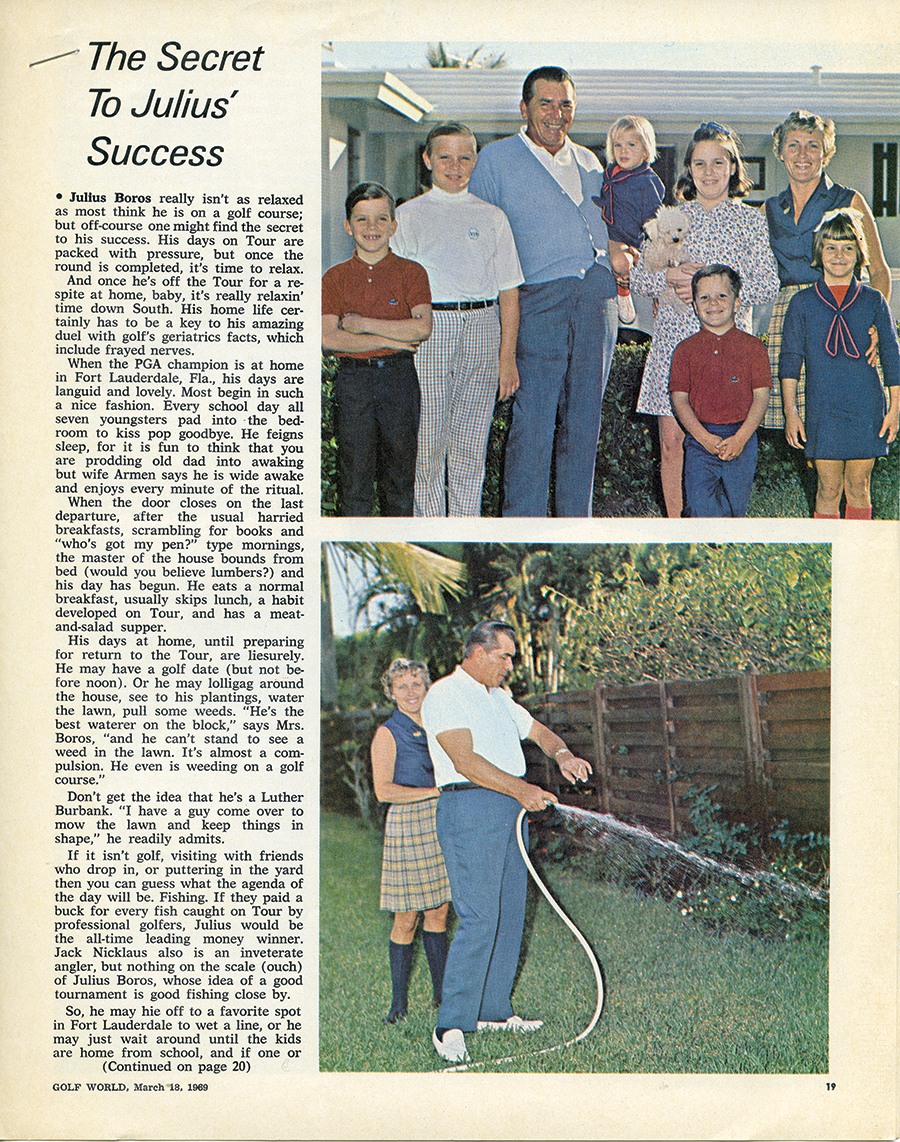
In 1972, Pop and Maisie Cosgrove, now well into their ’70s, sold Mid Pines to Quality Inns. When the Cosgroves left, Boros did too. He affiliated with Aventura Country Club (later Turnberry Isle Miami Resort), which was close to his home in Fort Lauderdale. Though he was aging, Julius was forever eager to play. “It would be pouring down rain and we would be getting ready to close,” recalls Nick, who worked in Aventura’s pro shop. “Dad would call and tell us to stay open; that he was going to come hit balls. He never lost his love of the game.”

Though his best golf was finally behind him, the 53-year-old Boros made one last run for a third U.S. Open victory in 1973 at Oakmont, tying for the lead after three rounds but blown away by Johnny Miller’s 63 on Sunday. He considered the performance one of his greatest achievements. “Boros has put on quite a bit of weight and now pads down the fairways at a sort of ursine lope, but age has not affected the lovely tempo of his swing or his almost disdainful calmness under pressure,” wrote Wind. His T-4 finish was his 11th top 10 in the U.S. Open. Ford’s explanation was simple. “Powerful and straight driving,” he says. “And Jay was a great long iron player.” When asked whether he was going to retire altogether, Boros replied with one of golf’s great one-liners. “What would I retire to?” he asked. “I already fish and play golf for a living.”

By the mid-’70s, Boros was spending most of his time in Fort Lauderdale with Armen and the children. With the help of his Amana connections, Boros sent several of his children to the University of Iowa. Nick, Julius, Jr., and Guy all played golf for the Hawkeyes. Nick and Guy became professionals along with their brother, Gary. Guy relished traveling the tour with his dad. “We’d be in the locker room and Lee Trevino would start to tell an off-color joke,” laughs Guy. “Dad would stop him and say, ‘Lee, please, my son is here.’ Lee would say ‘Oh, sorry Moose,’ then go right on with the story. I loved it.”

Guy was good enough to become a respected tour player. When he won the 1996 Vancouver Open, the family joined a select few father-son duos to have won on the PGA Tour. Guy acknowledges it has not always been easy to follow in the footsteps of his dad’s Hall of Fame career. “People think that because my father was so great, I have some sort of built-in advantage. But when I am on the tee, I still have to hit the shot.”

By 1979, Julius had vanished from the tour but he never seemed to lose the knack of seizing the moment. He agreed to partner in a team event with Roberto De Vicenzo in something called The Legends of Golf, the lone televised event for senior players. Boros and De Vicenzo tied Art Wall and Tommy Bolt. The ensuing playoff featured a spectacular birdie fest by both sides until the Boros-De Vicenzo team finally prevailed on the sixth extra hole. Viewer reaction to the fireworks was overwhelming. The memorable playoff was the catalyst that launched what’s now called the Champions Tour. The victory in the Legends was Boros’ last important golfing accomplishment, a fitting farewell to competition.

During the 1980s, Boros’ physical condition slowly deteriorated. Even after the incomparable swing had finally gone out of rhythm, Boros still treasured being on the course. He would drive his golf cart unhurriedly out on the Coral Ridge Country Club to savor the day. His favorite spot to park was under a willow tree near the 16th hole. He would silently, but smilingly, wave at the golfers as they went by. It’s the spot where Julius was found on May 28, 1994, after he had peacefully passed away. Quiet and unhurried.  PS

A Proper Pour

Where art meets industry, in a world of gritty timelessness

By Jim Moriarty   •   Photographs by Laura Gingerich

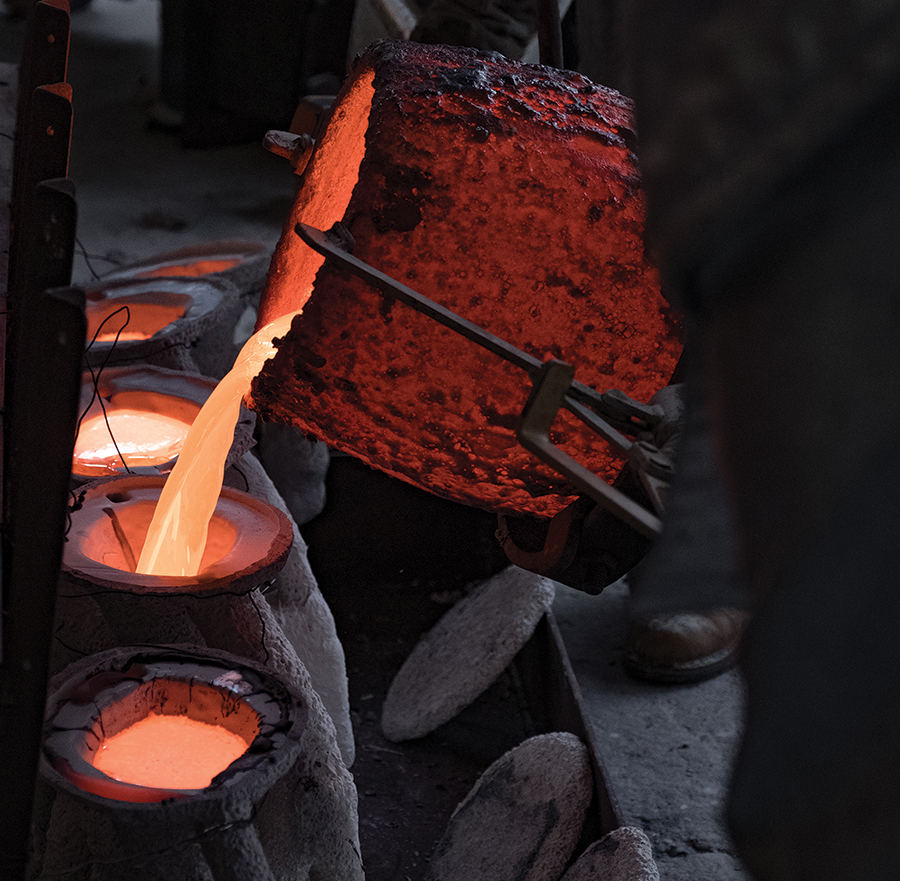
Dressed like Marty McFly paying a nocturnal visit on his adolescent father in Back to the Future, Brian Brown and Jackson Jennings shuffle along in their silver coats and hoods with plastic face shields, carrying 270 pounds of molten bronze as if it was the industrial version of Cleopatra’s golden litter. As they tip the glowing bucket, orange metal flows like lava into the gray-white ceramic casts wired in place in a steel pan on the cement floor. This is how Ronald Reagan got to the Capitol rotunda.

Carolina Bronze Sculpture, hidden down a gravel drive past Maple Springs Baptist Church on the other side of I-73 from Seagrove’s famous potteries, may be the foremost artists’ foundry in the eastern United States. Certainly it’s the one most often used by Chas Fagan, the Charlotte artist whose statue of Reagan resides in the people’s house in Washington, D.C.

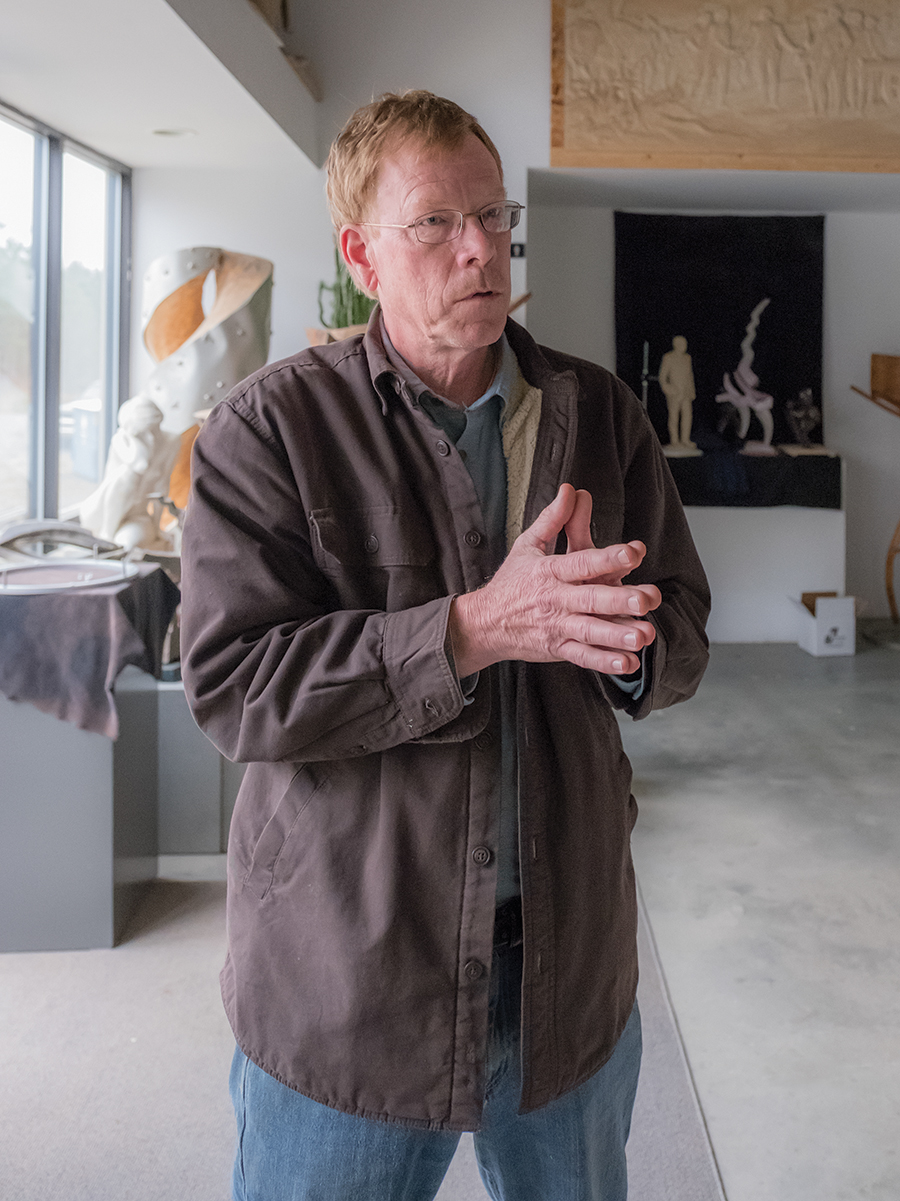
The foundry is the life’s work of Ed Walker, 62, a quiet, unassuming man with a quick smile and a knack for noodling on an industrial scale. Walker is a sculptor, too. His “Firefighter Memorial” in Wilmington, North Carolina, incorporating a piece of I-beam from the South Tower of the World Trade Center, was completed in 2013, and he hopes to have the recently announced Richard Petty Tribute Park with multiple sculptures completed in time to celebrate Petty’s 80th birthday on July 2. One of Walker’s large abstracts is on its way to Charleston, South Carolina, on loan for a year’s exhibition.

“Ed’s a rare combination of a complete artist’s eye mixed with an absolute engineer’s brain,” says Fagan. “He’s the kind of guy who can solve any problem — and every project has a list of them. Nothing fazes him.”

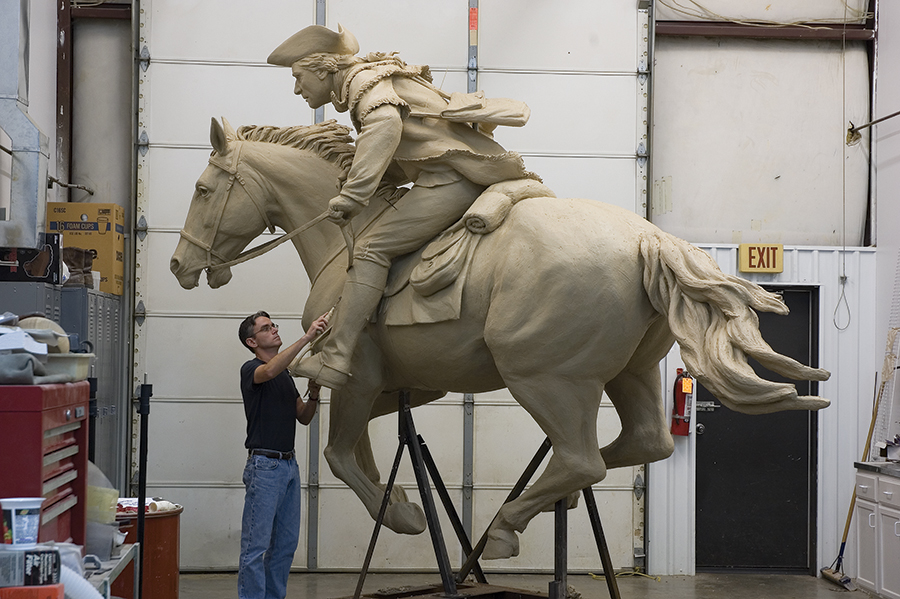
Take Fagan’s sculpture “The Spirit of Mecklenburg,” a bronze of Captain James Jack on horseback, the centerpiece of a fountain in Uptown Charlotte. “The design was not easy,” says Fagan of the 1 1/2 life-size bronze. “I had the thing leaning and he’s at full speed so the horse’s feet are not on the ground exactly. Engineers had to be involved, at least two of them, maybe three. We’re all standing around this big clay horse and a question popped up on something pretty important. Everyone pipes in, pipes in, pipes in. Eventually Ed offers his opinion in his normal, subdued, quiet manner. Then the discussion goes on and on and on, the whole day. Magically, everything circled around all the way back to exactly what Ed had said. I just smiled.”

Walker grew up in Burlington, living in the same house — three down from the city park — until he graduated from Walter M. Williams High School and went to East Carolina University. His father, Raleigh, was a WWII veteran who developed a hair-cutting sideline to his motor pool duties in the 5th Army Air Corps. “There was a picture he showed me of this barbershop tent, and Dwight Eisenhower and Winston Churchill were standing out in front of it. They’d just gotten a shave and a haircut by him, and he was on the edge of the photo.” The same shears kept Ed’s head trimmed, too.

Walker was drafted by art early on. He turned pro when he was in first grade. “Back then kids didn’t have money, at least not in my neighborhood,” he says. “My mom and dad (Lillie and Raleigh, who both worked in the textile mills) thought that ice cream was something you get on Friday for being good all week.” Others got it more frequently. Walker started drawing characters taken from classroom stories using crayons on brown paper hand towels, then trading them for ice cream money. Goldilocks. The Three Bears. Not exactly “Perseus with the Head of Medusa” but, heck, it was just first grade. Soon, he was coming home with more money than he left with in the morning. “My mom questioned me about it. The next day I had to go to the principal’s office and was told that under no circumstances could I be selling something on school grounds.”

Sculpture reared its head at ECU. “I took my first sculpture appreciation class with Bob Edmisten. Had my first little bronze casting from that class. They pushed everybody to explore. You could use or do anything. I fell in love with that. Started learning how to weld and cast and carve, the kind of range of things you could do.” In addition to getting a Bachelor of Fine Arts, Walker met his wife, Melissa, another art major, also from Burlington.

“We knew each other in high school,” says Melissa.

“She was in the good student end,” says Ed. “I was in the back with all the problem people.” The old art building at ECU was near the student center. She was going out. He was going in. They were pushing on the same door in different directions. By their senior year they were married.

The first stop after graduation was Grand Forks, North Dakota. If you’ve been to North Dakota, you know there are months and months of harsh winter followed by, say, Tuesday, which is followed by more winter. The University of North Dakota was interested in setting up an art foundry and offered a full stipend to the person who could do it. Walker had helped Edmiston put together the one at ECU’s then-new Jenkins Fine Arts Center. The professor recommended the student. North Dakota sent the Walkers a telegram — your grandfather’s instant messaging. Be here in two weeks. They were.

“They had a new building and a bunch of equipment in crates,” says Walker. “Figure it out. Set it up.” Walker’s art history professor at UND was Jackie McElroy, better known today by the pseudonym Nora Barker, a writer of cozy mysteries, who reinforced his belief that you could figure out how to do just about anything if you wanted to badly enough. It became a recurring theme.

Chased out of North Dakota with a master’s degree and a case of frostbite, the Walkers found themselves back in North Carolina trying to land teaching jobs. After traveling to a conference, essentially a job fair, in New Orleans, Ed and a friend, Barry Bailey, made a pact. If they didn’t have jobs in a year, they’d move to New Orleans. They didn’t and they did.

The Walkers arrived on July 3rd, dead broke. They slept on the floor of the apartment of a friend of their friend, Barry. “We had no job to go to, no food, no money,” says Walker. The next day at a Fourth of July block party, he picked up some carpentry work building a Catholic church. It lasted the rest of the steamy Louisiana summer. The couple attended art openings, went to galleries, met people. Walker got a gig as a bartender at a private party thrown by a local sculptor, Lin Emery. “At the end of the thing, she gave us a tour of her home and her studio,” says Walker. A creator of high-end kinetic sculptures, Emery mentioned she’d just lost her fabricator and was swamped with jobs that needed doing. “Do you know anybody who knows how to weld aluminum?” she asked. “Well, I can,” said Walker. He’d never done it before.

With a weekend to learn how to TIG (tungsten inert gas) weld, a professor friend introduced him to a guy in the maintenance department at Loyola University who offered to help. Walker showed up for work on Monday. “I did not confide to her that I lied my way into the job until about eight months later,” he says. He worked in Emery’s studio until — with Emery’s help — he was able to mix and match enough bits and pieces of teaching jobs to laissez les bon temps rouler. Part time at Loyola. Part time at Delgado Community College. Part time at Louisiana State University in Baton Rouge. Part time at Tulane University. Then, finally, a full-time job teaching sculpture at Tulane. “I had eight students,” Walker says of his first year. “In five years it went from eight students to 101 and eight sculpture majors.” But, as it turned out, Walker was more interested in sculpture than Tulane was.

The Walkers had purchased a single shotgun house with 12-foot ceilings built in 1876 in the Ninth Ward, east of the French Quarter, two blocks from the Industrial Canal that would fail when Hurricane Katrina hit in 2005. Ed created his own little foundry in the side yard. When he wasn’t tenured by Tulane in ’87, his little foundry became his business, initially casting bronze pieces for his students who suddenly had no place to complete their projects. By the fall of ’89, Melissa and their children, Sage and Nathan, moved back to North Carolina when Melissa got a job teaching art in Randolph County. Ed followed six months later. He fired up the foundry again in a building on North Fayetteville Street in Asheboro. In ’94 they bought 55 acres outside of Seagrove with a mobile home on the back corner. Carolina Bronze had a permanent place to live, one that they’re expanding to include what is, essentially, an outdoor gallery for large sculpture. It already has nearly 20 pieces in it, only a few of which are Walker’s. “We’re just getting going on it,” he says. “It’s not just to look at sculpture but to shop for it. It’s going to be a community park, too.”

Since moving to its current location in ’95, the foundry has produced works of art for hundreds of sculptors, the best known of whom is probably Fagan. “He is a person I know will be in the history books one day,” says Walker. “He’s done so many notable people.”

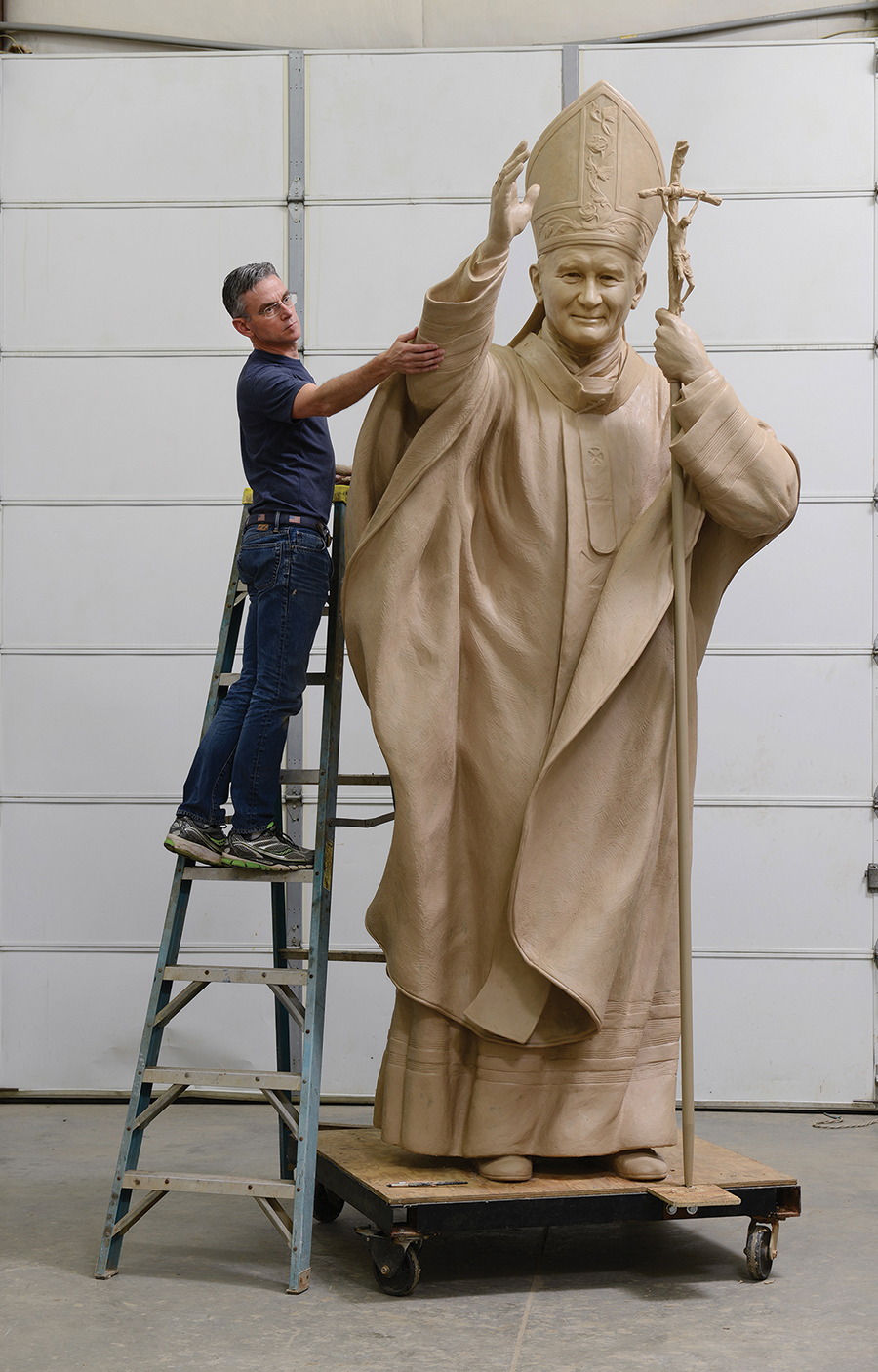
Fagan shares Walker’s penchant for figuring things out. He’s a 1988 graduate of Yale who majored in, of all things, Soviet studies. He took a couple of painting classes while he was in New Haven, and it turned out he had the one thing you can neither invent nor hide, talent. He says his work at the moment is mostly historical in nature. “I’m looking at a life-size seated James Madison. He’s in a 4-foot by 7-foot canvas,” says Fagan. While that commission was private, he had previously been hired by the White House Historical Association to paint all 45 U.S. Presidents. He did the portrait of Mother Teresa that was mounted on a mural and displayed during her sainthood canonization by Pope Francis. His sculptures include the Bush presidents, George H.W. and George W., shown together, and George H.W. alone; several versions of Reagan for Washington, D.C., London and Reagan National Airport; Ronald and Nancy Reagan for his presidential library; Saint John Paul II for the shrine in Washington, D.C.; and Neil Armstrong for Purdue University. The piece currently being produced at Carolina Bronze is a sculpture of Bob McNair, the owner of the NFL’s Houston Texans.

Fagan’s start in sculpture was, in its way, as unusual as studying Russia to master oil painting. While he was at the White House working on Barbara Bush’s portrait, he was asked if he could do a sculpture of George H.W., too. Sure, he said. Fagan had never done one before. Now the path to many of his finished pieces passes through Carolina Bronze.

“In this place I think we created a really nice marriage of modern technology and old school techniques that have been around for thousands of years,” says Walker.

Once a sculpture is approved and the project is on, an artist like Fagan will deliver a clay maquette, roughly a 2-foot version of the piece, to Walker. “From that Ed would determine how difficult it would be to make,” says Fagan. “I’m sure in his mind he’s planning out every major chess move along the way, because they are chess moves.”

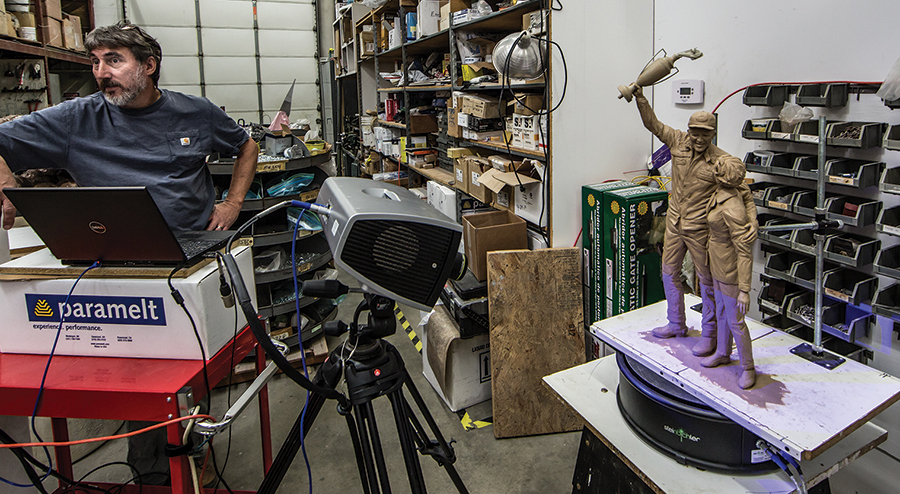
David Hagan, a sculptor himself who works mostly in granite and marble, will produce a 360 degree scan of the piece, a process that takes about a day. That digital information is fed into a machine that cuts pieces of industrial foam to be assembled into a rough version of the sculpture at its eventual scale. “It’s at that point that I come in with clay and sculpt away,” says Fagan. “You’re at your final size and it’s a fairly close version of what you had, which may or may not be a good thing. What looks so great at a small scale may end up being not so great. You can have awful proportion things wrong. The foam that’s used is a wonderful structural foam that you can slice with a blade. For me, you can sculpt that stuff.” The eventual layer of clay on the foam varies according to the artist’s desire.

Several intermediate steps eventually yield a wax version of the sculpture, except in pieces. “For the artist, you gotta go back in and play with that piece — or the piece of your piece — the head or a hand or an arm or something,” says Fagan. “They’re all designed or cut based on where Ed, foreseeing the chess moves, figured out what’s going to pour and how. The maximum size of the mold is dictated by the maximum size of the pour. Those are your limitations, so you have to break up the piece into those portions.”

Solid bars of wax, sprues, are added to the wax pieces to allow for the passage of molten bronze and the escape of gases. A wax funnel is put in place. Everything is covered in what becomes a hard ceramic coating. That’s heated to around 1,100 degrees. The wax melts away. Brown, who has a Bachelor of Fine Arts degree from UNCG and whose own bronze sculpture of a mother ocelot and kittens will go on display at the North Carolina Zoo this year, slags the impurities off the top of the molten bronze. It’s poured at roughly 2,100 degrees. “I found that I enjoyed the more physical aspect of working with sculpture as opposed to doing drawings or paintings,” says Brown.

After everything has cooled and the ceramic is broken away, the pieces need to be welded together to reform the full sculpture. “The weld marks on the metal, you have to fake to look like clay,” says Fagan. The artist oversees that, as well. “The bronze shrinks but not always at the exact same percentage. There are always adjustments.” The last step is applying the patina, one of a variety of chemical surface coatings, done at Carolina Bronze by Neil King. Different patinas are chosen for different reasons: if the piece is to be displayed in the elements; if it will be touched frequently; and so on. “For someone like the artist who is very visual, it’s hard to imagine what the end result is going to be when you see the process. It will just look completely different in the middle than it will at the end. It’s an absolute art,” says Fagan. When it’s finished, no one knows the structural strengths and weaknesses of the sculpture better than Walker. They crate it like swaddling an infant, put it in traction, and then ship it off.

In a digital world where so many things seem to have the lifespan of magician’s flash paper, a foundry is a world of gritty timelessness. “Because we do a lot of historical things here,” says Walker, “we get to make permanent snapshots of points in time.” At the end of the day, whether they’ve poured brass bases for miniaturized busts of Gen.George Marshall or pieces of a torso for a presidential library, the kiln and furnace go cold. Like any other small factory, the doors are locked and everyone goes home. Except for Walker. These are the hours he gets to spend alone shaping a bas relief of Richard Petty’s greatest hits. As George McFly said to Marty when his first novel, A Match Made in Space, arrived, “Like I’ve always told you, you put your mind to it, you can accomplish anything.”  PS

Jim Moriarty is senior editor of PineStraw and can be reached at jjmpinestraw@gmail.com.

Cave Men

A full wine rack is

Saturday mornings,

The first day of vacation,

A just-waxed car.

It is a promise of future good dinners,

of future celebrations,

of a future.

A full wine rack murmurs:

Don’t worry.

There’s plenty.

You’re safe.

— Joseph Mills

from Angels, Thieves, and Winemakers

A Mystic Reincarnation

Letting a house speak for itself

By Deborah Salomon   •   Photographs by John Gessner and from The Tufts Archives

If only the walls could talk.

We can.

We walls surround a house now surrounded by others that once stood alone in an infant village with muddy roads and big dreams — a village which, as founder James Tufts wrote, “would attract only a refined and intelligent class of people.” Our double-decker wraparound porches were meant for sitting and watching . . . very little, at the start. Today, the world strolls by. Music and aromas fill the air. Porch chairs are occupied by progeny hungry for history.

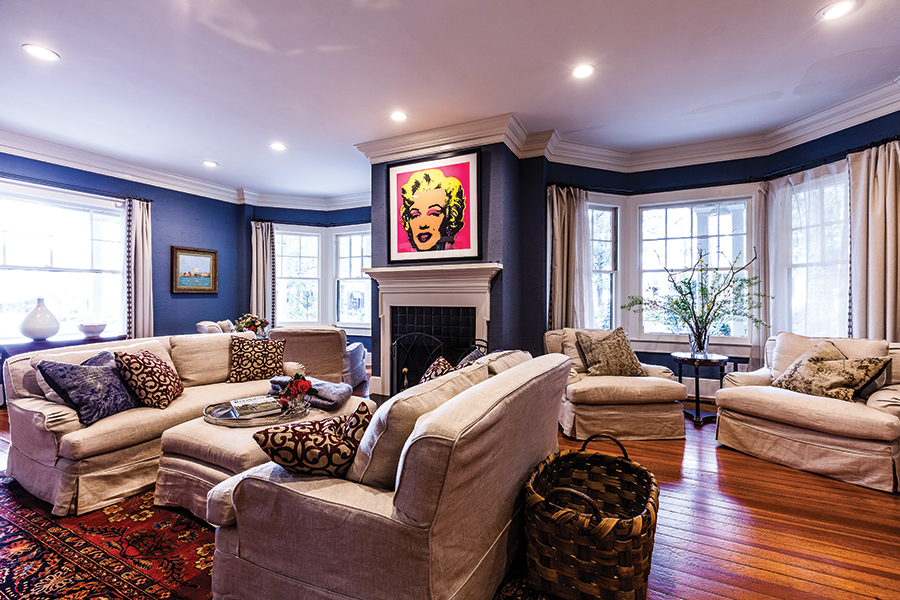
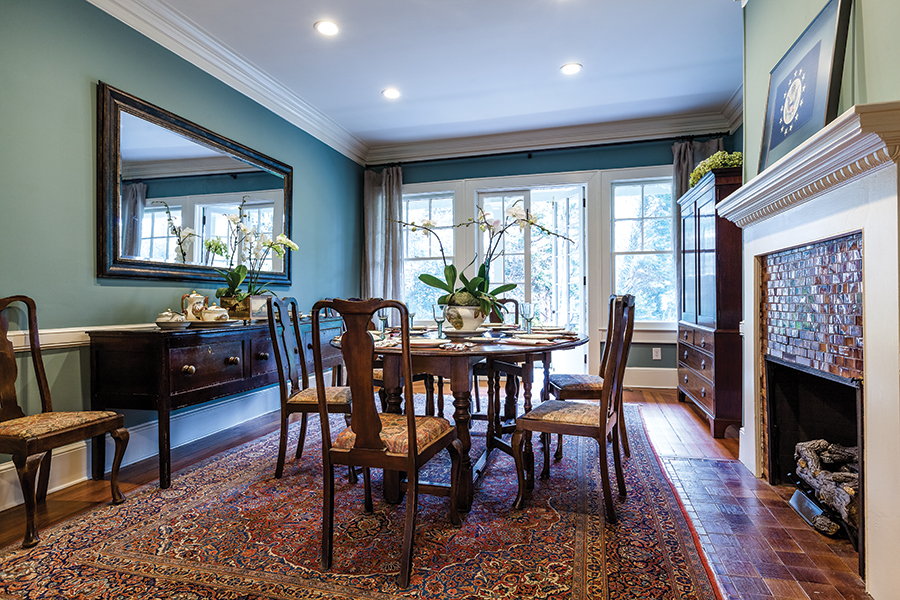
We walls, some plaster, formerly white, now sport a rainbow of blues: blue and grey and grey-blue and teal and almost turquoise; some of us old walls remain covered in grasscloth, also painted blue. No amount of scraping, stain or polish disguises our heart pine floorboards — although carpets and rugs of all sizes, shapes, colors and provenance draw attention to their antiquity with this exception: Flooring in the back hallway comes from a longleaf pine felled recently by lightning on Pinehurst No. 2.

Our exterior shingles, once white also, are a misty gray reminiscent of haze over the Mystic River, which flowed near the Tufts residence in Massachusetts. Nobody knows why the door blazes burnt orange.

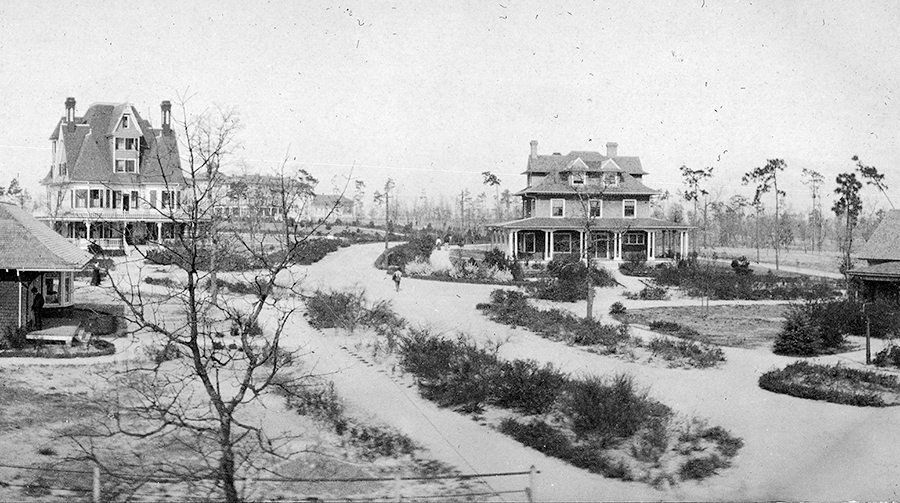
James Tufts built our Mystic in 1899 for his son Leonard who, after his father’s death in 1902, moved his growing family to Pinehurst and took over resort operations. What a mansion it was — 14 rooms, vaguely Queen Anne, designed by the same Boston architects as the Carolina Hotel. The Pinehurst Outlook described Mystic as “having steam heat, throughout with electric lights, a large steel range and cold storage for preservation of meats and vegetables.” The second floor bathroom was “fitted with the latest improvements such as sanitary plumbing, a porcelain bath tub and one set of bowls.” Also: Antique oak furniture and “rich Brussels carpets.” The Outlook further commented: “Nothing has been left to be desired. Mystic Cottage has a home-like appearance notably lacking in homes located in other winter resorts.”

Palm Beach, perhaps?

After Tufts moved across the street to Mistletoe Cottage in 1913, we were occupied by, among others, Mr. and Mrs. Robert Hunter, of Berkeley, California. Mr. Hunter, described as a cranky socialist and writer, took issue with Tufts over heating bills. “You charge the extreme limit for every service you render to the people of Pinehurst. You have driven away a large number of people . . .”

But not the lady ghost, rumored to be a lovelorn poet.

Nevertheless, the resort continued to grow, to prosper, and we continued to adapt. Our walls were reconfigured into apartments, offices, a bank branch and finally, Brenda Lyne’s home décor business. Lyne installed an elevator which, though convenient, seems anachronistic to us.

Then, in 2013, not without contention, Mystic was rezoned residential and sold to Richard Moore, CEO of First Bank, and his wife, Noel — definitely “intelligent and of refined tastes.”

The walls fall silent as another voice emerges.

“I fell in love the first time I went through (Mystic Cottage) when it was still a store,” Moore says. First Bank was moving headquarters from Troy to Southern Pines. He needed a place to stay during the week. He was also a Wake Forest history major, who had rebirthed Ashburn Hall, a 19th century meeting venue near Oxford.

But, the ever-practical walls query, why live on a busy village corner instead of a quiet cul-de-sac?

“I wouldn’t have picked downtown except for this house. I was happy to put money into a landmark that would be connected to First Bank,” Moore answers.

Banker-turned-rehabilitator Moore accomplished the redesign sans architect, quite the feat considering the scope of his plans.

“There’s practically nothing original on the inside — two fireplaces, one door,” also a darling wood-paneled dormered nest on the third floor, presumably the maid’s quarters. “I tried to be creative in where we put the bathrooms,” he adds, recalling the Tuftses and their three children had one and the Moores desired six.

Or is it seven?

No matter. Their vanities — repurposed antique bureaus — make the loos as elegant as the parlors.

What Moore accomplished was a maze of sitting areas (“so everyone could have their own space”), bedrooms (none vast), recreation (billiard room, TV nooks) and a kitchen, which, in an era of culinary ballrooms, illustrates restraint. “There was no kitchen; I just took a guess.” From the coffered ceiling — which Moore devised as a “strong statement” — to the painted cabinets and breakfast room with round table and pub chairs, Moore has created a contemporary kitchen shadowing the bygone.

Just imagine, in a renovation costing many zeros, no Sub-Zero!

“I went with Sears,” Moore says.

The walls’ primary purpose, aside from loquaciousness and connecting miles of moldings, is backdropping an art collection that would wow even persnickety James Tufts. Furnishings, none heirlooms, blend in; upholstery has been kept neutral lest patterns detract from paintings. Art of multiple spectra is the Moores’ passion, if not trademark. Above the living room fireplace hangs, of all things, an original Marilyn Monroe by Andy Warhol.

“When my wife walked through the house she said, ‘You need Marilyn there.’ So she bought one for me.” Even walls that stare at nothing else have trouble describing gilt-framed English landscapes by Duncan Cameron and American masterpieces by Impressionist/Expressionist Jane Peterson, also Dale Nichols, in the style of Grant Wood. Yes, that is pop artist Roy Lichtenstein, also, and a Toulouse-Lautrec print, but the enlarged photos were taken by the Moores’ son, William, when he worked for the United Nations.

Times, they have a-changed. Our chatty walls must learn a new script. Or amend the old one. Because once again, Mystic Cottage hosts a family of substance and taste, who appreciate both history and now-time. Other cottages may crowd its perimeter, but the interior still boasts “the latest improvements,” more likely zoned AC and Wi-Fi than electric lights. Of an evening, Richard Moore watches the world James Tufts sought to attract go by from a porch where Leonard’s children played on rainy days.

Whither the ghost? She hasn’t been seen for years. Just as well. Marilyn might scare her to death.   PS
Southern Pines Home & Garden Tour

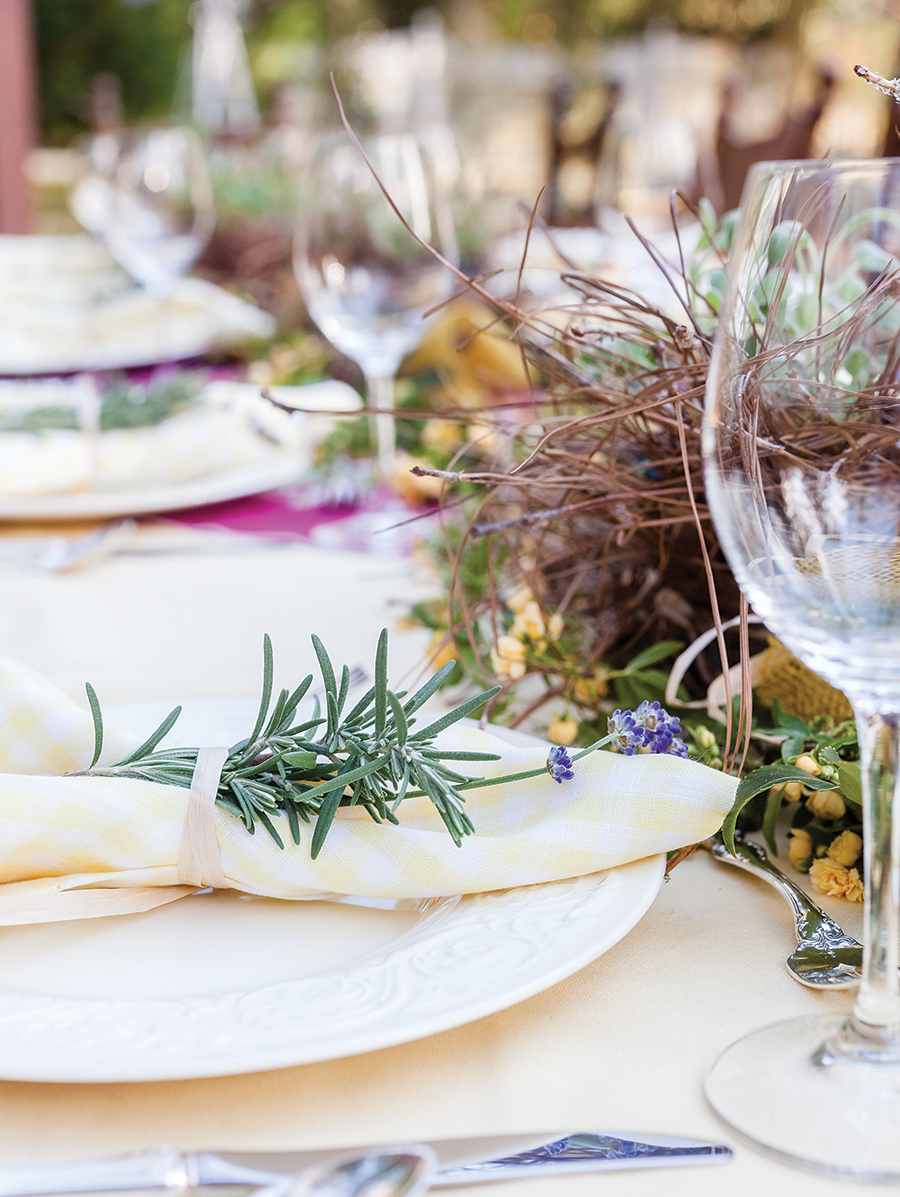
Mystic Cottage and five other premier area homes will be on display at the 69th annual Southern Pines Home & Garden Tour, from 10 a.m. to 4 p.m. on April 8. For the first time, the tour will take place on Saturday. Also included, the public gardens at Weymouth, Campbell House and Sandhills Horticultural Gardens. An exhibit of original watercolor landscapes will be on display at Campbell House. Tickets are $20 until April 5 at Campbell House and The Country Bookshop in Southern Pines, and The Woman’s Exchange in Pinehurst, or at www.southernpinesgardenclub.com. Day of tour, tickets may be purchased for $25 at the houses. Profits from garden club events fund scholarships and beautification projects.


Almanac

April Flowers

Daisy and sweet pea are this month’s birth flowers. The first is a symbol of innocence and purity, while the latter represents blissful pleasure. If you wish to brighten someone’s day, a simple bouquet of fern and daisies will speak volumes. A gift of fragrant sweet pea, on the other hand, is best reserved for a sweet goodbye.

Every spring is the only spring — a perpetual astonishment. — Ellis Peters

April Love Song

If ever there were a more delicious poem than April, perhaps only the bluebird would know it. Or the nectar-drunk duskywing. Or the glossy black rat snake, so entranced by the color of the robin’s egg that he swallows the pastel vessel whole.

April is here. Sow the beets and the broccoli. Plant the beans and the cukes. Harvest the tender green shoots of asparagus.

Welcome the rain. Let it kiss you, mused Harlem jazz poet Langston Hughes. Listen to its “sleep-song” on your roof at night.

Earth Day falls on Saturday, April 22. This month, gift the Earth a poem of love. Plant a tree in the garden. Buy local produce. Organize a community cleanup. And when the Earth sings, listen.   

Let the rain kiss you.

Let the rain beat upon your head with silver liquid drops.

Let the rain sing you a lullaby.

The rain makes still pools on the sidewalk.

The rain makes running pools in the gutter.

The rain plays a little sleep-song on our roof at night —

And I love the rain.

— Langston Hughes, “April Rain Song”

Must-See Moon

According to National Geographic, one of the “Top 7 Must-See Sky Events for 2017” will occur on Monday, April 10. On this dreamy spring night, just moments after sunset, Jupiter and the near-full Pink Moon will rise together in the eastern sky like forbidden lovers.

The Old Farmer’s Almanac speculates that a full moon in April brings frost. While it’s not actually pink, Algonquin tribes likely named this month’s full moon for the wild ground phlox that blooms with the arrival of spring. Also called the Sprouting Grass, Fish and Egg Moon, if the full Pink Moon rises pale on April 11, bet your folklore-loving bippy it will rain.

A Few Delicious Words

Henry James once mused that “summer afternoon” were perhaps the “two most beautiful words in the English language.”

“Easter brunch” make a
lovely pair.

Ditto “asparagus frittata.”

So if you find yourself playing host on Sunday, April 16, and life gives you fresh asparagus spears, steam until tender then add them to your favorite egg dish.

The Medicine Chest

Want to try your hand at an herb garden? Start now. Since most herbs thrive in full or filtered sun, carve out a cozy outdoor space with optimal light and drainage. Then, allow yourself to dream. Conjure up visions of lush beds with tidy labels, dark opal basil tangled with pineapple sage, aromatic bundles of herbs hanging upside down inside the coolest rooms of the house. Whether it’s medieval apothecary or fresh pesto that you’re craving, April is here to help make manifest your fantasy.

Here’s what to plant this month. Cue “Scarborough Fair” for reference.

Parsley – Rich in cancer-fighting compounds.

Sage – Digestive aid.

Rosemary – Improves memory.

Thyme – Antiseptic and anti-fungal properties.  PS
Golden Night

A pop-up meal blossoms on a spring evening

By Casey Suglia     Photographs by John Gessner

5:45 p.m.

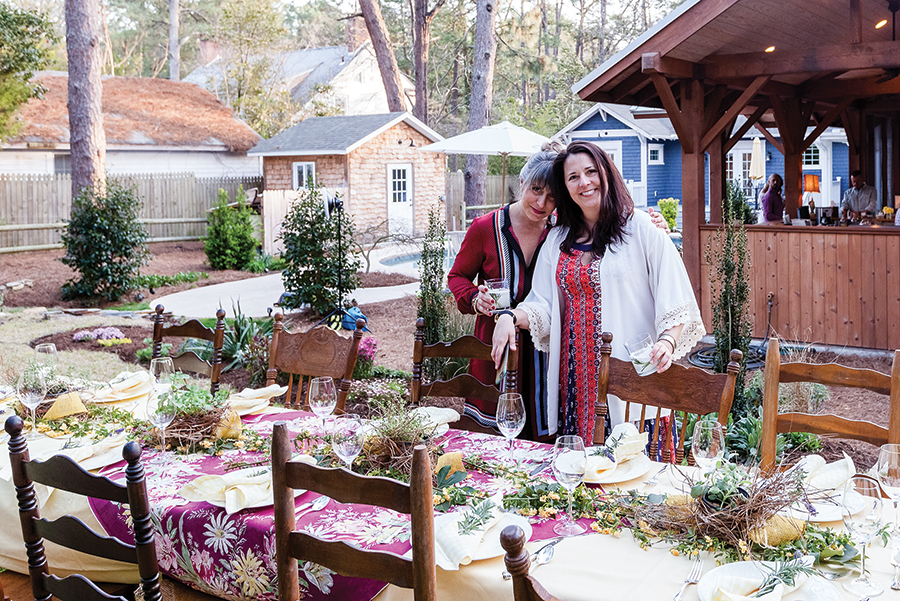
An outdoor fireplace crackles as a dozen guests mingle at the home of Jeff Kelly and Scott Harris. Tony Cross, of Reverie Cocktails, mixes a drink specifically designed for the night, the “Ágætis byrjun” — Icelandic for a good beginning. It’s a combination of Grüner Veltliner, a dry white wine from Austria, and Conniption Gin, a North Carolina-made “Navy strength” gin far more potent than your average bottle. Cold-pressed organic pineapple juice made at Nature’s Own, and smoked rosemary simple syrup, handmade by Cross himself, combine for a savory and sweet cocktail. Cross smacks the rosemary garnish to release the herb’s essence.

“The cocktail is local, as always,” he says. “It’s seasonal and springlike.”

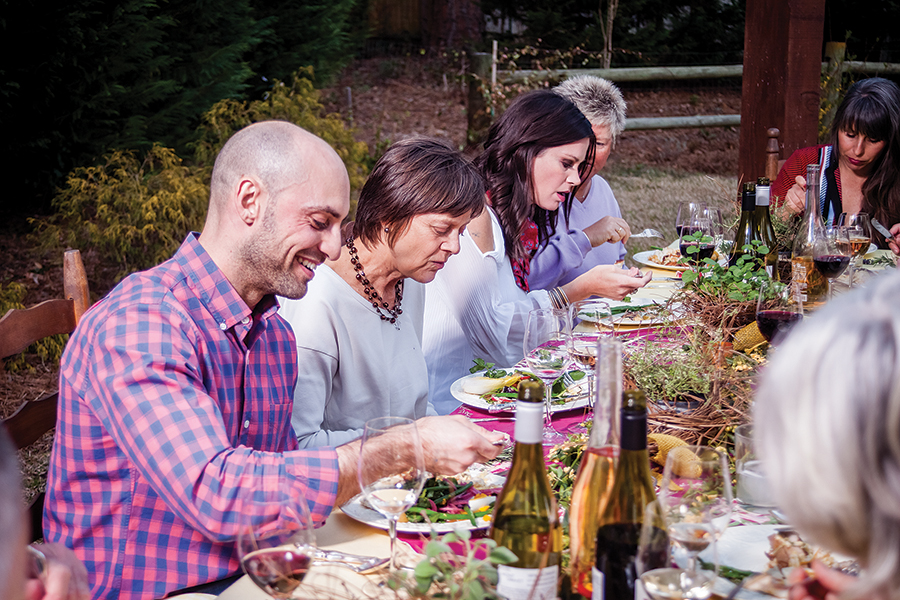
The outdoor kitchen and bar of the home, located just blocks away from Broad Street in Southern Pines, serves as the perfect place for entertaining. “We host small dinner parties out here all time,” Harris says. But tonight is different. A mixture of people — some strangers, others friends for years — gather for a seasonal pop-up dinner created by Southern Whey’s Angela Sanchez and Chris Abbey, and Jen Curtis of Chef Warren’s.

“This was the brainchild of Jen and me,” Sanchez says. “It was a way for us to do something outside of the box and express our creativity away from our day jobs.”

6:15 p.m.

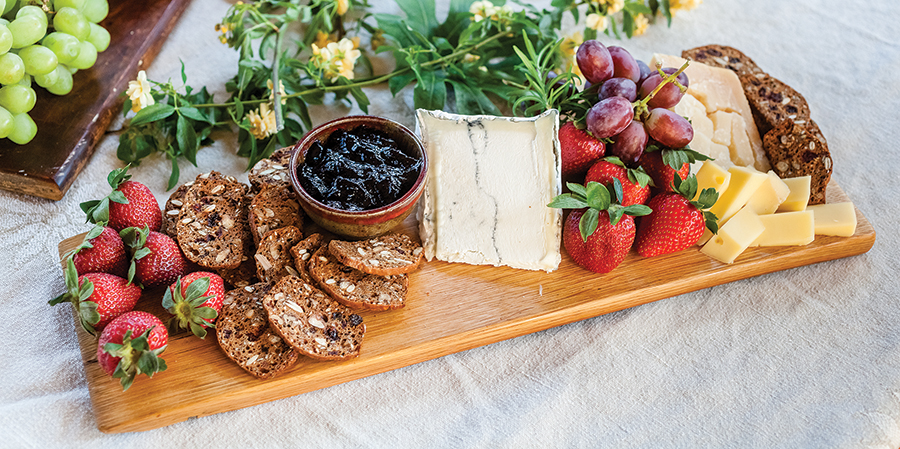
Sanchez sets out a tray of fresh, seasonal produce and cheese from Southern Whey — some local like Paradox Farm’s Cheese Louise spread. “The dinners all have different vibes or themes,” Sanchez says. “But our meals always have a local emphasis.” As the days lengthen and nights shorten, spring is the perfect time to match people and food. New blooms, new friendships, new beginnings.

6:30 p.m.

In the kitchen, Curtis plates the meal — a mix of local ingredients with fresh flavors hinting at the start of the season. The night’s menu is North Carolina pork belly served on a bed of locally grown grits from Anson Mills. A niçoise salad with North Carolina speckled trout, pickled okra and Amanda Curtis’ locally grown Heirloom Eggs.

“The meal is based on the coming of spring,” Curtis says. “There’s a Southern influence. We’re all transient here. Some of us have Northern roots, but we embrace the culture. Every tradition is identifiable, especially in food.”

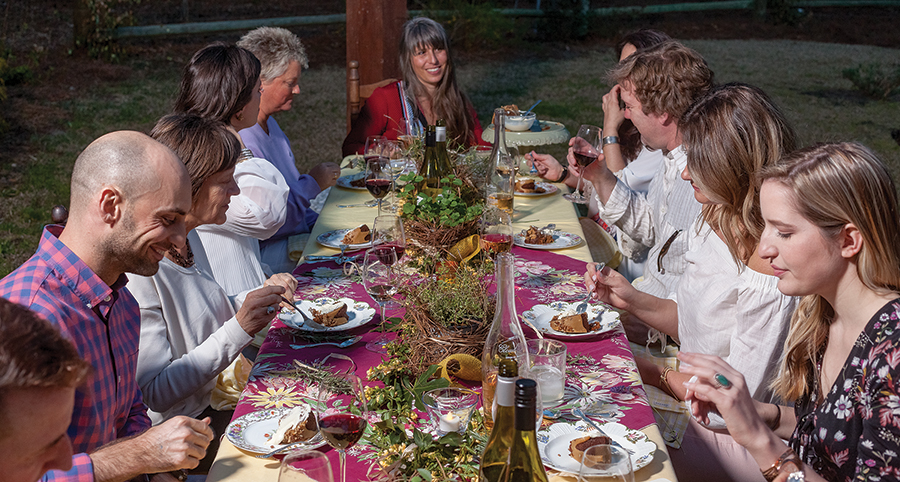
“The meals are made so they’re easy to pass and share,” Sanchez says. “Guests are encouraged to sit wherever they want and make new friends.”

“People being together and sharing food always leads to something else,” Curtis adds.

7:00 p.m.

The guests gather around the table and talk about what’s new on Netflix, the wavering weather and the changing landscape of Southern Pines, as the sun sets behind them.

“The great thing about this backyard is that it feels like an oasis, but it also feels like we’re in Southern Pines,” Harris says. “It’s our own secluded space. We created our own environment here.”

Christin Daubert, a librarian, has attended all of Curtis’ and Sanchez’s pop-up meals, yet is constantly surprised by the place she and her husband, Justin, have called home for three years.

“I love this tiny little town,” Daubert says. “Every day I meet new people.”

7:20 p.m.

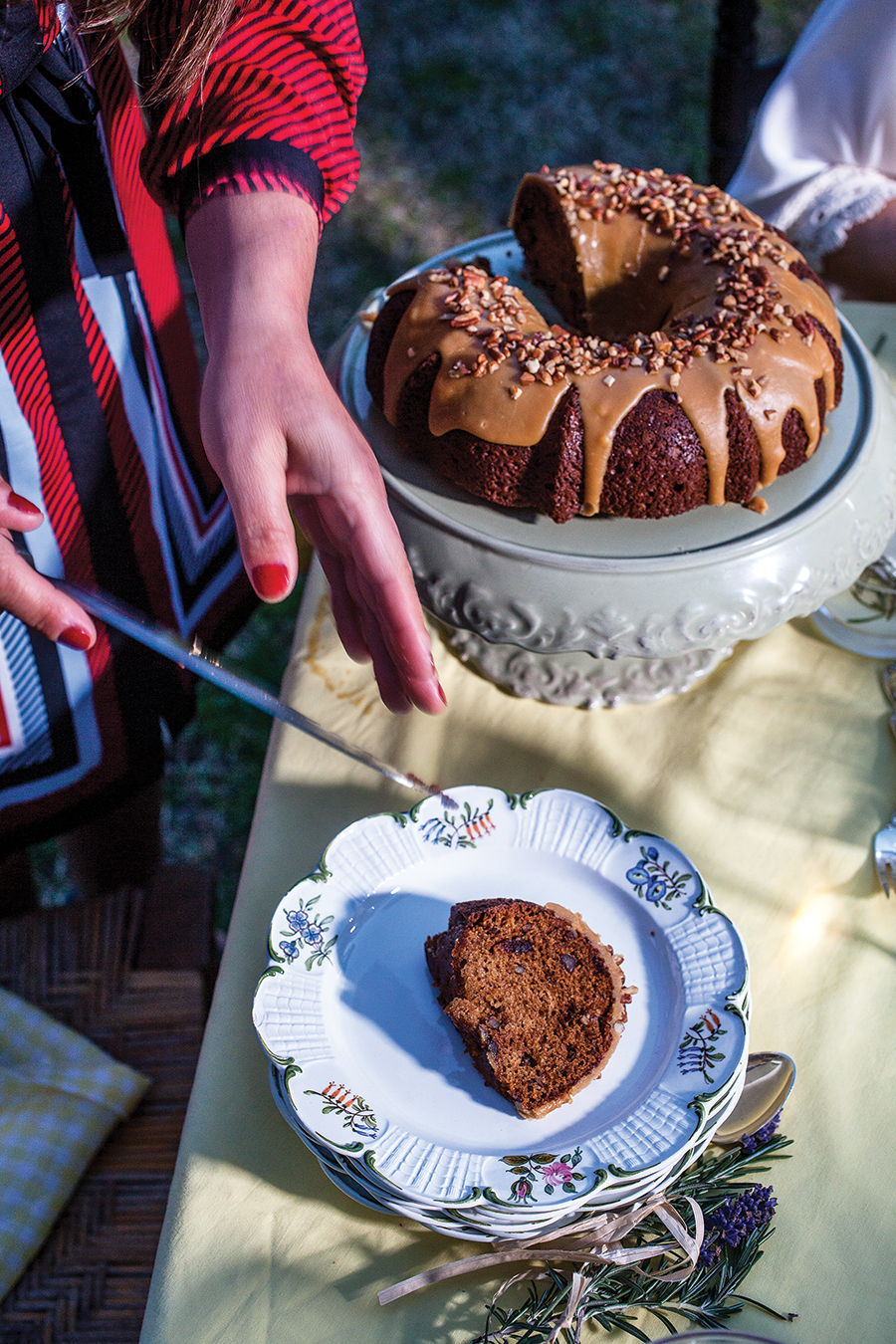
Dusk settles in and the cake — made with applesauce, rye flower, and dates with a pecan glaze — is served. Kelly and Harris’ yellow Labs, Lil’ Bit and Izzy, join the party for dessert, sneaking a bite of cake from some new friends of their own.

8:00 p.m.

The chill of the spring evening sets in the air, a reminder that the warm weather is still weeks away. The night feels young. The guests stand in front of the cracking outdoor fireplace, sip wine, and chat as if they’re new old friends.

“Spring is about renewal, change. We shed the past, move forward, and do that tonight with wine, conversation, and good food,” Sanchez says.   PS
Menu For A Southern Spring Night

Niçoise Salad with a Southern Twist –

Watercress, Belgian Endive,
Confit New Potatoes, Spring Radish,
Pickled Red Onion, Pickled Okra, Haricot Vert, Asparagus, Heirloom Eggs Soft Boiled Eggs and Smoked Speckled Trout
Citrus and Whole Grain Mustard Vinaigrette

*

NC Heritage Breed Ossabaw Pork Belly –

Star Anise, Juniper, Fenugreek and
Kombu Braised Pork Belly with
Anson Mills White Corn Grits,
Pork Braising Jus & Napa Cabbage,
Citrus and Mint Melee

*

Applesauce Cake –

Applesauce, Carolina Ground Rye Flour, 
Medjool Dates, Pecans with
Sorghum Caramel and
Marscapone Cheese whipped
with Local Honey

All Bottled Up

Poor man’s stained glass comes of age

By Susan McCrimmon  •  Photographs by Laura Gingerich

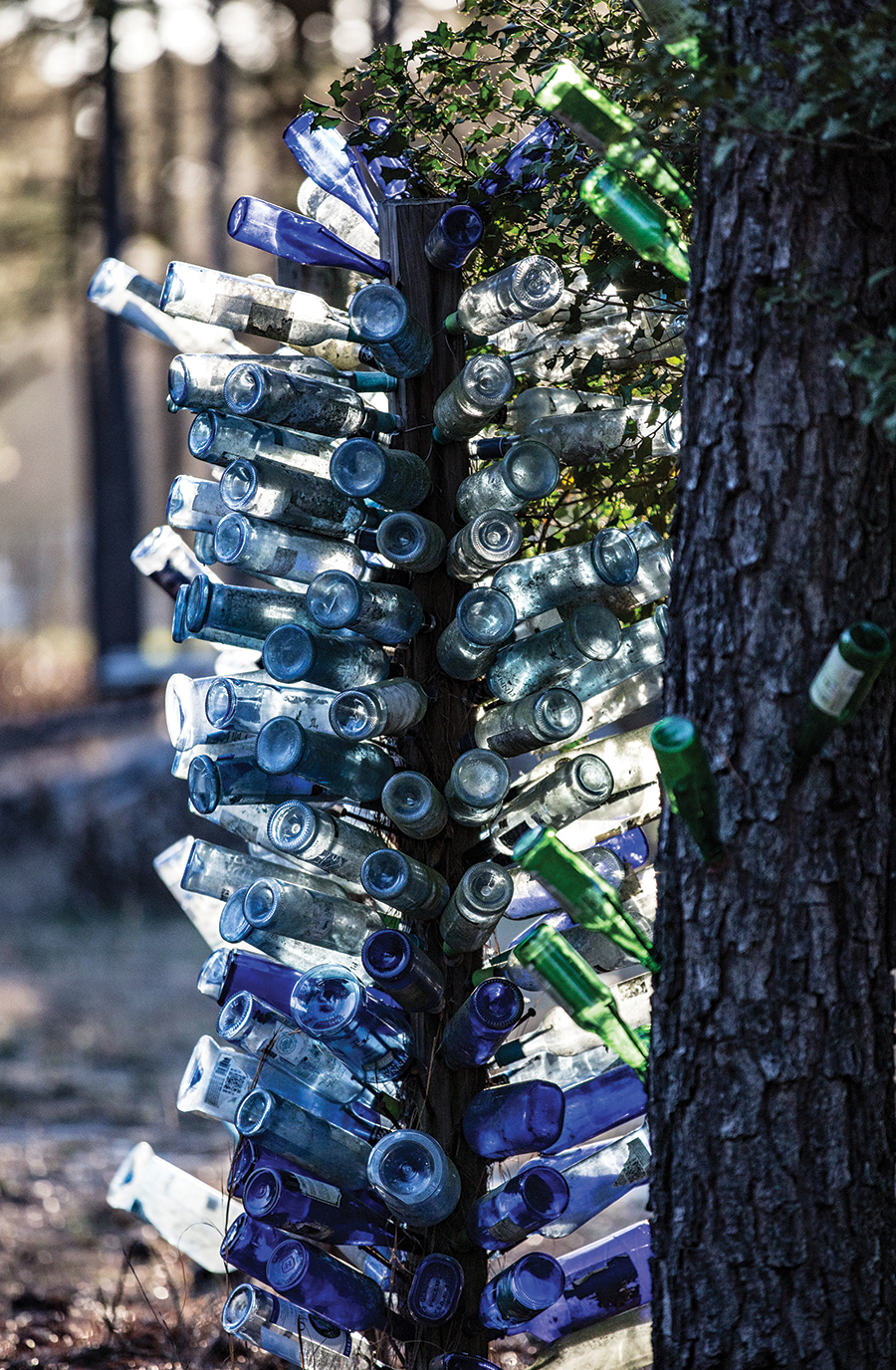
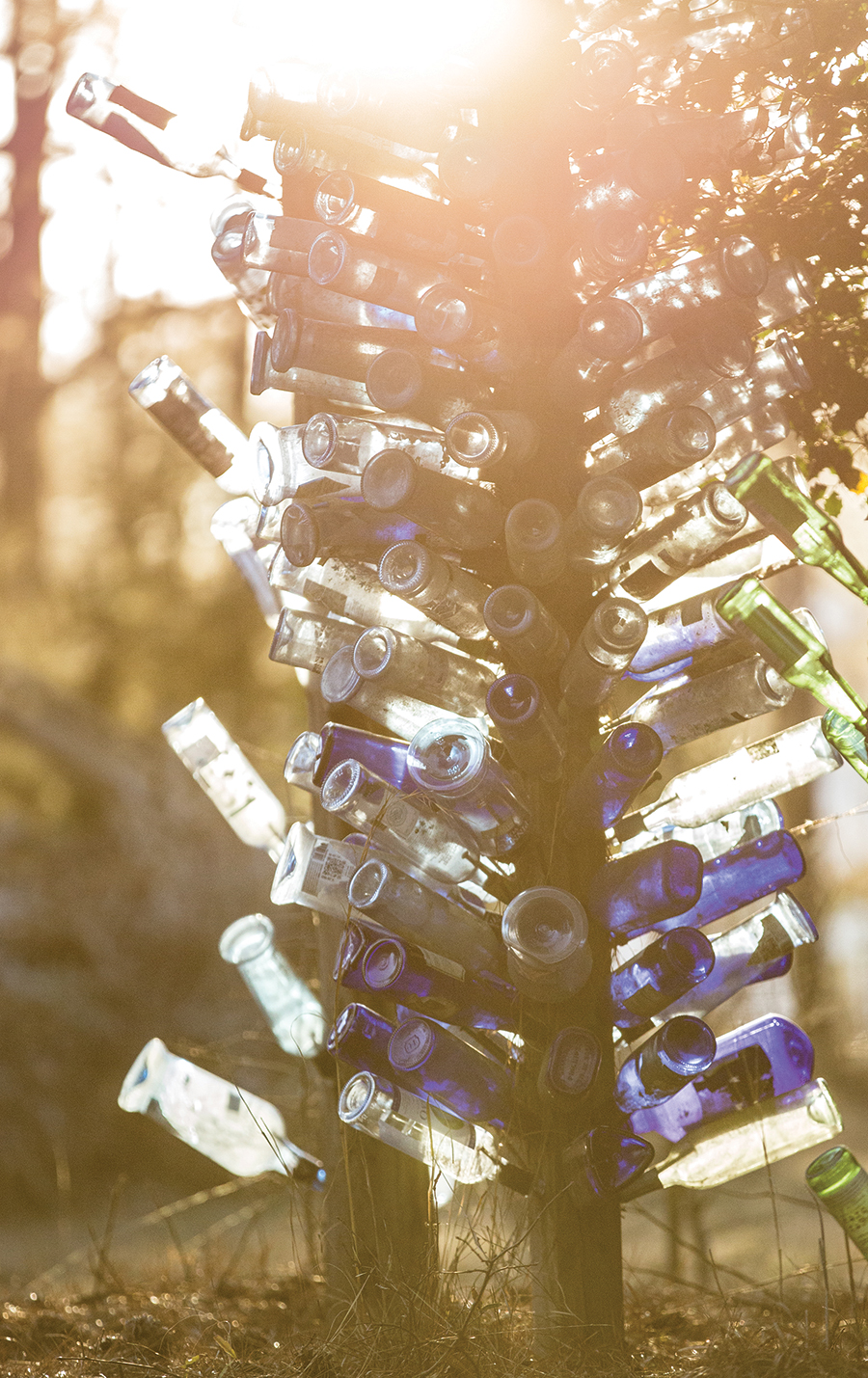
Are they trash recycled as art? Does your heart soar when one is spotted tucked back into some shrubbery? Does your nose wrinkle with distaste at the gaudy display? Love ’em or hate ’em, glass containers emptied of their various and sundry contents — liquid medicines, soft drinks, vinegar, beer, syrups, hard liquor — all have been transformed into an art form, the Pietà of salvage, the bottle tree.

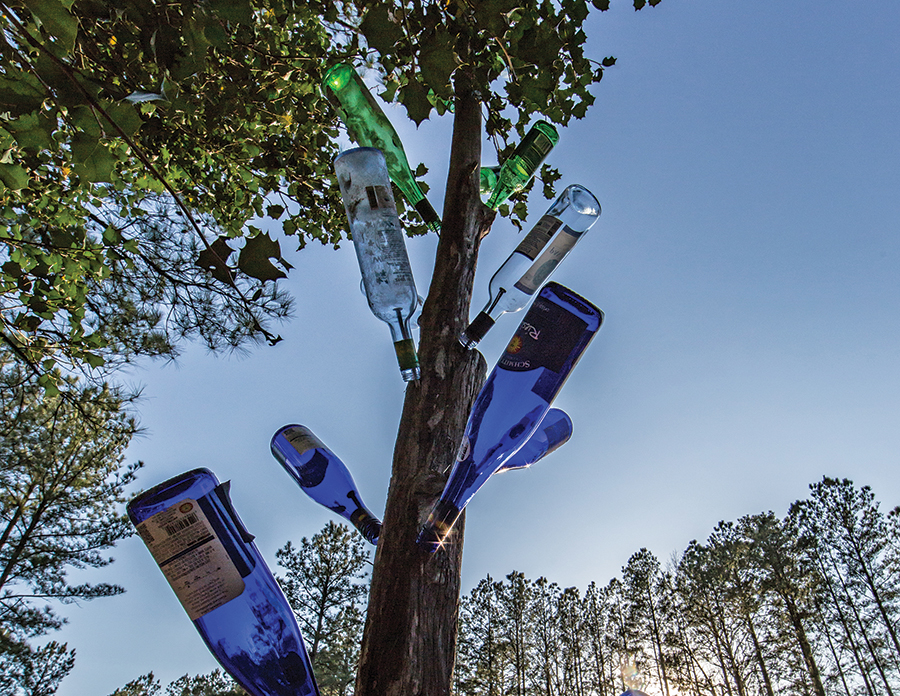
A splash of color in the corner of the garden or a note of whimsy as the garden’s focal point, there is no denying a bottle tree’s impact. There are no formulas, no blueprints, no set rules governing construction or design. Bottle trees are limited only by one’s imagination, creativity or pocketbook. The “poor man’s stained glass” can be constructed from a variety of materials. The most current manifestation can be purchased and installed in short order. Metal “trees” made from rebar or similar material are placed in the desired location and the chosen bottles are inverted onto the tree “limbs” to complete the look. Easy peasy. The more traditional bottle trees take a little more effort. If one is lucky, a  dead cedar tree or crape myrtle, in the right location, works great. Cedars and crape myrtles are traditionally associated with bottle trees, although anything with good limb structure will work. Just trim the limbs as needed and place saved bottles as your artistic muse dictates.

Otherwise, a strategically positioned post or tree trunk may be your best option. Some people drill holes and pound wooden dowels at an angle into the post or tree trunk to support the bottles. I prefer to hammer in 20-penny nails. Relatively inexpensive, they can be easily moved for creative effect. To finish, simply add the collected bottles. They can be a wide variety of shapes and colors or just one specific type or one specific color. The possibilities are endless.

Bottle trees have spiritual, cultural and aesthetic significance in history and garden design. Glass was first discovered in northern Africa about 3500 B.C. Glass bottles appeared in Egypt and Mesopotamia around 1600 B.C. It’s possible that the Arabic folk tale of the genie in Aladdin’s lamp is the first instance of bottles being used to capture spirits, pre-dating the common conception of bottle trees originating in the Congo during the ninth century where empty glass bottles were placed around entryways in order to ensnare evil spirits which then would be destroyed by sunshine. Wind blowing across the bottles was the sound of spirits trapped inside moaning to be released. At the same time in the Congo, tree altars were erected to honor dead relatives. Plates attached to trees or sticks would be placed around the gravesite as a memorial. The plates were thought to resemble mushrooms. The  Congolese word for mushroom was similar to their word for love. See a mushroom . . . think of love. Earth from the gravesite would be placed in bottles and they would be hung by the neck from low limbs of a tree. These bottles would emit a tinkling sound in a breeze, possibly the beginning of wind chimes. The two concepts began  to merge into the bottle tree.

The color of choice for bottle trees has predominantly been cobalt blue. Cobalt blue is universally accepted for relaxing and calming the spirit and has historically been associated with spirits, ghosts and haints. Blue bottles have been found on shipwrecks from the Minoans dating as far back as 2700 B.C. The most widespread means of adding blue color to glass was using the element cobalt, thus the name. The term cobalt is Greek in origin by way of medieval Germany. When smelting silver, the cobalt metal embedded in the silver ore could interfere with the process and cause respiratory issues. As early as 1335, “Kobald” referred to gnomes or spirits afflicting the silver miners. The association stuck. The word for troublesome spirits became associated with the main way of getting blue color into glass that was then used in bottle trees to capture evil spirits. Cobalt blue was the preferred color of Voodoo tradition. This color of the sky and water was a crossroads of heaven and Earth, the living and the dead, and creative and destructive spirits. 

The esteemed Southern writer Eudora Welty believed that place is what makes a story appear real, because with place come associations, customs and feelings. In the short story “Livvie” she writes:

“Out front was a clean dirt yard with every vestige of grass patiently uprooted and the ground scarred in deep whorls from the strike of Livvie’s broom. Rose bushes with tiny blood-red roses blooming every month grew in threes on either side of the steps. On one side was a peach tree, on the other a pomegranate. 

“Then coming around up the path from the deep cut of the Natchez Trace below was a line of bare crape-myrtle trees with every branch of them ending in a colored bottle, green or blue. 

“There was no word that fell from Solomon’s lips to say what they were for, but Livvie knew that there could be a spell put in trees, and she was familiar from the time she was born with the way bottle trees kept evil spirits from coming into the house — by luring them inside the colored bottles, where they cannot get out again. 

“Solomon had made the bottle trees with his own hands over the nine years, in labor amounting to about a tree a year, and without a sign that he had any uneasiness in his heart, for he took as much pride in his precautions against spirits coming in the house as he took in the house, and sometimes in the sun the bottle trees looked prettier than the house did . . . ”

My first two bottle trees came about due to my mother’s illness. She was a died-in-the-wool Southern iced tea drinker. Every day. If there wasn’t a pitcher of tea already in the fridge, it was being brewed on the stove. One of the manifestations of her illness was that it altered my mother’s drinking habits. She no longer wanted tea but began to drink Coke. Not any Coke, mind you, but it had to be the ones in the 6-ounce bottles. We bought them by the case. I began to store the small greenish bottles with the distinctive red labels. When I thought enough had been gathered, I dug a hole near a large camellia bush, beat in the nails, and erected this rather odd memorial to my mother. During the many months of her illness, almost every evening was passed with friends and family murmuring words of support while sitting on Mom’s screened-in porch. At times, alcohol was the crutch used to help numb the pain. My second bottle tree was born as a memorial to those evenings. The current count is six . . . and growing. 

Regardless of your color choice, be it blue, green, brown, clear, red or any array of color choices for your garden addition, remember its long tradition of keeping bad things away. No one can feel bad from something that brings one such joy.  PS
Susan McCrimmon is a noted science geek, Suduko and crossword addict and is rumored to be besotted by words…and bottle trees.

Longleaf Majesty

The roots of a massive ecosystem

By Bill Fields     Photographs by Brady Beck

For those who understand the longleaf pine, lose sleep over its well-being and know of its former ubiquity in the southeastern United States, there is a yearning to have witnessed the old landscape vastly different from today.

“Guys fantasize about a lot of things,” says Jesse Wimberley, outreach coordinator for the nonprofit Sandhills Area Land Trust, “but you’re talking to a guy who literally fantasizes about wanting to have seen that forest. I think we missed out on one of the greatest things that this country ever had — that endless longleaf forest that went on for miles and miles and miles.”

An Aberdeen native, 1976 Pinecrest High School graduate and fourth-generation longleaf farmer, Wimberley calls the 92 million acres of longleaf that once existed from Virginia south to Florida and west to Texas “the greatest ecosystem that ever existed in the United States.” It is hard to argue with him, especially in the Sandhills, where the species is the area’s long-needled fingerprint, the remnant that offers an inkling of what stood centuries earlier.

“They talked about being able to ride for days and days and never getting out of the piney woods,” says Robert Abernathy, president of the Longleaf Alliance, an education and advocacy organization started in 1995. “You can get a taste of that in Weymouth Woods and on the Walthour-Moss property. You can get out in the middle of it, and if you don’t listen to the traffic, you can get an idea of what the forest looked like 200 years ago.”

There are accounts of what that experience would have been like, from William Bartram’s writings near the end of the 18th century to Basil Hall’s book Travels in North America, in the Years 1827 and 28.

“For five hundred miles, at the least, we travelled, in different parts of the South, over a country of this description, almost every where consisting of sand, feebly held together by a short wiry grass, shaded by the endless forest,” Hall, a native of Edinburgh, Scotland, wrote. “I don’t know exactly what was the cause, but it was a long time before I got quite tired of the scenery of these pine barrens. There was something, I thought, very graceful in the millions upon millions of tall and slender columns, growing up in solitude, not crowded upon one another, but gradually appearing to come closer and closer, till they formed a compact mass, beyond which nothing was to be seen.”

Traveling out through longleaf from Raleigh in 1853, a correspondent for The New York Times described “a soft winter’s day, when the evergreens filled the air with a balsamic odor, and the green light came quivering through them, and the foot fell silently upon the elastic carpet that had spread, deluding one with all the feelings of Spring.”

As John Patrick and James Walker Tufts arrived at the tail end of the 19th century in what became Southern Pines and Pinehurst, amid the detritus of a landscape savaged for timber and turpentine, it was the lung-clearing, life-affirming air among the remaining longleaf that gave the founders a reason to settle. On the early laps of the 21st century, as hastening development intrudes even on second-growth Sandhills longleaf, claiming them for shopping centers and tract homes, their scent and sight become something to savor ever more. Even what you hear, standing among longleaf “through which the wind roves with a sound no poet can capture,” as Hamlet native Tom Wicker wrote in 1975.

Given that only 4.7 million acres of longleaf pine forests stand today, 5 percent of its original geographic range — which was roughly the size of California — it would at first glance seem there isn’t much to cheer about. But things have gotten better since 1995 when a Journal of Forestry article titled “Requiem or Renaissance?” noted losses had reduced remaining longleaf forests to fewer than 3 million acres, a far more dramatic shrinkage than that suffered by the Amazon rainforest.

“It is progress, especially since we stopped the decline of the system itself,” says Dan Ryan of The Nature Conservancy, a longleaf specialist based in North Carolina. “It was on a horrific trajectory for a couple of hundred years. The fact that it’s actually increasing is phenomenal. But the ability to increase acreage is extremely resource-intensive because essentially there has to be protection over the land, and the habitat of the land needs to be managed for the longleaf pine. A lot of money is involved in turning that number around.”

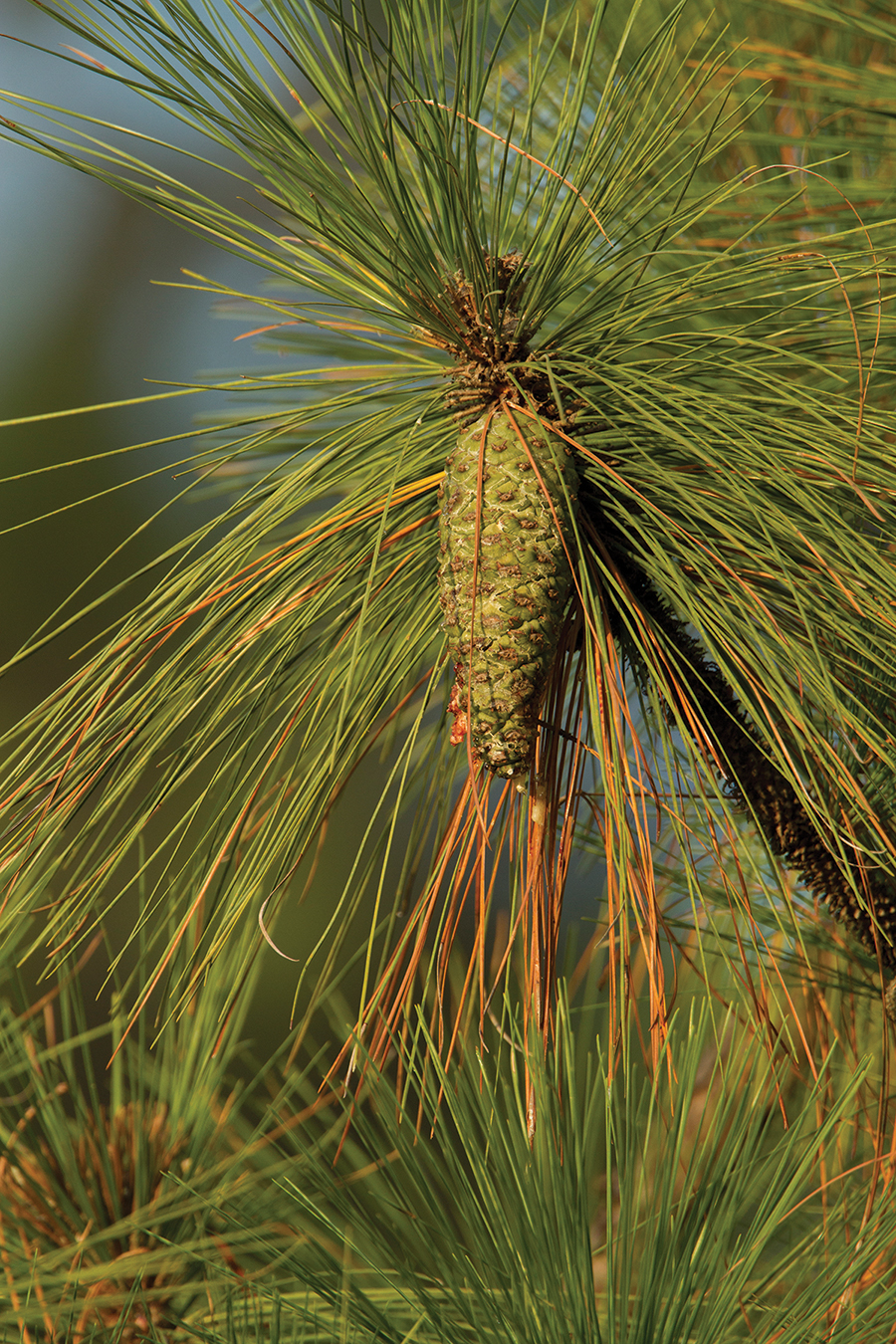
When conservationists talk about restoring Pinus palustris, they are referring to much more than saving a small stand of the Sandhills’ signature tree, say, in the median of Midland Road — not that they wouldn’t want to do that, too. Naturalist John Muir wrote of his 1868 journey through the Southern piney woods that he “sauntered in delightful freedom.”

Muir’s experience was possible because of the essential character of a longleaf ecosystem, in which mature trees 70 to 120 feet tall (height primarily depends on the quality of the soil) tend to be void of low-hanging branches. The open canopy allows sunlight to reach the sandy forest floor, which in its natural state, thanks to periodic fire, is alive with grasses, wildflowers and wildlife.

“I like to tell people it’s the opposite of the rainforest,” says Nancy Williamson, park ranger at Weymouth Woods Sandhills Nature Preserve. “In the rainforest, it’s so dark on the forest floor there isn’t a lot of diversity on the floor. It’s the different kinds of trees and the things that are going on in them. With longleaf, the diversity is in the open understory.” Abernathy adds, “If you have the right plants, you have the animals, a whole suite of species.”

With the red-cockaded woodpecker — an endangered species that uses the trunk of a living longleaf for a nesting habitat — at home high above, the unique understory can be a haven for a host of other birds and mammals (approximately 30 species of each, including quail and fox squirrels) characteristic to a longleaf ecosystem. Beyond the birds and mammals is a diverse population, particularly in the Sandhills, of reptiles and amphibians. Abernathy cites as one of his favorites the legless glass lizard, which evades predators by dropping off part of its tail. “All these really cool animals most people don’t know about live in the longleaf ecosystem,” Abernathy says.

The many plants include wire grass, morning glory, blackberry, pawpaw, low-bush blueberry, orange-fringed orchids, dwarf iris, golden aster and bird’s foot violet. Writing in 1791, Bartram described “a forest of the great long-leaved pine, the earth covered with grass, interspersed with an infinite variety of herbaceous plants . . . ”

Generations of Americans grew up hearing from Smokey Bear about the dangers of forest fires. But well before the popular mascot was created in 1944, longleaf environments — and the living creatures and vegetation within that depend on fire to survive — were victims of this philosophy as surely as they were of the ax and the turpentine box.

“A lot of the fear of burning came out of the Northeast, where there were primarily hardwoods, which have a thinner bark than pines do,” Abernathy says. “They came and saw Southerners burning their trees and said, ‘Are you crazy?’”

As Helen G. Huttenhauer details in the history of her hometown, Young Southern Pines, James Boyd’s longleaf-rich property suffered a terrible fire after being misguided by federal forest officials to clear thin strips on his land for fire defense rather than regularly singeing the forest with prescribed burns that locals knew to be the correct approach. “Woods are going to burn,” Wimberley says. “Either we burn them or they are going to burn on their own.”

In the spring of 1909 a spark from a passing locomotive started a small brush fire that moved up Vermont Avenue to Weymouth. “The wind rose and carried sparks and the sparks fell on wire grass and started new fires,” Huttenhauer writes. “The firefighters stood transfixed. Suddenly, a vast wave of flame surged high over the tree tops and, borne by the wind, in seconds outdistanced the ground fire . . . A goodly portion of Boyd timberland lay in smoking ruins.”

Another scary fire started in Pinebluff in the spring of 1963, destroying homes and 3,000 acres as it moved toward Pinehurst, its flames traveling through the forest canopy and spreading 10 miles in less than four hours, according to an Associated Press report.

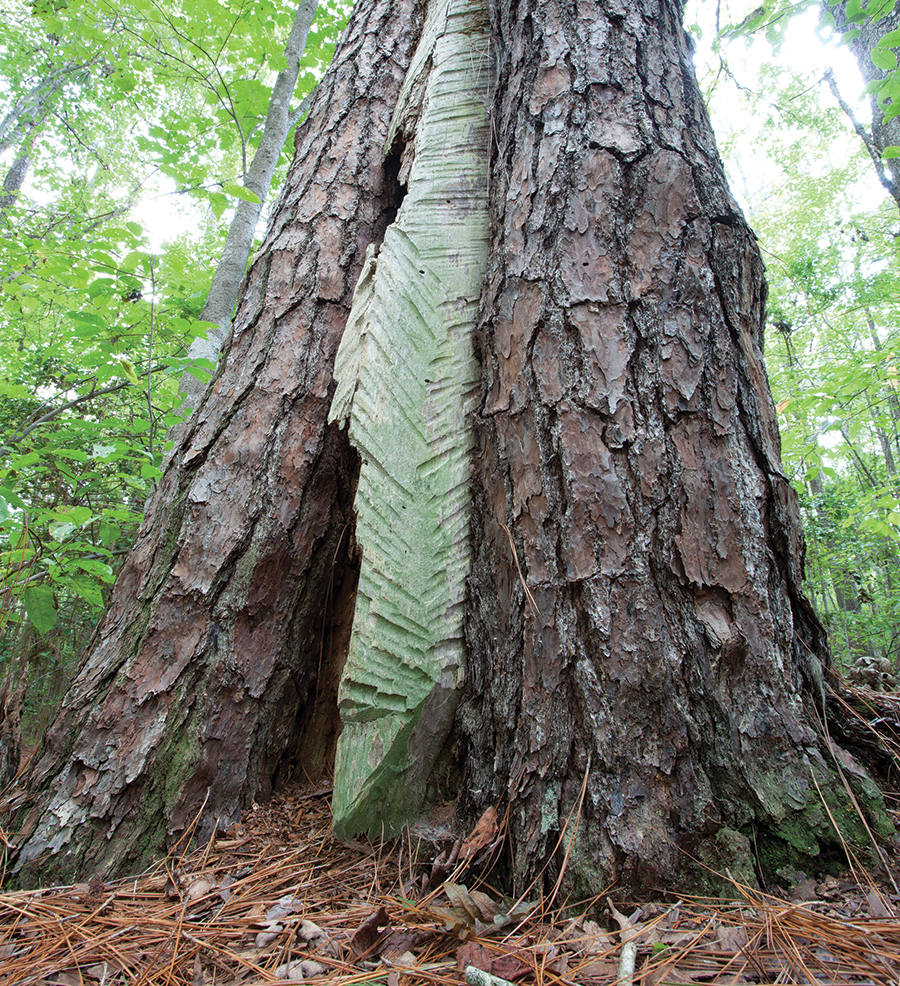
Longleaf withstands routine fires well, one of the reasons it came to dominate the Southeastern landscape, primarily because of its thick and tough bark described by author Bill Finch in Longleaf, Far as the Eye Can See “as layered as a Greek pastry.” Lawrence S. Earley, whose 2004 book Looking for Longleaf: The Fall and Rise of an American Forest provides a definitive look at the tree’s past and present, noted its formidable barrier.

“As a fire licks the bark of a tree, the temperature on the surface can rise to 1,600 degrees Fahrenheit,” Earley writes. “At a temperature of 140 degrees Fahrenheit, the cambium of a tree is killed. Thus bark can be considered the Maginot Line of a tree’s fire defenses.”

Combined with an unusually strong taproot, longleaf’s fire resistance contributes to its longevity. Although far from being the longest-living tree — a Great Basin bristlecone pine in the White Mountains of California is 5,066 years old, and giant sequoia have been verified at a few thousand years old — a longleaf’s lifespan can exceed more than 500 years. That’s about twice as long, for example, as live oak, pecan or American elm.

The oldest recorded living longleaf, situated off Den Road on the Boyd tract in Weymouth Woods, dates to 1548, its age determined a decade ago by a UNC Greensboro graduate student, Jason Ortegren, and his geography professor, Paul Knapp, who cored it for a historical climate study. That makes it 469 years old, having come to life 59 years before the founding of Jamestown, 228 years before the Declaration of Independence, 317 years before the end of the Civil War and 431 years before the state park acquired the 105-acre Boyd tract populated by old-growth longleaf James Boyd saved from the jaws of commerce when he bought his estate. The ancient pine is approximately 75 feet tall and 2 feet in diameter, its bark bulging in places like the arthritic knuckles of a senior citizen.

“The Boyd tract was never timbered and is mostly old-growth,” Williamson says. “A lot of the trees there are probably 400 years old. There could be older trees — we definitely have ones that are larger than the one that was measured. It may be even be a little bit older than 469 because when longleaf start out they’re in a grass stage for a couple of years. Whatever its exact age, every time we get a storm, we get nervous. Hurricane Matthew last fall made us hold our breath a little bit.”

Most of the longleaf that emerged in the 16th century were harvested long ago. The species was used for naval stores, goods for building and maintaining ships, from wood to various products made from the sap. Turpentine distillation accelerated prior to 1840, and later in the 19th century the advent of railroad lines and steam-powered sawmills led to the decimation of much of the virgin longleaf forest over a 50-year period following the Civil War. By 1955 only about one-eighth of the original longleaf forest was left. With longleaf being abandoned for faster-growing loblolly pine by many logging concerns — loblolly yields saw timber in 40 to 50 years versus 50 to 70 for longleaf — the longleaf acreage had decreased to about 4 million in 1985.

There was no secret why mature longleaf — dense, strong and pest-resistant because of its high resin content and slow growth — was so desirable. “It’s impervious to just about anything,” says Bennett Rose, a retired forester in Southern Pines. “A termite would break his beak trying to get through that stuff.”

Before techniques were invented to propel the modern steel industry in the second half of the 19th century, longleaf was the most valuable construction material. “Everybody in the wood business says the longleaf pine was the best wood the Lord ever made,” antique pine dealer Pat Fontenot told The New York Times in 2015. “If it wouldn’t have been for the longleaf pine tree, we wouldn’t have been able to do the Industrial Revolution.”

Much of the old-growth longleaf, centuries old, went north, for buildings and bridges (including underwater support for the base of the Brooklyn Bridge, built in 1883). Reclaimed longleaf has become a hot business in recent years as architects seek to use it for a vintage look. Bill Gingerich, owner of Timber Services, Inc., in Carthage, specializes in longleaf lumber and flooring. He buys old buildings and salvages the wood and also cuts down trees on private land that have to come out for construction.

Not long ago Gingerich bought big longleaf timbers that came from a building in rural North Carolina and was amazed when he studied the wood, suspecting it could 600 years old. “The growth rings on some of the beams are like pieces of paper,” he says. “It’s crazy old.”

But the longleaf that he cuts down doesn’t have to be quite that old. “We’ve learned that in order for longleaf to have good heart, which is what we make our flooring out of, it needs to be at least 80 years old,” Gingerich says. “We’re still finding those type trees and even older ones. We’ve seen some that were 150, 160 years old. Heart pine that old makes a beautiful floor. But an 80-year-old tree can be just as beautiful as an old-growth one.”

Longleaf advocates, who have an ambitious goal of increasing the longleaf environment to 8 million acres by 2025, spend their time educating and arm-twisting as they try to increase longleaf’s presence on private property. “We’ve done a good job restoring it on public lands,” Wimberley says. “Now the effort is on restoring it on private lands. Sixty percent of the potential longleaf restoration is on private land.” That potential could have economic as well as environmental effects.

“Rural eastern North Carolina has been devastated by the loss of tobacco and manufacturing,” Wimberley says. “It’s heartbreaking to see how hollowed out some of these towns are. We believe longleaf could be a game-changer that helps a landowner retain his land and see a profit from growing longleaf.”

It can be a tough sell, given the slower growth of longleaf compared to loblolly and the longer time frame before timber can be harvested. The distinctive, long needles and their landscaping popularity has turned pine straw into a financial winner, with property owners getting $100 to $200 an acre annually once trees start yielding straw at about a dozen years old. Yet that proposition is not without environmental trade-offs.

“Straw can be a lucrative thing in a place like the Sandhills,” says Ryan Bollinger, who works in Southern Pines for the Longleaf Alliance. “But if you rake really hard, you’re essentially doing commercial timber with longleaf pines, you’re basically creating an ecological desert under your longleaf when there is no understory. When you rake too hard for a number of years, then there is no food for the critters, and the rare plants and things get pushed out.”

Bollinger likes to preach “rake, rest, burn” to landowners, urging them not to rake every year. Or, if someone has a large property, a portion of it can be used for pine straw and the rest left undisturbed other than for prescribed burns.

“Landowners who are growing longleaf aren’t trying to make the most money possible on their property,” Abernathy says. “They want an income. But they want to ride their horses through that property. They want to hunt quail and deer. They want the look.”

They want a version of what a “magnificent grove of stately pines” brought to William Bartram more than two centuries ago, “a pleasing effect, rousing the faculties of the mind, awakening the imagination by its sublimity, and arresting every active inquisitive idea, by the variety of the scenery and the solemn symphony of the steady Western breezes, playing incessantly, rising and falling through the thick and wavy foliage.”  PS

Longleaf Pine Celebrations

The Party for the Pine, an annual celebration for the oldest longleaf pine, will take place on Earth Day, April 22, from 10 a.m. to 3 p.m. Festivities begin in the meadow behind the Weymouth Center, 555 E. Connecticut Avenue, Southern Pines. It’s sponsored by Weymouth Woods-Sandhills Nature Preserve, Sandhills Area Land Trust, the Arts Council of Moore County, the Sunrise Theater and is funded in part by the Renewable Resources Extension Act. Haw River-based singer-songwriter and guitarist Bill West will kick off the music, followed by Cousin Amy Deluxe Old Time String Band taking the stage at 11 a.m. Band members Amy McDonald, David McDonald, Steven Hedgpeth, Rob Shanana and Allen Ashdown transport the audience back in time with their Appalachian fiddle dance music. Abigail Dowd will be joined by Michael Gaffney and Jason Duff at 1:30 p.m. Gaffney, who grew up in the Sandhills, was a fixture in the Asheville music scene for over 35 years. There will also be a guided hike to the oldest tree, a falconry presentation by Hawk Manor Falconry, a birthday celebration and a live prescribed burn.

The movie Siren of the Round Timber Tract, by Brady Beck and Ray Owen, will debut at 5:30 p.m. at the Sunrise Theater, 250 NW Broad Street, Southern Pines. Admission is free and doors open at 5 p.m. The film is a dramatic work telling the story of the Round Timber tract, the most ancient part of Weymouth Woods Preserve. The saving of this section of forest effectively launched longleaf pine conservation throughout the Southeast. The film will be preceded by guest speaker Janisse Ray, writer, activist and naturalist who has authored six books, including her memoir, Ecology of a Cracker Childhood. She was a 2015 inductee into the Georgia Writers Hall of Fame. 

A Star Party, the fifth annual event and part of the N.C. Science Festival, takes place the evening of April 22. Bring blankets and lawn chairs and meet at the parking lot of the Weymouth Center at 555 E. Connecticut Ave. Activities, prepared by the statewide organizer, typically include stargazing, locating common constellations, a small telescope for viewing planets or the moon and kid-friendly crafts.  PS

A Natural Petition

When cats go to Heaven

they rearrange the order.

First, who made God, God?

Who decided angels didn’t

need fur, tails and whiskers?

Consider tail as a talking point.

Consider tail as a tour guide.

Consider tail conversational mapping.

But whiskers — ah, they let you

nuzzle a nuzzle. Soft, sexy.

Whiskers are out there

antennae catching vibes.

Whiskers are words

translated into touch.

Fur. . . the grandest of all.

One is always dressed for any

occasion.  Every occasion.

Tuxedo, calico, Bengal, leopard,

Persian. Fur is what the world

would wear if it could.

— Ruth Moose