
BIRD MAN

Bird Man
On a mission to help save a species
By Jenna Biter
Photographs by John Gessner & Todd Pusser
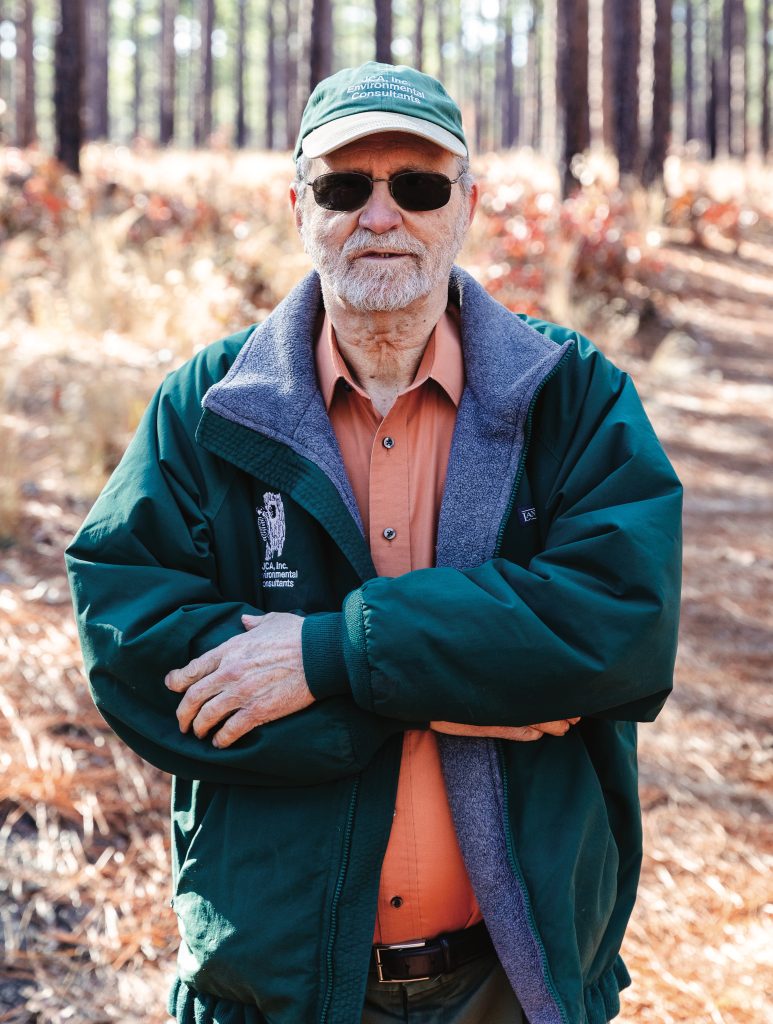
“I’ve always been interested in birds,” Dr. Joseph H. Carter III says, as matter-of-fact as his graying hair and beard.
The ecologist looks out from a pair of rimless glasses. He’s reclined in a dark leather chair with a knee propped up on a dark wooden desk opposite a fireplace framed by white tiles painted with mallards and other birds. A stuffed-animal opossum stares down from a shelf. Volumes including Saving Species on Private Lands and Manual of the Vascular Flora of the Carolinas line the wall behind him. “I started my life list of birds when I was 13.”
A birder’s “life list” is precisely what you’d think. It’s a running total of all the species they’ve spotted and identified. Carter has tallied 300 and some. “It’s really not that many,” he says. Most of the birds on his list are local to North Carolina, the place where his interest took flight.
Amassing an eyepopping number — say, a thousand or more — hasn’t been Carter’s life mission. That was reserved for one species in particular, the red-cockaded woodpecker.
After earning a degree in biology from the University of North Carolina at Wilmington and graduate degrees from North Carolina State, Carter launched his environmental consulting firm, Dr. J.H. Carter III & Associates, in 1976, when he was 26 years old. His first contract was with the North Carolina Department of Transportation consulting on the four-laning of U.S. 421 north of Wilmington.
It was in the Sandhills, where he grew up, that Carter’s devotion to the once-endangered (now-threatened) red-cockaded woodpecker transformed into one of the largest, longest-running research studies of any one species. The Sandhills Ecological Institute, a nonprofit organization Carter founded in 1998, helps run the study and is located next to his consulting firm on Midland Road.
Carter spent his boyhood in Southern Pines distracted by the flash of feathers. “I’d be watching out the windows at school,” he says. “Every day I wrote down every bird I saw, even if it was a starling or whatever.”
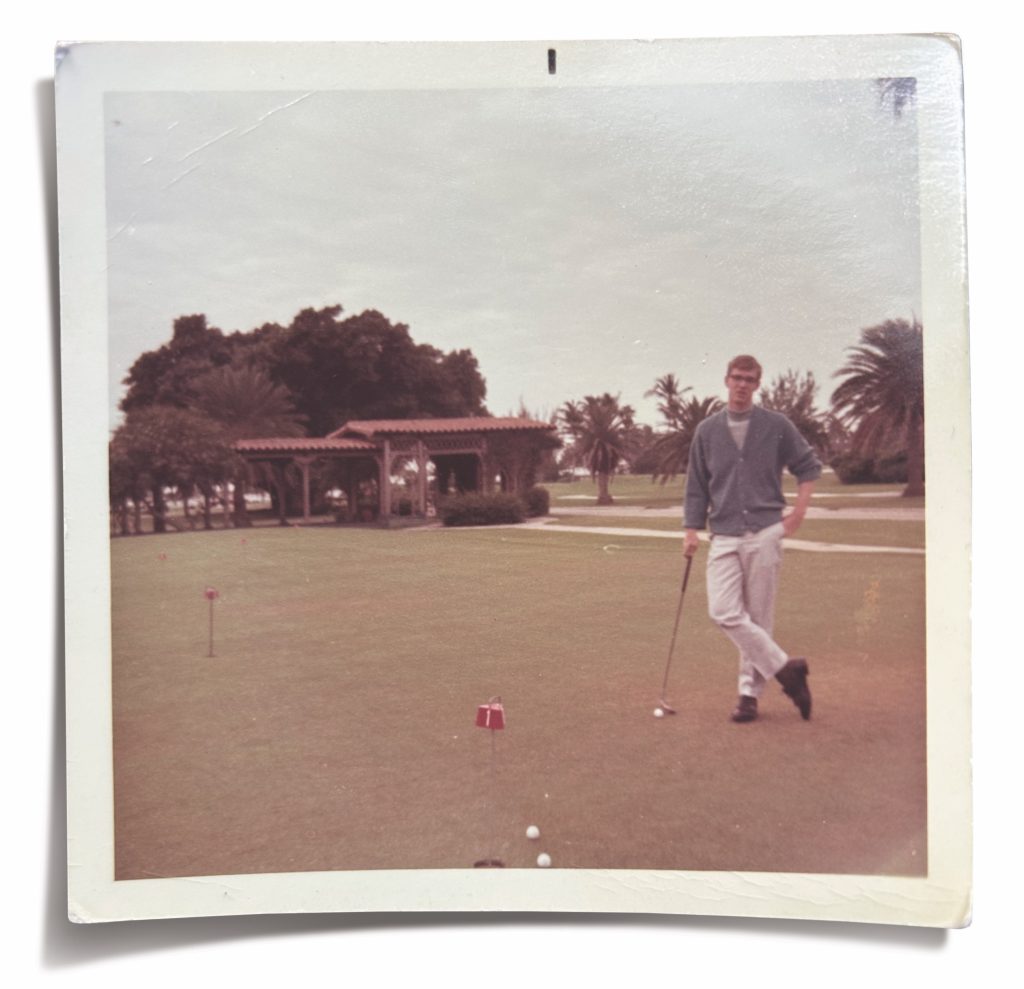
After school let out, Carter continued his birdwatching exploits at home. He’d walk into the family house on the “Little Nine” — the Southern Pines Golf Club’s now fallow nine holes — and right back out with binoculars dangling from his neck, disappearing into the woods bubbling with creeks and swamps in the swaths of nature the golf course didn’t occupy.
“My first pair of binoculars were my dad’s. He was in the Navy in World War II and brought his nautical binoculars back. They were about this . . . ” Carter says, measuring a great distance between his hands, “and weighed about seven or eight pounds. I probably did permanent damage to my neck wearing those things.”
Carter began banding birds when he was out of school with mononucleosis. “I got a banding permit from the federal government and just dove in,” says Carter. In the ’60s, it wasn’t difficult to acquire a permit for yard banding. Today, a citizen scientist needs to be involved with a research project to tag birds.
Carter set up a system of feeders and super-fine “mist nets.” Attracted by the food, the birds would fly into the nets, safely and temporarily captive. Carter took measurements, weighed the birds, distinguished the sex if he could, banded them and turned them loose. “I banded everything that came to the feeders,” he says. “Every day it was sunup to sundown — band, band, band, band.”
That winter Carter tagged more than 300 evening grosbeaks, 400 pine siskins and 900 purple finches traveling from Canada in a winter finch invasion. After he recovered from his illness, his hobby remained. He zigzagged across the Sandhills banding with his birder-mentor, a woman named Mary Wintyen. After getting his driver’s license, his territory expanded: Drowning Creek, Little River, the local lakes.
“I was going to the lakes looking at the waterfowl,” Carter says. “Other kids were doing teenage stuff. I was out there crawling around in the woods, trying to find neat things. I kept up with snakes and salamanders and all that stuff.”
But neither snakes nor salamanders — not even waterfowl, northern finches or other birds — would weave through Carter’s life like the red-cockaded woodpecker, a species he saw for the first time in September 1963 near the 12th green of the golf club.
Red-cockadeds are smallish woodpeckers, slightly longer than a new No. 2 pencil from eraser to the blunt end. The birds are almost entirely black and white, but the males wear a cockade, a tuft of red feathers on each side of its head, that gives them their name. Native to forests across the southeastern United States, their homes of choice are old longleaf pines, where they’ll peck themselves cozy cavities in which to roost and nest.
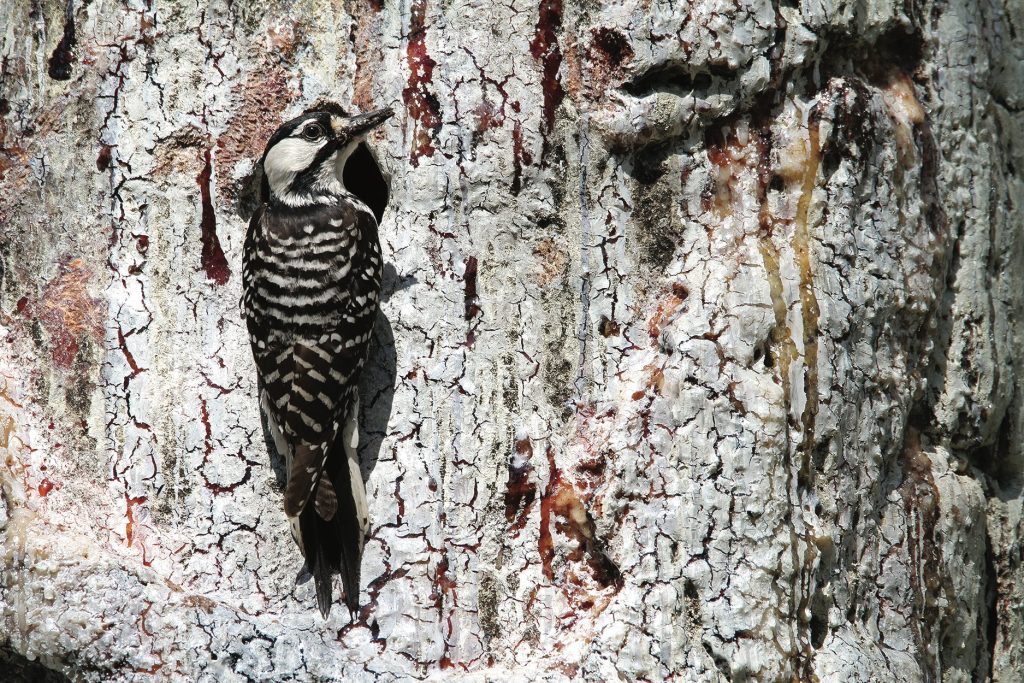
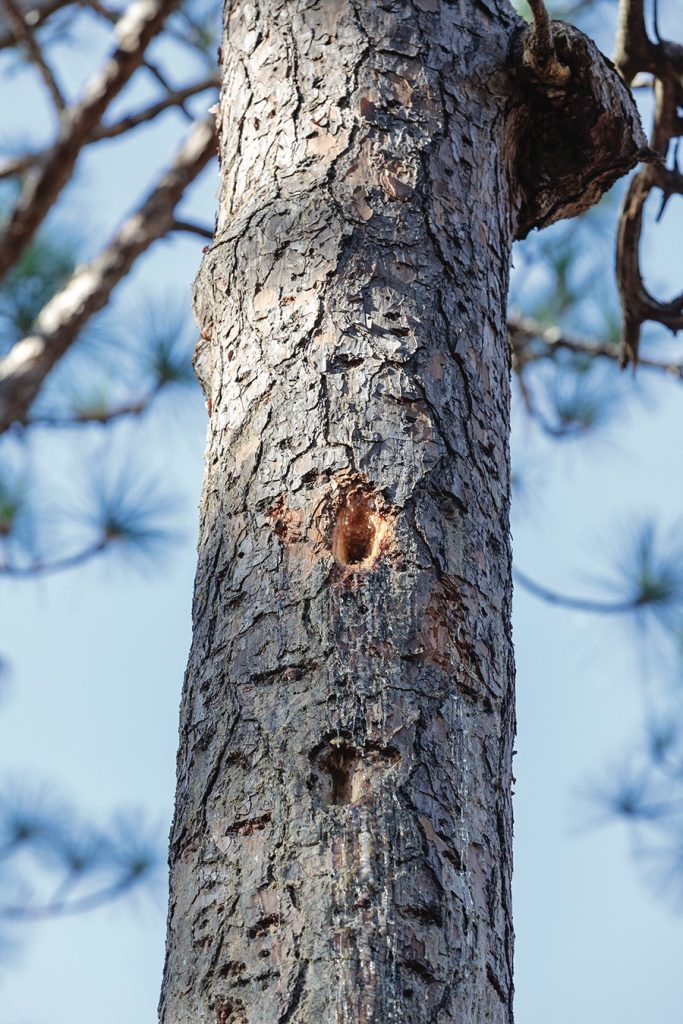
“After they make a cavity, they dress up the tree, and the tree gets a reddish appearance. Then they peck what we call resin wells in the tree,” Carter explains. “Because the tree’s alive, it bleeds resin, and it eventually turns the tree white. We call them candlesticks in the forest.”
If the sap has dulled to a dirty, yellowish gray, the red-cockaded woodpeckers have vacated long ago. Carter remembers seeing abandoned cavities while crisscrossing Moore County with Wintyen. “You’d see them on the golf courses. You’d see them on the side of the road,” he says. Birds were still active but their numbers seemed to be declining, and Carter was curious.
“I’ve been interested in the red-cockaded woodpecker since I was 15. That was when the first paper I co-authored was published in our Carolina Bird Club journal, the Chat,” says Carter. He and Wintyen wrote the paper for the bulletin in 1965. They described the cavities they’d seen. Where they were. What they were like. Only one nest, possibly two, was active, and Carter didn’t know the cause of the species’ decline. At the time, it wasn’t clear.
“One thing just built on another and the woodpecker got listed as an endangered species,” he says.
Congress protected the bird under the Endangered Species Act of 1973. It was around then that Carter graduated from UNCW and applied to NC State for his master’s degree. Initially rejected, he decided to plead his case in person and pitch his plan for a sweeping study of a the red-cockaded woodpecker. “Survey everything, tag all the trees, catch all the birds, band all the birds, and then just track what was going on to answer some of these questions: Why are the birds decreasing? How many are there? All the basic demographic questions you need to answer,” Carter says, outlining the elephant-size task.
The secretary for the head of the Zoology Department was out, but Carter could see that the head of the department himself — Dr. David E. Davis — was in his office, seated just around the corner. “He spoke, like, six languages. He could lecture in Russian. He’s way, way up there,” Carter says. “I asked if I could talk to him and he said yes. I sat down. I didn’t know I was supposed to be scared of this guy. He listened, thanked me and sent me on my way.”
Later Carter got a phone call from an ornithologist he knew at NC State. So long as he could finish his master’s in a year, he was in. He began surveying Southern Pines, Pinehurst, McCain, the northern part of the Sandhills Game Lands and the western part of Fort Bragg. “It was getting a population estimate as well as being able to characterize the habitats they were in. You know, how old were the pines? How dense were the pines? How much of a midstory, scrub oaks and whatever?” Carter says. “So I did all that and then I graduated with my master’s degree.”
Banding the birds would have to wait until a sprawling study was funded. “We started banding in ’79,” Carter says. The grant secured money for red-cockaded woodpecker research across 400 square miles of the Sandhills. Originally the study lived at NC State. Eventually it moved to the Sandhills Ecological Institute, which was founded and runs — with the help of Carter — to study and preserve the longleaf pine ecosystem.
Through decades of bands-on-birds, boots-in-field research, scientists could finally answer the whys behind the red-cockadeds decline, a mystery that long ago grabbed the attention of a self-admitted obsessive teen. Loss of habitat was one factor: Across the centuries, tens of millions of acres of longleaf pine had been logged. Moreover, the policy of total fire suppression, adopted in the 20th century, was harming the biodiversity of the still-standing longleaf forests.
In retrospect, Carter knew something was off since the time he was just a curious kid exploring the woods with his dad’s old binoculars. There were no birds to see where turkey oaks and vines and shrubs crowded a pine forest’s midstory. But the aha moment didn’t come until years later when Carter surveyed Fort Bragg’s blast sites, where fire was the way of things. “All of a sudden, you can see to the horizon. There is no midstory,” Carter says, a touch of awe warming his gravelly voice.
There were woodpeckers all over the place. There were songbirds all over the place. To Carter, it was like discovering Atlantis. “You can’t have a longleaf pine forest without frequent, low-intensity fire, and its cycle and its nutrients.”
By the end of the ’80s, the red-cockaded woodpecker population had leveled, and there was potential for an uptick. Sometime around then, Dr. Jeffrey Walters, who had been involved with cockaded research since early days, secured funding to determine whether drilling artificial cavities into trees could boost the woodpecker’s numbers. As it turned out, it could, and Carter’s firm still drills artificial cavities today. You can even spot one of his company’s nests on Pinehurst’s No. 2 golf course.
Thanks to conservation efforts, the red-cockaded woodpecker was downgraded from federally endangered to threatened in October 2024. There are now an estimated 7,800 active clusters across 11 states in the Southeast — up from an all-time low of roughly 1,500 in the early ’70s when the Endangered Species Act became law.
As a threatened species, red-cockaded woodpeckers are still protected by the act. According to Carter, they are a “conservation-reliant species,” and their numbers will drop if management ceases.
Carter pushes back from his office desk. His cast of characters watch attentively from their fireplace tiles and shelf as he prepares to leave. “It’s a labor of — I hate to say labor of love, that sounds tacky as hell,” Carter says, “but it takes people who are willing to basically dedicate their lives to projects like this. Whether they’re studying elephants or bacteria or whatever, it takes folks like that. We’ve all benefited from each other and the sacrifices that we were willing to make to keep these things going.”