
Birdwatch

Birdwatch

Nesting Season

There’s no place like home

By Susan Campbell

It is almost that time again for our feathered friends: nesting season. Pairs of birds will team up to bring forth the next generation. In some cases, they will even repeat the process once or twice before the days shorten and temperatures begin to drop.

As with so many behaviors, reproduction is triggered by hormonal changes, which are the result of changes in day length. Females will become responsive to the advances of males as daylight increases. And before long, the hunt for a spot to nest will begin. Interestingly, the strategies vary among the bird species we find in central North Carolina.

The investment in nest building for some species is minimal. Killdeer, for instance, only create a slight scrape in a sandy or pebbly surface. They are ground nesting birds whose splotched eggs blend in perfectly with the substrate. Furthermore, killdeer young are precocial, meaning that they are mobile as soon as they hatch and will instantly begin following their parents. There is no nestling phase, so protection of the young birds is unnecessary.

In the Sandhills it is not unusual for mourning doves to nest at ground level in a layer of grasses or small twigs. Even when doves nest in small trees or shrubs, their nest platform is minimal. It is amazing that the eggs or young do not fall through the nest. Then again, this species is known to raise young in virtually any month of the year, so losing an egg or youngster through the cracks is not problematic in the long run.

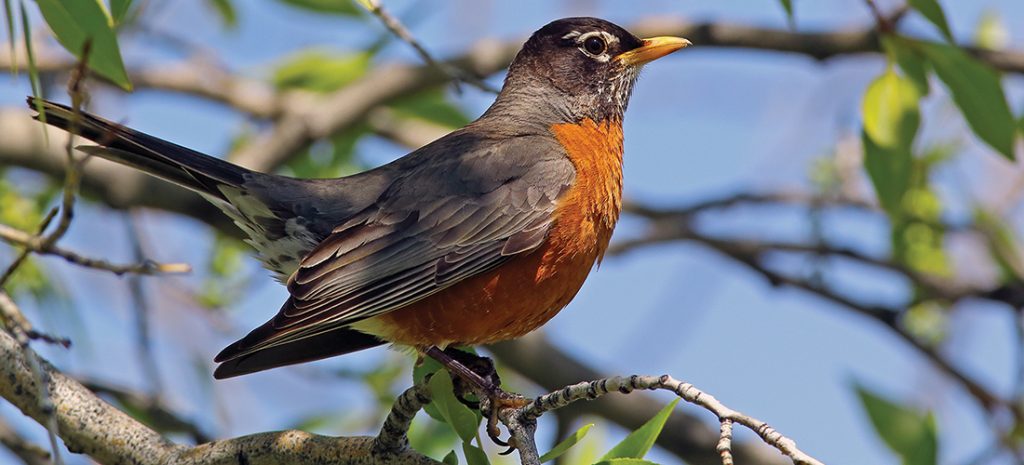
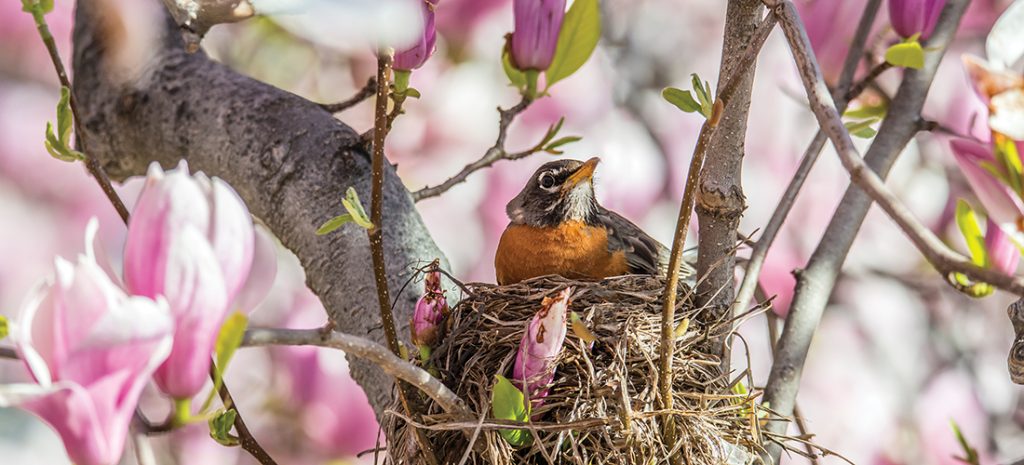
Cup nests are a very common strategy for nesting — especially among songbirds. Northern cardinals, blue jays, American robins all form a typical nest from small branches, twigs and grasses. Such nests can be visible through the leaves and are not infrequently depredated. As a result, some species, such as blue-gray gnatcatchers and ruby-throated hummingbirds, have evolved to use camouflage in the form of mosses or lichens on the outside of the cup so that the nest is not obvious to predators on a bare limb.

Hawks and eagles have taken nestbuilding to the next level and may create an enormous, cupped platform for their young. These huge stick nests, placed high in a live tree or snag, typically are enlarged with more material every year. They can be very noticeable given their bulk. However, given the size and ferocity of these birds, the strategy is not problematic. Furthermore, one of the adults typically guards the nest until the young are close to fledging.

And then there are the species that use holes: the cavity nesters. Woodpeckers and nuthatches can carve out a cavity in dead wood using their powerful bills with little trouble. Species such as chickadees, titmice, bluebirds or wood ducks will move right into these spaces when the architects move on. It is these birds that many of us have been giving a helping hand by erecting bird boxes. Box design varies by species, of course, given the different reproductive requirements of different birds. The height, the depth of the box and, most importantly, the size of the entrance hole will determine who will move in.

So, if you have not yet done so, this is the time to be cleaning out and repairing nest boxes for the breeding season. Old nests should be removed, and the boxes should be aired out for a day or two.  It would not hurt to give them a rinse with the hose as well — but do NOT use cleaning products. And then stand back: It will not be long before your first feathered tenants will be moving in!  PS

Susan Campbell would love to receive your wildlife sightings and photographs at susan@ncaves.com.

Birdwatch

Poem February 2023

The Eagles Have Landed

America’s bird is on the rebound

By Susan Campbell

Anyone who has had the good fortune to spot a bald eagle, whether soaring overhead or perched along a waterway, cannot help but be awed by their handsome appearance. This large raptor is not only our national symbol but the only eagle found solely in North America.

Benjamin Franklin supposedly lobbied for the wild turkey, the only endemic bird species to the United States, to be our national bird. But Congress decided on the bald eagle in 1782, as a result of its perceived fierce demeanor. In actuality, bald eagles are mainly carrion eaters but will attack wounded mammals, birds and aquatic animals as well. They are very opportunistic and will also snatch prey from crows if they get the chance.

During the first half of the 20th century, eagles were erroneously persecuted by raptor hunters, often by ranchers who were attempting to protect their investments. They were also affected by metal toxicity as a result of feeding on game containing lead shot. Additionally, during the period of broad-scale DDT application, as most people know, the toxin accumulated in carnivores at the top of the food chain. And, as was the case in several bird species, it caused eggshell thinning such that eagle eggs broke long before they could hatch.

Bald eagles were declared an endangered species in 1967. Following the ban on DDT and the passage of the Endangered Species Act in 1973, their numbers began to rebound. On June 28, 2007, the species was declared recovered. Here in North Carolina they are being closely monitored by state biologists. Although the number of nests and young has been increasing, they are still considered threatened here.

In the Sandhills, there are year-round sightings of individuals, most commonly on larger lakes such as Lake Surf (Woodlake) or Lake Pinehurst. At least one pair has been nesting in Moore County for a few years now: in (wait for it) Eagle Springs. Farther north, they can be frequently spotted around Falls or Jordan Lake in the Triangle or Lake Townsend in Greensboro.

In mid-winter, birdwatchers and endangered species biologists are on the lookout for eagle nests. Bald eagle pairs return to their breeding territories and lay eggs ahead of most other raptors (the exception being great horned owls, which begin breeding activities a bit earlier). Their sizable platforms of dead branches and large sticks may or may not be easy to spot. Eagle nests, if they are reused from year to year, will be gradually enlarged but not massive affairs. Newer nests can be well concealed in the top of a live evergreen or large snag.

Eagle young, who typically fledge in April, take three to four years to mature. They will not successfully attract a mate until they have a fully white head and tail. Should you see an adult in the weeks ahead, keep an eye out for a second bird. A pair of adults may mean there is a nest somewhere nearby. If you suspect that you have found a nest, definitely give me a holler!  PS

Susan Campbell would love to receive your wildlife sightings and photographs at susan@ncaves.com.

Birdwatch

PinePitch January 2023

A Winter Wonder

Evening grosbeaks visit the Sandhills

By Susan Campbell

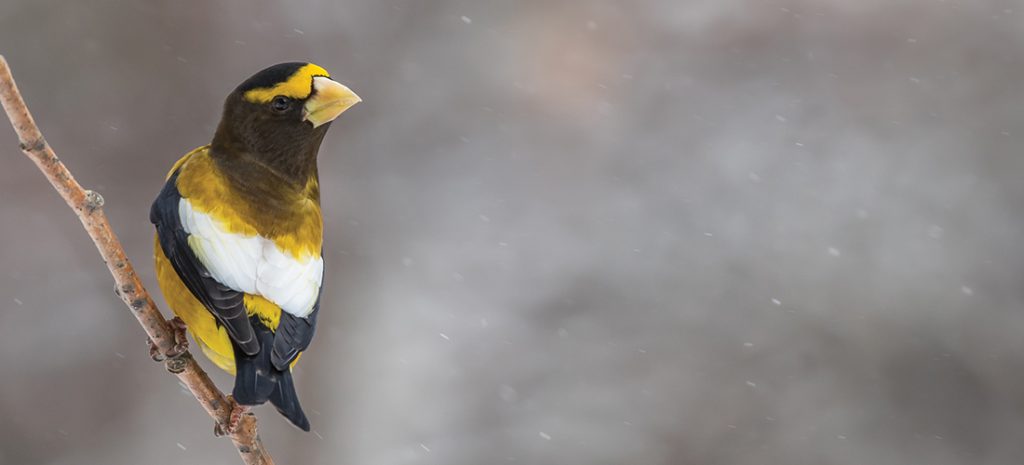
Evening grosbeaks are a most unexpected surprise in North Carolina during the winter months. Last month I made a similar claim about purple finches, explaining that food shortages further north would bring these raspberry-colored songbirds our way in numbers over the coming months. In fact, much to my delight, that has already happened at our feeders in Apex. But evening grosbeaks, which could be found reliably here in our state every few years, are nowhere as numerous as they were just a couple of decades ago. Therefore, they are far less likely to appear even when seed resources plummet across southern Canada and the northern United States.

Evening grosbeaks are robin-sized birds with a distinctive heavy white bill and varying amounts of yellow feathering, depending on the bird’s age and sex. All individuals have white and black wings as well as a gray crown and nape. Adult males with their yellow eyebrows and bellies are hard to miss. Immatures as well as adult females are more muted, having limited yellow feathering above with gray underparts.

Being larger, grosbeaks’ songs and calls can carry a good distance. Furthermore, they are almost always found in flocks during the colder months. So they are likely to vocalize a good bit throughout the day. You may be startled by the cacophony of warbling songs or hear their buzzy chips as they keep track of one another.

These big birds have a broad diet. As with most songbirds, evening grosbeaks feed heavily on insects and insect larvae during the spring and summer. But beginning in early fall they seek out berries, not as much for the fruit but for the seeds contained within. With their large bill and strong tongue, they can easily manipulate these sizable morsels to get at the protein in the middle. During the colder weather they can be found foraging on seeds from maple, ash, tulip poplar and pine. It is likely that a combination of a better-than-average breeding season with a poor mast crop is causing their winter range expansion. Individuals and small groups have already been spotted in our state — all the way to the coast. I was startled to hear one calling a couple weeks ago from high in the forest along the creek at Weymouth Woods Sandhills Nature Preserve in Southern Pines. And I expect it is not the only encounter I will have this season.

Laying out the welcome mat for these handsome birds is not complicated. Of course, your odds of attracting evening grosbeaks are better if you have the native vegetation they favor. Commonly cultivated apples, cherries and Russian olives will also get their attention. Feeding stations with sunflower seeds will be a draw, of course — especially if the seeds are hulled. Additionally, they will consume peanuts and other larger nuts like pecans and even walnut pieces.

Given the size of a grosbeak, you can imagine that the amount of seed they consume on a winter’s day is not insignificant. But folks lucky enough to host them are usually willing to provide as much seed as the birds will eat. Paying the price for such special guests is worth the investment, especially if you are a Southern birdwatcher who likely will only have such an incredible opportunity once in a lifetime.  PS

Susan Campbell would love to receive your wildlife sightings and photographs at susan@ncaves.com.

Birdwatch

An Uncommon Visitor

The feisty purple finch is in the hood

By Susan Campbell

If you happen to be maintaining a bird feeding station over the next few months, you will want to be on the lookout for an uncommon winter visitor: the purple finch. These feisty little birds are common to our north but some years, when their numbers surge as a result of above average reproductive success, they head further to the south following the breeding season.

It seems that spruce budworms were abundant in boreal forests in June and July, and this resulted in a bumper crop of baby finches. Like most of our songbirds, nestling purple finches require lots of caterpillars to grow into strong fledglings. The family groups merged into wintering flocks sometime in the last couple of months and are working their way southward, as they always do. Given their numbers, purple finches will spread much farther throughout the eastern half of the United States than they normally would. They’ve already been spotted in forests and at feeders in North Carolina.

Purple finches are robust birds that are larger than the chickadees and titmice, which they often associate with during the cooler months. They appear most similar to our ever-present house finches. Male purple finches are not really “purple” as their name would imply. They are more of a raspberry color. In addition to their coloring, they have a distinct whitish eye stripe and heavier bills than their cousins. Females and immature males that lack color can be overlooked as just another little brown bird at your feeder. But note that they are more aggressive and have that distinctive eyebrow. As so many of our winter feeder visitors do, purple finches love black oil sunflower. But they also will come to nyjer, or “thistle seed.” They, like goldfinches, find this tiny but highly fatty seed irresistible.

Away from feeders, purple finches feed on the seeds from conifers to tulip poplar, maple seeds to ragweed, and even dandelions. They may mix in with local house finches at feeding stations or simply with wintering sparrows in brushy habitat. These birds crush seeds and fruits using their powerful bills and strong tongues. The nut inside is consumed completely; therefore, purple finches are considered to be predatory and not dispersal agents, as many birds are.

You may notice a flock as a result of the males chorusing at the tops of trees. Purple finch song is distinguished by a fast rising and falling series of up to two dozen notes. Interestingly, males may incorporate bits of songs sung by other species where they breed. It is not that rare to hear American goldfinch or rufous-sided towhee notes mixed in.

If purple finches learn to efficiently find food as well as avoid predators, they can live a relatively long time for a small bird. The oldest known individual was documented as living over eight and a half years. It was a banded bird — recaptured right here in North Carolina.  PS

Susan Campbell would love to receive your wildlife sightings and photographs at susan@ncaves.com.

Birdwatch

Early Signs of Winter

Sighting the white-throated sparrow

By Susan Campbell

Here in the central part of North Carolina, the winged harbinger of winter is the white-throated sparrow. Summering in the forests of the far North, this bold little bird breeds across Canada and at elevation in northern New England. A medium-sized sparrow, it is brown above and white below with bold markings on the head. Pale stripes on the crown and a white throat patch are set off by gray feathers on the face. White-throateds also sport a yellow spot at the base of their stout bill.

Interestingly, there are two color forms of this species: those with heads that are white-striped as well as those that are tan-striped. Both forms persist because, as much as white-striped individuals are more aggressive during the breeding season, each almost always pair with the other type. Nests are made by the female in a depression on the ground under a low-growing tree or shrub. However, should it be depredated, the second nest may be placed on low branches.

If you have not spotted one of these birds, you almost certainly have heard their distinctive loud “seet” call emanating from thick vegetation. Their song, which can be heard even during cold weather, is a recognizable, liquid “oh sweet Canada” or to some, more of an “old Sam Peabody.” Since they tend to flock together, you are likely to encounter small groups along forest edges, farm fields, parks and suburban areas that have thick shrubbery.

White-throateds are commonly found at feeding stations, often in association with dark-eyed juncos, another bird of high country. These squatty sparrows actually have a broad diet. Although they primarily feed on a range of seeds during the winter months, their preference shifts during the year. In spring, they are more likely to seek out buds and flowers of fresh vegetation.

White-throated sparrows do not walk or run but hop when on the ground. As they forage, they will forcefully scratch backward in leaf litter using both feet and pouncing on food items that they uncover. These birds will also flick aside dead leaves using their bills. In the winter months, pecking orders form within flocks with the more aggressive males dominating.

If you want to attract white-throated sparrows this winter, it is easy and inexpensive. Since they tend to stay low, scattering a seed mix in a cleared spot near shrubs or other thick vegetation is all it may take. White-throateds will hop up onto a stump or low platform feeder as well. Easier yet, simply leave a portion of your yard unmown until spring, and these predictable visitors may well turn up to take advantage of the resulting seeds that remain as the growing season winds down.  PS

Susan Campbell would love to receive your wildlife sightings and photographs at susan@ncaves.com.
Birdwatch

What a Hoot

Call of the barred owl

By Susan Campbell

Owls definitely fall into the “spooks” category for many people. But there is one species that tends to be more endearing than scary: the barred owl. Maybe you have heard the “Who cooks for you? Who cooks for you a-a-a-a-ll?”  echoing through bottomland forest. The song is most frequently heard in early spring when male barred owls are claiming territory and advertising for a mate. But they actually can be heard vocalizing any time of the year. These are large but well camouflaged birds. Only a little bit smaller than the great horned owl, barreds are often their close neighbors. Disputes over space and feeding areas are not uncommon. Vocal sparring early in the year can get quite heated; however, male barred owls can be heard now, calling or squawking not only at night but at dawn and dusk as well.

This owl gets its name from the distinct vertical brown streaks on its breast, belly and flanks. The bird’s spotted head and dorsal surface, in addition to the barring, make it very hard to spot during daylight hours when it is perched motionless close to the trunk of a large tree. Their liquid brown eyes make them very endearing to bird lovers far and wide.

Barred owls find a wide variety of prey in swamps and bottomland forests. They feed on not only mice, rats, rabbits, small and medium sized birds, but reptiles and amphibians as well. These owls will also wade into shallow streams and pools after crayfish and small fish. At dusk, barred owls take advantage of large flying insects such as moths and large beetles.

Barreds, in spite of their size, actually nest in cavities. They will use old woodpecker holes, rotted stump holes and even larger manmade nest boxes. Up to five young are raised by both parents for close to a full year. Adult barred owls are sedentary and probably mate for life. This likely explains why they tend to be so defensive of their territory. Not surprisingly, during the breeding season, the larger-bodied female barred owls are the most aggressive. Raccoons, opossums and hawks are common nest predators. But it is great horned owls that are the greatest predatory threat, so competition can be quite intense. 

These owls are not averse to roosting, or even nesting, close to human habitation. People who get close to a nest may be subjected to distraction displays. The female may call loudly, quiver her wings or even attack with her talons. So, should you ever discover a nest hole, it is best to give it a wide berth to avoid any unintended consequences. They are known to use the same cavity year after year if they are successful. A pair of barred owls was documented to use the same cavity in the middle of the campus of the University of North Carolina for six seasons.

Despite the fact that they are non-migratory, barreds have expanded their range. Over the last century, they have moved westward into the Pacific Northwest and into southwestern Canada. They are in the process of displacing other native owls of the region including their close cousin, the endangered spotted owl. Certainly the future of this endearing species seems quite secure in our area.  PS 

Susan Campbell would love to receive your wildlife sightings and photographs at susan@ncaves.com.

Birdwatch

Songster in the Shrubs

The Eastern towhee hides to survive

By Susan Campbell

“Drink your tea, drink your tea,” the loud, emphatic call comes from dense shrubbery right outside our front door. It is the voice of a common, but frequently overlooked, Eastern towhee. It is hard to imagine that such a persistent songster could keep so well hidden, but towhees’ larger size makes them a target for predators, and keeping hidden is the survival strategy they employ. Belonging to the sparrow family, they are short-billed birds found in brushy or grassy habitat. The bird’s name originates from its typical “tow-hee” call.

Many backyard birdwatchers in central North Carolina are rather confused when they finally catch their first glimpse of a towhee. Is it some kind of oriole? Perhaps it is a young rose-breasted grosbeak? Males are quite colorful with rufous or chestnut flanks set against a white belly with a black hood, back and wings as well as a long black and white tail. The bill, too, is jet black. Females sport brown feathers instead of black but still have rufous sides. Their legs are long and powerful: good for kicking around debris in search of insects and seeds. Towhee eyes, which are usually dark red, may be orangey in the Sandhills population. Farther east, individuals have irises that are a striking pale yellow.

Eastern towhees are found, as their name implies, throughout the eastern United States. Here in the Southeast, they are year-round residents, although we do have some wintering individuals that breed further north. Their diet is variable, consisting of a variety of invertebrates (insects, spiders, millipedes) during the breeding season. However, in colder months, towhees can also be found scratching for seeds dropped by other birds from feeders. Their heavy bill allows them to take advantage of a variety of seeds. The powerful jaw muscles associated with such a strong bill make it a formidable weapon. If attacked, a towhee can inflict quite a bite. Males will viciously attack each other during territorial disputes and may inflict mortal wounds from grabbing the head or body of an opponent. Conflict is not infrequent where food is abundant, so the potential for fights exists throughout the year in our area.

It is not uncommon for Eastern towhees to raise three broods in a summer. Each brood involves three to five young. Nests are simple affairs, in short shrubbery or even directly on the ground. As a result, nestlings often do not remain in the nest long after their eyes open and downy feathers cover their bodies. They will move around noisily begging from the adults. Young towhees instinctively run for cover if their parents sound the alarm.

A little known fact about this species is that it was first described by some of the earliest Europeans to arrive in the New World. The artist-cartographer John White noticed towhees during his visit to the English colony on Roanoke Island in 1685-86. It was this trip that documented the colony’s disappearance — the Lost Colony. White’s unpublished drawings of both males and females predated the famous work of Mark Catesby in Natural History of Carolina, Florida and the Bahama Islands in the 1700s, since republished with a modern perspective as Catesby’s The Birds of Colonial America.  PS

Susan Campbell would love to receive your wildlife sightings and photographs at susan@ncaves.com.

Birdwatch

Nighthawks

But not the Edward Hopper kind

By Susan Campbell

The common nighthawk is neither “common” nor a “hawk.” Found in the Sandhills and Piedmont of North Carolina, these large birds feed exclusively on insects and actually do so at night. They use their large mouths to catch prey. Beetles and other insects are instantaneously intercepted and ingested by way of the birds’ oversized mouths. Nighthawks are unique in that they literally fly into large insects. Because their weak feet are designed purely for perching, they do not grab at them as true hawks do.

These medium-sized birds are active mainly at dawn and dusk when beetles and other big insects are also most active. Due to their terrific night vision, nighthawks hunt effectively in darkness, though they may even feed during the day, especially when they have young to provide for. In early summer, cicadas, grasshoppers, larger wasps and true bugs are abundant and, given their aerodynamic prowess, nighthawks are very successful predators at any hour.

As one of many survival tactics, common nighthawks spend the day perched horizontally on a pine branch. Invisibility is the goal during daylight hours. Although their vision is not compromised, they have a better advantage when light intensity is low. The mottled black, gray and white feathering is very hard to see regardless of the time of day, but their characteristic low “peee-nt” call and erratic moth-like flight is distinctive.

Common nighthawks’ nests are well camouflaged. Females simply scrape a spot to create a nesting area. Their speckled eggs blend in well with the mineral soil and miscellaneous debris typical of native arid terrain. Females are known to perform a feeble “broken wing” display if they are disturbed. This act is the only defense they have to draw potential predators away from the eggs or young.

More likely, common nighthawks’ presence will be given away by males “booming” in the early morning over high quality open habitat. In the Sandhills those would include the Moore County Airport and the drop zones on Fort Bragg. The unique noise they produce comes from air passing over the wing feathers of breeding males — not vocalizations — as they move through the air.

Amazingly, nighthawks are one of a handful of bird species that will also nest on flat rooftops. As large fields become scarce, common nighthawks are more prone to using large artificial spaces. These birds can easily support a family on the associated abundant flying insects found in open foraging habitat such as agricultural fields or some athletic venues, so it’s not unusual to see or hear nighthawks at summer baseball games or early fall football games throughout the region. They are capitalizing on the abundant prey associated with the evening floodlights at stadiums and other outdoor sites.

The species is found in many open areas in the eastern United States in summer, and so it is no surprise that common nighthawks begin to move south in late summer in large flocks. They migrate long distances to winter destinations in Central America and northern South America. Large numbers can be seen feeding in the evening in August and early September, so there’s plenty of time left to spot a nighthawk before cooler weather sets in.  PS

Susan Campbell would love to receive your wildlife sightings and photographs at susan@ncaves.com.

Birdwatch

Rare Bird Alert

Keep an eye out for the roseate spoonbill

By Susan Campbell

With its bright pink body, the roseate spoonbill is certainly the most distinctive and garishly colored bird in North America. And what about that odd bill? Although their typical range does not include North Carolina, spoonbills do stray into the extreme southeastern part of our state in late summer into early fall. So, if you keep your eyes peeled at this time of year, you may be lucky enough to spot one.

Research indicates that breeding colonies are found in parts of Florida, Louisiana and Texas. Unfortunately, the birds there are not widespread, even where they are regular. Loss of foraging habitat has restricted roseate spoonbills to protected areas such as wildlife refuges. Water quality has also reduced prey, as sedimentation and chemical pollution have inundated bays and estuaries in the Southeast.

There are several species of spoonbills worldwide, but roseate is the only one found on this continent. Their name comes from the birds’ bright red-pink plumage and spoon-shaped bill tip. Their extremely sensitive mandibles snap shut around food items such as small fish, crustaceans and insects found in the shallow waters they probe. Roseate spoonbills swing their heads side to side as they slowly walk though brackish or saltwater. The types of foods they capture result in their bright feathers.

Those amazing pink feathers put the birds at risk of extinction during the 19th century when many spectacularly colored birds were hunted for their plumes. The wings of roseate spoonbills were, unbelievably, actually sold as fans as well as for hats and other adornments.

When these amazing birds are spotted in our state, they are almost always mixed in with other waterbirds such as herons and egrets. They are extremely gregarious year-round. The best place to scan along the coast beginning in mid-July is Twin Lakes, in the Sunset Beach area. However, individual roseate spoonbills have also been found at Ocean Isle and North Topsail, as well as in the mouth of the Cape Fear in recent years.

Last summer, there were many reports of roseate spoonbills, not only inland in North Carolina but well to our north, including immature birds with their size and unusual bill as well as their pale pink plumage. One roseate spoonbill was sighted in Pinehurst and up to four in Woodlake. If you catch sight of one of these distinctive birds anywhere in the Sandhills or Piedmont, please let me know. PS

Susan Campbell would love to receive your wildlife sightings and photos. Contact her at susan@ncaves.com.

Birdwatch

Stranger in Town

Mississippi kite finds new regions

By Susan Campbell

Seldom do we hear of good news when it comes to the status of our migrant bird populations. But there are species that are actually expanding their ranges as a result of human alteration of habitats. The Mississippi kite here in the Southeast is one. This is a handsome raptor of wooded terrain that feeds mainly on large insects. It was found breeding in the floodplain of the Roanoke River in the late 1980s. The next region where it was detected happened to be here in the Sandhills. And now it can be found in the Triad as well as other locations in the Piedmont and the Coastal Plain.

These are small, sleek raptors that are very maneuverable. Adults are a mix of gray and black with long, tapered wings, a relatively long, squared-off tail and a delicate, hooked bill. Immature birds are streaked brown with barred tails. They are birds built to catch rapidly moving, aerial prey. Grasshoppers, beetles, dragonflies and even bats are targets when hunting. They also feed low to the ground when small reptiles and mammals are abundant. In late summer, as they are preparing to head south, large flocks can be seen foraging over large open areas such as farm fields where flying insects are abundant.

Although they breed here, Mississippi kites winter in South America. As well-studied as the species has been in the United States, little is known about them after they leave. Although they collect in large groups in the south-central U.S. and travel to southern Brazil and northern Argentina, their ecology is a question mark. But we have good data on the Midwestern and Southeastern populations, both of which are expanding. Everything from increases in pasture lands, golf courses and parks adjacent to mature woodlands are providing opportunities for nesting.

An increase in nesting around human habitation means an increase in kite interactions with people. And this can actually be problematic. Mississippi kites are very aggressive when it comes to defending their nests and young. I have been on the receiving end of warning whistles given by territorial individuals a number of times. Furthermore, they will readily dive bomb perceived threats — and this includes humans. I was very startled one summer several years ago to not only observe a new family on the farm where I was living in Southern Pines, but to also be buzzed by one of the adults. I was shocked by how quickly I was attacked and how close the bird came to my head. A very effective defensive maneuver for sure!

Late in the summer, kites will amass at rich foraging sites before they migrate southward. These sites may be north or west of the breeding grounds. Dozens can be seen alternately soaring and wheeling around above farm fields where an abundance of large insects such as grasshoppers, locusts, and beetles are found. If you happen upon one of these locations, it is quite a sight to see. For whatever reason, few areas consistently attract kites from year to year. One spot that is reliable in the N.C. foothills (oddly enough, since they do not breed there) is Irma’s Produce fields in McDowell County —right along I-40. If you are passing in late July or early August, it is well worth a stop. Not only do the birds put on quite a show, but I hear that Irma’s fruits and veggies are a treat as well.

There is much interest in documenting nesting Mississippi kites here in North Carolina. Should you know of a nest site or see adults or immature kites in the next few months, please drop me an email. These are beautiful and fascinating birds and certainly worthy of special attention. PS

Susan Campbell would love to hear about your wildlife sightings and receive your photos. She can be contacted by email at susan@ncaves.com or by phone at (910-585-0574).