Golftown Journal

GOLFTOWN JOURNAL

Coore & Crenshaw Redux

Back in the sandmines again

By Lee Pace

Bill Coore was tromping through the woods about 3 miles south of the village of Pinehurst one morning in November 2011. The 900-odd acre site around him had quite the varied dossier:

It was mined for sand to blend into construction materials dating back to the early 1900s.

It later became a haven for hunters and dirt-bikers.

It was the canvas in the mid-1980s for golf architect Dan Maples to design a dramatic, do-or-die, high-testosterone course called The Pit.

One corner of the land now owned by Pinehurst Resort had been walked by Rees Jones and later Jack Nicklaus for ideas on golf courses they would build in the afterglow of the 1990s golf boom but before the 2001-03 “dotcom” bust and 9-11 aftershocks shuttered golf course activity for several years.

And it was where Coore and design partner Ben Crenshaw had been invited by Pinehurst owner Bob Dedman Jr. to chisel out a new course that would, at the time, be known as Pinehurst No. 9.

In 2011 Coore looked around at trees growing through moguls and mounds of sand left half a century before, at the various hues of sand, at the stark rolls of the land left not by Mother Nature but by heavy machinery, then nodded at his preliminary golf course routing sketched on a topo map.

“It gets me excited when I come out and look at this stuff,” he said then. “I’m not particularly thrilled with what we have on the plan, but I think it’s here. It makes you want to go stumbling through the woods.”

He nodded toward a mature pine popping through a hillside. “A dune like that with a tree growing through it? That just doesn’t happen. If you can figure out a way to utilize that, you’ve got a fascinating feature for a golf course. This is an interesting piece of ground. Overall, it’s a spectacular place.”

That golf course was never built, Dedman opting instead to buy the course originally known as Pinehurst National in 2014 and making it No. 9. Then, in the post-COVID golf boom in 2022, Dedman and resort President Tom Pashley began exploring options to add to their golf inventory and simultaneously put these 925 acres to work. Coore & Crenshaw were booked at the time, so Pinehurst retained Tom Doak to design No. 10 and told Coore & Crenshaw to reserve a spot on their schedule for a second course a couple of years down the road.

That time has come.

The Doak course occupies the western expanse of the site, with holes eight, 13 and 14 bordering N.C. 5 as it runs from the west side of Pinehurst Resort, south toward Aberdeen and an intersection with U.S. 1 and U.S. 15-501. The Coore & Crenshaw course will sit adjacent to No. 10 and extend eastward. The courses will share a common golf shop and restaurant, and the facility as an entity will be known as Pinehurst Sandmines.

“Some have suggested it was better we never built that first course. I would agree with that. I think the course we’re going to build now will be better than what we had before and will be a great companion course to what Tom did with No. 10,” Coore says. “This site is so interesting. I don’t think I have ever seen two more physically different sites that are contiguous, that touch each other, than the site for No. 10 and No. 11. They are massively different in terms of characteristics and landforms.”

The Doak course features wide, sweeping vistas and long, gradual slopes. Only the eighth hole embraces the ancient sandmines heritage with dramatic hillocks, mounds and a blind shot off the tee. The Coore & Crenshaw course will be more compact and have more of the flavor of the old Pit golf course, which was closed in 2010.

“This is choppy, ridgy ground,” Coore says. “It’s not as much elevation change, but it’s so quirky with the ridges and the piles and the trees and the angles. This is going to be so intimate in scale. You’re winding your way through trees and over old piles and across ridges. We’re far, far from the sea, but we have these contours and features and landforms that remind you of spots in Ireland or Scotland. And yet here it is, in Pinehurst.” 

Pinehurst staff and subcontractors are working to clear centerlines for the fairways, and are using mini excavators because standard logging trucks would have trouble negotiating the terrain and would destroy some trees that Coore wants to save. Coore & Crenshaw’s lead shaper, Ryan Farrow, will move to Pinehurst in early fall to begin construction work.

“We do not want to be in a hurry,” Coore says. “We have a routing, but the concept of the holes will evolve. We’ll go little by little and study where to knock down the ridges, where to keep them as is. There are ridges and giant piles dating back many decades we’ll look at individually. There are some you’ll say, ‘Oh my God, let’s play over that.’ I’m pretty darn excited about this one.”

Given that Coore grew up about an hour from Pinehurst near the town of Denton and has fond memories of playing summertime golf marathons on the No. 2 course, the Sandhills have always held a special place in his golf-design heart. He was stoked to come to Pinehurst and design Dormie Club, a course that opened in 2006 on a piece of rugged ground just northwest of town. He was excited to return in 2010-11 and direct a major restoration of No. 2 predicated on ripping out much of the grass and smooth edges that had encroached over the decades and returning the layout to the ragged, linksy feel that architect Donald Ross left upon his death in 1948.

Now this project at No. 11 is an entirely different kettle of fish — a made-from-scratch course that combined with the Doak layout will give Pinehurst a satellite operation featuring courses from two of the game’s most noted architectural firms of the 2020s.

“I’m prejudiced because we’re doing one of them, but this will be a really big plus for Pinehurst. So many amazing resort courses are being built on properties ideal for golf. They are photogenic and dramatic and are the proverbial you-build-it-and-they-will-come scenario happening all over in America and other parts of the world. People go to Bandon, sit around the firepit at night, and a conversation might find advocates for any one of the five being the best golf course,” says Coore.

“At Pinehurst, it’s always been about No. 2, and rightly so,” he adds. “The addition of No. 10 and 11 will really be positive for Pinehurst. No homes, pure golf, interesting landforms, dramatically different from everything else.”

NC Surround Sound

NC SURROUND SOUND

Feast of Festivals

A magical musical tour

By Tom Maxwell

There are music festivals across the length and breadth of North Carolina this year — more than you will have either the time or gas money to attend. July alone features four worthy of mention, existing on the widest possible spectrum of musical and geographic diversity. We’ve got fiddles in the highlands, jazz on the beach, classical quartets in the Nantahala National Forest and a regular smorgasbord of sounds in the Piedmont.

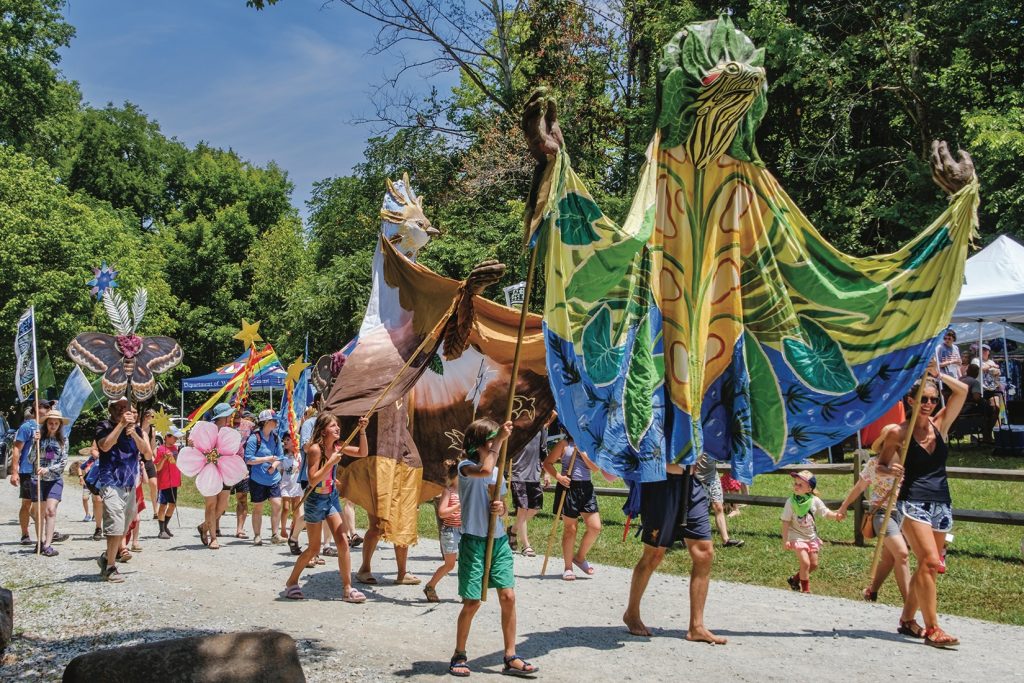
The 46th annual Festival for the Eno kicks off in Durham on Friday, July 4. The two-day event features over 60 artists performing on four different stages, including former Carolina Chocolate Drops’ Dom Flemons, local poet and musician Shirlette Ammons and the Empire Strikes Brass.

There will be some novel attractions as well. “Since the festival’s inception, our Grove stage has focused primarily on traditional music through the lens of Americana,” festival director Bryan Iler says. “This year, there is still going be all that bluegrass and country and clogging, but there’s also going be a wider representation of traditional cultural music that I think is a little more representative of the Triangle community. We’re going to feature a full mariachi band, a traditional West African Senegalese pop band and Congolese percussionists. Oh, and Rabbi Solomon [Hoffman] from Chapel Hill has put together a klezmer group.”

And there’s more than just music. Attendees can learn fly-fishing, poster-making or browse handmade arts and crafts from 80 different vendors. “It’s really a salad bar of ways to have a good time and plug into at a deeper level with our community,” says Iler.

July 4 is also opening day for the Ocean City Jazz Festival on Topsail Island. “It’s a three-day event with three artists per night,” says Carla Torrey, who has organized the festival with her husband, Craig, for the past 12 of its 15 years. “We are trying to promote the history of the community and support its legacy.”

The Ocean City Beach Community is a neighborhood 3 miles north of Surf City that stretches from beach to sound. It was founded in the late 1940s as an interracial corporation where African Americans could own beach property in the days of segregation. A 700-foot lighted pier constructed in 1958 — at the time the only pier in the South Atlantic open to people of color — and many of its 100 or so Black-owned homes were destroyed by Hurricane Fran in 1996. Though those structures were not rebuilt, the community remains, and the festival is committed to preserving and expanding on its legacy.

This year’s Ocean City Jazz Festival features artists like Jackiem Joyner, Jazz Funk Soul, Nathan Mitchell, The Double Bass Experience and the John Brown Little Big Band, featuring Camille Thurman. Related events include an exhibition of paintings by artist Rik Freeman called “Black Beaches During Segregation” (on display starting June 28), day parties featuring line dancing instructors, food vendors and a boozy “Uncle Nearest Experience” with executive bourbon steward David Neeley. (Uncle Nearest Premium Whiskey honors the memory of Nathan “Nearest” Green, the formerly enslaved man who taught Jack Daniel the art of distilling.)

“We’re truly a jazz festival,” Torrey says. “All the music is going to be jazz, and we do a mix of smooth and straight ahead so that everybody gets to appreciate it as a genre.” Music plus an ocean breeze and sand between your toes? Sounds like a plan.

The 44th annual Highlands-Cashiers Chamber Music Festival kicks off July 5 in the southwestern counties of Jackson and Macon, roughly 400 miles from Topsail Island. You don’t have to be in a rush to get there, though; this festival lasts until August 10, featuring four concerts every weekend.

“It is a six-week festival of predominantly classical music,” Executive Director Nancy Gould-Aaron says, “but we do bring in other things to mix it up a little bit. We have jazz versus classical this year. In the past we’ve brought in Mark and Maggie O’Connor, so we’ve had a little bit of bluegrass, too. We probably have three or four quartets a season. Not too many duos, but we have a lot of soloists and put them together. For our gala event, we’ll have enough musicians to make up an orchestra.”

This year’s Highlands-Cashiers Chamber Music Festival features the North Carolina debut of Paul Colletti’s Viola Quintet featuring The Viano Quartet, poet laureate Rita Dove, the Whitehead Family Young Pianist Concert with Zitong Wang, the Pacifica Quartet featuring Sharon Isbin on classical guitar; and, a final gala “Cellobration” — a concert with eight cellos led by the Grammy-winning cellist Zuill Bailey.

The two-day 54th annual Old Time Fiddlers Convention, held in Ashe County Park in the state’s northwest corner, begins July 25. It takes place rain or shine, so bring your camping gear and get ready to hear a slew of banjo, fiddle, guitar and mandolin by the likes of Sassafras and the New Ballards Branch Bogtrotters. As usual, there will be open jam sessions galore, as well as competitions for young and old musicians alike, featuring several thousand dollars in prizes. Proceeds from the festival go to support JAM, the Junior Appalachian Musicians program, an organization that instructs third- to fifth-graders in fiddle, banjo and guitar.

This quartet of festivals barely scratches the surface of North Carolina’s musical itch. What an opportunity to explore the state and expand your musical horizons.

Crossroads

CROSSROADS

The Accord

And the art of the deal

By Janet Wheaton

In 1976, at the age of 25, I left the U.S. with my French husband. People ask me where I met Jean-Claude, expecting to hear an exotic story set in a romantic Parisian café, and they are surprised to hear that we met in Kansas. I only mention him because he’s the reason I spent 14 years living in Canada, Germany and The Netherlands, where Jean-Claude and I divorced in 1989.

I was single, 39 and on my own for the first time when I landed in L.A. to pursue a new career and rent an apartment, both of which are impossible in Southern California without an automobile. So, my first order of business was to acquire one.

It was the end of a hot and sunny day, my second on the new job, when I stepped out of a taxi at the local Honda dealership and stared out at a sea of automobiles.

“Looks like you’re a lady in need of a new car.” It had taken less than 10 seconds for a salesman to beam his body from inside the showroom and materialize on a spot directly in front of me. I don’t remember his name, so I’ll call him Mike. Mike was a thin man of average height, with a tan face of pleasant features that were unfortunately overshadowed by a ghastly toupee.

“What did you have in mind? A Civic, Accord, CRX, wagon, hatchback?”

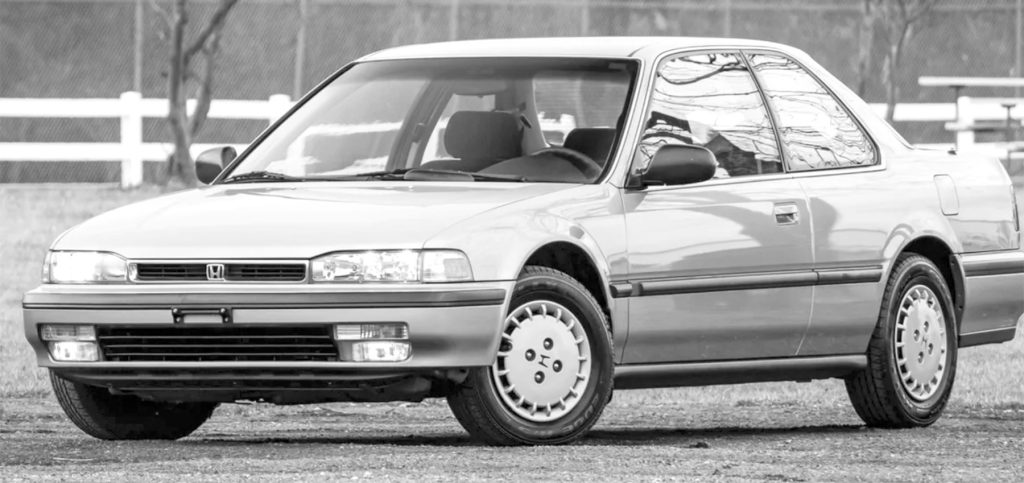
What I had in mind was a simple business transaction. The simpler the better. I looked past Mike and pointed to a sleek and shiny sedan parked in front of the showroom. It was taupe. Cars don’t get any simpler than taupe. “What’s that one?”

Mike looked over his shoulder. “That’s a 1990 Accord. Been a dealer’s car, just driven a couple of months by one of our execs.” We walked over to it and he opened the door. “Want to take it for a drive?”

“Sure.”

“You have a driver’s license?”

“Of course.”

It was Canadian. I also had a license from The Netherlands, which practically qualified me to fly an airplane. I had the sense that, for a sale, Mike wouldn’t have cared if the license came from Kuala Lumpur. He went inside for the key.

“All set.” Mike tossed the key to me, and I slid behind the steering wheel and studied the dashboard.

“The car’s insured, right?” I couldn’t help messing with him.

“Absolutely, every car on the lot is insured,” he said, though I noted a slight furrow of concern creasing his brow.

A moment later we were cruising down the street as Mike described the car’s features: power windows and mirrors, cruise control, AM/FM stereo cassette sound system. He droned on about the LX model upgrades: comfier this, snazzier that.

The car had almost 8,000 miles on it but Mike assured me it still came with a new automobile warranty. The exec must’ve been a very tidy guy — the interior was pristine and still had that new car smell. After driving it a few blocks, I took it out on the Freeway and eased down on the accelerator. Hold on to your hair, Mike, I thought.

“So, what were you doing up there in Canada?” he asked, his eyes fixed firmly on the highway.

“You know, working, living, stuff.”

“Did you like it?”

I gave him the answer I’d settled on over the years. “Some things a lot; some things not so much.”

When I pulled back into the dealership 10 minutes later, Mike asked me if I’d like to try out another model.

“No, this one’s fine. How much is it?”

Mike seemed pleasantly surprised. “Let’s go back inside and talk about that.” He ushered me into his office and shut the door. Mike flipped through some paper, punched some numbers into his computer and smiled at me like he’s ringing up my discount coupons. But I hadn’t come in that day quite as unprepared as it may have seemed. A friend of a friend was a Honda dealer who had been willing to violate the industry’s blood brother oath by giving me some ballpark figures.

When Mike announced what he thought “his manager might accept,” I countered with the one my friend of a friend had assured me he would accept. I padded it a bit because I was anxious to get back to my new apartment and have a glass of pinot grigio. Mike frowned. I smiled politely. He sighed a dubious sigh. “Let me see what I can do . . . ” he said and left the room.

I could see him consulting with his manager, a conversation that I felt certain was more likely to be about the Dodgers than about me. When Mike came back into his office and closed the door behind him, he gave his head a shake meant to convey his utter disbelief. “This must be your lucky day.” He grinned at me. “You’ve got yourself a deal.”

Then he asked me about financing.

“I’m paying cash,” I said. I’d come back into the country flush and with an aversion to credit.

“OK,” Mike said, rubbing his hands together. “We take cash. You can write me a check and drive that beauty home this evening.”

I shook my head. “Sorry, I need to call my insurance company first.”

Mike countered dismissively, “Actually, my dear, your current car insurance will cover the new one automatically.”

Oh, right, I’m just a lady.

“I don’t have any insurance . . . in this country,” I said. “I’ll get that set up first thing in —”

“You don’t have to drive it home this evening,” he cut me off. “You can give me a check, we’ll slap a sold sticker on it and it’ll be sitting here waiting for you.”

I shook my head again. “Once I give you a check and the car’s mine, I don’t believe your insurance would cover it if someone were to drive it and wreck it.”

Mike stood up and came around his desk, leaned against it, while I remained seated. He lowered his chin. That furrowed brow was back and deepening into annoyance. “But no one,” he said, “is going to drive it.”

He was obviously not familiar with hypervigilance, for which I am a poster child.

I stood up and smiled. “You never know.”

I sensed his mounting exasperation. “If you don’t take advantage of this opportunity today,” Mike straightened up, positioning himself between me and the door. “Someone else might.”

This brought to mind a boy in college who’d once issued that same warning. I wanted to tell Mike what I’d told that guy. But I was feeling more indulgent with Mike because he was, after all, just trying to earn a living.

“I want to buy this car but if it’s gone in the morning, I’ll buy another one. So, I guess I’m ready to go.” I glanced at the closed door behind him. “Unless you’re holding me captive?”

“Of course not!” He jumped aside. “I just know how much you want that car.”

“I do, and I believe it will be here tomorrow morning,” I said and asked if he might call me a cab.

It took me a little longer than I anticipated to get my insurance set up, but when I finally got back to the dealership, I was glad to see that “my” car was indeed still there. Mike’s face lit up when he saw me.

“Have you been guarding my car for me all this time?” I asked.

“Yes, ma’am,” he said and laughed. A good deal, I once heard, was one that was just as good for the other guy as it was for you. I don’t know about Mike but I got 20 years out of that Accord.