












Photographs by Tim Sayer
Produced by Brady Gallagher
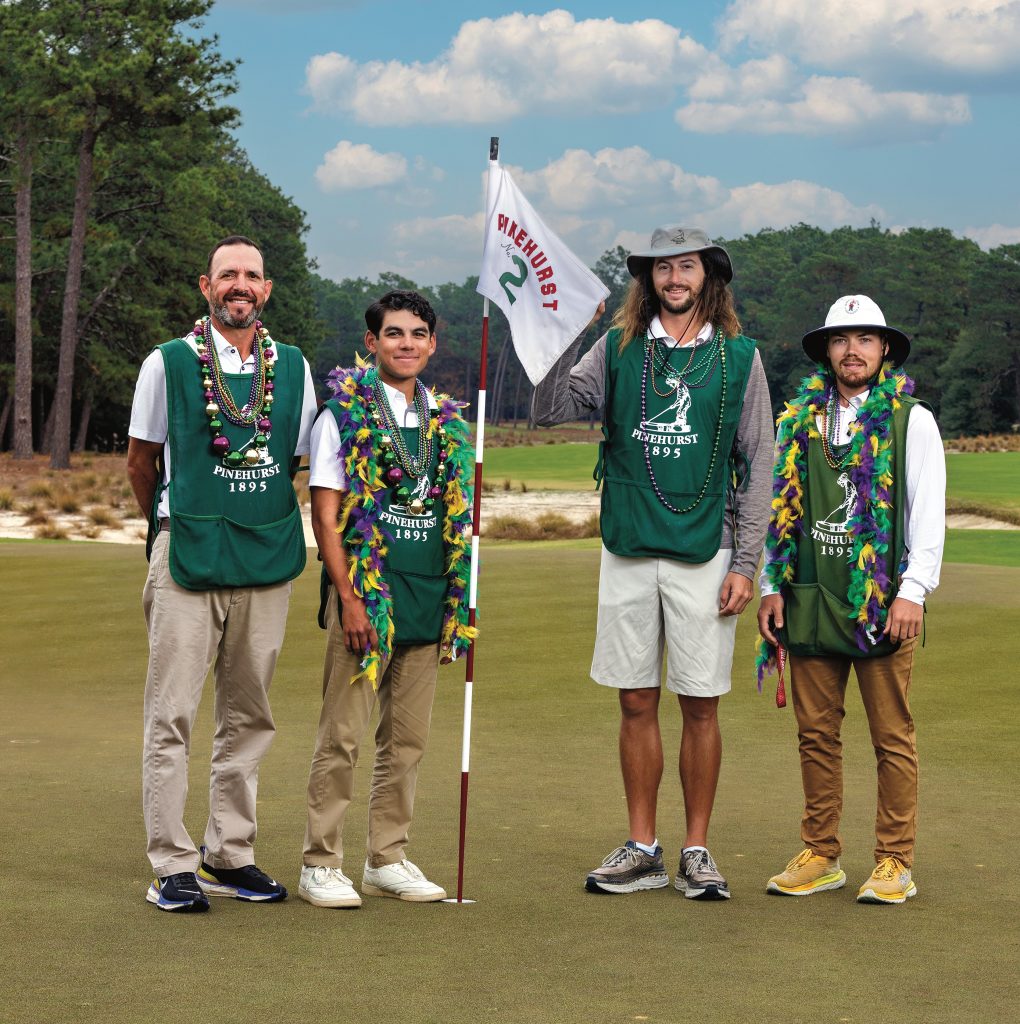
New Orleans has been celebrating Mardi Gras almost since the city was founded in 1718. By the late 1830s there were street processions of horse drawn carriages, gaslight torches and masked members of what would become a growing number of carnival societies, the forerunners of today’s krewes. Masked celebrants reveled in their anonymity, no longer bound by social strata. They were free to be whoever they wanted to be and to mingle with whoever they wanted to mingle. With each succeeding year, its krewes and parades, its magic and mystery, grew. The Mardi Gras colors — purple, gold and green — stood for justice, power and faith. If you’ve ever seen a jazz funeral in the French Quarter, you know that no place on Earth handles tragedy and loss the way they do in New Orleans. While the krewes of Moore County may not be parading through the French Quarter, they can be there in spirit.


By Deborah Salomon • Photographs by John Gessner
Who says you can’t tell a book by its cover? Or, for that matter, a house by its façade?
This one — with bright yellow clapboards, bumpy fieldstone walkway and fanciful front porch — almost shouts “Welcome!” from the end of a long wooded driveway opening onto a busy road. Carry-On Cottage, its name posted on a tree, was built in 1937, and sounds as upbeat and admired as one of its previous owners, Miss Hall, a legendary fourth-grade teacher.
Further provenance is unnecessary. Given the enthusiasm and skills of owners Linda and Larry Wolf, how could living there not be a sunny experience?
Linda and Larry were high school sweethearts in Connecticut, married during college, lived in Boston, then on Linden Road in Pinehurst. Larry, fit and perpetually tanned, directed tennis programs at Pinehurst Resort and elsewhere. Linda attended the New York School of Interior Design. Renovation spins their wheels. They bought Carry-On Cottage in 2005. “A home base for our three kids,” Linda explains, as well as a project worthy of their skills.
The three kids now arrive with five grandkids to an expanded homestead that fairly oozes personality expressed in bright colors, family memorabilia, Design Market “finds” like metal end tables painted bright red, and the occasional surprise: Linda points to two interior split (“Dutch”) doors, left behind by an owner with tall dogs who objected to being shut away. A framed sign from The Tennis General Store recalls a previous business venture. A tiny table set for chess reminds Larry of his parents, and a stormy seascape by son Tyler represents Linda’s bout with chemotherapy.

Renovations, as expected, went way beyond cosmetic. All systems needed replacing. The one bathroom begged an upgrade but in 1930s black and white, with beadboard panels. Two additions happened at separate times. The first resulted in a small TV den adjoining the kitchen, the other a master suite/sitting room/spa bathroom. New window frames were made to match the old. Hooked rugs over original knotty pine floors add character, as do glass doorknobs. The armoire was rescued from the Pinehurst Hotel, painted black and distressed, while the carved settee came from grandparents.
A four-poster bed, antique quilts and family photos complete the retro charm.
Linda didn’t shy away from splashy floral upholstery in the living room, the colors echoing her and Tyler’s paintings, several depicting their favorite hydrangeas, others Cape Cod scenes mounted on deep-turquoise walls, a color furloughed from the modern décor palette.
For Larry, wood is a hot topic. Tennis, it seems, isn’t his only game. Observe the massive, rough-hewn corner cupboard in the small TV room. “I made it for the children’s toys,” Larry says, with modest pride. He also made their dining room table, a patio picnic table and a long bench. The edge of his low coffee table bears teeth marks left by the grandchildren. Other handiwork, Linda says, “was made to look old,” while some light fixtures surely arrived by FedEx.
For the last century renovators have come to lavish space and funds on kitchens. Jumbo appliances circling islands weren’t an issue in the thrifty ’30s. Linda and Larry’s kitchen, a carefully planned second renovation completed during the COVID shutdown, is a small pass-through done in black and off-white, with a two-seat breakfast bar. For this cooking couple, more important than the latest gadget is a cookbook written and illustrated by the Wolf children, a compilation of their Grandma Bonnie’s recipes. Sausage gravy, anyone?
Despite the attention lavished on the interior Larry calls the cottage an “outside house” where, weather permitting, Christmas brunch is served on the patio. His al fresco activities include replanting donated dead chrysanthemums which, few people realize, are perennials that will bloom again. Larry’s raised beds yield tomatoes and peppers, which he pickles.
The Wolfs, soon celebrating their 50th anniversary, have accomplished what many couples desire without achieving: “This will be our retirement home,” Linda says. A manageable size, convenient location, repository of cherished family artifacts, informal and sturdy on a big lot with a firepit and a shed.
To seal the deal, the exterior glows an appropriate sunshine yellow. Now who says you can’t judge a book by its cover?


By Bill Case
In 1938 John P. Marquand’s breakthrough novel, The Late George Apley, won him the Pulitzer Prize. From 1939 until his death in 1960 at age 66, six Marquand novels cracked the top 10 in annual sales. No author, including Ernest Hemingway and John Steinbeck, surpassed his output of bestsellers in that time frame. During Marquand’s heyday, he appeared on the covers of Time and Newsweek magazines, and Life magazine labeled him “the most successful novelist in the United States.”
Thus Pinehurst was abuzz in early 1956 when it was learned the famed author was staying in town for the winter. Convinced there was more October-like weather during colder months in Pinehurst than anyplace else, Marquand rented a house for the season — Nandina Cottage —and would purchase it three years later. He described its location as “the first house on the right after the double road becomes a single road, coming in from Southern Pines.”
The writer became enamored with the Sandhills during monthlong visits in 1954 and ’55 when he lodged with old friends Gardiner and Conney Fiske, Bostonian patricians who wintered in Southern Pines. The Fiskes’ home, called Paddock Jr., was in horse country. Conney rode in hunts (sidesaddle, no less) with the Moore County Hounds. Friends since 1912, John and Gardiner met as undergrads at Harvard University, where Marquand wrote for The Harvard Lampoon and Fiske served as the magazine’s business manager.

Though the Sandhills constituted a relaxing change of scenery for Marquand, he did not curtail his writing. His early morning hours in Pinehurst were invariably spent working on new pieces. “As of this week,” noted a reporter who interviewed the author for The Pilot in February 1956, “he has just finished a serial for the Saturday Evening Post — which required a trip to the Orient last year. He has ‘almost finished’ an introduction to novels of his that are being reprinted; he is doing a couple of pieces for Sports Illustrated magazine; and he’s getting ready to start a new novel: subject undisclosed.”
For roughly 10 days each month, family matters and business dealings necessitated Marquand’s departure from his “fairly quiet life” in Pinehurst for trips to Cambridge, Massachusetts and/or New York City. He owned a home in Cambridge, where his second wife, Adelaide, spent the bulk of her time, sans John. On visits to New York, Marquand conferred with representatives of his publisher, Little, Brown and Company. While in the city, he generally bunked in with longtime friends Carl Brandt and his wife, Carol.
Brandt, Marquand’s literary agent since the early 1920s, helped jumpstart his client’s career by arranging for regular placement of his early short stories in the Saturday Evening Post, Cosmopolitan and other magazines. Both Carl and Carol (also a literary agent) contributed to Marquand’s climb to the top rung of authors by encouraging him to write novels. Carol also assisted John’s writing by persuading him to orally dictate his musings to a secretary.
Marquand’s most successful novels, including his Pulitzer Prize winner, contained heavy doses of satire. Several targeted the perceived foibles of New England’s old guard upper crust — the pomposity, clannishness, snobbery, excessive focus on family history and devotion to exclusive social clubs. While Marquand’s characters also shared some redeeming qualities, Boston Brahmin types nevertheless resented his portrayals.
When asked whether he might someday be tempted to write unflatteringly about Pinehurst and its residents, Marquand responded that the prospect seemed unlikely, adding that he “could perhaps some time write a book about Pinehurst — but then I’d probably not be able to come back here again.”
On the surface, Marquand seemed to possess the same deep roots of the very bluebloods he satirized. He came from old-line stock, his ancestors arriving in the Colonies in 1732, settling in Newburyport, Massachusetts. There was family money, at least at first. The early generations of Marquands operated a thriving shipping business, so successful that John’s great-grandfather worried his wealth had become an embarrassment to his Puritan nature.
The writer’s grandfather, also named John P. Marquand, made his mark as a New York stockbroker and investment banker. When he passed away in the 1890s, each of his six children, including the author’s father, Philip Marquand, inherited approximately $100,000, a tidy fortune at the time.
With the proceeds of that bequest, Philip purchased a seat on the New York Stock Exchange, and life was luxurious for Philip, wife Margaret, and young John in their spacious Rye, New York, home. The Marquands employed a cook, maid, coachman and a nanny. But when the Panic of 1907 upended financial markets, Philip lost everything, including his seat on the exchange. The family’s upscale lifestyle came to a screeching halt. As John remarked later, “I was just a little boy living comfortably with my parents, and the rug was pulled out from under me.”
Philip, having been trained as an engineer, decided his best chance for a financial rebound was to seek employment on the West Coast, but he and Margaret concluded it was not financially feasible for their son, then 13, to accompany them. Thus it was arranged in 1907 for John to live with his two maiden aunts (Bessie and Mollie) and grand-aunt (Mary) in Newburyport at Curzon Farm, a family homestead built by the prior generation. It had survived tough economic times thanks to the frugality of the aunts, who, perhaps, lived a bit too parsimoniously, since the dilapidated Curzon Farm was in dire need of repairs throughout Marquand’s residence.
During that time yet another aunt, Margaret (aka Greta) Hale, frequently visited Curzon Farm along with her six children. Greta was the wife of Herbert Hale, the son of Unitarian theologian Edward Everett Hale, author of a classic 1863 short story, “The Man Without a Country.” Coincidentally, Edward Hale also had connections to Pinehurst. At the behest of village founder James Tufts, he conducted nondenominational church services, a religious forerunner to what would become The Village Chapel.

Marquand befriended his Hale cousins, but quickly became aware of the economic disparity between them and himself. Enrolled at prestigious private schools, the cousins enjoyed vibrant social lives. By contrast bookish and shy, John attended the local Newburyport High School and had few social outlets. His tight-fisted aunts exacerbated his discomfiture by informing him he would never be able to afford life’s niceties.
Marquand was a good enough student to earn a scholarship to Harvard University, beginning in the autumn of 1911. Though he aspired to be a member of one of the university’s famous social organizations, such as the Porcellian Club, founded in 1791, none asked him to join.

Marquand would later satirize the Harvard clubs for their pretentiousness, but by the same token, he grudgingly admired the traditions and sense of kinship the clubs promoted — an ambivalence reflected in his novels. Though later referring to himself as a “poor social outcast” at Harvard, Marquand’s time there could not have been all bad. Writing for the Lampoon carried weight on campus.
After graduating in 1915, Marquand landed a position as a reporter with the Boston Transcript newspaper, earning $15 a week. He fell in love with and devotedly courted the beautiful Christina Sedgwick, progeny of a legendary Boston family — the very sort Marquand would later skewer. The young man was awestruck upon learning that Christina’s uncle, Ellery Sedgwick, was editor of Atlantic Monthly. He could not imagine a lowly hack reporter like himself ever writing anything worthy of publication in Uncle Ellery’s highbrow magazine.
Perhaps to impress Christina, Marquand joined a local National Guard unit — Battery A of the Massachusetts Field Artillery. In June 1916, his unit was ordered to Mexico to pursue the bandit Pancho Villa. Marquand made more friends in three months in Battery A than in his four years at Harvard. During his time on the border, he developed a gift for oral storytelling. His histrionic and comic presentations induced sidesplitting laughter from fellow soldiers.
When America was drawn into World War I, Marquand joined the Army. In contrast to his Mexican experience, bloodshed and death surrounded him on the fields of France, though he managed to return from the war physically unscathed.
After discharge from the Army, Marquand headed to New York with hopes of earning an income that would persuade Christina to marry him. To save money he lived with his Hale cousins. Following a brief stint as a Sunday feature writer for the New York Herald, Marquand entered the field of advertising, pitching slogans for Yuban Coffee and Lifebuoy Soap. But he despised the ad world and began considering whether he could make a living as a writer.

After observing that many fictional pieces appearing in the post-war magazines were “about a man of low social standing who falls in love with a girl who’s socially above him,” Marquand submitted a short story with that theme to the Saturday Evening Post. To his surprise, they bought it. To build on this triumph, he retained Carl Brandt, who assisted in placing more stories, generally for $500 apiece. Eventually Marquand segued to the writing of mystery stories, featuring Mr. Moto, a Japanese secret agent specializing in solving international crimes.
Marquand asked Christina to marry him several times during their seven-year courtship, though she, concerned they could not live comfortably on his writing income, put him off. When Marquand (with Brandt’s aid) sold a serialized novel in 1922 to Ladies Home Journal for $2,000, she consented. The newlyweds settled on Beacon Hill, Boston’s high society section, and would parent two children.

The marriage encountered turmoil almost from the start. Christina was needy and John was impatient with her, particularly when she interrupted his work. So that he could write in peace, he rented a small room on Charles Street. To further avoid his wife, Marquand frequently bivouacked with the Fiskes at their Beacon Hill apartment.
Christina’s mother compounded the couple’s conflicts, disparaging her husband’s writing, labeling it cheap pulp fiction — hardly writing at all! “Why,” she wondered out loud, “can’t John write something nice for Uncle Ellery at Atlantic Monthly?” In fact, the Atlantic paid its contributing writers a pittance compared to the sums other publishers were doling out for Marquand’s potboilers.
John and Christina divorced in 1935. By then, Carl Brandt had married Carol. Marquand’s best friends were now two married couples — the Fiskes and the Brandts. In his biography The Late John Marquand, Stephen Birmingham writes that Marquand “enjoyed being the third point in a triangle that included a happily married couple . . . In these triangles he felt safe, comforted, loved — and assured of free lodgings, which he definitely appreciated.”
It was during the breakup of his marriage that Marquand began work on The Late George Apley, his satirical portrait of Boston’s upper class. To make sure he was headed in the right direction, he sought critical advice from Conney Fiske. Her insider’s knowledge of Old Boston and awareness of both the frivolities and positive attributes of her class helped temper Marquand’s occasionally derisive tone. Conney would continue to play a sounding board role for Marquand throughout his career.
Set in the 1930s, The Late George Apply is the story of a wealthy gentleman, John Apley, who asks the undistinguished Boston author Horace Willing to write a no-holds-barred biography of John’s recently deceased father, George Apley. The request presents a dilemma for the fictional Willing, having been a friend of the deceased and thus naturally reluctant to disclose any unflattering details of Apley’s life.
Willing tells the story in epistolary fashion, quoting correspondence from his friend’s personal papers. Against all mores of upper crust (and Protestant) Bostonians, Apley courts a lovely Irish Catholic girl, Mary Monahan. This sort of departure from the natural order of things is, however, doomed on Beacon Hill. Apley is unable to resist societal pressures and abandons the relationship. Willing, a bigger snob than his deceased friend, unsurprisingly approves of this decision, characterizing the dalliance as “a youthful lapse” on George’s part.
In a telling letter quoted by Willing, Apley admonishes his Harvard student son, John, that nothing, including the achievement of good grades, is more important than joining a prestigious club — an obvious reference to Marquand’s own Harvard experience.

In the letters the Beacon Hill elite stick together, travel together and attend the same schools. They tend to avoid contact with outsiders — even wealthy ones — if they lack a Back Bay connection. Though pointing out the pomposity of all this, Marquand subtly expresses admiration for the positive qualities of George Apley: strong support of public and charitable activities, adherence to tradition, and unflinching loyalty.
While the book was no potboiler, it brought Marquand to the attention of more intellectually inclined readers than those of his Mr. Moto series. When he was announced the winner of the 1938 Pulitzer Prize — besting Steinbeck’s Of Mice and Men — his ex-mother-in-law must have been aghast.
In the same year he divorced Christina, Marquand met Adelaide Hooker on a visit to China. He was immediately attracted to her and, presumably, to her family legacy as well. Her direct ancestor, Thomas Hooker, founded Connecticut. Adelaide’s father headed an electrochemical manufacturing company, and her sister was the wife of John D. Rockefeller III. John and Adelaide would marry in 1937 and parent three children. However, Adelaide’s personal ambitions and insistence on involving herself in John’s business affairs aggravated him. She, in turn, suspected John of unfaithfulness, and not without cause. Over their 22-year marriage, mutual bitterness increasingly characterized the couple’s relationship. As he had with Christina, John sought escape, often in the companionship of the Fiskes and Brandts.
Though domestic tranquility proved largely illusive for Marquand, financial success was not. His follow-up novel, the New England-themed Wickford Point, placed fourth on the bestseller list for 1939. Though cast as fiction, the book appears to be a thinly veiled satirical reprise of Marquand’s childhood experiences at Curzon Farm. The members of the novel’s Brill family are recognizable stand-ins for John’s quirky, shabbily gentile aunts, and legacy-conscious Hale cousins. The book’s protagonist, Jim Calder, seems a dead ringer for John.
Marquand turned to the ominous backdrop of World War II to frame his mid-1940s novels. So Little Time, published in 1943, ranked third in the bestseller list that year. The story deals with Americans who could not bring themselves to confront the likelihood of war in the uncertain period leading up to Pearl Harbor. The author followed this success in ’46 with another sales hit, B.F.’s Daughter, in which the rebellious daughter of a conservative tycoon (B.F.) leaves her good-guy boyfriend to marry a left-leaning scholar. Enhancing the melodrama is the former boyfriend’s death in the war. Conflicts galore follow.
When World War II ended, many returning G.I.s chose business careers to achieve success and financial security. Marquand, observing a downside in climbing a company’s organizational ladder, authored Point of No Return in 1949. The plot centers around the question of whether the fictional Charles Gray will win a promotion to vice-president of the bank. While his wife, Nancy, desperately wants it to happen, Charles is ambivalent. Disillusioned by the rat race and feeling looked down upon by the town’s elite, he is certain that obtaining the vice-president position will not lead to happiness. Nevertheless, when he ultimately receives the promotion, Gray dutifully accepts it. Life goes on, albeit unsatisfactorily. Marquand’s rather dreary ending suggests that the Charles Grays of the world are powerless to resist society’s expectations, and it is futile for them to try.
Marquand novels were made into movies (and later television dramas) featuring major Hollywood stars like Barbara Stanwyck, Van Heflin, Susan Hayward, Kirk Douglas, Ronald Colman, Robert Young and Hedy Lamarr. Peter Lorre played a recurring role as Mr. Moto in eight films. Enhancing Marquand’s income from novels and films were commissions earned from his stream of short stories, which magazines continued to snap up. He also became a Book of the Month Club judge, a gig paying $20,000 annually. By 1950, his combined annual income from these assorted ventures topped $100,000, remarkable for the time.
His success led to other perks. With Gardiner Fiske greasing the skids, he joined Boston’s Somerset Club, the preferred club of Boston Brahmin families. He played golf at another aristocratic haunt, Myopia Hunt Club. Harvard welcomed its newly discovered favorite son with open arms. Literary critic Terry Teachout noted that Marquand “bought his way into society with money made by writing stories and novels satirizing the world that had initially spurned him.”

Marquand generally played golf as a single at Pinehurst’s five courses, accompanied only by caddie Robert “Hard Rock” Robinson. Hard Rock, a charter member of the club’s Caddie Hall of Fame, cheered Marquand’s intermittent good shots. But when the putts weren’t falling, Robinson would lighten the author’s mood by relating tales from his own colorful past. A tap dancer in his youth, Hard Rock appeared in early Fox Movietone films and claimed to have once danced with Gloria Swanson.
Soon after his arrival, Marquand joined The Tin Whistles, a membership society of Pinehurst Country Club’s male golfers formed in 1904. Given Marquand’s golf bashfulness, it is unlikely he made many appearances in society competitions, and there is no record of him having won anything, though he did become a regular attendee at Tin Whistle social occasions. His affability and whimsical humor must have made a favorable impression, since the author was elected to the organization’s board of governors and served on its Audit Committee.
Marquand also joined The Wolves, a men’s bridge club. Friend and fellow Wolves member George Shearwood recalled a game of bridge with John that “died a natural death somewhere around the second deal, if, indeed, it ever even got that far” once Marquand began spinning tales.
Guests at Pinehurst’s cocktail parties experienced Marquand’s stand-up act in its top form. “Give him an audience, however small, and he was off,” marveled Shearwood. “He was a terrific storyteller, the more so with his hand wrapped around a glass, whose contents may have contributed somewhat to his bent for the sardonic, satiric and sometimes almost satanic.”
Marquand made friends with a number of Pinehurst couples, including the Shearwoods, and hosted numerous gatherings at Nandina Cottage. Despite immersion in the village’s social whirl, he did not neglect his morning writing routine, dictating to secretary Marjorie Davis, who stayed in a small apartment over the garage. One novel Marquand partially wrote there, Sincerely, Willis Wayde, contained a Pinehurst reference when Wayde attends a convention at the Carolina Hotel.
He also penned a hilarious spoof of country clubs for Sports Illustrated titled “Life at Happy Knoll.” One character, Old Ned, serves as Happy Knoll Country Club’s bartender. He can’t mix drinks worth a damn, but management fears replacing him because he knows too much. Though a poor mixologist, Ned is an attentive listener and a master at getting overserved members to unburden themselves, hearing more confessions of adulterous affairs than a Catholic priest.
Then there is the club’s golf pro, Benny Muldoon. Having won the state open, he threatens to leave Happy Knoll for more profitable digs at rival Hard Hollow Country Club. Despite his golf chops, Benny is a terrible instructor who never improved a member’s game. He’d rather chase women than teach them. Yet management views it imperative to overpay Benny so Hard Hollow won’t snatch him away.
Enterprising young board member Bill Lawton suggests the club liven up its annual dinner by hiring a “professional drunken waiter” for the evening’s entertainment. A more senior member responds, “Why pay for an artificial drunken waiter when flocks of real ones would be present at no additional cost?” While members at Marquand’s two real golf clubs, Myopia Hunt and Pinehurst Country Club, may have speculated as to whether the author was satirizing them, it’s doubtful he was targeting Pinehurst. He revered the place. “At least it has one thing that other resorts lack,” he wrote, “a consistent and carefully maintained tradition. I know of no other winter resort where money in and of itself counts for so little.”
Though Marquand’s Pinehurst experiences during the late 1950s brought him a degree of tranquility, unsettling events disrupted his personal life. He constantly warred with Adelaide before finally divorcing. His two best friends, Gardiner Fiske and Carl Brandt, passed away. Bouts of loneliness seem to have gripped Marquand, given that he asked both newly widowed Carol and Conney to marry him. Both women declined, though Carol and John apparently did maintain an intimate relationship.
The loss of his close friends caused Marquand to brood. “Just think,” he reflected, “I’ve spent all my life working so I can meet and have fun on their own level with people like the people at Pinehurst, and now all the best ones are dead or dying, and all the rest are nothing but God-damned fools.”
Marquand mitigated his ennui with public appearances and peripatetic travel to far-flung places. The Pilot, keeping track of the whereabouts of locals, reported his excursions to Boca Grande, Florida; Italy; the Virgin Islands; Greece; and east Africa. His six-week visit to the latter destination was made in the company of travel agent George Shearwood,
On July 15, 1960, a few months after his African journey, Marquand died suddenly in his sleep at his summer home in Newburyport, Massachusetts. He was 66. Shearwood summed up his friend’s time in Pinehurst: “John Marquand, in those winters of his life down here, full of prestige, and still strutting in stage center to the enjoyment of all of us and himself in particular . . . a very relaxed, amusing good companion who fitted into the local scene with ease, and perhaps a sense of happy relief at being far removed from the crowded world in which he fought his way to the peak of his profession.”
While Marquand reached the top rank of authors during his lifetime, it is also true that neither he nor his writings achieved the lasting import of a Steinbeck or Hemingway. Perhaps it is because the subjects he generally tackled, though riveting in their time, became passe. He held no illusion that his fame, or that of his novels, would long endure. “When you are dead,” he mused, “you are very dead, intellectually and artistically.”


By Stephen E. Smith • Photographs by Tim Sayer
Photographed at Weymouth Center for the Arts & Humanities
At 1 p.m. on Thursday, January 27, 1966, I sat in the old Southern Railway depot in Greensboro waiting to catch the Peach Queen to D.C. for the semester break. It had been snowing all day, and the train was running late, but I’d brought along my English 112 anthology with the intention of reading The Great Gatsby, which was assigned to all second-semester freshmen: “In my younger and more vulnerable years my father gave me some advice that I’ve been turning over in my mind ever since . . . ” and so forth.
I tried to connect with the characters, but I didn’t know anyone like Nick Carraway or Tom and Daisy Buchanan. My family didn’t drive a snazzy automobile or live in a mansion with a swimming pool, but I read through chapter five before putting the novel aside. I spent the remainder of the evening playing penny-ante poker.
The conductor called “All aboard!” at about 11 p.m., and my fellow refugees and I climbed onto an olive-drab heavyweight pre-war passenger car that had been added to the train to accommodate the increase in ridership. The heat wasn’t working properly and the lighting was poor, but I picked up reading Gatsby in chapter six as we lurched out of Greensboro. By the time we arrived in Richmond, Fitzgerald was waxing poetic and I’d made the necessary connection:
“When we pulled out into the winter night and the real snow, our snow, began to stretch out beside us and twinkle against the windows, and the dim lights of small Wisconsin stations moved by, a sharp wild brace came suddenly into the air. We drew in deep breaths of it as we walked back from dinner through the cold vestibules, unutterably aware of our identity with this country for one strange hour, before we melted indistinguishably into it again.”
I finished my reading of Gatsby as the Peach Queen rocked through northern Virginia. It was still snowing, and it occurred to me, in my fatigued, mildly sentimental state, that Fitzgerald was correct: the future was already gone, “ . . . lost in the vast obscurity where the dark fields of the republic rolled on under the night.” It was obvious that he had a clear vision of what it meant to be an American: “ . . . tomorrow we will run faster, stretch out our arms further. . . .” I knew, too, that the novel wasn’t intended to be read as a realistic depiction of life. It was an allegory with meaning and intent beyond its narrative components. Mostly, I was struck by the novel’s resonance — the futility of Gatsby’s untimely demise — and during the semester break, my mind kept drifting back to passages that struck me as lyrically poignant. I’ve been an admirer of Gatsby ever since.
In more than 50 years of hanging out with writers of various stripes and persuasions, I’ve never known one who didn’t consider F. Scott Fitzgerald’s The Great Gatsby an essential and enduring moment in American literature. Gatsby was published 100 years ago, and considering the intervening Great Depression, World War II, the endless military, economic and political turbulence that has bombarded our consciousness — and the sad fact that we now live in an America where the laundry detergent we buy amounts to a political statement — it would seem inevitable that the novel would have lost some of its relevance. But that has not happened. For the thoughtful reader, Gatsby speaks as clearly and profoundly now as it did in 1925.

It’s reasonable to expect contemporary audiences to be mildly annoyed by the social ambiguities that intrigued readers a century ago. For example, there is no justice in Gatsby. In the early 20th century narratives — cinema, drama, black and white TV, print media — the bad guys rarely got off without suffering the consequences of their misdeeds. Tom and Daisy, the characters Gatsby most admires, betray him, mastermind his murder by proxy, and are none the worse off for having done so. “They were careless people, Tom and Daisy — they smashed up things and creatures and then retreated back into their money or the vast carelessness, or whatever it was that kept them together and let other people clean up the mess they had made.” There’s undoubtedly a touch of the real world in that outcome.
Moreover, Fitzgerald set his novel during Prohibition, a long-forgotten period when the possession of alcoholic beverages was against the law. Audiences reading the novel a century ago were very much aware of the scourge of alcohol addiction and the lawlessness of the cold-blooded criminals who controlled the distribution of intoxicating beverages. The passage of time has turned the mobsters of the ’20s into cartoons. In our world, criminals pop up on our phones and computer screens and stand on our street corners peddling overdoses. We’ve come to expect that they will get away with it.
Fitzgerald was no intellectual or social critic, but he was a masterful prose stylist, and the best passages in his stories and novels are all based on the musings of a perpetually love-sick frat boy who can’t let go of the past. Alcohol exacerbated this nostalgic inclination — and Fitzgerald was a hard drinker. The tales of his near-apocalyptic benders are legion and oft-repeated in biographies. Excessive drinking would eventually kill him, and it probably robbed his audience of more and better art. Still, the prominence of heavy drinking in the novel was a daring inclusion in 1925. Only Hemingway made a bigger deal out of alcohol consumption, and his settings were in foreign countries. To his credit, Fitzgerald constantly points out the ill effects of excessive alcohol consumption (Hemingway does not), but he never possessed the self-awareness to incorporate that knowledge into his disorderly lifestyle.
I suspect Gatsby strikes many contemporary readers as “quaint,” and its historical context no doubt casts a nostalgic shadow over those who find the Roaring ’20s — that frenzied period of economic prosperity and cultural change as depicted in Baz Luhrmann’s 2013 razzle-dazzle film treatment — captivating and kitschy. But what else does the novel offer? Orgies and automobile accidents, suicide and murder, unrequited love and impotence, giant symbolic eyeglasses, an ash heap, and a fatal fascination with the relationship of the past to the present — bits and pieces of plot and substance we might find in any postmodern American novel. None of these minor inducements explains Gatsby’s lasting appeal.
It comes down to the theme — what Fitzgerald tells us about ourselves. The simple, direct and obvious message is best couched as a question: Is it possible to realize spiritual happiness through material possession? We may pretend to know the answer, but few of us ever practice a viable response, so we keep reading — and pondering. And Gatsby lives on and on.
Having bragged about my writer friends’ appreciation for Gatsby, I admit that an equal level of enthusiasm was not always shared by the college students I taught during my 34 years in academia. Once a semester, I’d announce that we’d be reading The Great Gatsby, and I’d look at my students, their faces a gauzy web of bewilderment, and I knew that I’d be unable to adequately communicate my enthusiasm for Fitzgerald’s masterwork. For a teacher of literature, there is no more discouraging moment than when he or she realizes that a student isn’t going to comprehend the joy a great book can impart, and how it can change one’s life for the better.

I’d tell the students how I’d discovered Gatsby, replete with snowstorm and my rail trip north, and I’d read a few of my favorite passages. In most cases, I convinced them to read and enjoy the novel. Of course, there were always a few souls who’d resented the assignment since before they were born, but by and large, my students came to understand what Fitzgerald was telling them. I like to believe their lives were better for it.
For those who live in the Sandhills, a Fitzgerald connection is immediately accessible. In the late spring of ’35, the author of The Great Gatsby visited with novelist James Boyd and his wife, Katharine, in their home in Weymouth Heights, now the Weymouth Center for the Arts & Humanities. Boyd and Fitzgerald shared an editor at Scribner’s, the celebrated Maxwell Perkins, who also edited Hemingway, Thomas Wolfe and Sherwood Anderson, and at Perkins’ insistence, Boyd had been cajoling Fitzgerald to visit for more than a year. He hoped that Boyd, solid citizen that he was, would have a positive influence on the wayward Jazz Age author. That did not happen. Fitzgerald drank too much while visiting with the Boyds, and a week after his stay in Southern Pines, he wrote a lengthy letter of apology from Baltimore’s Hotel Stafford. “In better form I might have been a better guest,” he wrote with typical candor, “but you couldn’t have been better hosts even at the moment when anything that wasn’t absolutely — that wasn’t near perfect made me want to throw a brick at it. One sometimes needs tolerance at a moment when he has least himself.”
If Fitzgerald was the American author most representative of the Roaring ’20s, that final evening with the Boyds in the Great Room at the Weymouth Center marked the end of the Jazz Age. The mid-’30s were the darkest period of his life. He was heavily in debt to Perkins and his agent, Harold Ober. His wife, Zelda was confined to the Sheppard-Pratt psychiatric hospital in Baltimore, and his financial resources were drained by his high living and his daughter’s tuition at the exclusive Bryn Mawr School. Because of his wastrel reputation, his short stories, always his primary source of income, were becoming difficult to place in popular magazines.
Fitzgerald soon relocated to Hollywood to write for the movies. When he died there in 1940 at the age of 44, Boyd wrote to Perkins that he’d recently reread The Great Gatsby and considered it the finest work of fiction written between the wars. He was correct in that appraisal.
Fitzgerald’s last royalty statement from Scribner’s, dated 1 August 1940, was for $13.13, which included the sale of seven copies of Gatsby. The novel was reissued to GIs during World War II. Eventually, it became ensconced in our literary canon, fitting neatly into the “major themes” approach to teaching American literature. In recent years, The Great Gatsby has sold over half a million copies annually, with over 30 million copies in print worldwide.


By Jenna Biter • Photographs by John Gessner
A pair of life-size nutcrackers stand guard at the top of a grand outdoor staircase. If you dare approach the unflinching sentries, look past them and you can see golden holiday lights through the glass double doors that lead into the Bailey house. Not those Baileys. Our Baileys. It’s not Bedford Falls, it’s Pinehurst, but it’s still a wonderful life.
“We really love Christmas,” Michelle Bailey says. “A house where you can see the Christmas tree through the door — we always wanted that.”
In their previous home, Michelle and Justin Bailey had to rearrange the living room so their fresh-cut tree could take its rightful place in the window. Not anymore. They designed their forever home, a 6,500-square-foot modern manse in the Country Club of North Carolina, with that ghost of Christmas past in mind.
Just inside the entryway, a grand double staircase flanks a plump fir topped with a bow. Garlands strung with red balls and more golden lights festoon the banisters that nearly encircle the tree, like a room-size wreath. And that’s only steps to the foyer.
Michelle smiles wide. “Justin’s just as much of a cheeser for overdoing the holidays as I am,” she says.

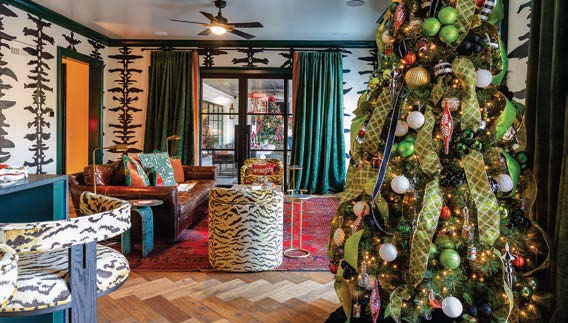
Holiday decorator Hollyfield Design Inc. helped the Baileys breathe the spirit of Christmas into their new home, popping a swag over each mantel and a Christmas tree into what seems like every room. From the candy-colored ornaments to the hot-pink plaid ribbons, the Whos down in Whoville would absolutely adore the playful palette and trimmings. Certainly the Grinch would love to shove the entire jolly scene into a sack and steal it.

The Baileys purchased their 1-acre lot in 2020, began construction the following year, and moved into their sprawling build on the Dogwood golf course just in time for the 2022 holiday season. But the family of four had few decorations, let alone furniture, by the time Santa made his annual rounds.
“We put a tree there, and we had lawn chairs and folding tables,” Michelle says, pointing.
Since the move-in, the house has been filled to the brim, like St. Nick’s sleigh on Christmas Eve. From the outside, the home is a minimalist’s dream. Clean lines meet traditional architecture in a transitional style that’s finished in off-white painted brick and crisp black trim. Inside, it’s maximalism to the max.
“I didn’t want a khaki house with a few accents,” says Michelle with a shrug.
Halfway through construction, she found a like mind in South Carolina decorator Aston Moody.



“I told her I like Persian rugs and animal prints and Buddhas, and that is exactly what she brought me,” Michelle says.
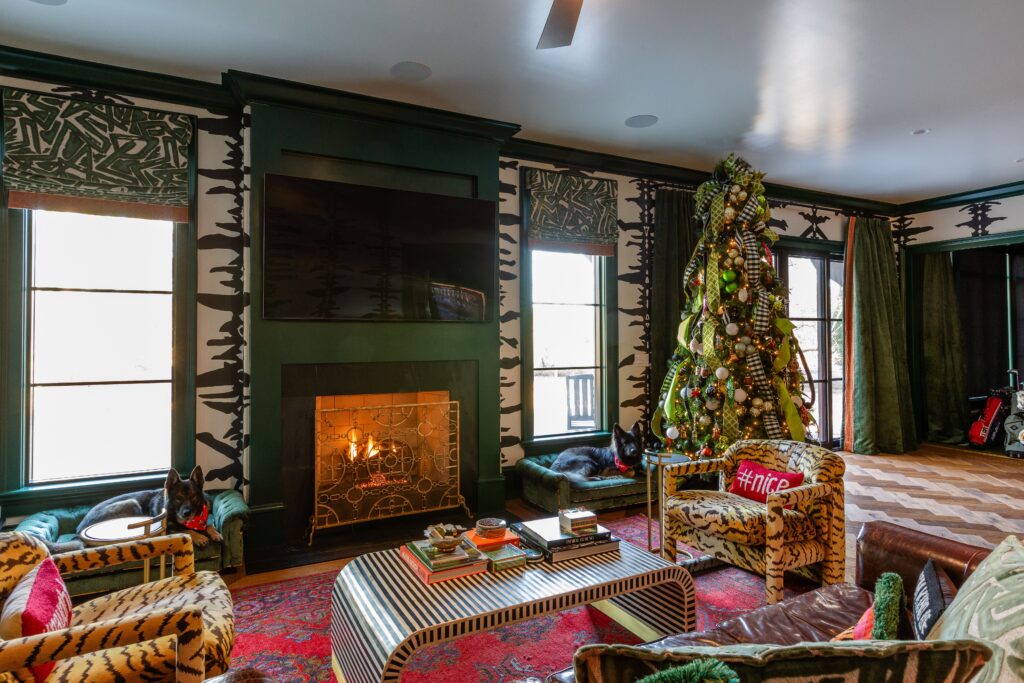
Like kids on Christmas morning, cheetah-print rugs race down the stairs to white oak herringbone floors. A pair of wingback chairs converse with a funky floor lamp that resembles a Truffula tree.
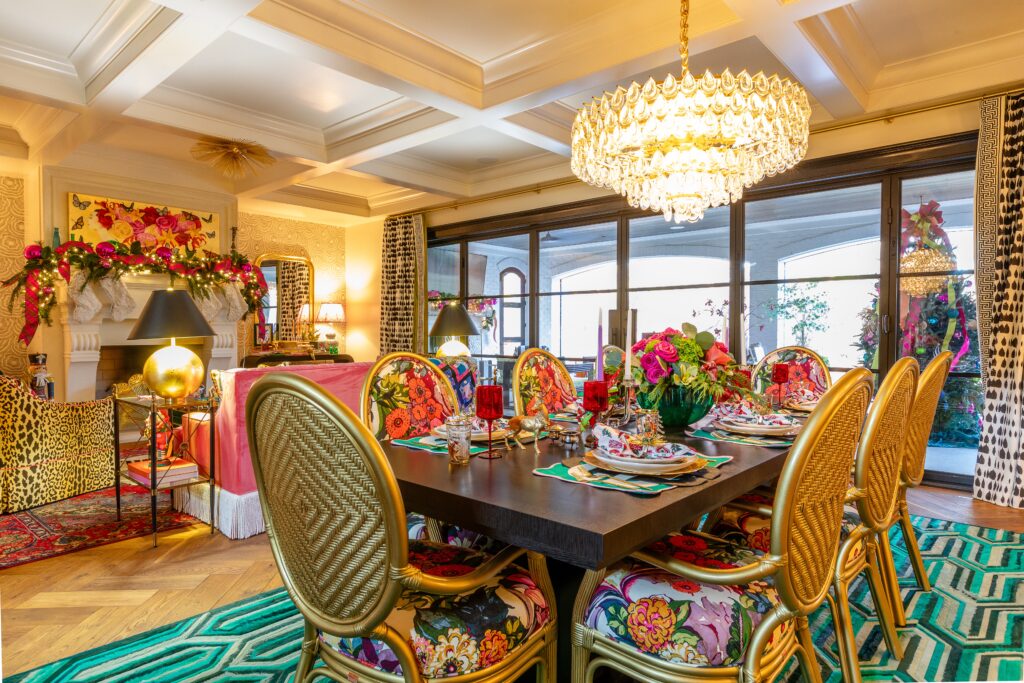

Past the chairs, in the heart of the house, a dining table basks beneath a tiered crystal chandelier hanging from a coffered ceiling. The open floor plan flows from living room to dining room to kitchen, where a black and brass La Cornue range demands all the attention. Its massive hood curves to the ceiling like a billow of smoke.
“This stove was in my dreams forever,” says Michelle, still pinching herself.
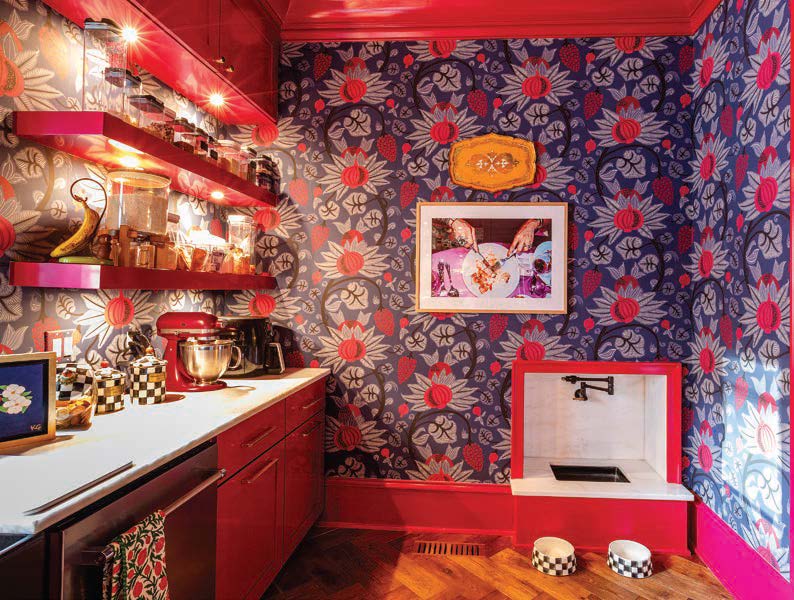
It’s choose-your-own-adventure to explore the rest of the Bailey house. From the kitchen, you have two options: 1). Turn through a pocket door into a pantry wallpapered in a very Southern, very busy cornflower-blue print; or 2). Blow past the look-at-me stove into an entertaining wing complete with a restaurant-size bar, champagne vending machine and golf simulator. Michelle’s good friend and Pinehurst artist Kristen Groner hand-painted the walls with a Rorschach design.

From the entertaining wing, exit sliding glass doors onto a patio looking out at the 10th hole. There’s a second dining table, plus a sitting area with a TV. Fans, heaters, a fireplace, retractable screen doors and a roof keep the space pleasant year-round.
“One of the big things about loving to entertain is I love my private space, too,” Michelle says. “Upstairs is us only.”
The second floor is where you’ll find bedrooms for the Baileys’ teenage children, Peyton and Preston, plus the master en suite. Standout features include a stately brass tub by Catchpole & Rye and a Persian rug, more than a century old, that was a wedding gift for Michelle’s grandparents.
Once the furniture install was completed in June 2023, Michelle threw herself a birthday bash/housewarming party for 60 people on the patio. The Baileys’ first full season of entertaining had begun.

“It’s how I grew up,” Michelle says. Surrounded by family, friends and fun.
Both Michelle and Justin are from California. The couple met in high school. She attended college, earned her nursing degree and now works in medical device sales. He’s retired from the Army Special Forces. Like many families, Justin’s military service is what moved the Baileys to the area, first to Raeford, then Fayetteville, Southern Pines, and now to their home in Pinehurst.
The Baileys thought they’d pack up and return to the West Coast after Justin retired, but that didn’t happen.
“We fell in love with it here,” Michelle says, “so we built the forever home. This will always be home base.”
And always home for the holidays.
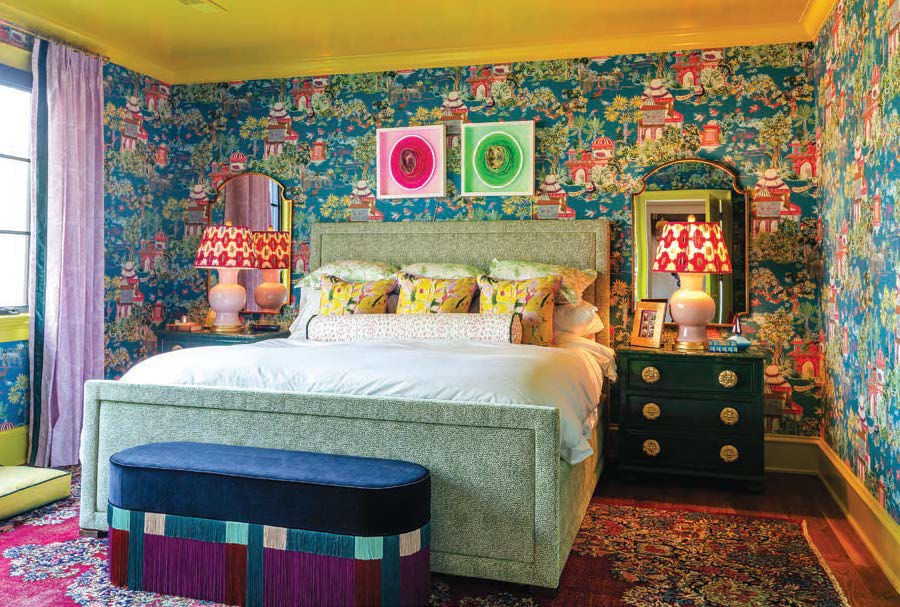
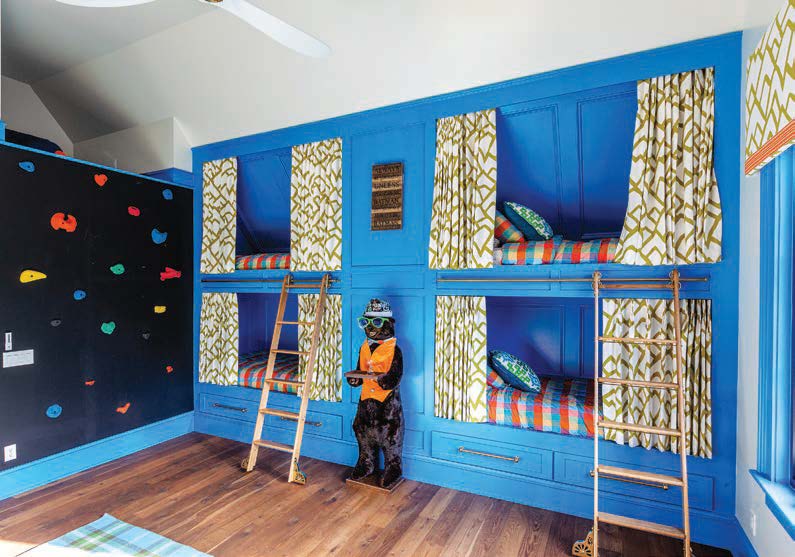

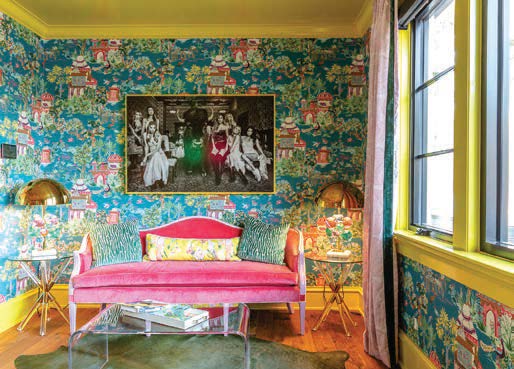



By Deborah Salomon
Photographs by John Gessner
God rest ye merry gentlemen let nothing you dismay.
Old fashioned wreathes and trees and lights will never go away.
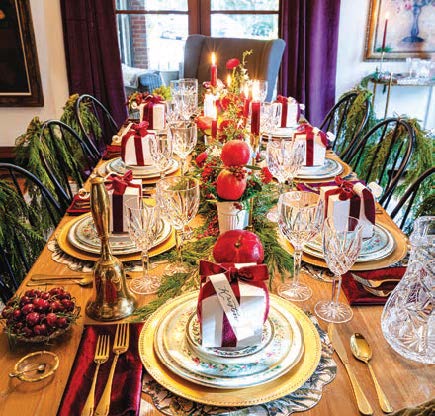
In fact, a goodly amount may be found at Kristen Moracco’s historic home in Weymouth, where Mom, Dad, three young children and two dogs commence decorating in a decidedly traditional style in early November. The halls are decked well before Tom Turkey, or an appropriate alternative, appears on a dining room table set with Yule-themed dishes.
Christmas decorations, like fashion, follow fads. Some families prefer a Victorian Christmas. Other celebrants go mod, expressed in silver and blue. Kitchen trees can drip macaroni and hard candy garlands while outside, the hot item is a projection device that showers the house with colored stars.

But nothing enhances traditional Christmas décor more than a suitable backdrop. Kristen grew up with four siblings in a large, comfortable Colonial in a New York City suburb. Happy memories of decorating with her mother provide inspiration. Being a Realtor specializing in historic properties and a member of The Pines Preservation Guild adds context.
About that backdrop: Rosewood, this military family’s 5,000-square-foot home on a prime 2-acre Weymouth lot in Southern Pines, was built in the 1920s by engineer Louis Lachine, who assisted society architect Aymar Embry II in developing the Weymouth enclave. Lachine, recognizing a moneymaker, bought land and built 10 houses on his own. Rosewood, the most impressive of them, was named for its first occupant, the Robert Rose family of Binghamton, New York. Its dark beams and window frames suggest the Arts and Crafts style popular into the 1930s and now enjoying a resurgence.
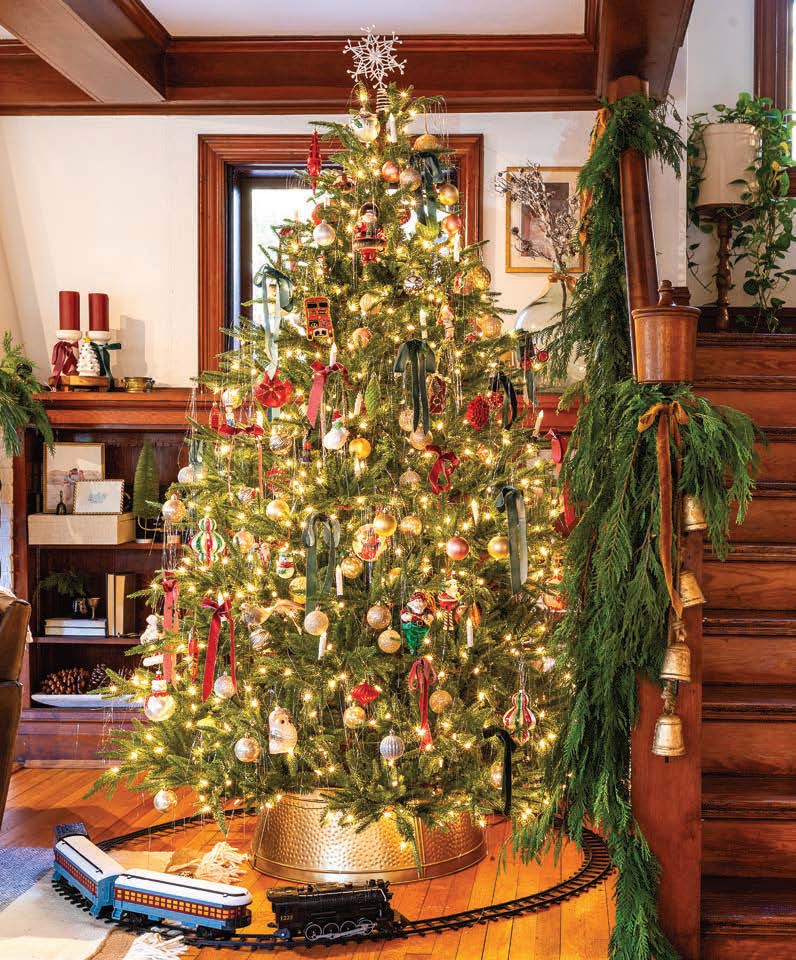
Renovations accomplished by previous owners, including a magnificent kitchen island of bowling-alley proportions, provides an authentic backdrop for Kristen’s whole-house transformation, which starts with multiple trees, including one in each child’s room.
Professionals install outdoor lighting, but the family accomplishes most interior placements. “It’s fun to be the magic maker . . . a big, important job,” Kristen says.
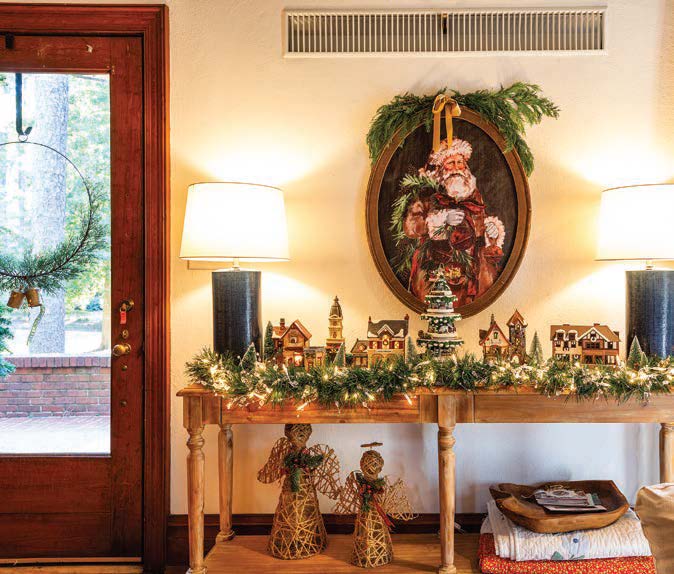

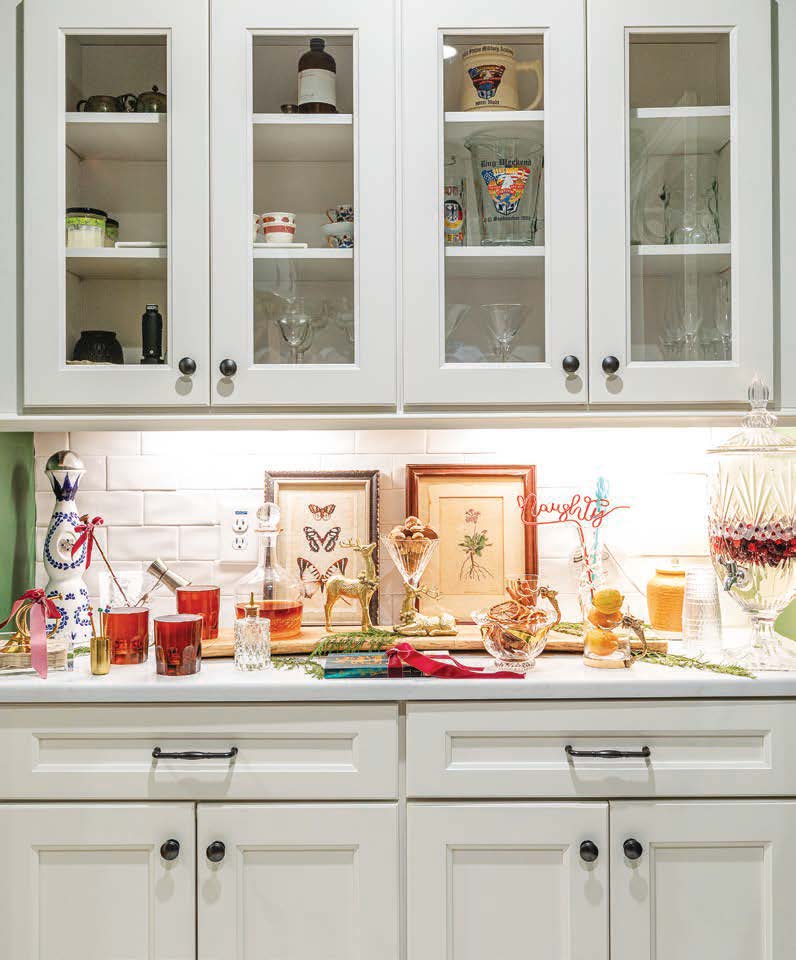
The main tree, as expected, stands between the fireplace and stairway, encircled by an electric train. Almost as massive is the master bedroom tree. After struggling with live ones, “I was forced to join the fake tree club,” Kristen admits. But ornaments are deeply personal, often reflecting family travels: a Scottish thistle; a soldier; a red telephone box and bus from London. Some are estate sale finds. Santa regularly leaves an ornament for the family collection. Other precious mementoes include a needlepoint stocking made by Kristen’s grandmother, and her mother’s angel collection, part of a dining room spread devoted to angels.
“My mom made Christmas so magical,” she recalls.
Last Christmas, Kristen tried something different: a pasta bar with assorted sauces, meats and veggies for a Christmas dinner attended by 10. “Much more fun,” she says.
Recently, Kristen was given a Christmas village, complete with moving ice skaters, which sprawls across a long table under a portrait of St. Nick that even their 10-year-old accepts as real. The result is a wonderland, full of music, lights, pine boughs and surprises where the family gathers around the fireplace after dinner and listens to Nat King Cole, among others, singing traditional carols.
Then, on Dec. 26, after six weeks of total immersion, Kristen comes up for air and, with a sigh, out come the boxes.






Fiction by Jim Moriarty
Illustrations by Matt Myers
Every Christmas, for as long as I can remember, the ornament Mother took special care to hang on the tree was a silver bell. For 11 months of the year it lived in a green felt bag, occupying a corner in the storage box that came down from the attic each December. It was the first, and sometimes only, ornament she put on the tree. It had a red ribbon for hanging, tear drop openings to let its high, sweet tones escape, and a name ornately engraved in the silver:
Emma
Sometimes Mother would smile when she found just the right spot for it. The last few years I’ve watched as her eyes misted over. The name existed nowhere on our family tree. I had often thought of asking Mother who Emma was and where the bell came from but never did, fearing the memory might bring more heartache than pleasure. But when we packed up her things — she was moving away to live with her sister Taylor — I knew she wouldn’t want her silver bell left behind. I also knew it was time to ask.
“Mother,” I said as I dangled the bell from its red ribbon. “Who is Emma?”
Jenny and Emma looked like sisters but they were closer than that. Jenny’s eyes were just as brown as Emma’s, and their hair color was borrowed from the same wheatfield. Side by side, they were often mistaken for twins. If one grew half an inch one month, the other would catch up the next. This went on and on from the first day they could remember and into their eleventh year. All that time, even when they tried to look different — Jenny’s hair in a bun and Emma’s in a ponytail — by the end of the day it all came unraveled and they looked just alike again.
Among the first memories they shared was being watched by the older ones, the neighborhood gang.
“Where is Emma?” Jenny asked.
“Don’t worry, we’ll find her,” Tommy said, because he was a very good older brother.

“Where is Emma?” Jenny said again, and then again.
“Stop crying,” Tommy said. “Look, look. There she is!”
And it was Emma. And Jenny took her hand and held it as tightly as she could.
“Now you two stay here,” Tommy ordered.
“Don’t follow us,” Jenny’s sister Taylor warned them.
“It’s too dangerous,” said Derek from down the street, as if he and all the rest were setting off into the bone-chilling wilderness.
Of course, it wasn’t really scary at all. They just didn’t want two little girls tagging along. And so Jenny and Emma held hands and watched the old ones, all of them, go sliding down the hill, ducking under the sassafras limbs and laughing until they were gone from sight. But even when they were left behind, Jenny and Emma knew something no one else did: Their souls were connected and always would be.
Everyone knows that the very best friends can sometimes do different things, but even when Jenny and Emma were apart, they were together. Emma was the fastest girl in school, and when she ran a race no one cheered louder for her than Jenny. And Jenny loved ballet — oh, how she could pirouette — and no one applauded louder when she danced in her recitals than Emma.
Families have Christmas traditions all their own, too. In Jenny’s house everyone had an ornament that was theirs and theirs alone and only they could hang it on the tree. Jenny’s father had a copper teapot, and Mother a miniature oaken bucket. Every year Father would tell the story of the teapot and the bucket, survivors from their first Christmas tree, in an apartment Mother and Father lived in before any of the children were born. Tommy’s ornament was a dinosaur. Taylor’s was a pair of tiny blue beach sandals. Jenny’s, of course, was a crystal ballerina. How that dancer would twirl!
Emma and Jenny had a tradition of their very own. On Christmas Eve they left their shoes on the porch by the front door — even their houses looked exactly alike — and in the night their shoes filled up heel-to-toe with packages of chewy red and green and yellow and orange gummy bears, each to each, because they both loved them so.
This year, though, Jenny didn’t feel much like leaving her shoes by the door. Emma was moving away. And not just to a different house a few streets across town but to a whole different state hundreds and hundreds and hundreds of miles away. The day before Christmas it was cold outside and as they sat in the living room by Emma’s Christmas tree, Jenny asked her friend if she had a special ornament just like Jenny did.
Emma got up from the floor, reached high up, almost to the star, and took her own special decoration down. It was a silver bell with her name on it in the most elegant writing Jenny had ever seen. Emma gave it a shake and a delicate, beautiful note came out of it.
“Why do you have to move?” Jenny asked her.
Emma sighed. “My mother got a new job.”
“Where?”
“Out West,” Emma said, trying to say it with a hint of adventure but it sounded like the dark side of the moon.
“West,” Jenny said. That was where the sun went down.
That night was Christmas Eve, the best night of the year in Jenny’s house. It was the night they put up their tree. After everyone found the perfect spot for their special ornament, they had one last tradition before disappearing upstairs to wait for morning to come. They were all allowed to open one present. Just one. Father opened his first. Then Mother opened hers. Then Tommy, then Taylor. Jenny was the youngest and had to wait the longest.
Father passed a long, thin present to Tommy. “I wonder what this is,” her brother said as he shook it and put it up to his ear, pretending he couldn’t figure out what was inside the wrapping when it couldn’t have been anything else in the whole world but a hockey stick. Everyone laughed, even Jenny. And they oohed and aahed at the sweater, as downy as kitten fur, when Taylor pulled it over her head. “It’s so soft,” she said.
“This is for you, Jenny,” her father finally said and gave her a small, rectangular box. Jenny pulled the ribbon apart on the top, then pried the tape off one end. She knew what it was, too, but was afraid to hope too hard. It was a plain old shoebox but inside it she found the most wondrous thing — her very first pair of point shoes. Jenny gasped, and she looked at her mother and father and her sister and brother. She pulled her slippers off in a rush, put her feet in her new ballet shoes and tied the pink ribbons around her ankles to hold them in place. She stood up in the middle of the living room, beside their tree with all the lights and ornaments, kicked aside the wads of wrapping paper and empty boxes and twirled and danced and leaped with joy.
Jenny danced around the living room and through the dining room and back through the living room and out the front door onto the porch where her new shoes made a musical sound, scraping and clicking against the wooden deck as if she was keeping time with her heartbeat. As she held her arms out, posed exactly so, and turned and turned, her head flipped around one last time and she saw Emma watching from her living room window. Her best friend in the whole world waved to her and Jenny waved back and they smiled at each other as though their smiles might never vanish.

Though she was very sad, before she went to bed Jenny put her brand new point shoes out on the porch by the door. Then, later that night, when everyone was asleep, she crept down the stairs. The lights on the tree were shining and there were piles and piles of presents, so many she had to slide some out of the way to reach her crystal ballerina. She unhooked it from the tree and sneaky-peeky in the cold night air, carried the ballerina next door, up the stairs onto Emma’s porch. There were two running shoes by the door and Jenny filled the first with gummy bears, then slid her ballerina oh so carefully inside the second.
In the morning when Jenny woke up she rushed downstairs faster than Tommy and quicker than Taylor, past the tree in the living room, past all the presents, straight to her front door where she had left her new point shoes. One was filled heel to its very hard toe with brightly colored gummies. Inside the other was a silver bell. And a note:
We will always be a pair.
Soon, too soon, a big truck backed up to the house next door. But no matter how many winters passed or how many states separated them, even after they each had little girls of their own, the bell and the ballerina found special places on Christmas trees because souls go on forever.

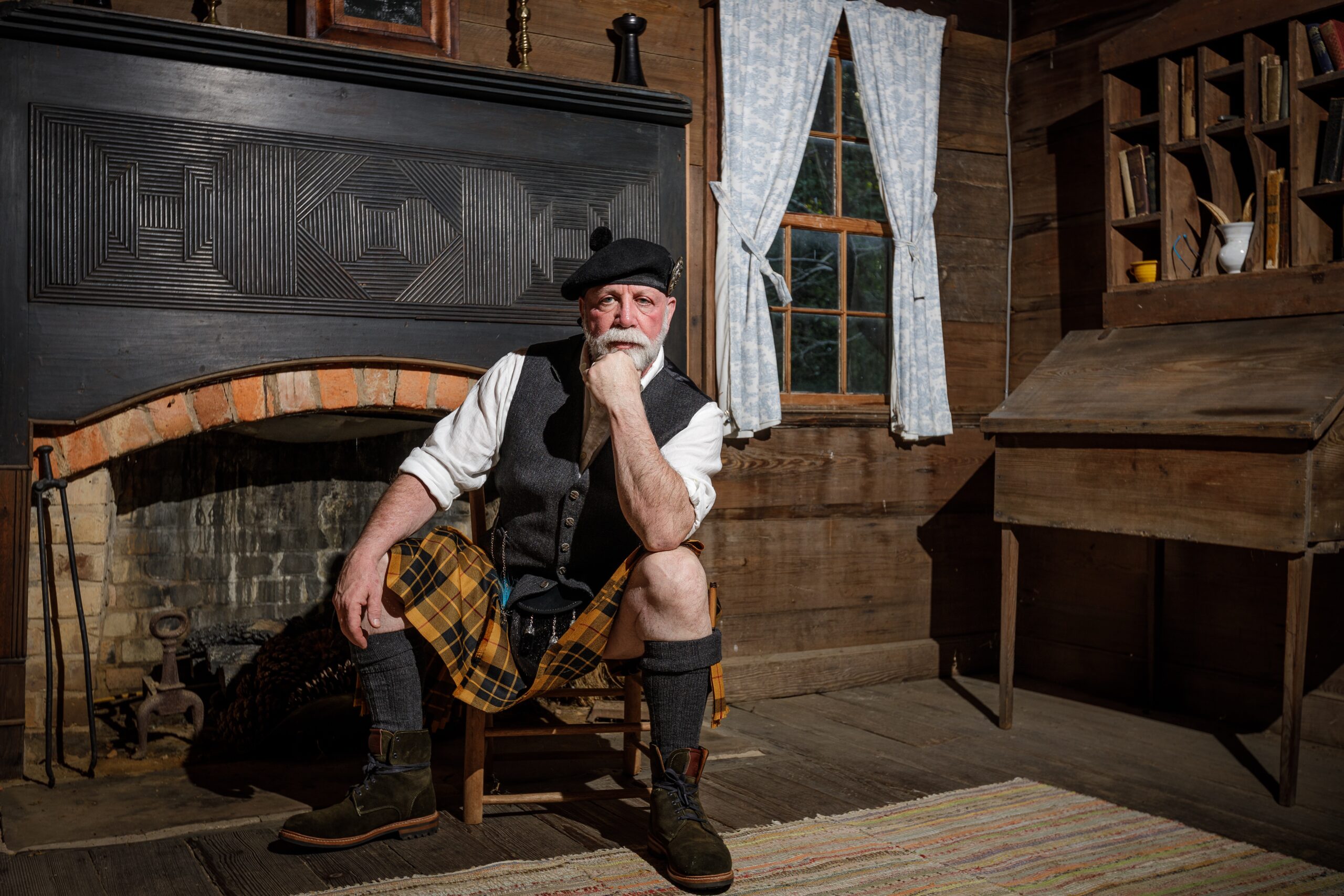
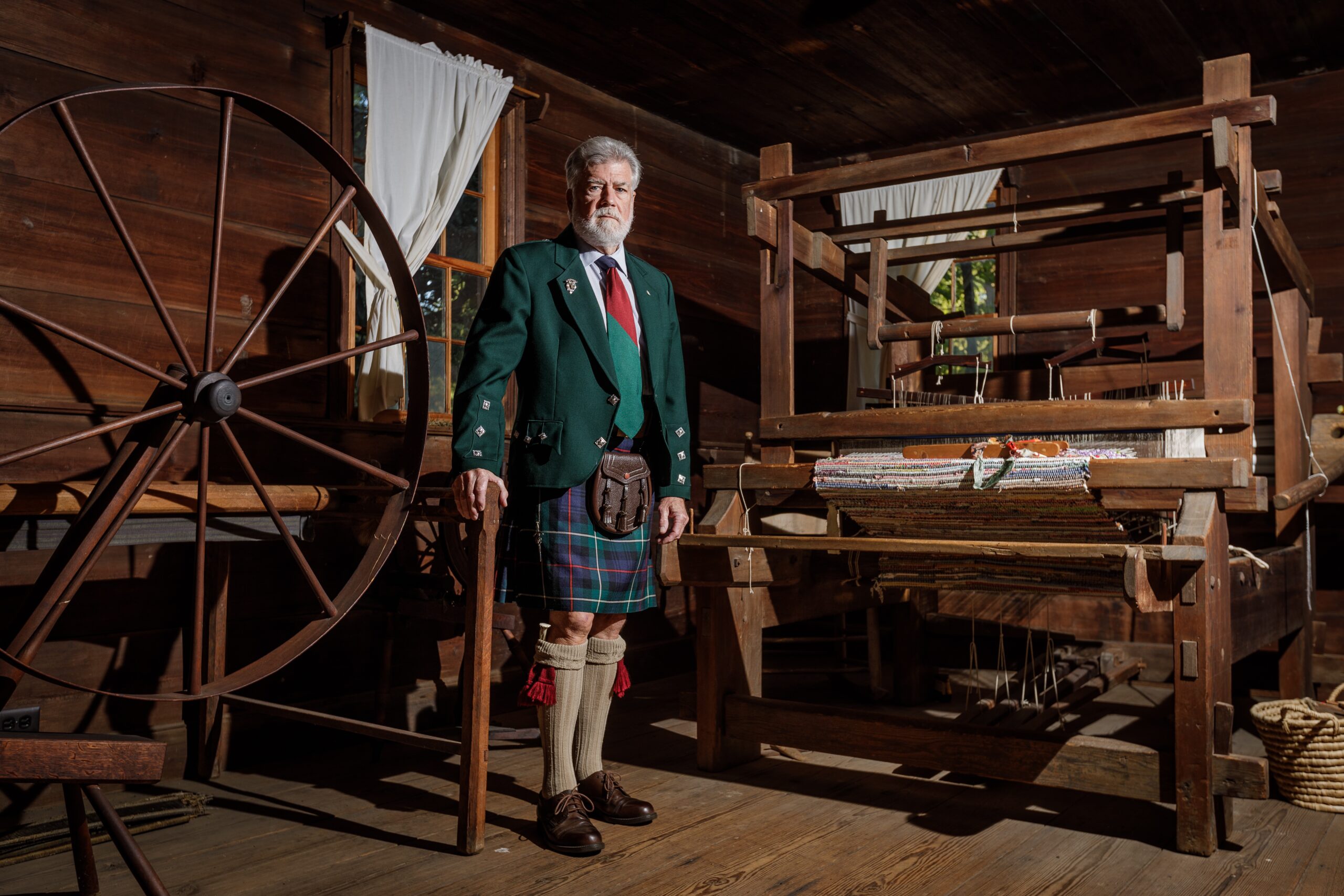
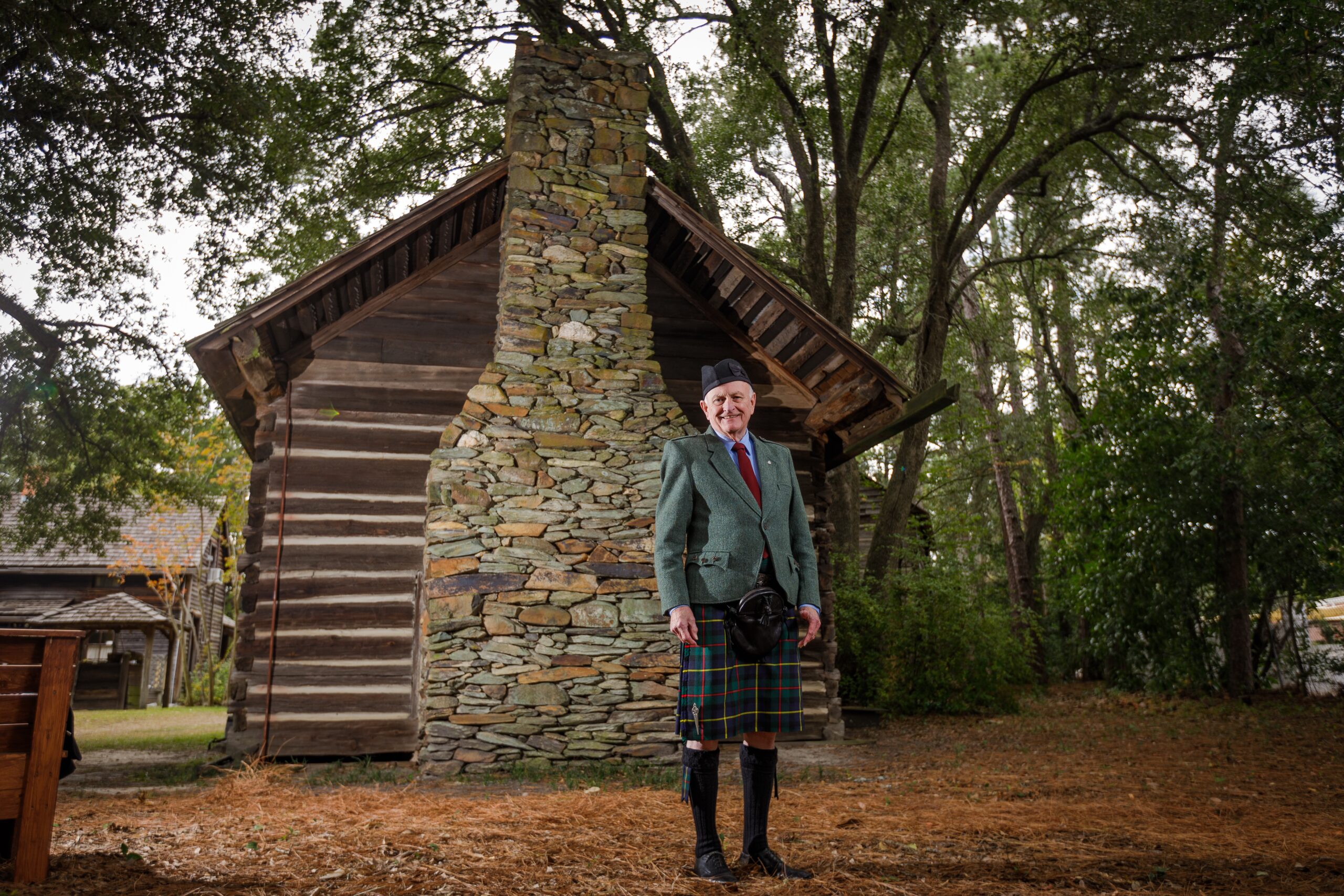
Aye, lads, it’s not the crime, it’s the cover-up, especially when it comes to raising money for a good cause. A dozen Moore County men donned the kilts of their clans to pose as pin-ups for a 2025 calendar supporting the Moore County Historical Association. The calendars are available at the Shaw House, 110 W. Morganton Road, Southern Pines and the Country Bookshop, 140 N.W. Broad Street, Southern Pines.
Photographed on the grounds of the Moore County Historical Association’s Historic Properties

By Bland Simpson • Photograph by Elliott Landy
“A little more to the left.”
“No. It’s fuller around to the right.”
“Just try it my way and you’ll see.”
“Now the stand’s leaking.”
“Somebody’s liable to get electrocuted.”
“I swear you’ve got the best side to the wall.”
“I thought we’d be through by now.”
“You’re right — it was better back to the left.”
“Oh, God. I’ve already gone and tied it to the wall sconce.”
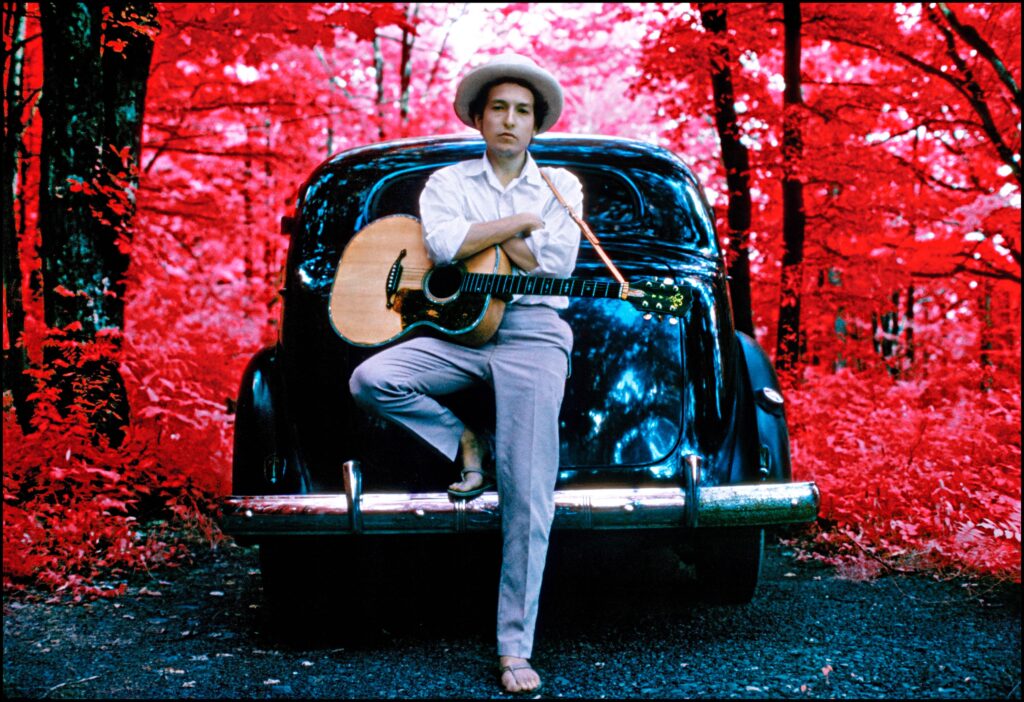
It was a few days before Christmas, 1968, and my family had gathered. The living room was filled with the intense clean resinous smell of the tree. Once we had it hoisted into place, we set about the bristly business of decorating. I was twenty, and my mind was full of music. Withdrawing to the sofa, I thought: Bob Dylan wouldn’t be caught dead doing this.
“The angel’s crooked.”
“Let’s not have the angel this year.”
“Not have the angel?!”
I decided to make a pilgrimage to Woodstock, New York, to see Dylan. It didn’t slow me down a bit that I had little to tell the man except that I was inspired by his songwriting. To shake Dylan’s hand, that would be Christmas enough.
The next afternoon, with no more than fifty dollars, I set out. I was catching a ride north with two friends from UNC, paying my share of all the twenty-six cents per gallon gas we’d burn, and coming back south by thumb. Fifty dollars would be plenty.
This was really my second pilgrimage to Dylan and Woodstock. The first I had undertaken several weeks before, during Thanksgiving, and had abandoned outside of East Stroudsburg, Pennsylvania. I got cold and lost my nerve on a little-traveled high-ridge country road there, and I turned back. On the way home I caught a ride with a Black schoolteacher, who carried me all the way down 81 through the Shenandoah Valley night. We drank a beer together the last hour before he let me out, and agreed that things might be getting better between the races, or at least we hoped they were.
Then a trucker hauled me from Hillsville down the Blue Ridge Mountains. When we stopped at a Mount Airy diner and I didn’t order anything, he thought I was broke and made me let him buy me a cup of coffee and a chance on a punchboard. Back in the semi, he gave me some liquor, which I drank from a six-ounce hillbilly souvenir jug he’d stashed under the seat. He let me off at 52 and 40 in Winston-Salem about four in the morning.
Immediately a hunter with an enormous buck strapped to the top of his Impala picked me up. A couple minutes later he said: “Look, I hope this don’t bother you none but I got to hear some music.” He popped an eight-track of Johnny Horton’s Greatest Hits into the tape player, and the car was full of the songs I’d learned to sing by: “Battle of New Orleans” and “Sink The Bismarck!” and “North to Alaska.” The teacher and the trucker and the Horton-loving hunter made me think better of the pilgrimage business. I forgot the Stroudsburg cold and knew I’d try again.
It was several weeks later, the evening of December 10th, when we piled into my friend’s ’65 Rambler and went roaring up the three-laned U.S. 1, which is these days a ghost road just south of the Petersburg Turnpike. On and on, all night, the first of many deep and dreamless long-haul trips up and down the Eastern Seaboard. I was astounded at the size and magnificence of the great bridge at Wilmington, aghast at the dazzling lunar landscape, gas flares and chemical air of north Jersey. One of my more worldly companions gazed upon the scene and remarked with a combination of pride and disgust: “America flexing her muscles!”
From the George Washington Bridge we looked out over the vast glare of Manhattan. In less than a year it would be my home, but that night it made me feel thoroughly out of place, for a few moments sorry I had even come. Soon it was past, and we were in the dark Connecticut country, and it was snowing lightly. I recovered my spirits; after all, I was on a mission.
They were driving me towards Storrs, Connecticut, to see the Hickey family, late of Chapel Hill, and coincidentally to perform a flanking maneuver to approach Woodstock from the north and east. The plan had been to leave me in New Haven where the big roads fork, but at the last minute my compatriots, who were bound for Boston, found it in themselves to veer off to the north and take me right into Storrs.
They left me at a gas station at first light, a gray dawning, six or eight inches of snow on the ground and more still coming down. I showed up oafish and unannounced at the Hickeys’ home between eight and nine in the morning, four days before Christmas. They masked whatever annoyance they might have felt and greeted me affectionately.
All four daughters in the Hickey family were home for Christmas except the one who drew me there. She wasn’t expected for another twenty-four hours or so. No matter. The other three were going ice-skating that day, and so, now, was I. Most folks don’t forget their first time on ice-skates, and with good reason.
Sue did finally come home, and we had a lovely New England time that next day. It was brisk, and the sun was bright on the unmelting snow. She got over the surprise of my presence, commiserated with me about the Tower-of-Babel Christmas tree back home, and wondered what I would say to Bob Dylan, himself, when we met. After breakfast the next morning she drove me out to the highway, and I was soon up at the Massachusetts Turnpike in the company of a Goddard student driving a Volkswagen with skis strapped to the back.
He was on intersession, he told me. He was going somewhere to ski for six or eight weeks, for which he would get academic credit. We drove west towards New York and the Hudson, and, before he left me off at the Saugerties exit, I had seen groves of chalk-white paper birches for the first time.
A couple of artists, a man and a woman, in a dingy old Pontiac drove me from Saugerties to Woodstock. They said they were friends of Bob’s, and suddenly everything felt very chummy. The artists called themselves Group Two-One-Two, after the route number of the Saugerties-Woodstock road. A few years later, when I was living on the Upper West Side in New York, I would see a notice in the Village Voice about a show they were having down in SoHo and meant to ramble down and take a look. But the notice would stay taped up on the refrigerator until well past the closing of their show, and I would never make the trip.
Group Two-One-Two’s explanation of where exactly Bob Dylan lived was so convoluted that I stepped into a shop in downtown Woodstock, a bakery, and asked them. In moments I was tromping on out of town through a wood and up a hill towards something called “The Old Opera House.” Dylan’s driveway, the bakers said, was right across from it.
It was about eighteen or twenty degrees in the middle of the afternoon, and I wasn’t used to such cold. I didn’t feel dressed for it, but I certainly looked like I was. I had on a Marine greatcoat from a surplus store south of Wake Forest, a slouch hat from a surplus store on Granby Street in Norfolk that I’d bought on my way to see Cool Hand Luke with my Virginia cousins, and a pair of snakeproof boots from Rawlins, Wyoming, that I’d bought on my way to be a cowboy in eastern Montana. (You, or your beneficiary, said the card in the boot box, got a thousand dollars if you died of snakebite while wearing the boots, providing the snake bit you through the boots.) All this was practical and, back home in North Carolina, warm winter wear, though my mother lamented that I looked like something from the Ninemiles — a remote swamp in Onslow County down east. It hardly mattered here. In Woodstock everyone looked like something from the Ninemiles.
Without my even thumbing for it someone offered me a ride, and there I was at The Old Opera House. There turned out to be six or eight driveways next to and across from the place, no names on mailboxes, certainly no sign that said: “This way to Bob Dylan’s house.” I waited. About twenty minutes went by before a thin man in his thirties came striding up the paved road. He would have walked right past me, but I spoke up: “Excuse me, do you know which one of these driveways goes to Bob Dylan’s house?”
“This one.” He pointed at the one he was starting down.
“Thanks.” I fell in beside him, and we walked fifty yards or so before either of us spoke again.
“Is Bob, uh, expecting you?”
“No.”
“Hunh. I don’t know if it’ll be cool for you to just . . . go up to his house.”
This was discouraging, but what could I do? Go back to the bakery and telephone for an appointment? “I’ve come from North Carolina,” I announced.
“Oh.” He gave up, and we kept walking. A few hundred yards into the woods the road forked, and he pointed towards a long low building of dark logs that looked like a lodge. “That’s Bob’s house.” Then he disappeared down the other fork.
In the driveway at Bob’s house were a ’66 powder blue Mustang and a boxy 1940 something-or-other with the hood up. Two men, one of them small and weedy, the other bulky and bearded, were working on the engine. I stomped up in my snakeproof boots, but neither of them looked up. After a minute or two of staring over their shoulders at the old engine, I finally said, quite familiarly, “Bob around?” The weedy man didn’t respond, but the big fellow gave a head-point at the log lodge and said, “Yeah.”
Sara Dylan answered the door, gave me a blank look, and closed the door. About two minutes later Bob Dylan himself appeared and stepped out onto the small porched entry. He wore blue jeans, a white shirt buttoned all the way up and a black leather vest, and he was very friendly and relaxed.
“Bland. What kind of name is that?”
A family name, I said. Then just to make sure he’d hear me right, he asked me to spell it.
“Bland. Well, I sure won’t forget that.” He talked in person just like he sounded on record in “The Ballad of Frankie Lee And Judas Priest.”
“North Carolina, that’s a long way.”
I agreed, but I wanted to meet him, shake his hand, tell him I admired his work, that I wanted to write songs myself.
“What did you want to do before you got this idea about writing songs?”
“I was going to go to law school.”
“Well,” he said, more serious than not, “country’s gonna need a lot of good lawyers. Maybe you ought to keep thinking ’bout that.”
This wasn’t what I had traveled hundreds of miles to hear. I started asking questions. Did he live in Woodstock all the time? Most of the time, he said, but he was thinking about moving to New Orleans. When would he have a new record out? In the spring — “I’m real happy with this one.” He was talking about “Nashville Skyline,” which he had just finished. I asked about a song of his the Byrds had recorded a song I’d heard out in Wyoming the summer before. “Yeah, I know the one you mean, but I can’t call the name of it right now — it’s in there somewhere.” The song was the riddle-round “You Ain’t Going Nowhere.”
We talked along like that for almost forty-five minutes, during which time I felt the cold acutely. Dylan was dressed in shirtsleeves, but he didn’t seem to notice the cold at all. He must have known my head was full of hero-worship, and he was kind enough to let my time with him be unhurried. The moment of my mission played out as naturally as the tide. I was immensely grateful, am grateful yet.
The pilgrim was ready to go home. I pulled my map out, unfolded it, and while we talked about what the best way to head back south was, the bulky fellow lumbered over from the old car where he and the weedy man had been working all the time. The mechanic ignored me, and I ignored him right back, which was easy enough: I had the entire eastern United States spread out in front of me. My mind was on the road, but I did want one last word or two with Bob Dylan. He gave Dylan a report on all the things that weren’t wrong with car, then said: “I think we can get it started if we hook it up to the battery charger.”
“Okay,” Dylan said. “It’s in the garage.”
“I got it already, and tried to hook it up, but even with that long cord it won’t reach. We need another extension cord.”
“Extension cord,” Dylan said, and looked past the big man at the old car. He thought about the request a few moments, then shook his head.
“Gee, Doug,” he said, “I’m afraid we just used the last extension cord on the kids’ Christmas tree.”

By Jenna Biter • Photographs by John Gessner
Dozens of guests swirl about a long, rectangular room. A vase of sherbet roses and powder blue hydrangeas anchors the space on a table in the center. It’s a cool dusk outside, but inside the walls, the atmosphere is warm. It’s heated by the chatter of old and new friends, or at least friendly strangers. They flit in and out of conversations, gabbing and howling like they’re enjoying one last party at the end of the world.
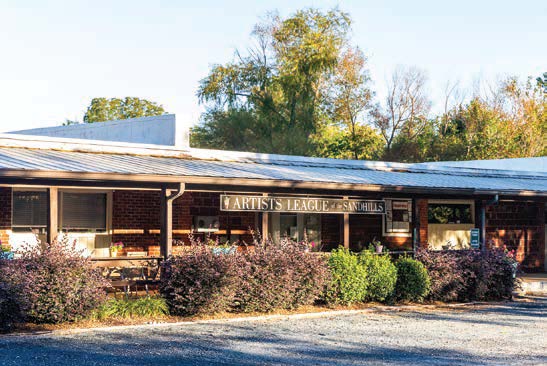
They aren’t, of course. The Artists League of the Sandhills begins most months like this, with a gallery opening held the first Friday evening in that slender room in the not-for-profit organization’s headquarters. The building is situated not at the end of the world but at the end of Exchange Street, with its rear wall kissing the main train tracks that slice through historic Aberdeen.

A woman leans toward a friend while pointing at a small portrait of a lady peering through a monocle on the opposite wall. “We’re getting . . . ” she begins, but her voice trails off as she gets lost in the art. She walks across the room, magnetized. A red sticker on the artwork’s label marks it sold not long into the event.
The time of the gallery openings is always the same — 5 p.m. to 7 p.m. — but the theme varies from one show to the next. In August it was small art. In September viewers with reading glasses were grateful to see the works return to regular size. In October, the gallery showcased figures and faces, and November boasts the biggest event of the year, the annual fall exhibit and sale, which opens with a public reception Friday, Nov. 8, and hangs through Dec. 20.
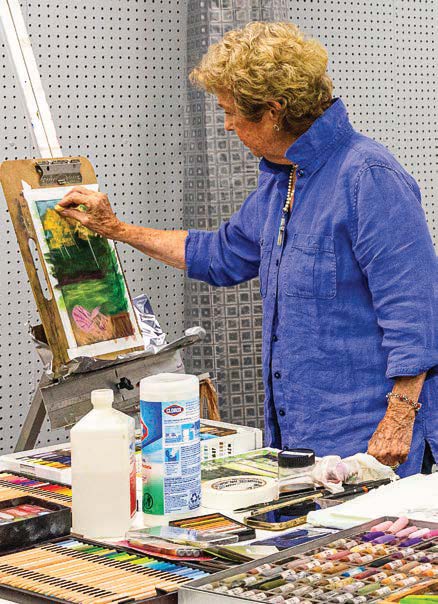
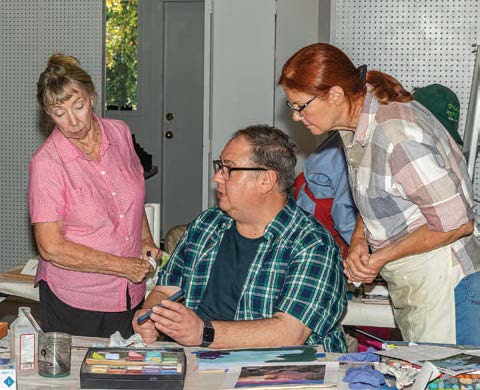

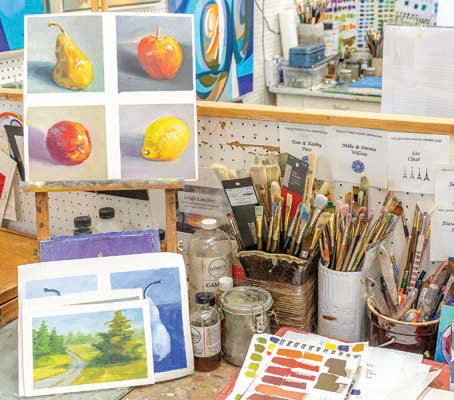
The sprawling gallery show features somewhere around 150 new pieces of art, with works for sale by many of the league’s dozens of members. If you wander across the one-story building, through two large classrooms, past a framing station and a library of catalogued art books and into a maze of cubicle-like studios, you’ll find an additional 300 or so pieces for sale. With a pocketful of dollars and a can-do spirit, you could easily redecorate your entire house with an evening’s offerings.
The November opening is an art lover’s delight, but this year it’s something more — the exhibit marks a milestone anniversary, too. Originally the Workshop of the Sandhills, 2024 marks 30 years since the Artists League opened shop in the same old Aberdeen Rockfish railroad warehouse that it occupies today.
As if on command, a train roars past, releasing a protracted honk into the graying night sky. The blast is a visceral reminder of the league’s modest beginnings, when a pair of retired executives scrubbed through oil and grime to transform a century-old train depot into a gathering place for artists of all calibers and kinds.
The Sandhills knew Chuck Lunney as the audacious and distinguished World War II pilot who swooped his B-29 bomber under the Golden Gate Bridge on a dare, but he’s also remembered as an advertising professional and lifelong artist with an interest in art education and community, driven to create an organization for likeminded folks. Lunney found one such mind in retired sales manager and watercolorist Mike D’Andrea at a Campbell House Galleries reception sometime in the 1980s. After a half-decade’s search for the perfect location for their artists’ haven, the men opened the Artists League of the Sandhills on Oct. 26, 1994, in one-half of a dirty train terminal. When the town of Aberdeen offered to rent them the building for a dollar per year, the word “perfect” suddenly seemed to describe the broken building tucked all the way back on a forgotten side street.
“Their goal, I think initially, was to have 20 artists just so they could pay the bills,” says Pam Griner, the league’s office manager of 14 years. Sure, rent was dirt cheap, but they still had to keep the lights on.
The initial goal was immediately surpassed. According to a Nov. 10, 1994 article in the Moore County Citizen News-Record, 28 local artists signed up the very first day.
Thirty years later, both founders have since passed — Lunney, 93, in 2012, and D’Andrea, 89, in 2018 — but their legacy lives on in the organization they scrubbed into existence. The Artists League now occupies the entire warehouse, and membership bumps its head against 200, with tens of artists able to key into studios 24/7.
There’s always a waitlist for those 34 cheap-as-bananas workspaces.
In a typical week, members teach art classes Monday through Friday on media that run the full artistic gamut from oil to watercolor. Nationally known professional artists visit to host multiday intensives several times per year. With the fees from those classes and workshops, memberships and generous donations, as well as a small percentage of sales from the monthly art shows, the league stays up and running.
As more guests shuffle in, more red stickers claim ownership. The show led off with a large work of art, a reinterpretation of Gustav Klimt’s Lady with a Fan — a dove has been added in an upper corner. A blurb on the wall explains why. Beyond the Klimt-alike more paintings, a scratchboard engraving of a goat, and mixed media of all types ranging in size from postcard to poster, snake around the room like a boa constrictor squeezing onlookers into a tight-knit group.
Most of the league’s artists are amateurs — stay-at-home moms or refugees and retirees from their day jobs — while others have taught or made art their entire lives. It doesn’t really matter who they are, the members bond over art. Learning it, loving it, making it. They exchange Christmas cards during the holidays, often crafted in a special December class, offer bedside company when ER visits become a sad reality, and grab lunch together even when it isn’t in the Artists League’s break room.
The spirit of community bubbles over, into the corners of the gallery space and out the front doors like an uncorked bottle of champagne. Even in the dim light of evening when the last guests are walking to their cars, the atmosphere is as bright as the roses and hydrangeas still on the center table.
“The new community facility offers artists, from the beginner to the accomplished, the opportunity to share their knowledge, gather inspiration and improve their skills,” the News-Record said in 1994.
Besides the word “new,” the same sentence could be printed today.



We use cookies to improve your experience on our site. By using our site, you consent to cookies.
Manage your cookie preferences below:
Essential cookies enable basic functions and are necessary for the proper function of the website.
Statistics cookies collect information anonymously. This information helps us understand how visitors use our website.
Google Analytics is a powerful tool that tracks and analyzes website traffic for informed marketing decisions.
Service URL: policies.google.com (opens in a new window)
SourceBuster is used by WooCommerce for order attribution based on user source.