The Silver Scot’s Shangri-La

THE SILVER SCOT'S SHANGRI-LA

The Silver Scot’s Shangri-La

Legendary Great Tommy Armour and Pinehurst

By Bill Case     Photographs from the Tufts Archives

He had survived — a luckier fate than that suffered by millions of World War I soldiers — but his battlefield injuries were grievous. A German mustard gas explosion had totally blinded the young Edinburgh native. One lung was badly burned by the gas. In another engagement, shrapnel from an enemy shell caused serious injuries to his head and left arm, necessitating the implanting of metal plates. Lying battered and helpless in a British military hospital bed, the odds seemed heavily against Tommy Armour ever resuming a normal life.

Serving in the Black Watch Regiment’s tank corps from 1914 to 1918, Armour rose from the rank of private to staff major and achieved widespread notoriety for his machine-gunning prowess. He assembled, loaded and fired his weapon faster than anyone in the Army. This singular talent required superior manual dexterity but, in addition, his hands were remarkably strong: While singlehandedly capturing a German tank, Armour strangled the tank’s commander to death when he refused to surrender.

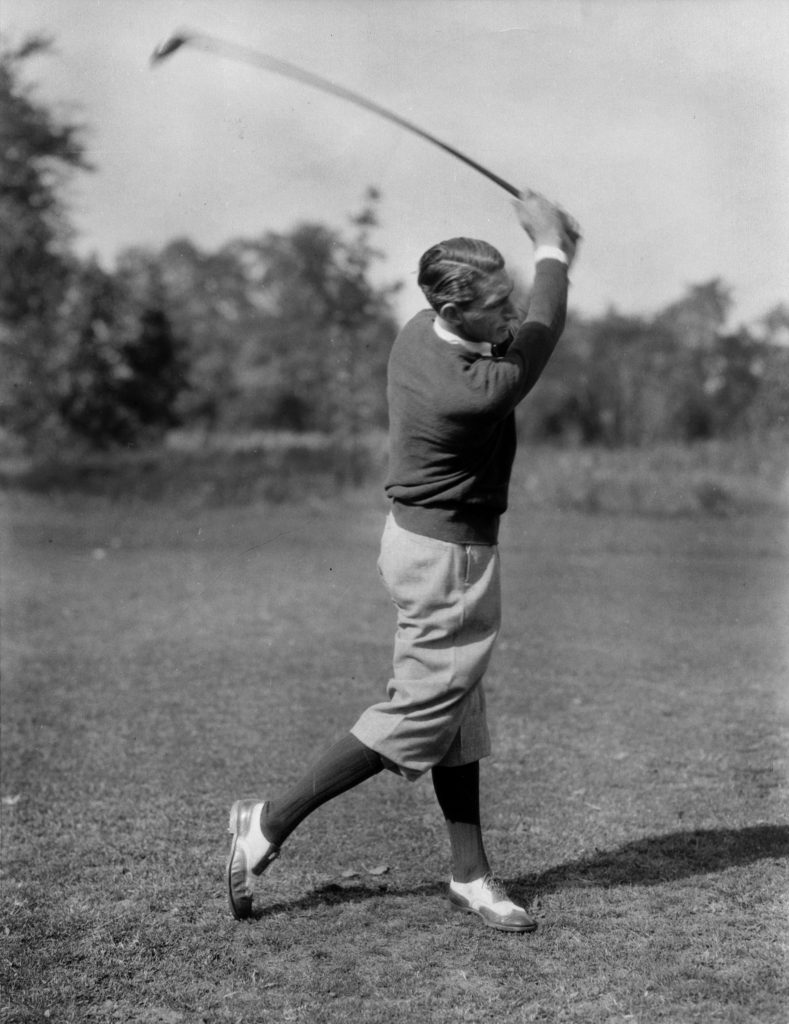
Prior to the war, those formidable hands had served him well. Among his talents, Armour was a virtuoso violinist and a high-level bridge player, but his favorite pastime was golf. Armour, his older brother Sandy, and lifelong friend Bobby Cruickshank toured Edinburgh’s Braid Hills Golf Course at every opportunity. “In the summer,” Armour later recalled, “I would be on the first tee at 5 a.m. and in the evening . . . play a couple of rounds.”

Throughout his convalescence, Armour kept up his spirits by dreaming of playing golf again. While it took six months, sight gradually returned to his right eye, though he remained blind in his left. The recuperating 23-year-old would play golf again, but could his limited vision scuttle any hope of regaining his previous form? The preternaturally confident Tommy Armour believed otherwise.

Armour joined Edinburgh’s Lothianburn Golf Club with the expectation of not just recovering his game but elevating it. Adapting to his partial blindness, he steadily lowered his scores, though his putting was erratic. The blindness in his left eye was distorting his depth perception. One day, in a fit of pique, he hurled his collection of putters off the Forth Rail Bridge into the firth below. It was these all-too frequent episodes of balky putting that would one day prompt him to coin the phrase “the yips.”

Despite his weakness on the greens, Armour began making his presence felt in tournaments, finishing runner-up in the 1919 Irish Amateur at Royal Portrush. He really raised eyebrows when he won the French Amateur in July 1920. Soon afterward, Armour sailed to New York, looking to test his game against America’s best. While aboard ship he met Walter Hagen, the game’s top professional golfer. The two men found they had much in common: Both enjoyed parties, the company of attractive women, and the consumption of copious amounts of alcohol. As author Mark Frost wrote in The Grand Slam: Bobby Jones, America, and the Story of Golf, the young Scot had a capacity for liquor surpassing his older friend. “Whereas ‘The Haig’ often watered down drinks to polish his reputation as a boozer,” wrote Frost, “Armour’s glass was never half-empty.”

Hagen took the young man under his wing, setting up an exhibition match for the visiting amateur’s American debut. On July 25 the fellow bon vivants squared off against Jim Barnes and Alex Smith in New London, Connecticut. The Armour-Hagen team lost the match 1-down, but The New York Times reported that Armour’s “long driving surprised the gallery,” and that his mashie play “stamped him as a golfer who will be hard to beat.”

In early August 1920, Armour entered the U.S. Open at Inverness Country Club, in Toledo, Ohio, finishing 48th, 22 strokes behind winner Ted Ray. But those who assumed the hype regarding this Scottish upstart had been overblown were in for a surprise two weeks later at the Canadian Open. Playing brilliantly throughout, Armour finished the championship in a three-way tie at the top with Charles Murray and J. Douglas Edgar, eventually losing the playoff to Edgar. The Scot followed that promising finish with another, reaching the quarterfinals of the U.S. Amateur at Engineers Country Club in Roslyn, New York.

While stateside, Armour found time for other pursuits. An October 29, 1920, New York Times article reported that the golfer had wed 26-year-old Consuelo Carreras de Arocena the previous day. A son, Thomas Dickson Armour Jr., would be born to the couple a year later.

Though Armour had played creditably that summer, he had yet to achieve a victory on U.S. soil. That changed in November after he arrived in Pinehurst to compete in the resort’s inaugural Fall Amateur-Professional Best Ball Tournament on course No. 2. The event attracted many leading players, including Gene Sarazen, the aforementioned Douglas Edgar, and Leo Diegel, later a two-time PGA champion.

Already recognized as a tournament hotbed, the Pinehurst resort successfully lured top players for tournaments on their way south for the winter and then again on their way northward in the spring. March and April were the months when the United North and South Amateur championship and the North and South Open were held. The tournaments attracted resort visitors looking to spot their favorites both on and off the course. What could be more appealing to a devout golf fan than encountering the legendary Walter Hagen in The Carolina Hotel bar?

Pinehurst appealed to Armour as well. Partnering with Diegel, the two ham-and-egged their way to the Amateur-Professional title, posting a four-round best ball score of 275. The win provided the Scot a measure of revenge against Edgar, whose team finished runner-up. The euphoric Armour extended his stay, competing in the resort’s match play Fall Tournament. He reached the quarterfinals before bowing to Frances Ouimet. After that, Armour and his bride sailed home to Great Britain.

Back in Scotland, Armour continued to polish his game in amateur tournaments. In May 1921, he joined a team of British amateur stars for a match against a formidable American team that included Bobby Jones, Chick Evans and Ouimet. The informal match, held at Royal Liverpool Golf Club and won by the U.S., drew over 10,000 spectators and sparked the institution of the Walker Cup matches the following year.

Having experienced the good life in America, Armour yearned to return. Following the 1921 slate of British golf championships, he was back in the U.S. competing in tournaments. In October he informed the press he intended to make America his permanent home. Armour’s brother Sandy and Braid Hills running mate Cruickshank also chose to emigrate. The New York Times observed, “The British golf world is faced with the odd spectacle of its previous defenders against American invasions being members of future attacking parties.”

Still an amateur, Armour looked to establish himself in America and, once again, Hagen came to the young man’s aid, making the connections that led to Armour being hired as the secretary of Westchester-Biltmore Country Club in Rye, New York. A sprawling complex, the club featured two golf courses, a polo field, racetrack and 20 tennis courts, built at a cost of $5 million.

Armour’s natural social skills made him ideal for the post. He deftly saw to the needs of the Biltmore’s guests and entertained them as well, regaling patrons with raucous stories evoking paroxysms of laughter. Byron Nelson considered Armour the most gifted storyteller he ever knew. “He could take the worst story you ever heard,” said Nelson, “and make it great.”

Armour’s job kept him busy during the warmer months, but when the weather turned chilly, he headed to Belleair, Florida, where he played numerous matches and tournaments against top players. Convinced he could hang with golf’s upper echelon, he turned professional in 1924. Soon after, Armour became the professional at Whitfield Estates Country Club, a Donald Ross-designed golf course (now Sara Bay Country Club) that was part of a Sarasota real estate project. Lifetime amateur Bobby Jones was also on-site, earning some extra dough peddling lots as the project’s assistant sales manager. Armour played golf daily, frequently in the company of either Jones or Hagen, who was affiliated with a nearby golf community.

In March 1925, Armour won the Florida West Coast Open, his first victory as a pro. With the North and South Open approaching, the triumph did not go unnoticed in the Sandhills. A piece in the Pinehurst Outlook reported that the word coming out of Florida was to “watch Tommy Armour!” The transplanted Scot played admirably in the North and South, finishing fourth.

Though Armour was rapidly progressing up the pecking order of top players, his share of tournament purses was never going to be enough to make a decent living. Even the game’s greatest supplemented their incomes by competing in exhibitions and securing club pro affiliations for both the summer and winter. Armour landed a premier summer gig as pro at Congressional Country Club in Bethesda, Maryland. Over the years, he would prove something of a vagabond in his northerly club employments: Medinah in Chicago, Tam-O-Shanter in Detroit, and Rockledge in Hartford would be featured among his other stints.

Armour’s primary goal, however, was to win tournaments. After two years adjusting to tour play, he skyrocketed to superstar status, winning five titles in 1927, including the U.S. Open held at America’s most demanding course, Oakmont Country Club. Trailing Harry Cooper by a shot as he arrived at the green of the championship’s final hole, Armour faced a birdie putt from 10 feet to force a playoff.

Bobby Jones, who was in the gallery, overheard two spectators debating whether any golfer would be able to successfully handle the pressure of such a critical moment. Jones calmly informed the bystanders that a man who had snapped the neck of a German tank commander with his bare hands was unlikely to be bothered by a 10-foot putt, regardless of its import.

Armour cooly drained it. In his 18-hole playoff victory over Cooper, Armour took just 22 putts over Oakmont’s diabolical greens. Perhaps he wasn’t such an awful putter after all.

The victory, coupled with his charismatic persona, thrust Armour into golf’s spotlight. Tall, dark, handsome and, like Hagen, impeccably attired, Armour, was a hit with the ladies, an attraction he did nothing to discourage. A penchant for heavy gambling, particularly on the course, also drew attention. Golf great Henry Cotton expressed uncertainty as to what Armour liked best, the golf or the betting. “He is not satisfied,” claimed Cotton, “unless he is wagering on every hole, every nine, each round, and if he can, on each shot.”

Augmenting Armour’s swagger was the occasional wearing of a patch over his left eye. He sported the best nickname on tour — The Black Scot — referring to the jet-black hue of his luxurious head of hair.

More victories followed. By the time Armour arrived at Fresh Meadows Country Club in Flushing, New York, for the 1930 PGA Championship, he had eight more tournament titles to his credit, including the prestigious Western Open. In his quarterfinal match at Fresh Meadows against Johnny Farrell, Armour found himself 5-down after six holes before rallying to win. Fighting his way to the championship’s final match, he took on Gene Sarazen in a nailbiter, beating “The Squire” on the 36th hole.

By 1930 Armour’s domestic life was in turmoil. In the course of his wanderings, he had met Estelle Andrews, the widow of an iron manufacturer. They started an affair, a fact unappreciated by Armour’s wife, Consuelo, who responded by initiating a series of lawsuits. Eventually, the differences were resolved; Armour got divorced, married Estelle, and adopted her two teenage sons, Ben and John. “Love and putting are mysteries for the philosopher to solve. Both are subjects beyond golfers,” said Armour.

In 1931, he won what, given his Scottish background, was his most meaningful title, the Open Championship at Carnoustie. An early finisher in his final round and sitting in a distant third place, Armour anxiously sipped whisky in the clubhouse while awaiting the two men ahead of him — Jose Jurado and Macdonald Smith — to complete their rounds. “I’ve never lived through such an hour before,” he told reporters. Jurado and Smith both collapsed, and Armour won the championship by one stroke, giving him a victory in all three of the major championships then available.

The rigors of travel and competition were beginning to take a toll on Armour, hastening the graying of his hair which, in turn, necessitated a nickname modification. Henceforth he was the Silver Scot.

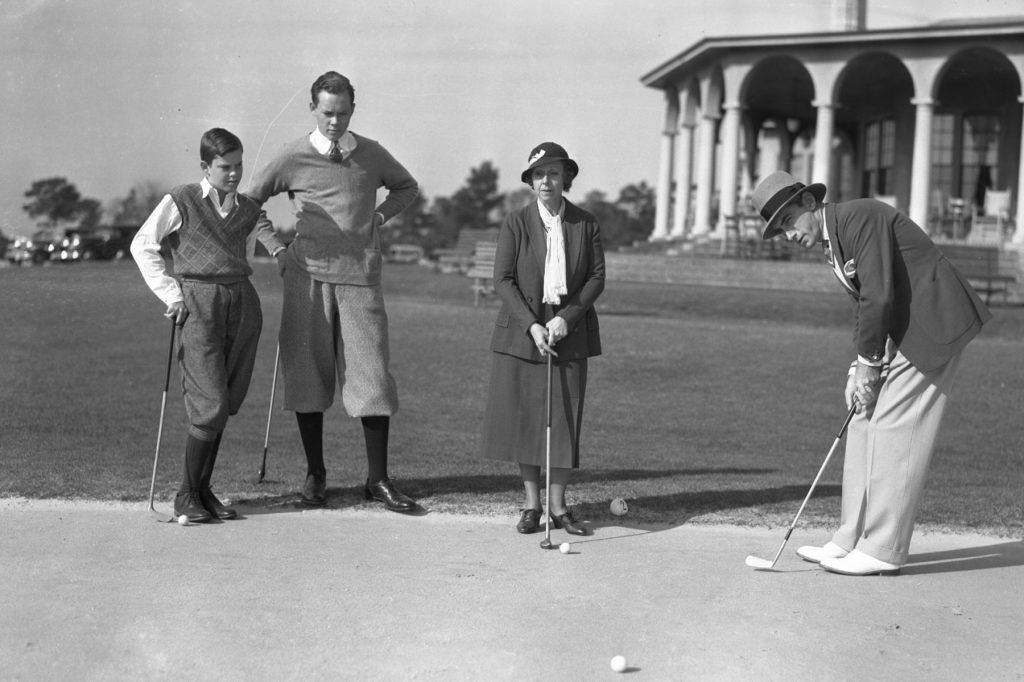
Armour began slowing things down a bit by lengthening his sojourns in Pinehurst. His affection for the town would blossom into a full-blown love affair. His first extended visit occurred in the fall of 1932. After winning  the resort’s Mid-South Best Ball Tournament with partner Al Watrous, the Armours, Tommy and Estelle, stayed over at The Carolina for several weeks’ rest before decamping to Boca Raton Hotel and Club, a winter head professional gig Armour would keep for the remainder of his life.

While in Pinehurst, the couple relaxed and socialized like any other guests of the resort. They brought sons Ben and John, both cadets at New York Military Academy, to Pinehurst for the holidays. The couple’s frequent movie attendance at the Pinehurst Theatre was dutifully reported in the Outlook. The Armours attended a dinner hosted by Southern Pines Country Club professional Emmett French, himself a three-time tour winner and runner-up in the 1922 PGA Championship. The Armours reciprocated, inviting the Frenches to dinner at The Carolina.

And, like most visitors to Pinehurst, Armour played loads of golf, generally with excellent players like French, Halbert Blue and poet Donald Parson, all reported in the Outlook. As the Armours prepared to depart Pinehurst in mid-January 1933, the paper recapped Tommy’s sensational scoring: “For a stretch of two weeks there was not one day in which Armour failed to equal or better the par of 71 for the No. 2 course. He had as low as 65 one day, this figure failing by one stroke to equal a round of his last month which tied the course mark.” And Armour revered No. 2, saying, “it is the kind of course that gets in the blood of an old trooper.”

In the spring of 1933, the Armours arrived early for the North and South and stayed two weeks after. Ben and John visited again, and Tommy played rounds with Pinehurst’s young phenom, George Dunlap Jr. Later that year, Dunlop won the U.S. Amateur, attributing significant credit for his victory to Armour. “Watching him play, of course, was a lesson in itself,” said Dunlop.

In December 1933, the Armour family once again celebrated the Christmas holidays in Pinehurst, and Armour was elected an associate member (later designated as an honorary member) of Pinehurst’s venerable golf society, the Tin Whistles. Returning in the fall of ’34, he paired with his boyhood friend Cruickshank to win the Mid-South Scotch Foursomes. After the victory Tommy and Estelle remained in Pinehurst, enjoying an array of social functions and attending the theatre, until the second week of January.

After 1935, Armour was competing only sparingly on tour. He was hired by MacGregor Golf in 1936 and, unwilling to simply sit back and endorse the company’s clubs, actively involved himself in their design. As a result, MacGregor became the industry-leading club manufacturer. “Tommy Armour” brand clubs are still made and marketed today.

Armour achieved fame as an instructor, despite delivering frequent tongue lashings to his pupils. An article by H.K. Wayne described his unique teaching methods: “His preferred style involved sitting in the shade in Boca Raton each winter or in Winged Foot each summer, with his trademark tray of gin, Bromo-Seltzers and shots of Scotch and passing judgment on his wealthy pupils, all of whom feared him.” Armour would subsequently author, with the assistance of golf writer Al Barkow, How to Play Your Best Golf All the Time, a bestseller, still in print. 

Armour continued making pilgrimages to Pinehurst. The more time he spent in the Sandhills, the more he rhapsodized about how wonderful it was to be there. His fawning quotes were undoubtedly appreciated by the resort’s public relations department. “I’ve seen strangers, jaded and dull, come to Pinehurst, and after a few days be changed into entirely delightful fellows,” said Armour. Pinehurst’s practice ground elicited quotable praise. “Maniac Hill is to golf,” he asserted, “what Kitty Hawk is to flying.”

In yet another homage, he declared, “I can’t help it. Pinehurst gets me. From morning firing practice at Maniac Hill, to vespers at the movies, Pinehurst is the way I’d have things if it were left to me to remold this sorry scheme of things entirely. . . . It’s the last in the vanishing act of fine living.”

In a sense, Armour promotes Pinehurst even today. Exhibited in the resort clubhouse’s hallway of golf history is a rotating display that provides another Pinehurst tribute from the Silver Scot. It neatly combines in one statement his sentimentality and occasional brusqueness, reading, “The man who doesn’t feel continually stirred when he golfs at Pinehurst beneath those clear blue skies and with the pine fragrance in his nostrils is one who should be ruled out of golf for life.”

When Armour came to Pinehurst in November 1938 to play the resort’s two professional events — the Mid-South Professional Best Ball and the Mid-South Open — he was semi-retired from competition. His last individual tournament victory had taken place three years prior at the Miami Open. Inspired by his surroundings, the 42-year-old rekindled his old form. Not only did he and sidekick Cruickshank tie for the best score in the best ball, Armour won the individual title, too. It would be his 25th and last PGA Tour victory.

One of the few titles to elude Armour’s grasp was the North and South. This gnawed at him both because of his love of the venue and because of the tournament’s prestige. Runner-up twice, Armour dwelled on his near misses, ruminating that “there are five traps on this course (No. 2) that have cost me the North and South five times.” He continued competing in it long past his competitive heyday. He even had a shot at victory after the tournament’s first two rounds in 1948 when his 143 total left him just three strokes out of the lead, but an 81 in round three ruined the aging veteran’s bid.

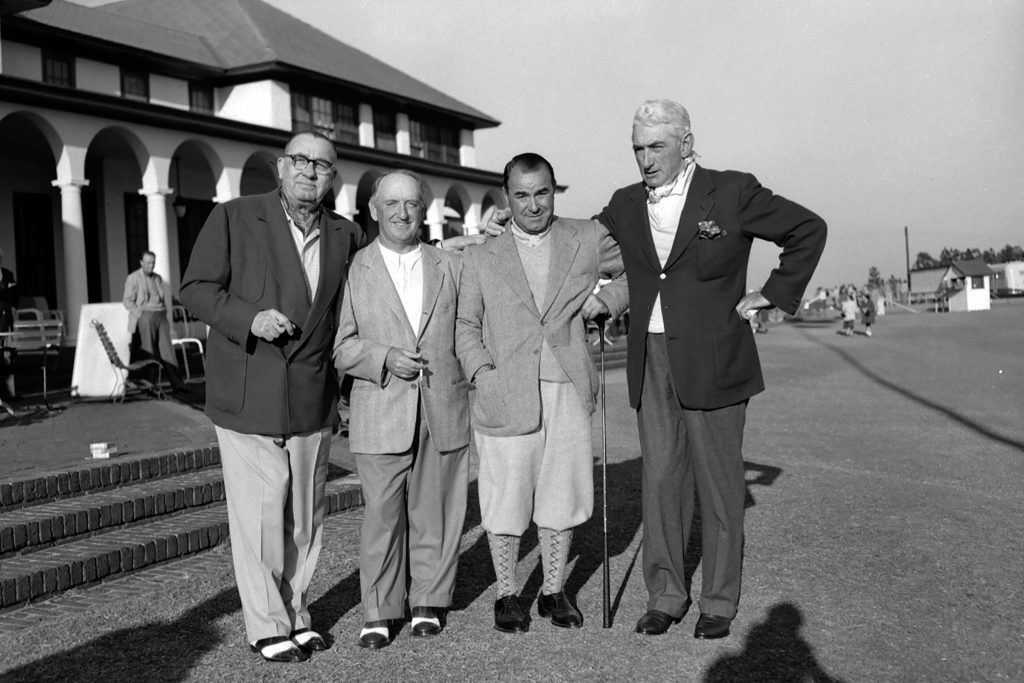
In 1951, Armour attended Pinehurst’s lone Ryder Cup. It turned into a delightful reunion for the 54-year-old. Longtime friends Hagen, Sarazen and Cruickshank were also on hand, and Armour delightedly joked and hobnobbed with the old stalwarts. When Hagen held a driver for a photo op with his fellow legends, Armour, ever the scolding instructor, pointed out, “You never gripped a club that way in your life!”

The North and South immediately followed the Ryder Cup, and Armour gave it one final try, missing the cut by two shots. The ’51 event also marked the end of the line for the North and South itself — the result of a brouhaha between the PGA tour and Pinehurst resort owner Richard Tufts. He had resisted efforts by the tour to have the amount of prize money bumped from $7,500 to $10,000 — the tour minimum. In response, several American Ryder Cuppers left Pinehurst following the matches, effectively boycotting Tufts’ event. Only one team member, Henry Ransom, completed all 72 holes. Reciprocating the hard feelings, the miffed Tufts terminated the North and South after a 50-year run.

In Armour’s later years, he kept on playing, teaching, storytelling, gin playing, gambling and cocktailing. In a 1978 Sports Illustrated article, Scottish writer and an excellent golfer in his own right John Gonella recounted an experience 30 years before when Armour hosted him at the Boca Raton Hotel. The writer was amazed at how the hotel’s management cheerily indulged Tommy’s every whim, happily picking up a multitude of expensive tabs for him and his parade of guests. After the young Gonella, short on funds at the time, and Armour teamed up to win a golf bet, Armour generously shared the winnings with his broke writer friend.

At lunch in the grillroom afterward, Armour asked Gonella if he would like to meet Walter Hagen. When the reply was affirmative, Armour called to the bartender and commanded, “Get me Hagen on the phone: Detroit Athletic Club, last stool at the left end of the bar. And bring us a phone!” According to Gonella, Tommy had Walter on the line two minutes later, and greeted The Haig with, “Hello, you old has-been. There’s a friend of mine here from Scotland I want you to meet.”

Armour, a 1976 inductee into the World Golf Hall of Fame, passed away in 1968 at the age of 71. Shortly before his death, he shared a visit with his 8-year-old grandson, Thomas Dickson Armour III. The fruit would not fall far from the tree (though perhaps skipping a generation). Tommy III became a fine player himself, winning twice on the PGA Tour and setting a 72-hole scoring record. Now semi-retired from competitive play, Tommy III resides in Las Vegas, where his reputation for living the high life tends to overshadow his golf achievements. He even has his own nickname, “Mr. Fabulous.”

Given his tender years at the time of the childhood visit, it’s understandable Tommy III doesn’t remember much about his grandfather. But it did stick in his memory that the elder Armour was very handsome and, even in the late stage of life, exceptionally strong. Those hands never weakened.

Contemporary and Comfy

CONTEMPORARY AND COMFY

Contemporary and Comfy

A modern vision for a family

By Deborah Salomon    Photographs by John Gessner

If you think an interior designer’s house should knock your socks off, you’d be right. Especially a designer with international credentials who conceived the house from the ground up and the studs out.

The designer is Liz Valkovics. The location is lakeside, in a gated Pinehurst golf community. The exterior is Carolina casual to blend with surroundings but inside is a magazine layout, contemporary in vision, curated for practicality, incorporating an ice bath and sauna for daily use and wellness events, a ground-level game room with pool table, movie screen, guest quarters and kitchenette. Because . . . sophistication notwithstanding, this house is also home to Luke, 11, Sophie, 4, and golden retriever Gus, whose fur matches the oatmeal-textured low-slung sofa in front of the glowing tubular fireplace. The result: stunning yet comfortable for a young family.

“The kids don’t have to be too careful,’’ Liz says.


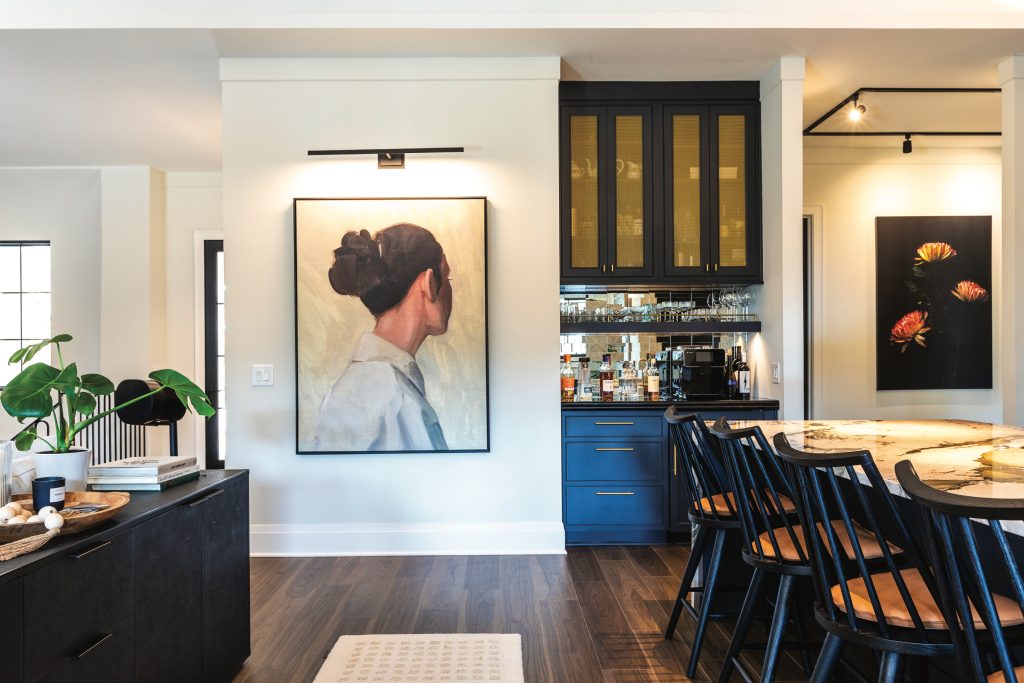
Over the mantel a frame surrounds the wall-mounted TV. The whole equals a study in earth tones with a generous nod to black, from set-in houndstooth rugs to matte charcoal kitchen cabinets and a matching Hallman (Italian) six-burner range with a grill top, where Luke and Sophie make pancakes on weekends. Even the quartzite countertops — hard as granite, beautiful as marble — have undulating waves of gray. “I’ve done a purple kitchen but this was for us, no clutter, happy and inviting,” Liz says.

Liz paints. Her choice of art, some digitally achieved, is wide ranging. A computer program that moves furnishings within a room and performs other diagnostics aid her decorating decisions. She studied and taught art, became a full-time painter, and earned a degree from the London School of Interior Design. Her specialty: hospitality venues, restaurants and commercial space. The jewel in her crown is a boutique hotel in Dubai, although she also served as creative director for a Florida hotel, worked in Baku, Azerbaijan, and undertook design projects at London’s Gatwick Airport.

Her husband, Paul, a British national, traveled the world in operations and management of sporting events, including the summer Olympics and FIFA World Cup. He also partners in his wife’s design business. Liz is from Ohio, but she met Paul in Cape Town, South Africa, a stopover on one of life’s adventure tours.

So, with world-wide connections, why choose Pinehurst for home base?

Simple. “My parents retired here,” Liz says. And it doesn’t hurt that Paul and Luke are enthusiastic golfers.

Liz and Paul absorbed the cosmopolitan feel of the area while renting a golf-front condo during their home’s construction year. It enabled Liz to participate in day-to-day decisions like the high windows and window seats flanking the living room fireplace — a space usually filled by bookcases. “It’s perfect for curling up with a book and a glass of wine,” she says. Look up: Some ceiling fixtures feature circles of small round globes, “like golf balls,” she smiles. Almost all furnishings are new, sourced from her international and High Point providers.

Some pieces qualify as both unusual and practical, like the elongated dining room table positioned on a pedestal for comfortable seating. The table is set against a wall lined with a wipe-clean leather banquette. A bench opposite provides flexible seating, while Mom and Pop chairs at either end, now reupholstered in a wild abstract, come from Liz’s family. Over the table is a row of smallish paned windows with black frames, a Liz signature throughout the house. This fluid seating arrangement in a modest space has accommodated a dozen at Thanksgiving.

Sophie’s room and the master suite opening onto a deck overlooking the lake complete the main floor, with Sophie’s bathroom doubling as a powder room.

If the main floor illustrates how Liz interprets contemporary icons, the lower level — opening onto the patio and grill — has what Liz calls a “playful feel,” beginning with the pool table. Luke’s quarters are there along with a guest room and the office for Liz’s design business. Shelves hold all the classic board games.

Here, Liz has adopted Paul’s favorite green, reminiscent of his Yorkshire childhood, on kitchenette cabinets. True, it is more jalapeño than mint, but still a pleasant surprise. Nearby stands another relic from relatives, a velvet-upholstered settee, poised as if it’s awaiting the arrival of a time-traveling Louis XIV. Wellness devotees, Liz and Paul’s home gym occupies a garage bay.

Contemporary homes and their contents are often labeled cold, stark. Not here. Who would guess that this modest, creamy white cottage located on a cul-de-sac in a prime golf enclave might, beyond the front door, reveal 3,200 square feet of family-friendly space sparked with art and design, sprinkled with whimsy?

“We tried to be respectful of the area, which meant sometimes going back to the drawing board,” Paul recalls. “Our forever home? It sure is. I plan to be buried in the backyard.”

Zeppole

ZEPPOLE

Zeppole

A Love Story

Fiction by Joseph Bathanti     Illustration by Mariano Santillan

My mother swears she’s pregnant. She wants to cook. Which she never does. In our house, my father handles the cooking. As recently as yesterday she wasn’t even speaking to us, but this baby — the baby, she says — has her happy and she wants to make zeppole. Little patties of dough fried in hot olive oil, then sprinkled with sugar. She has a craving. The way her mother used to make them. I don’t remember ever eating them, but my mother assures me I have. At my grandmother’s. But we hardly see her anymore, and I’m not certain I’d recognize her if she crashed through the roof.

My mother produces a white prayer book with a tiny lock like an antique diary’s. With a key the size of an infant’s thumbnail she opens it. Should she drop to her knees, mumbling antiphonies like those insane Calabrian widows on Good Fridays at the graveyard, I will fall over dead in astonishment, and my father will join me. But she does not pray. Rather, she takes from the prayer book’s withered secret pages a slip of frayed paper and, reading from it as she puffs on a Chesterfield, assembles the grayish-yellow mound of dough.

My father sits reading the obituaries at the kitchen table. Wearing a long white terrycloth robe with a black hex sign on the back, he looks like a prizefighter. He tells my mother that Philly Decker died and is laid out at Febraro’s.

“Did somebody shoot him or did he just eat himself to death?” she asks.

“Doesn’t mention,” says my dad.

“I thought he was too in love with himself to die. How will the world keep spinning?”

“I think we should go see him, Rita.”

“You go. I never liked him, but please tell him I said hello.”

“Your mother has no respect for the dead, Fritz,” he says to me. “Or for the living.”

He gets up and takes the newspaper into the living room. I follow him, lie on my stomach on the floor with the comics and doze off. As I sleep, the dough, hunkered in a glass bowl covered with a tea towel, miraculously doubles in size.

When I wake, I walk toward the kitchen. My mother, in a pink summer nightgown, stands at the ironing board running the steaming wedge back and forth across the collar of the black dress she’ll wear to work. The iron occasionally hisses. From the radio, volume hiked way up, Elvis Presley, in a whispery voice, sings “I Can’t Help Falling in Love with You.”

She sings along as she irons, fervently, churchy, then sways, guided by Elvis over the dance floor of dream. She has not noticed me. There are tears in her eyes. Behind her, like excelsior, sun sprays the window, silhouetting her, the gown chiseled in relief, her hair spun at her crown in filigrees, her face a marbled shadow of backlight out of which drifts a disembodied yearning not clearly my mother’s. And for that instant I am blinded and do not see until the sun flares off the Pentecostal flames from the ignited oil in the skillet raging behind her.

“Mom,” I scream. She looks up surprised and smiles, still singing unabashedly: Take my hand, take my whole life too.

Then she turns and sees the fire licking at her. She grabs the wooden skillet handle. The flames leap from the skillet to her gown, pour over it like liquid, and she is instantly engulfed. The music like requiem, Elvis Presley like the cantor at High Mass looping incense over his mesmerized flock as the church burns down. I can’t move. I can’t take my eyes off her, no longer my mother, like sacred art restored, an angel wedding fire.

My father storms by me and scoops up my mother. He kicks open the screen door. There is an audible suspiration as he too catches fire, stumbling down the three concrete steps to the yard where he drops her, still clutching the spouting skillet, in my swimming pool, then simply steps out of his fiery robe and leaps in the water beside her.

The pool has sat in the little yard all winter. Leaves float on its surface. Neighborhood dogs drink out of it. The blue plastic bottom, patterned with yellow cartoon fish with long-lashed eyes and huge puckered lips, is slick with algae. The round aluminum frame is caving.

Unharmed, my mother and father sit next to each other in the pool. Laughing. She in what’s left of the charred pink gown. Bit by bit it falls off her body and floats on the water like scraps of flesh. My father is naked. Together they splash water on his burning robe until the flames die down, and there is the sodden smell of fried terrycloth, the nubs at the end of each thread brown on white like blackened marshmallows.

Side by Side

SIDE BY SIDE

Story of a House

Side by Side

When home is next door, too

By Deborah Salomon 
Photographs by John Gessner

A Pinehurst palace outfitted with the accoutrements of fine living was not what Cathy Vrdolyak and spouse Marilyn Barrett, both successful Chicago professionals, sought in 2013. They wanted a retreat, a vacation home, something as low-key as their three-level, 3500-square-foot loft in a historic Chicago industrial building was top-echelon.

Golf and climate factored in, given the Windy City’s often brutal winters. Barrett knew the area; her father, a lawyer and musician, had performed and later retired to the Sandhills. What they found — a neglected cottage bordering a public works facility, probably built to house a tradesman’s family — became the rock from which they chiseled a mini homestead, unique in having wooden pegs instead of closets and a few refrigerated drawers instead of a hulking Sub-Zero.

Really? No closets? Classic utensils but no refrigerator? Not necessary, they decided, for a cuisine based on farmers’ wares, homegrown produce and a simple but interesting menu. Once completed, Barrett said the interior was “like walking into a hug.”

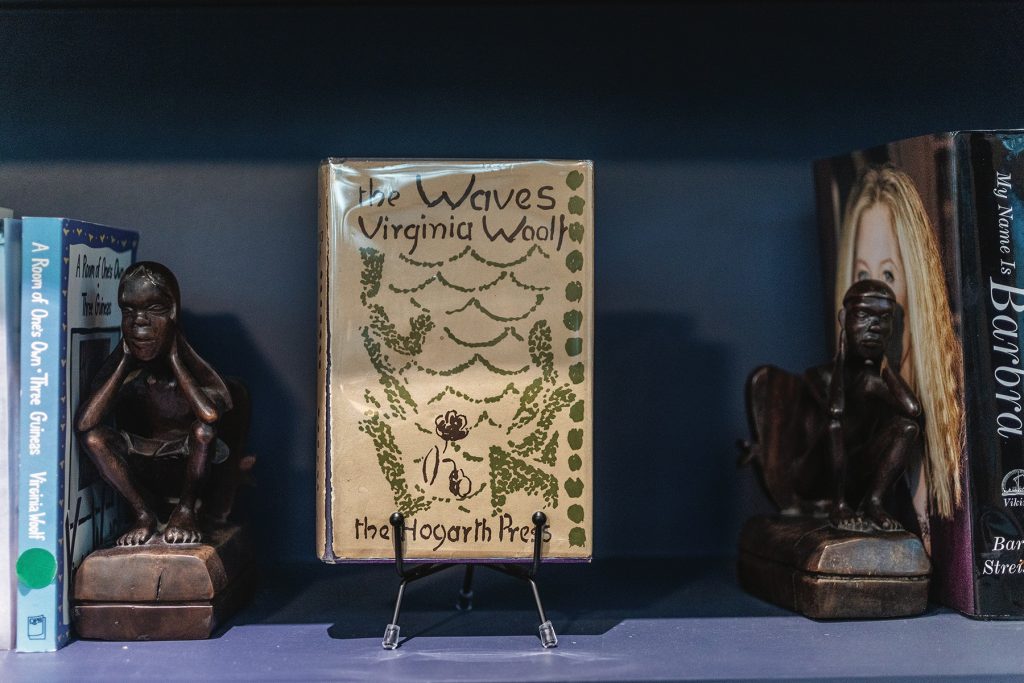
The women named their getaway, renovated by Pinehurst architect Christine Dandeneau, “Bloomsbury Cottage” after the literary coterie formed in the early 20th century that included British feminist author Virginia Woolf. The cottage layout and contents became the palette for the designer.

“She got it,” Barrett says of Dandeneau’s plans.

In addition to the cottage, Vrdolyak and Barrett have compact freestanding studios overlooking the gardens, lap pool, deck and a tall brick Croatian barbecue-oven.

Nearly a decade of weekends and vacations passed happily at Bloomsbury. Retirement loomed. The cottage has two tiny bedrooms and a loft accessed by a steep ladder, a tough ask for the nimblest houseguest. Besides, their elegant furnishings and collections from the Chicago loft needed a proper home.

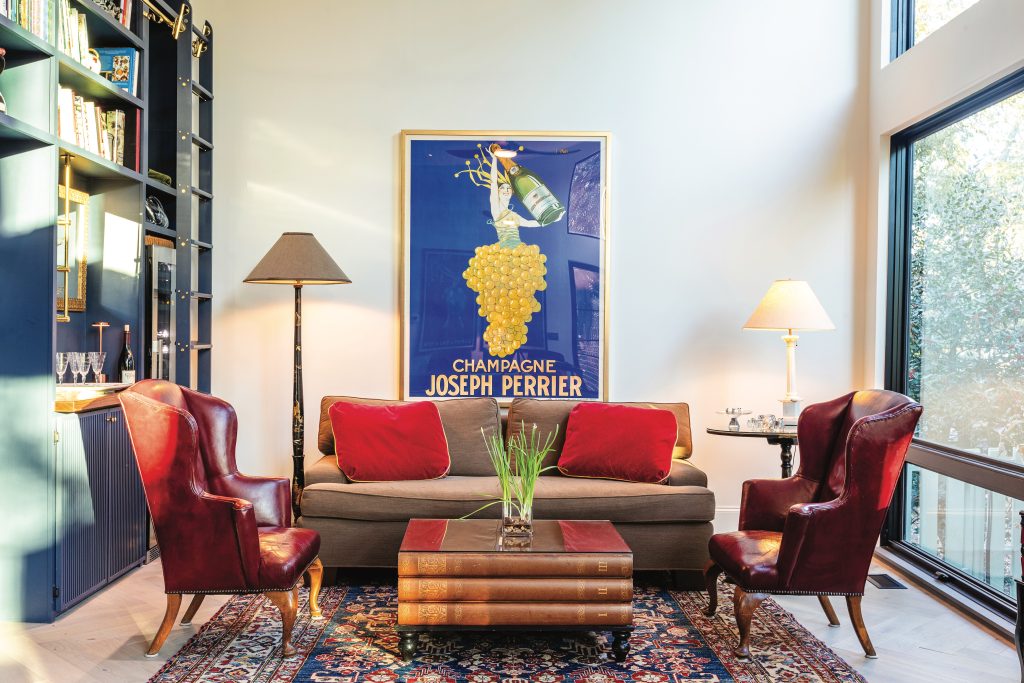
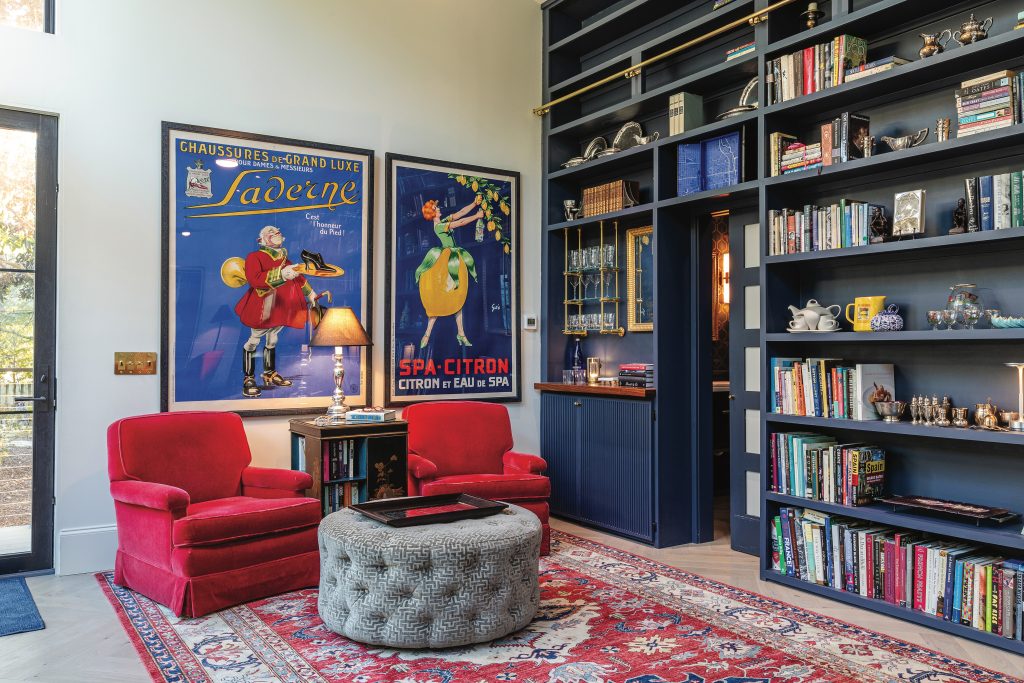
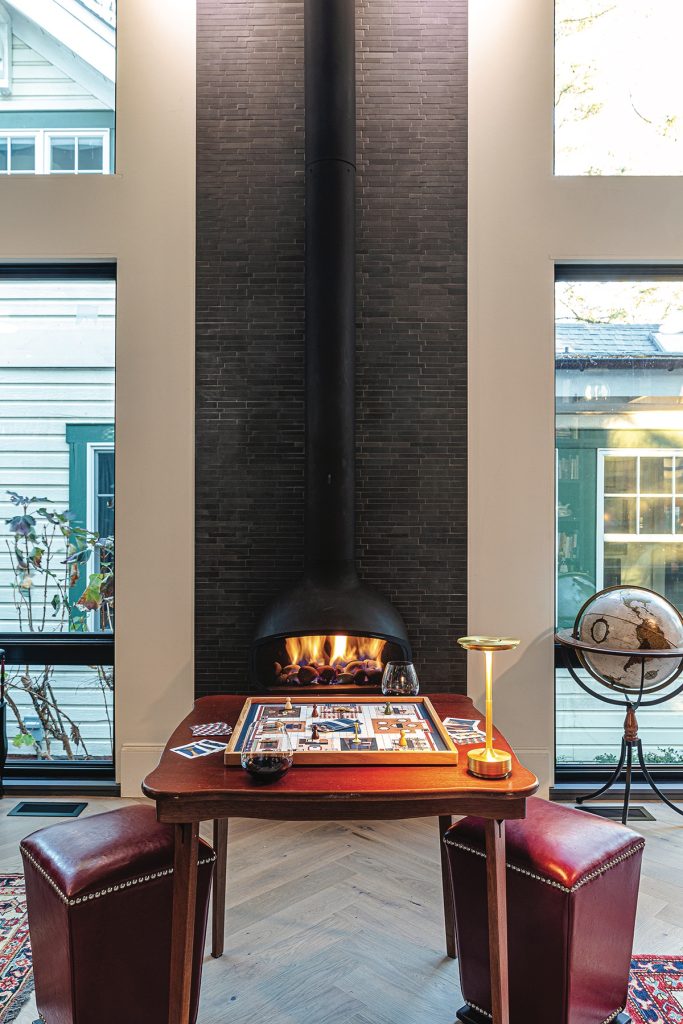
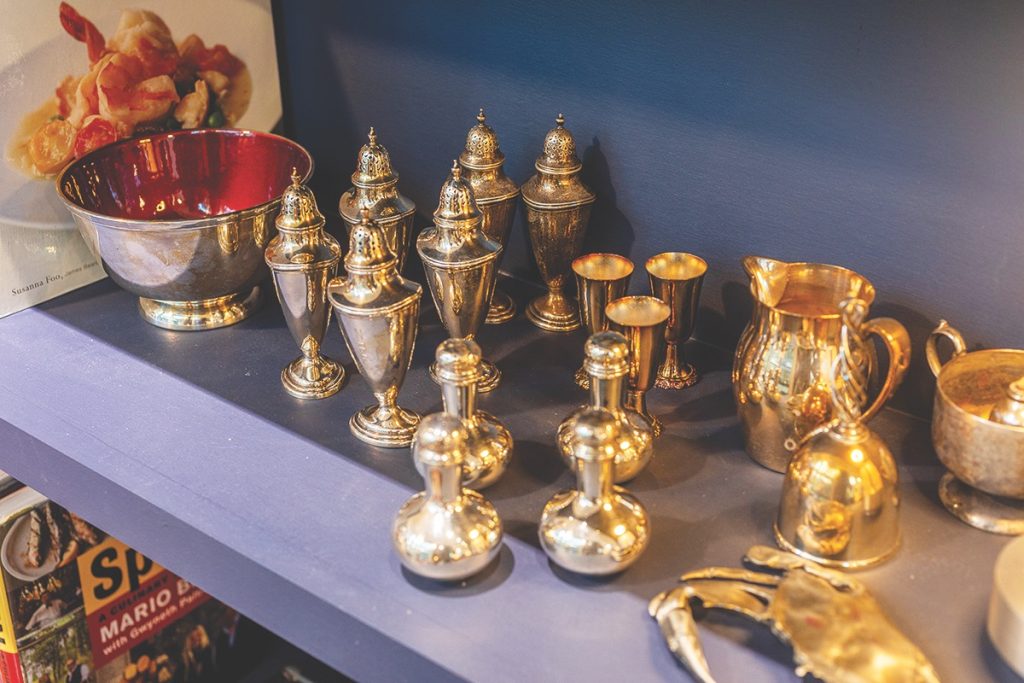
As usual, the possibilities ran perpendicular to the norm. Maybe build a unit beside, but not connected to, the cottage, on the sliver of land tucked between Bloomsbury and the public works fence? Call it The Salon, in keeping with the European theme. Give it a 16-foot high wall of windows, a statuesque gas fireplace with exposed stovepipe and whitewashed wood floors laid in a chevron pattern. Opposite the window wall, construct shelves displaying dozens of cookbooks plus New York Times besties, writings of Virginia Woolf, crystal objets and, in the center, a bed that unfolds out, not down. Include a full bathroom, an ice machine, hot plate and, most importantly, a well-stocked wine refrigerator.

Here, detail-oriented CPA/attorney Vrdolyak calls attention to a barely discernable chevron pattern lining the sink and its handsome brass hardware that coordinates with the chevron floor. Their cottage may lack closets but The Salon, in addition to creativity and quality, offers ample storage.

The idea of a separate dwelling unit intrigued Dandeneau, who recognized it as part of a trend, limited in square footage but not in usage. “They are lovely clients who build with character,” Dandeneau says, “and they’re not afraid.” She was able to overcome a glitch locating the wall-hung fireplace but fulfilled her clients’ desire for a multi-purpose space suitable for social occasions as well as sipping mid-morning tea. The location screens The Salon from street view, not that theres much traffic anyway.

Its predominant color is a dusty navy blue — drawn from the blue, crimson and yellow in the area rugs — that offers a striking background for oversized French wine posters, some liberated on their travels, and adored by Barrett.

“They were advertisements and I was in advertising,” she says. “So vibrant, they make me happy.” Two red velveteen, 1940s-ish easy chairs from Barretts’ parents’ home, further the retro mood. What better setting for a dinner party, game night, business meeting, or book club?

“It’s as though you’re going into a different era,” Vrdolyak says of The Salon décor. “Even the dogs come running, as though they’re going to another place.” Barrett, who practices yoga there, is still able to glance from her mat into the cottage through aligned windows. “It’s like getting a break from the everyday,” she says.

This side-by-side life “is definitely not for everybody,” says Barrett. But who cares? The concept, its execution and livability, is definitely for them.

The Hunt for the Guv

THE HUNT FOR THE GUV

The Hunt for the Guv

Caught between a rock and a lost place

By Jim Moriarty

As it turns out, what you really need in the search for a forgotten grave in the woods is an archivist. As luck would have it, I sleep with one.

Ordinarily this woman’s field of expertise is confined mostly to the history of Pinehurst and a cast of characters whose final resting places are widely known. But when you’re looking for a spot last viewed — to the best of our knowledge — 50 years ago, marked only with a fieldstone, you need all the help you can get.

The grave we were seeking belongs to Marble Nash Taylor, a man who was the governor of North Carolina — or posed as the governor of North Carolina — from sometime in early November 1861 until Abraham Lincoln appointed Edward Stanly the military governor of the state on May 27, 1862. Taylor was the Methodist minister at the humble wooden church on Hatteras Island — the old building is long since gone — when he more or less elevated himself to this lofty post in the wake of the successful amphibious landing of Federal troops there on August 28, 1861. In rather short order, the Union Army spread its dominion over all of the Outer Banks.

Following the appearance of the troops, a “constitutional convention” — accompanied by flowery declarations covering perceived injustices of every imaginable sort — was spearheaded by three men, most notably, Rev. Taylor and his chief ally, Charles Henry Foster, a lawyer and journalist. Taylor is sometimes apocryphally referred to as the man who was governor “for a day,” though his term of office, clearly, was rather more prolonged. This did not happen through the kind graces of the Great Emancipator in Washington, D.C., who wanted absolutely nothing whatsoever to do with either Taylor or Foster.

Finding the general area where the reverend’s earthly remains reside was deceptively simple. In the book A Guide to Moore County Cemeteries, compiled by Anthony F. Parker and published by the Moore County Historical Association, the author gives detailed instructions: down such-and-such county road for 1.2 miles; take the “woods” road 3/10 of a mile to a clearing; walk the fire break north for 150 yards; the site is 100 yards east on top of the highest hill, marked at the time with two wooden knots. Parker was led to the grave in 1975 by Moses Jackson, who hunted the land and knew the location well. Before leaving the spot, Parker marked it with a simple fieldstone.

Of course, the problem with 50-year-old directions to a lonely place in the woods is that, well, they’re 50 years old, and the woods haven’t stopped growing.

The first thing I thought of was to call someone in the North Carolina Forestry Service’s Moore County office. There was an old, no longer in-service fire tower where the county road intersected the main highway, roughly 1.2 miles and this and that from Marble Nash Taylor’s grave. Maybe, just maybe, someone there would know of a modern day Moses Jackson who could be my sherpa.

The laughter at the other end of the line when I spoke with a gentleman at the Forest Service was, if not audible, palpable. It was summer. It was hot. We were in drought conditions, and he seemed rather more concerned with wildfires than dead governors, which is how I came to rely on the services of my resident archivist.

I ordered a pair of orange Day-Glo high visibility reflector vests. If we were going to go traipsing around in the woods in northern Moore County it made a certain amount of sense to take whatever precautions seemed prudent to avoid getting shot. We had little trouble finding the “woods” road off the county road, and we drove to the end of it, where there was a gathering of modest dwellings. At the home closest to where we thought we might find the good reverend, I knocked timidly on the door. No response. I turned to leave. The archivist, whose Day-Glo vest hung on her like a shiny minidress at a disco party, was not nearly so faint of heart. Her pounding could have raised the dead all by itself.

A delightful and friendly, if somewhat perplexed, lady came to the door. The archivist produced an official-looking business card. The house’s occupants knew nothing of Marble Nash Taylor or his remains; however, they did allow as how we could park our car in their yard while we searched. The archivist and I walked back up the hill toward its highest point.

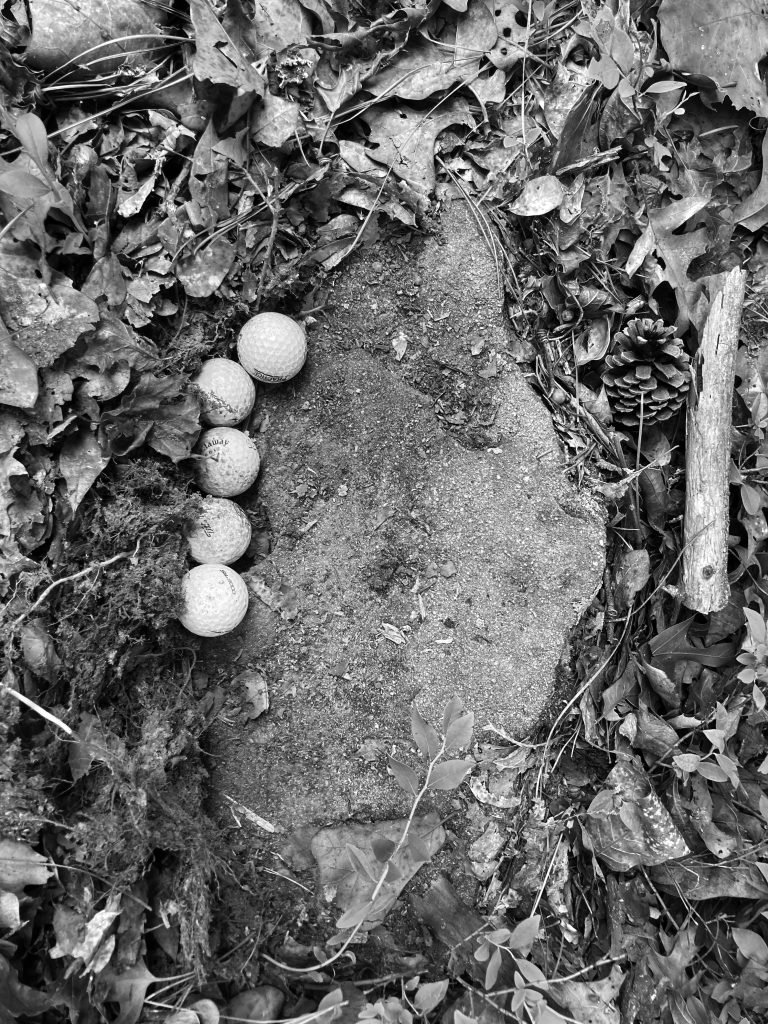
The wide fire break described by Parker in his book survives with modern power lines running through it. Someone had been using this long cleared strip as sort of a rural Topgolf, providing a narrow chute to practice power fades, though judging from the age and condition of the golf balls we found, whoever it was hadn’t been working on their game much lately. Several of the balls bore the markings of Forest Creek Golf Club. Certainly the “forest” part fit.

If the fire break still existed 50 years on, the clearing didn’t, so the archivist and I split up, slashing our way through overgrowth in what we believed to be the general area of the governor’s grave. As densely wooded as it was, one thing that it was not was rocky. You couldn’t find so much as a pebble, much less a fieldstone, in this patch of the Sandhills.

Scratched by tree branches and dripping sweat, with my patience running thinner than the governor’s resume, I was ready to abandon our search. My mind began wandering to lunch at the Pinehurst Brewery and rehydrating with an 1895 lager when the archivist called out. She’d found a very large rock indeed. The truth is, we could have combed those woods for days and would have been more likely to find a marble sculpture by Donatello than another stone like it. Without hesitation, I proclaimed this large, flat rock none other than the fieldstone marking the grave of Marble Nash Taylor, governor of the great state of North Carolina, or at least the Outer Banks.

So how, you may ask, did the right Rev. Taylor wind up in Moore County anyway? The truth is, there is more lore than there are facts. Though Taylor’s public duties, such as they were, never actually required him to leave the Outer Banks — he did make one fundraising trip north — his associate Foster did, in fact, travel to Washington, D.C., and attempt to be seated as a representative of North Carolina’s second district. He was laughed off the floor of the House of Representatives. In a letter to Lincoln’s Treasury Secretary Salmon P. Chase, one person described Foster as “an unprincipled scamp and cheat.” In March 1862, a journalist from Boston traveled to Hatteras, where he found Taylor who, by then, had more or less gone back to being nothing loftier than a Methodist minister.

This did not, however, prevent others from voicing their disapproval of the ersatz governor. The Richmond Dispatch, reprinted this from the Norfolk Day Book:

“Marble Nash Taylor is one of the most despicable of the human family — hated alike by God and man, and for the reason that he employs the garb of religion to cover the rottenness of his depraved and corrupt heart. So pious did this treacherous hypocrite become at one time, that nothing would do but that he must preach the gospel. . . .He was found to be a black-hearted hypocrite who desecrated the name and character of the minister of God, and he was speedily ousted from the Conference, and his license to preach taken away from him. (According to the State Archives of North Carolina Taylor is mentioned in the minutes of the Dec. 6, 1861 meeting of the Methodist Episcopal Conference, presumably not in a flattering way.) . . . This is the scamp who dares to issue a proclamation to the people of that good old State, calling upon them to become as base and perfidious as himself.”

Though it seems that Taylor stayed on Hatteras Island preaching the good word until the end of the Civil War, during Reconstruction he was appointed “keeper of the poor house” in Fayetteville, where he stayed for roughly 15 years. Sometime around 1880 he moved to Moore County, where he sold peach trees and lived in a shack constructed of the castoffs from a sawmill. He died in 1894, remembered as a “dour” man who was addressed as “governor” right up to the end.

The Krewes of Moore County

THE KREWES OF MOORE COUNTY

The Krewes of Moore County

Photographs by Tim Sayer

Produced by Brady Gallagher

New Orleans has been celebrating Mardi Gras almost since the city was founded in 1718. By the late 1830s there were street processions of horse drawn carriages, gaslight torches and masked members of what would become a growing number of carnival societies, the forerunners of today’s krewes. Masked celebrants reveled in their anonymity, no longer bound by social strata. They were free to be whoever they wanted to be and to mingle with whoever they wanted to mingle. With each succeeding year, its krewes and parades, its magic and mystery, grew. The Mardi Gras colors — purple, gold and green — stood for justice, power and faith. If you’ve ever seen a jazz funeral in the French Quarter, you know that no place on Earth handles tragedy and loss the way they do in New Orleans. While the krewes of Moore County may not be parading through the French Quarter, they can be there in spirit.

First Impressions

FIRST IMPRESSIONS

First Impressions

A home with a sunny disposition

By Deborah Salomon    Photographs by John Gessner

Who says you can’t tell a book by its cover? Or, for that matter, a house by its façade?

This one — with bright yellow clapboards, bumpy fieldstone walkway and fanciful front porch — almost shouts “Welcome!” from the end of a long wooded driveway opening onto a busy road. Carry-On Cottage, its name posted on a tree, was built in 1937, and sounds as upbeat and admired as one of its previous owners, Miss Hall, a legendary fourth-grade teacher.

Further provenance is unnecessary. Given the enthusiasm and skills of owners Linda and Larry Wolf, how could living there not be a sunny experience?

Linda and Larry were high school sweethearts in Connecticut, married during college, lived in Boston, then on Linden Road in Pinehurst. Larry, fit and perpetually tanned, directed tennis programs at Pinehurst Resort and elsewhere. Linda attended the New York School of Interior Design. Renovation spins their wheels. They bought Carry-On Cottage in 2005. “A home base for our three kids,” Linda explains, as well as a project worthy of their skills.

The three kids now arrive with five grandkids to an expanded homestead that fairly oozes personality expressed in bright colors, family memorabilia, Design Market “finds” like metal end tables painted bright red, and the occasional surprise: Linda points to two interior split (“Dutch”) doors, left behind by an owner with tall dogs who objected to being shut away. A framed sign from The Tennis General Store recalls a previous business venture. A tiny table set for chess reminds Larry of his parents, and a stormy seascape by son Tyler represents Linda’s bout with chemotherapy.

Renovations, as expected, went way beyond cosmetic. All systems needed replacing. The one bathroom begged an upgrade but in 1930s black and white, with beadboard panels. Two additions happened at separate times. The first resulted in a small TV den adjoining the kitchen, the other a master suite/sitting room/spa bathroom. New window frames were made to match the old. Hooked rugs over original knotty pine floors add character, as do glass doorknobs. The armoire was rescued from the Pinehurst Hotel, painted black and distressed, while the carved settee came from grandparents.

A four-poster bed, antique quilts and family photos complete the retro charm.

Linda didn’t shy away from splashy floral upholstery in the living room, the colors echoing her and Tyler’s paintings, several depicting their favorite hydrangeas, others Cape Cod scenes mounted on deep-turquoise walls, a color furloughed from the modern décor palette.

For Larry, wood is a hot topic. Tennis, it seems, isn’t his only game. Observe the massive, rough-hewn corner cupboard in the small TV room. “I made it for the children’s toys,” Larry says, with modest pride. He also made their dining room table, a patio picnic table and a long bench. The edge of his low coffee table bears teeth marks left by the grandchildren. Other handiwork, Linda says, “was made to look old,” while some light fixtures surely arrived by FedEx.

For the last century renovators have come to lavish space and funds on kitchens. Jumbo appliances circling islands weren’t an issue in the thrifty ’30s. Linda and Larry’s kitchen, a carefully planned second renovation completed during the COVID shutdown, is a small pass-through done in black and off-white, with a two-seat breakfast bar. For this cooking couple, more important than the latest gadget is a cookbook written and illustrated by the Wolf children, a compilation of their Grandma Bonnie’s recipes. Sausage gravy, anyone?

Despite the attention lavished on the interior Larry calls the cottage an “outside house” where, weather permitting, Christmas brunch is served on the patio. His al fresco activities include replanting donated dead chrysanthemums which, few people realize, are perennials that will bloom again. Larry’s raised beds yield tomatoes and peppers, which he pickles.

The Wolfs, soon celebrating their 50th anniversary, have accomplished what many couples desire without achieving: “This will be our retirement home,” Linda says. A manageable size, convenient location, repository of cherished family artifacts, informal and sturdy on a big lot with a firepit and a shed.

To seal the deal, the exterior glows an appropriate sunshine yellow. Now who says you can’t judge a book by its cover?

Writer’s Retreat

WRITER'S RETREAT

By Bill Case

In 1938 John P. Marquand’s breakthrough novel, The Late George Apley, won him the Pulitzer Prize. From 1939 until his death in 1960 at age 66, six Marquand novels cracked the top 10 in annual sales. No author, including Ernest Hemingway and John Steinbeck, surpassed his output of bestsellers in that time frame. During Marquand’s heyday, he appeared on the covers of Time and Newsweek magazines, and Life magazine labeled him “the most successful novelist in the United States.”

Thus Pinehurst was abuzz in early 1956 when it was learned the famed author was staying in town for the winter. Convinced there was more October-like weather during colder months in Pinehurst than anyplace else, Marquand rented a house for the season — Nandina Cottage —and would purchase it three years later. He described its location as “the first house on the right after the double road becomes a single road, coming in from Southern Pines.”

The writer became enamored with the Sandhills during monthlong visits in 1954 and ’55 when he lodged with old friends Gardiner and Conney Fiske, Bostonian patricians who wintered in Southern Pines. The Fiskes’ home, called Paddock Jr., was in horse country. Conney rode in hunts (sidesaddle, no less) with the Moore County Hounds. Friends since 1912, John and Gardiner met as undergrads at Harvard University, where Marquand wrote for The Harvard Lampoon and Fiske served as the magazine’s business manager.

Though the Sandhills constituted a relaxing change of scenery for Marquand, he did not curtail his writing. His early morning hours in Pinehurst were invariably spent working on new pieces. “As of this week,” noted a reporter who interviewed the author for The Pilot in February 1956, “he has just finished a serial for the Saturday Evening Post — which required a trip to the Orient last year. He has ‘almost finished’ an introduction to novels of his that are being reprinted; he is doing a couple of pieces for Sports Illustrated magazine; and he’s getting ready to start a new novel: subject undisclosed.”

For roughly 10 days each month, family matters and business dealings necessitated Marquand’s departure from his “fairly quiet life” in Pinehurst for trips to Cambridge, Massachusetts and/or New York City. He owned a home in Cambridge, where his second wife, Adelaide, spent the bulk of her time, sans John. On visits to New York, Marquand conferred with representatives of his publisher, Little, Brown and Company. While in the city, he generally bunked in with longtime friends Carl Brandt and his wife, Carol.

Brandt, Marquand’s literary agent since the early 1920s, helped jumpstart his client’s career by arranging for regular placement of his early short stories in the Saturday Evening Post, Cosmopolitan and other magazines. Both Carl and Carol (also a literary agent) contributed to Marquand’s climb to the top rung of authors by encouraging him to write novels. Carol also assisted John’s writing by persuading him to orally dictate his musings to a secretary.

Marquand’s most successful novels, including his Pulitzer Prize winner, contained heavy doses of satire. Several targeted the perceived foibles of New England’s old guard upper crust — the pomposity, clannishness, snobbery, excessive focus on family history and devotion to exclusive social clubs. While Marquand’s characters also shared some redeeming qualities, Boston Brahmin types nevertheless resented his portrayals.

When asked whether he might someday be tempted to write unflatteringly about Pinehurst and its residents, Marquand responded that the prospect seemed unlikely, adding that he “could perhaps some time write a book about Pinehurst — but then I’d probably not be able to come back here again.”

On the surface, Marquand seemed to possess the same deep roots of the very bluebloods he satirized. He came from old-line stock, his ancestors arriving in the Colonies in 1732, settling in Newburyport, Massachusetts. There was family money, at least at first. The early generations of Marquands operated a thriving shipping business, so successful that John’s great-grandfather worried his wealth had become an embarrassment to his Puritan nature.

The writer’s grandfather, also named John P. Marquand, made his mark as a New York stockbroker and investment banker. When he passed away in the 1890s, each of his six children, including the author’s father, Philip Marquand, inherited approximately $100,000, a tidy fortune at the time.

With the proceeds of that bequest, Philip purchased a seat on the New York Stock Exchange, and life was luxurious for Philip, wife Margaret, and young John in their spacious Rye, New York, home. The Marquands employed a cook, maid, coachman and a nanny. But when the Panic of 1907 upended financial markets, Philip lost everything, including his seat on the exchange. The family’s upscale lifestyle came to a screeching halt. As John remarked later, “I was just a little boy living comfortably with my parents, and the rug was pulled out from under me.”

Philip, having been trained as an engineer, decided his best chance for a financial rebound was to seek employment on the West Coast, but he and Margaret concluded it was not financially feasible for their son, then 13, to accompany them. Thus it was arranged in 1907 for John to live with his two maiden aunts (Bessie and Mollie) and grand-aunt (Mary) in Newburyport at Curzon Farm, a family homestead built by the prior generation. It had survived tough economic times thanks to the frugality of the aunts, who, perhaps, lived a bit too parsimoniously, since the dilapidated Curzon Farm was in dire need of repairs throughout Marquand’s residence.

During that time yet another aunt, Margaret (aka Greta) Hale, frequently visited Curzon Farm along with her six children. Greta was the wife of Herbert Hale, the son of Unitarian theologian Edward Everett Hale, author of a classic 1863 short story, “The Man Without a Country.” Coincidentally, Edward Hale also had connections to Pinehurst. At the behest of village founder James Tufts, he conducted nondenominational church services, a religious forerunner to what would become The Village Chapel.

Marquand befriended his Hale cousins, but quickly became aware of the economic disparity between them and himself. Enrolled at prestigious private schools, the cousins enjoyed vibrant social lives. By contrast bookish and shy, John attended the local Newburyport High School and had few social outlets. His tight-fisted aunts exacerbated his discomfiture by informing him he would never be able to afford life’s niceties.

Marquand was a good enough student to earn a scholarship to Harvard University, beginning in the autumn of 1911. Though he aspired to be a member of one of the university’s famous social organizations, such as the Porcellian Club, founded in 1791, none asked him to join.

Marquand would later satirize the Harvard clubs for their pretentiousness, but by the same token, he grudgingly admired the traditions and sense of kinship the clubs promoted — an ambivalence reflected in his novels. Though later referring to himself as a “poor social outcast” at Harvard, Marquand’s time there could not have been all bad. Writing for the Lampoon carried weight on campus.

After graduating in 1915, Marquand landed a position as a reporter with the Boston Transcript newspaper, earning $15 a week. He fell in love with and devotedly courted the beautiful Christina Sedgwick, progeny of a legendary Boston family — the very sort Marquand would later skewer. The young man was awestruck upon learning that Christina’s uncle, Ellery Sedgwick, was editor of Atlantic Monthly. He could not imagine a lowly hack reporter like himself ever writing anything worthy of publication in Uncle Ellery’s highbrow magazine.

Perhaps to impress Christina, Marquand joined a local National Guard unit — Battery A of the Massachusetts Field Artillery. In June 1916, his unit was ordered to Mexico to pursue the bandit Pancho Villa. Marquand made more friends in three months in Battery A than in his four years at Harvard. During his time on the border, he developed a gift for oral storytelling. His histrionic and comic presentations induced sidesplitting laughter from fellow soldiers.

When America was drawn into World War I, Marquand joined the Army. In contrast to his Mexican experience, bloodshed and death surrounded him on the fields of France, though he managed to return from the war physically unscathed.

After discharge from the Army, Marquand headed to New York with hopes of earning an income that would persuade Christina to marry him. To save money he lived with his Hale cousins. Following a brief stint as a Sunday feature writer for the New York Herald, Marquand entered the field of advertising, pitching slogans for Yuban Coffee and Lifebuoy Soap. But he despised the ad world and began considering whether he could make a living as a writer.

After observing that many fictional pieces appearing in the post-war magazines were “about a man of low social standing who falls in love with a girl who’s socially above him,” Marquand submitted a short story with that theme to the Saturday Evening Post. To his surprise, they bought it. To build on this triumph, he retained Carl Brandt, who assisted in placing more stories, generally for $500 apiece. Eventually Marquand segued to the writing of mystery stories, featuring Mr. Moto, a Japanese secret agent specializing in solving international crimes.

Marquand asked Christina to marry him several times during their seven-year courtship, though she, concerned they could not live comfortably on his writing income, put him off. When Marquand (with Brandt’s aid) sold a serialized novel in 1922 to Ladies Home Journal for $2,000, she consented. The newlyweds settled on Beacon Hill, Boston’s high society section, and would parent two children.

The marriage encountered turmoil almost from the start. Christina was needy and John was impatient with her, particularly when she interrupted his work. So that he could write in peace, he rented a small room on Charles Street. To further avoid his wife, Marquand frequently bivouacked with the Fiskes at their Beacon Hill apartment.

Christina’s mother compounded the couple’s conflicts, disparaging her husband’s writing, labeling it cheap pulp fiction — hardly writing at all! “Why,” she wondered out loud, “can’t John write something nice for Uncle Ellery at Atlantic Monthly?” In fact, the Atlantic paid its contributing writers a pittance compared to the sums other publishers were doling out for Marquand’s potboilers.

John and Christina divorced in 1935. By then, Carl Brandt had married Carol. Marquand’s best friends were now two married couples — the Fiskes and the Brandts. In his biography The Late John Marquand, Stephen Birmingham writes that Marquand “enjoyed being the third point in a triangle that included a happily married couple . . . In these triangles he felt safe, comforted, loved — and assured of free lodgings, which he definitely appreciated.”

It was during the breakup of his marriage that Marquand began work on The Late George Apley, his satirical portrait of Boston’s upper class. To make sure he was headed in the right direction, he sought critical advice from Conney Fiske. Her insider’s knowledge of Old Boston and awareness of both the frivolities and positive attributes of her class helped temper Marquand’s occasionally derisive tone. Conney would continue to play a sounding board role for Marquand throughout his career.

Set in the 1930s, The Late George Apply is the story of a wealthy gentleman, John Apley, who asks the undistinguished Boston author Horace Willing to write a no-holds-barred biography of John’s recently deceased father, George Apley. The request presents a dilemma for the fictional Willing, having been a friend of the deceased and thus naturally reluctant to disclose any unflattering details of Apley’s life.

Willing tells the story in epistolary fashion, quoting correspondence from his friend’s personal papers. Against all mores of upper crust (and Protestant) Bostonians, Apley courts a lovely Irish Catholic girl, Mary Monahan. This sort of departure from the natural order of things is, however, doomed on Beacon Hill. Apley is unable to resist societal pressures and abandons the relationship. Willing, a bigger snob than his deceased friend, unsurprisingly approves of this decision, characterizing the dalliance as “a youthful lapse” on George’s part.

In a telling letter quoted by Willing, Apley admonishes his Harvard student son, John, that nothing, including the achievement of good grades, is more important than joining a  prestigious club — an obvious reference to Marquand’s own Harvard experience.

In the letters the Beacon Hill elite stick together, travel together and attend the same schools. They tend to avoid contact with outsiders — even wealthy ones — if they lack a Back Bay connection. Though pointing out the pomposity of all this, Marquand subtly expresses admiration for the positive qualities of George Apley: strong support of public and charitable activities, adherence to tradition, and unflinching loyalty.

While the book was no potboiler, it brought Marquand to the attention of more intellectually inclined readers than those of his Mr. Moto series. When he was announced the winner of the 1938 Pulitzer Prize — besting Steinbeck’s Of Mice and Men — his ex-mother-in-law must have been aghast.

In the same year he divorced Christina, Marquand met Adelaide Hooker on a visit to China. He was immediately attracted to her and, presumably, to her family legacy as well. Her direct ancestor, Thomas Hooker, founded Connecticut. Adelaide’s father headed an electrochemical manufacturing company, and her sister was the wife of John D. Rockefeller III. John and Adelaide would marry in 1937 and parent three children. However, Adelaide’s personal ambitions and insistence on involving herself in John’s business affairs aggravated him. She, in turn, suspected John of unfaithfulness, and not without cause. Over their 22-year marriage, mutual bitterness increasingly characterized the couple’s relationship. As he had with Christina, John sought escape, often in the companionship of the Fiskes and Brandts.

Though domestic tranquility proved largely illusive for Marquand, financial success was not. His follow-up novel, the New England-themed Wickford Point, placed fourth on the bestseller list for 1939. Though cast as fiction, the book appears to be a thinly veiled satirical reprise of Marquand’s childhood experiences at Curzon Farm. The members of the novel’s Brill family are recognizable stand-ins for John’s quirky, shabbily gentile aunts, and legacy-conscious Hale cousins. The book’s protagonist, Jim Calder, seems a dead ringer for John.

Marquand turned to the ominous backdrop of World War II to frame his mid-1940s novels. So Little Time, published in 1943, ranked third in the bestseller list that year. The story deals with Americans who could not bring themselves to confront the likelihood of war in the uncertain period leading up to Pearl Harbor. The author followed this success in ’46 with another sales hit, B.F.’s Daughter, in which the rebellious daughter of a conservative tycoon (B.F.) leaves her good-guy boyfriend to marry a left-leaning scholar. Enhancing the melodrama is the former boyfriend’s death in the war. Conflicts galore follow.

When World War II ended, many returning G.I.s chose business careers to achieve success and financial security. Marquand, observing a downside in climbing a company’s organizational ladder, authored Point of No Return in 1949. The plot centers around the question of whether the fictional Charles Gray will win a promotion to vice-president of the bank. While his wife, Nancy, desperately wants it to happen, Charles is ambivalent. Disillusioned by the rat race and feeling looked down upon by the town’s elite, he is certain that obtaining the vice-president position will not lead to happiness. Nevertheless, when he ultimately receives the promotion, Gray dutifully accepts it. Life goes on, albeit unsatisfactorily. Marquand’s rather dreary ending suggests that the Charles Grays of the world are powerless to resist society’s expectations, and it is futile for them to try.

Marquand novels were made into movies (and later television dramas) featuring major Hollywood stars like Barbara Stanwyck, Van Heflin, Susan Hayward, Kirk Douglas, Ronald Colman, Robert Young and Hedy Lamarr. Peter Lorre played a recurring role as Mr. Moto in eight films. Enhancing Marquand’s income from novels and films were commissions earned from his stream of short stories, which magazines continued to snap up. He also became a Book of the Month Club judge, a gig paying $20,000 annually. By 1950, his combined annual income from these assorted ventures topped $100,000, remarkable for the time.

His success led to other perks. With Gardiner Fiske greasing the skids, he joined Boston’s Somerset Club, the preferred club of Boston Brahmin families. He played golf at another aristocratic haunt, Myopia Hunt Club. Harvard welcomed its newly discovered favorite son with open arms. Literary critic Terry Teachout noted that Marquand “bought his way into society with money made by writing stories and novels satirizing the world that had initially spurned him.”

Marquand generally played golf as a single at Pinehurst’s five courses, accompanied only by caddie Robert “Hard Rock” Robinson. Hard Rock, a charter member of the club’s Caddie Hall of Fame, cheered Marquand’s intermittent good shots. But when the putts weren’t falling, Robinson would lighten the author’s mood by relating tales from his own colorful past. A tap dancer in his youth, Hard Rock appeared in early Fox Movietone films and claimed to have once danced with Gloria Swanson.

Soon after his arrival, Marquand joined The Tin Whistles, a membership society of Pinehurst Country Club’s male golfers formed in 1904. Given Marquand’s golf bashfulness, it is unlikely he made many appearances in society competitions, and there is no record of him having won anything, though he did become a regular attendee at Tin Whistle social occasions. His affability and whimsical humor must have made a favorable impression, since the author was elected to the organization’s board of governors and served on its Audit Committee.

Marquand also joined The Wolves, a men’s bridge club. Friend and fellow Wolves member George Shearwood recalled a game of bridge with John that “died a natural death somewhere around the second deal, if, indeed, it ever even got that far” once Marquand began spinning tales.

Guests at Pinehurst’s cocktail parties experienced Marquand’s stand-up act in its top form. “Give him an audience, however small, and he was off,” marveled Shearwood. “He was a terrific storyteller, the more so with his hand wrapped around a glass, whose contents may have contributed somewhat to his bent for the sardonic, satiric and sometimes almost satanic.”

Marquand made friends with a number of Pinehurst couples, including the Shearwoods, and hosted numerous gatherings at Nandina Cottage. Despite immersion in the village’s social whirl, he did not neglect his morning writing routine, dictating to secretary Marjorie Davis, who stayed in a small apartment over the garage. One novel Marquand partially wrote there, Sincerely, Willis Wayde, contained a Pinehurst reference when Wayde attends a convention at the Carolina Hotel.

He also penned a hilarious spoof of country clubs for Sports Illustrated titled “Life at Happy Knoll.” One character, Old Ned, serves as Happy Knoll Country Club’s bartender. He can’t mix drinks worth a damn, but management fears replacing him because he knows too much. Though a poor mixologist, Ned is an attentive listener and a master at getting overserved members to unburden themselves, hearing more confessions of adulterous affairs than a Catholic priest.

Then there is the club’s golf pro, Benny Muldoon. Having won the state open, he threatens to leave Happy Knoll for more profitable digs at rival Hard Hollow Country Club. Despite his golf chops, Benny is a terrible instructor who never improved a member’s game. He’d rather chase women than teach them. Yet management views it imperative to overpay Benny so Hard Hollow won’t snatch him away.

Enterprising young board member Bill Lawton suggests the club liven up its annual dinner by hiring a “professional drunken waiter” for the evening’s entertainment. A more senior member responds, “Why pay for an artificial drunken waiter when flocks of real ones would be present at no additional cost?” While members at Marquand’s two real golf clubs, Myopia Hunt and Pinehurst Country Club, may have speculated as to whether the author was satirizing them, it’s doubtful he was targeting Pinehurst. He revered the place. “At least it has one thing that other resorts lack,” he wrote, “a consistent and carefully maintained tradition. I know of no other winter resort where money in and of itself counts for so little.”

Though Marquand’s Pinehurst experiences during the late 1950s brought him a degree of tranquility, unsettling events disrupted his personal life. He constantly warred with Adelaide before finally divorcing. His two best friends, Gardiner Fiske and Carl Brandt, passed away. Bouts of loneliness seem to have gripped Marquand, given that he asked both newly widowed Carol and Conney to marry him. Both women declined, though Carol and John apparently did maintain an intimate relationship.

The loss of his close friends caused Marquand to brood. “Just think,” he reflected, “I’ve spent all my life working so I can meet and have fun on their own level with people like the people at Pinehurst, and now all the best ones are dead or dying, and all the rest are nothing but God-damned fools.”

Marquand mitigated his ennui with public appearances and peripatetic travel to far-flung places. The Pilot, keeping track of the whereabouts of locals, reported his excursions to Boca Grande, Florida; Italy; the Virgin Islands; Greece; and east Africa. His six-week visit to the latter destination was made in the company of travel agent George Shearwood, 

On July 15, 1960, a few months after his African journey, Marquand died suddenly in his sleep at his summer home in Newburyport, Massachusetts. He was 66. Shearwood summed up his friend’s time in Pinehurst: “John Marquand, in those winters of his life down here, full of prestige, and still strutting in stage center to the enjoyment of all of us and himself in particular . . .  a very relaxed, amusing good companion who fitted into the local scene with ease, and perhaps a sense of happy relief at being far removed from the crowded world in which he fought his way to the peak of his profession.”

While Marquand reached the top rank of authors during his lifetime, it is also true that neither he nor his writings achieved the lasting import of a Steinbeck or Hemingway. Perhaps it is because the subjects he generally tackled, though riveting in their time, became passe. He held no illusion that his fame, or that of his novels, would long endure. “When you are dead,” he mused, “you are very dead, intellectually and artistically.”

Forever Gatsby

FOREVER GATSBY

Forever Gatsby

F. Scott Fitzgerald's masterpiece turns 100

By Stephen E. Smith     Photographs by Tim Sayer
Photographed at Weymouth Center for the Arts & Humanities

At 1 p.m. on Thursday, January 27, 1966, I sat in the old Southern Railway depot in Greensboro waiting to catch the Peach Queen to D.C. for the semester break. It had been snowing all day, and the train was running late, but I’d brought along my English 112 anthology with the intention of reading The Great Gatsby, which was assigned to all second-semester freshmen: “In my younger and more vulnerable years my father gave me some advice that I’ve been turning over in my mind ever since . . . ” and so forth.

I tried to connect with the characters, but I didn’t know anyone like Nick Carraway or Tom and Daisy Buchanan. My family didn’t drive a snazzy automobile or live in a mansion with a swimming pool, but I read through chapter five before putting the novel aside. I spent the remainder of the evening playing penny-ante poker.

The conductor called “All aboard!” at about 11 p.m., and my fellow refugees and I climbed onto an olive-drab heavyweight pre-war passenger car that had been added to the train to accommodate the increase in ridership. The heat wasn’t working properly and the lighting was poor, but I picked up reading Gatsby in chapter six as we lurched out of Greensboro. By the time we arrived in Richmond, Fitzgerald was waxing poetic and I’d made the necessary connection:

“When we pulled out into the winter night and the real snow, our snow, began to stretch out beside us and twinkle against the windows, and the dim lights of small Wisconsin stations moved by, a sharp wild brace came suddenly into the air. We drew in deep breaths of it as we walked back from dinner through the cold vestibules, unutterably aware of our identity with this country for one strange hour, before we melted indistinguishably into it again.”

I finished my reading of Gatsby as the Peach Queen rocked through northern Virginia. It was still snowing, and it occurred to me, in my fatigued, mildly sentimental state, that Fitzgerald was correct: the future was already gone, “ . . . lost in the vast obscurity where the dark fields of the republic rolled on under the night.” It was obvious that he had a clear vision of what it meant to be an American: “ . . . tomorrow we will run faster, stretch out our arms further. . . .” I knew, too, that the novel wasn’t intended to be read as a realistic depiction of life. It was an allegory with meaning and intent beyond its narrative components. Mostly, I was struck by the novel’s resonance — the futility of Gatsby’s untimely demise — and during the semester break, my mind kept drifting back to passages that struck me as lyrically poignant. I’ve been an admirer of Gatsby ever since.

In more than 50 years of hanging out with writers of various stripes and persuasions, I’ve never known one who didn’t consider F. Scott Fitzgerald’s The Great Gatsby an essential and enduring moment in American literature. Gatsby was published 100 years ago, and considering the intervening Great Depression, World War II, the endless military, economic and political turbulence that has bombarded our consciousness — and the sad fact that we now live in an America where the laundry detergent we buy amounts to a political statement — it would seem inevitable that the novel would have lost some of its relevance. But that has not happened. For the thoughtful reader, Gatsby speaks as clearly and profoundly now as it did in 1925.

It’s reasonable to expect contemporary audiences to be mildly annoyed by the social ambiguities that intrigued readers a century ago. For example, there is no justice in Gatsby. In the early 20th century narratives — cinema, drama, black and white TV, print media — the bad guys rarely got off without suffering the consequences of their misdeeds. Tom and Daisy, the characters Gatsby most admires, betray him, mastermind his murder by proxy, and are none the worse off for having done so. “They were careless people, Tom and Daisy — they smashed up things and creatures and then retreated back into their money or the vast carelessness, or whatever it was that kept them together and let other people clean up the mess they had made.” There’s undoubtedly a touch of the real world in that outcome.

Moreover, Fitzgerald set his novel during Prohibition, a long-forgotten period when the possession of alcoholic beverages was against the law. Audiences reading the novel a century ago were very much aware of the scourge of alcohol addiction and the lawlessness of the cold-blooded criminals who controlled the distribution of intoxicating beverages. The passage of time has turned the mobsters of the ’20s into cartoons. In our world, criminals pop up on our phones and computer screens and stand on our street corners peddling overdoses. We’ve come to expect that they will get away with it.

Fitzgerald was no intellectual or social critic, but he was a masterful prose stylist, and the best passages in his stories and novels are all based on the musings of a perpetually love-sick frat boy who can’t let go of the past. Alcohol exacerbated this nostalgic inclination — and Fitzgerald was a hard drinker. The tales of his near-apocalyptic benders are legion and oft-repeated in biographies. Excessive drinking would eventually kill him, and it probably robbed his audience of more and better art. Still, the prominence of heavy drinking in the novel was a daring inclusion in 1925. Only Hemingway made a bigger deal out of alcohol consumption, and his settings were in foreign countries. To his credit, Fitzgerald constantly points out the ill effects of excessive alcohol consumption (Hemingway does not), but he never possessed the self-awareness to incorporate that knowledge into his disorderly lifestyle.

I suspect Gatsby strikes many contemporary readers as “quaint,” and its historical context no doubt casts a nostalgic shadow over those who find the Roaring ’20s — that frenzied period of economic prosperity and cultural change as depicted in Baz Luhrmann’s 2013 razzle-dazzle film treatment — captivating and kitschy. But what else does the novel offer? Orgies and automobile accidents, suicide and murder, unrequited love and impotence, giant symbolic eyeglasses, an ash heap, and a fatal fascination with the relationship of the past to the present — bits and pieces of plot and substance we might find in any postmodern American novel. None of these minor inducements explains Gatsby’s lasting appeal.

It comes down to the theme — what Fitzgerald tells us about ourselves. The simple, direct and obvious message is best couched as a question: Is it possible to realize spiritual happiness through material possession? We may pretend to know the answer, but few of us ever practice a viable response, so we keep reading — and pondering. And Gatsby lives on and on.

Having bragged about my writer friends’ appreciation for Gatsby, I admit that an equal level of enthusiasm was not always shared by the college students I taught during my 34 years in academia. Once a semester, I’d announce that we’d be reading The Great Gatsby, and I’d look at my students, their faces a gauzy web of bewilderment, and I knew that I’d be unable to adequately communicate my enthusiasm for Fitzgerald’s masterwork. For a teacher of literature, there is no more discouraging moment than when he or she realizes that a student isn’t going to comprehend the joy a great book can impart, and how it can change one’s life for the better.

I’d tell the students how I’d discovered Gatsby, replete with snowstorm and my rail trip north, and I’d read a few of my favorite passages. In most cases, I convinced them to read and enjoy the novel. Of course, there were always a few souls who’d resented the assignment since before they were born, but by and large, my students came to understand what Fitzgerald was telling them. I like to believe their lives were better for it.

For those who live in the Sandhills, a Fitzgerald connection is immediately accessible. In the late spring of ’35, the author of The Great Gatsby visited with novelist James Boyd and his wife, Katharine, in their home in Weymouth Heights, now the Weymouth Center for the Arts & Humanities. Boyd and Fitzgerald shared an editor at Scribner’s, the celebrated Maxwell Perkins, who also edited Hemingway, Thomas Wolfe and Sherwood Anderson, and at Perkins’ insistence, Boyd had been cajoling Fitzgerald to visit for more than a year. He hoped that Boyd, solid citizen that he was, would have a positive influence on the wayward Jazz Age author. That did not happen. Fitzgerald drank too much while visiting with the Boyds, and a week after his stay in Southern Pines, he wrote a lengthy letter of apology from Baltimore’s Hotel Stafford. “In better form I might have been a better guest,” he wrote with typical candor, “but you couldn’t have been better hosts even at the moment when anything that wasn’t absolutely — that wasn’t near perfect made me want to throw a brick at it. One sometimes needs tolerance at a moment when he has least himself.”

If Fitzgerald was the American author most representative of the Roaring ’20s, that final evening with the Boyds in the Great Room at the Weymouth Center marked the end of the Jazz Age. The mid-’30s were the darkest period of his life. He was heavily in debt to Perkins and his agent, Harold Ober. His wife, Zelda was confined to the Sheppard-Pratt psychiatric hospital in Baltimore, and his financial resources were drained by his high living and his daughter’s tuition at the exclusive Bryn Mawr School. Because of his wastrel reputation, his short stories, always his primary source of income, were becoming difficult to place in popular magazines.

Fitzgerald soon relocated to Hollywood to write for the movies. When he died there in 1940 at the age of 44, Boyd wrote to Perkins that he’d recently reread The Great Gatsby and considered it the finest work of fiction written between the wars. He was correct in that appraisal.

Fitzgerald’s last royalty statement from Scribner’s, dated 1 August 1940, was for $13.13, which included the sale of seven copies of Gatsby. The novel was reissued to GIs during World War II. Eventually, it became ensconced in our literary canon, fitting neatly into the “major themes” approach to teaching American literature. In recent years, The Great Gatsby has sold over half a million copies annually, with over 30 million copies in print worldwide. 

Christmas to the Max

CHRISTMAS TO THE MAX

Christmas to the Max

A forever home for the holidays

By Jenna Biter     Photographs by John Gessner

A pair of life-size nutcrackers stand guard at the top of a grand outdoor staircase. If you dare approach the unflinching sentries, look past them and you can see golden holiday lights through the glass double doors that lead into the Bailey house. Not those Baileys. Our Baileys. It’s not Bedford Falls, it’s Pinehurst, but it’s still a wonderful life.

“We really love Christmas,” Michelle Bailey says. “A house where you can see the Christmas tree through the door — we always wanted that.”

In their previous home, Michelle and Justin Bailey had to rearrange the living room so their fresh-cut tree could take its rightful place in the window. Not anymore. They designed their forever home, a 6,500-square-foot modern manse in the Country Club of North Carolina, with that ghost of Christmas past in mind.

Just inside the entryway, a grand double staircase flanks a plump fir topped with a bow. Garlands strung with red balls and more golden lights festoon the banisters that nearly encircle the tree, like a room-size wreath. And that’s only steps to the foyer.

Michelle smiles wide. “Justin’s just as much of a cheeser for overdoing the holidays as I am,” she says.

Holiday decorator Hollyfield Design Inc. helped the Baileys breathe the spirit of Christmas into their new home, popping a swag over each mantel and a Christmas tree into what seems like every room. From the candy-colored ornaments to the hot-pink plaid ribbons, the Whos down in Whoville would absolutely adore the playful palette and trimmings. Certainly the Grinch would love to shove the entire jolly scene into a sack and steal it.

The Baileys purchased their 1-acre lot in 2020, began construction the following year, and moved into their sprawling build on the Dogwood golf course just in time for the 2022 holiday season. But the family of four had few decorations, let alone furniture, by the time Santa made his annual rounds.

“We put a tree there, and we had lawn chairs and folding tables,” Michelle says, pointing.

Since the move-in, the house has been filled to the brim, like St. Nick’s sleigh on Christmas Eve. From the outside, the home is a minimalist’s dream. Clean lines meet traditional architecture in a transitional style that’s finished in off-white painted brick and crisp black trim. Inside, it’s maximalism to the max.

“I didn’t want a khaki house with a few accents,” says Michelle with a shrug.

Halfway through construction, she found a like mind in South Carolina decorator Aston Moody.

“I told her I like Persian rugs and animal prints and Buddhas, and that is exactly what she brought me,” Michelle says.

Like kids on Christmas morning, cheetah-print rugs race down the stairs to white oak herringbone floors. A pair of wingback chairs converse with a funky floor lamp that resembles a Truffula tree.

Past the chairs, in the heart of the house, a dining table basks beneath a tiered crystal chandelier hanging from a coffered ceiling. The open floor plan flows from living room to dining room to kitchen, where a black and brass La Cornue range demands all the attention. Its massive hood curves to the ceiling like a billow of smoke.

“This stove was in my dreams forever,” says Michelle, still pinching herself.

It’s choose-your-own-adventure to explore the rest of the Bailey house. From the kitchen, you have two options: 1). Turn through a pocket door into a pantry wallpapered in a very Southern, very busy cornflower-blue print; or 2). Blow past the look-at-me stove into an entertaining wing complete with a restaurant-size bar, champagne vending machine and golf simulator. Michelle’s good friend and Pinehurst artist Kristen Groner hand-painted the walls with a Rorschach design.

From the entertaining wing, exit sliding glass doors onto a patio looking out at the 10th hole. There’s a second dining table, plus a sitting area with a TV. Fans, heaters, a fireplace, retractable screen doors and a roof keep the space pleasant year-round.

“One of the big things about loving to entertain is I love my private space, too,” Michelle says. “Upstairs is us only.”

The second floor is where you’ll find bedrooms for the Baileys’ teenage children, Peyton and Preston, plus the master en suite. Standout features include a stately brass tub by Catchpole & Rye and a Persian rug, more than a century old, that was a wedding gift for Michelle’s grandparents.

Once the furniture install was completed in June 2023, Michelle threw herself a birthday bash/housewarming party for 60 people on the patio. The Baileys’ first full season of entertaining had begun.

“It’s how I grew up,” Michelle says. Surrounded by family, friends and fun.

Both Michelle and Justin are from California. The couple met in high school. She attended college, earned her nursing degree and now works in medical device sales. He’s retired from the Army Special Forces. Like many families, Justin’s military service is what moved the Baileys to the area, first to Raeford, then Fayetteville, Southern Pines, and now to their home in Pinehurst.

The Baileys thought they’d pack up and return to the West Coast after Justin retired, but that didn’t happen.

“We fell in love with it here,” Michelle says, “so we built the forever home. This will always be home base.”

And always home for the holidays.