California Goes Carolina

CALIFORNIA GOES CAROLINA

California Goes Carolina

With charm, art and a dash of fun

By Deborah Salomon

Photographs by John Gessner

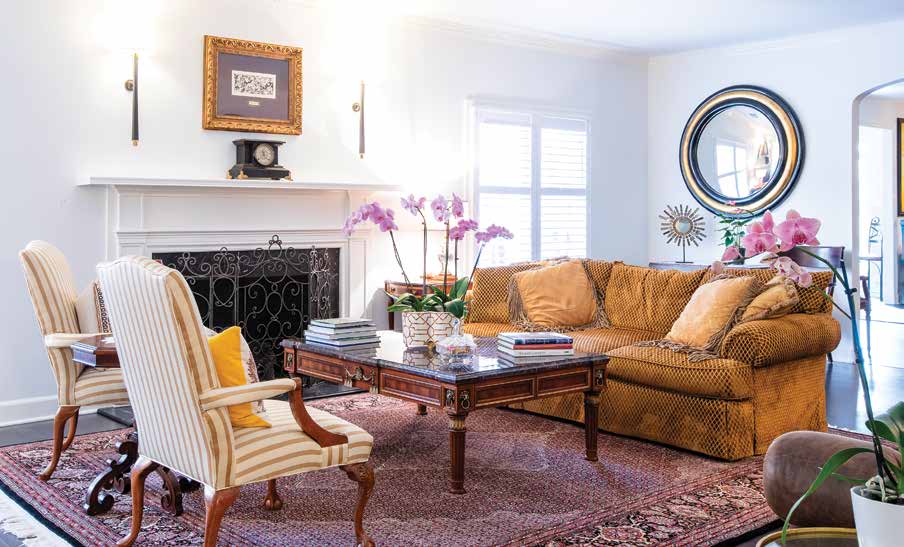
Some houses come with their own histories. Others conform to their residents’ tastes and lifestyles. A very few built by builders or interior designers for personal occupancy showcase materials and expertise. This one began with a sad event, then blossomed into a happy ending.
Randy Boyd, an interior designer based in California’s Laguna Beach and Palm Springs, had been friends with Joyce Reehling, a New York-based TV, film and stage actress, for more than 30 years. Joyce and her husband, Tony Elms, retired to Pinehurst in 2008, where their contributions to the arts community have been significant. When Tony died in 2024, Randy visited Pinehurst to support Joyce. He and partner Mark Stine, liked what they saw: a pretty little town filled with interesting people involved in worthwhile activities. Some but not all were retirees. They were looking to relocate and saw much to like beyond Pinehurst’s reputation for golf.

“We fell in love with the village, the charm, the people,” Randy says.

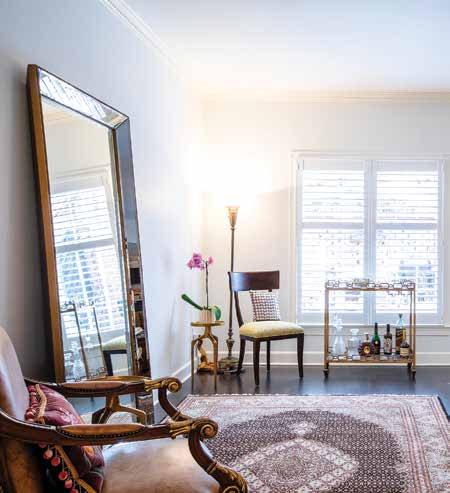
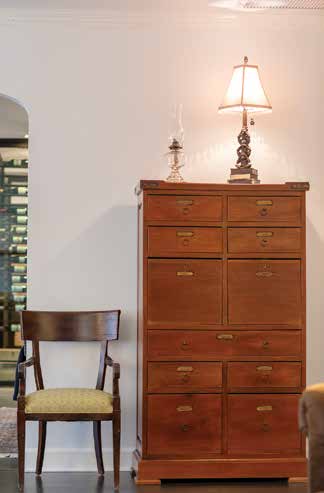
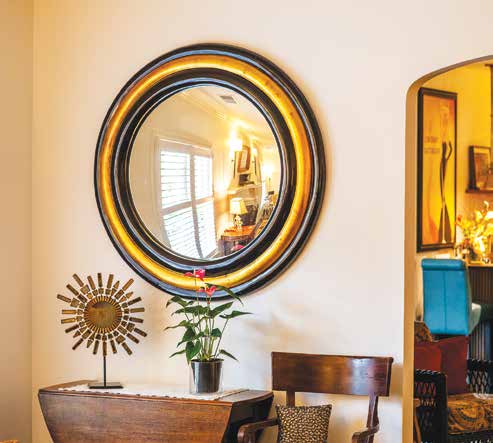
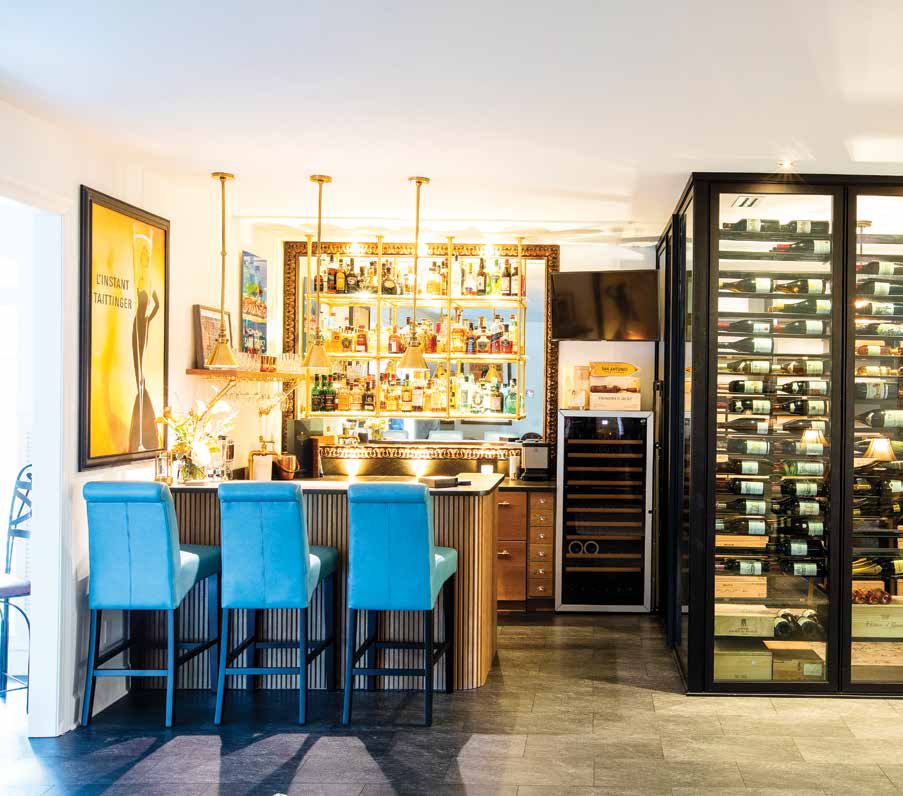
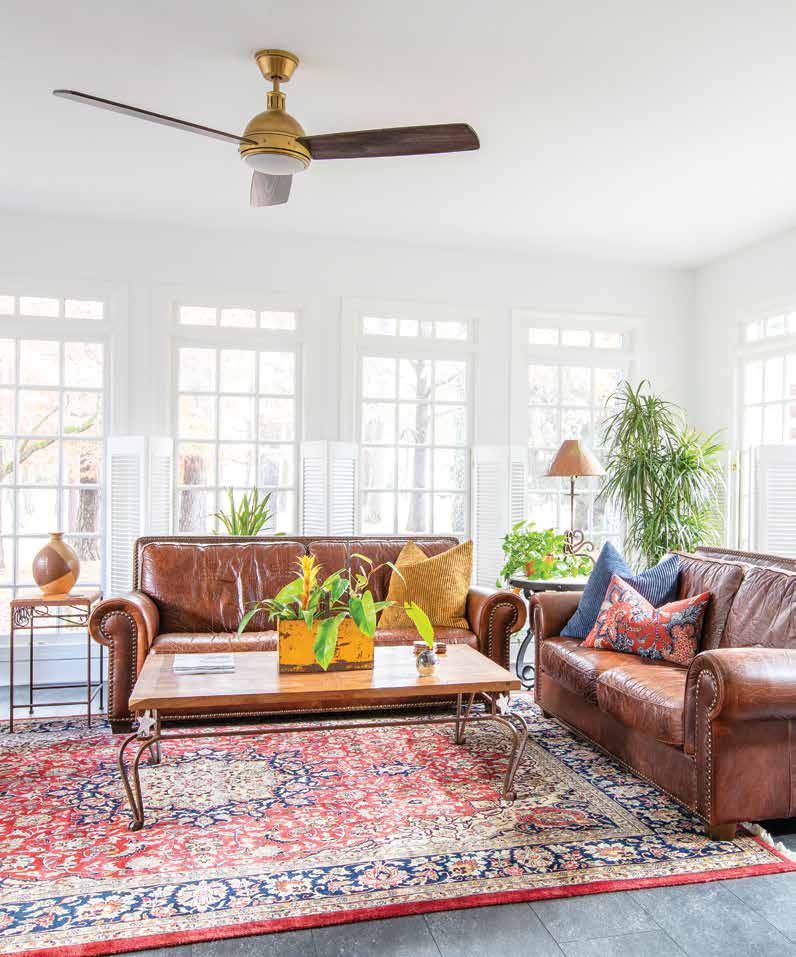
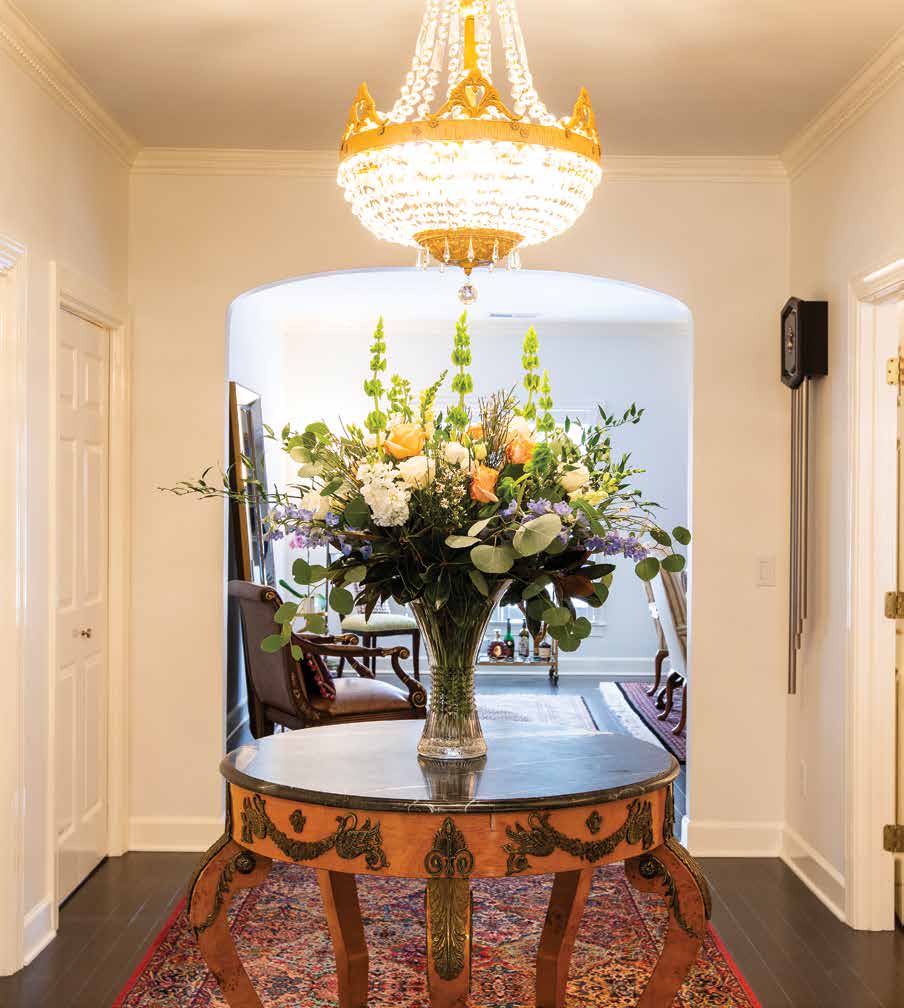
Finding the right living space was a major factor, given Randy’s profession, which he planned to continue pursuing. The shoemaker’s children, after all, mustn’t go barefoot. He and Mark shared similar tastes. Neither pined for historic Pinehurst properties, a good thing since most Old Town Taras and Georgians are spoken for. Better a bright, breezy Camelot that Randy could transform with ideas gained as an antique dealer, the kind who scours France and sends back shipping containers full of fascinating stuff.

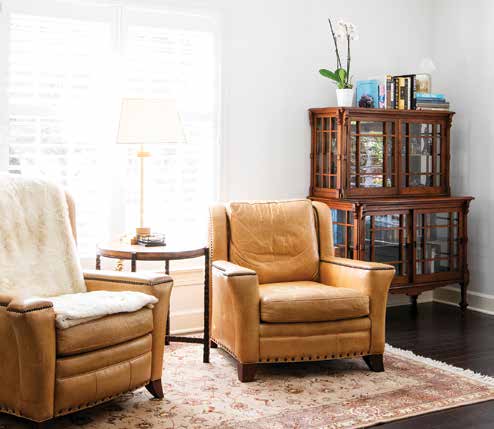
How about two handsome armoires, one shelved for shoes, a rustic pine grandmother clock and statuesque lamp bases? But all the right stuff is just the beginning. Randy nods “yes” when asked if hanging photos and paintings isn’t an art itself: height, layout, subjects, frames. He measures and draws, then mocks up on the floor. Originality counts, like a bedroom wall hung with portraits of men, likely 19th century, with facial hair and pensive expressions.

“The guy in the middle reminds me of Poirot,” Randy says. “He makes me smile.”

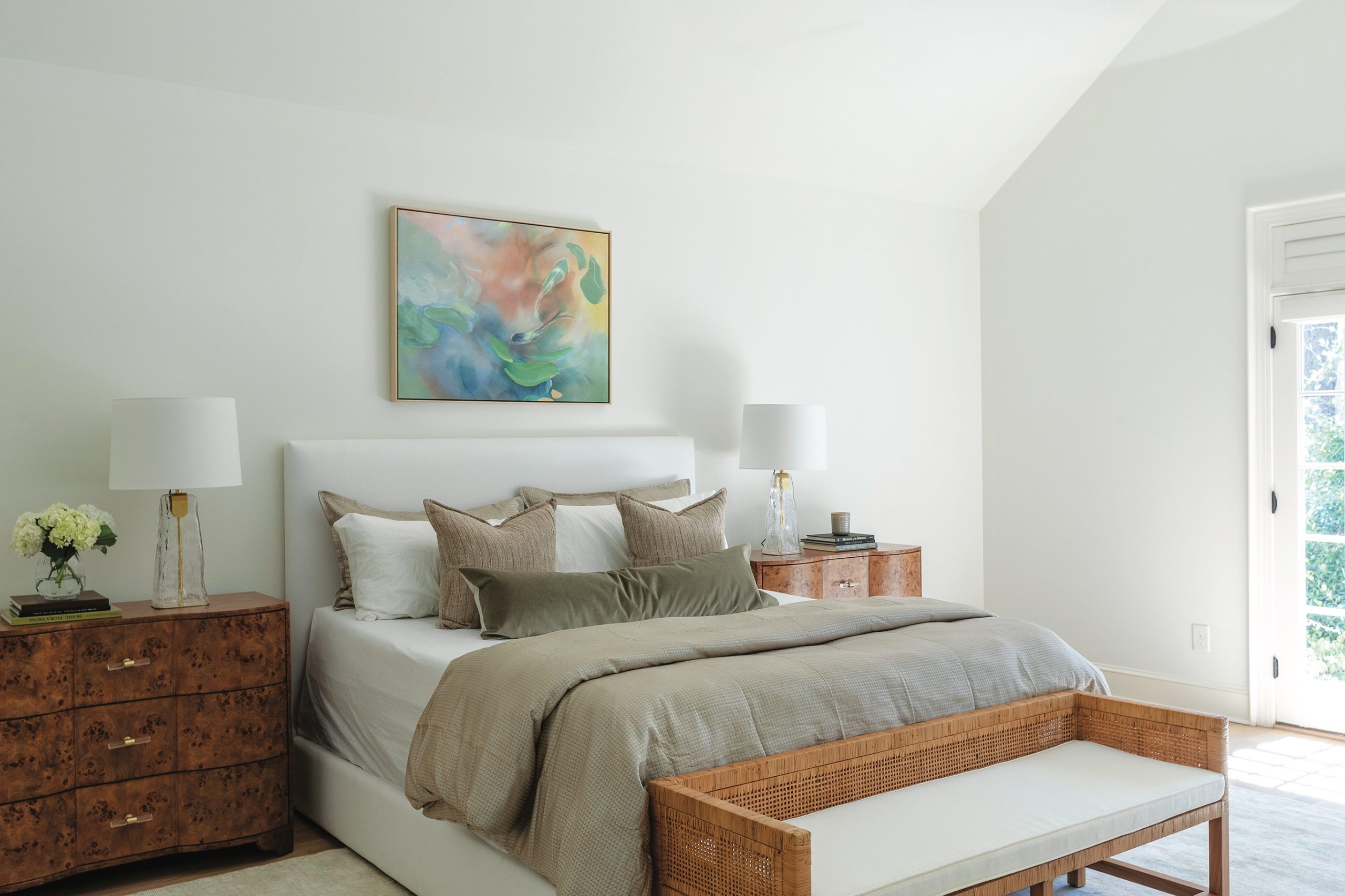
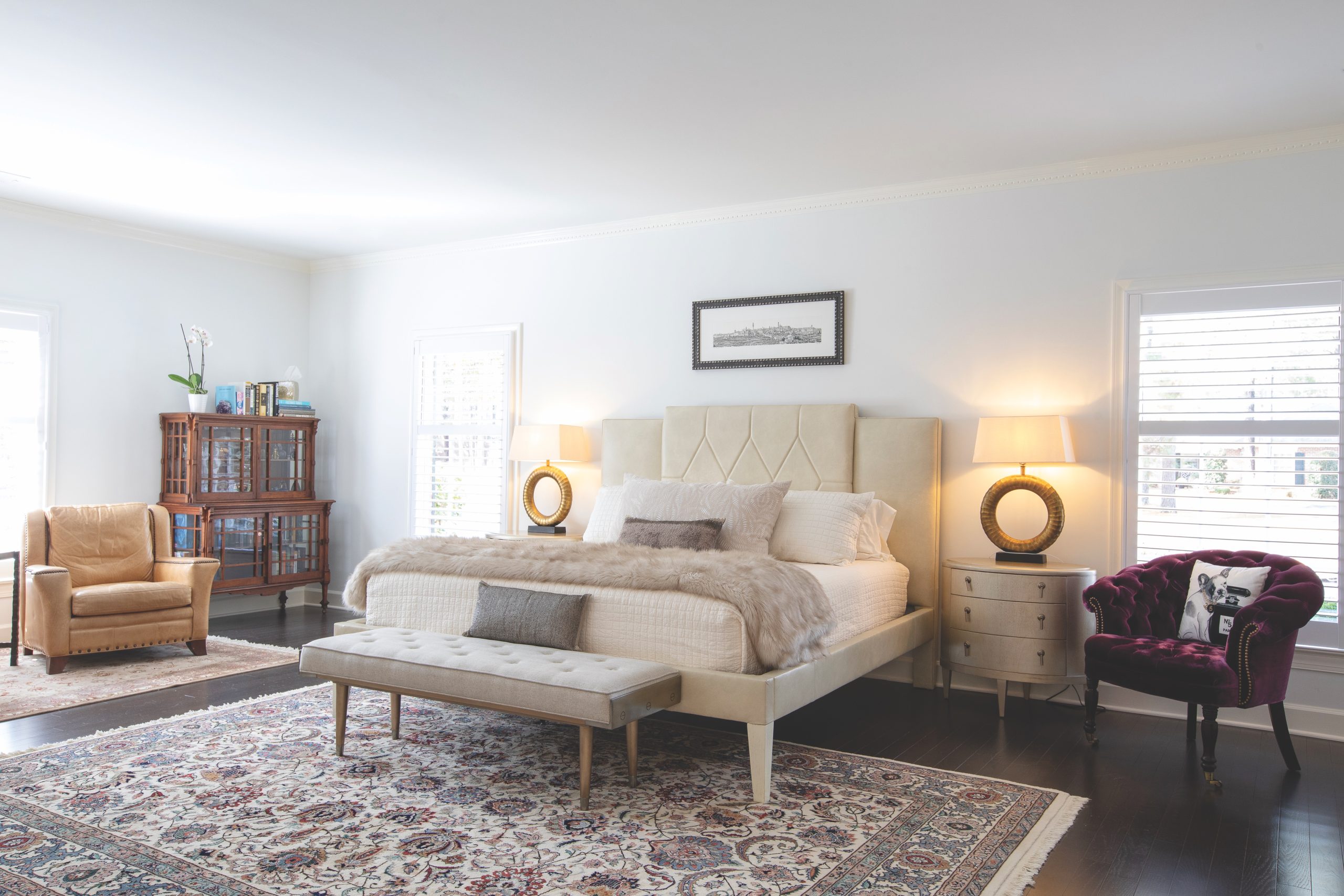
Another bedroom pays homage to Randy’s mother and grandmother, their nearly life-sized portraits dominating intersecting walls. Color, even white, adds excitement, like the filmy white “veils” hanging off tall bedposts; the overstuffed quilt where two big dogs sleep; blankets woven with multi-colored threads; a chair upholstered in lime green, others covered in line drawings of rabbits on a white background — all different, all unusual, related only by their unpredictability.

Both bathrooms required gutting. One returned papered in rich jewel-toned leaf shapes, the other in staccato black and white.

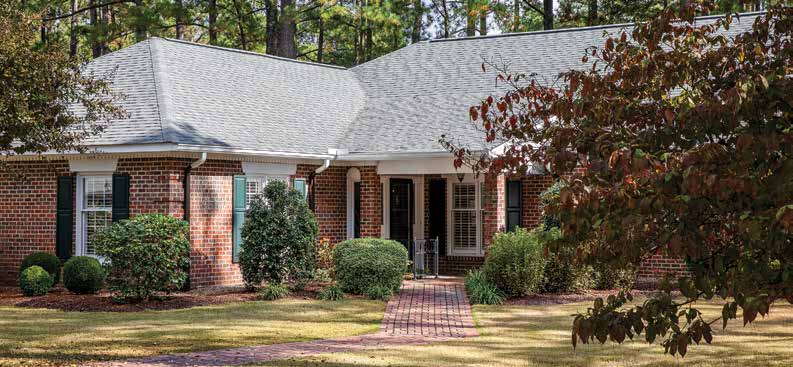
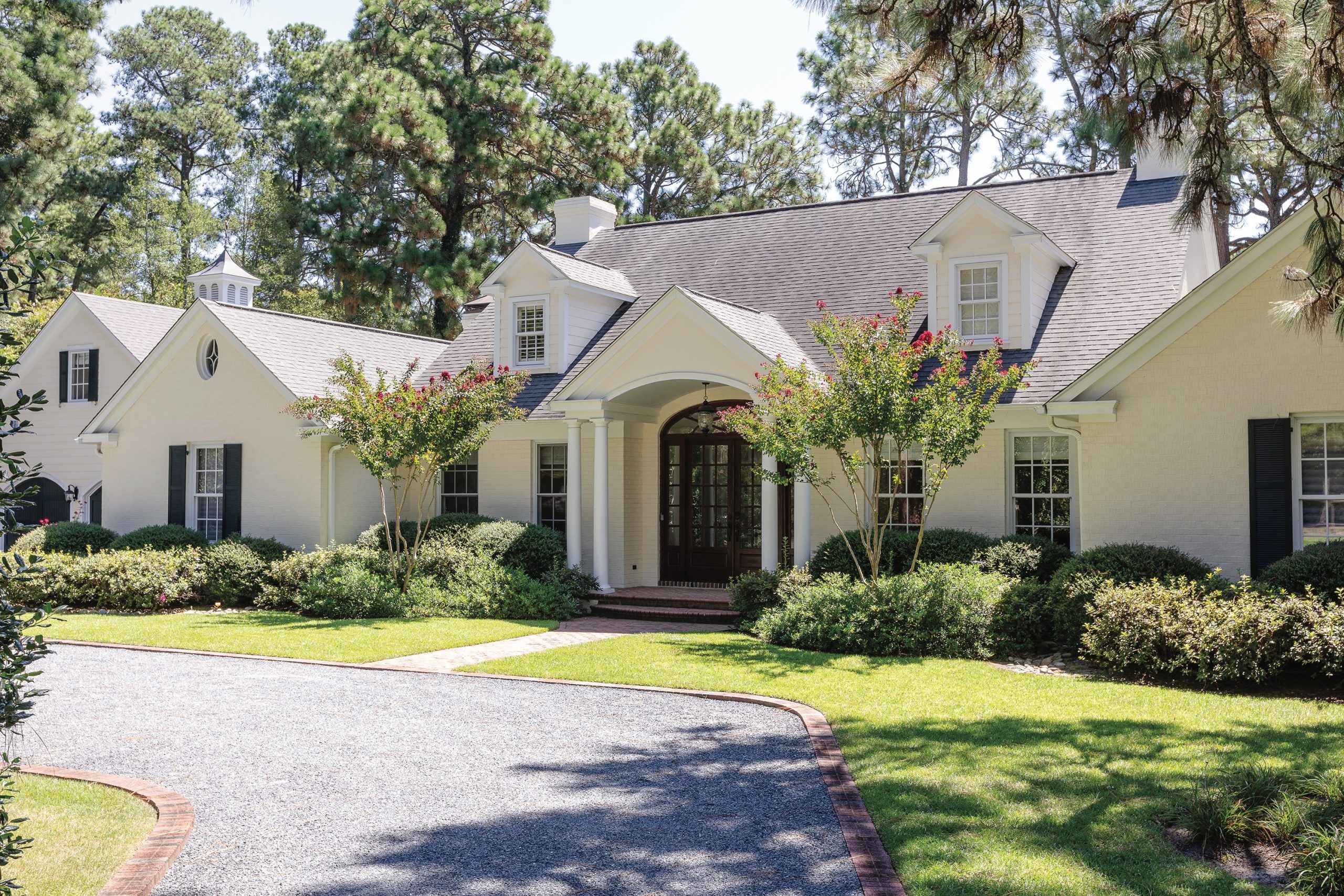
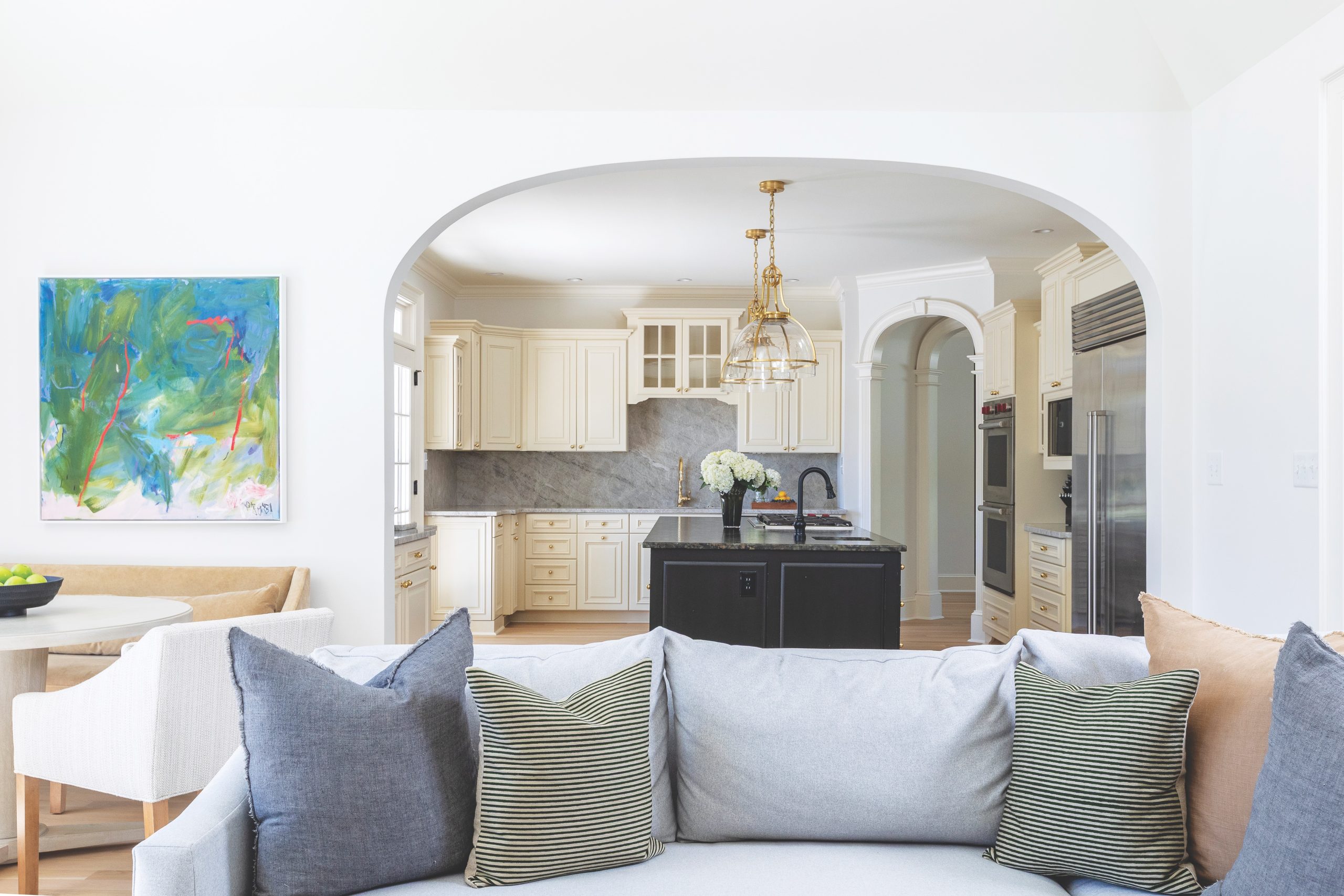
Variety, tempered by surprise, rules. Art, formal or not-so, needs an airy, well-lit display venue. At 2,300 square feet, this semi-detached brick unit with 13-foot salon ceilings, an eyebrow front door and British-themed neighborhood signage fit the couple’s furnishings. Mature trees, a reprieve from longleaf pines, manicured boxwoods and weathered brick exteriors give a settled appearance, while two walled terraces anchored by olive oil jug planters expand entertaining space.

Randy and Mark purchased the unit, hired a contractor, rented an air B&B for the duration and got to work. The project took less than a year. They, along with their two pups, moved in May, along with Randy’s business, Thurston Boyd Interior Design.

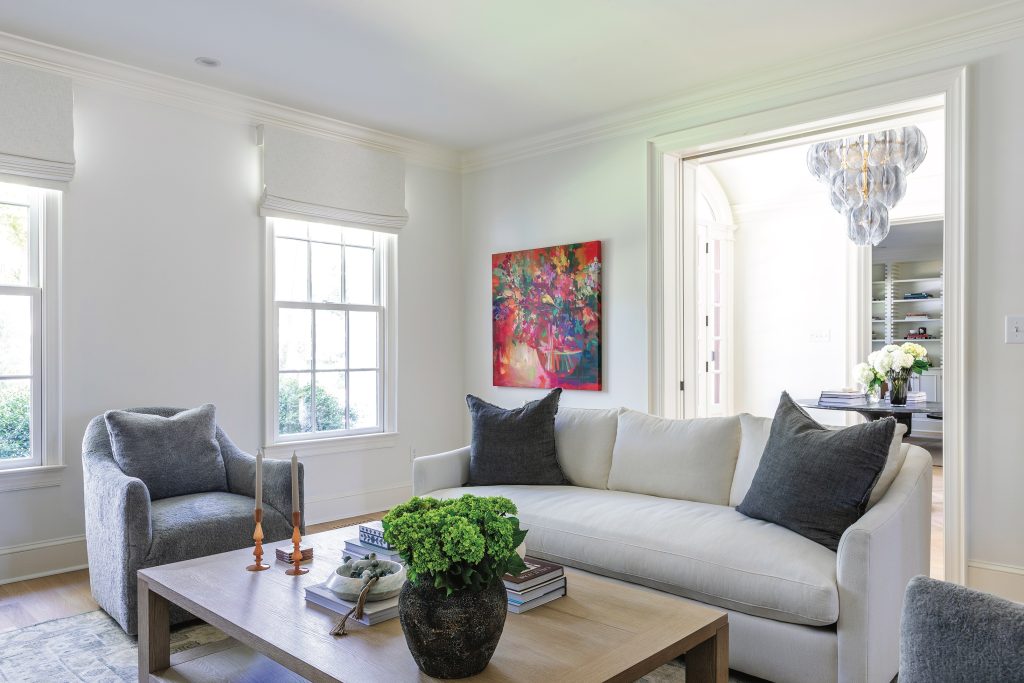
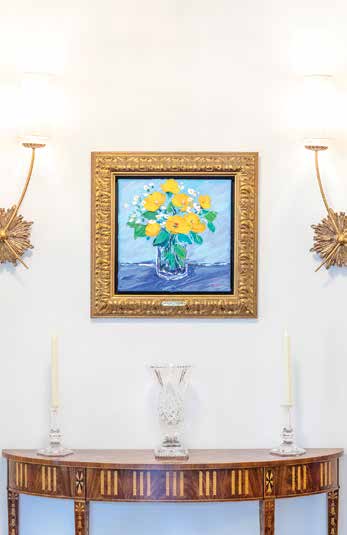
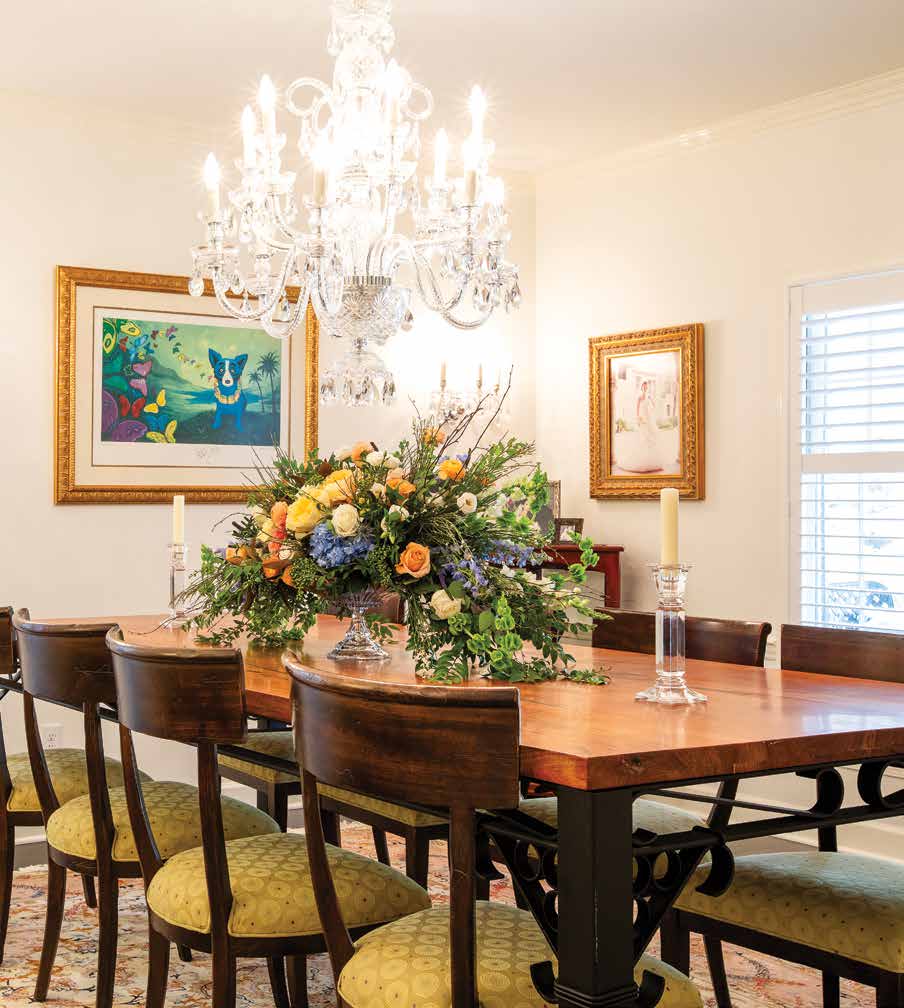
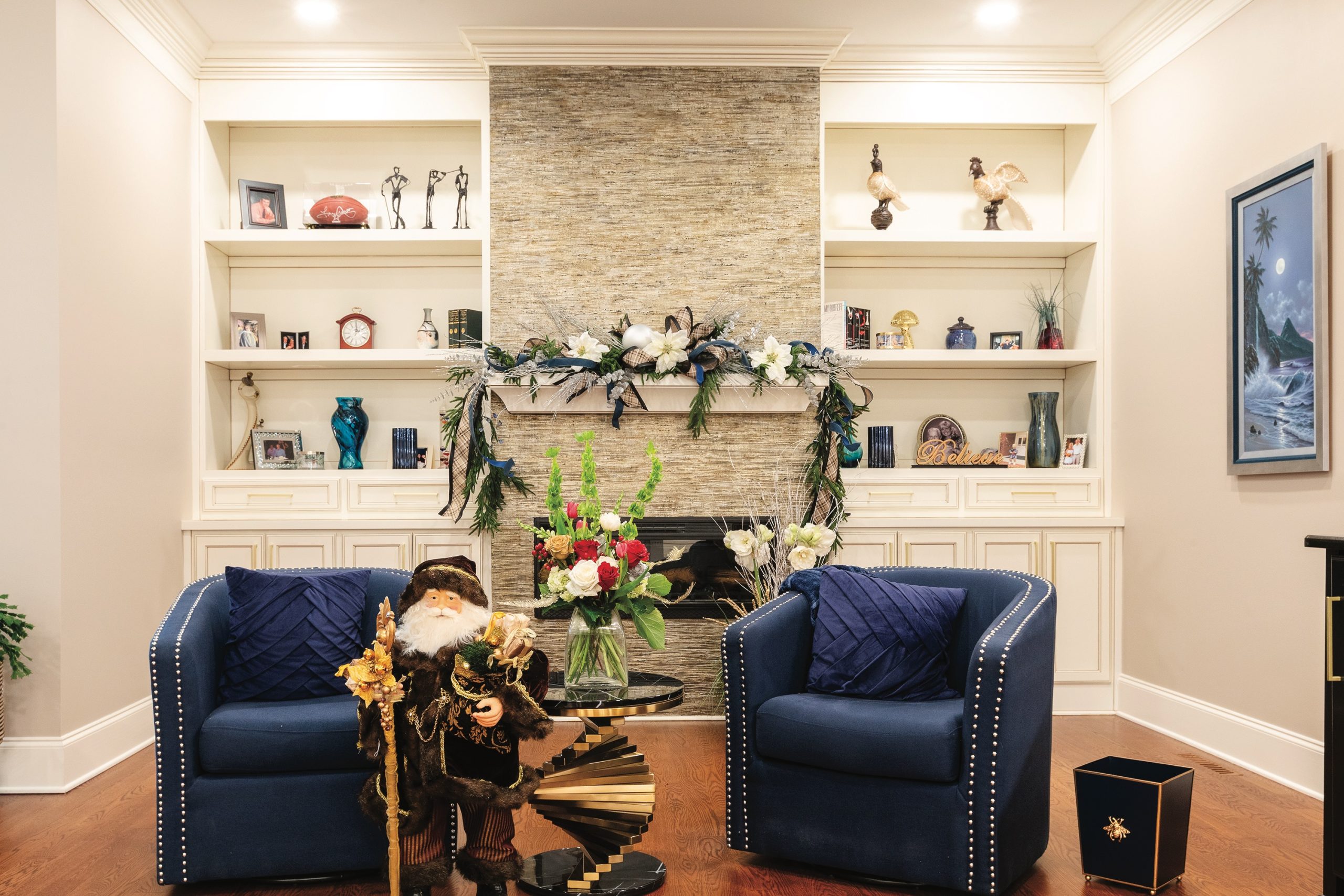
Each room showcases several pieces or a collection. In the living room, Lucite shelves hold bright Chinese roof tiles in the form of warriors protecting the property. In ancient times, quality of workmanship symbolized wealth and social status. Balancing their artistry, a contemporary sofa and simple painted wood coffee table face the proscenium opening into the dining room, where four paintings (by Mark’s niece) of flowers in vases suggest, in brilliance and style, Van Gogh sunflowers or a mixed bouquet by Cézanne. Hung against wallpaper that wriggles with life, they are anything but “still.” A massive, intricately carved desk, perhaps Asian, offsets the colors, as does a gathering of spider-webby landscape prints.

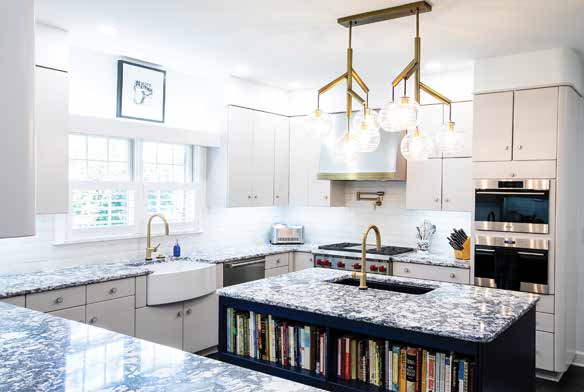
The kitchen, small but efficient, locates the gas range top on a center island. Almost bare countertops and blue-grayish cupboards impart Shaker plainness interrupted only by a collection of whimsical ceramic pitchers aligned on a pantry shelf. A sideboard with a built-in frontal wine rack resides here.

Opposite the kitchen is a dining area — a touch more formal than a breakfast nook — that opens out onto a patio, where a life-sized alligator, carved from wood, lurks among the planters. Throughout, carpet and tile were replaced by stained hardwood, knotty and laid randomly.

Nothing here blares California, but nothing screams Old Pinehurst, either — the house lacks a name or a resident ghost. It blends practicality with charm, fine art with a dash of fun, all the trademarks of “Pinehurst Now,” where wine-tastings, farmers markets, walking tours, pickleball and food festivals fill out calendars.

“People are so friendly,” Mark says. “It’s like we’ve lived here for years.”

A Fungus Amongus

A FUNGUS AMONGUS

A Fungus Amongus

Making ’shroom for a new method of farming

By Emilee Phillips

In the dark basement of a sprawling farmhouse, a mother and son work daily — and meticulously — tending to colorful bunches of oyster and lion’s mane mushrooms. Like the natural mushroom systems that grow underground, the labyrinthine basement is laid out in intricate patterns, a maze of rooms, each dedicated to its own phase of cultivation.

The rhythmic routine of misting, monitoring humidity and harvesting is as much art as it is science — a quiet but steady labor rooted in patience and precision only to be broken up by the laughter of a family joke.

In a home that sits on 200 acres of farmland that has been in the family for three generations, Candice Graham and Jonathan Bumgarner have converted their basement into Cranes Creek Mushrooms, breathing new life into empty space.

There is something profoundly grounding about a family farm. In the fast-paced, ever-changing landscape of modern life, the farm represents a constant — a space where the rhythms of nature dictate the pace of life, where the priorities shift from instant gratification to patience. It’s about cultivating a lifestyle that prioritizes sustainability, where food is grown with intention, animals are raised with care, and the land is honored as a precious resource.

Graham inherited the farm from her mother, who wasn’t a farmer herself but had a vision for her children’s future. In an act at the intersection of hope and business, she arranged for 322 pecan trees to be planted that, one day, would tower over the land and provide an additional revenue stream to sustain the farm. Though still young, some of her trees are beginning to produce, her promise literally coming to fruition.

Determined not to see the land broken up and sold off, the family had to get creative. They decided to take a leap into the unknown with mushroom farming. Aside from pecans, neither Graham nor Bumgarner had dabbled in agriculture before. “You take one step forward and three steps back with farming,” Graham says. “There’s a lot of education and research involved.”

Their first summer was trial and error. Beginning outside in a barn, they quickly learned the unpredictability of the effect natural climates can have on fungus farming — an experience that resulted in a complete do-over and driving them inside and underground. One way to bypass the natural limitations of mushroom farming, such as seasonality, is through indoor farming, which allows for year-round production and more control over the finicky crop. Now Cranes Creek Mushrooms produces a variety of oyster mushrooms, including black pearl, elm, chestnut, king trumpet and blue. From start to finish the process takes about two to three months. Lion’s mane — especially prized for tinctures and unique dishes — takes even longer, requiring about five months to grow. The longest part of the process is the preparation and sanitation of everything.

“It’s a very sterilized process, which is ironic considering how much mold mushrooms produce,” Bumgarner says with a chuckle.

The operation begins by soaking wheat grains to use as a breeding ground for the mushroom spores to colonize and reproduce, building vast networks of their root-like structures, called mycelium. Then the spawn is placed into large biodegradable bags and formed into blocks. The blocks are monitored closely after spores are added. These blocks are then arranged on rows of shelves in one of the converted basement rooms, where the mushrooms grow mostly in the dark, changing color from brown to white to nearly black, and then back to white again. In the wild, this part of the journey would happen underground.

“If it gets just one little germ in it, it multiples,” Graham says. If at any point in the process something appears wonky, the entire bag must be discarded. It’s survival of the fittest for these fungi. “You have to keep an eye on them every single day,” she says.

In another room, the next phase begins in large inflatable tents equipped with zippered doors and climate control. This “fruiting” space is lined with shelves of carefully arranged grow blocks that sprout with alien-like forms. Mushrooms thrive in humidity, but the temperature must be carefully managed. “A lot of people think mushrooms grow in the dark, but they actually crave light,” Graham says.

The family works in the tents wearing masks to avoid inhaling too many spores in the confined space. “A lot of it is about the tedious little things,” Bumgarner says.

“None of the labor is hard; you just have to keep an eye on them. It’s like having little babies,” Graham says.

Just days after the fungi begin emerging from the mycelium bags, they’re ready to harvest. For Bumgarner, the most satisfying part is twisting off a large clump of mushrooms, a small and crisp snap accompanying the plucking. Oyster mushrooms sprout in delicate clusters, their soft, fan-shaped caps unfolding in shades of pale cream or dusky blue-gray, like the soft brushstrokes of a watercolor painting. The bushels vary in size, resembling bouquets of flowers.

Just as mushrooms seemingly pop up out of nowhere, so too has their rise in popularity. With growing awareness of their health benefits, mushrooms were named “Ingredient of the Year” by The New York Times in 2022. At the Moore County Farmers Market in Southern Pines, Graham and Bumgarner regularly set up their booth with a selection of oyster mushrooms, lion’s mane and mushroom tinctures, all far from your average white button mushroom. They take the time to educate the curious about the complexities of mushrooms, whether for cooking or as tinctures. “We’re met with a lot of curiosity,” says Graham.

Every week, it seems, the duo find themselves explaining the benefits of lion’s mane mushrooms with their distinctive, almost otherworldly appearance — long, white, hair-like tendrils resembling the mythical abominable snowman. Despite the growing buzz around their potential health benefits, Graham and Bumgarner are often surprised when people haven’t heard of lion’s mane. Graham takes tincture droplets daily, which she believes improves memory and reduces inflammation. For them, mushrooms aren’t just a culinary ingredient; they’re a form of nature’s medicine.

The two are also experimenting growing rieshi mushrooms, which are thought to help aid relaxation. “Everyone needs to relax more,” says Graham. Mushroom-based products like mushroom coffee have been gaining popularity in recent years, but Bumgarner believes tinctures are the way to go. “They’re more potent, pure, and taste better,” he says. Cranes Creek Mushrooms soak their mushrooms in pure vodka to make their tinctures.

Oyster and lion’s mane mushrooms are seldom found in traditional grocery stores. In many ways, they are a quiet luxury, accessible to those who shop with intention at places like farmers markets and co-ops. Their luxury isn’t due to high cost or rarity, but rather their shelf life, which makes them less suited for conventional grocery store environments.

In addition to the farmers market, you can find Cranes Creek Mushrooms in gourmet dishes from local restaurants such as Ashten’s and Elliott’s on Linden. For Bumgarner, nothing beats the simplicity of sautéing mushrooms in butter. He and his mother agree that lion’s mane has a more unique texture, almost chicken-like, with a flavor that is difficult to explain to someone who has never tasted it. “It’s meatier,” he says. “One of the most interesting things I’ve learned about mushrooms is that you don’t get any of the benefits, other than fiber, unless you cook them.” 

Graham says the shared mother and son moments are one of the most rewarding parts of their business. “We get a lot of family time. We can tease and talk and work.” As someone passionate about eco-friendly practices, Graham was thrilled to learn about the benefits the mushroom spawn blocks could bring to the soil on the farm.

Along with mushrooms, Graham and Bumgarner have added quail and chickens to their operation, knowing the extra minerals and nutrients from the spent mushroom blocks can aid the overall health of the animals on their property. “We are trying to get to the point where the farm supports itself,” she says. “I also have to stay busy or I’m not happy.”

More than a business, Cranes Creek Mushrooms is life underground, a labor of love, fueled by family.

The Nature of it All

THE NATURE OF IT ALL

The Nature of it All

The soothing embrace of the Healing Gardens

By Claudia Watson

It’s a slight squeak of the wooden gate that welcomes me to the garden, but once I step inside, the sounds shift. There’s a gentle breeze rustling the leaves, creating a soft whisper. The garden’s colors and textures blend with its aromatic smells and birdsong. It’s a soothing symphony, all mine for a few sacred minutes at dawn.

Nature has always been an escape for me, keeping me centered even in the most challenging of times. When I was young, I filled the hours in a woodland and creek, teasing polliwogs, rock-hopping and chasing the delicate butterflies flitting among the wildflowers. Then, I’d seek my secret sanctuary, an ancient white birch tree, snuggle into its curved hollow and listen as the wind in its branches whispered.

Immersive experiences, such as those youthful pursuits, connect us to nature’s wonders. We are hard-wired to find them engrossing, soothing and a powerful tool for healing. Gardens are particularly well-suited to tap into those connections in health care settings where life-challenging and life-threatening events are amplified.

Healing gardens engage the senses and foster those connections. They are designed with a passive involvement approach that allows visitors to be present and absorb the elements of nature, without structured activities and programs.

It was the long and exhausting experience of caring for their loved ones in the hospital that motivated Dr. Lynda Acker and Cassie Willis to approach the Foundation of FirstHealth with a vision to construct a healing garden on the regional hospital system’s Pinehurst campus. Acker and Willis were longtime gardeners, and it was their vision and design, supported by the community’s love for the concept and philanthropic spirit, that brought the Healing Garden oasis to life in 2012.

Located behind the Clara McLean House, the public garden is meticulously designed, expansive and mature. On any given day, it might host a patient undergoing treatment at the hospital, a medical provider taking a break, or a garden club enjoying the season’s blooms. Its beauty and tranquility instill a sense of calm and peace.

Upon entering the Healing Garden through its rose-laden moongate, a visitor is immediately greeted by the sound of birdsong. This auditory experience, combined with the garden’s visual beauty, creates a tone that sets the stage for a peaceful and engaging journey. The meandering, curved stone paths encourage exploration and curiosity about what lies around the next turn.

Small seating areas, including an intimate Lutyens bench in the Cottage Garden surrounded by mophead hydrangeas and roses, invite visitors to linger. The replica of a 15th century English stone dovecote serves as the visual and functional centerpiece of the garden.

The bounty of unusual trees, including a mature loquat, towering snowball viburnum, Chinese elms and vitex, adds a sense of curiosity. Beds of showy Japanese anemones and Mexican petunias add bursts of color. At the same time, sensory stimulation is offered by new dawn climbing roses, daisies, native salvias, herbs and a grey owl juniper that smells like a Christmas tree.

Many plants possess unique features that make them a natural conversation starter. One morning, as I was guiding our weekly volunteer work session, I was approached by a visitor intent on learning more about the plant he held in his hand.

“Can you please tell me the name of this?” asked 76-year-old Harlan Devore, holding out a weed.

“Chickweed,” I said.

“The Latin name, please?” he asked.

Embarrassed, I replied, “I don’t know.”

It was the beginning of our friendship, made in the garden. Devore, a retired military officer and science teacher for 20 years, was a patient undergoing treatment for cancer and staying at the Clara McLean House.

“I grew up loving plants because my mom did and she always used a plant’s Latin name, so that’s how I know plants, not by the common name,” he told me. Using a lot of show-and-tell, we discussed weeds in two languages. He met many of the garden’s volunteers and then asked if he could pull the weeds when he had spare time.

“Sure, if you’re OK with the work. It would be greatly appreciated,” I said, and showed him where we stored our tools and the debris bins.

When I returned a couple of days later, I found three 32-gallon bins full of weeds. Later that week, Devore asked if he could join the garden volunteers every week. He believes that active physical involvement with the garden enhanced his healing while instilling a sense of usefulness and accomplishment — and he made new friends who share his love for it. Today, he’s in remission, spending time with his family, volunteering for numerous organizations, kayaking on a local lake and, of course, pulling weeds at home.

“You reflect on your life, but sitting by the garden’s waterfall reading and listening to the birds took my mind off my worries,” he says of the garden. “I felt absorbed into nature, and that helped me relax.”

Gardens and natural spaces enrich both the body and the soul. When you view nature, you become embraced by its tranquility and beauty. It’s a welcome distraction, especially if you’re grieving. The gardens on the FirstHealth Hospice and Palliative Care campus opened in 2015 and were conceptualized with nature in mind, recalls Acker, who, with Sally DeWinkeleer, designed the peaceful space. With its carpets of densely planted, vibrant flowers and plants, the gardens provide patients, families and caregivers a place for rest, reflection and engagement with nature.

“We considered the individual needs of those who will benefit from this space,” explains Acker. “They need relief from the stressful conditions and long hours in Hospice House. The gardens and the outdoor sitting and walking areas provide respite at any time of the day or night.”

In addition to the beautiful flowers and serene atmosphere, the gardens feature a single-path labyrinth shaded by white Natchez crape myrtles. The labyrinth serves as a therapeutic tool, encourages mindfulness, and is designed to help individuals navigate the complex emotions associated with grief and loss.

“It’s a meditative experience, a reflection of your journey,” says DeWinkeleer, who lost her mother before working on the project. “It was a powerful and safe way to help me process my grief.”

A small pond was placed at a corner across from the Hospice House, where its mesmerizing movement and gentle sound offer a calming space to passersby.

One of the most poignant scenes at the gardens happens in early spring, when the grounds present a breathtaking display of thousands of cheerful daffodils. As the sun crests the horizon at dawn, its golden light illuminates the fields of daffodils, symbolizing hope, rebirth and new beginnings.

The healing gardens at FirstHealth of the Carolinas, including two of its newest at the Cancer Center, are lovingly cared for by community volunteers, many of whom have spent years tending them. These dedicated individuals aren’t just nurturing plants — they are creating an environment where patients, families and staff find peace and serenity during some of life’s most challenging times.

“When I saw how many people found comfort in this garden, I knew I had to be part of it,” says Melanie Riley, a volunteer at FirstHealth’s Cancer Center, which opened in 2023. Riley had just begun the 13-week Extension Master Gardener program with the Moore County Extension Service when she was diagnosed with breast cancer. After reviewing the options, she elected a double mastectomy, and days later, passed her final EMG exam. After her recovery, she began volunteering at the Cancer Center’s Healing Gardens, co-designed by Acker and the building’s architect.

“Working here among those with cancer, as well as survivors, gave me a sense of control over my health and emotions,” she says. Now cancer-free, Riley says her experience in the garden was not only life-enhancing, it became life-rebuilding. She cherishes her mornings working in both the lobby-level and rooftop healing gardens.

“Patients and their caregivers come out to the garden for an uplifting distraction from their concerns,” she says. “I’ll introduce myself as a cancer survivor and offer them an encouragement stone that’s engraved with an uplifting message.”

That small stone is often the conversation starter, as they share their experiences. “It’s such an important validation for them to know another has made it through,” says Riley, reflecting on her own turbulent passage through the disease. “Then, I’ll notice a shift in their mindset. They are calmer and will ask about the flowers and plants, as well as the little bugs they see. They leave their worries for a bit and depart with a brighter perspective and a smile.

“It’s magical when they step into the nature of it all.”

Time spent in green spaces has a profound and positive impact on our lives. Whether it’s birdsong, a gurgling stream or the wind blowing through the tall trees, nature provides joy and comfort. Listen closely, as it whispers, “All is well.”

The Ladder

THE LADDER

The Ladder

Fiction and Illustration by Daniel Wallace

She kept the ladder hidden against the far side of the house, on its side, behind an array of shrubbery and a small pyramid of partially charred firewood. It was a metal ladder, and heavy, yellow and blue, and picking it up involved several challenging moves — lifting, leaning, pushing, and prying it into its sturdy inverted V. Harder now than ever but still doable. The hinges adjoining the two sides of the ladder sometimes stuck, and with her bare hands she had to thwonk them until they were perfectly straight. The meaty part of her palm had been pinched more than once during the course of this procedure; her Saran Wrap-thin skin roughly torn like a child’s scraped knee. All this happened at night, in almost complete darkness, the only light from the dim bulb in the laundry room, casting a soft, milky glow through the dusty windows onto the thorny leaves of a winterberry. Once the ladder was open she shook it, made sure the ground was level. Usually she’d have to adjust it, moving the legs this way and that a few times before it felt secure. Then she climbed, step by step, testing her balance on each flat rung, falling into a worry that made her take special care not to slip or get her slacks caught on anything. It was especially dangerous when she got to the very top, where it was written in serious, Ten Commandant letters: THIS IS NOT A STEP. Here there was a sharp metal protrusion, the final test that she had, so far, nimbly passed. She got on her knees on the step that wasn’t, and with her forearms on the shingles drug herself onto the sloping edge of the roof, turned herself around, and sat breathing. She brushed the dirt off her forearms. Another breath and she was fully there.

This is what she did for her cigarette, the only one she allowed herself, once a night every night, for almost all her adult life. She didn’t even have to hide it anymore, because there was no one here to secret it from. But it had become a part of who she was, a tradition she could not and would not and did not want to end until she couldn’t make the climb. It was necessary. It was her spot, her perch. There was no great view to be had, really, just the cross-the-street neighbors, a young couple in the modest, red-brick split-level, their lives ahead of them, as they say, as if all our lives weren’t ahead of us, some just farther along than others. Sometimes she could see them — the Shambergers? — as they moved from room to room, miniature people, busy as little ants. It was like watching a movie from a thousand feet away.

She smoked, and the smoke rose and quivered from the red and orange coal into a dreamy cloud, then off into a dreamy nothing. But most of the smoke was inside her, in her lungs and her blood. It made its way to her brain and she felt lighter, lighter. She felt like she could follow the smoke if she wanted. The cigarette didn’t last very long, never as long as she wanted it to, but always time enough to review the plot points of her life, the highlights, good and bad, the husband and the children and now the grands, the cars, the planes, the ships, the glam, and the struggle, the love, the sex, so much of it really it didn’t seem fair that one woman should have it all. So much. But every night she climbed the ladder’s rungs and sat here, here on top of the world, smoking, she wondered what it meant that out of all of it, out of every single second she remembered, this was the best, the very best, the moment she lived for, surrounded by the invisible world beneath the moon and long dead stars, sharing her own light with the dark.

One For All – By All

ONE FOR ALL - BY ALL

One For All - By All

The complicated birth of the Moore County Hospital

By Bill Case     Photographs from the Tufts Archives

Last year, U.S. News and World Report ranked Pinehurst’s FirstHealth of the Carolinas Moore Regional Hospital sixth best in North Carolina. Money magazine placed it 65th in the country. With 402 beds, it serves as a primary care referring facility for the surrounding 15-county area. It employs more than 3,000 people, by far the most of any private Moore County employer. The spacious cancer clinic, opened in 2023, is the latest jewel in the crown.

Exactly a century ago, the residents of Moore County weren’t so lucky. In May 1925, the county’s lone acute care facility, James McConnell Hospital (named for Carthage’s heroic World War I flier) was teetering on its last legs. Located in rural Eureka, 4 miles from Carthage, the facility offered four private rooms and two wards, totaling 20 beds. During the influenza epidemic of 1918, McConnell treated 35 additional patients by putting beds on the porch.

Lacking an endowment, McConnell struggled to stay afloat, financially and literally. The wells serving the hospital totally dried up in periods of drought. Nurses and other employees hauled buckets of water from a spring half a mile away. As the Sandhill Citizen put it, McConnell was constantly “working against the task of too little money for too big a job.” The hospital closed its doors on June 1, 1925.

Following the shutdown, the nearest hospitals to Moore County were now located in Fayetteville and Hamlet. Southern Pines’ celebrated author James Boyd believed the status quo was unacceptable. “If a man gets seriously sick in this section of North Carolina, what can he do?” Boyd wrote in The Pilot newspaper. “That means a trip to Raleigh, or Charlotte, or Hamlet, or Fayetteville . . . if it is a case of accident, or other emergency, the two or three hours necessary to make the trip may cost the patient his life.”

Community-minded members of the Kiwanis Club of Aberdeen (later Kiwanis Club of the Sandhills) began considering the feasibility of building a modern hospital located close to Moore County’s population centers — Aberdeen, Southern Pines and Pinehurst. A Kiwanis committee met several times in late 1925 and early 1926 to discuss the parameters for a new hospital. At a February 3, 1926, Kiwanis meeting in Pinebluff, club president Talbot Johnson announced that there was a “chance to get a half-million-dollar hospital for the neighborhood of the most modern type.” He also announced that a newcomer to the campaign, Simeon B. Chapin, “and others of the moving spirits will be on hand to discuss this situation.” Johnson urged his fellow Kiwanians to pack the house for their meeting.

Proponents floated the concept of building a 70-bed hospital costing $500,000 plus an additional $250,000 endowment. Other public forums were scheduled in Aberdeen and Pinehurst. An overflow crowd at Pinehurst’s Carolina Theatre turned the presentation into a pep rally for the hospital, giving the project an enthusiastic (and nearly unanimous) thumbs up. “The pledge of support expressed by the audience would seem to indicate the county can be counted on for the maximum amount of support,” The Pilot reported.

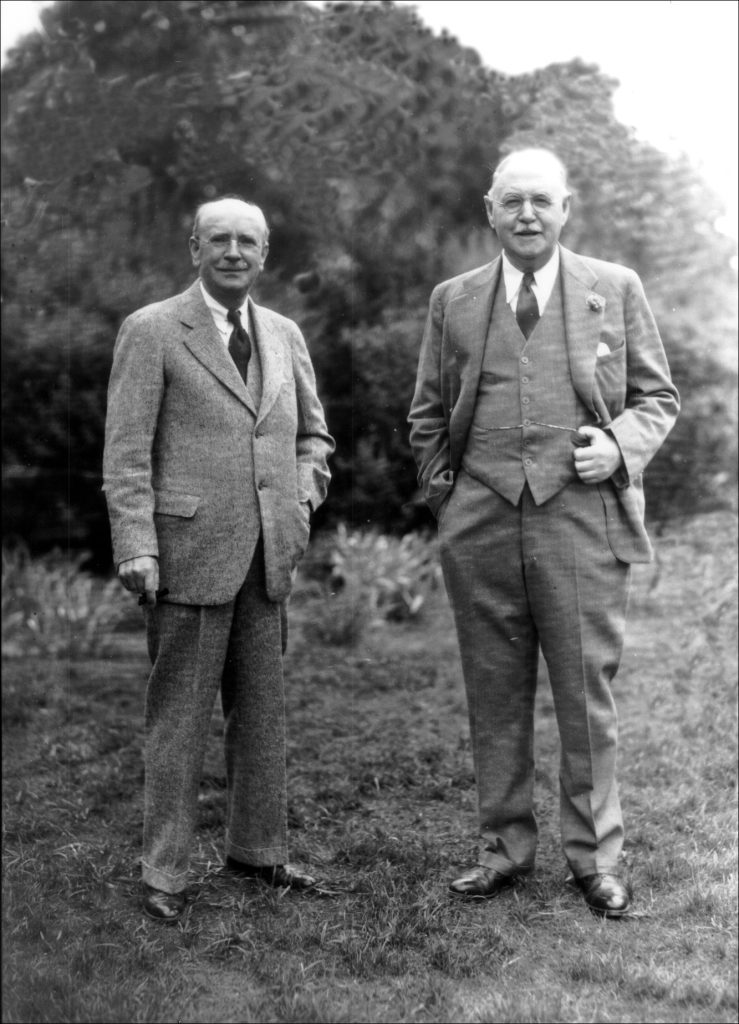
However, it is one thing for citizens to stand up in a meeting and collectively voice their “huzzahs” and quite another to reach into their pockets to support it. It became clear that fundraising for a hospital would likely flounder unless people of substantial wealth stepped up. Six such men (two of whom were Kiwanians) banded together for the purpose of making the hospital a reality. The men who referred to themselves as the Hospital Committee were Leonard Tufts, whose family owned almost everything in Pinehurst; Jackson Boyd, a Pennsylvania coal magnate and, with brother James, co-master of the Moore County Hounds; Eldridge R. Johnson, founder of the Victor Talking Machine Company, which revolutionized the phonograph industry; Henry A. Page, Jr., president of two North Carolina railroads and owner of a chain of Ford auto agencies; John D. Chapman, a Wall Street broker and member of the New York Stock Exchange; and Simeon B. Chapin, owner of S.B. Chapin and Co., a stock and grain brokerage firm with offices in Chicago and New York City. After making Pinehurst his winter retreat circa 1910, he built several houses and acquired thousands of acres of Sandhills real estate. His Chapin Orchards made him the area’s foremost peach farmer.

But Chapin’s most profitable venture came in 1912 when, in partnership with the Burroughs family, he acquired 64,000 acres of South Carolina pine forested real estate, together with 9 miles of ostensibly “worthless” beachfront. Chapin and Burroughs developed the property into an unparalleled resort community — Myrtle Beach.

Chapin and the other members of the Hospital Committee, recognizing they were not qualified to evaluate the scope and size of the proposed hospital, retained the New York firm of Wright and O’Hanlon that specialized in such matters. In 1927, that firm’s lead partner, Henry C. Wright, conducted a survey of the area and concluded it was feasible to build a 35-bed hospital at a cost ranging from $80,000 to $140,000. The Hospital Committee’s members were ready to pool their money to fund the bulk of that price tag, but they considered it important to have citizens from the county at large also contribute.

Soon, a source of charitable funding emerged. It was learned that North Carolinian tobacco heir-investor-philanthropist James B. Duke had established the Duke Endowment, a trust fund totaling $400 million in assets. Among its missions was support for rural hospitals in North and South Carolina.

In March of 1927 committee members greeted Dr. Watson S. Rankin, the director of the Duke Endowment’s Hospital and Orphans section. Rankin advised those assembled that once the hospital was built, the Duke Endowment would be willing to contribute $1 per day per bed toward the care of patients unable to pay their bills. This was significant, because Moore County had its share of impoverished individuals, including many in its Black population (who were to be treated in a segregated wing).

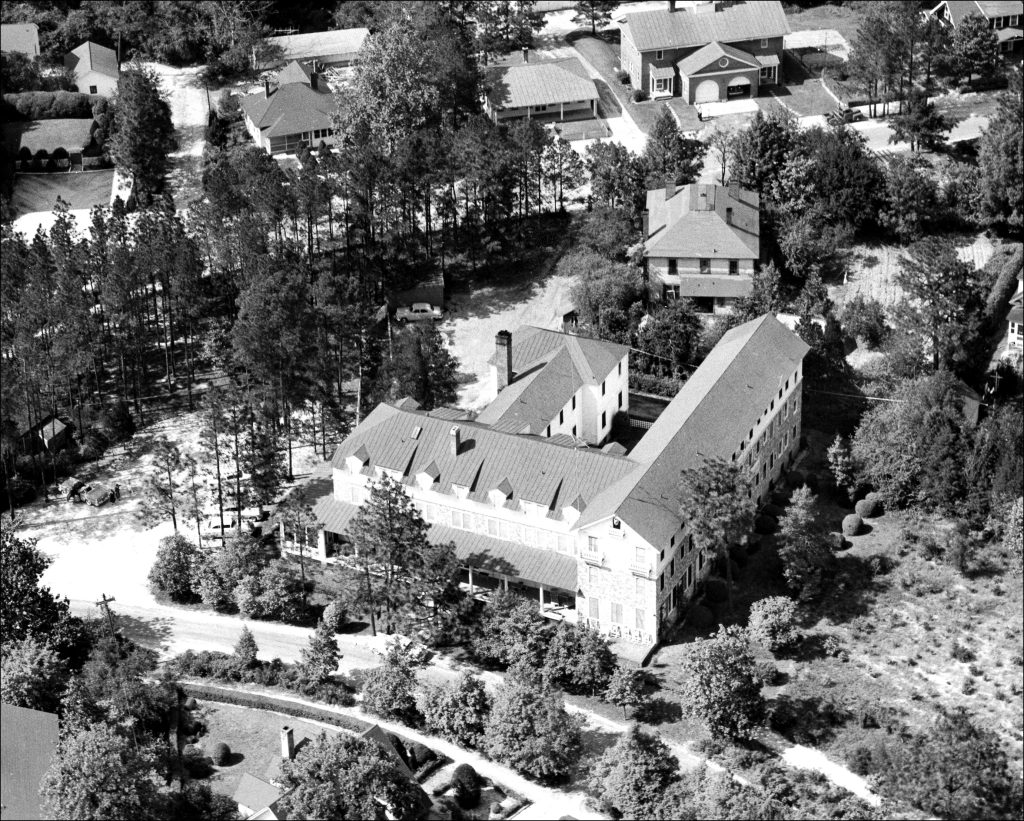
While wrestling with financing, the committee also dealt with the thorny issue of the hospital’s location. Since Pinehurst was in the central section of Moore County, several properties on the outskirts of the village were considered. The members were unable to reach a consensus regarding the best site, so it was decided to have the consultant, Wright, make the choice. He picked property near the intersection of N.C. 211 and Page Road — the southern reaches of the current campus — citing as tiebreakers the fact that it was well situated to catch breezes (a must pre-air-conditioning), and that a sewer line was already in place. That site, like virtually all the land in and around Pinehurst, was controlled by the Tufts family. Leonard Tufts deeded the land over without compensation. 

The task of raising money beyond its own membership continued to frustrate the Hospital Committee throughout the summer and fall of 1927. This included the securing of charitable funding. A Nov. 16, 1927, newspaper article in the Greensboro News caught Leonard Tufts’ attention, eventually breaking the logjam. The story indicated that the Duke Endowment was planning to build six or seven hospitals a year in North and South Carolina.

The following day, Leonard Tufts wrote Rankin, expressing his “hope one of these will be located in this section.” Rankin promptly responded: “I am glad to convey to you the encouraging information that we will probably be able to help you materially in the building and equipment of your new hospital.” He promised to send Tufts an application and did so on Dec. 27.

When the Duke Endowment’s trustees reviewed the information set forth in the application regarding contributed pledges, they were dismayed. Outside of “a few wealthy people from Pinehurst and Southern Pines,” there were few pledges. The Duke Endowment was disinclined to contribute anything unless the “people of Moore County” proved their interest with cash contributions in the amount of $25,000.

Why were people reluctant? “It has so happened that during the period when funds were being solicited, the farmers and businessmen in rural communities throughout the country were undergoing business readjustment through a period of deflation, which has made it very hard for them to get hold of any spare cash,” The Pilot reported.

But resistance went beyond that. Some scoffed that “a hospital is the last thing the county needs.” Decades later, Leonard’s son, Richard Tufts, wrote “Today it is difficult to believe that the establishment of our hospital was not a popular decision with all the people of this county. Many thought of a hospital as a place where you went to die and not to get well.”

Some local residents were peeved that wealthy winter residents from the North were running the show. “They have the money; they can afford it; let them pay for it,” was the sentiment. Naysayers also voiced the view that the hospital was being built to benefit Pinehurst resort guests, not permanent residents.

Based on the committee’s assurance that it would raise the requested $25,000, the Duke Endowment trustees conditionally approved a $25,000 grant on March 27, 1928. Rankin hinted more money might be forthcoming once the committee raised $25,000 from small, local donors.

The hospital committee shifted into overdrive, pushing for donations in Aberdeen, Southern Pines, Vass, West End, Lakeview, Pinebluff and Jackson Springs. In a meeting on April 24, 1928, the committee advised that “sufficient funds are definitely in sight for the construction of an A-1 hospital.” In sight perhaps, but not yet in the bank.

At the meeting, it was determined that building of the hospital would move forward even though the conditions of the Duke Endowment’s grant had yet to be satisfied. The prospect that the endowment could still pull the plug on its sizable contribution was deemed a risk worth running.

Contracts for the hospital’s design and construction would be required, so the committee formed a corporation to execute them. The board included representatives from throughout the county, including the mayors of Carthage, Southern Pines and Aberdeen. Simeon Chapin was named board president. The board immediately created a building committee composed of Leonard Tufts, Aberdeen’s Robert Page, Pete Pender, West End engineer George Maurice, Aberdeen Mayor G.C. Seymour and James Boyd. Cincinnati architect Samuel Hannaford was hired to design the building.

Meanwhile, contributions trickled in, but far too slowly. Hopeful that favorable press might sway hesitant donors, Leonard Tufts wrote The Pilot’s Bion Butler on May 5, 1928, seeking the paper’s assistance in clearing up “misconceptions” about the hospital. Butler printed Tufts’ correspondence verbatim on the front page. Tufts maintained the wealthy winter residents who were contributing the bulk of the money were doing so “not for selfish reasons, but giving of their riches to aid the health conditions in this county.”

The Pilot offered words of editorial support. “Men who do as much as the visiting strangers must not be looked on as the open pocket for everything that is wanted here, for it would soon destroy their regard for the community that would permit such mendacity, and it would also ruin the community’s regard for itself.”

Though not having obtained the necessary subscriptions from “outside Pinehurst” as required by the Duke Endowment, the Moore County Hospital Association boldly plunged into deeper waters on Nov. 13, 1928, hiring Sanford contractor Jewell-Riddle Company to construct the hospital. The company estimated the cost to build at $167,000. Groundbreaking took place that same month.

Meanwhile, hospital boosters resorted to new measures to eliminate the fundraising gap. On Sunday, Nov. 24, 1928, pitches for subscriptions were made at the services of every Moore County church. The new owner of The Pilot, Nelson Hyde, implored readers to contribute, “in any sums, big or little as it is desired.” In his Nov. 30 editorial, Hyde offered a rallying cry for this effort. “One for all — by all.” Subscription forms were printed in the paper.

The fundraising campaign was still short of its goal when the cornerstone for the building was laid on March 19, 1929. Conditional funding from the Duke Endowment remained up in the air. Chapin briefly addressed those assembled at the cornerstone ceremony: “This hospital is built by all the people of Moore County to serve all the people of Moore County, and is here and now dedicated to the county and its citizens for ever and ever.“ He closed with, “We wish it Godspeed on its errand of mercy into the future.”

To those still skeptical regarding the county’s need for a hospital, events the following day in Southern Pines served as a grim wake-up call. The town’s police chief, Joseph Kelly, was ambushed and shot four times while searching an automobile. The motorist who fired the gun was wanted by law enforcement for an assortment of holdups and burglaries.

The chief was in a bad way but managed to stagger to his patrol car and drive to the residence of Dr. W.C. Mudgett before collapsing to the ground. Mudgett summoned an ambulance, which transported the gravely wounded chief to Highsmith Hospital, in Fayetteville. He died the following morning. It cannot be said with any certainty that Chief Kelly would have survived had the hospital been nearby, but that thought undoubtedly crossed peoples’ minds.

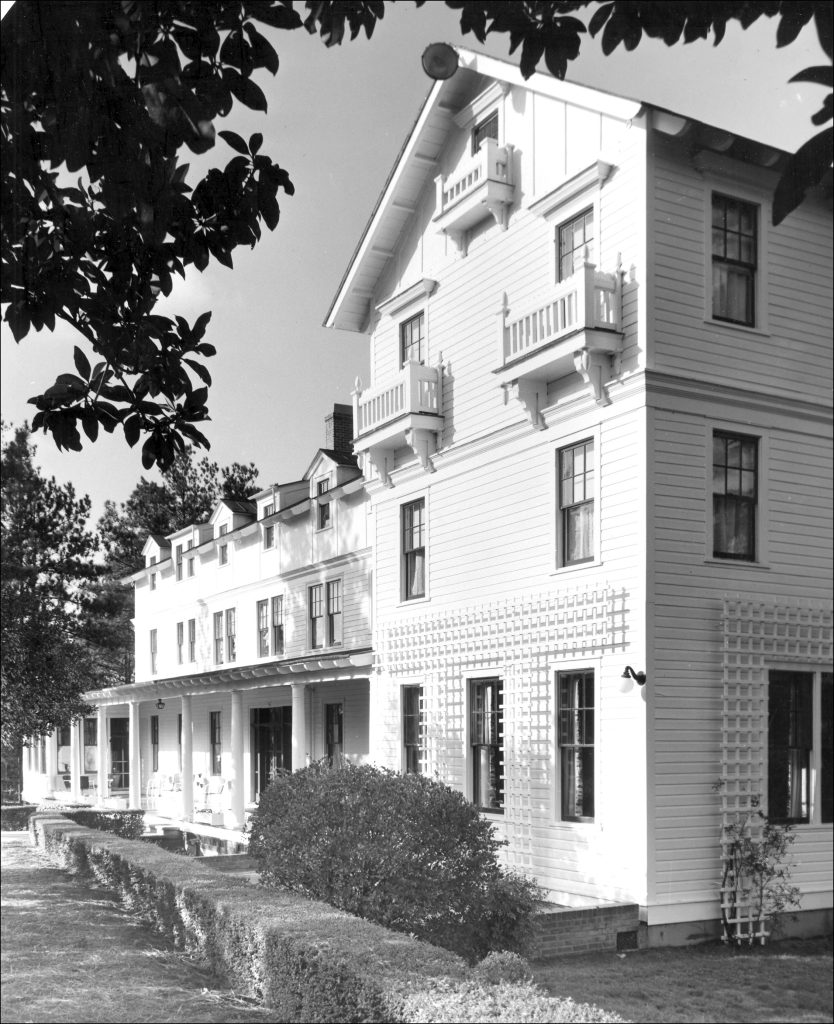
Perhaps the murder loosened strings on some pocketbooks. Or maybe the eye-catching sight of the new three-story brick and columned hospital did. In any event, it was announced in the Sept. 20, 1929 Pilot that “the necessary donations to make available the conditional subscription of $50,000 by the Duke Endowment have all been paid in.” Construction was finished two months later. The final cost of the building plus needed equipment turned out higher than projected. The Duke Endowment upped its building contribution to $75,000.

Moore County Hospital’s 33 beds and two operating rooms opened to patients on Nov. 25, 1929. Chapin continued in his role as board president. Dr. Clement R. Monroe became the institution’s first doctor and administrator. The omnipresent Dr. Mudgett was named chief of surgery. Ellen Bruton supervised the nurses. To the surprise of the staff, the hospital was filled to capacity almost from the start.

While all the members of the Hospital Committee deserved credit for their steadfastness, Simeon Chapin came to be regarded as its guiding spirit. In 1930, the Sandhills Kiwanis Club awarded Simeon the Builder’s Cup. The Pilot noted that “Mr. Chapin’s faith and optimism through the long campaign for funds, plus his untiring efforts in soliciting contributions, and in overseeing the proper expenditure thereof, which has given to this section of the state one of the finest institutions to be found anywhere in the United States.”

However, the struggles continued. With the onset of the Great Depression, nearly two-thirds of the patients during the hospital’s first year could not afford to pay for treatment. In his role as administrator, Dr. Monroe scrambled to keep the operation above water, describing himself as the “all around water boy.”

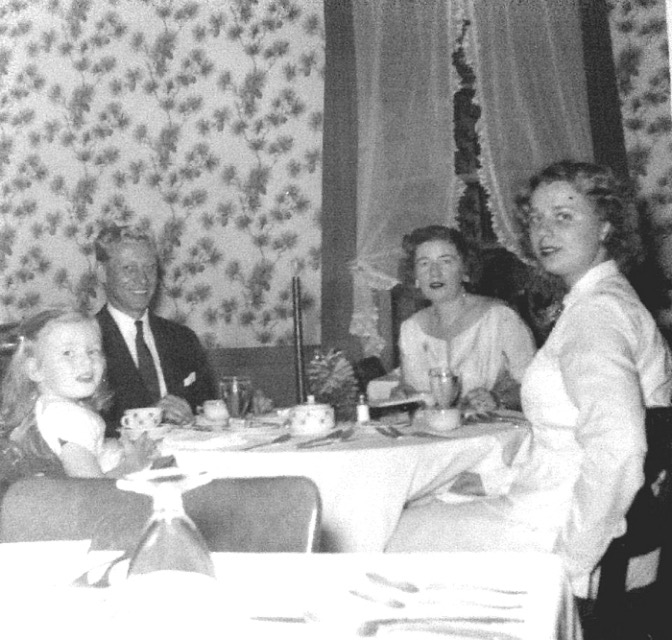
Alarmed by the shortfalls, several organizations pitched in to assist. The women who comprised the Moore County Hospital Auxiliary contributed money, towels, curtains and bedclothes. The 400 members of the Birthday Club made it their practice to donate funds, canned goods and linens on their respective birthdays. An old fashioned “pounding” was held in the early years, in which local farmers donated vegetables, fruits, jellies and jams. The hospital even purchased a cow to supplement its dairy requirements.

Despite the hardships, Moore County Hospital prospered and grew, and soon needed to expand. By 1939, housing for nurses and a new wing featuring 26 additional beds had been added to the campus. The hospital’s endowment and footprint would eventually grow far beyond the dreams of the founders.

James Boyd passed away in 1944. Four of the remaining stalwarts responsible for the birth of Moore County Hospital died in 1945: Leonard Tufts, Eldridge Johnson, Pete Pender and the hospital’s honorary president, Chapin. On the day of his passing, the latter visited the hospital to make a donation for the purpose of ensuring the presence of Bibles in every room.

It was the sort of thing Chapin had been doing his whole life. He liberally supported churches of all types, including Pinehurst’s Village Chapel, serving on that church’s building committee during its erection in 1924 and ’25. In Chapin’s 1929 hospital dedication speech, he opened with this anecdote: “About five years ago, when the new church was being built in Pinehurst, a certain person who had had sickness in the family said to me, ‘We need a new hospital more than we need a new church.’ My answer was, ‘We need both.’”

He got both.

Doctors’ Orders

DOCTORS' ORDERS

Doctors’ Orders

Breathing life into a contemporary villa

By Deborah Salomon    Photographs by John Gessner

Embarking on a second career in retirement is nothing new: Lawyers become clergyman; bank tellers resurface as hairstylists; farmers write novels. But a retired Army physician renovating high-end residences? Well, why not?

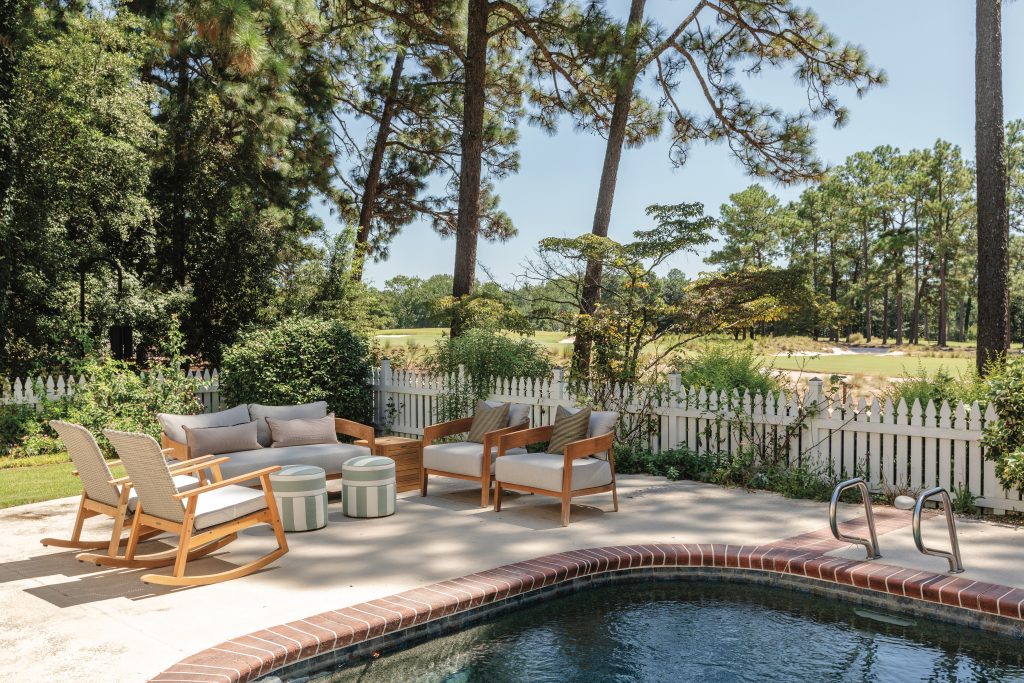
Retired Lt. Col. Teresa Pearce, M.D., a public health specialist with a master’s degree in epidemiology, and her husband, Dr. Tony Freiler, M.D., a retired Lt. Col. Army radiologist practicing locally, found Pinehurst perfect for work and family. With two sons, 8 and 12, Teresa thought about renovating a house large enough for several generations to live communally. “I’m very big on family,” she says. She found a candidate in an estimated 7,200-square-foot manse built in 2001, with detached garage/apartment and pool on 5 acres overlooking a Country Club of North Carolina golf course. The multi-generational living plan didn’t materialize but, oh, what a venue for honing interior design skills and showcasing good taste.

Although the property does not conform to any off-the-shelf architectural mode — try contemporary Italianate villa — its wings spread over a section of CCNC where land parcels are of similar size. Teresa’s method was simple: Find something to make your own and get to work. Upgrades took about a year.

“This one . . . it was very well-built but the layout, the flow, didn’t work,” she says. But, given the imagination, the means and the neighborhood, it was a diamond in the rough.

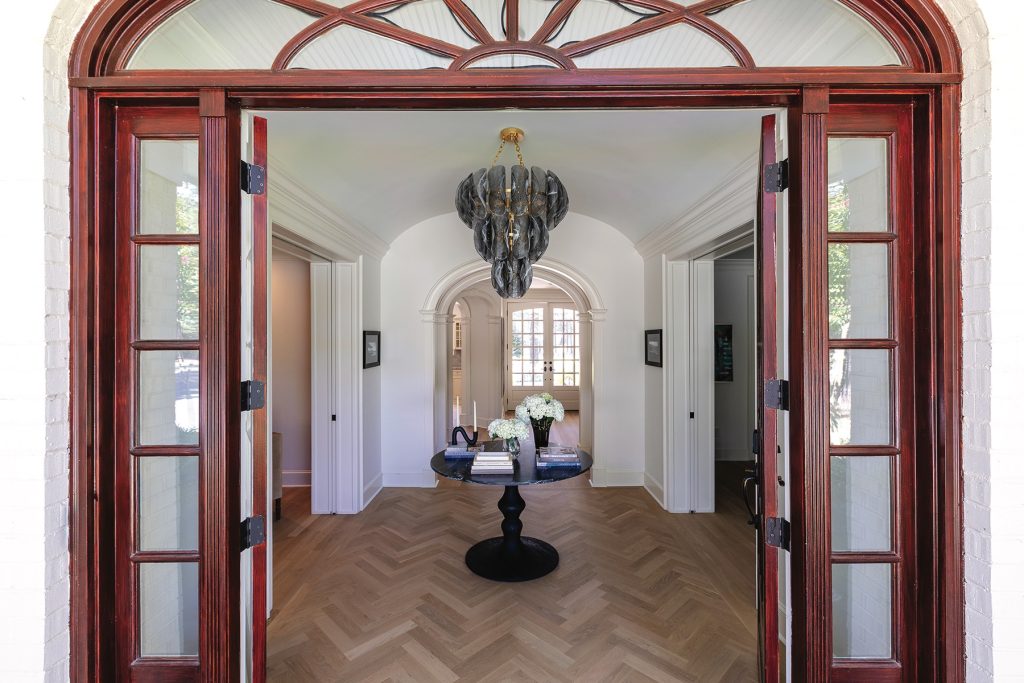
The interior spreads out along hallways on either side of the foyer, where a large painting of a golden orb mounted on grasscloth hangs. Could it be the moon? Teresa’s father was part of the space program, in Florida. His NASA helmet contributes to the décor.

To the right, near the kitchen entrance, was a small formal dining room Teresa commandeered for her office, with a narrow glass-topped table — an unlikely but decorative desk — and a spectacular set of double doors she found in Maryland.

Beginning in the office, a trail of wallpaper and fabrics continues throughout the house — ferns, fruits, flowers, creatures and dense European mini-prints so vivid they jump off the background.

“Wallpaper, it’s my thing,” Teresa says, often in unusual color gradations. Navy, with a touch of teal, becomes Prussian blue; red has deep rather than bright overtones; and green imitates frogs, not limes.

The core of Teresa’s renovation is the living room, whose back wall, paneled to the ceiling, rises 20-plus feet over a formal gathering space with a library section and, at the far end, a dining table seating 12 to 14 “in a pinch.”

Here, Teresa is not shy about expressing her taste. Against one living room wall stands a lamp table lacquered red with gold curlicues, stripped down to pale wood at the top. “All that red and gold . . . just too much,” she decided.

The kitchen escaped significant reconfiguration, although wood cabinets became white and the island more user-friendly. Notable are the side-by-side Sub-Zero refrigerator and freezer. Beyond is a kid-friendly family room where the giant circle motif is repeated in wall mirrors. And beyond that is a screened porch and pool.

Teresa haunts auctions and estate sales. “I’m an accumulator,” she admits. At one time, she owned an antique business. Now, she and a partner, Jennifer Beranek, operate Elliott Rowell, an interior design firm in Aberdeen.

Living space continues in an above-ground lower level, encompassing a game room with pool table, a lounging area for watching movies, several guest bedrooms, 2 ½ bathrooms, a kitchenette and gym with weight-training equipment, an arts and crafts area, and Tony’s office. The walls are mostly done in Teresa’s signature navy blue, also the favored color (along with white) in the main floor master suite.

The totality allows for overstuffed sofas, large fireplaces and multi-era furnishings with a surprise around every corner: A campaign throne/chair stands in a hallway. Children’s furniture creates a village, with ceiling shelves for stuffed animals. A combination laundry/dog parlor has an elevated tub for bathing twin Springer spaniels. Teresa’s classic butler’s pantry is a rarity in contemporary construction, but oh, so convenient when serving those 14 guests. A canopy-free four-poster bed dominates the master suite, also home to a giant Boston fern and a bay window. Next up: a rose garden.

“I love renovation,” Teresa says. “I feel like the house has a new life, like it’s relevant again.”

A Little Gem

A LITTLE GEM

A Little Gem

Sweet, small and smart

By Deborah Salomon 
Photographs by John Gessner

Pinehurst has become an enclave of castles and cottages, outdoor showers and indoor pools, antiques and art, dog grooming parlors and tech control rooms accommodating generals and musicians, bankers, brewers, judges and surgeons. From this residential potpourri a new genre emerges: the little gem.

A prime example is the cottage tucked into a quiet, lesser known lane on the edge of a newish residential area. Pinehurst estates have garages bigger than its 820 square feet.

This little gem presents an optical illusion: classic furniture in dark woods is scaled for a larger house but sits comfortably uncrowded in small rooms with low ceilings and a patchwork of floorboards that suggest additions after its completion in 1941. Soon, its intimate parlor, with a few adjustments, will welcome a baby grand piano.

The sorceress performing this magic is Tess Gillespie, who also turned a patio into a garden with seating for a dozen guests — or her children and grandchildren. Bear in mind, the house has no dining room, just a drop-leaf table to pull out when required, and a sweet little bench in the kitchen, where two, maybe three, can add chairs for brunch.

Of course this one bedroom, one bathroom Lilliputian lifestyle requires some sacrifices: no bathtub; no giant TV screen; no walk-in closets; and, by choice, no dishwasher.

What was this residential iconoclast thinking?

The story opens as do many Pinehurst relocations. Tess grew up in the Boston area, loving the sea — hence seascape art dominating the walls. Like other Northern cosmopolites, she and husband Bill looked for a vacation home in a warmer climate rich in facilities, including golf. They tried Florida.

“We didn’t want a condo,” Tess recalls. Driving through Pinehurst they spotted a For Sale sign on the cottage and an adjacent building lot. They purchased the package in 2004, built a new house on the lot and moved into it a year later. Tess has such fond memories of their short time in the cottage that after Bill died in 2013 she worked it up and moved back in.

“We were happy here,” she says. Besides, she muses, “I’ve never been one who loves a big house. Downsizing is freeing.”

Tess brought experience and taste to the task gained while working for Laura Ashley, Lord & Taylor and other high-end fashion and home goods retailers. She decided on a milky/linen white for walls throughout, which she painted herself. Fabrics, where required, are printed in bright navy blue.

“My mother had a great eye for furniture,” Tess says. When she died, Tess and her sisters met and divided up these household treasures. “We cried, we laughed, we remembered . . . ” Results of this and other forays included large wing chairs and a one-armed settee in the living room. On the settee are cushions made from her father’s fisherman knit sweaters.

Tess replaced several space-gobbling doors with curtains and built a window seat with a mattress to accommodate any unexpected guests. The only true bedroom barely contains a queen bed and long dresser. The remodeled bathroom squeezes in a glass stall shower and stacked washer and dryer.

The kitchen, visible from the sitting room, is a slim galley with country French touches. Tess opened the space under the stairway to a second floor apartment (grandfathered as a rental) for a pantry displaying jars and baskets. The countertop is thick, heavy marble; the island, that dark, narrow wooden bench. The chandelier is weathered brass. Tess replaced the dishwasher with an oversized round metal sink, hearkening back to times she and her sisters would laugh, talk and do dishes together in their family home.

Tess, who works part-time in a local real estate office, has a way with flowers. White orchids bloom throughout the house. A small office overlooks her informal gardens, in full bloom.

As much as style and innovation, this mini-gem, barely visible from the street, represents the philosophy of a wise woman. “I have an independent spirit,” says Tess. “I know I can do things, and I’ve learned to compromise and do things myself.” Like create an environment, totally her, filled with talismans.

“I feel safe and secure here . . . the house makes me happy because this is where Bill and I started,” she says. “I don’t want ‘big’ or more stuff. Really, what more do I need?”

The Great Wagon Road Odyssey

THE GREAT WAGON ROAD ODYSSEY

THE GREAT WAGON ROAD ODYSSEY

A pilgrimage half a century in the making

By Jim Dodson

Not long ago, during a breakfast talk in a retirement community about my forthcoming book on the Great Wagon Road, I was asked by a woman, “So, looking back, what would you say was the most surprising thing about your journey?”

“Everything,” I answered.

The audience laughed.

The first surprise, I explained, was that it took me more than half a century to find and follow America’s most fabled lost Colonial road that reportedly brought more than 100,000 European settlers to the Southern wilderness during the 18th century. As I point out in the book’s prologue, I first heard about the GWR from my father during a road trip with my older brother in December 1966 to shoot mistletoe out of the ancient white oaks that grew around his great-grandfather’s long-abandoned homeplace off Buckhorn Road, near the Colonial-era town of Hillsborough.

The first of many surprises was the discovery that my father’s grandmother, a natural healer along Buckhorn Road named Emma Tate Dodson, was possibly an American Indian who had been rescued and adopted as an infant by George Washington Tate, my double-great-grandfather, on one of his “Gospel” rides to establish a Methodist church in the western counties of the state.

A second surprise came during the drive home when the old man pulled over by the Haw River to show my brother and me a set of stones submerged in the shallows of the river — purportedly the remains of G.W. Tate’s historic gristmill and furniture shop.

“Boys, long ago, that was your great-great-granddaddy’s gristmill, an important stop on the Great Trading Path that connected to the Great Philadelphia Wagon Road that brought tens of thousands of European settlers to the South in the 18th century, including your Scottish, German and English ancestors.”

This was pure catnip to my lively eighth-grade mind. Owing to a father whose passion for the outdoors was only matched by his love of American history, my brother and I were seasoned explorers of historic Revolutionary and Civil War battlefields.

“Can we go find it?” I said to him.

He smiled. “How about this, Sport. Someday I’ll give you the keys to the Roadmaster, and you can go find the Wagon Road.”

I searched for years but found only the brief occasional mention of the Great Wagon Road in several histories of the South, but nothing about where it ran and what happened along it. The road seemed truly lost to time.

Forty years later, however, the Great Wagon Road found me.

On my first day as writer-in-residence at Hollins University in Virginia in 2006, I took a spin up historic U.S. Highway 11 — the famed Lee-Jackson Highway — and was surprised to come upon a historic roadside marker describing the “Old Carolina Road” that was part of the 18th century’s “Great Philadelphia Wagon Road.”

The sweet hand of providence was clearly at work, for the next day, while browsing shelves at a used bookshop in the Roanoke City Market, I found a well-worn copy of a folksy history called The Great Wagon Road: From Philadelphia to the South, by Williamsburg historian Parke Rouse Jr. I purchased the book (originally published in 1973 and long out of print) and read it in one night, taking notes. I also attempted to track down author Parke Rouse Jr. but discovered he’d been deceased for many years.

Still, the cosmos had cracked open a door, and I began collecting and reading all or parts of every history of America’s Colonial era that I could lay hands on for the next decade, eventually building a personal library of more than 75 books. About that same time, I purchased a 1994 Buick Roadmaster Estate station wagon from an elderly man in Pinehurst, almost identical to the one owned by my late father in the mid-1960s. Pinehurst pals playfully nicknamed it “The Pearl,” which turned out to be among the last true “wagons” built by Detroit before they switched to making SUVs.

I suddenly had my very own wagon. Now all I had to do was find the most traveled road of Colonial America to travel in it. 

Eight years later, thanks to the late North Carolina historian Charles Rodenbough and other history-minded folks, I discovered that I wasn’t alone in my quest — that, in fact, a small army of state archivists and local historians, genealogists, “lost road” experts, various museum curators and ordinary history nuts like me had finally cracked the code on the road’s original path from Philly to Georgia.

By the spring of 2017, I and my traveling pal, Mulligan the dog, were ready to roll when another big surprise — an exploding gallbladder and a baby carrot-sized tumor in my gut — required surgery and a four-month recovery.

Finally, on a steamy late August night, I began my journey (minus Mully, alas, owing to her age and one of the hottest summers on record) at Philadelphia’s historic City Tavern, which claims to be the birthplace of American cuisine. As I enjoyed a pint of Ben Franklin’s own spruce beer recipe and nibbled on cinnamon and pecan biscuits from Thomas Jefferson’s own Monticello cookbook, I eavesdropped like a tavern spy from Robert Louis Stevenson on three couples having a rowdy celebration of matrimony and a game of trivia based on American history that kept going off the rails.

At one point, a young woman called out a question in clear frustration: “Where and what year were the Articles of Confederation, the nation’s first constitution, adopted?”

None of her mates answered.

So, I did. “I believe it was York, Pennsylvania, in November 1777.”

Her name was Gina. She gave me a beaming smile and scooted her chair close to mine. “Correct! How did you know that?”

“Because it happened on the Great Wagon Road.”

What ensued was a delightful conversation about a frontier road that shaped the character and commerce of early America, the historic Colonial road that opened the Southern wilderness and became the nation’s first immigrant highway — the “road that made America,” as my friend Tom Sears, an Old Salem expert on Colonial architecture, described it to me.

Gina was thrilled to learn about it and apologized that she’d never heard its name.

I assured her that she wasn’t alone. Most Americans living today have never heard its name spoken, yet it’s believed that one-fourth of all Americans can trace their ancestral roots to the Great Wagon Road in one way or another.

Charmed and fascinated, Gina wondered how long it would take me to travel the road from Philly to Augusta, Georgia.

I mentioned that settlers took anywhere from two months to several years to reach their destinations depending on the weather and unknown factors like disease, getting lost or encountering hostile native peoples or wild animals.

“I plan to travel the entire road in three or four weeks,” I said. “I’ve spent years researching it.”

Silly me. God laughs, to paraphrase the ancient proverb, when men make plans.

A third big surprise came at the end of my third week on the road. I hadn’t even gotten out of Pennsylvania.

On the plus side, I’d met and interviewed so many fascinating people who were passionate keepers of their own Wagon Road stories, I realized I’d just tapped the surface of the trail’s saga.

Instead of writing an updated history of the Great Wagon Road, as originally planned, I borrowed a strategy from my late hero Studs Terkel and decided that the real story of the Wagon Road lay in the voices of the people living along it today, keeping its stories alive — the flamekeepers, if you will, of the “road that made America.” If it took a full year to complete my travels, so be it.

Instead, subtracting 12 months for COVID, it took six years and counting.

My focus on the storytellers proved to be deeply rewarding, introducing me to a broad array of Americans from every walk of life and political persuasion whose vivid and often untold tales about the development of a winding and once forgotten Colonial road (originally an American Indian hunting path that stretched from Pennsylvania to the Carolinas) carried our ancestors into the Golden West and shaped the America we know today, hence the book’s main title: The Road That Made America. Unexpectedly, their voices and stories ultimately restored my faith in a country where democracy — and civic discourse — was supposedly in short supply.

Looking back, this was the nicest surprise of all. For what began simply as an armchair historian’s quest to find and document America’s most famous lost road ended as nothing less than a powerful, emotional pilgrimage for me.

At the journey’s end, while I was heading home through the winter moonlight on a winding highway believed to be the path Lord Cornwallis took while chasing wily Nathanael Greene to the Dan River, I had a final revelation of the road’s impact on me:

. . . a true pilgrimage is said to be one in which the traveler ultimately learns more about himself than the passing landscape.

Perhaps this is true. But for the time being, it’s enough to think about some of the inspiring people and stories that gave me hope in a nation where democracy is said to be hanging by a thread: an old Ben Franklin and a young Daniel Boone, the Susquehanna Muse, real Yorkers, the candlelight of Antietam, a Gettysburg living legend, an awakening at Belle Grove Plantation, Liberty Man, the passion of Adeela Al-Khalili, good old cousin Steve, a lost Confederate found, a snowy birthday in Staunton, and final road trips with Mully.

Without question, my life and appreciation of my country have both been enriched by the people and stories of the Great Wagon Road.

This was the nicest surprise of all.

Art is for Everyone

ART IS FOR EVERYONE

Art is for Everyone

Celebrating 45 years of the Fine Arts Festival

By Jenna Biter

Push through the double front doors of Campbell House and you’ll find refuge from the dog days of summer boredom. The walls and halls and nooks and crannies of the home of the Arts Council of Moore County’s first floor galleries will be bursting with art, from ceilings to baseboards.

Cats and dogs will chase each other across canvases, children will laugh in watercolor, and painted flowers will forever be in bloom. The doors to the Fine Arts Festival at the Campbell House galleries, 482 E. Connecticut Ave., Southern Pines, are flung open wide beginning July 23. The only theme is art.

Proudly put on by the Arts Council since 1980, the annual exhibition gives amateur and professional artists alike a time and place to show and sell their work. “As long as it’s suitable for public viewing,” says Chris Dunn, the executive director of the host organization, with a smile.

2020 People's Choice Award, "My LIttle Town" by Paula Parke
2024 Best in Show, "The Wild Swan" by Jo Tomsick

In its 45th year, the Fine Arts Festival fills the sprawling brick mansion with about 250 artworks each summer. Participants can submit one or two pieces. So long as a submission meets requirements — no bigger than this, no heavier than that, no older than two years, etc. — the art will make the show. “Anybody 16 and above,” says Kate Curtin, the Arts Council’s program and art gallery director.

Beyond that, the barrier to entry is a modest $20 or $30, depending on council membership. “I’ve enjoyed being part of this exhibit,” says Ellen Burke, a regular festival contributor. “And I love that my adult students participate in it.”

Burke is a retired arts educator who traded golden years in New England for arts festivals on Connecticut Avenue. She lectures at the council, helps award arts scholarships, and sometimes instructs workshops en plein air watercolor painting. Somewhere in this year’s show, you might see her study of a garden in the dead of a Massachusetts winter or a simple watercolor of peas in a pod. Although Burke made the move south, residency isn’t required to participate in the festival. Submissions come from across the county, the state and beyond.

2020 Best in Show, "A Little Peanut Thief" by Lynn Ponto-Peterson
2022 People's Choice Award, "A Boat on The Ocean" by Michael Mention

Wander through the White Gallery or the Brown Gallery and somewhere you’ll find a horse studying its reflection in a pond, a scene painted by Betsey MacDonald. She’s a science-turned-art teacher who’s entered the festival consistently over the past decade despite living in horse country — not of the Sandhills, but of Rhode Island. When a good friend packed up and moved to North Carolina, she connected MacDonald to the Arts Council.

“I was crushed, but we’ve remained friends, and she set up a show for me,” MacDonald says.

The Fine Arts Festival began as a way for local artists to improve their skills, and showcase and sell their work. That first year, the exhibition hung at the Weymouth Center for the Arts & Humanities, across the street from its current home in the Campbell House.

“I don’t know the timeline, but we eventually landed here. And this became our galleries,” says Dunn, gesturing to the rooms of the historic house around him.

An Army spouse, Jo Tomsick moved to Sanford during the COVID pandemic. She’s pressing toward a full-time career in gallery art and, during her time in North Carolina, she’s pressed hard. Tomsick held her first solo gallery show, “Of a Feather,” at Sandhills Community College in 2023 and ships her art to galleries across the United States. “I have a piece that’s actually in Tokyo right now,” says Tomsick, a glimmer in her eye.

Last year, she submitted an oil painting to the Fine Arts Festival, her interpretation of how the princess might have felt in Hans Christian Andersen’s The Wild Swans. The painting won best in show and just sold a couple of months ago.

“I was mind-boggled,” Tomsick says. “People actually want the art that I make, which is so cool.”

Once all submissions have been delivered but before they have been hung, a judge looks everything over and selects winners. Since awards are assigned across a wide spectrum of seven categories spanning oil painting to photography, the judge must be a versatile veteran of the art industry and not locally connected. This way the art of the usual participants is unfamiliar, and submissions remain anonymous. Blake Kennedy, clay studio manager of N.C. State University’s Crafts Center, will shoulder the burden in 2025.

Every category has a first, second and third place award, each with a monetary prize, as well as an unlimited number of honorable mentions. Whether a piece wins or not, all the works hang throughout the Campbell House galleries, not necessarily by category but by what goes together, like, for example, a quiet set of blue florals entered by Paula Montgomery.

As many artists do, Montgomery started by copying masterpieces. She excelled at the practice and enjoyed it until someone nudged her in the direction of developing her own style, one that’s grown into something bold, geometric and fun.

Ulli Misegades was similarly motivated. As a child, she was told by a teacher that she “had no gift.” It’s the very sort of comment that might turn the faces of art educators like Burke and MacDonald purple. Fortunately, the callous remark didn’t stop Misegades from picking up drawing and watercolor during sleepless nights when her children were young. Eventually, she led a portrait group in Cary, and her art has won awards and been published in newspapers and magazines like The Pastel Journal. “I love children and I love dogs,” says the grandmother of six. “Those are my favorite subjects, and that’s what I usually enter.”

After an exclusive preview night for businesses and individuals who commit to making purchases, there will be a public opening reception the first Friday in August, from 6 to 8 p.m. Typically, it’s standing room only, not by design but necessity; more than 300 people attended last year. The popular event will likely remain cozy until the Arts Council completes its capital campaign for a 1,700-square-foot gallery addition to Campbell House.

Guests will nibble and sip as they swirl about the exhibition, looking for winners and determining their own. At that point, the only medalists not known will be the Sara Wilson Hodgkins Best in Show — which is revealed during the evening’s awards ceremony — and the Lee Barrett People’s Choice, which will be tallied from paper slips after the exhibition ends August 27.

“It’s never been the same,” Dunn says about the two biggest accolades. “To this day, it’s never been the same.”