



Scooping out the world of frozen treats
Story and Photographs by Rose Shewey
Ice cream is by far the most enticing frozen dessert on hot summer days — no argument here. But Southern summers are long, and even the most lickable scoop can taste flat after months of indulgence. Why not shake things up a little and expand your freezable repertoire? For a simple icy cold treat, try granita — even the fanciest kind requires little more than a flavorful liquid and a freezer. Or dive into the world of sorbets — add a scoop of berry sorbet to your Prosecco and call it a float. For the youngest (and young at heart), coconut water turned into popsicles will not only cool you down but replenish and nourish your body. Get the scoop on how to add variety to your frozen dessert spread. Brain freeze guaranteed!
If you thought gelato was just a ritzy name for ice cream, you would be (mostly) wrong. While gelato literally means “ice cream” in Italian, American ice cream and gelato aren’t made the same way, and as a result, differ in texture and density. To make a no-churn gelato at home, prepare a custard, chill, and fold in whipped cream. Freeze for about one hour and stir; repeat this twice more before allowing the gelato to fully freeze. For a seasonal fruit take, mix in fresh apricot compote and drizzle with honey.
If you’re new to making sorbet — which, in essence, is pureed fruit and sugar — start with strawberries. With lots of pectin acting like a thickener, strawberries will make an exceptionally creamy sorbet, reminiscent of regular ice cream. For an out-of-the-ordinary twist, fold in pink pepper, which adds a spicy, citrusy note. To make an instant, no-churn sorbet, try this: Add 4 cups of frozen fruit with 1/4 cup honey and a dash of lemon juice to a food processor (not a blender) and mix until creamy.
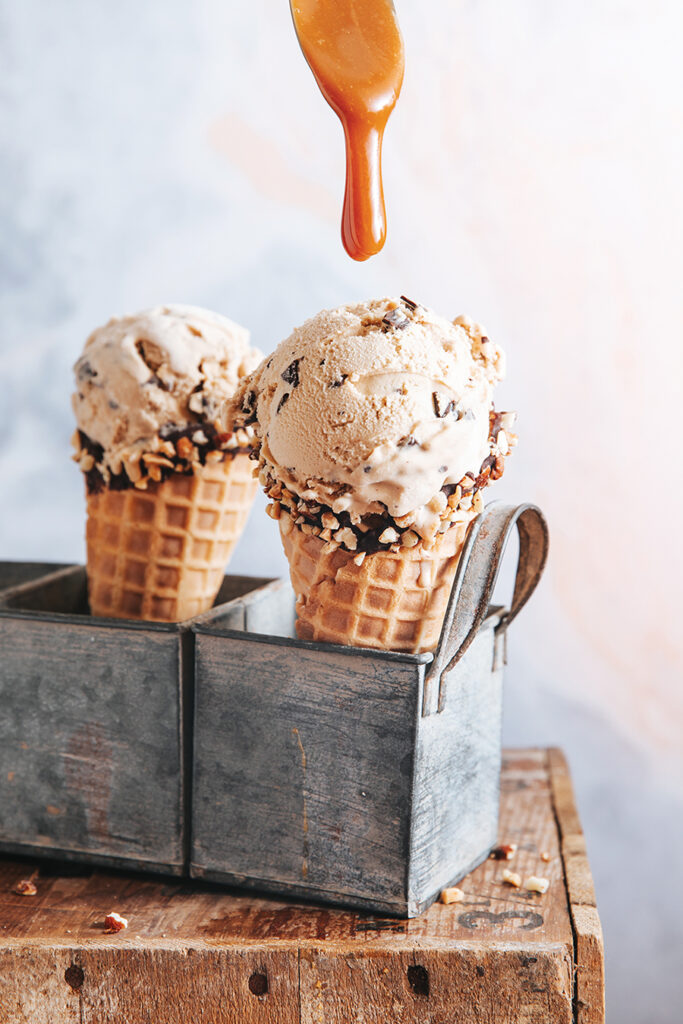
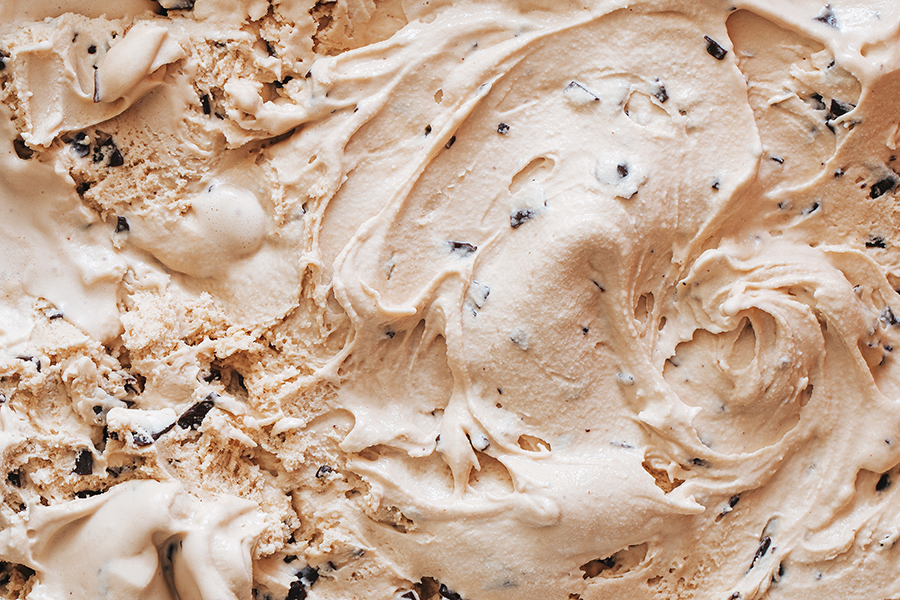
Cold brew coffee, yogurt and hazelnuts, sweetened with honey and a sprinkling of chocolate, is practically breakfast — and a healthy one, at that. Take your favorite frozen yogurt recipe (no-churn recipes are a good option if you don’t have an ice cream maker) and add a dash of cold brew coffee. Sweeten with honey instead of granulated sugar, and fold in dark chocolate chips or cacao nibs for a little crunch. It’s a fine way to start your day or a welcome pick-me-up in the afternoon.
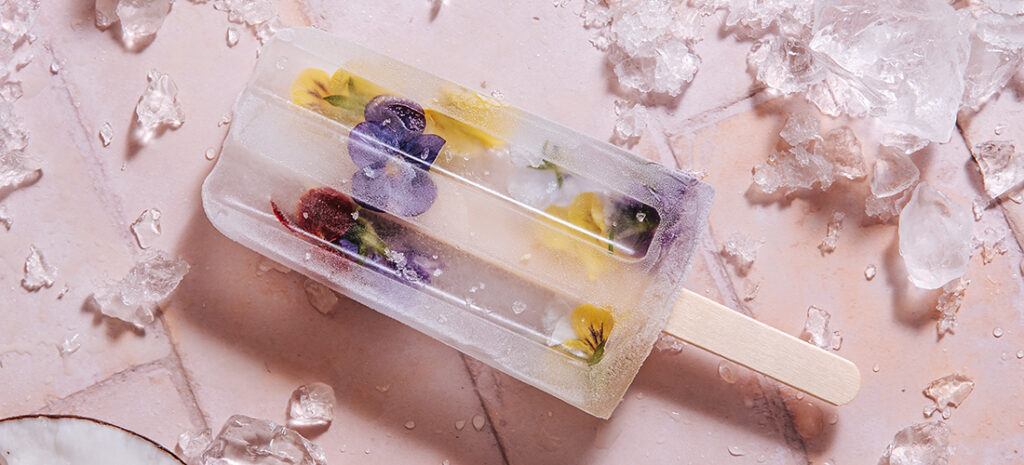
Get your dose of electrolytes on hot, sweaty summer days with coconut water popsicles. Add fresh or frozen fruit, such as pineapple, berries or kiwi; mix with a dash of fruit juice (lemon juice works well) for more flavor; add edible flowers for a whimsical touch. Coconut water is an excellent substitute for sports drinks, minus the added sugars and synthetic ingredients, and will keep you hydrated all summer long. These pops are even kid-approved — mix in a little honey if your babes have a sweet tooth.
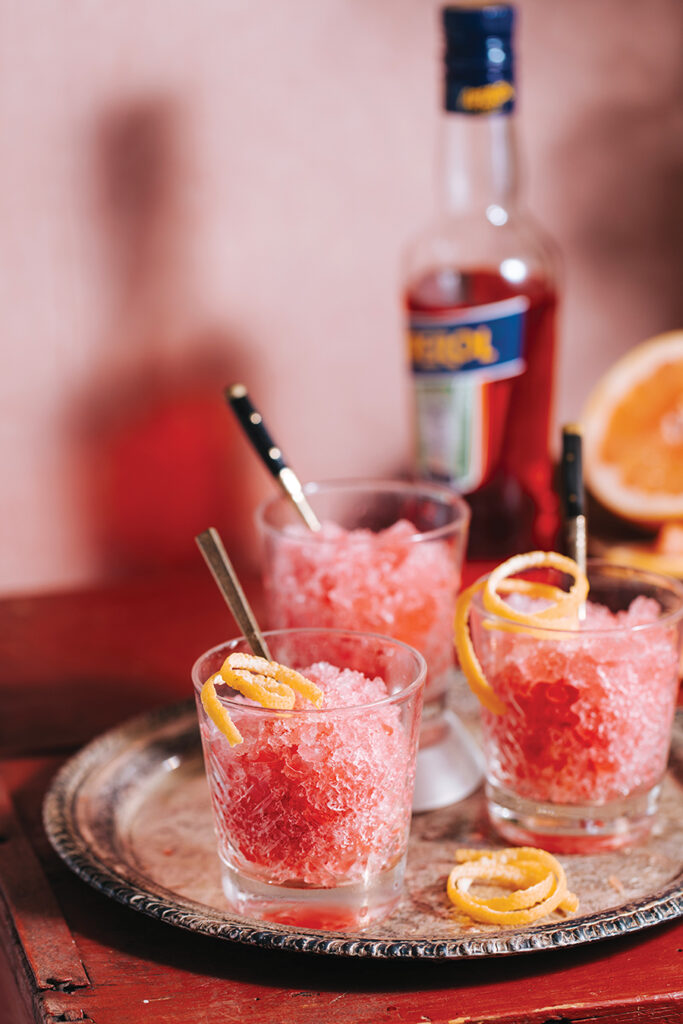
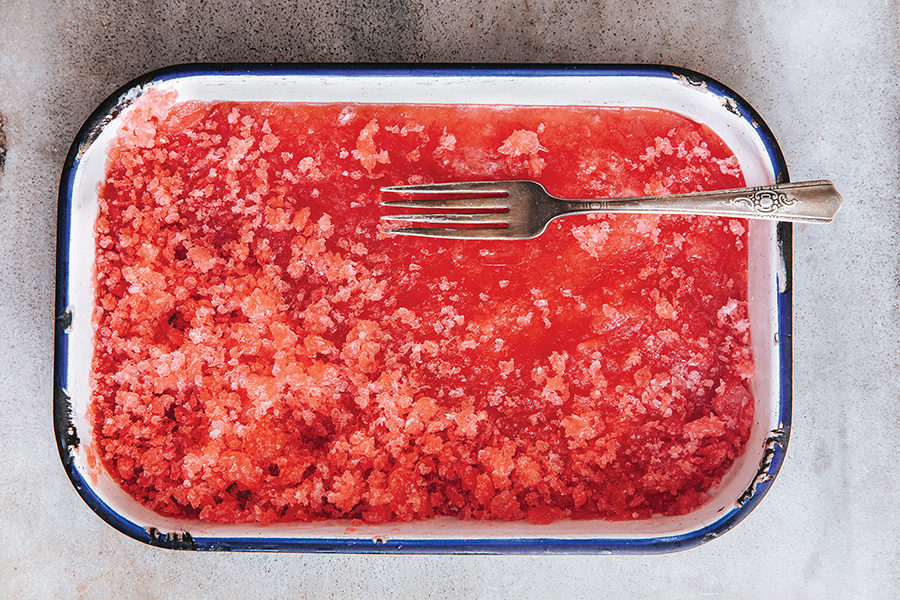
Granita is likely one of the most under-appreciated frozen treats outside of Sicily. This glittering, icy snow doesn’t require any special equipment — all you need is a shallow tray, a fork and a freezer. For a Grapefruit Aperol Granita, heat 1 cup of water with the zest of a grapefruit and about 1/2 cup sugar until the sugar dissolves. Chill, mix in 5 cups grapefruit juice and 1/2 cup Aperol, and freeze in a tray for about 1-2 hours, then start scraping with a fork from the edges to the center. Repeat every 30 minutes until the mixture has turned into sequined ice flakes. PS
German native Rose Shewey is a food stylist and food photographer. To see more of her work visit her website, suessholz.com.

The patriotism of petals
By Emilee Phillips
Photographs by John Gessner
A rose is a rose is a rose.
And a flag is more than dyed fabric.
Together they can evoke emotions filled with
symbolism, lifting and carrying their
message with it.
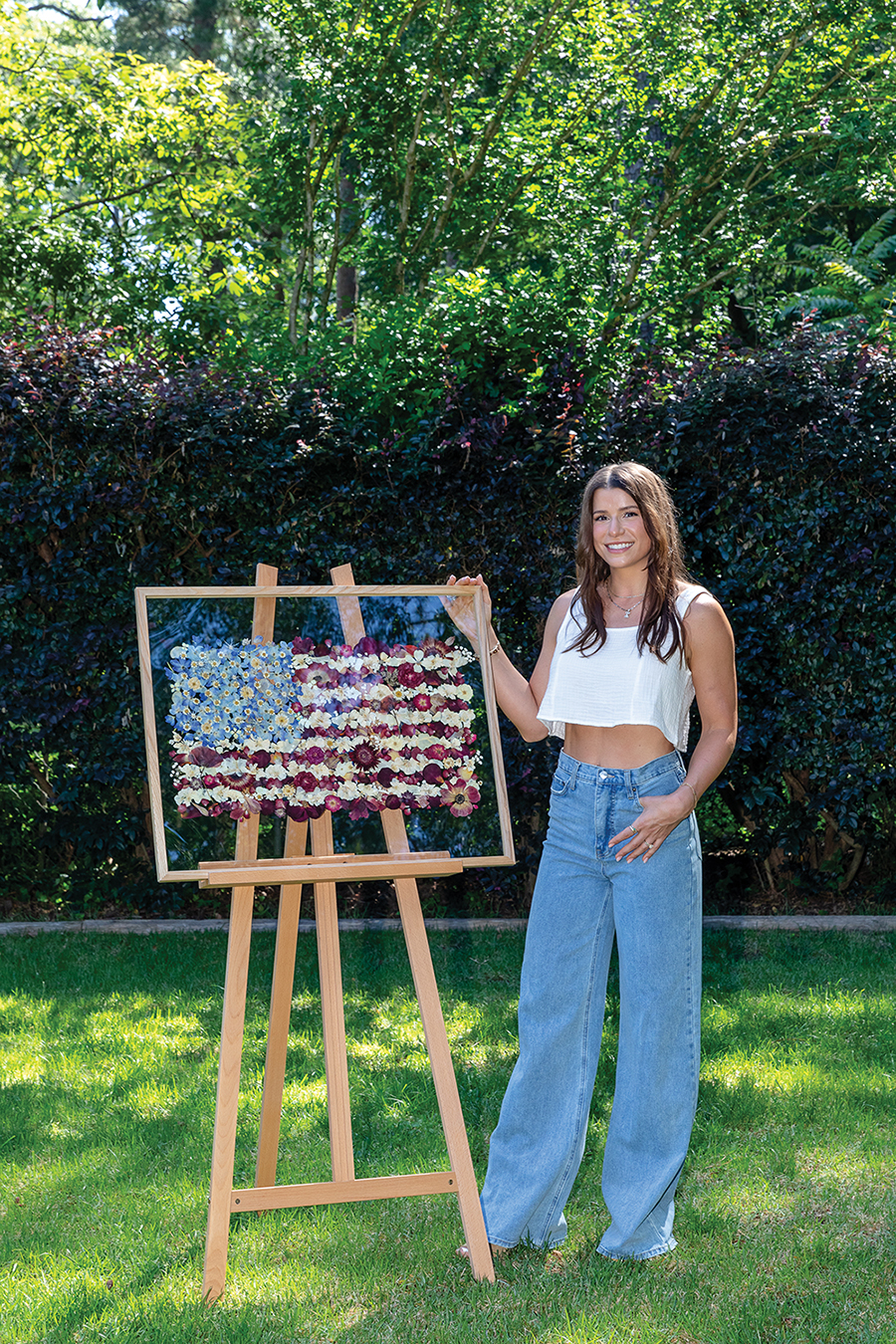
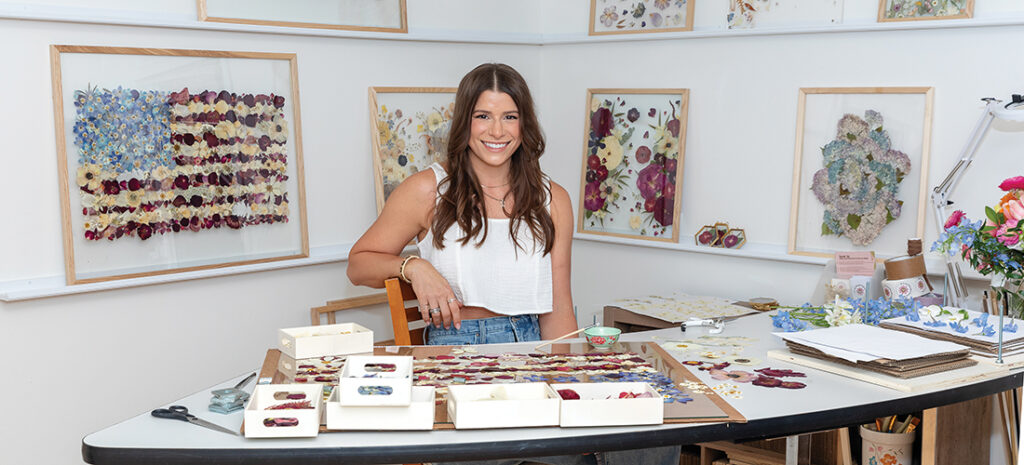
“I wanted to show the strength of an American flag but in a softer, more feminine way,” says Katie Tischler, a military spouse with a love of the outdoors who creates botanical art she dubs “Blossoms of Patriotism.”
The idea wasn’t born overnight. An old scrapbook filled with papers, photos and a single rose cemented itself in Tischler’s childhood memories. Puzzled at first by their commonplace nature, it took her a moment to realize it was a flower her dad had given her mom, kept as a memento of love. “It was brown by the time I saw it,” says Tischler, “but it was sweet when I saw it as a young girl, to see that they kept that.”
Now a card-carrying, certifiable, sentimental romantic, Tischler’s trade elevates pressed flowers to an art form. Her business, Pine Pressed Flowers, preserves flowers from any occasion. She began the business in 2019 preserving bouquets from weddings, funerals or any milestone with deep, personal meaning. Some of her work is simply for aesthetic purposes, but roughly 90 percent of her business consists of custom orders arising from these watershed events.
“Life is short, and there are only so many big days,” says Tischler. Her philosophy: If you want to preserve a memory, just do it.
The process is simple. You pick your frame size and floral layout, be it bouquet style, deconstructed or abstract, then in a few months, voilà, you’ll be met with a work of art. “I love the less literal, more organic look,” says Tischler.
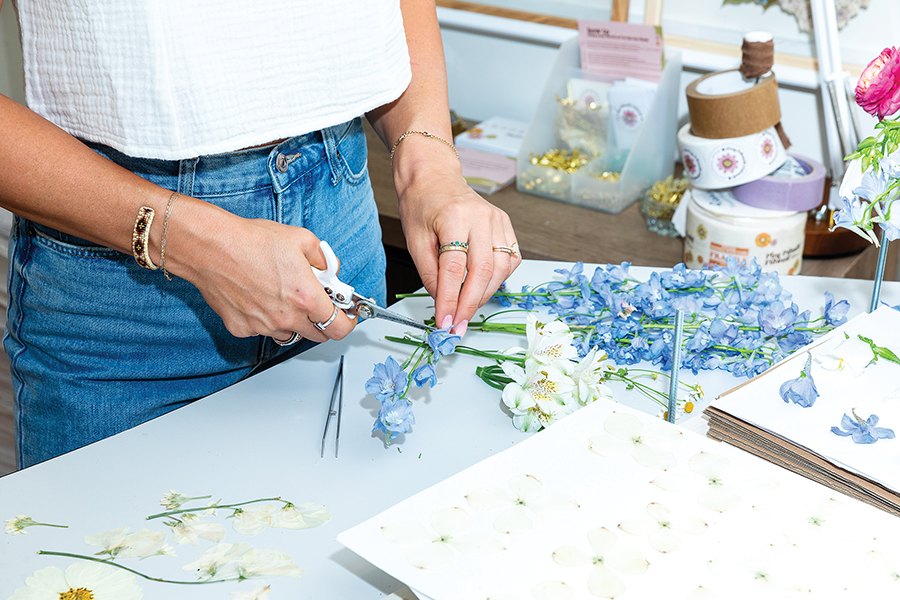
The craft of pressing flowers demands four to six weeks of careful handling and rotating. In a world of instant gratification, the slow, precise technique adds to its charm.
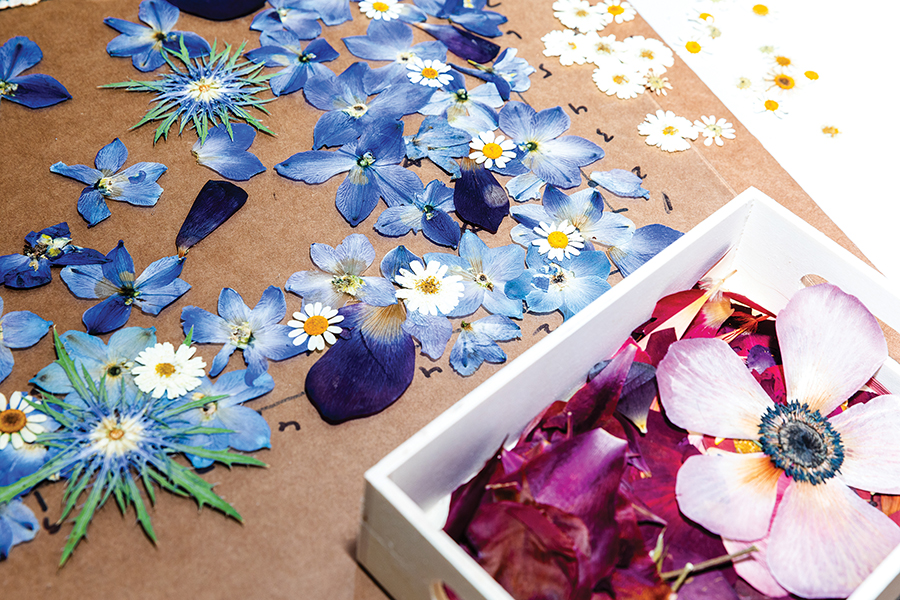
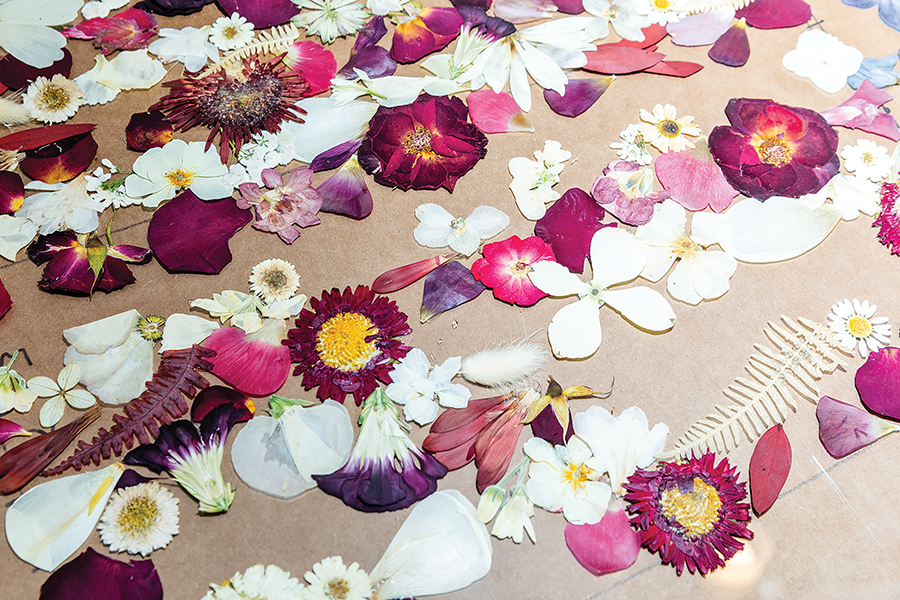
Tischler’s floral flags take months to construct, between scavenging for the perfect assortment of flowers, pressing them and delicately arranging them. Each part of the flag, like a flower, serves its purpose. Each has its meaning. Tischler is mindful in her construction and searches for flowers that are local, typically trying to add dogwoods — the North Carolina state flower — to her flags.
Start to finish, flowers undergo subtle color transformations in the pressing process, rendering the creation of her floral flags particularly challenging. Tischler doesn’t use dyes to achieve her red, white and blue hues. To date she’s made five flags, the first of which was donated for a charity gala for the nonprofit Shields & Stripes.
“Each of the flags are all so different, if you look closely,” Tischler says. Staring at one is like staring at a mesmerizing kaleidoscope and spotting something new each time you come back to it.
A typical week begins with the more mundane routines of processing flowers, documenting, collecting and labeling. But, later in the week, her creative headspace kicks in. Tischler doesn’t do layouts prior to constructing. She adopts the organized chaos of nature and just begins gluing. “I feel more free without a roadmap,” she says.
The routine in her home studio begins with a hot cup of herbal tea and noise-canceling headphones. The workspace is filled with hundreds of handmade wooden flower presses. “My husband cut wood for weeks,” she says with a laugh. The walls are adorned with glass panes of clients’ memories filled with every type of flower imaginable. Each flower takes time to deconstruct, keeping in mind it will need to be reassembled later on.
Tiny, delicate frames adorn one of the walls of the sunroom, each cradling a single pressed flower from a distant land. “Every time my husband deploys he brings me back a flower,” Tischler says, smiling. One of those “contraband” flowers found its place between the pages of a medical book that he had tucked away beneath his mattress until he returned. “He claims not to be sentimental,” she says. But the flowers say otherwise.
Thrifted books have become a favorite way for Tischler to press flowers, especially for personal projects, as the sturdy old pages drink in the essence of the blooms with their superior absorbency.
Each piece she makes includes a certificate of authenticity and a “best practices” guide for preservation — it’d be a shame for your art to brown from overexposure to direct sunlight. On the back of the guide is an Aristotle quote she includes with every keepsake: “The aim of art is to represent not the outward appearance of things, but their inward significance.”
Included with each floral flag’s certificate of authenticity is a detailed list of all the flowers the frame holds. “I think it’s important to show your patriotism,” Tischler says. “I wanted to do it in a way that was my own.” PS
Emilee Phillips is PineStraw’s director of social media and digital content.

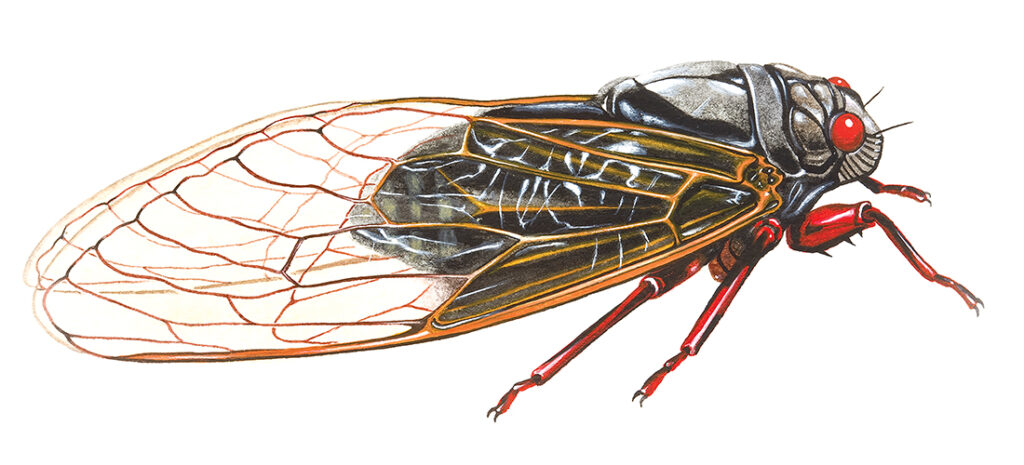
They don’t so much sing as plead
In their droning sound stampede.
I hope they find the love they need —
Something more than meet-and-breed.
Can that even be with insects —
To have sensations beyond touch?
Do they know joy as well as sex?
They don’t so much.
— Paul Jones
Paul Jones is a professor emeritus at the University of North Carolina at Chapel Hill and the author of the collection Something Wonderful.

Good things come in small packages
By Deborah Salomon
Photographs by John Gessner
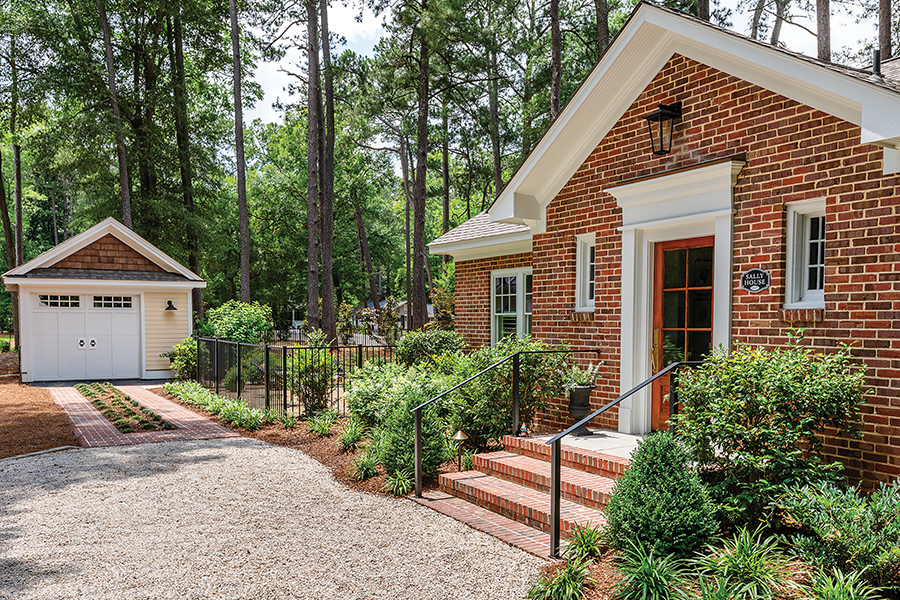
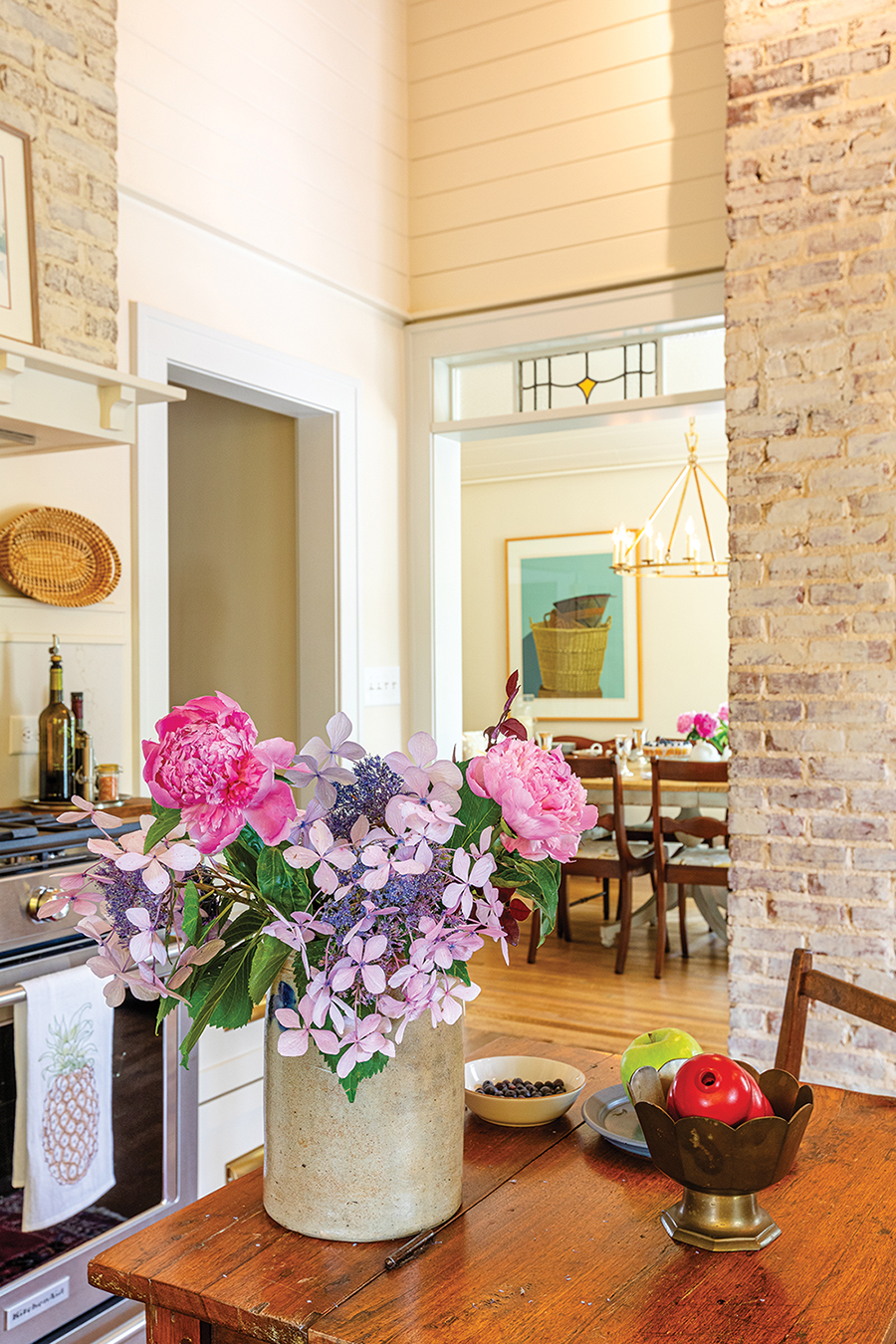
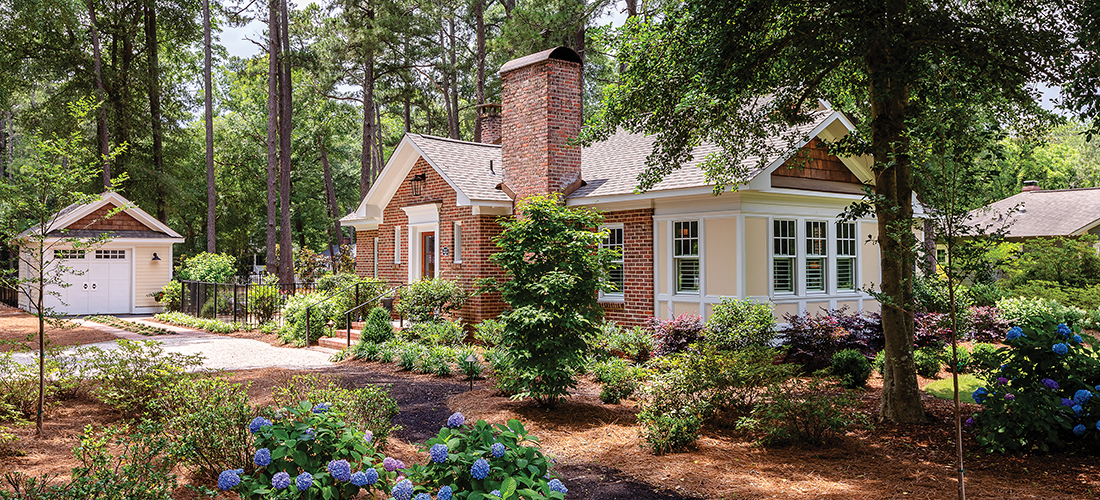
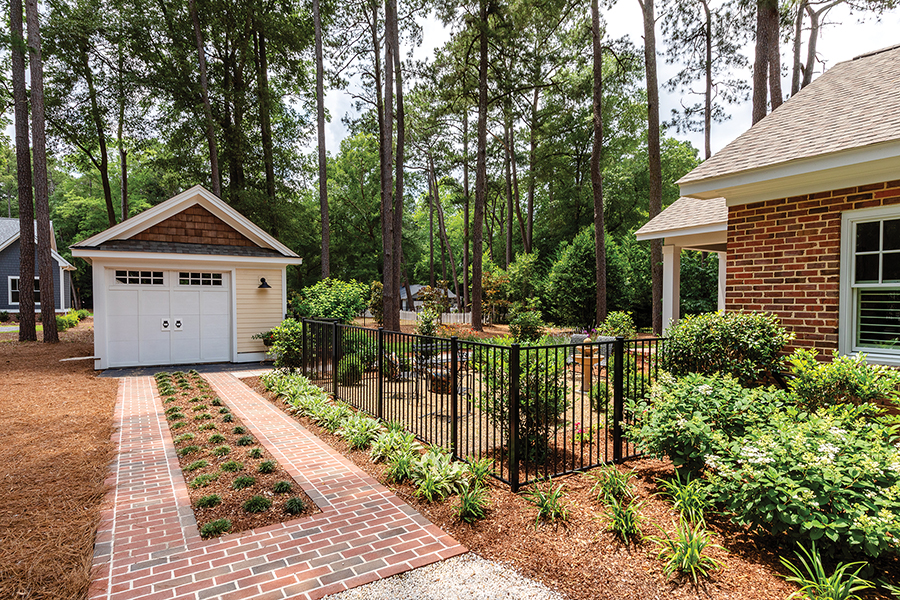
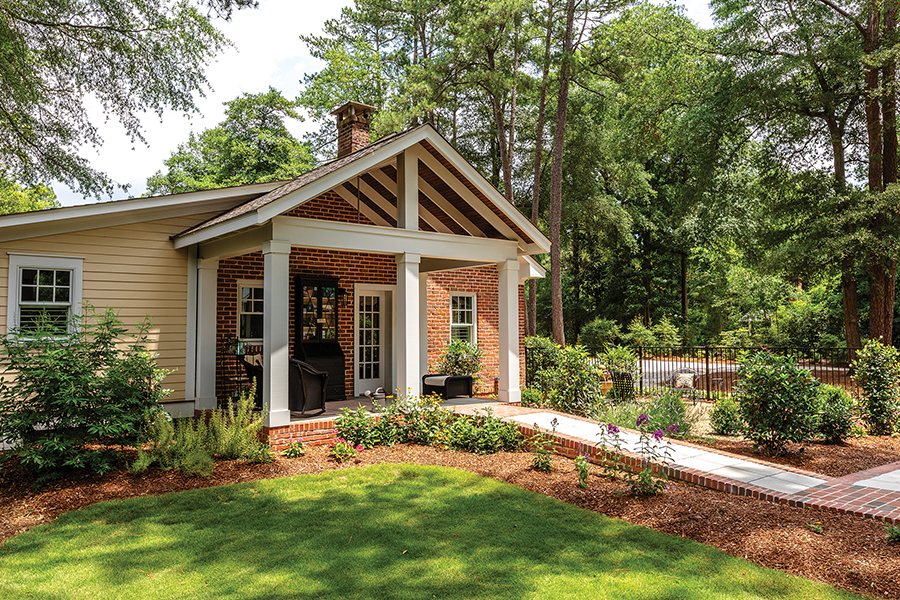
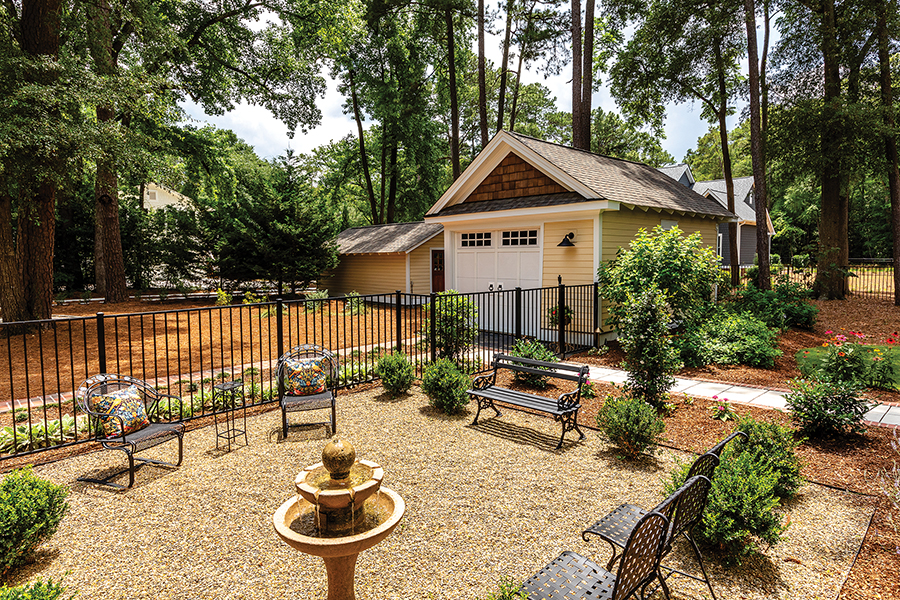
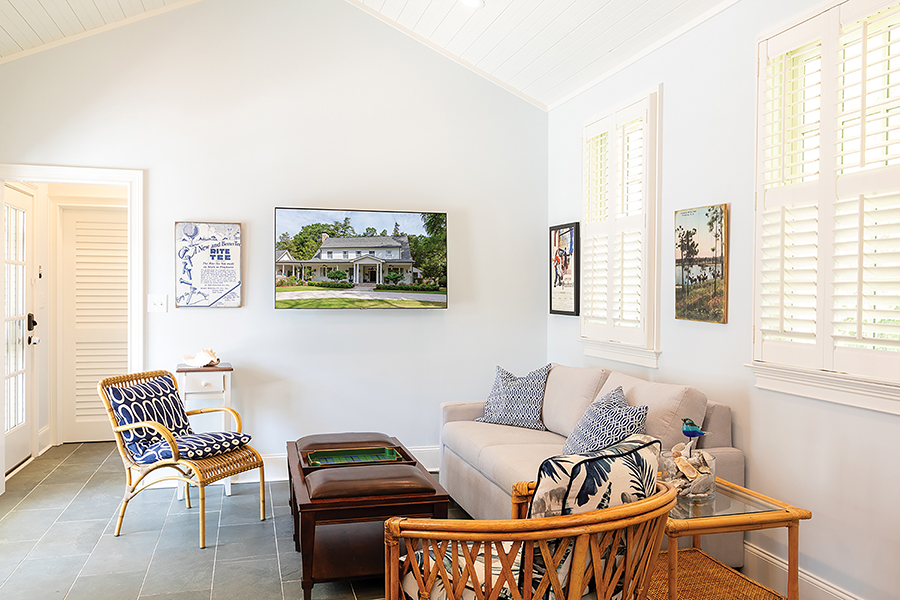
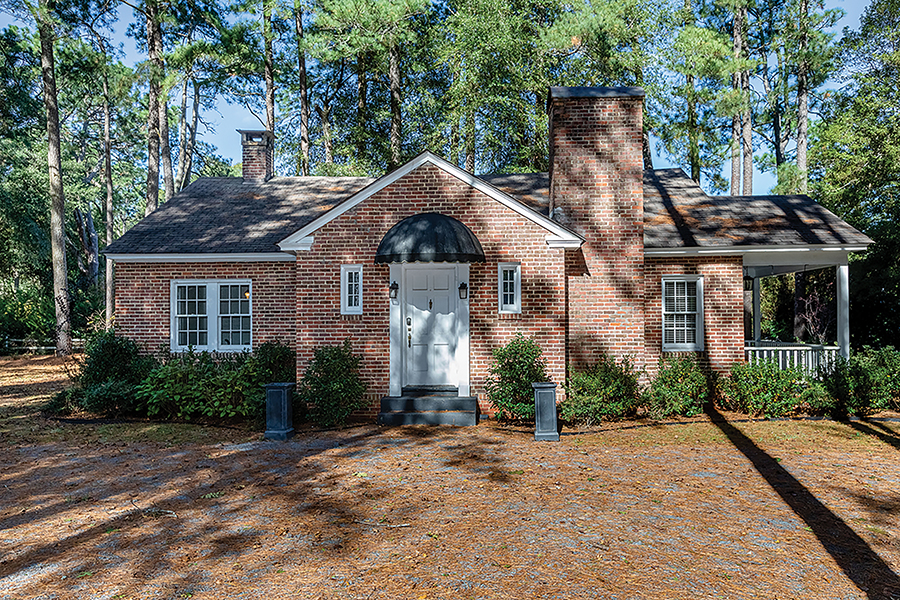
 “Perfect” is an imperfect word when applied to houses. But once in a blue moon, it fits: A small dwelling that, through careful staging, appears larger; a historic Pinehurst property neither castle nor Tara; furniture of several different periods and provenances that hangs together harmoniously; a hydrangea-lined walkway and a garden surrounded by a wrought iron fence, designed for sitting and sipping tea with neighbors.
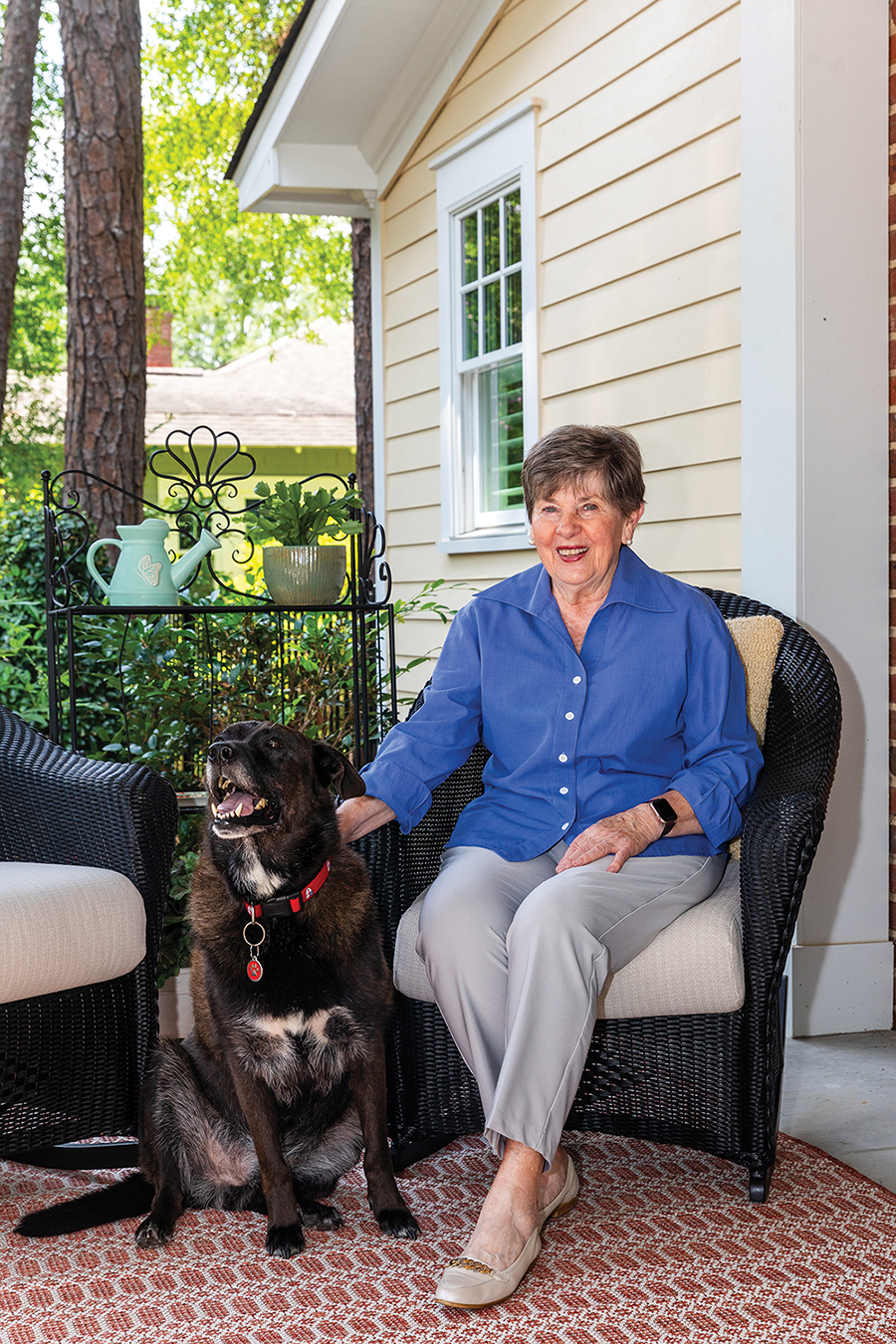
The finishing touch is a sweet black Lab named Ritter, same as a Pinehurst street. Most mornings Ritter walks Judy Davis to The Villager Deli, where the owner enjoys breakfast and the dog greets friends, old and new.
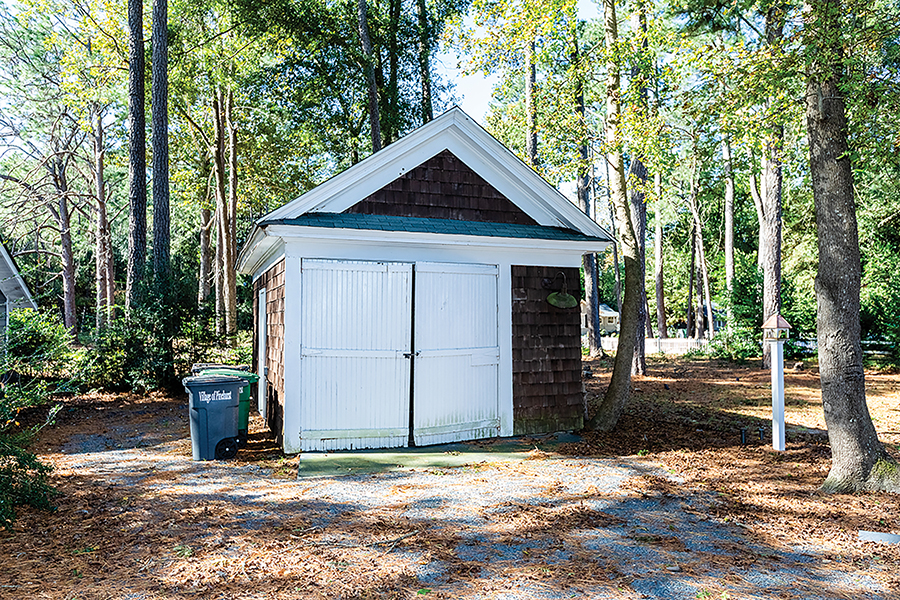
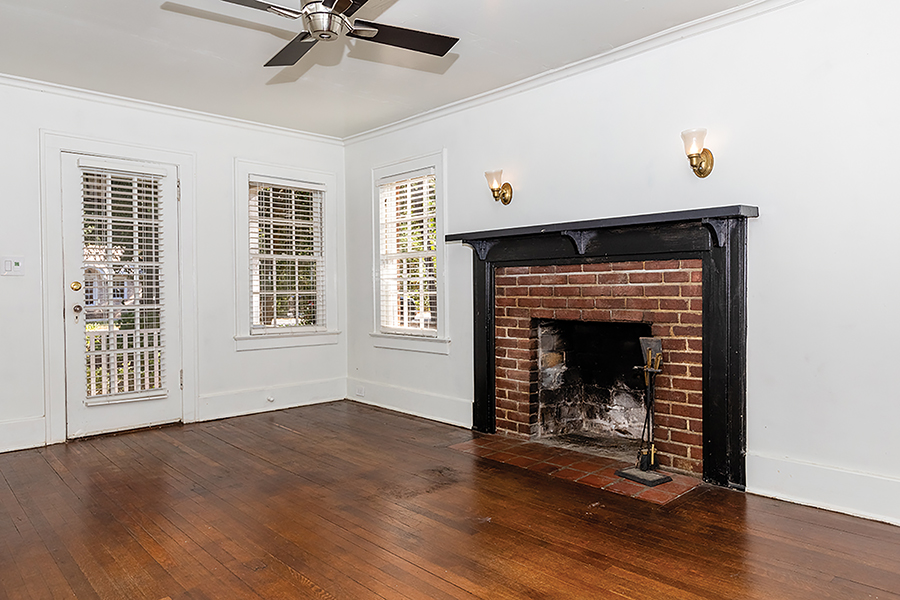
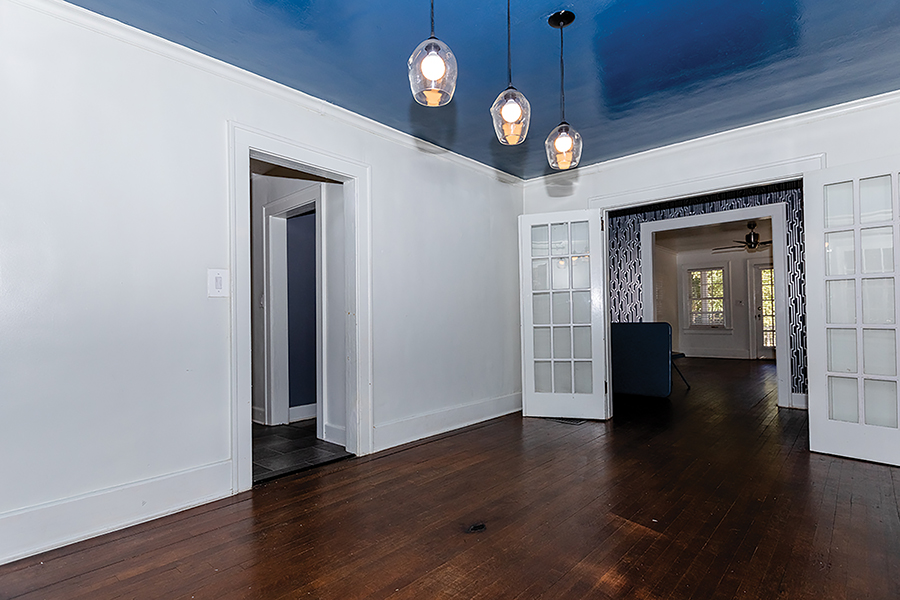
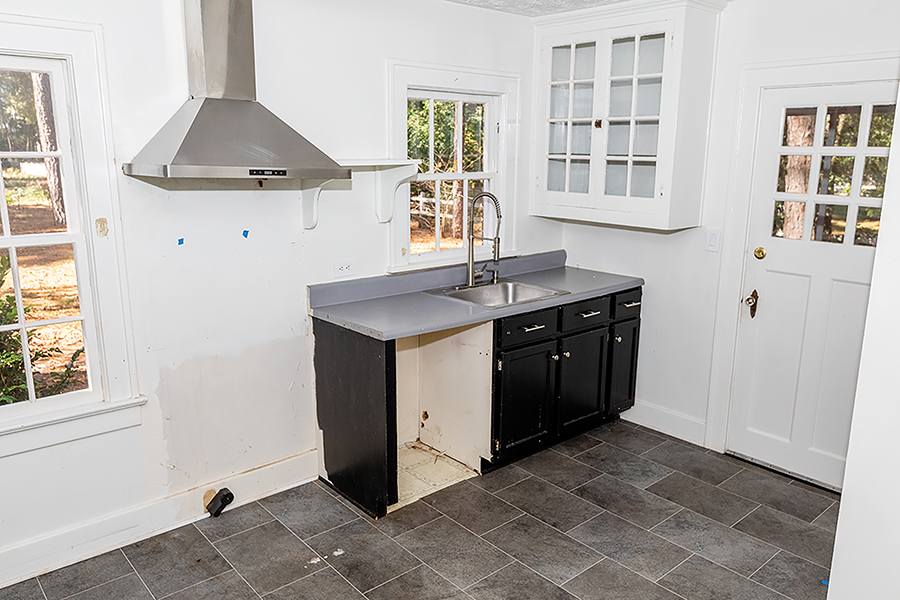
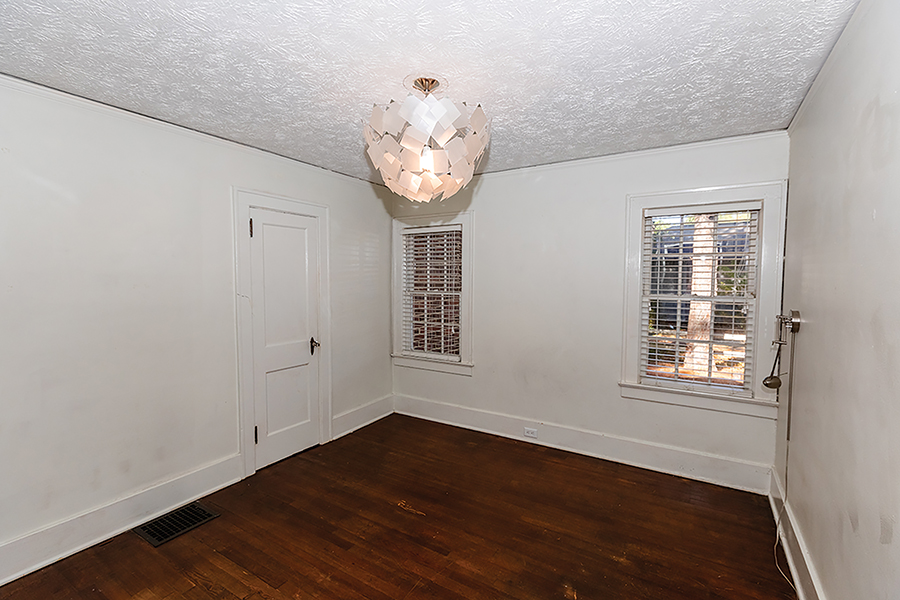
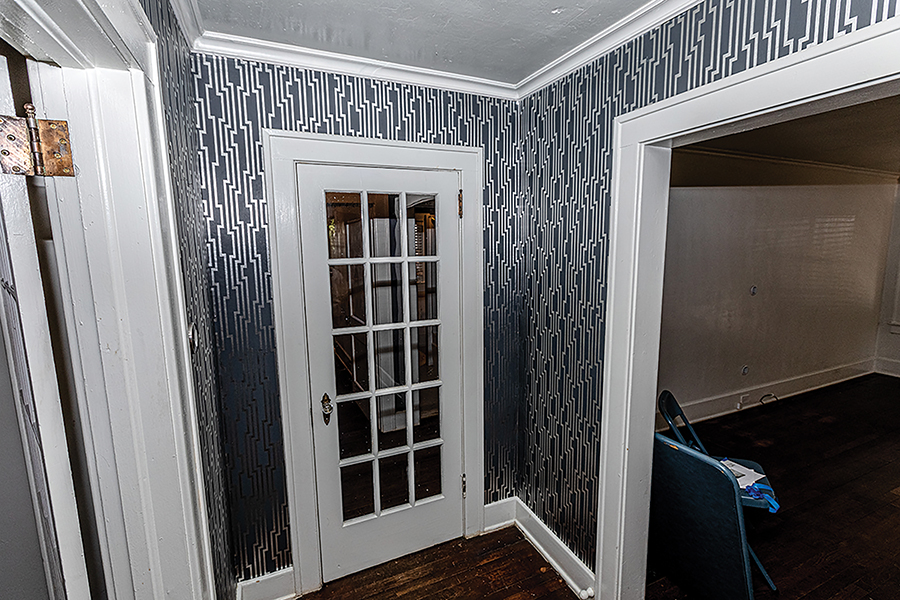
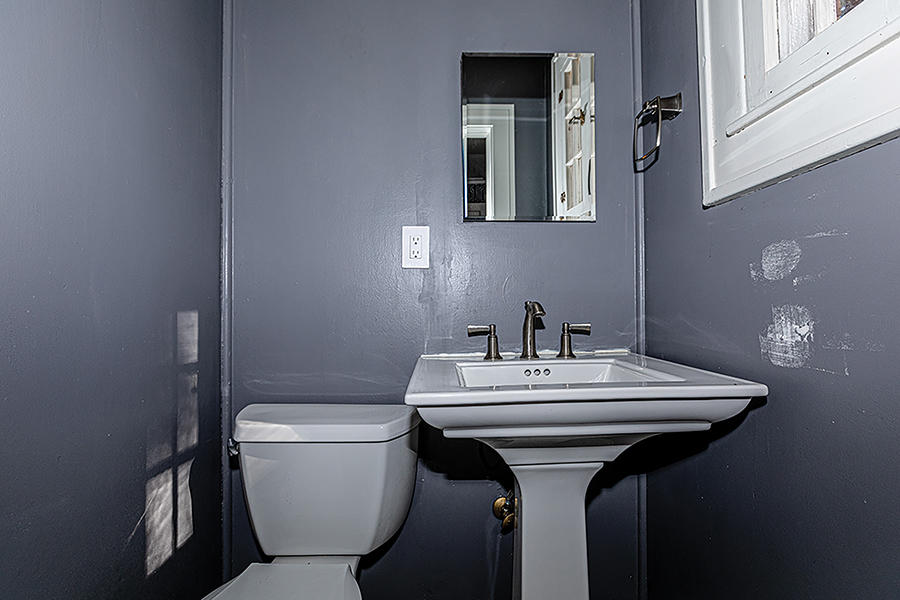
Above: Photographs of pre-renovation
They live in a cottage, circa 1,500 square feet, on the outer ring surrounding the estates Pinehurst is famous for. These cottages, built for teachers, shopkeepers, resort employees in the 1920s — later rented to military personnel -— are, one by one, being renovated as mini-showplaces for golf-loving retirees in search of mild winters, upscale amenities and likeminded neighbors.
Davis grew up in Virginia and South Carolina, worked in marketing in Ohio until retirement in 2013. Along the way she discovered Pinehurst while attending a Peggy Kirk Bell “Golfari” at Pine Needles Lodge and Golf Club. What followed became an odyssey of purchasing, renovating and moving out of several properties in this outer ring until she found her historic gem.
“You could call me a serial renovator,” Davis says with a laugh.
Beside the front door hangs a plaque proclaiming Sally House 1927, named after A.B. Sally, its builder.
This time the youthful grandma and former Pinehurst Village Council member had a new objective: aging in place. It meant two showers but no tub — no sills to trip over. Instead of a conspicuous ramp out front, an attractive brick version slopes off the back porch. Topping her list of practicalities is a generator powerful enough to keep the whole house humming if Duke Power can’t.
Realtors recognize the aha moment when a client walks into the just-right house. Davis experienced hers when she noticed the door that separates the public area from bed and bathrooms. She saw beyond the dark, geometric wallpaper and a kitchen devoid of personality. With the assistance of architect Christine Dandeneau, familiar with the area from living a few blocks away, Davis assumed the task. “I didn’t want an open floorplan,” she says.
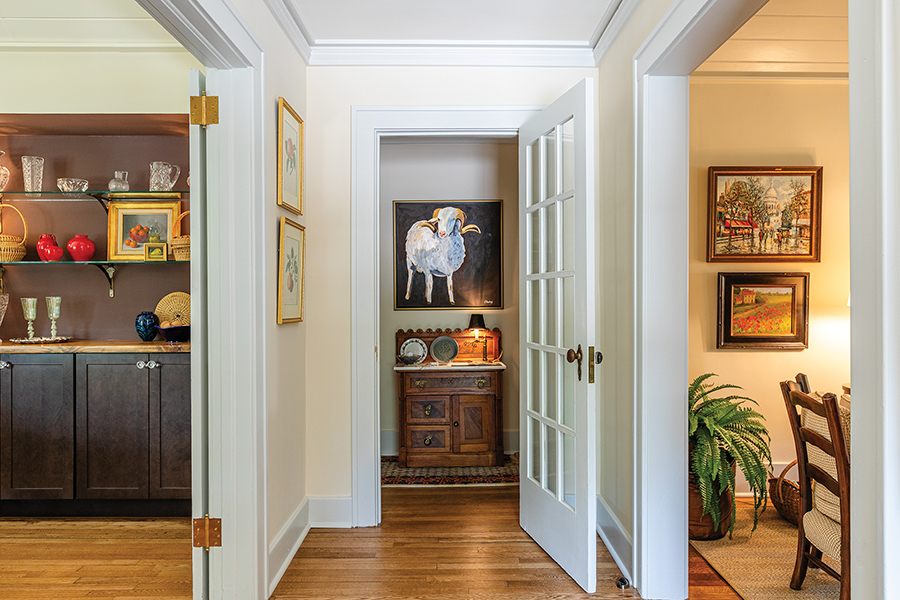
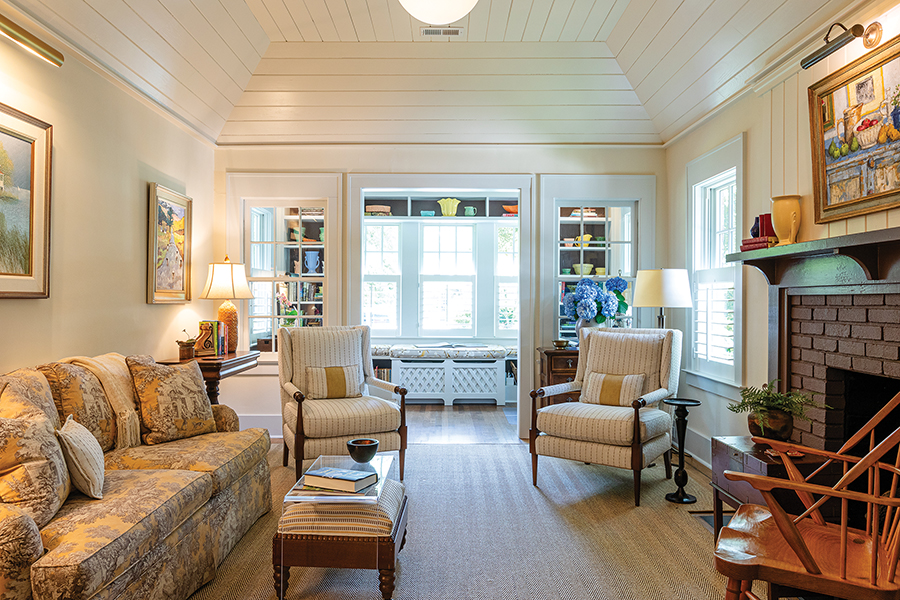
Since the house has no family room, great room or, in ’60s-speak, den, the living room is lived in. A scaled-down sofa is upholstered in a neutral toile print. The area rug is grasscloth, the side chairs comfortable, and the coffee table a contemporary Plexiglas over wicker. Press a button on the long console chest and a TV screen rises from its depths.
“I don’t like to look at a blank screen all the time,” Davis explains.
Topping it off while adding height and volume is an inverted hip ceiling done in a textured pattern. A variation of this mode appears on the dining room ceiling over an oval table with an unusual rough finish, where Davis holds meetings as well as dinner parties.
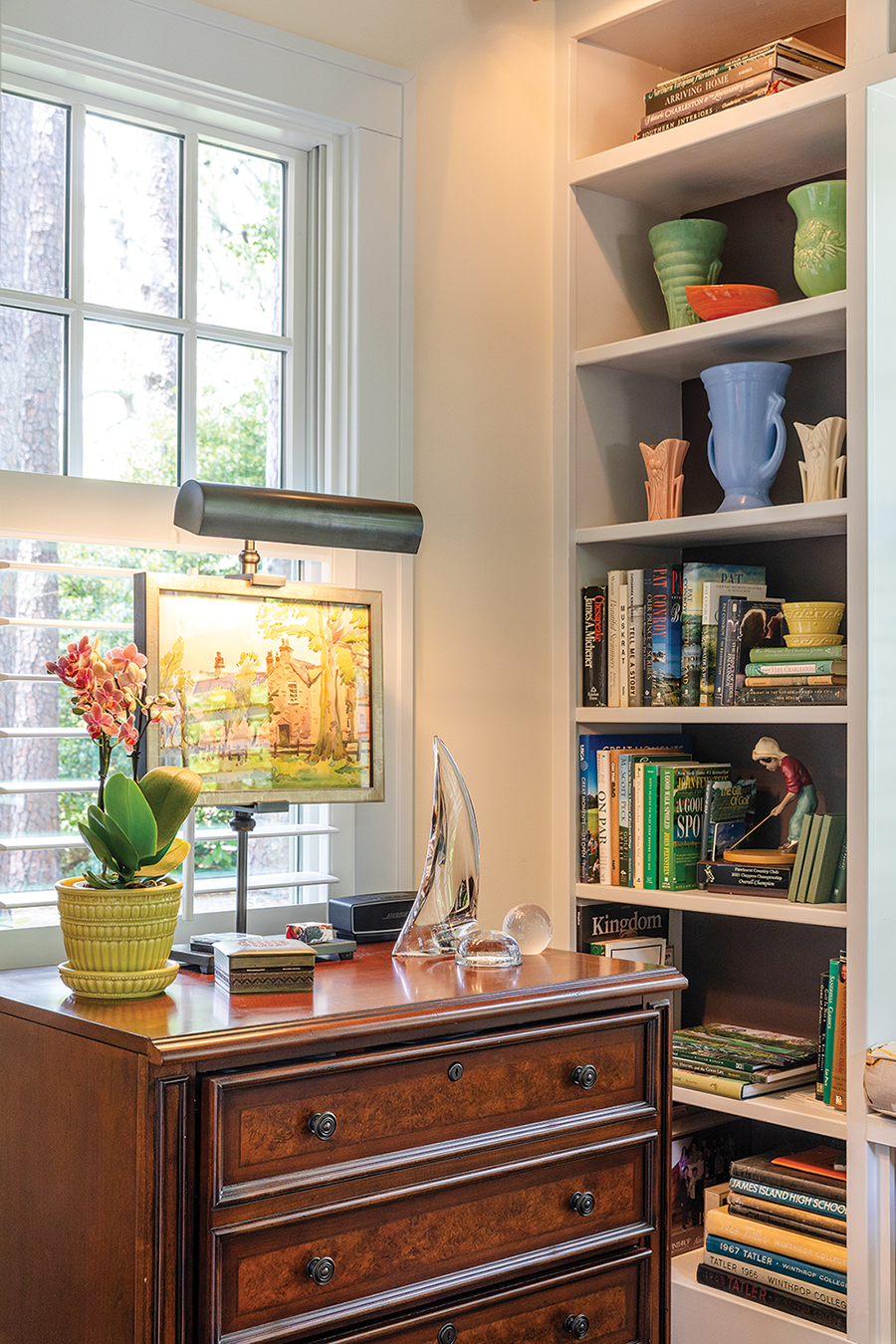
Beyond the lived-in room, Dandeneau enclosed a narrow porch for an office, with window seat and built-in bookcases displaying a first glimpse of Davis’ McCoy pottery, a prized American collectible from the mid-1900s, appearing throughout the house as vases, pitchers, mugs, teapots. This pottery, along with paintings depicting fruit, flowers and dogs, provides bursts of color against French vanilla walls uniting the rooms, as do original floorboards whose imperfections add character. Davis is particularly fond of stylized canine art by Stephen Huneck, an internationally recognized Vermont folk artist and creator of children’s books featuring, coincidentally, his black Lab named Sally.
Dandeneau agrees that working with a small space requires ingenuity. Davis looked at a shallow closet in the dining room and saw a bar/storage nook. Off came the doors, in went cabinetry, a counter, unusual lighting fixtures wired into the sidewalls, the entirety painted a rich aubergine. She keeps the everyday dishes there, since the kitchen has only one wall-hung cabinet, back-lit to display fine china.
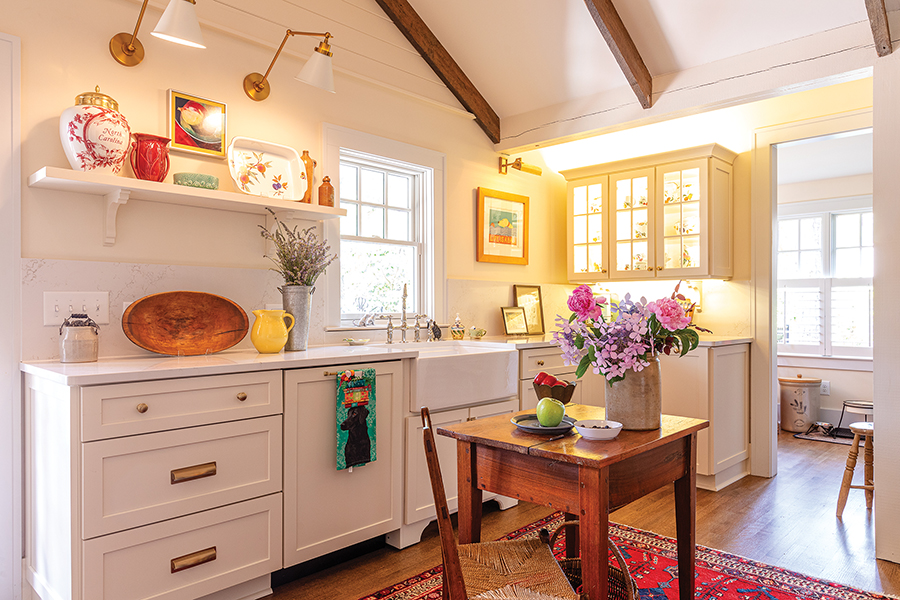
By some sleight-of-hand that kitchen — with exposed brick, multi-angled ceiling, wall-mounted shelves, footed cabinets and splashy art — does not feel cramped despite the gas range and refrigerator. Instead of an island, Davis placed an antique school desk and chair on a small rug, decorative and useful. Extending beyond the kitchen, an addition to the house provides space for stacked laundry equipment, a window and storage.
The result: European flair, American practicality.
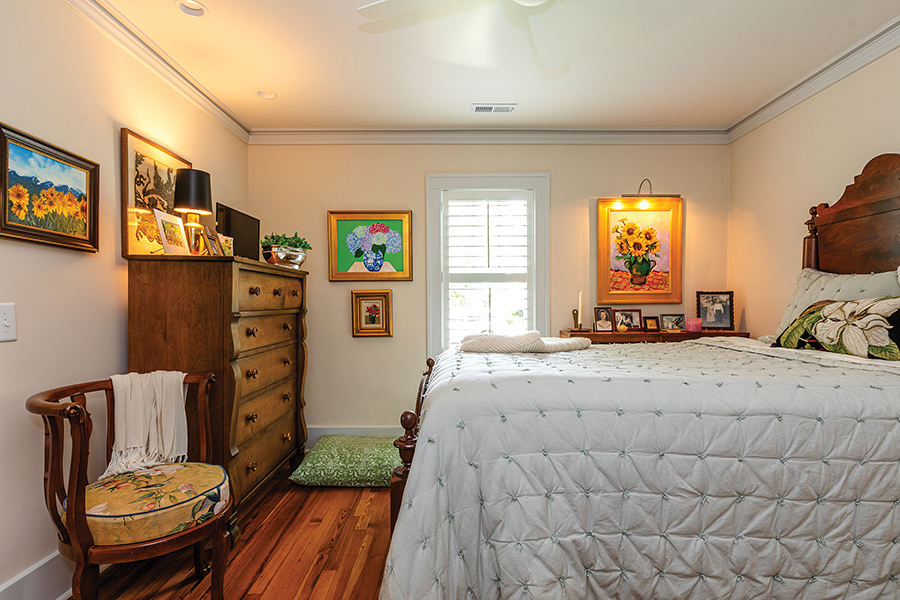
Two bedrooms, also modest in size, prove that queen-sized beds fit just fine if other pieces are kept to a minimum. Two large and thoroughly modern bathrooms plus an adorable powder room might have surprised A.B. Sally in an era when nobody gilded the loo.
Who would know better than Ann Dixon, Mr. Sally’s granddaughter, who lives nearby in a similar cottage? The two met while dog walking. Dixon recalls visiting Davis’ cottage as a child and provides town history so important to its new owner/curator.
The result?
Adorable. Charming. Traditional yet trendy. Practical, personal and innovative. In a word . . . perfect.
“And the best part is I get to live here,” Davis says. PS


Beating the Heat at Judson Theatre’s Summer Festival
By Jenna Biter
Sunshine streams through the floor-to-ceiling windows like a spotlight.
“We do have a star in the Summer Theatre Festival this year,” Morgan Sills says from a bench just inside the lobby of the Sandhills Community College Bradshaw Performing Arts Center. Sills, the executive producer and co-founder of Judson Theatre Company, the professional theater company in residence at BPAC, pauses for a second, then smiles.
“Linda Purl is coming back,” he says.
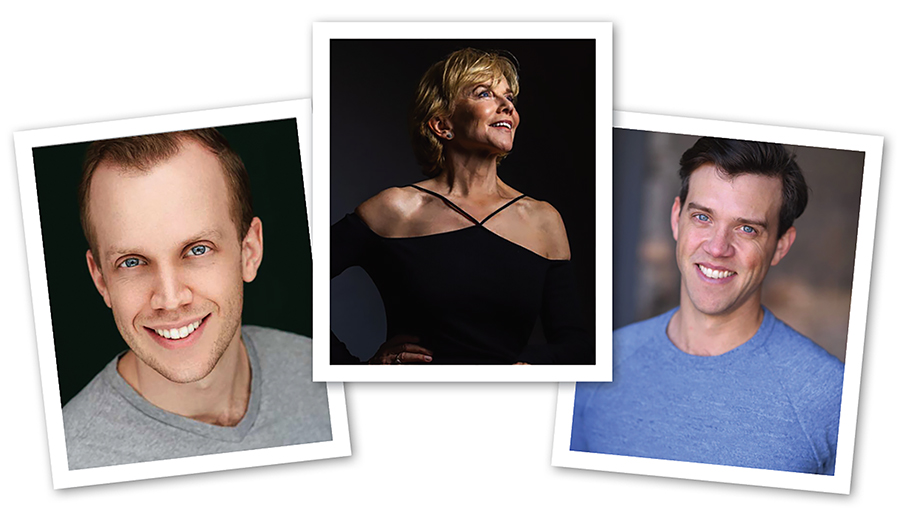
The name bursts into the room. Baby boomers and millennials — perhaps even Gen Z cinephiles — recognize Purl, either as Henry Winkler’s girlfriend in Happy Days; Andy Griffith’s daughter, Charlene, in Matlock; or Jenna Fischer’s mom/Steve Carell’s love interest in The Office.
Regulars at Judson’s productions will also remember Purl from The Year of Magical Thinking, the one-woman Joan Didion play that ran for two weekends last August in BPAC’s McPherson Theater, in the company’s second annual summer series.
“I loved it,” Sills says, reflecting on Purl’s powerful performance of Didion’s masterpiece about loss and grieving. The material deviated from Judson’s typical summer formula: a bright and fun musical, followed by a comedy — “hopefully one that people haven’t seen,” says Sills — and finishing with another musical.
This year’s summer series returns to that original, lighter formula, with a boredom-busting lineup beginning July 19 and ending Aug. 25. Each show will run for two long weekends, for a total of six straight weeks of air-conditioned entertainment when you need it most.
As always, all three plays will be performed in the McPherson black box theater, a stage-less, intimate chameleon of a venue that can be configured to suit the production. It seats a maximum of 80 and, without traditional sets, asks the audience to use its imagination on the canvas of the four black walls.
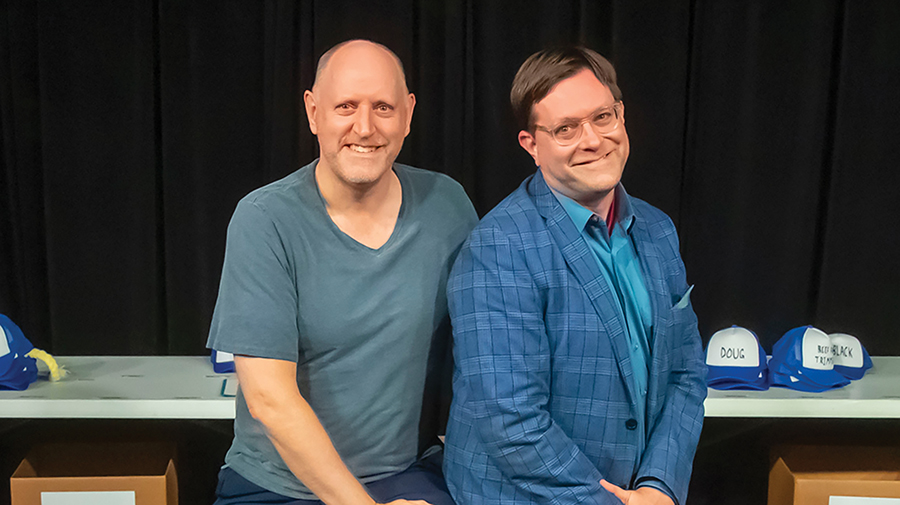
“The middle’s back to comedy,” Sills says, describing Purl’s encore in an Emily Post-approved two-person play, Mrs. Mannerly, sandwiched between two musicals. “It’s a two-hander about a small-town, charm school teacher with a past, and the young man whose life she changes for the better.”
Purl performs opposite Jordan Ahnquist, known for his lead in New York’s production of Shear Madness, the interactive whodunit that holds the record for the longest-running nonmusical play in America.
“We’re opening with They’re Playing Our Song,” says Sills. The Neil Simon play, written with lyricist Carole Bayer Sager and composer Marvin Hamlisch, is loosely based on Sager and Hamlisch’s real-life romance and ran for more than 1,000 performances in Broadway’s Imperial Theatre. “It’s never not a hit,” says Sills.
The Emmy-Grammy-Oscar-Tony, or EGOT, award winner Hamlisch, who died in 2012, would have turned 80 this year, so Judson’s production is a tip of the cap.
“When you’re not laughing, you’ll be tapping your toes,” Sills says. “That score is so wonderful. It’s so late ’70s and rhythmic and catchy. There’s a whole lot of . . . Tell it to me, Mama! Listen to me, Baby! Huh. Huh. Huh,” he says, breaking into song.
Sills punctuates his rendition with Elvis flair, though a different Pressley — Jacob, with one more ‘s’ — will be playing the musical’s leading man, Vernon Gersch. Like Purl, Pressley is a Judson series veteran. This year marks the actor’s third straight season flying south for the summer.
Last year, Pressley belted his way through the rise and fall of a marriage in The Last Five Years and the year before saw his Sandhills debut in Gutenberg! The Musical!, a romp about two playwrights of a farcically inaccurate historical play about the inventor of the printing press.
“This show kind of marries the two,” Pressley says of this summer’s selection. “They’re Playing Our Song is a relationship show. It’s touching and sensitive and personal at times, but also the book is written by Neil Simon, so it’s witty, it’s clippy.
“It’s a fun read because of all the quippy little Neil Simon-isms,” Pressley says of the great American playwright who created classics like The Odd Couple and The Sunshine Boys. “At the same time, I’m reading through thinking, ‘Oh my gosh, I have to remember all of this.’”
While Sills will direct Mrs. Mannerly, Daniel Haley, Judson’s artistic director and other co-founder, will reclaim his usual seat in the director’s chair for They’re Playing Our Song, as well as Tell Me on a Sunday, the festival’s final show.
“This is another little gem people don’t know about,” Haley says. “The music is by Andrew Lloyd Webber, and I think it would be difficult to find someone who doesn’t know who that is, right?”
Like Hamlisch, Webber, the Englishman responsible for classics like The Phantom of the Opera and Cats, also has an EGOT. Tell Me on a Sunday is a one-act, one-woman musical about a Brit who journeys to America in search of love. Like many of Judson’s summer picks, it has slipped the greater limelight. “You find these little gems that people don’t know about, and it’s really such a pleasure to bring them to people,” Haley says.
Selecting shows for the summer series that aren’t widely known or shown isn’t accidental, but it has been mildly prophetic. “I feel like we have our finger on the pulse because Gutenberg! was on Broadway this past year,” says Sills. Similarly, tick, tick… Boom! — another former Judson summer selection — was recently directed by Neil Patrick Harris at the Kennedy Center, in Washington, D.C.
Purchase tickets to the 2024 Summer Theatre Festival by visiting ticketmesandhills.com or going to Judson’s website, judsontheatre.com. PS
Jenna Biter is a writer and military wife in the Sandhills. She can be reached at jennabiter@protonmail.com.


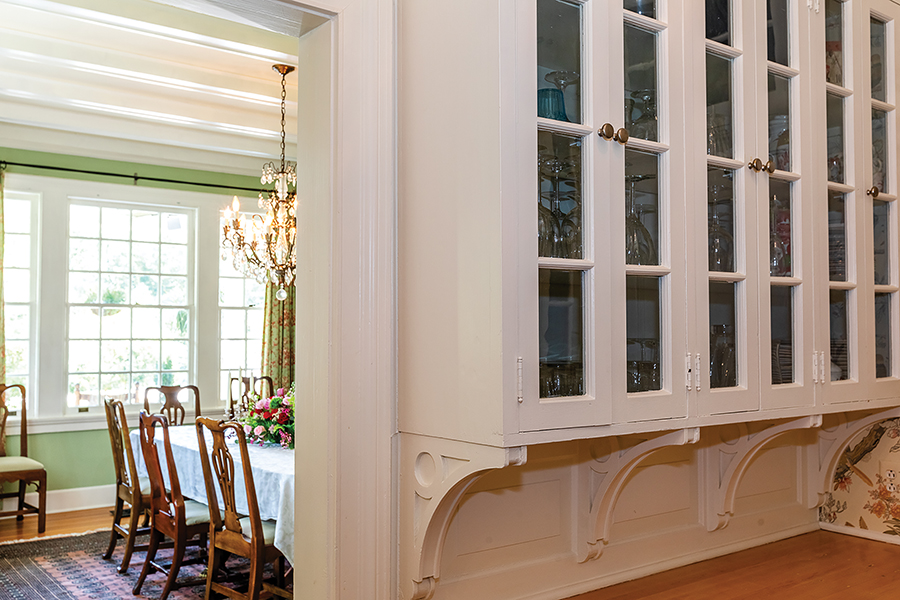
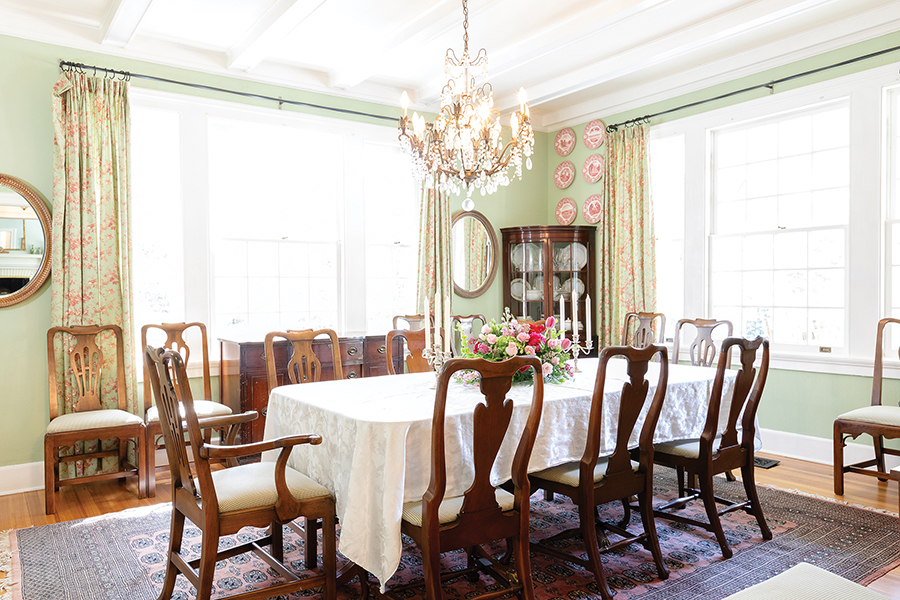
Historic home comes full circle
By Deborah Salomon
Photographs by John Gessner
In the late teens and early roaring twenties, society hostesses planned guest lists around the comings and goings published in The Pinehurst Outlook.
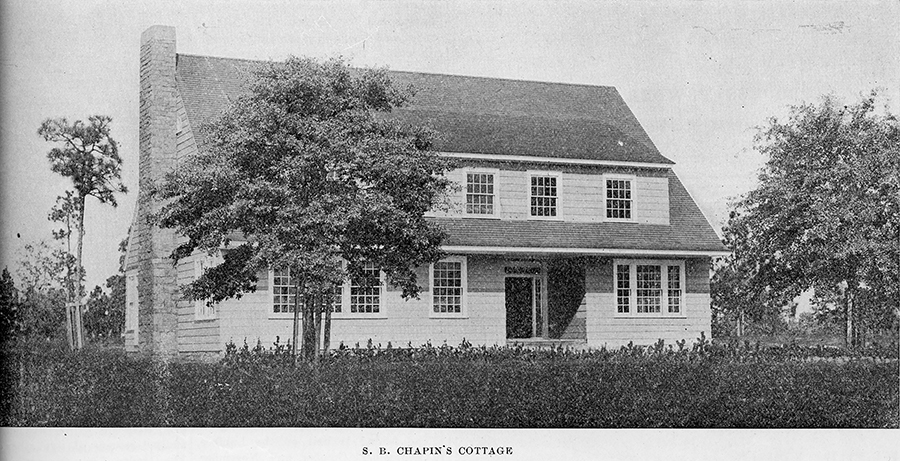
December 15, 1923: “Most of the regular colony came down earlier than usual, with practically every cottage in the village occupied. Mr. James Barber has opened up Thistle Dhu . . . Mr. S.B. Chapin came down and opened While-a-Way (sic) but had to go back to New York on a business trip.” In New York, the Chapins — engaged in finance, the stock market and real estate — lived in one of the last private homes on Fifth Avenue to survive the Gilded Age.
Old money. Big money.
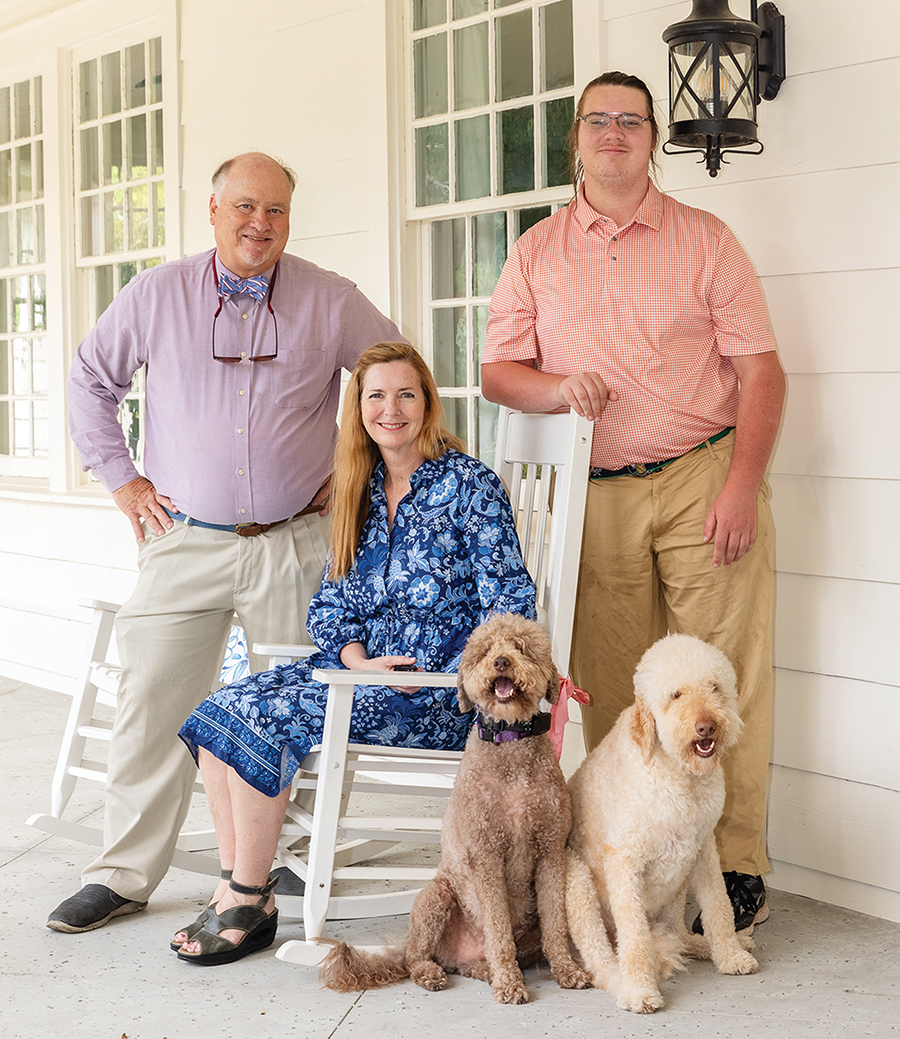
“Chapin wouldn’t be able to find his way around (While-Away) if he came back now,” says Kevin Drum, who with his wife, Dr. Jennifer Stoddard, bought the cottage in 2014. For Drum, owner of the Drum & Quill — the name a tip of the cap to his golf journalist father, Bob Drum — who has served on the Pinehurst Village Council and run for mayor, ownership of this historic property completes a circle.
Left: Tufts Archives
Right: Kevin Drum, Jennifer Stoddard and Kevin Klenzak
“My mother told us kids not to play over here,” meaning the exclusive Old Town side of the village. He gestures beyond The Carolina Hotel: “We lived over there.”
Stoddard, a UNC Medical School alumna from Potsdam, New York, returned to North Carolina to join Pinehurst Nephrology Associates. After Drum and Stoddard married, they went house hunting. “I made the Realtor crazy,” Stoddard says. She wanted a historic property, as did Drum. While-Away was close enough to Jennifer’s office and the hospital, and easy walking distance to the Drum & Quill for Kevin. Plus, at 6,000 square feet, it was roomy enough for her three school-age children.
“When you walk into a house, you get a feeling,” Stoddard says. “It was so comfortable, not anything tangible, just the smell, the feeling. I knew this is the house I wanted.”
She researched While-Away and Chapin at the Tufts Archives, discovering the wealthy philanthropist credited with developing Myrtle Beach to be “a good Great Gatsby.”
“But it wasn’t on the market,” Drum adds. Obviously, the story has a happy ending. “I looked at Jennifer and realized she wouldn’t be happy until we bought this house,” he says. Mission accomplished.
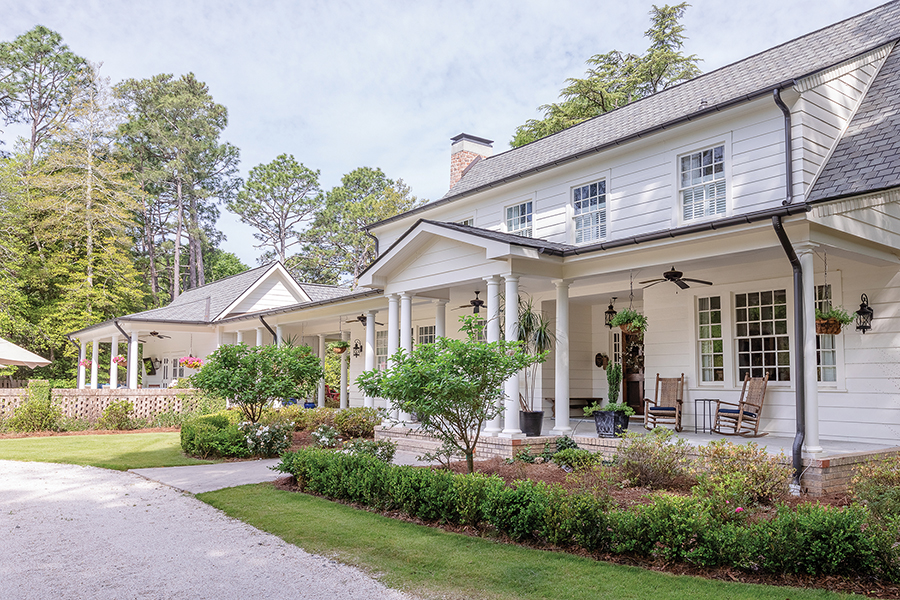
Previous owners had performed renovations, but the exterior was about to undergo a transformation, beginning at the recessed front door. A document filed with the village soon after construction was completed in 1917 describes While-Away as “a one-and-a-half story frame house of asymmetrical design . . . and no clearly identifiable façade.” Perhaps the main entrance faced away from the road, as with other cottages built during the infancy of motor transportation, with its fumes and noise.
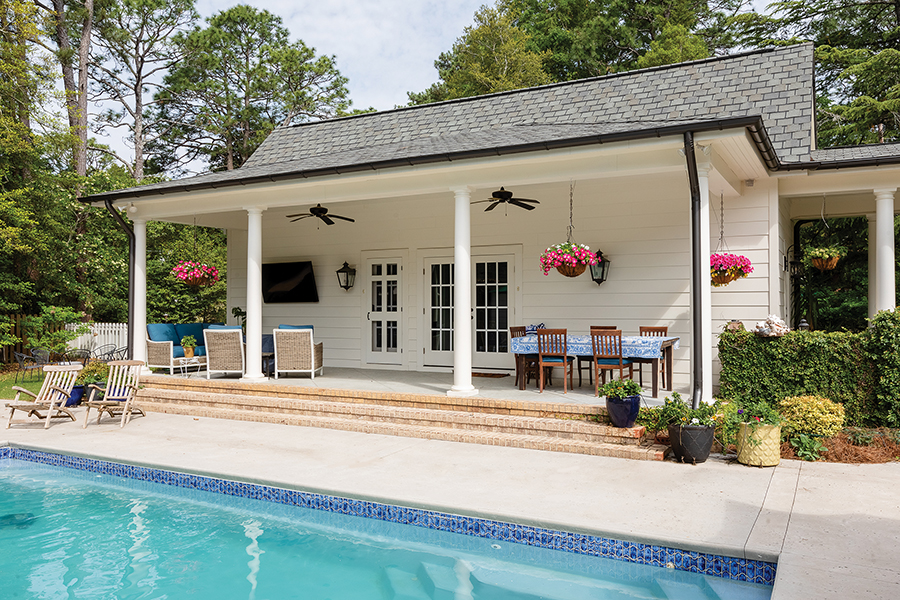
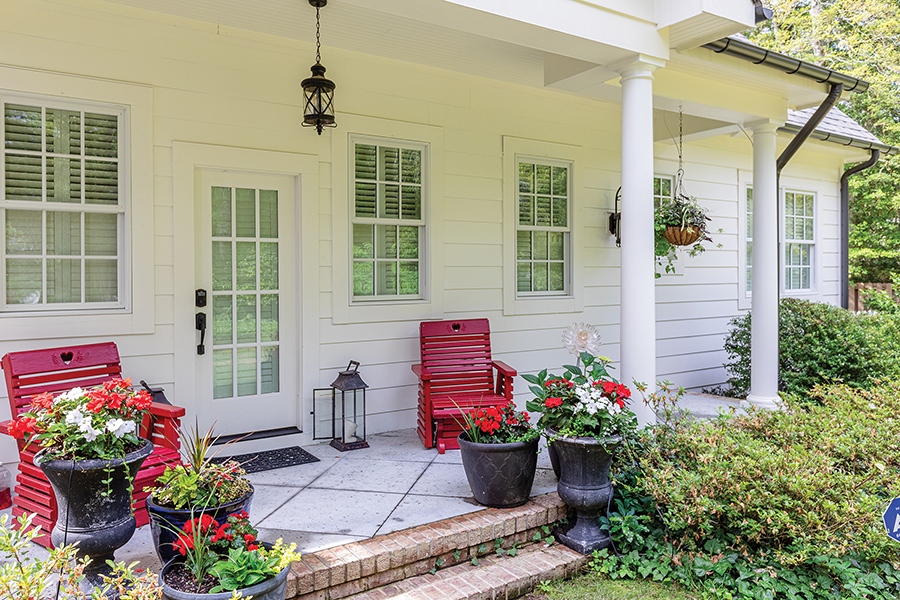
That was fixable. Designer Mark Parsons and builder Jeremy Strickland added a veranda stretching across the entire front, a brick patio across the back, a portico defining the front door, a garage, plunge pool, adorable pool/guest house, new roof and landscaping. The house, brightened from grayish shingles to gleaming white, is now approached by a circular drive, with the pool and pool house perpendicular to the well-defined front.
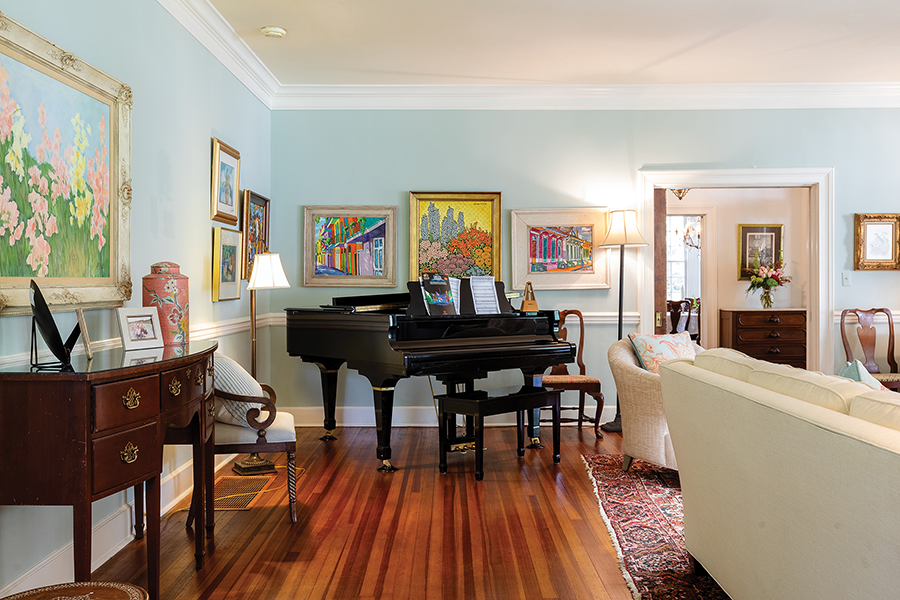
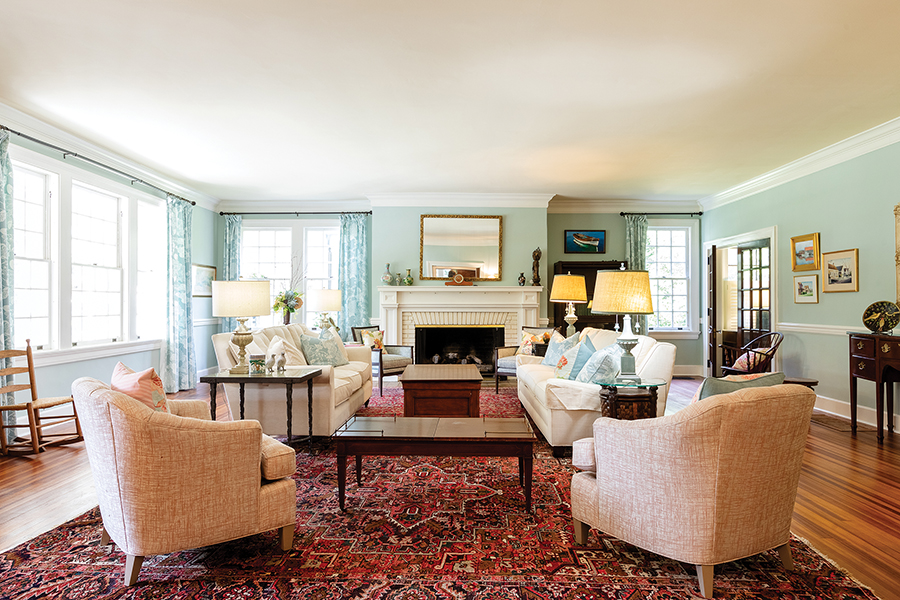
The interior retains a whiff of bygone days, more comfy-homey than formal or exotic, beginning in a living room proportioned for Pinehurst society soirees. The main floor layout — cross-hall with the living room and dining room on either side of the foyer — flows in a circle from foyer into dining room, butler’s pantry, kitchen, den and back into the living room with its gleaming wood floors which, if cleared out, could be a dance floor. In place already, a grand piano.
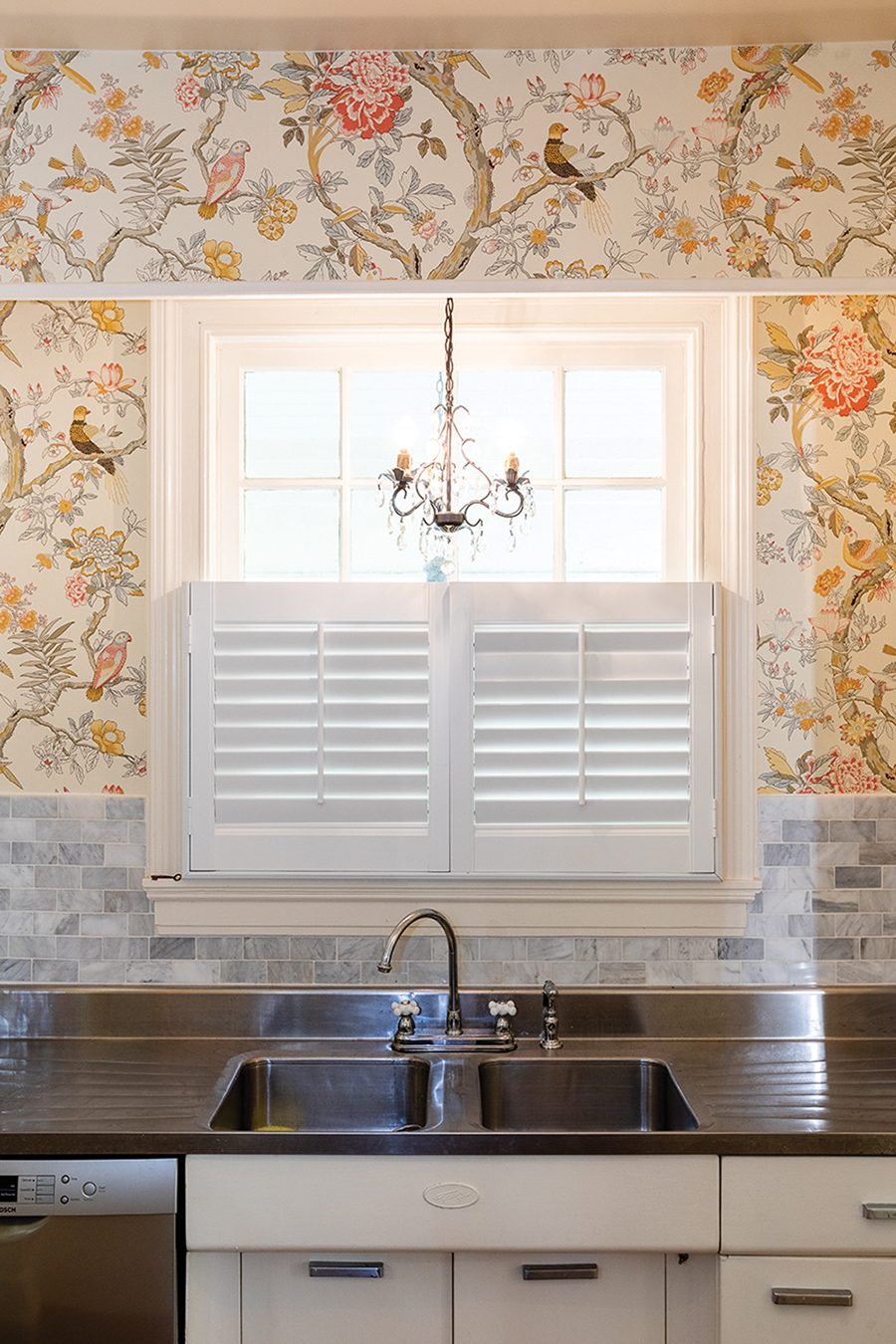
The classic floor plan pleased the new owners. “I don’t like open concepts,” says Stoddard, who chose soft pastels, a pale olive and watery blue, for the public rooms. Bathrooms go rogue with fanciful wallpaper. Some furnishings suggest the genteel 1950s, while others are secondhand “finds,” reproductions and family heirlooms that integrate well with High Point’s finest. Drum stands by a bedroom armoire: “It was my grandmother’s, from Pittsburgh. It stood in my room as a kid.” The dining room table owns the same provenance.
Stoddard admits the butler’s pantry, virtually untouched, sold her on the house. Drum sounds partial to the finished basement with wine cellar, pool table, movie room, bedroom and bath. The surrounding acre is divided into an expanse suitable for a lawn party plus a secret garden where Stoddard is “working on peonies.” The rear patio encompasses a meal preparation area with a pizza oven and separate grills for meat and vegetarian dishes.
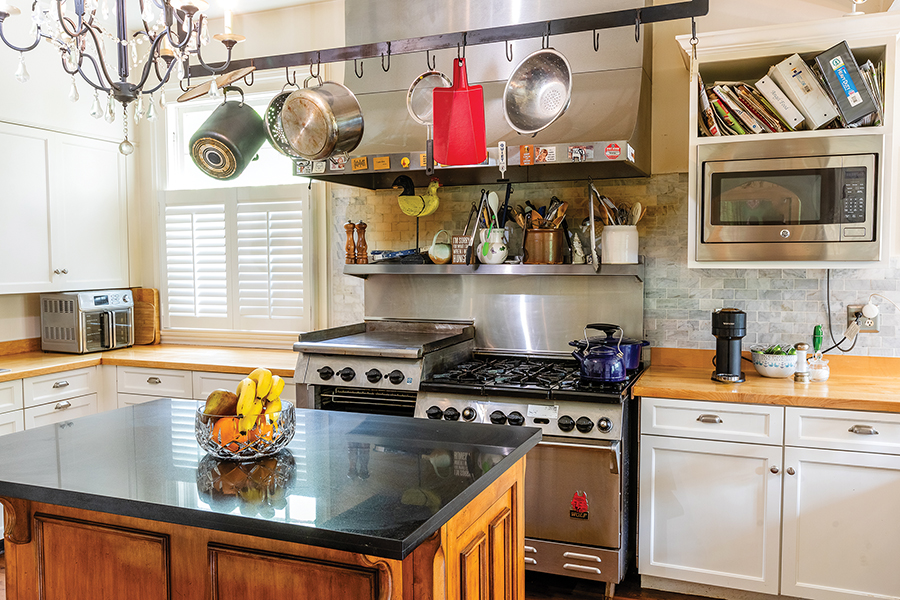
The jewel in most renovations is usually the kitchen. While-Away’s, redone by a previous owner, is neutral in hue, Shaker in simplicity but equipped with a large Sub-Zero. “I like it the way it is,” Stoddard says. She and Drum both cook, “but at different times,” she says.
The only walls that needed moving were for upstairs bathrooms, some with marble tiles and oversized showers, featuring built-in rather than clawfoot tubs. In one upstairs bathroom a stacked washer-dryer combo — one of three laundry areas — is handy for towels and bed linens.
On the staircase landing hangs a large, stylized painting created from a photo of golfing great Babe Zaharias. Upstairs hallways are lined with paintings of famous golf courses. Golf hats and bar paraphernalia fill Drum’s “cave.” Stoddard, president of the Moore County Medical Society, also has a home office.
As the children grow and strike out on their own, their bedrooms will become guest quarters or perhaps, one day, nurseries. “We’re about to become empty-nesters,” Stoddard says, as she prepares for guests attending her daughter’s graduation from UNC-Chapel Hill. “This has been my dream house, a labor of love, the perfect family home for us.”
Simeon Chapin built While-Away and five other cottages in Pinehurst. He died suddenly in one of them, the Albemarle, in 1945. At his funeral in The Village Chapel he was celebrated as Pinehurst’s “first citizen.” The house remained in the family until 1952. Chapin lives on in the charitable foundations established in every city where he maintained a residence: Pinehurst; New York; Chicago; Lake Geneva, Wisconsin; and Myrtle Beach, South Carolina. Now, more than 100 years after the Chapins “arrived for the season,” a rejuvenated, still genteel but mercifully air-conditioned residence earned Pinehurst Historic Plaque certification in 2023. It hangs by While-Away’s main door, now proudly facing front. PS


By Ron Green Jr.
Feature Photograph: Martin Kaymer (USGA/Steven Gibbons)
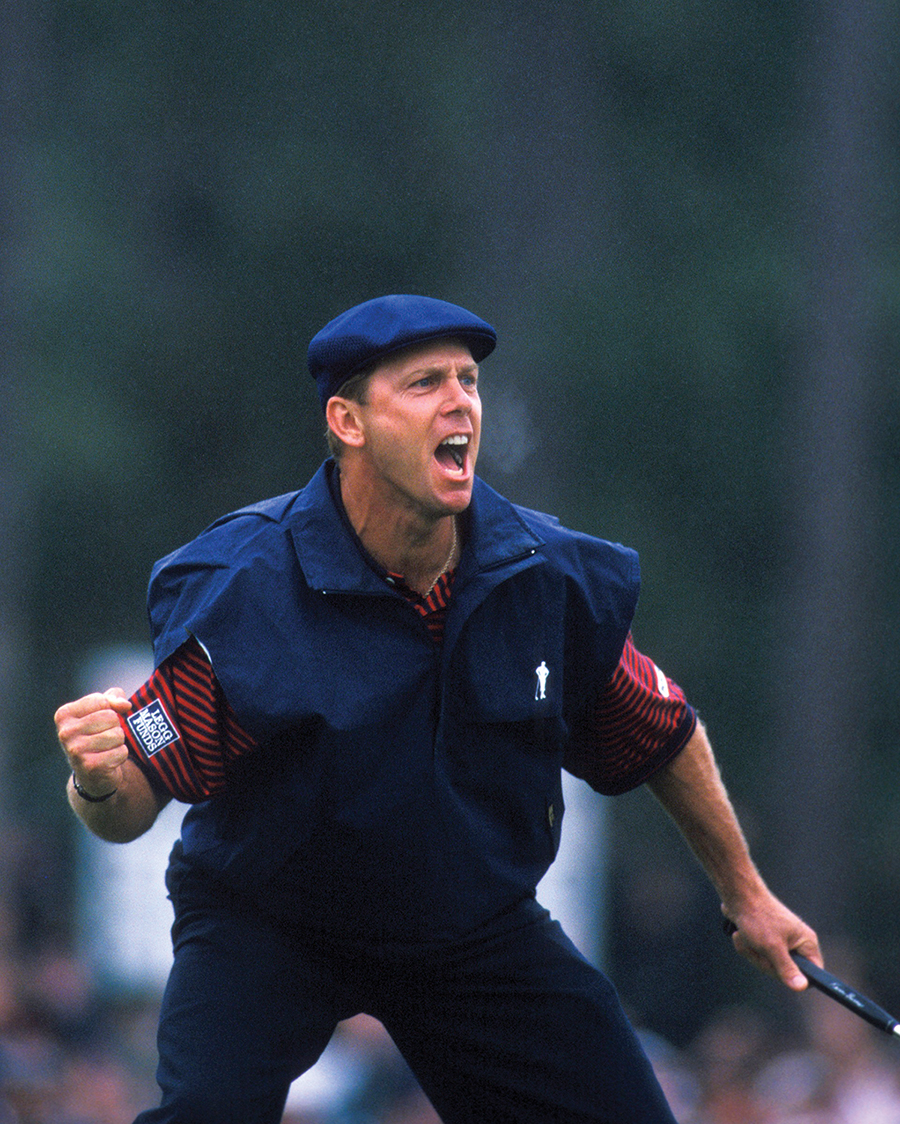
It has been 25 years since Payne Stewart leaned over that 20-foot par putt on the 18th green of Pinehurst No. 2 with the U.S. Open title hanging in the damp, gray Sunday afternoon air.
Phil Mickelson, who had celebrated his 29th birthday five days earlier, could only watch from beneath his white visor as the thousands surrounding the scene fell into a heavy hush. For a moment, the only sound came from a bird on a pine branch nearby.
Then a movie came to life.
Stewart’s putt fell in, he punched the air, hugged his caddie and, amid the combustible noise, consoled Mickelson, who would become a father for the first time the next day.
Pinehurst, where golf had already lived for more than a century, had its timeless moment and Stewart’s joy felt contagious. It was Pinehurst No. 2’s first U.S. Open and, to borrow from Humphrey Bogart in Casablanca, it was the beginning of a beautiful friendship, one that has led to multiple U.S. Opens and a second home for the USGA.
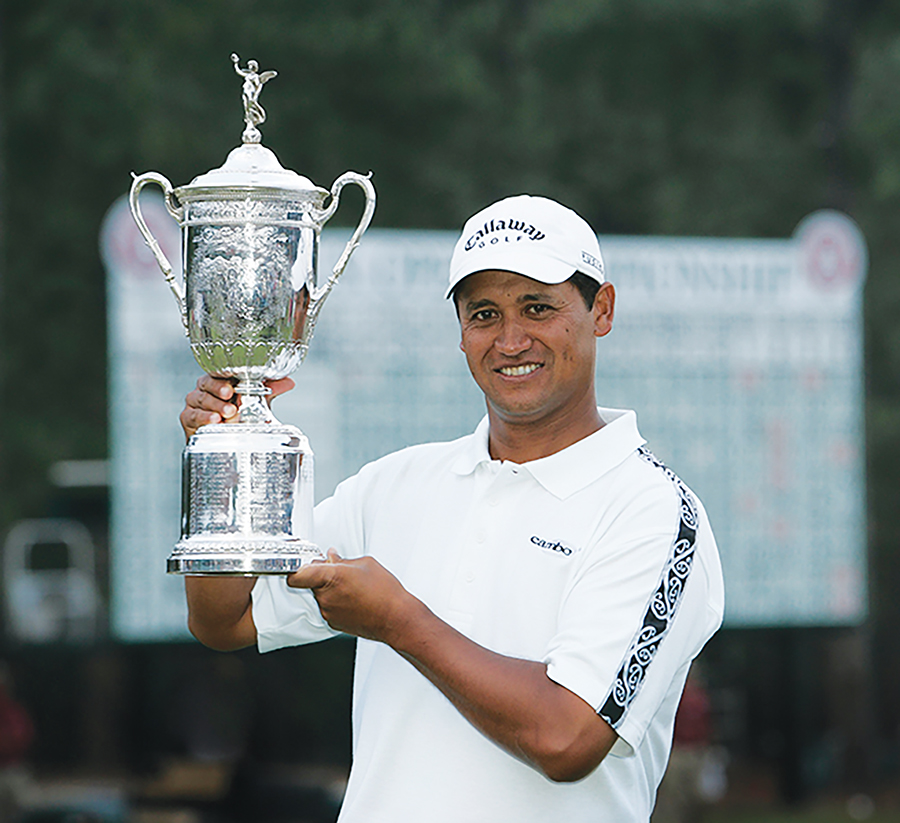
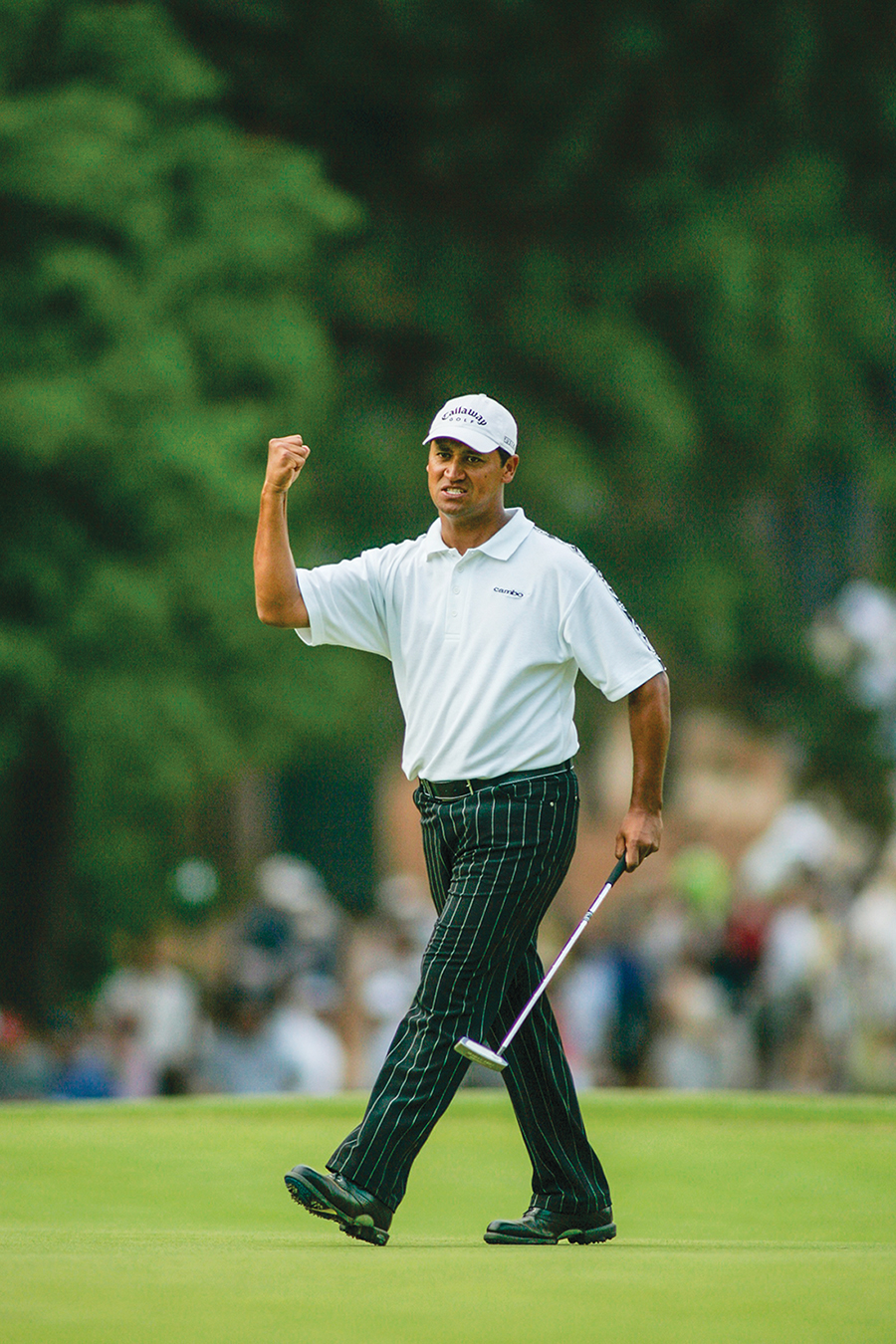
There is, however, a bittersweet thread that runs through the four U.S. Opens hosted at No. 2 — the men played there in 1999, 2005 and 2014 and the women followed the men in 2014. The four champions — Payne Stewart, Michael Campbell, Martin Kaymer and Michelle Wie — didn’t know it at the time, but their careers would never again touch the sky like they did in Pinehurst. In fact, Stewart and Kaymer never won another tournament, while Wie (now Michelle Wie West) and Campbell managed just one more official victory in their respective careers.
Stewart died in a plane crash four months later. Campbell struggled with the attention that came with being a major champion, and his game deteriorated. Kaymer, once the top-ranked player in the world, dealt with injuries and a loss of confidence. Wie won one more LPGA title nearly four years after her Pinehurst win, but her career never equaled her celebrity.
It’s wrong to suggest U.S. Open winners at Pinehurst are cursed — golf is hard enough without introducing the occult — but the titles the four players won there largely defined careers that took curious, even tragic turns, in the aftermath. It calls to mind one of the curiosities in the village that surrounds the golf resort involving the Magnolia Inn, which has been around since 1896.
In its original form, the Magnolia was tall enough that it blocked the view of the nearby and majestic Carolina Hotel. To remedy that, the top two floors of the inn were removed so that the Carolina stood in no building’s shadow.
By essentially cutting off the top of the Magnolia, it left the hotel with a stairway that was a series of steps that led, not to a room nor another floor, but to a wall. It became known as the stairway to nowhere and, in a sense, that has been the pathway for players after they’ve won U.S. Opens at Pinehurst. What could fairly be seen as a career springboard has instead — whether coincidentally or not — become more of a jumping-off point.
That’s not to suggest that, with five more U.S. Opens scheduled at No. 2 through 2047, something strange is going on, but it has produced a peculiar pathway from the top of golf’s mountain to whatever comes next.
Stewart’s story is tragic and familiar. He was one of golf’s stars, both cocky and charismatic, with a golf swing that angels might envy. Stewart dressed the part, wearing plus-fours and a flat cap, and there were times when his ebullience was more annoying than entertaining.
He had, however, begun to grow into a different man when he won the U.S. Open at Pinehurst. Faith played a larger role in Stewart’s life and his sense of seeing beyond himself was demonstrated in the instant when he put his hands on Mickelson’s face mere seconds after breaking the left-hander’s heart on Pinehurst’s 18th green and gave him a message of joy about becoming a father.
Three months later, Stewart led the American celebration after a rowdy victory in the Ryder Cup at The Country Club outside Boston, the happiness practically dripping off him like the champagne being sprayed.
Then Stewart was gone, leaving a forever hole in the Pinehurst story, but his achievement and the spirit in which he accomplished it live on. Taking a photo alongside the bronze statue behind No. 2’s 18th green of Stewart’s reaction upon holing the winning putt — right leg kicked behind and his right fist punching the air — has become part of the Pinehurst experience for visitors.
Six years after Stewart’s win, New Zealander Michael Campbell arrived at the U.S. Open after narrowly qualifying. He’d earned his spot by birdieing the last hole in a European qualifier at Walton Heath in England, holing a 6-foot putt that would ultimately help redefine his career.
Imagine if Campbell missed and never made it to Pinehurst.
Campbell was a world-class player, having won six times on the European tour and with an admirable habit of showing up on major championship leaderboards, but like everyone else in the 2005 U.S. Open, he arrived in the immense shadow of Tiger Woods.
Photographs: J. D. Cuban/Courtesy USGA Museum, USGA/John Mummert, USGA/Matt Sullivan
When Sunday arrived, Campbell was one of several players chasing third-round leader Retief Goosen, who was 18 holes away from winning his third U.S. Open title in six years. When Goosen stumbled in with a disastrous closing 81, Campbell outplayed Woods, who bogeyed the 16th and 17th holes, clearing the path for Campbell.
If Stewart’s victory became the stuff of legends, Campbell’s win seemed more a victory for one of golf’s working class. Half a world away in New Zealand, Parliament paused to watch Campbell’s victory.
Three months later, Campbell won the HSBC World Match Play Championship, and he seemed to be riding a rainbow. But, like rainbows, Campbell quickly faded. His game went flat, he injured a shoulder lifting his luggage in the Hong Kong airport, and 10 years after his greatest triumph, Campbell retired for a time from competitive golf.
When Campbell showed up at the 2019 U.S. Senior Open, he had a spot earned through his former glory rather than recent performance.
“I’m just starting out with no expectations,” he said.
Campbell rekindled friendships and felt the competitive juices again but, now 55 years old, his tournament golf is limited to senior events in Europe these days.
Pinehurst must feel like a lifetime ago.
Kaymer’s tale remains more open-ended but, to use today’s parlance, he’s trending in the wrong direction. At age 39, Kaymer is entering the netherworld in competitive golf, beyond his prime but still young enough to believe he can dig out what he once had.
It’s possible that Kaymer reached No. 1 in the world rankings with less attendant fanfare than any player ever. Even now, ask ardent fans to name players who have won the U.S. Open, the PGA Championship and the Players Championship and, chances are, few will come up with Kaymer’s name. He was No. 1 for eight consecutive weeks in early 2011, the impact of his PGA Championship victory the year before helping to catapult him there. The numbers said one thing, but Kaymer felt something different inside.
“At that time I didn’t (feel like No. 1) because I never made the cut at Augusta. I never felt comfortable in Augusta just fading the golf ball. When I said to my coach after missing the cut for the fourth time in a row, how can I be No. 1 in the world if I can’t hit any shot? I didn’t feel like the best player in the world,” Kaymer said.
In 2014, better able to move the ball in both directions, Kaymer won the Players Championship in May, then dominated the U.S. Open at Pinehurst, winning by eight strokes. Playing the new No. 2 as retouched by Ben Crenshaw and Bill Coore, Kaymer separated himself with brilliant ballstriking and a willingness to putt over and around the slopes when he missed No. 2’s famously difficult greens.
“It was probably the best week of my career I would say,” Kaymer said.
Kaymer would play 27 more major championships after Pinehurst and he managed just one more top-10 finish.
Left: Michael Campbell (USGA/Steven Gibbons)
Middle: Michelle Wie West (USGA/John Mummert)
Right: Payne Stewart (USGA/John Mummert)
Playing on the LIV Golf tour now, the German-born Kaymer is raising his family in Europe and is happy with the choices he has made. When he returns to Pinehurst, it will be with fond memories but different expectations.
“Back then there were no scar tissues,” Kaymer said.
The week after Kaymer’s runaway victory, the U.S. Women’s Open followed at No. 2, the first-ever back-to-back national championships played on the same site. Intent on allowing nature to dictate the course setup, No. 2 played firm and fast while turning from green to brown.
Until that hot week, Wie West’s star power had always exceeded her professional achievements. Since her teenage years, she had been the face of women’s golf but, after her headline-catching tee times in men’s events, she settled into an LPGA career that never caught up to the expectations.
Except that one week at Pinehurst.
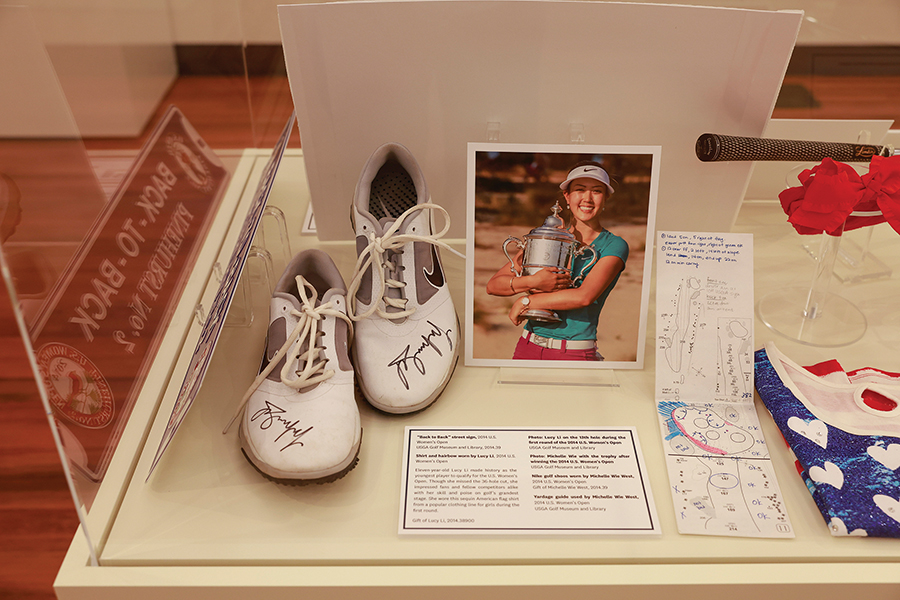
On Sunday of the men’s U.S. Open, Wie West and Jessica Korda walked 18 holes watching Kaymer and Rickie Fowler in the final pairing, imagining making a walk like Kaymer’s up the final fairway. One week later, it happened but not until Wie West double-bogeyed the 16th hole to see her three-stroke lead drop to one stroke. No stranger to drama, she responded by holing a long, double-breaking birdie putt on the par-3 17th hole to help seal the most meaningful victory of her career.
“The walk from my second shot to the green, I wish it could’ve lasted for hours, for days. It was the best walk I’ve ever had — well, outside of the walk to the altar and stuff like that,” Wie West said during a return visit to No. 2 last year.
She took a walk with her memories around the closing holes at No. 2.
It’s a place where ghosts and memories tend to hang around and, as flat as the place may be, you could swear there’s a mountaintop there.
Climbing that mountain may be the hard part, but coming back down may be the stairway to nowhere. PS
A Charlotte native, Ron Green Jr. is a senior writer for Global Golf Post and was the recipient of the 2023 PGA of America Lifetime Achievement Award in Journalism.

Benevolence begins at the top
By Jim Dodson
Photographs by John Gessner
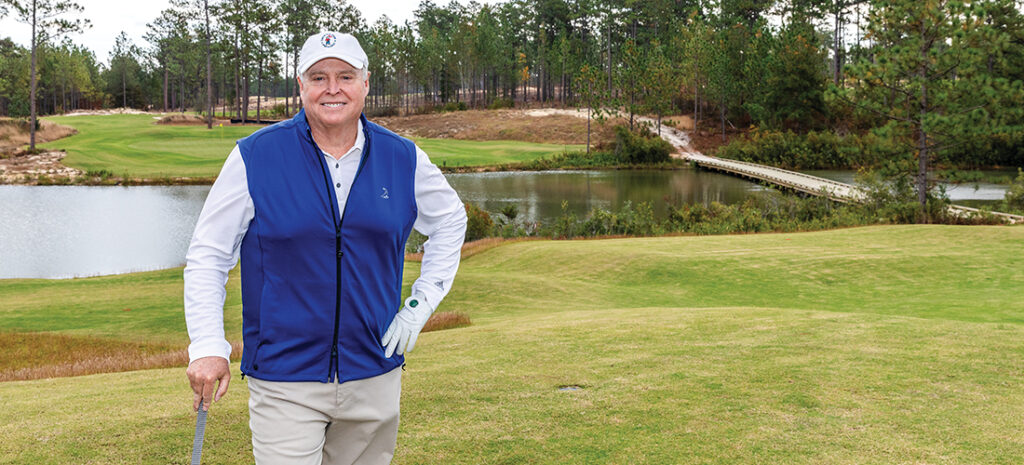
Bob Dedman Jr. is one pleased fellow.
On a gray and windy afternoon threatening rain — not quite the “beautiful day in Pinehurst” that resort operators chime as they answer phones — the owner of the Pinehurst Resort can’t stop smiling.
“Isn’t this something?” says Dedman with the tempered excitement of the father of a newborn. “You know, we just started this last November, and it amazes me to see how quickly it has all come together. It turned out to be something very special, a bit different from what many would expect to find at Pinehurst — but very much in our tradition.”
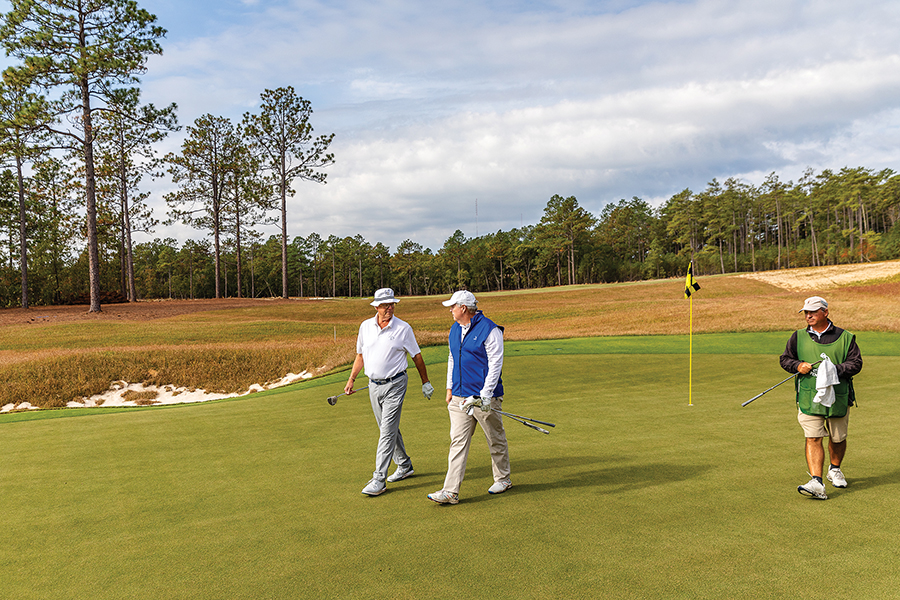
The “baby” Dedman speaks of happens to be the new Course No. 10 — the Pinehurst Sandmines — a spacious, soulful, sweeping links-style layout created by acclaimed golf course designer Tom Doak that weaves its way through the surviving mounds of a former sand mining operation and the remains of The Pit Golf Links. Dedman has graciously invited a friend to join him for a casual look at the course, where flags have just been set.
The key word in Dedman’s reflection is “tradition,” an indication that the past may indeed be prelude to the continuing evolution of Pinehurst, America’s oldest and most influential golf resort, which is in full readiness to host the 2024 United States Open Championship, its fourth staging of the Open in 25 years.
“This year marks the 40th anniversary of our family’s involvement here,” Dedman points out as he and his friend limber up on the first tee of No. 10, the resort’s first new golf course since the opening of No. 8 that celebrated Pinehurst’s centennial three decades ago. The buzz has it that an 11th layout by the design firm of Coore and Crenshaw may already be in the planning stages for the same 900-acre track southeast of town.
“The first two decades were spent restoring what was already here and reacquiring parts of the resort,” Dedman says. “And now we believe we have the opportunity to make Pinehurst relevant for the next 100 years with new projects and experiences for our members, guests and visitors. Building on that tradition is the core of what we hope to do.”
This easygoing single-index (7.1) son of the game stripes a drive to the heart of the first fairway, a 350-yard jewel that appears harder than it plays. The boss clearly has game. “It’s been quite a journey,” he allows in the next breath.
In a sense, the journey has come full-circle since his dad, Robert Dedman Sr., owner of Dallas-based ClubCorp, acquired Pinehurst in 1984 from a consortium of banks that owned it in the aftermath of Diamondhead Corporation’s pyrrhic effort to “modernize” a threadbare Pinehurst Resort during the 1970s. Principally a real estate development company, Diamondhead controversially built hundreds of condos snug against the fairways of the No. 3 and No. 5 courses, removed the famous porches of The Carolina Hotel (renamed The Pinehurst Hotel) and sent its beloved wicker interiors to the town dump, replacing Southern comfort with coastal chic. Longtime customers weren’t amused.
On the plus side, Diamondhead did bring professional golf tournaments back to the Sandhills two decades after Richard Tufts ended the much-loved North and South Open in 1951. This effort was highlighted by a mammoth 144-hole tournament modestly called the “World Open” in 1973. The following year heralded the opening of the $2.5 million World Golf Hall of Fame on the hill behind the fourth green of No. 2, a move some Diamondhead execs believed might eventually persuade the USGA to bring a U.S. Open to Pinehurst. Instead, Diamondhead itself ran into financial difficulties, leaving the Pinehurst Resort to the banks.
Dedman Sr. was its savior, a hard-charging but philanthropic billionaire lawyer who grew up in deep poverty in Arkansas, made his first million by age 50, and built an empire from buying distressed golf courses and private clubs, and spectacularly turning them around.
Recalling the day he first laid eyes on Pinehurst No. 2, Dedman Sr. told a Sports Illustrated writer: “The first time I stood in front of the clubhouse and looked out on those ribbons of fairways, I got tears in my eyes. . . . I had always venerated Pinehurst for its place in the history of golf, and when I finally saw it, I knew instantly that we would take this fallen angel and make it not as good as it was, but better than it had ever been.”
Four decades later, as the younger Dedman scoots along No. 10’s rumpled fairways, there’s time to reflect. “It didn’t happen overnight, and it took a lot of hard work by many talented people over many years to bring back the grace and charm of Pinehurst,” he says. “I’m just very fortunate to be following in my dad’s footsteps. When our family got involved with Pinehurst, there were six golf courses and one very run-down hotel. He liked to tell the story of how the chef actually fell through the kitchen floor into the basement.
“Now we have four excellent hotels and 10 1/2 golf courses,” he adds with a chuckle, referring to The Cradle, the delightful and wildly popular nine-hole, par-3 course created by architect Gil Hanse and his partner Jim Wagner in 2017, shortly before the duo spectacularly revised Pinehurst No. 4.
Following his father’s passing in August 2002, the younger Dedman became chairman of ClubCorp. Four years later, along with his mother, Nancy, and sister Patty, the family sold its portfolio of 170 top-tier clubs to a Denver-based private investment equity group for a reported $1.8 billion. They chose to keep ownership of Pinehurst, a decision Dedman says was shaped by his father’s promise to restore a fallen angel known as the Home of American Golf. Not long afterward, Dedman purchased the historic Fownes house in the village for his wife, Rachael, and two daughters, Catherine and Nancy, and began spending increasingly lengthy periods of time in Pinehurst.
“Having the ability to keep Pinehurst was important to my family,” he says, pausing by the eighth green, a vest pocket gem tucked artfully into the lee of the dunes. “It was all about ensuring the legacy of this unique place, which has come to mean so much to all of us. We buried my father in his Pinehurst U.S. Open jacket, a reflection of how passionate he was about bringing Pinehurst back to its rightful position, a place synonymous with the best of golf and the game’s history in this country. I view our role in taking it forward into the future as an important calling. One lesson I learned from my dad was to provide the vision and support for what needs to be done, then allow the right people to create it.”
If, at first blush, Bob Dedman appears to lack his late father’s dynamic and colorful style, he displays an internal calm and reassuring grace that matches the moment and inspires his employees with a steady vision that may be just the thing for an angel that’s once again soaring. As Ron Green Jr. of the Global Golf Post summed up, “Dedman is many things — smart, influential and bold — but he’s not brash. In fact, he fits Pinehurst almost perfectly, appreciating the legacy that began more than a century ago while believing the resort’s best days are still to come. Dedman’s touch is like that of a good cashmere sweater and Pinehurst itself, soft but with an unmistakable depth of quality.”
Under his dad’s aegis, the team of President Pat Corso and Director of Golf Don Padgett engineered the slow but steady comeback of Pinehurst. Following significant work on No. 2 by architect Rees Jones in advance of the 1999 and 2005 U.S. Opens, Dedman Jr. pulled the trigger on a gutsy decision to allow the design team of Bill Coore and Ben Crenshaw to take No. 2 back to what the golf course looked and played like when Donald Ross began creating it in 1907. Starkly revised, it debuted with the staging of the historic back-to-back men’s and women’s U.S. Opens in 2014 — and proved to be a resounding success.
Against fears that the game’s best might make easy work of an Open course minus its traditional narrow fairways and brutal rough, only three men and one woman bested par during the historic Opens that year. When leader Michelle Wie faced potential disaster from a wayward approach shot on her 70th hole of play, an eagle-eyed fan named Bob Dedman Jr. found her ball nestled in a patch of wiregrass, preserving her path to victory. Talk about a sign from the golf gods.
Since that time, Dedman’s thoughtful leadership combined with the seasoned skills of Tom Pashley, who was named president of the resort following the retirement of Don Padgett II in 2014, have restored the soul and charm of Pinehurst’s past with a savvy eye to the future that’s visible almost everywhere one looks — in the transformation of the resort’s abandoned steam plant into a powerhouse brewery; a refurbished clubhouse that features lush new digs for members; an expanded Deuce Grill; the beautifully restored Manor Inn and renovation of the Magnolia Inn; and the budding partnership that attracted the USGA’s sparkling new Golf House Pinehurst and World Golf Hall of Fame, returned from St. Augustine, Florida.
Pashley says of his boss: “Bob is smart, curious, analytical, humble and funny. He constantly challenges conventional thinking and offers creative solutions to complex problems, offering up out-of-the-box thinking that has shaped much of our renovation work over the last decade. As we enter a new phase of creation versus restoration, he’s equally passionate about land planning and design. I’ve never seen him truly mad or upset except when he occasionally hits a poor golf shot.”
As the skies darken and a soft rain begins, Dedman and his guest decide to pick up their balls and finish another day, heading for a spot where No. 10’s rustic lodge and pro shop “with a barn-like feel” will rise to serve golfers and resort guests.
Possibly the golf world’s happiest resort owner easily slips into philosophic mode, chatting about the importance of giving back and quoting his famously philanthropic dad’s favorite lines from Henry Longfellow’s “A Psalm of Life”: Lives of great men all remind us / We can make our lives sublime, / And, departing, leave behind us / Footprints on the sands of time.
It seems only logical to ask if he has one rule of life to live by.
Dedman smiles. “I do. I used it at the Boys and Girls Club dinner. We had the privilege of starting the first chapter in 1999 and have supported it ever since. It’s a quote by John Wesley. After all, I’m a Methodist.”
Do all the good you can,
By all the means you can,
In all the ways you can,
In all the places you can,
At all the times you can,
To all the people you can,
As long as ever you can.”
It’s a fitting spiritual coda for a rainy afternoon filled with talk of family, tradition and reborn angels. But make no mistake, Bob Dedman’s generous Methodist eye is fixed on the future, and the bottom line of a game and place dear to his heart. He jokes that there’s a “Fun Bob and a Business Bob.” The two are sometimes indistinguishable.
“We’ve been so blessed in Pinehurst. No one knew what to expect after the recession and COVID. But there has been a wonderful resurgence of golf, especially among women. New people are coming into the game. That’s a great thing. We believe that being given the opportunity to host the Open a total of eight times over a 50-year period is a validation of the things we are doing to provide a memorable and fun experience to everyone who comes here.”
Which prompts a final question from his slightly sodden golf partner: Is Pinehurst enjoying a second Golden Age?
Dedman smiles again. “I think it might be. Pinehurst is really the soul of American golf. Our job is to carry that soul into the next hundred years. Hopefully the things we’re doing today — rain or shine — will stand the test of time.” PS

Pinehurst, the USGA and a common purpose
By Lee Pace
Feature Photograph by USGA/John Mummert
Grant Spaeth and David Fay had heard all the arguments about why Pinehurst and its No. 2 course could never host a U.S. Open.
The club, through the mid-1980s, had yet to figure out how to marry climate and agronomy with the sometimes contrasting needs of having good putting surfaces during the spring and fall months for the paying customers, with the stiff and brisk greens mandatory for the Open’s customary third week of June dates.
The town was too remote; the biggest city, Charlotte, was two hours away.
There were two-lane roads in every direction.
There weren’t enough beds and dinner tables.
Still . . . that ambience, that pine scent, that bouncy hardpan sand, the ghost of Donald Ross, the pristine routing, that umbilical cord to the roots of golf in America, that specter of Richard Tufts of Pinehurst’s founding family having been a USGA president and a visionary on matters of agronomy, course setup and rules.
Spaeth, the USGA president, and Fay, the executive director, were unbowed that April day in 1990 when they stopped off in Pinehurst to play No. 2 on their way to Augusta, Georgia, for the Masters.
Fay believed a U.S. Open at Pinehurst could be “Tracy-and-Hepburnesque, a match made in heaven.”
“We agreed: Can’t we take a second look? How can we not go the extra mile to see if it will work here?” Spaeth said.
“Early on in this process I thought Pinehurst No. 2 was one of the great courses in the world,” Fay said. “It’s the United States’ answer to St. Andrews. Opens are usually played in and around large metropolitan areas, but there are a couple of exceptions. It might be that arguably two of the most outstanding sites for the Open are played quite far away from these metropolitan areas — Shinnecock and Pebble Beach. You look at the pattern of the British Open, which is actually played away from metropolitan areas. My feeling was, if you can have an Open at Pebble Beach, if you can have an Open at Shinnecock Hills, you can have an Open at Pinehurst.”
Fay reveled in the tradition and mystique of the golf course, the resort and the village. An avid baseball fan, he believed a visit to Pinehurst was like a trip to Wrigley Field or Fenway Park.
“How many times today do you hear some hot young star in any sport hear the name of a Hall of Fame player in his sport and say, ‘Who was he?’” mused Fay, the USGA chief until his retirement in 2010. “When you get to Pinehurst, that changes. It’s impossible not to get caught up in the history. It’s everywhere. It’s where you look, it’s in the air, it’s in the turf, it’s in the images on the walls, it’s in the church bells. You can almost feel the ghosts coming out.”
And what a story those ghosts can tell over three-and-a-half decades. Pinehurst No. 2 did in fact get its long-coveted U.S. Open in 1999, and the dominoes have been falling ever since.
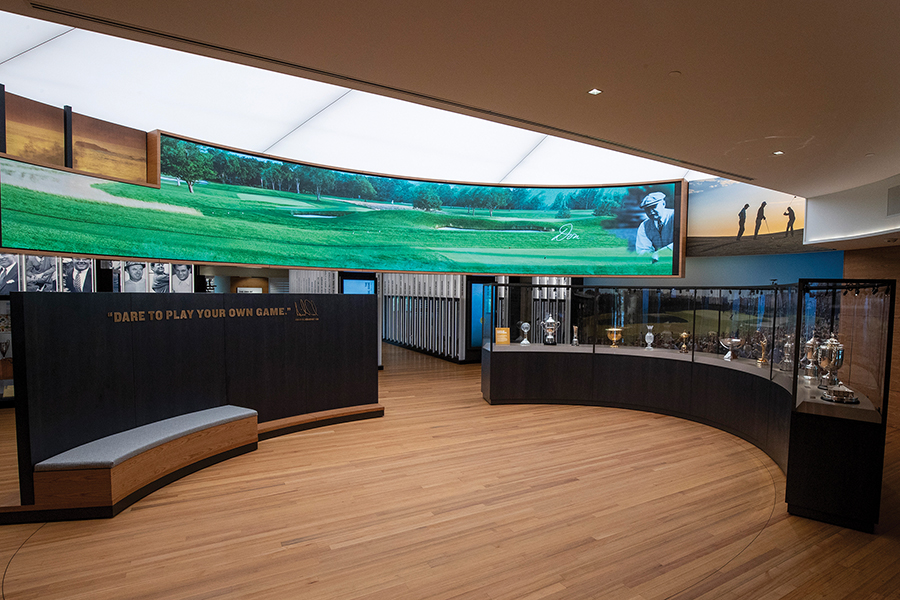
Look at the Sandhills community and the USGA today: three Opens in the books, another this month and four more set through 2047; two U.S. Amateurs on courses No. 2 and 4 in 2008 and 2019; four U.S. Women’s Opens held just down Midland Road at Pine Needles; and the USGA this spring opens its 6-acre Golf House Pinehurst complex with an administrative and testing center in one building, and a second devoted to a museum and the World Golf Hall of Fame, relocated from earlier homes in Pinehurst and then St. Augustine, Florida.
“There is no better place for the USGA to plant new roots than the home of American golf,” Mike Davis, the USGA’s CEO from 2011-2021, said in 2020 when announcement was made of the satellite facility to complement the USGA’s longstanding headquarters in Liberty Corner, New Jersey.
“North Carolina is a fantastic hotbed of golf, so it provides the opportunity to get closer to our customers, our core golfers,” added USGA chief brand officer Craig Annis. “We also see Pinehurst as striving to innovate, and that is also what we are doing. We are proud of our history. Both the USGA and Pinehurst Resort are celebrating their 125th anniversary this year, but we also need to look for what we can do to bring the game into the future.”
Left: USGA/Chris Keane
Right: USGA/Jason E. Miczek
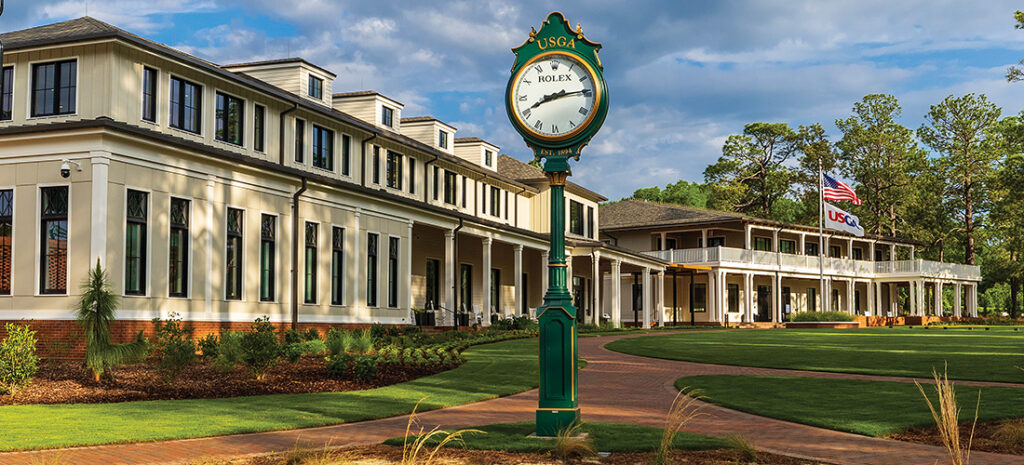
The $54 million Golf House Pinehurst facility is situated on the former site of club tennis courts on the west side of Carolina Vista Drive. The design for the buildings evokes the architectural heritage of Pinehurst with wide verandas punctuated by columns, hipped-roof features with dormers, large windows, and textured clapboard and shake siding details. The landscape around and between the buildings highlights the USGA’s ongoing work to help make golf more sustainable with native plants and pollinator habitats.
“We’ve spent more money on the façade and the grasses and the outdoor walking gardens than you can imagine, making sure we look like a 125-year-old neighbor and not a 12-year-old neighbor,” says Mike Whan, who followed Davis as the USGA’s CEO in 2021.
Six hundred yards to the north is the Carolina Hotel. Three hundred yards to the east is the first tee of Pinehurst No. 2. Four hundred yards to the south are The Cradle and Thistle Dhu, the immensely popular duo of ancillary golf venues just outside the resort clubhouse at Pinehurst Country Club.
The new USGA Experience Building and World Golf Hall of Fame are in the thick if it all — in contrast to the first rendition of the Hall of Fame in Pinehurst from 1974-98, when it was situated in the woods on the opposite side of the fourth green and fifth tee on No. 2.
“The original hall was not on the beaten path for golfers going to play Pinehurst No. 2 and all the other courses at the resort,” Whan says. “If you’re at the Carolina Hotel or in the village and you’re going to play No. 2 or The Cradle, you’re going to be within walking distance of the World Golf Hall of Fame. That’s very different.”
The Test Center and Administrative Building has been occupied by approximately 70 USGA staffers since late 2023. Next door, the USGA Experience Building with the World Golf Hall of Fame on the second floor opened in May.
This second building is open to the public. With the lower floor at 9,500 square feet and the Hall of Fame at 8,000, the building is large enough to display a significant amount of educational content about the game of golf and historical artifacts saluting its history, without being saddled with exorbitant maintenance costs.
“Everyone who plays golf will make the pilgrimage to Pinehurst at one point or another,” Whan says. “This is not a separate trip. Golfers are already coming. Together with the Hall of Fame, we’re more committed than ever to delivering experiences that build even deeper connections between golf fans and those who have truly led the way in this great game.”
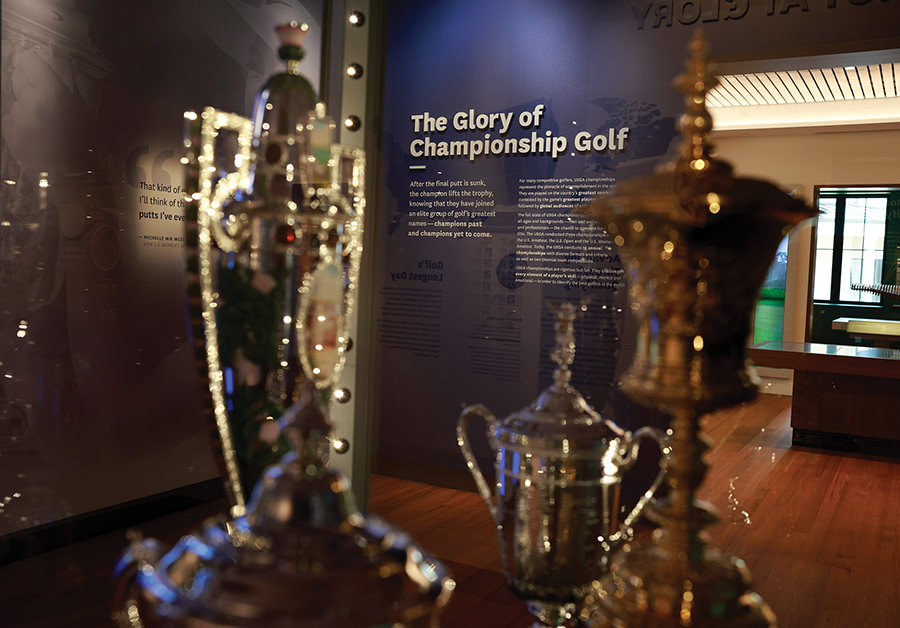
The USGA Experience tells the story of golf’s governing body in America, beyond the national championships it conducts. One gallery highlights the science of the game with agronomy and equipment testing, the two areas in which the USGA has significant footprints. Another gallery embraces the U.S. Open and all the other championships, a total of 16 annually. One area will be devoted to a rotating exhibit, with some artifacts and memorabilia coming out of storage from the USGA’s headquarters in New Jersey.
Appropriately enough, that area for its debut theme will feature Pinehurst history and how the resort and town evolved into the “St. Andrews of American golf.” Interactive displays and kiosks, along with film and video snippets, enhance the experience. The area pays homage to a Pinehurst/USGA marriage that grows deeper in years to come.
In addition to the Opens set for 2029, 2035, 2041 and 2047 on No. 2, the USGA has set Pinehurst for the 2027 U.S. Women’s Amateur, the 2032 U.S. Junior Amateur and U.S. Girls’ Junior, the 2038 U.S. Amateur, the 2044 U.S. Women’s Amateur and a future U.S. Adaptive Open. The 2027 and 2044 U.S. Women’s Amateurs and 2038 U.S. Amateur will also be held on Pinehurst No. 2.
Middle: USGA/Jason E. Miczek
Right: USGA/Jason E. Miczek
“Bringing more championships to a venue like Pinehurst is a testament to the USGA’s commitment to our long-term partnership with the resort and our promise of expanding the presence of our organization in the area,” says John Bodenhamer, USGA chief championships officer. “Pinehurst’s rich golf heritage and commitment to excellence make it the perfect setting for all of the USGA’s world-class events. Their commitment to our Open championships is incredible, and now we are able to shine a light on the amateur game here as well.”
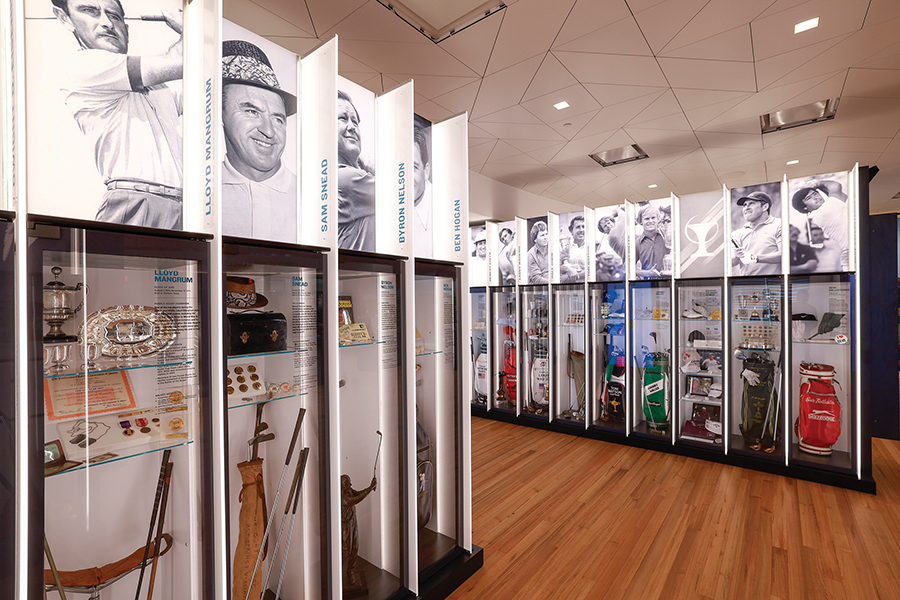
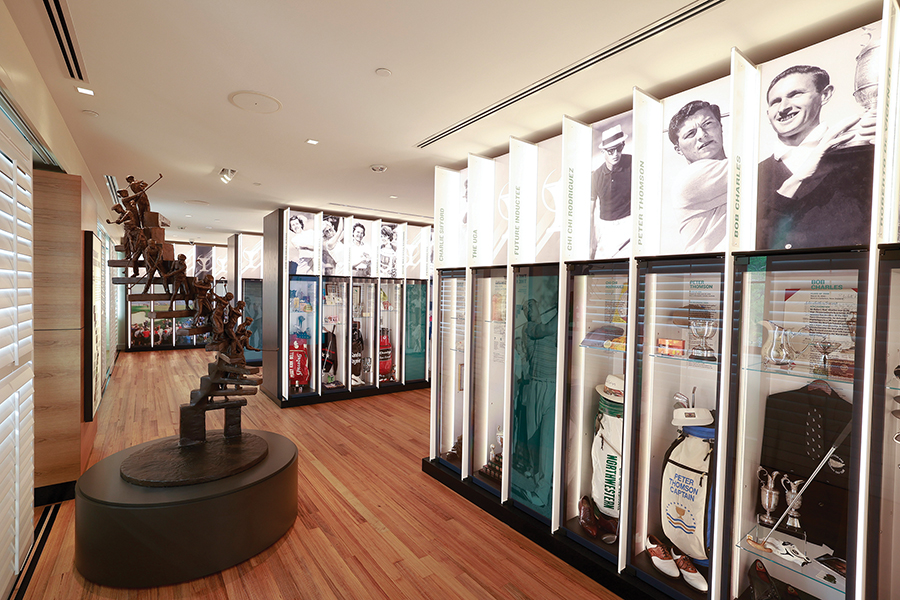
The headline display area in the World Golf Hall of Fame will be the locker room concept relocated from St. Augustine. Lockers assigned to its 164 members feature personal memorabilia stored behind plexiglass walls, items such as Johnny Miller’s clubs used in shooting a final-round 63 in the 1973 Open at Oakmont; Jack Nicklaus’ MacGregor bag from the 1965 Masters; Bob Jones’ Spalding 9-wood; the Wilson Pay-Off putter Sam Snead used throughout most of the 1950s; Beth Daniels’ 1990 Solheim Cup bag autographed by both U.S. and European teams; and a pair of plaid golf shoes and black and white-checkered houndstooth cap and white plus-fours worn by Bob Hope. Visitors can access a mobile app on their phones to hear voice recordings and footage from various inductees.
“Putting these displays in Pinehurst in front of the hundreds of thousands of people who come here every year will be a major benefit to the game of golf,” says Hillary Cronheim, senior director of the USGA Golf Museum and Library. “St. Augustine wasn’t particularly easy to get to. We certainly have our challenges in Liberty Corner. Pinehurst is just such a mecca for golfers, we’re confident we’ll get a lot of people here.”
It has been 31 years since the USGA announced at the 1993 Open at Baltusrol that it had awarded the Open to Pinehurst six years later, and Reg Jones has been a central part of the USGA/Pinehurst relationship for all but one of those years. Jones was fresh out of Wake Forest University and was hired as an intern in 1994 by Pinehurst Championship Management, a department within Pinehurst Resort & Country Club created to market and manage the golf championships set for the Sandhills in the 1990s — the 1991 and ’92 Tour Championship, the 1994 U.S. Senior Open, the 1996 U.S. Women’s Open at Pine Needles, and the big one, the U.S. Open itself in 1999.
His first office was in the catacombs of the Member Clubhouse, and from there he learned the gritty details involved in setting up the mini-city a golf tournament becomes — how to find and manage volunteers, where to rent Port-A-Lets and buy ice, where to position concessions and grandstands. When the ’99 U.S. Open arrived, “our tents, signage and landscaping all needed to look like what you would expect to find at Pinehurst 365 days a year,” Jones says. The corporate village had white columns to match the look of the Carolina Hotel. The media center featured 300 custom-built desks with state-of-the-art communications. Signs welcomed you coming in and thanked you going out. “Over the years, we’ve developed the ability to give each Open a flavor of its own. It’s not just a cookie-cutter operation.”
Jones was promoted to championship director for the 2005 Open at Pinehurst and then was hired by the USGA to manage the outside-the-ropes operation at all its U.S. Opens. He was allowed to maintain his base of operations in Pinehurst, and for nearly two decades Jones and his staff worked out of offices on the second floor of the Department Store Building in the village of Pinehurst.
Now he runs the Open from the sparkling new USGA building on Carolina Vista. “Going back to ’99, I remember the newness, the anticipation, the excitement, sometimes the trepidation,” says Jones. “There was the question hanging over the week of whether or not Pinehurst could host the championship from an agronomic and logistical perspective. I think we answered those questions. Then there was the finish — the weather, how eerie it felt to have Scottish weather in June in North Carolina, the one putt by Payne Stewart to win it all.
“Then you go to 2005 and the memories are a lot about the people, the spectators, the volume of the galleries. The sheer numbers were incredible — right around 325,000 for the week.
“And 2014 was all about having the men and women back-to-back. On Sunday the first week, we had Martin Kaymer and Ricky Fowler warming up on the range getting ready to go out, and the women were arriving to register and practice. It was really cool having the leaders of the men’s championship on one side of the hitting area, and Michelle Wie and Paula Creamer on the other.”
Ticket sales will be limited to 35,000 per day for the 2024 championship, the same as the 1999 Open. The USGA could handle a larger crowd but learned in 2005 that bigger is not necessarily better.
“In 2005, it was cool to see all the people and the energy, but I’m not sure it was the best spectator experience. We want to make sure that our fans that come here have that bucket list experience,” Jones says. “It’s the little details that make the experience that much better. We’ve learned each year, and that’s why coming back to Pinehurst is so good for us because we’ve got a plan that has worked so well. We like to say, ‘This is a home game for us.’” PS


The making of NBC’s award-winning golf telecasts
By Bill Fields
Feature Photograph: (L-R) Joe Martin, Tommy Roy and Tom Randolph (Photograph by Kent Horner/NBC Sports)
As the people who love me could testify, for better or worse I have watched a lot of golf on television in a lifetime around the sport. This was the case when it was only a couple of hours and a handful of holes on weekends in the 1970s and ’80s, and in the 21st century, when major championships get sunrise-to-sunset treatment with technology that was the stuff of fantasy years ago.
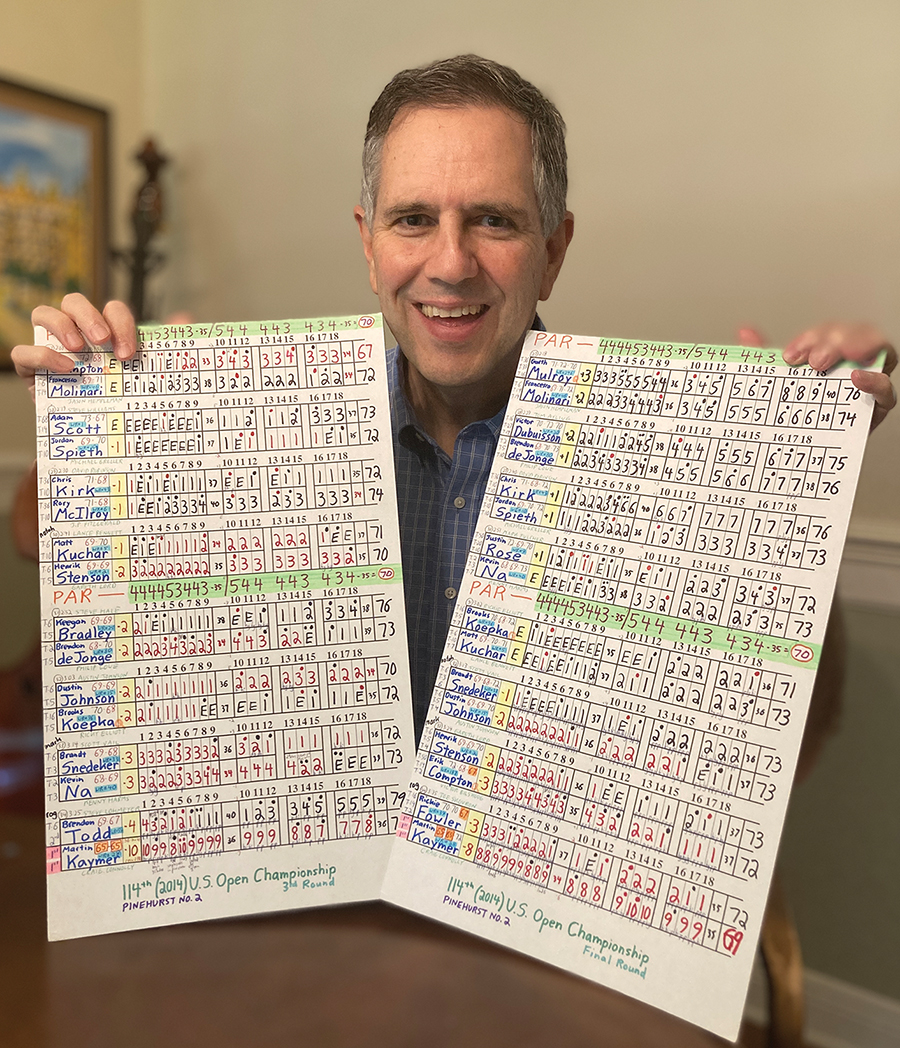
But until the fall of 2017, despite decades in golf media during which I’d written, edited and photographed, I had never worked on a broadcast. Then Gil Capps, longtime NBC Sports’ editorial adviser and 18th tower mainstay, called to see if I wanted to fill in as a researcher/statistician for someone who recently had left the position. I soon had a new gig at a dozen or so events each season — and a perspective on televised golf that wasn’t possible watching from home or a press room where I was chronicling a tournament for one periodical or another.
Hundreds of shows later, I’m in my seventh year as a contributing researcher assisting talent in the main booth, a spoke in the large wheel that is NBC Sports’ golf production team, which will bring the 2024 U.S. Open at Pinehurst to millions of viewers. What was at first an alien new world is now familiar. Strangers have become friends. Sometimes, at least, I even remember to not place my backpack on a damp floor before our attentive stage manager, Kathy Noce, has issued a warning.
I’ve been pumped when an announcer has used a meaningful tidbit or framed a moment with the context I suggested, and bummed on the occasions (fortunately rare) when I passed along something to talent that was incorrect. Television is a tightrope that typing stories, even on a short deadline, isn’t.
“When you’re on live television everything’s immediate,” says Capps, a Hickory native and Davidson College graduate, who worked his first U.S. Open in 1995 at Shinnecock Hills and has been alongside golf host Dan Hicks since 2000. “There are no backspace keys, no eraser. You’re obviously striving to be right all the time, but it’s not just that — it’s being able to show things or tell things that make sense, that do justice to what you’re seeing.”
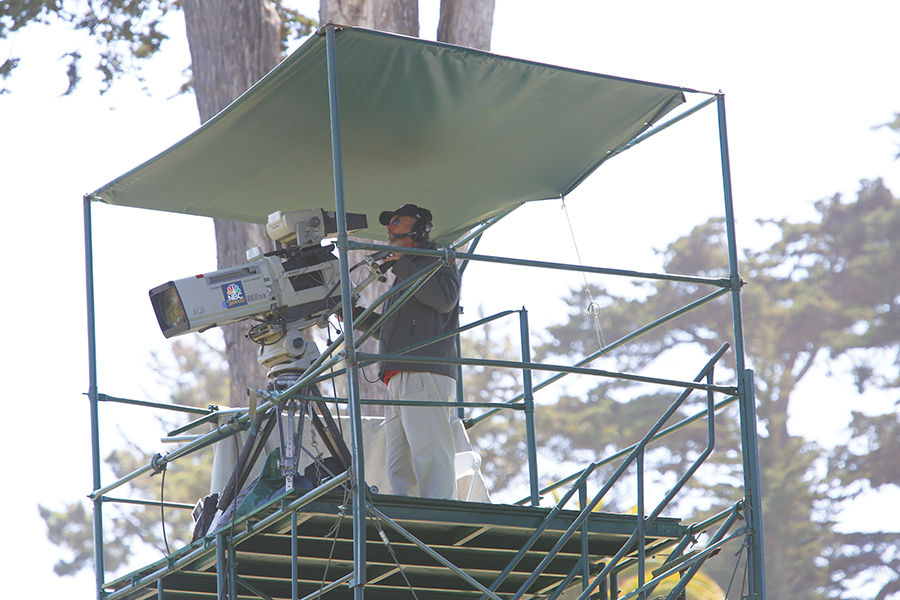
Many people and much equipment are needed to broadcast golf, more than a casual viewer would imagine. That includes production managers who handle logistics for the traveling circus, to caterers who feed us, and support staff who toil long hours making sure everybody has what they need to do their jobs, whether that’s getting index cards to the tower or putting down plywood to make it possible to traverse a muddy compound.
“The producer is telling the story. The director is painting the pictures,” says Joe Martin, an industry veteran who has directed NBC’s tournament broadcasts since 2021. “But the technical team — technical director Mark Causey, the replay guys, the camera operators, the audio technicians — are really the backbone of getting a golf show on the air. It doesn’t happen without them.”
It is hard to imagine NBC’s golf coverage without lead producer Tommy Roy, who has been at the helm since 1993, and co-producer Tom Randolph, who has been alongside him for the whole ride. Both men got into golf TV years earlier, Roy while he was a student at the University of Arizona, Randolph after playing collegiately at UCLA, where he was a teammate of Corey Pavin. (His cousin, Sam Randolph, won the 1985 U.S. Amateur.)
Left: (L-R) Joe Martin, Tommy Roy and Tom Randolph (Photograph Kent Horner/NBC Sports)
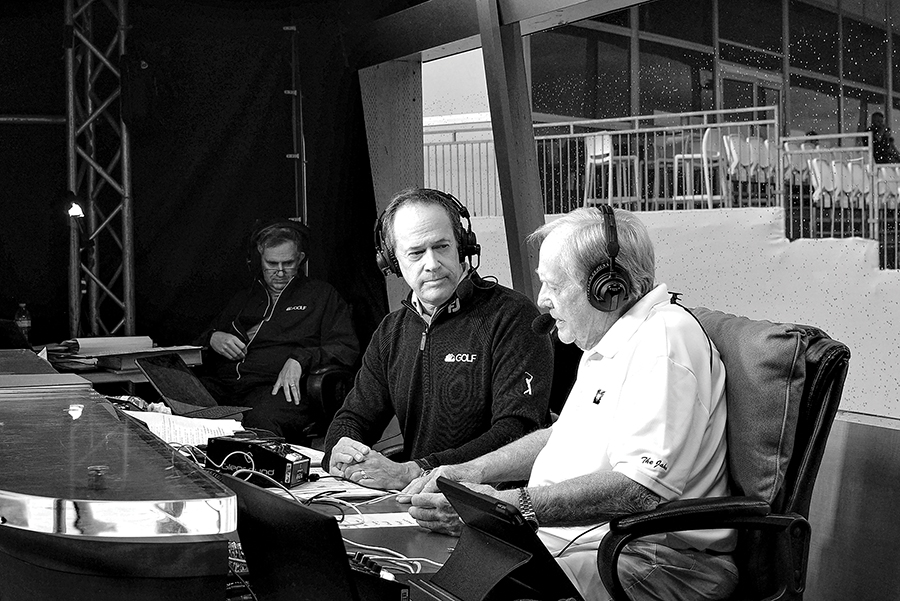
Middle: Brad Faxon, left, and Mike Tirico will be joined in the 18th tower at the U.S. Open by Dan Hicks and Brandel Chamblee (Photographs by Bill Fields)
Right: (L-R) Dan Hicks, Brandel Chamblee, Brad Faxon, Steve Sands on camera, and researcher Harrison Root
Roy comes from a golf family as well. His late father, Billy, a native of Manitoba, was a longtime club professional in Tucson, where he moved to be in a warm climate after contracting polio as a young adult. “He was in the hospital for a year and lost the muscles in his legs,” Roy says. “He could play golf but not with power, and he walked stiffly. He became known in the Tucson area for giving lessons to handicapped people and the elderly. I was always very proud that my dad was a golf pro.”
In 1978, when Roy was on holiday break in the middle of his sophomore year at Arizona, his dad helped him get a job at the Tucson Open. He had a choice of working in an on-course bar or as a runner for NBC delivering coffee to cameramen. He chose the latter because a friend had done it the prior year, the perk being the use of a rental car during the tournament.
But a week to earn spending money and drive fresh wheels turned into something of greater consequence when he was asked to help in the control room on Saturday. “When I went into the truck for the very first time, I knew that’s what I wanted to do,” says Roy, who was instantly attracted to the organized chaos. “Most of the time you’re taught to take your time, think about the possibilities, then make your decision. In the truck, you have to make a decision ‘now.’ It kind of goes against what normal jobs are.”
When Roy returned home that evening, he told his mother, Luanne, that his future had a shape, and soon he was on the road during the spring as part of the golf crew, joining NBC full time when he graduated in 1981.
That was the year that Randolph, who grew up in Menlo Park, California, got his start. He was a golf partner and friend of John Brodie, the former San Francisco 49ers quarterback who was an NBC announcer. Brodie thought Randolph’s playing experience could be put to good use on a crew that at the time was somewhat thin in golf knowledge. As had been the case with Roy, Randolph enjoyed the hectic environment of many voices from Day One.
Left: Photograph by Bill Fields
Middle: Photograph by Tomas Ovalle/NBC
Right: Editorial advisor Gil ( Photograph byCapps Katie Capps)
“Some people are fascinated by it and love it, and others come in there and have to get out as quick as possible because it’s too much,” Randolph says. “I had a little trouble studying and reading books, but I could watch two games at once, hear a conversation next to me and play cards at the same time. For most people, that would be hard. But I sometimes focus better doing more than one thing at a time.”
Randolph stands behind and between Roy and Martin during shows, his eyes on dozens of monitors. “I’m kind of a traffic controller in the truck,” Randolph says. “I have a lot of spotters and other people helping me. I’m looking at many monitors and figuring out where we go live. If Tommy wants to do a replay, or show some taped shots or other elements, where can we get those in without missing the most critical live shots? It is definitely a team effort.”
Martin will have roughly 65 cameras at his disposal in Pinehurst. Many are operated by experienced and expert hands such as Mike Wimberley, Gunnar Garrity and Rick Rice, who have done golf for years. Martin is communicating with them throughout broadcasts along with volunteer spotters reporting who is hitting what shot where. “I can listen to three conversations at once and know which one I need to actually pay attention to, and why it matters to me,” Martin says.
Drones and an airplane will be in the Sandhills skies during the U.S. Open to capture distinctive views. Remember the dramatic images looking down at Tiger Woods as he exulted his must-make putt on the 72nd green of the 2008 U.S. Open? Those were shot by Bob Mikkelson, who will be flying above No. 2 in June.
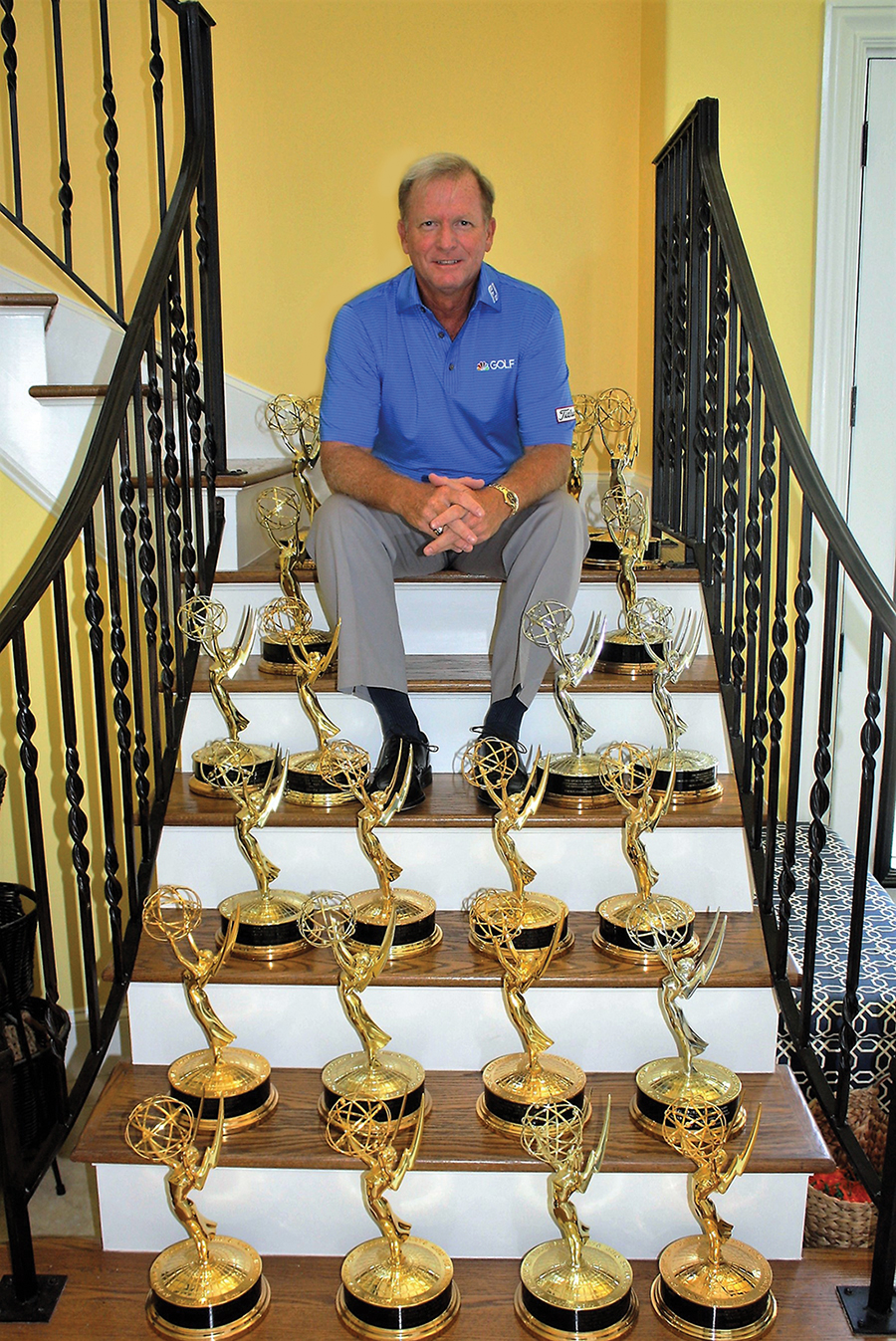
Overseeing it all is the intense, Pepsi-fueled Roy, the 29-time Sports Emmy winner who in addition to working about 500 golf events has excelled at coverage of the Olympic Games (producing every medal-winning race of Michael Phelps’ glorious swimming career), the NBA and the NFL. Roy is the definitive and decisive captain of the golf ship.
“These are gigantic sports productions, and you have to have a leader,” says Hicks, who coincidentally also grew up in Tucson and graduated from Arizona, although he didn’t meet Roy until 1992. “Without a leader, you’re lost. Tommy has a huge swath of responsibility, and he’s done the job very well for a long time. He is our leader.”
Complacency doesn’t fly with Roy. “I’m just driven for greatness,” he says. “I’ve seen people who get in positions who no longer strive for greatness. They strive just to be good enough to get by. And I don’t ever want that to happen for me personally or for anybody who works with us. We give our best all the time. We’re relying on so many people to do their jobs perfectly.”
As Mike Tirico, who will share the lead announcing duties with Hicks in Pinehurst, says, “You don’t ever want to let Tommy down. He has a bar for excellence that is higher than most people, and it’s there all the time. I’ve worked with great people, and he’s got a passion, an ability, an energy like nobody else. Nolan Ryan had command, a presence. He threw in the 90s for a long time. Tommy is just as good as he was when I first worked with him 25 years ago. That’s a lot of shots and a lot of miles to keep your fastball at 95, and Tommy’s is 95 with movement.”
Hicks and Tirico still bring it too, many years since their childhood aspirations of becoming broadcasters turned into esteemed careers on the air. Working closely with them affords a better appreciation of their talent: how fully they prepare, the cool under pressure, the ability to deal with an unanticipated detour, the judgment to let a moment breathe.
Capps has worked alongside Hicks for nearly 30 years. “I’m awfully biased, but at the same time I try to be objective, and I just don’t think there’s been a better golf play-by-play host all-time than Dan,” Capps says. “It’s a role that’s been blessed with a lot of good folks, Jim McKay and Dick Enberg among them. The list is deep with Hall of Famers. But Dan is unique in the way he can tell stories, weave them throughout an entire show, explaining what you’re seeing and why it’s important.”
Left: (L-R)Gil Capps, Dan Hicks and Jack Nicklaus (Photograph by Bill Fields)
Right: Tommy Roy (Photograph Courtesy of Jennifer Logue, Ponte Vedra Recorder)
“All hell can be breaking loose, and he’s going to come through time after time with the proper coverage,” Roy says of Hicks. “We’ve done so many hours of television together. That’s why there’s trust — he comes through every single time.”
Tirico, because of his extensive NFL play-by-play and Olympics hosting work, is more widely known to casual sports fans. He knows and appreciates that golf is different.
“You can’t please everyone,” Tirico says. “Some people want ball speed on every shot. Some people like the backstories of players. And some people just want to take a nap — they want the golf to be background noise. Golf is interesting because every time you show someone, as an announcer you could have so many different angles to explore. There’s statistics, there’s data, there’s historical material, there’s personal details about the player, there’s the shot that he’s facing or she’s facing. There are a lot of choices, and sometimes the best one in the biggest moment is to set up the shot and shut up, let people watch.”
Everyone on the crew will be looking forward to having the chance to broadcast the big moments in Pinehurst.
“Tommy has produced so many big events, and he’s clutch in the big moments,” Randolph says. “The thing I respect the most in Tommy is that he takes every show seriously and never mails it in. That said, he excels when the moment gets bigger.”
It will be the fourth Pinehurst U.S. Open that NBC has done, starting with the first one in 1999, when a star-heavy battle on a cool and misty Sunday came down to Payne Stewart’s clutch par putt on the 18th green.
“Your greatest hope in those types of moments is to take a back seat to what has happened, but you want to be able to enhance it,” says Hicks. “It can be easy to do, but you also can get in the way — and that’s what you don’t want to do.”
Hicks nailed the call after Woods sank his tying birdie on Sunday at Torrey Pines in 2008. “Expect anything different!” Hicks said, a brilliantly terse call for the ages that captured what everyone was thinking. Then he yielded to the many visuals that detailed the historic 12-footer in all its glory.
“There are always things I know we could have done better,” Roy says, “but Tiger making that putt in the 2008 U.S. Open was close to perfect. Dan’s call. All the angles. All the replays we had. Everything worked out.”
NBC’s last Pinehurst Open, in 2014, was bittersweet because it was the final one before the USGA took its championships to Fox. But in 2020, NBC regained the rights, doing the COVID 19-delayed one that year at Winged Foot and each championship since. The 2024 U.S. Open, the USGA’s 1,000th championship, will be the 25th U.S. Open for Roy and his team. (The network did a run of them in the early years of sports TV, ending in 1965.)
“It’s really cool to produce historical events, events that mean something,” Roy says. “The U.S. Open is huge.”
Like the golfers, we’ll be ready. PS
We use cookies to improve your experience on our site. By using our site, you consent to cookies.
Manage your cookie preferences below:
Essential cookies enable basic functions and are necessary for the proper function of the website.
Statistics cookies collect information anonymously. This information helps us understand how visitors use our website.
Google Analytics is a powerful tool that tracks and analyzes website traffic for informed marketing decisions.
Service URL: policies.google.com (opens in a new window)
SourceBuster is used by WooCommerce for order attribution based on user source.