Drinking With Writers

Coffee with Conscience

Best-selling novelist Amy Reed on Asheville writers, young adult
books and the challenge of living one’s values
By Wiley Cash     Photographs by Mallory Cash

There are countless humiliations specifically reserved for writers, from online reviews — Book arrived late. One-star — to empty chairs in the audience at a reading to sitting beside someone on an airplane who, after asking you what you do for a living, tells you he or she has never heard of you or your books.

One rarely discussed humiliation is the signing line. Signing lines can be lonely places for authors, especially during literary festivals when a much better known and beloved writer is signing hundreds of books at the table beside yours. Once, at a book festival in Nashville, Tennessee, I signed — which is to say I did not sign — books beside Bill Bryson. I also did not sign books beside Sue Monk Kidd at a literary festival in Florida. Last year, at the Doris Betts Spring Literary Festival in Statesville, North Carolina, I did not sign books beside novelist Amy Reed.

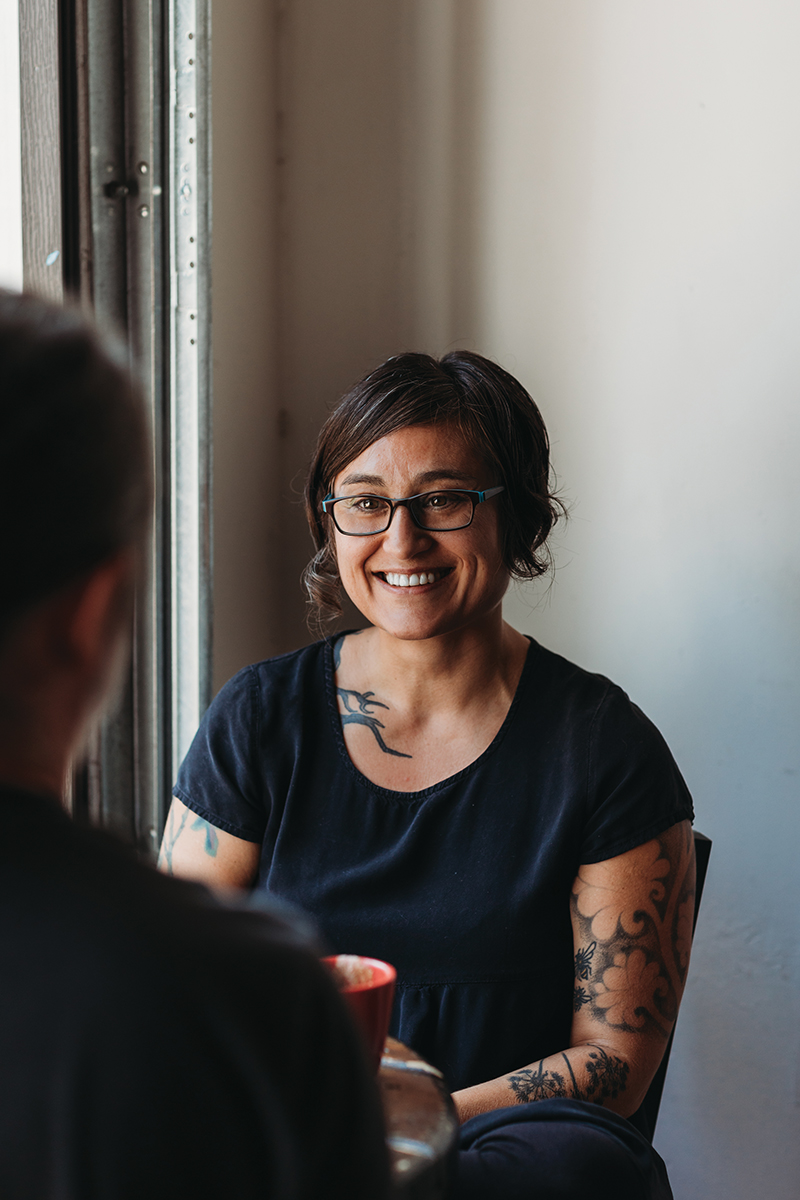
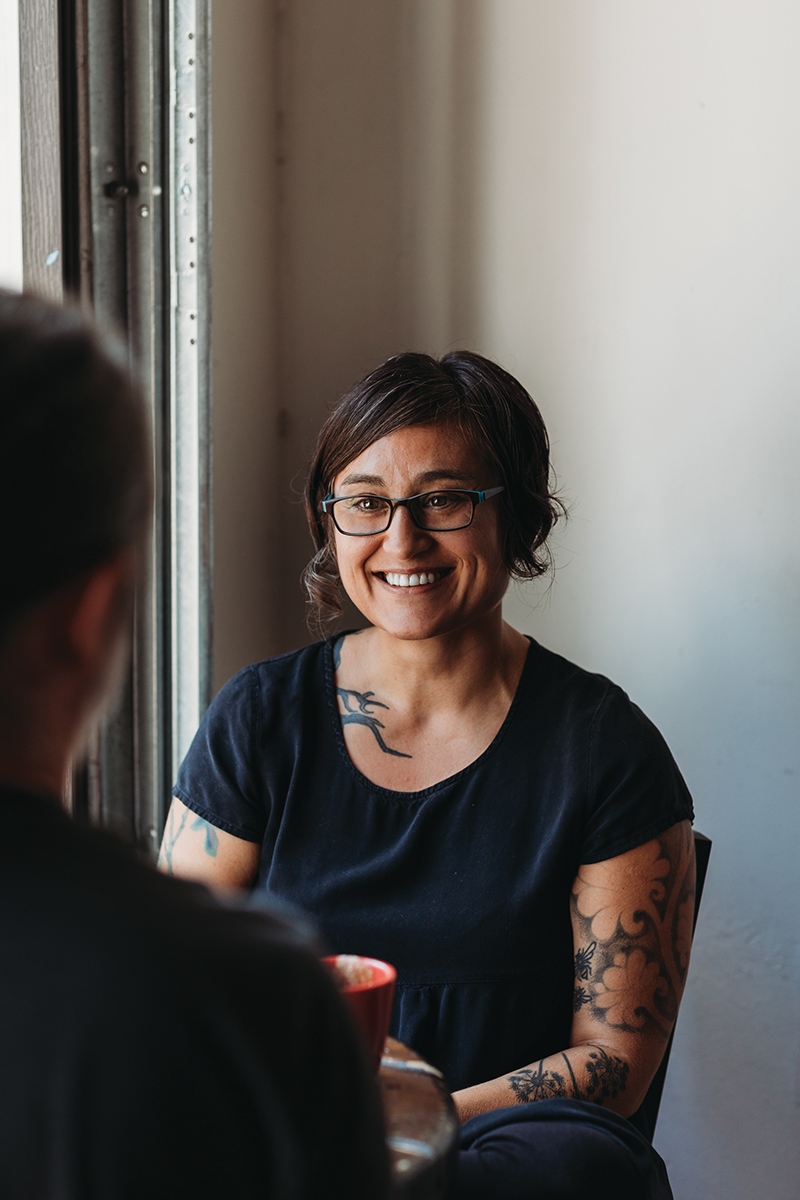
In early August, Amy and I sat down over coffee at Odd’s Café on Haywood Road in West Asheville, North Carolina, and I reminded her of our time together signing (and not signing) books at the festival in Statesville. Amy moved to Asheville from Seattle years ago, and she regularly writes at Odd’s Café, which, like most things in West Asheville, is odd. A few years back, the slogan “Keep Asheville Weird” appeared, and while Asheville as a whole has gotten less weird over the ensuing decade, West Asheville has maintained the city’s weirdness, its penchant for the arts, and an open invitation to artists of all kinds.

A stroll down Haywood Road in the heart of West Asheville reveals gorgeous murals painted on the sides of independent bookstores, coffee shops and hipster consignment stores. I feel more at home in West Asheville than I do in just about any other place in the country, and Amy Reed might just agree. Our conversation quickly turns to the city’s writing community.

“There are so many amazing writers here, especially young adult writers,” she says. She takes a sip of her coffee and gazes out at Haywood Road, where people pass in cars and on foot. The names of the local writers she rattles off next are a virtual Who’s Who of national and international bestsellers: “Alan Gratz, Alexandra Duncan, Stephanie Perkins, Beth Revis, and Jaye Robin Brown are just a few. Asheville’s writing community is so welcoming. Writing is a solitary profession, so it’s great when you’re able to connect with another writer.”

It is not just her colleagues in the local YA community that Amy has connected with. I remind her of the string of young people who waited in line to have their books signed at the literary festival in Statesville. Most of them were clutching a copy of her novel The Girls of Nowhere, which tells the story of three high school girls in Oregon who band together to fight back against misogyny and abuse at their high school, an act that transforms not only the students and their teachers, but their entire town.

I ask her why she thinks The Girls of Nowhere resonates with so many young people. “There’s just something universal about the teen experience,” she says. “When we’re teens we’re the most vulnerable and raw, and the stakes are so high. Teens want to read about themselves and their problems, and sometimes adults want to remember the teenagers they were.”

I agree. There is value in finding yourself on the page, and you can always return to the books you loved as a teen and find yourself there, which may explain adults’ sustained love for books like The Outsiders, Catcher in the Rye, and I Know Why the Caged Bird Sings.

I ask Amy what kind of reader she was as a teenager growing up in Seattle. She laughs and rolls her eyes. “I loved Anne Sexton and Sylvia Plath,” she says. “It was Seattle in the ’90s. Grunge was everywhere, but I was into female singer/songwriters. I was emo before emo was a thing. I was that girl.”

My two daughters, ages 4 and 3, are sitting at a table beside us, playing quietly. I confide to Amy that I consider my own books as time capsules that my daughters can read to discover who I was and what was important to me. I ask her if she thinks of her own books that way, as breadcrumbs she is leaving behind for her 6-year-old daughter so that she can know what her mother believed to be important and true.

“I do,” she says. “I try to live in a way that mirrors my values, especially now that I have a daughter. She was raised understanding that women and girls are strong and independent. I think she will find that in my books.”

Amy’s new novel, The Boy and Girl Who Broke the World, tells the emotional and humorous story of two young outcasts — an optimistic boy named Billy and a cynical girl named Lydia — whose bond may just save the world just as the world seems to be ending. Despite its surreal plotline, which involves a narcissistic rock star and a war between unicorns and dragons, the book is a lesson in honesty and vulnerability.

Apparently, writing about the apocalypse interested Amy enough to imagine a dystopian America in her next novel, which she describes as a near future gender-swapped, feminist retelling of The Great Gatsby set on an island off the coast of Seattle. “It’s very weird and dark and twisty,” she says. “In the novel, the world is falling apart, but the girl at the center of the book is able to find her own power.”

I’ll read it, and, once they are old enough, I’ll want my daughters to read it, too.  b

Wiley Cash lives in Wilmington with his wife and their two daughters. His latest novel, The Last Ballad, is available wherever books are sold.

Sporting Life

Remembering a Hero

A cabin, a pack of Red Man and a distant war

By Tom Bryant

Sometimes fall has a way of sneaking up right in the middle of summer, or maybe it just seems like it. That’s the way it was just prior to dove season: scorching hot days, long soft humid nights and then bam, a cool day that guarantees that summer has had its time and here we go with the next part of the year. That’s one reason I love North Carolina with its defined seasons.

Summer might bleed into fall; but when the sun rises lower on the horizon and shadows lengthen and cicadas sing in earnest, a smart man will check his woodpile, hoist out the winter clothing, and make sure his hunting coat and boots are ready. Deck shoes, shorts and knit shirts are to be put away.

That’s exactly what I was doing when the call came from Bubba. I had hunting gear piled high in the roost, our little garage apartment where I write, mess with outdoor gear and, in general, just hang out. I was making sure everything was ready for the upcoming cold months when Linda, my bride, came to the door and shouted up the stairs. “Tom, Bubba has been trying to call you. Where is your phone?”

“Oh, man. I forgot. It’s in the truck. I’ll get it and call him back.”

She laughed and said, “I don’t know why you have a phone. You never have it with you.”

I hustled down to the Bronco, found the phone under the front seat and saw where I had missed four calls from Bubba. I punched a button and returned his call.

“Coot.” Bubba had installed the nickname Cooter years before and it took. “That woman you married is too good for you. I don’t believe you would ever get a phone call if it wasn’t for her.”

I laughed and said, “You’re right, Bubba. I know it more and more every day. She does have a tendency to look out for me. What’s up? I thought you were heading to Costa Rica fishing.”

“Naw, decided to stay home and do a little dove shooting. That’s the reason I’m calling. Several of the old-timers are gonna meet at Slim’s store Saturday and talk about likely spots to hunt. Come on up and join us. We sure don’t want to leave you out. Ritter’s gonna be here with some of his apple brandy, and even Johnson is joining us. There’ll be a good crew.”

Slim’s store was a tradition in that part of the country, catering to hunters, fishermen and as Slim loved to put it, reprobates of all kinds. After Slim passed away, Bubba bought the place, kept Slim’s cousin, Leroy, to run the business on a daily basis so, as Bubba put it, “I’ll have a place to go. Plus I like the coffee.”

“I’ll be there, Bubba. I’m just in the process of checking out some gear. It sure feels like fall, doesn’t it?”

“Yep, and I’m sure ready. See you Saturday.”

I decided to drive the old Bronco up to Slim’s place to check her out. I recently had a lot of work done on the old vehicle and wanted to see how she would ride. I thought as long as I kept to the back roads, everything should be OK. She was slow, but she usually got me there.

The old crew was kicked back in rockers on the side porch when I pulled into the gravel parking lot. At one time Slim had tried selling gas, but that didn’t work. So he had the pumps removed to make room for a spot to play horseshoes. He always said he hated those gas pumps, a lot of trouble for nothing.

It was good to see the old group, and after a reasonable amount of good-natured insults, we all relaxed and enjoyed each other’s company. Old Man Time was beginning to trim the ranks of the aging crew. In the couple of years since my last visit, several had gone on to their rewards. Somehow, I’ve always had a feeling that everything would remain the same, but lately, age and time have proven me wrong.

Most of the crowd broke up early, having to get home for one reason or another, and as the sun set and the moon began to rise over the tree line where Johnson’s pasture used to be, only Bubba, Johnson, Ritter and I were left to hold forth.

“It seems funny not to see cows over there in that pasture, Johnson,” Bubba said.

“I know, but the developer had more money than them cows. I did get him to promise to keep that space green, though.”

Johnson had sold out his farm several years ago to a major developer who’d split it up into 10-acre mini-farms.

“I hope you did more than get a promise,” Bubba replied.

“I did. It’s in the contract that he has to keep that buffer like it is.”

Leroy came out, careful not to let the screen door slam. “Bubba, I’m heading home. Lock up before you leave. Good to see you guys.”

“OK, Leroy. Coot’s gonna stay overnight. We’ll be back in the cabin.” Bubba had built a small log cabin behind the store on a little pond that Slim had put in years before. He used it every now and then when he partook a little too much of Ritter’s apple brandy.

We watched Leroy’s pickup drive up the road. “That’s a good man you got there running the store, Bubba.” Johnson said.

“Yep, I’m lucky to have him. I think Slim would approve.”

Ritter reached in a pocket of the coat he had hung over the porch banister and pulled out a pouch of Red Man chewing tobacco. He answered the inquisitive looks. “I know, I started chewing again last week. I haven’t had a good chew since I was in Vietnam.”

We watched as the moon slowly rose over the pines. Bubba had gone in and turned off the outdoor lights, and when he sat back in his rocker he said, “If your brandy won’t kill you, that tobacco surely will.”

“Yep.” Ritter was quiet for a time. “You know I feel I’ve been living on borrowed time ever since that stupid war.” He had served in the Marines, and his platoon was one of the first to suffer casualties.

“I had a dream the other night about one of the boys who didn’t make it home. His name was Bud, a nickname really, picked up in boot camp. He was big, stood about 6 feet 4 inches and weighed around 250. And could he eat! Always borrowing C-rations when we were in the field. The drill instructors gave him the name Bud by calling him Big, Ugly and Dumb, shortened to Bud.

“We were still using M1 rifles then, M1As came later and then M14s, but we mostly liked the M1. Bud was so big he carried a .30-caliber machine gun. He toted that heavy thing like it was a tobacco stick.”

We sat silently watching across the old pasture. The moon was fully up now, and as a group we were surprised to hear Ritter talk about his war experience. In the past he would respond to any question about his service with only a perfunctory answer.

“Bud was a real hero,” he continued. “He’s the reason four of us in the unit came home from that stinking war.”

I don’t know if Ritter’s melancholy eloquence came from his own brandy or old age or maybe the dream he had about his friend, but in the moonlight I thought I could see a tear on his cheek. “Are you all right?” I asked.

“Yep, Coot,” he replied as he wiped his cheek. “I learned a long time ago in that war that you don’t cry for heroes, because there were so dang many. Bud was one of the best.”

No one broke the spell by speaking. We just sat silently, lost in our thoughts.  PS

Tom Bryant, a Southern Pines resident, is a lifelong outdoorsman and PineStraw’s Sporting Life columnist.

The Accidental Astrologer

Guts, Game and the Good Life

Virgos have it all


By Astrid Stellanova

By September, ole summertime holds on like the last drop of sweat.

September-born Virgo children have guts and game — and a taste for the good life, especially if you can plate it or pour it in a fancy glass. A few: Queen Elizabeth I, Prince Harry, Greta Garbo and Lauren Bacall, and the first woman to run for President, Victoria Woodhull. To that add a short list of a long list of actors: Charlie Sheen, Danielle Brooks, Lily Tomlin, Michael Keaton and Salma Hayek. Plum crazy, right? Virgo birthday celebrations sizzle like frog legs (or fried chicken) in a cast-iron pan. The Colonel himself, Harlan Sanders, was a finger-lickin’ Virgo. Let’s talk food and drink, Star Children.


Virgo (August 23–September 22)

That famous old curmudgeon Hemingway said he drank to make other people interesting. What makes you break out the bubbly? If nothing else, celebrate a year of wild-child creativity at the cusp. This may just be your best year ever, Sugar Foot. So hit the dance floor, do the worm, get down tonight, and savor that muscadine slurpee.

Libra (September. 23–October 22)

The slump you’ve been in is going to come to an end. Best of all, you will have a breakthrough versus a breakdown. Somebody close to you is biting their tongue and you owe them. Treat ’em right; your tastes in spirits are downright amazing, and you owe more than one round.

Scorpio (October 23–November 21)

When you did one of those drink-and-paint the ducky nights, turns out you sure do have a gift — for drinking. Don’t sulk, because your ducky was the most original. Originality is one of your trademarks, but so is radio silence, Honey. Open up and call a friend.

Sagittarius (November 22–December 21)

You got catfished. Conned. But it wasn’t all a failure, Sugar. The catfish in life keep the rest of us on our tippy toes. You won’t be caught again. And, it keeps you intrigued. Plus, catfish themselves are pretty damn tasty dipped in corn meal and fried up.

Capricorn (December 22–January 19)

Your mouth may be saying cheese, chocolate and a malted, but your jeans are saying, for goddsakes, order soup and salad. The bingeing was fun, Honey Bun, but now it’s done and get your sweet self back in training for that killer fall wardrobe you wanna rock.

Aquarius (January 20–February 18)

You get emotional just doing the Happy Baby pose in yoga. And you have been known to express your feelings in the most unusual ways, Sugar. Whatever has made you so vulnerable is intensifying but will release by the month’s end so you find a way to chill without a smoothie or a milkshake.

Pisces (February 19–March 20)

Innocent soybeans died for your veggie burger, Sugar. You have imposed a lot of strict ideas on yourself and others, but remember you can’t survive without making a lot of choices. And some are going to be far harder than skipping a mouth-watering bacon cheeseburger.

Aries (March 21–April 19)

Well, a good friend just pickled your okra, didn’t they? Now you have to put up or shut up, which is a Devil’s bargain. There’s no shame in just holding back one more hot minute before you unload your bucket. Patience is going to be your best ally.

Taurus (April 20–May 20)

Sure, you can make wine disappear, but, Honey, that is not some kind of a super power. Not exactly. But, in one way, the best thing you can do is keep your mouth full, because not everybody is buying what you have been selling lately.

Gemini (May 21–June 20)

You are at a crossroads, Sweet Pea. Can you be honest all of the time? Because you have hurt some people who care about you and left them wondering if you care for them. Do not feel compelled to tell Aunt Ida her cooking stinks. She’s too old and too tired from a lifetime at the hot stove.

Cancer (June 21–July 22)

You towed your bass boat to the wrong lake. You backed into the wrong situation. Maybe you put in, maybe you fished, but you are in the wrong place, Honey. If you can find a graceful exit, go home and grill the catch of the day before you get hooked.

Leo (July 23–August 22)

Were you slurring or trying to talk in cursive, Sugar? Seriously, you were way more entertaining than you even remember. Now you have to get some steel in your back and face up to a situation that will require you to be sober and serious — if only about what you will cook for dinner.  PS

For years, Astrid Stellanova owned and operated Curl Up and Dye Beauty Salon in the boondocks of North Carolina until arthritic fingers and her popular astrological readings provoked a new career path.

Hometown

Manhattan Memories

From the Pines to Park Avenue


By Bill Fields

My New York Days, to borrow the title of Willie Morris’ 1993 memoir, weren’t much like those of the Mississippi-born writer and editor, who led Harper’s in the late 1960s as it documented the political and cultural doings of that tumultuous time.

Aside from the fact that we were both small-town Southerners who moved to the big city, the only other similarity was where, geographically speaking, we worked. His office was at 2 Park Avenue. Mine, at Golf Illustrated magazine two decades later, was located at 3 Park Avenue, across the street.

The building that housed Golf Illustrated for a handful of years, until the publication’s abrupt closing in 1991, is on the southeast corner of 34th Street. Built of bricks the color of café con leche, 3 Park stands 42 stories and is aligned diagonally on the block. It was designed by Shreve, Lamb & Harmon, architects of the Empire State Building, and 3 Park’s proximity to its famous neighbor — along with a distinctive shape and hue — make it easy to spot flying in and out of New York.

Seeing it upon takeoff or approach at LaGuardia takes me back. I lived in the city from 1986-88 and commuted from Connecticut for three additional years, until Golf Illustrated’s owner pulled the plug and gave us two days to pack up.

I had only been to New York twice before I became a senior editor and photographer at the magazine — laying over for a few hours in 1980 during a long bus ride, and two years later when I made a summer visit to a former college roommate who was living in the Bronx.

We took long rides in hot, graffiti-rich subway cars, hung out at museums and Central Park, drank a bunch of beers at McSorley’s and elsewhere, and closed some of the long nights at a Greek diner. Driving me around the Bronx in his beater, Bernie pointed out the apartments where serial killer David Berkowitz had lived before the “Son of Sam” murders. The Yankees were in town, and we bought cheap seats for a Saturday afternoon game. My vocabulary was enriched during those couple of hours in the right field bleachers. It was not Bob Sheppard’s precise baritone over the P.A. that lingered with me but the language of the louts jostling for a drink at the water fountain.

Although Bernie got me a gratis room in the Bronx for a few days to hunt for an apartment once I was hired by Golf Illustrated and suggested I consider the borough for my new home, I settled elsewhere. For $725 a month, I rented a one-bedroom in a brownstone in the Carroll Gardens section of Brooklyn, then predominantly an Italian neighborhood and only starting to become gentrified. It was almost three times my rent in North Carolina, and I traded a fireplace and a yard for a kitchen and bathroom sized for a kindergartner. 

My place was a short walk to the Carroll Street subway station, where I got on an F train for the trip to 34th and 6th Avenue in Manhattan — between 20 and 25 minutes without any delays. From there, I walked down 34th Street, right past the Empire State Building, to the magazine. We were housed in a couple of different offices at 3 Park, none lower than the 31st floor, each with an astounding view compared to where I’d come from.

It was a new world. I’m not sure how brave I was, but I coped with it. The pleasure of those days — having gotten the opportunity to fulfill a dream by moving to New York — surely exceeded the anxiety. Although I explored the city, I wish I had been more adventuresome. My only true regret, though, is not splurging on an air conditioner during the infernal summer of ’87, even if I had to strap it on my back and walk it over the Brooklyn Bridge and all the way down Court Street. New York was more stifling than North Carolina had ever felt.

My former neighborhood, like the larger city, doesn’t much resemble its 1980s self aside from the brownstones themselves, which have soared in value. What I paid in rent probably would get me a twin bed in a crowded share. Manhattan is full of chain stores, places not unique to the city. It’s not as gritty, or charming, as when I moved there. To see 3 Park Avenue from the air is not only to recall a place and a time but a person, young and excited, eager for the next chapter.  PS

Southern Pines native Bill Fields, who writes about golf and other things, moved north in 1986 but hasn’t lost his accent.

Drinking with Writers

Coffee with Conscience

Best-selling novelist Amy Reed on Asheville writers,
young adult books and the challenge of living one’s values

By Wiley Cash     Photographs by Mallory Cash

There are countless humiliations specifically reserved for writers, from online reviews — Book arrived late. One-star — to empty chairs in the audience at a reading to sitting beside someone on an airplane who, after asking you what you do for a living, tells you he or she has never heard of you or your books.

One rarely discussed humiliation is the signing line. Signing lines can be lonely places for authors, especially during literary festivals when a much better known and beloved writer is signing hundreds of books at the table beside yours. Once, at a book festival in Nashville, Tennessee, I signed — which is to say I did not sign — books beside Bill Bryson. I also did not sign books beside Sue Monk Kidd at a literary festival in Florida. Last year, at the Doris Betts Spring Literary Festival in Statesville, North Carolina, I did not sign books beside novelist Amy Reed.

In early August, Amy and I sat down over coffee at Odd’s Café on Haywood Road in West Asheville, North Carolina, and I reminded her of our time together signing (and not signing) books at the festival in Statesville. Amy moved to Asheville from Seattle years ago, and she regularly writes at Odd’s Café, which, like most things in West Asheville, is odd. A few years back, the slogan “Keep Asheville Weird” appeared, and while Asheville as a whole has gotten less weird over the ensuing decade, West Asheville has maintained the city’s weirdness, its penchant for the arts, and an open invitation to artists of all kinds.

A stroll down Haywood Road in the heart of West Asheville reveals gorgeous murals painted on the sides of independent bookstores, coffee shops and hipster consignment stores. I feel more at home in West Asheville than I do in just about any other place in the country, and Amy Reed might just agree. Our conversation quickly turns to the city’s writing community.

“There are so many amazing writers here, especially young adult writers,” she says. She takes a sip of her coffee and gazes out at Haywood Road, where people pass in cars and on foot. The names of the local writers she rattles off next are a virtual Who’s Who of national and international bestsellers: “Alan Gratz, Alexandra Duncan, Stephanie Perkins, Beth Revis, and Jaye Robin Brown are just a few. Asheville’s writing community is so welcoming. Writing is a solitary profession, so it’s great when you’re able to connect with another writer.”

It is not just her colleagues in the local YA community that Amy has connected with. I remind her of the string of young people who waited in line to have their books signed at the literary festival in Statesville. Most of them were clutching a copy of her novel The Girls of Nowhere, which tells the story of three high school girls in Oregon who band together to fight back against misogyny and abuse at their high school, an act that transforms not only the students and their teachers, but their entire town.

I ask her why she thinks The Girls of Nowhere resonates with so many young people. “There’s just something universal about the teen experience,” she says. “When we’re teens we’re the most vulnerable and raw, and the stakes are so high. Teens want to read about themselves and their problems, and sometimes adults want to remember the teenagers they were.”

I agree. There is value in finding yourself on the page, and you can always return to the books you loved as a teen and find yourself there, which may explain adults’ sustained love for books like The Outsiders, Catcher in the Rye, and I Know Why the Caged Bird Sings.

I ask Amy what kind of reader she was as a teenager growing up in Seattle. She laughs and rolls her eyes. “I loved Anne Sexton and Sylvia Plath,” she says. “It was Seattle in the ’90s. Grunge was everywhere, but I was into female singer/songwriters. I was emo before emo was a thing. I was that girl.”

My two daughters, ages 4 and 3, are sitting at a table beside us, playing quietly. I confide to Amy that I consider my own books as time capsules that my daughters can read to discover who I was and what was important to me. I ask her if she thinks of her own books that way, as breadcrumbs she is leaving behind for her 6-year-old daughter so that she can know what her mother believed to be important and true.

“I do,” she says. “I try to live in a way that mirrors my values, especially now that I have a daughter. She was raised understanding that women and girls are strong and independent. I think she will find that in my books.”

Amy’s new novel, The Boy and Girl Who Broke the World, tells the emotional and humorous story of two young outcasts — an optimistic boy named Billy and a cynical girl named Lydia — whose bond may just save the world just as the world seems to be ending. Despite its surreal plotline, which involves a narcissistic rock star and a war between unicorns and dragons, the book is a lesson in honesty and vulnerability.

Apparently, writing about the apocalypse interested Amy enough to imagine a dystopian America in her next novel, which she describes as a near future gender-swapped, feminist retelling of The Great Gatsby set on an island off the coast of Seattle. “It’s very weird and dark and twisty,” she says. “In the novel, the world is falling apart, but the girl at the center of the book is able to find her own power.”

I’ll read it, and, once they are old enough, I’ll want my daughters to read it, too.  PS

Wiley Cash lives in Wilmington with his wife and their two daughters. His latest novel, The Last Ballad, is available wherever books are sold.

Out of the Blue

Back to the School of Life

Where we’re all graded on the curve

By Deborah Salomon

Back to school is one calendar event that justifies commercialization. Makes sense that over the summer kids grow out of clothes and shoes. They need notebooks and backpacks and haircuts. But the very phrase provokes mixed memories: being the “new girl” from Mars in a class where the other kids’ mothers had been BFFs . . . not good. Freshman year at Duke, getting lost first day of classes . . . terrifying. Next three years . . . glorious. It also reminds me of what I did and didn’t learn beyond the three R’s and other “core curriculum” requirements, now gone with the wind.

Then, my practical side conjures ways to incorporate life skills into a syllabus.

Sociology, for example. This people science would benefit from a segment on obituaries. Fascinating, how people’s lives progress, how names modernized (Ida’s granddaughters Skye and Madison), then returned to Emma and Sarah, Dorothy and Frances. Obits bid farewell to the last generation of “homemakers” who knitted and gardened and taught Sunday School; wording finally recognizes domestic and/or same-sex partnerships. Obits prove pets’ importance for the isolated and lonely. Also how death has become a social event, with jokes, casual descriptions of the deceased, and receptions at the golf club or restaurant occasionally replacing a funeral.

Death rituals are vital to studying society. Reference the ancient Egyptians.

If I taught history or economics I might require students to Google their previous homes. Shocker alert! If the property has been recently on the market, the Realtor might post a virtual tour. The tiny two-bedroom New York City apartment in a then-nice neighborhood where I grew up became junkie junction before the tide turned. Our rent in the 1940s was about $50; now, the apartment rents for nearly $3K. Or, buy it for $400K.

Anyway, seeing empty rooms with gleaming floors where once you played can be an unsettling experience.

Phys. Ed. majors (previously known as jocks) need a course in athletic attire, especially footwear, which may cost more than Italian leather loafers. Brands speak allegiance. Mustn’t wear shoes endorsed by your fave’s arch rival.

Seems like medical/dental students already take advanced placement courses in office décor. I am all too familiar with reception and treatment rooms of local dentists, oral surgeons, endodontists and prosthodontists. No periodonture yet but the night is young. My dentist’s office is a happy place staffed by happy people who could not possibly inflict pain. It keeps the latest issues of the best magazines. Sometimes I arrive early, just to read them. Another provider has water babbling into a rocky pond — which sends me straight to the restroom. My latest specialist offers a glass-front mini-fridge stocked with bottled water, also a Keurig machine, as well as tufted leather sofas and landscapes by a prominent local artist. The common feature: birdfeeders, sometimes formal gardens, placed in view of treatment chaise lounges. Very soothing, as is the music, either classical or Billy Joel-style soft rock. Makes you almost look forward to a root canal.

The providers’ subliminal message: I am good. I am successful. I can afford the niceties.

Agreed. I will gladly put my money where my mouth is. Nobody wants a dentist with frayed upholstery and 6-month-old Field & Streams.

Wall-mounted TVs remain problematic. CNN or Fox? Don’t want to frighten the horses, let alone fuel controversy among patients.

Physics is the science of matter, its motion and behavior. Parking qualifies. I am a champion parallel parker, having learned The Trick as a teenager. Since men still claim mastery of this maneuver, I suggest every girl learn it before heading out into the real world. Unfortunately, The Trick is best demonstrated, not explained, even with diagrams. You don’t learn to swim on dry land. Physics 101 will now adjourn to the parking lot.

Any modern English course should include interpreting TV advertising prose. Concentrate on medications, cars, financial services (unless already covered in mathematics). Most ads belong to theater of the absurd. A cancer or cardiac patient is seen enjoying “longer life,” preferably with an attractive and loving family (dog, always) at their lakeside retreat. Across the bottom scrolls, in tiny letters. “Actor portrayal. Do not expect these results,” while the voice-over warns of dire complications, including death.

Likewise, car ads are just too ridiculous. No, Subaru doesn’t mean love. It’s simply urabus spelled backward. Once ads are mastered, English students might decipher political speeches, which dance around the subject like witches around a bonfire. Absent from political discourse will be the words YES and NO because why answer a question monosyllabically when you can prevaricate an entire paragraph?

Then, I have sensual memories of school — the woodsy aroma of a full pencil sharpener, the feel of those spongy erasers, the sight of a colored pencil rainbow in a stand-up box. The sound of an empty Thermos rattling around a metal lunch pail. The squeak of chalk against the blackboard.

Too bad an iPad provides neither smell nor squeak. Calculators obviate flash cards and Google combines dictionary, thesaurus, encyclopedia. Siri, did Mommy put a Devil Dog in my lunch box? Those organic oat and cranberry power bars stick in my teeth.

Whatever, I’d still like a mulligan. Because students outgrow sneakers and jeans, state capitals and geometry theorems, but we never outgrow school.  PS

Deborah Salomon is a staff writer for PineStraw and The Pilot. She may be reached at debsalomon@nc.rr.com.

Good Natured

Herbal Asset

A boon to good health


By Karen Frye
The time is right to learn more about the herb andrographis. It is gaining in popularity, but many folks may not yet realize the wonderful benefits it gives. This one nutrient has the ability to strengthen the immune system, while also enhancing cardiovascular health, liver and kidney function, joint mobility, and even more. It has been used by herbal practitioners and patients for thousands of years as one of the most effective natural medicines without any side effects.
Andrographis is best known as a botanical that boosts your immune system’s ability to protect you from viruses and bacteria, thus helping us recover from colds and the flu faster and reducing the intensity of the symptoms. It’s a great herb to take as a preventive to keep you well during the upcoming cold and flu season. There’s a need for effective immune-boosting interventions that don’t create the side effects — something that works other than an antibiotic.
There are a lot of clinical studies ongoing with andrographis. One study showed it relieved symptoms including fatigue, sore throat, runny nose and sleeplessness in just two days. By the fourth day the people in the study taking andrographis saw a significant decrease in all symptoms: headache, earache, mucous and coughing.
Andrographis combats dangerous bacteria like staphylococcus by preventing it from replicating and has the ability to help in the treatment of Lyme disease. It’s a powerful antioxidant, anti-inflammatory, antiviral, anti-fungal, cancer preventive, neuroprotective and immune stimulant.
It has been the subject of over 800 studies in the National Institute of Health’s PubMed online database.
Here are some of the findings in theses studies:
Preserves brain/cognitive health, increases brain cell communication and helps handle stress.
Protects heart and arteries, relaxes blood vessels for healthy blood pressure.
Protects the liver (traditionally used to detoxify the liver and repair
liver damage).
Prevents pain, inflammation, arthritis and protects the cushioning cartilage between the joints.
Stops or prevents tumors. Research suggests this herb stops DNA damage and the development and proliferation of brain, skin and pancreatic cancer cells.
Boosts the immune defenses, reducing cold and flu symptoms and can even help fight Lyme disease.
Soothes digestive symptoms, balances pH levels in the stomach, stops inflammation associated with ulcerative colitis, protects the lining of the stomach and intestines against ulcers.
Andrographis may enhance your life in many ways. Read the research. It may be the wonder herb that can improve your health. PS
Karen Frye is the owner and founder of Nature’s Own and teaches yoga at the Bikram Yoga Studio.

Mom Inc

My Little Buddy

S.S. Minnow lands in West Virginia


By Renee Whitmore

I am hiding behind a straggly bush at my friend Kat’s house. She lives down the road from my house. Ants are crawling around my bare toes. The ground is damp under my feet. The cool West Virginia air blows through the bush. I have a Walkie Talkie in my left hand, and the static is buzzing in my ear.

“I see him!” I hear through the buzz of my radio. Kat is behind another bush at the house next to hers, watching. Waiting.

I hit the talk button, “Where?”

“Porch.”

I look to his porch, and sure enough, there is he is. Standing alone, wearing his beige hat, smoking a cigarette.

“Get a picture,” I say into my Walkie Talkie.

I imagine her with her Polaroid, squinting with her left eye, framing our subject, pushing the shutter button, spewing a picture out of the front of the camera.

“Got it!” she says.

“10-4.”

Our target is Gilligan. Yes, the Gilligan, the one from the popular ’60s TV series. When Gilligan (Bob Denver) retired from acting, he, his wife and son moved to southern West Virginia just down the road from where I grew up. I spent hours — more than a healthy curiosity should allow — trying to spy on him. After all, I was obsessed with Gilligan’s Island, in black and white and color. And who gets to grow up living on the same block as a celebrity?

Gilligan, however, did not seem to appreciate our fascination. In real life, he wasn’t as, uh, friendly and funny as he was on the show. Who could blame him? An entire life in the spotlight? (And I was way too young to know anything about Dobie Gillis and Maynard G. Krebs.) No wonder he moved to the West Virginia mountains. It’s as primitive as can be, after all.

We used every excuse we could think of to try to see him in person. One day Kat and I were selling chocolate bars for our school’s fundraiser. Without hesitation, we marched ourselves over to his door, and asked if he wanted to buy any. He answered the door wearing the same beige bucket hat he wore every day he was stranded on the island. He bought a box of chocolate bars, but had no interest in a Q&A and closed the door abruptly. I may have been just 9 years old but I wanted an interview. I had questions. Where did they get all that stuff?

Halloween was the perfect time to see Gilligan. I dressed up as Little Red Riding Hood, my brother was a pirate, and my sister was a clown. His front porch light was off, the sure sign to bypass the house. I just couldn’t.

All three of us piled up on the porch and rang the doorbell. His wife answered.

“Trick or treat!” we yelled in unison. She looked alarmed, but gave us a shy smile.

“Is, uh, Gilligan here?” my brother asked. I jabbed him in the stomach with my elbow.

Then we saw him, walking to the door right behind her with his hat on! They poured some Jolly Ranchers and Kit Kat bars into our plastic pumpkins and closed the door before I could say anything else. Disappointed, we trudged to the next house on the mountain.

I was a teenager the last time I saw Gilligan in person. I was browsing in Lowe’s hardware store with my parents and there he was, in the middle of the paint aisle, his beige hat pulled low, covering his eyes.

“Look,” I whispered to my mom. “Gilligan.”

She nodded. “Can I ask for his autograph or something?” I asked.

“Probably not,” she said.

We continued our three-hour tour.  PS

When Renee is not teaching English or being a professional taxi driver for her two boys, she is working on her first book.

Pleasures of Life Dept.

Pimento Cheese, Please

A Southern comfort food for all seasons


By Gayvin Powers

The delicious juxtaposition of sharp, smooth, spicy flavors in pimento cheese have been hitting palates for over 100 years. This gussied-up cheese dish regularly crosses the line between being known as a penny-pincher’s pâté to Southern caviar. Over the last century, it has been regularly spotted at potlucks, Sunday dinners, family gatherings, restaurants, funerals and picnics.

Due to the popularity of pimento cheese in the South, many are surprised to discover that it got its start up North and transformed into a culinary masterpiece in its adopted region.

Pimento cheese is hospitality and culture between two slices of white bread. The South can be hard and beautiful, sweet and strong, traditional and innovative. It makes sense that the South adopted a food that can seamlessly go from tea on the porch to a state dinner. It’s chic, down-home, no fuss, full-bodied and eccentric all in one.

Originally, pimento cheese was created during the processed food movement around the turn of the 20th century, and rumors are that the modern twists on it took root once the South adopted it as its own.

The first step in this delightful culinary favorite began in the 1870s when New York farmers were inspired to create an American version of the French Neufchâtel, a soft, unripened cheese. By the early 1900s, an American Neufchâtel (cream cheese) was on shelves for purchase. Around the same time, Spain started shipping canned pimentos, Spanish peppers, to the United States. The mild, colorful pepper and cream cheese concoction fit the processed food movement and needs of homemakers at the time. It brought “order and scientific precision to all aspects of the home, with a particular emphasis on scientific cooking and a neat dinner table,” according to the website Serious Eats.

The first sighting of pimento cheese is in a 1908 Good Housekeeping article. Lovers of modern pimento cheese recipes will notice key ingredients missing in the first recipe, which called for a cream cheese base without any mention of mild and sharp cheeses or mayonnaise. Early on, newspaper columnists and cookbooks encouraged readers to take the bland mix (cream cheese and pimentos) and experiment with spices and flavors. Early renditions of today’s Southern recipe can be seen in a Shreveport, Louisiana, writer’s recommendation of including “mayonnaise, lemon juice and Tabasco.”

By 1910, pimento cheese was being mass-produced and sold by the slice or in jars from Virginia to Oregon. Georgia farms capitalized on the trend in 1911 by growing pimentos, making the expensive imported delicacies more affordable. Pimento cheese was the blue-collar sandwich that inexpensively fed countless World War I soldiers, and was also the height of sophistication as domestic engineers served it in scooped out cabbages at garden and card parties. Prior to World War II, pimento cheese was found throughout everyday life, regularly featured in newspapers, on menus at the lunch counter and in one’s own icebox. Thanks to its mass appeal, Pomona Products Company of Griffin — a Georgia company and one of the United States’ largest packers — reached a pinnacle year in 1938, producing 10 million cans of pimentos.

As pimento cheese evolved, shredded cheese (sharp and mild) was added as a main ingredient. Sharp cheddar cheese features prominently in modern recipes. This addition meant a binding agent was needed. Cue the mayonnaise. Traditionally, cooks used homemade mayonnaise. Some found that homemade mayonnaise lacked the desired flavors, while others swear by it. If someone is going to use store-bought, Duke’s mayonnaise tends to be the enduring favorite. Due to the playful interpretations of pimento cheese recipes, some cooks won’t touch it without jalapeños, bacon, mustard, cayenne pepper or other ingredients.

Pimento cheese has an uncanny ability to walk in both the high cotton and tidal marshes. The Masters is a perfect example of this quintessential dichotomy. Every April at the Augusta National Golf Club, golf aficionados will spare no expense to attend the Masters and, once inside the gates, purchase a coveted pimento cheese on white bread for a whopping $1.50. Made fresh daily, these sandwiches turn a lowbrow meal into a fashionable tradition at a highbrow event.

While pimento cheese plays a featured role in Augusta, the ruby-speckled creation is a veritable chameleon of culinary versatility: Sometimes it’s a supporting role, and other times it’s the lead. Due to its robust flavor, it’s the star of any plate. In the South, it can be layered into or topped on just about anything from celery, grilled cheese sandwiches, fried green tomatoes, Saltines, Ritz crackers, apples, burgers and more. Others consider pimento cheese a main dish, spooning it straight from the bowl.

One of those people is Pinehurst resident Kristie Sullivan, Ph.D., best-selling author and the head of community at Diet Doctor, who is known for her savory and sweet keto meals that over 275,000 people loyally follow on social media every month. In her fourth keto book, Crazy Busy Keto, coming out in November, Sullivan puts her pimento cheese recipe in the main dish section of the cookbook. Her West Coast editors thought a pimento cheese recipe didn’t belong there.

“Oh, you are not from the South,” she told them, laughing.

Pimento cheese found a home in the South and like many transplants, its arrival enhanced the food, culture and hospitality here. One bite can convert anyone.

Original Recipe — Good Housekeeping, 1908

This recipe calls for a blend of cream cheese, mustard, chives and
minced pimentos.

The Masters Pimento Cheese Recipe

(One Man’s Best Guess)

By Dave Lobeck BBQMyWay writer for News and Tribune and on on YouTube

Over half a century of tradition is wrapped up in the green plastic bags at the Masters at Augusta National. While disturbances over pimento cheese suppliers since 2013 have led longtime patrons, and ESPN, to question the current recipe, Lobeck swears he has cracked the code. By using the ingredients label on the back of the package.

Ingredients

1 cup shredded extra sharp cheddar cheese

1 cup shredded Monterey Jack cheese

8 ounces cream cheese

2/3 cup real mayonnaise

4 ounce can pimentos and juice

2 tablespoons grated onion (or 1 teaspoon onion powder)

1 1/2 teaspoons black pepper

1 1/2 teaspoons granulated garlic

1 teaspoon cayenne pepper

Kristie’s Southern Style Pimento Cheese

By Kristie Sullivan  (Keto Friendly)

Many Sandhills residents know Sullivan for her pervious work at Sandhills Community College and her pioneering work worldwide with keto. At 3 years of age, Sullivan began struggling with obesity. After a lifetime of diets, health concerns and ailments, she found a solution in strict ketogenic eating and now works to help others overcome similar struggles.

Pimento cheese is great for a busy lifestyle. Sullivan encourages cooks to play around with ingredients and use what is available in the pantry.

Ingredients

1 cup plus 1 tablespoon mayonnaise

2 ounces cream cheese, softened to room temperature (one carb per serving)

16 ounces shredded cheese (one sharp and one mild — Sullivan uses a blend of Cabot sharp and Kerry Gold)

2 to 3 tablespoons diced pimentos

1 tablespoon Worcestershire sauce

1/4 teaspoon garlic powder

1/4 teaspoon cayenne powder, or more to taste

4 to 5 tablespoons bacon pieces

Mix mayonnaise and cream cheese until well blended. Add mayo mixture to the shredded cheese and mix well. Add pimentos, Worcestershire, garlic powder, cayenne and bacon, and blend well. Refrigerate for an hour or more before eating. Enjoy with a spoon, on celery, or pepperoni chips. This is delicious baked, hot and gooey, and on burgers.

To ensure keto eaters are keeping with keto guidelines, Sullivan recommends the following:

Use Primal Kitchen’s Avocado mayonnaise or Duke’s mayonnaise — Duke’s contains no sugar.

Grate your own cheese. The texture is better when grated at home and is without the starches that coat pre-blended cheeses.

Get creative on your favorite cheeses, one sharp and one mild.

Bacon is a key ingredient in keto cooking. In pimento cheese, it provides protein and salt for flavor.  PS

Gayvin Powers is the author of The Adventure of Iona Fay series and a writing coach at Soul Sisters Write. She can be reached at hello@gayvinpowers.com.