
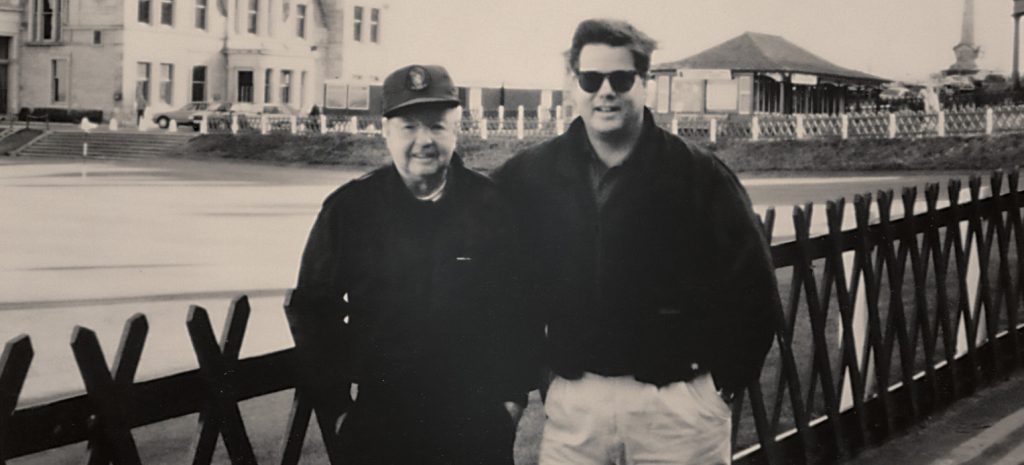
Three Decades Down the Road
Excerpt from Final Rounds: A Father, a Son, the Golf Journey of a Lifetime
By Jim Dodson
It was not until the next October — far too long to suit my tastes — that we played again. I’d been working hard, traveling a lot, trying to figure out why it was that whenever I was in some glorious, glamorous golf place, I spent so much of my time thinking about home, worrying about my children and my roses, both of which require a lot of hands-on attention.
Two of my colleagues at Golf Magazine invited me to join them for a round at Pinehurst No. 2, the marvelous Donald Ross course where Opti and I had played many rounds over the years. The course was one of his favorites. I invited my father to join us, and he agreed.
The day was raw, wet, and cold, and everyone’s game was off, but my father’s was really desolate. He topped balls and missed putts he could once have made with his eyes shut. At one point I was passing a steep fairway bunker when I heard him sheepishly call my name. I turned and saw him asking me for a hand up. I reached and took his hand. It was trembling ever so slightly. My heart almost broke on the spot.
We attempted to joke off the disaster on the hour drive home. I told Dad those super senior clubs he rejected would have saved his skin, and he said at least nobody died in the train wreck. We rode along for a little while in silence, looking at the slick road and rainy countryside. He seemed as down as I’d ever seen him. Then an idea came to me.
“Let’s take a trip,” I said.
“What trip?”
“The trip we always talked about. The one we never took.”
He glanced at me and steered Old Blue, his ancient barge-sized Cadillac, around a farmer pulling a hay wagon.
“Don’t you remember?” I said.
“Of course. But you go there all the time.”
“I go there all the time by myself,” I corrected him. “I’ve never been there with you. We’ve got some unfinished business.”
“I suppose so.” He managed to conceal his enthusiasm for the idea. I hoped his rotten day on the course accounted for this.
In any event, that’s where it really began, the first step in our final golf journey — a trip to the places where he learned to play golf as a sergeant in the Eighth Army Air Corps during the war. “There” was St. Andrews, the birthplace of the game. Thousands of golfers went there every year. But we hadn’t. It was now or never and almost that simple.
But nothing is really that simple. I knew not to push my father on the subject. Things were obviously changing fast in his life. Losing his golf pals had merely revealed his mortality. I sensed a powerful urgency in him to tie up loose ends, to finish whatever needed finishing at home, and in his life and work.
We didn’t speak of it again for months. I got on with my own life, telling myself I’d planted a proper seed. What else could I do? I hoped — I even prayed — it would grow.
By early August, everything was set. I’d made plane and hotel reservations, reserved the rental car, and contacted several club secretaries who were enthusiastic about helping out. It read like a grand tour of the British golf establishment: Sunningdale, Royal Birkdale, Royal Lytham, Turnberry, Royal Troon, Carnoustie, possibly Gleneagles and Muirfield, and of course, St. Andrews. I’d been to most of these places on my own but couldn’t wait to go back with my old man.
Two weeks before the trip, he called again.
I took the call on our cellphone, standing out behind the perennial garden where I was trying to figure out the best place to build my daughter a playhouse like the one she’d seen in a local theater production of Peter Pan.
“I’m afraid the trip will have to be postponed,” he said. With a sinking heart, I asked why.
“I had some bleeding. I didn’t think it was any big deal, but I guess I was wrong. They did some tests. They want to do some more, starting tomorrow.”
The cancer of a decade ago had come back, he said, spreading radically throughout his pelvic region. It had moved into his back, had even invaded his stomach and intestines.
I asked for the official prognosis and will never forget what he told me: a month, two at most.
Then he laughed. Only Opti would have laughed at such a verdict. He said he would call back in a couple more days when he knew more.
I hung up the phone and sat down on a wooden bench. My first thought was undeniably selfish: Christ, we’ll never play golf again. I went through the next few days in a trance. I tried to read stories to my children but kept missing passages. I tried to write my columns and prune my roses, but nothing helped. I went to my golf club and played three holes and quit. I picked up the phone to begin canceling reservations but put the receiver down again.
Then my father called back.
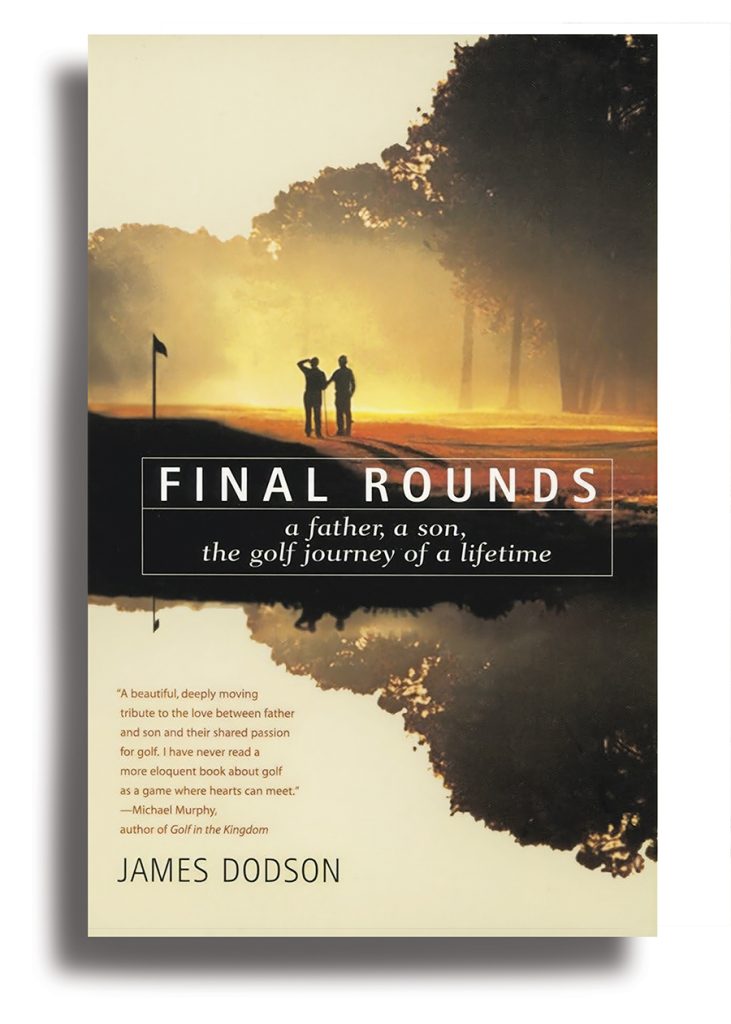
“Well, the options are not good,” Opti said, sounding eerily like his old self. “They can pump me full of poisons and maybe hook me up to some machines and buy a few more weeks. Who the hell needs that?” He said he planned to let nature take its course.
I told him I admired his courage.
He told me to save my lung power for the golf course.
“I’m planning to whip your tail at Lytham and St. Andrews,” he said. “Hope you haven’t canceled those reservations or anything.”
I said I hadn’t.
“Good. Here are my terms,” he continued. “No complaints. No long faces. We go to have laughs, hit a few balls, maybe take a bit of the Queen’s currency from each other’s pockets. But when I say it’s time to go home, I go home. No questions asked. I’ve got plenty of stuff to do. But I do want to pin your ears back for old times’ sake — so you’ll at least remember me.”
I sort of laughed; then agreed.
“Good. See you at the airport in Atlanta,” he barked happily, banging down the phone.
Opti the Mystic had spoken again.
I went out and finally pruned my roses, damn near barbering them to the ground.
* * *
The lane led to a gated burying ground at the rear of the church. On the far side of the graveyard was a public park of some sort, with a rose garden at its center. Dad opened the iron gate and proceeded along the stone pathways of the graveyard, eyeing the headstones. I followed him to a large polished granite cross positioned near the rear of the cemetery. It was a common grave. Wreaths and wildflowers had recently been placed there, but the chill nights had turned them rusty, bundles of asters and poppies and chrysanthemums. I read some of the names inscribed on the stone border: Gillian and June Parkinson. George Preston. Michael Probert. Kenneth Boocock. Lillian Waite. Silvia Whybrow. Judith Garner. Annie Harrington . . .
The names went on, thirty-eight in all. A mass grave.
“How did these folks die?” I asked.
“They weren’t folks,” he replied softly. “They were children.”
The words didn’t sink in at first. We stood there for a few seconds staring at the names.
“Children?” I repeated finally.
He nodded. “Four- and five-year-olds. Maggie’s and Jack’s ages. They went to the infants’ school here at the church. One of our bombers crashed into the school. The airfield was just over there.” He lifted his head, solemnly, to indicate where.
I didn’t have a clue what to say. I’d never heard of anything so awful. So for a change, I said nothing.
We stood in silence for a few minutes more before he spoke again. He shut his eyes and opened them. I wondered if he was praying or just reliving scenes I couldn’t begin to imagine.
He spoke evenly. “It was about ten in the morning. A large thunderstorm had just come up. We had our parachute crews working double shifts because this was six or seven weeks after D-Day. I’d just stretched out on my cot in our Nissen hut to steal some shut-eye when I heard a big roar overhead, followed by an explosion. The whole hut just shook. Jesus, it shook . . . I knew it was one of our birds. The hut I was in was probably the closest one to the school here. One of the other guys jumped up and ran out, and I ran after him. It was raining like hell, but I saw fire down at the school and started running. We were all running.”
Dad cleared his throat. He was shaking a bit. I placed my hand on his arm. He continued:
“I guess I was one of the first to reach the school, though others got there quickly. God . . . what a sight. The plane had gone right through the school and struck a café where lots of our guys and R.A.F. personnel used to hang out. It set half the town on fire. Burning fuel was running down the street. I just remember . . . starting to pull away pieces of things . . . pieces of the plane, you know, also bricks and mortar . . . and all these precious little kids inside . . . buried alive or killed by the explosion. I remember the sound of a child weeping. I couldn’t seem to find her. We pulled out several of the children. They were dead or badly injured. You didn’t have time to think. You just kept digging.”
His voice stopped. I saw tears gathering in his eyes for only the second time in my life. The first time had been when we buried my nephew Richard, one summer day in 1987. Richard, his first grandchild, had been gamely battling a rare nervous system disorder when he died in his sleep. Richard was nine.
I slipped my arm around my father.
We stood that way for several more minutes. He cleared his throat again and said, in a stronger voice: “I knew a lot of these kids, Jim. As I told you, they were always hanging around the base. The guys loved them. We each had our favorites. There was one little girl in particular I loved. She was always laughing, like your Maggie. I called her Lady Sunshine. I used to tell her I hoped I had a daughter like her someday. She was one of those killed.”
Good lord, I thought.
“A week or so after the crash, after the funeral and all of that, I found a note attached to the bulletin board from that little girl’s parents. They wondered if anybody had taken a photograph of their daughter. Can you imagine? They didn’t even have a picture of their only daughter. I took them all I had. They were so grateful. We sat there in their little front parlor and just cried. I don’t think I ever experienced anything quite so sad.”
“Were you okay?”
My father gave me an anguished look. Dumb question, I realized.
“Hell, no!” he snapped. “How could anybody be okay after something like that?”
“I’m sorry. I guess I meant physically. Were you injured . . . “
“Yes . . . no . . . my hands were burned a bit. Wore bandages for a while. No big deal. I was fine . . . but I didn’t feel up to going to the funeral. They brought Bing Crosby in to sing to the people of Freckleton. I couldn’t even stand to go hear him sing. I think I went somewhere and tried to play golf. Burned hands and all. I just wanted to be alone.”
“Do you remember the little girl’s name?”
Dad, better now, considered the names on the grave.
“Harrington. Maybe it was Annie Harrington.” He took out a handkerchief and blew his nose. “Lady Sunshine,” he murmured.
I took my father’s arm, and we left the burying ground, slowly closing the iron gate behind us. Two boys on bikes were pedaling furiously up the alley and swerved to avoid hitting us. One of them turned his head and gave us a dirty look. My father, rubbing his eyes, didn’t see it. The air was cold. The moon was already out. It was going to be a beautiful night.
“I’m surprised you never told me this story,” I said when we reached the car.
He paused and looked back at the church, a looming shape in the early shade of evening now. I saw a single small light burning somewhere inside.
“The war ended for me right here,” he said. “I promised myself I would never speak about it again.”
* * *
We were standing on the seventeenth tee of the Old Course. The Road Hole.
The sun was gone, the air was cold, and the course lay almost fully in the embrace of a blue twilight now. A few faint stars were visible above the clouds, and there were lights on in the Old Grey Toon. The group we’d been following had hit their drives and disappeared rapidly down the fairway.
“This is where I wish we had our real clubs,” I said.
“Aw, who needs ’em?” Dad said. “Let’s play anyway.”
“You’re right,” I agreed. “We could play air golf with the ghosts of St. Andrews the way I played air guitar with The Beatles. Please play away, Mr. Dodson.”
Dad teed up his air Top-Flite, took his stance, and swung. “There,” he said. “Right over the sheds. Just like fifty years ago.”
I teed up my air Titleist and asked, “How fast did that fifty years go by?”
“Stick around. You won’t believe it.”
I struck my shot and outdrove him, as usual, by at least a hundred yards.
We walked down the darkened fairway side by side. For a change, I wasn’t really thinking about all the greats who had walked this way to immortality: Old Tom and Young. Taylor and Braid. Jones and Snead. Nicklaus and Lema. Ballesteros and Faldo. Watson who had crossed this spot with a record-tying sixth Open within his grasp — to just miss.
I was thinking, instead, how simply fine and proper it was that my old man and I were finally playing the Road Hole together. Now came Opti and son.
From the heart of the fairway, Dad used an air three-wood to lay up short of the infamous Road Hole bunker. From the left rough, I swatted a beautiful air four-iron to the lower half of the green. We were playing our own games, if I may say so, magnificently.
He walked up to his air ball, just shy of the bunker, and announced he was using his air sand wedge, then lofted his ball sweetly to the green, stopping it within a few feet of the cup.
“Very nice,” I said. “Before we putt out, though, tell me about your birdie.”
He looked at me, then nodded solemnly at the bunker.
It took a few seconds for me to realize what he was telling me. He’d somehow made birdie from the Road Hole bunker!
“That’s unbelievable,” I said, shaking my head. “I’ve never heard of anybody doing that.”
“It came as a major shock to me, too.”
I demanded that he describe in detail this miraculous little feat, on a par in my mind with anything Jones had done at Lytham or Palmer at Birkdale.
He said the details were kind of foggy, but he seemed to think the hole was considerably different back then. “For one thing, the bunker was a lot shallower than it is now. The sod wall was nowhere near as high as it is here. You could escape pretty easily with a decent shot.” He took a step closer, sizing up the wall, which was higher than a man’s head. “I don’t see how anybody could come out of this thing.”
He added that the pin he’d shot at that day fifty years ago was on the lower half of the green. The greens were thicker grass in those days, before modern lawn mowers came along. That made a big difference, too.
“You still made a hell of a shot,” I said to him, “And it wasn’t an air ball.”
“No,” he said a little wistfully, “it wasn’t. Sometimes, though, it takes on the quality of a dream. Perhaps, I simply imagined it.”
“No,” I said. “Not a chance.”
We putted out rather quickly. I made an uncharacteristically fine air lag from the lower part of the green and tapped in for four — a brilliant air par! Dad sank a clutch five-footer to halve the hole.
“Two air pars on the hardest hole in golf,” I said as we shook hands.
We walked to the eighteenth tee, struck fine drives into the darkness, then moseyed down the fairway of the most famous finishing hole in golf, crossing the little arched stone bridge. For weeks I’d been so fearful of this moment, anticipating how awful I would feel when it finally arrived. But, strangely, I wasn’t the least bit sad now. I was cold as blazes but almost unnaturally happy to be finishing a round of golf that only I would ever remember. No card would ever show the score. Our match would vanish into the air.
“Call me sentimental if you like,” my father said, taking my arm as we approached the Valley of Sin, the dangerous swale that guards the front of the eighteenth green. “I think it’s been a hell of a journey.”
“You’re just being sentimental,” I replied. “The showers were much worse than expected.”
“You’re talking about the trip,” he said. “I’m talking about the journey.”
