

THE ROAD TO THE HOUSE IN THE HORSESHOE
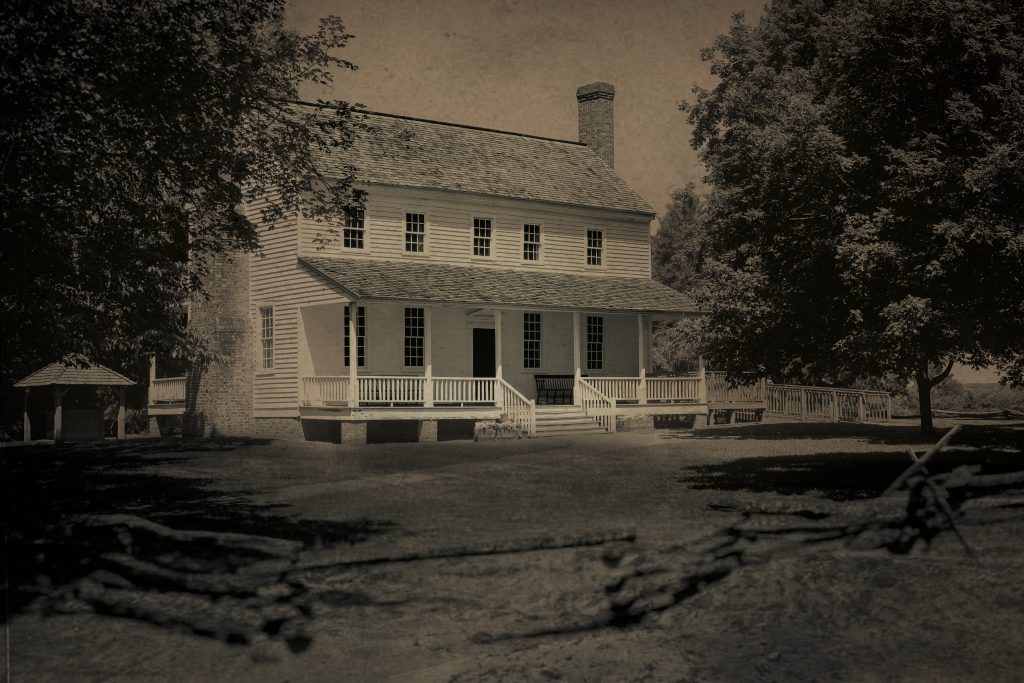
The Road to the House in the Horseshoe
A Revolutionary tale of murder, survival and derring-do through the Sandhills
By Bill Case | Photograph by John Gessner
The skirmish at Col. Philip Alston’s home had raged for over three hours without any definitive result. But when an oxcart was discovered in Alston’s barnyard, an end to the stalemate appeared to be at hand. The leader of the attacking Loyalist Militia, 26-year-old Col. David Fanning, ordered his men to bed the cart with hay, set it afire, and wheel it ablaze into the two-story frame house. Col. Alston, inside with wife, Temperance, their six children, and around twenty Patriots under his command, recognized this dilemma had no ready solution. If he and his militia members ventured outside, they would be sitting ducks for Fanning’s sharpshooters. Staying inside a burning tinderbox meant certain death for all.
Fanning and Alston had taken turns chasing each other through the Sandhills during the month of July, 1781. Now Fanning was the pursuer and Alston was his prey. The news that Alston’s forces had killed non-fighting Loyalist supporter Kenneth Black had sent the irascible Fanning over the edge, and revenge was foremost on his mind. When Fanning found out the Patriot leader and a number of his men had retreated to Alston’s “House in the Horseshoe” (so named because of its location within a bend of the Deep River) 10 miles north of Carthage, he resolved “to make [an] [e]xample of them for [what] . . . they had done to one of my pilots by name Kenneth Black.”
Alston, Fanning and Black: The convergence of this trio in July 1781 yielded compelling though oft-overlooked Revolutionary War history. Local history buff Paula Caddell finds the contrasts in the backgrounds of the three protagonists fascinating. “Philip Alston was born with a silver spoon in his mouth as the privileged son of a plantation owner. David Fanning was something of an abused child indentured to a man who forced David to live mostly outdoors in the woods attending cattle. This neglect caused an unsightly condition known as ‘scald head,’ which permanently took all the hair off Fanning’s head. Kenneth Black, a Scottish Highlander, emigrated here from Jura, an isle in the Hebrides, seeking a better life.”
Black was among thousands of Highlanders impacted by the defeat of Bonnie Prince Charlie’s Jacobite Army at the Battle of Culloden in 1746. To punish the rebels, the crown disbanded the centuries-old Scottish clan system. Many were driven off their land. Those remaining were forced to pay exorbitant rents. Facing starvation, a large proportion of Highlanders sought a fresh start in America. And the king, desirous of encouraging settlement in the colonies, was willing to pardon past offenses and permit the Highlanders to leave provided they pledged an oath of allegiance vowing never to take up arms against the sovereign. Those signing acknowledged that breach of the oath would cause them to be “cursed in all . . . [their] undertakings and family.” Abiding by the oath was considered a religious necessity. In his 1854 treatise, “The Old North State in 1776,” Rev. Eli Caruthers remarked that most Scots’ mindset was that “they must not violate their oath, for that would be giving themselves to the devil at once.”
The trickle of Scots immigrating to this region was accelerating rapidly when Kenneth Black arrived sometime around 1765. He and wife Catherine settled on a 100-acre allotment near the Little River just south of Carthage. Sometime after 1772, he acquired a 50-acre plot near present-day Southern Pines and constructed a home where the Residence Inn is now located. Residing nearby were several brothers with the surname of Black who likewise migrated from Jura. There is disagreement among historians regarding the relationship of the brothers to Kenneth, but they were certainly kin in some way and good friends. Other Scottish- born families like McNeill, Buchan, Paterson, Buie, Blue and Stewart soon arrived in the area. Descendants of these families still populate Moore County today.
The most celebrated arrival was undoubtedly Flora MacDonald. She achieved everlasting fame after the Culloden debacle, when she aided Bonnie Prince Charlie’s escape to the Island of Skye by disguising him as an Irish spinning maid. She paid for her assistance to the Jacobite cause with imprisonment in the Tower of London for several months. In 1750, she married Allan MacDonald, ironically a captain in the British Army. They lived on Skye until emigrating to North Carolina in 1774.
The Highland Scots destined for North Carolina assumed they were leaving behind a civil war that had rendered their lives unbearably difficult. It must have been alarming to arrive here to find rebellion in their midst once again. They wanted no part of it. Aside from their irrevocable oaths to King George III, other practicalities mitigated against supporting the cause of independence. England had easily crushed the Jacobites at Culloden. What would prevent the greatest military power on Earth from quelling an American rebellion? There was commerce to consider too. Many of the Scots, like Kenneth Black, had become successful farmers. The longleaf pines on their estates produced naval stores of pitch and turpentine marketed to the mother country. And there was cotton. War would interrupt that trade. Why rock the boat?
Once the “Shot Heard Round the World” was fired in Lexington on April 19, 1775, war was suddenly at hand. One month later, patriots (also known then as Whigs) in the Charlotte area adopted the Mecklenburg Declaration, which is said to be the first formal action by any group of Americans to declare independence from Great Britain. When word reached Royal Gov. Josiah Martin that the Whigs’ Safety Committee in New Bern was poised to seize him, he fled the Royal Palace and took refuge in a British ship offshore. With astonishing alacrity, the Whigs orchestrated a takeover of the reins of government.
In August 1775, a convocation of Whigs was held at the “Hillsborough Provincial Congress.” This assembly took up the question of raising troops to defend the colony against an anticipated British invasion. Two regiments were authorized (known as the “Continental Line”) , but lack of funding meant that the majority of Patriot fighters during the war were militia members.
While those favoring independence in North Carolina were in the majority, the Highland Scots provided a formidable counterweight favoring allegiance to the king. They were joined by remnants of the Regulators movement. The Regulators were western North Carolina settlers who had rebelled against the fraudulent imposition of fees and taxes by conniving public officials. This brouhaha had led to the Battle of Alamance in 1771 — a devastating defeat for the Regulators. The movement collapsed, and its surviving members were forced to swear their own oaths of allegiance to the king.
In the early stages of the Revolution, the Whigs sought to lure the Highland Scots and Regulators (collectively referred to as “Tories”) to the revolutionary cause with various inducements. But when those offers were rejected, the Whigs resorted to coercion in the form of arrests, banishments, estate confiscations and tax penalties. Seeking to restore royal rule, the embattled Gov. Martin made his own overtures to recruit the Highlanders to join the Royal Highland Emigrant Regiment (“the Highland Regiment”), promising 200-acre grants to all who enlisted. Martin, not above threatening reprisals against recalcitrant Scots, proclaimed those refusing service risked having “their lives and properties to be forfeited.”
Martin’s recruitment efforts met with some success. On February 2, 1776, 1500 Highlanders and a smaller number of Regulators gathered at Cross Creek near Fayetteville to join the Highland Regiment led by Gen. Donald MacDonald. Flora MacDonald’s husband, Allan, served as an officer in the Regiment. Flora herself is said to have made a fiery oration urging valor in upcoming battles to her fellow Highlanders. The plan was to march the Highland Regiment to Wilmington to link up with British forces led by Gen. Lord Charles Cornwallis, who was scheduled to be arriving shortly by sea. But Patriots led by Col. James Moore and Richard Caswell rushed to block the Regiment at Moore’s Creek, eighteen miles north of Wilmington. Realizing that the Regiment would be crossing Moore’s Creek Bridge, Moore and Caswell removed most of the bridge’s planking, greased its support rails with tallow, and awaited the Regiment’s appearance. When the Highlanders arrived and attempted a charge across the bridge, they were welcomed with deadly cannon and rifle fire.
It was a rout. Fifty Scots perished on the bridge, and the majority of the Regiment was captured and imprisoned. Allan MacDonald was among them. Those that escaped hastened back to their farms and laid low. When Cornwallis finally arrived in Wilmington in May 1776, there were no Highlanders to greet him, only a chagrined Gov. Martin, whose foolproof plan to take back North Carolina had backfired. With no fighting Tories around to augment his own army, Cornwallis chose to sail for Charleston with the intent of attacking the Patriot stronghold of Fort Moultrie. With the Tories in disarray, armed resistance to the Patriots in North Carolina melted away. In short order, the Whigs cemented their hold on government by adopting a new constitution, electing Richard Caswell as governor of the new state, and levying property taxes.
While there was a hiatus on military engagements in the state, the Highlanders’ troubles continued. Flora MacDonald’s home at Cheek’s Creek was ransacked and seized. Poor Flora! Once again, she had cast her lot with the losing side. Now age 54, homeless, separated from her husband, and a pariah, she appealed to Kenneth Black for help. He allowed Flora to hide at his Little River property, where she remained until reuniting with Allan after his release in a prisoner exchange. In 1779, the couple left America and returned to Skye.
Kenneth Black himself ran afoul of the four-fold tax that the authorities imposed on those who refused to take an oath to the new state. This led to an altercation reported by Caruthers in his treatise. In the fall of 1778, an unintimidated Black rebuffed the efforts of two tax collectors for the county who came to his home.
Subsequently the taxmen brought in reinforcements, who promptly seized “a negro man, a stud horse, and a good deal of other property, amounting in all to seven or eight hundred dollars.” Black offered no resistance. Caruthers offered the view that given the rough treatment afforded Black, “a man in good circumstances, and of much respectability in his neighborhood . . . we may suppose it was worse with men of less property and influence in the community. During this period the Scots complained bitterly of such military officers as [Philip] Alston [and others] . . . for carrying away their bacon, grain, and stock of every description, professedly for the American army, but without making compensation, or even giving a certificate, and thus leaving their families in a destitute and suffering condition.”
Labeled by local historian Rassie Wicker as a “swashbuckling, aristocratic rascal,” Philip Alston wore many hats during the Revolutionary years: tax assessor, justice of the peace, and member of the legislature. And he was certainly a man of means. His wife, Temperance Smith, came from a wealthy family. Alston’s land holdings — mostly in the Deep River area, and including the House in the Horseshoe, totaled nearly 7,000 acres, and he owned slaves. But Alston sensed that the best way to further his emerging political career would be to lead his men into battle. Eager to join the revolutionary fray, he sufficiently impressed his Patriot superiors to be named First Major of the Cumberland County Militia. But after heading south, his regiment was mauled in the Battle of Briar Creek, Georgia, a stinging defeat for the Patriots. Alston was taken prisoner, but later escaped. As he made his way back to North Carolina, Cornwallis’ army was finally gaining a solid foothold in the South, having overrun Savannah and Charleston by May 1780. Moreover, British Maj. James Craig successfully occupied Wilmington in January 1781, so Cornwallis now had available a North Carolina sea coast supply base and garrison.
With Patriot prospects in the South on the downslide, Gen. Horatio Gates, the victorious American leader at the Battle of Saratoga, was placed at the helm of the Patriots’ “Southern Department.” But Gates suffered a humiliating defeat after marching his troops, including 1,200 North Carolinians, into the jaws of a surprise attack by Cornwallis at Camden, South Carolina.
Gates’s failure at Camden caused George Washington to replace him with Gen. Nathaniel Greene. Intent on demolishing the new leader’s troops, Cornwallis re-entered North Carolina and pursued Greene northward through the Piedmont. In the process of fording a stream, Cornwallis’s troops discovered that Greene had dumped tar in the stream’s bed to hinder the British crossing — one of a couple derivatives for the nickname “the Tar Heel State.” The adversaries met in battle on March 15, 1781, at Guilford Court House near Greensboro. While the engagement was declared a British victory, it was a Pyrrhic one. The heavy casualties on both sides hurt Cornwallis far more than Greene. With his army depleted and running low on supplies, a frustrated Cornwallis abandoned his pursuit of Greene and marched to Wilmington for refitting. He then departed that city with his army for Virginia on April 25.
While Cornwallis’ forays into North Carolina failed to subdue the Patriots, his presence nonetheless reignited Tory resistance. Young David Fanning emerged as a resourceful and ferocious leader of guerrilla-fighting Tories who terrorized the countryside in 1781. Much had happened to Fanning in his 10 years since leaving home at age 16 to escape the cruel treatment he endured as a child. After a period of wandering, he was rescued in Orange County by the O’Deniell family. The O’Deniells restored Fanning to health and cured him of the “tetter worm” disease that had caused the loss of his hair. They taught him to read and write. At age 19, Fanning settled in South Carolina, and traded with the Catawba Indians. When the Revolution came, Fanning favored the Whigs’ cause. However, according to Caruthers, everything changed when, “. . . on his return from one of his trading expeditions, he was met by a little party of lawless fellows who declared themselves Whigs, and robbed him of everything he had . . . [H]e at once changed sides and in the impetuosity and violence of his temper swore vengeance on the whole of the Whig party.” He then joined a Tory group of militants in South Carolina, until returning to North Carolina in tandem with Cornwallis’s army in early 1781.
Though not receiving any formal command from the British, Fanning nonetheless became a feared foe of the Patriots. Caruthers reports, “He was often upon his enemies when they were least expecting it, and having accomplished his purpose of death or devastation, he was gone before their friends could rally. Often when supposed to be at a distance, the storm of his presence in a neighborhood was communicated by the smoke of burning houses, and by the cries of frightened and flying women and children.”
While both Patriot militia and Tory guerrillas committed atrocities during the conflict, one incident really inflamed passions on both sides, and it stemmed from a seemingly inconsequential event. A member of a Patriot militia led by Col. Thomas Wade stole a poor servant girl’s piece of cloth. Her ensuing complaint was communicated to Tories who discovered that Wade was camped nearby at Piney Bottom Creek, where Fort Bragg is today. The Tory band launched a surprise attack on Wade before daybreak, quickly killing six of his men. A young camp-following boy who was a favorite of Wade begged for his life only to have an attacker split the boy’s skull in two with a swipe of the sword.
The massacre sent the Patriot militia into a paroxysm of rage. Retributions against the Tories increased dramatically. One retaliatory raid by Wade and company targeted Kenneth Black. Wade’s men rode horses into Black’s house and gathered 51-year-old Black and his family into the chimney. Wade intended burning the house, but decided to search it first. After finding two chests belonging to British army officers who had left the chests with Black, the militiamen broke them open and dumped the contents on the floor. By unhappy coincidence, two daughters of Flora MacDonald arrived to visit the Blacks out of concern for a bout of smallpox the family had endured and weathered. According to Caruthers, the militiamen “took the gold rings from their [the MacDonald daughters] fingers and the silk handkerchiefs from their necks; then putting their swords into their bosom, split down their silk dresses and, taking them into the yard, stripped them of all their outer clothing.”
Wade’s men were preparing to leave with their plunder when Catherine Black exclaimed, “Well, you have a bad companion with you!” When the men apprehended she meant smallpox exposure, they immediately threw down their booty. Wade and his men took old Kenneth along to guide them out of the area. But “probably thinking that there might be danger of getting the smallpox from him, they told him he might return home.” A gunshot fired with bad intentions whizzed by Black’s head as he departed his captors to return to his devastated family. His fellow friends from Jura were not so fortunate. Wade’s men killed Alexander Black and Archibald Black was badly injured. Thus, Kenneth Black, though not himself a fighting man, nevertheless had a score to settle with the Patriots.
Of course, violence begets violence, and David Fanning had no inclination to be gentle with Patriots he encountered. The British commander in Wilmington, pleased with Fanning’s success in engendering panic and dread among the Patriots, appointed him colonel of the Loyalist Militia on July 5, 1781. Proud of his new status, the vainglorious Fanning donned the British army redcoat, and looked for a bold strike that would further impress his superiors. He found it at the Chatham County Courthouse in Pittsboro. Caruthers recounts that on July 16 or 17, Fanning and about 35 men “. . . dashed into Pittsboro when the county court was in session . . . and captured the lawyers, justices and other officers of the court, with such of the citizens and prominent men in the place as he wanted . . . [H]e swore the rebels should never hold court there again.” Fanning then proceeded to transport 14 of the captured to Wilmington, where Maj. Craig had erected a stockade prison.
While en route to Wilmington with his prisoners, Fanning stopped for the night (probably July 20) at Kenneth Black’s farm. Fanning probably was unaware when feasting at Black’s that Philip Alston, newly appointed to colonel in the militia, was trailing him in hot pursuit less than a day behind. After breakfast the following morning, Fanning resumed his journey to Wilmington. Kenneth Black accompanied Fanning’s band for a few miles “as a pilot.” But after the ride began, Fanning’s horse, Red Doe, a celebrated and normally lightning-fast steed, became lame. Fanning and Black swapped their rides. Black said his goodbyes and — astride his friend’s lame horse — turned back toward home.
Unfortunately for Black, his path home ran smack into the pursuing Alston at Ray’s Mill Creek, where Southern Pines Golf Club is now located. According to Caruthers, “As soon as he [Black] saw them he turned up the creek and attempted to escape on Fanning’s foundered horse. They discovered and pursued him, shot and wounded him; but he went on some two hundred yards further, into the edge of the swamp, and then fell with his face on the ground. When they came up they smashed his head with the butt of his gun, and when begging for his life [killed him].”
Alston ultimately abandoned his chase of Fanning and retreated north toward the Deep River. When passing by the Black homestead, Alston called on Catherine Black and “expressed much regret” that his men had killed her husband.
After Fanning dropped off his prisoners in Wilmington, he headed back the way he came. While en route to his headquarters at Coxes Mill, he stopped by the Blacks’ farmstead, where Catherine Black informed him of her husband’s death. Enraged, Fanning headed for the House in the Horseshoe to seek revenge. On the way, he learned Alston’s militia “had separated into small parties thinking I should never return from Wilmington.” Fanning wrote that he and his men “marched all that day and that night following and just as the day [sometime from July 29 to August 5 — accounts differ] [d]awned commenced firing on Alston and his reduced force.”
As musket balls smashed through the windows, Temperance Alston protected her two smallest children “by putting a small table . . . in the fireplace, for them to stand on, and thus they were entirely beyond the reach of the bullets.” Temperance, clutching her 6-month-old daughter, scurried beneath her bed for protection. Alston’s two teenage sons probably were among the defenders returning fire. Caruthers reported that there was “among the assailants, a lieutenant from the British army by the name of McKay . . . and he told Fanning that if he would give him [McKay] the command he would take the house in a few minutes.” Fanning consented, and McKay promptly led a “pell-mell” rush toward the house. But as soon as McKay started his charge by jumping a rail fence, “a rifle ball entered his head and he fell dead on the spot.” Those following McKay retreated back behind the fence. Fanning then “bribed a free negro to set the house on fire at the far side where it was supposed he could do it without being observed.” However, Alston got wise to the scheme and shot the man as he was about to torch the house.
By noon, “one or two had been killed in the house and four or five wounded; but Fanning’s loss in killed and wounded was more than double.” It was then that Fanning conjured up his end-game strategy of propelling the fire-laden oxcart into the house. “In this perilous and critical moment, Mrs. Alston came out of her bedroom . . . and with perfect composure, requested them to commit the business to her.” Temperance volunteered to venture outside with a raised white flag. All the men, and Alston particularly, objected. They thought it “very improbable that Fanning, under all the circumstances, would respect even a lady of her standing.” But Temperance would not be denied, and she courageously walked out on the step. Rather than shoot down the unarmed woman, Fanning “called to her to meet him half-way, which she did.” Then Temperance calmly announced her message: “We will surrender, sir, on condition that no one shall be injured; otherwise we will make the best defense we can; and if need be, sell our lives as dearly as possible.”

Fanning agreed to her proposal, provided that Alston and his men agreed firstly not to venture more than five miles from their homes for the duration of hostilities, and secondly to swear oaths not to take up arms against the king or “cause anything to do or be done prejudicial to the success of His Majesty.” The terms were agreed upon and the lengthy skirmish was over. It appears that Alston and his men abided by their oaths throughout the rest of the war.
Thereafter, Fanning continued his guerrilla raids. His most spectacular maneuver involved capturing Gov. Thomas Burke and 200 other Patriots in Hillsborough on September 12. While en route to Wilmington to incarcerate his prisoners, Fanning was attacked by Patriots at Lindley’s Mill. Numerous dead and wounded resulted on both sides. But Fanning succeeded in delivering Gov. Burke to Maj. Craig for imprisonment.
While Fanning was terrorizing North Carolina as the bloody summer of 1781 came to a close, Gen. Cornwallis found himself check-mated in Yorktown, Virginia. Surrounded by American and French armies, and the French navy preventing his rescue by sea, Cornwallis surrendered to Gen. George Washington on October 19, 1781, and the British began vanishing from the South. Maj. Craig evacuated Wilmington on November 18. For a time, Fanning continued his reign of terror, but he too ultimately fled Wilmington for Charleston — still holding on as a British bastion — in May 1782. But then that city was abandoned by the English on December 14 and Fanning, along with his new 16-year-old bride departed as well. He ultimately settled in New Brunswick — a haven for exiled Loyalists.
The end of the war still left unresolved what the state should do with the Tories and their confiscated property. The Black farm apparently escaped seizure as wife Catherine resided there for many years after Kenneth’s death. In 1783, the state legislature passed a measure pardoning all Tories and permitting some restoration of confiscated properties. There were three named exceptions to the pardon, one of whom was David Fanning.
Both Alston and Fanning led controversial lives after the war. After the southern half of Cumberland County became Moore County in 1784, Alston held various positions in county government. But he made political enemies, and they sought to eliminate him as a foe by causing his indictment for murder arising out of the aforementioned killing of Thomas Taylor when Alston was trailing Fanning in July 1781. Alston ultimately received a pardon for this offense, but other scrapes followed.
George Glascock, Alston’s principal political nemesis, was murdered in 1787. Alston’s slave Dave was accused of the crime. Alston, who was hosting a party at the time of the murder, was charged as an accessory. Records of the disposition of the charges are sketchy, but it appears that Alston was confined for a time, but later escaped to Georgia, where he owned property. In 1791, he was assassinated by an unknown killer.
Fanning faced his own charge of criminal conduct while in New Brunswick. In 1800, he was convicted of the rape of a neighbor’s young daughter. Fanning received the death sentence but managed to avoid this punishment by receiving a pardon through appeal. The pardon was conditioned on Fanning’s exile from the province, so he sailed to Nova Scotia, where he enjoyed success in shipbuilding until his death in 1825.
The Moore County Historical Association (MCHA) was involved in efforts to preserve the graveyard of Kenneth Black and family, located between Hwy. 15-501 and Morganton Road across from the Target shopping center in Southern Pines. For decades, the unmaintained graveyard was forgotten as vandals decimated gravestones and rock walls collapsed.
In the 1960s, Tony Parker, a local history writer and devotee of ancient graveyards, rediscovered the Black family burial ground. Black descendants and brothers Bill and Nolan Moran got local media interested in the site and convinced a local bank to place a new marker over Kenneth’s grave.
Over a decade ago, the Moran family requested that MCHA serve as an agent to oversee the cemetery. MCHA’s volunteers sprang into action to restore the burial ground by unearthing buried stones and rebuilding a fallen wall. Money was raised to pay for ground-penetrating radar to identify the specific locations of all 34 graves in the cemetery to ensure their nondisturbance. Impressed by MCHA’s restoration efforts, Vince Viscomi, the Tennessee physician who owned the property at the time, made known his desire that any development of the property would preserve and protect this historic burial ground.
Had Kenneth Black sided with the Patriots and been killed by the British under similar circumstances, he likely would be remembered as a martyr and hero of the Revolution. John Brown of Roanoke, Virginia, another Black descendant who succeeded the Morans as a family representative for the cemetery, agreed. Though his ancestor was not on the winning side, preserving the story of his role in the Revolution is important.
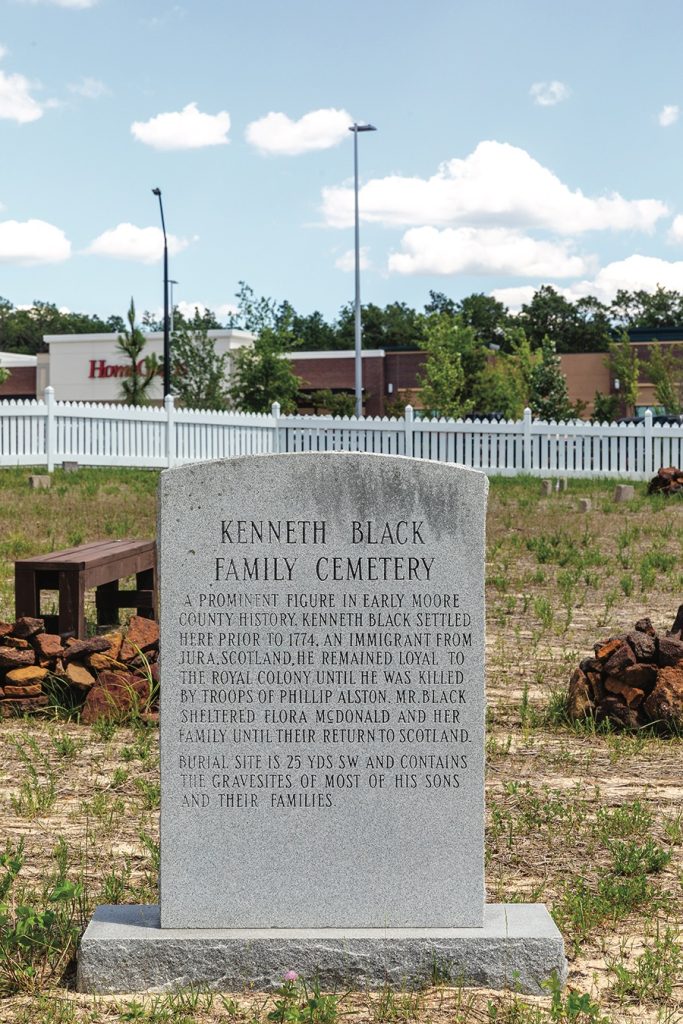
“The work by MCHA and the Black family descendants to maintain the cemetery shows that people sill care about history. Today, too many people don’t care,” Brown said. In 2020 a development plan by Mid-Atlantic Properties for the 100-acre site that included the cemetery was approved contingent on the cemetery’s preservation. According to MCHA, “GPS recordings of the gravestones and rock walls were recorded and then the objects placed in storage. Approximately 17 feet of soil was then placed over the cemetery as part of the grading process. The stones were then returned to the GPS recorded locations. A sturdy white picket fence was erected around the cemetery, and a pair of brick columns were constructed to mark two entrances of paved walkways to the cemetery.”
MCHA also helped preserve the House in the Horseshoe itself by acquiring it in the 1950s from a private owner and restoring the house to close to its original condition. MCHA subsequently conveyed the property to the state of North Carolina. The state’s Department of Natural and Cultural Resources welcomes thousands of visitors annually who examine numerous bullet holes still visible from the desperate fight that took place 244 years ago. The site’s low-key operation, coupled with its splendid, isolated setting, do much to help a visitor visualize the time when a courageous woman emerged from the House in the Horseshoe to confront hostile attackers long ago.