

THE PERFECT MATCH
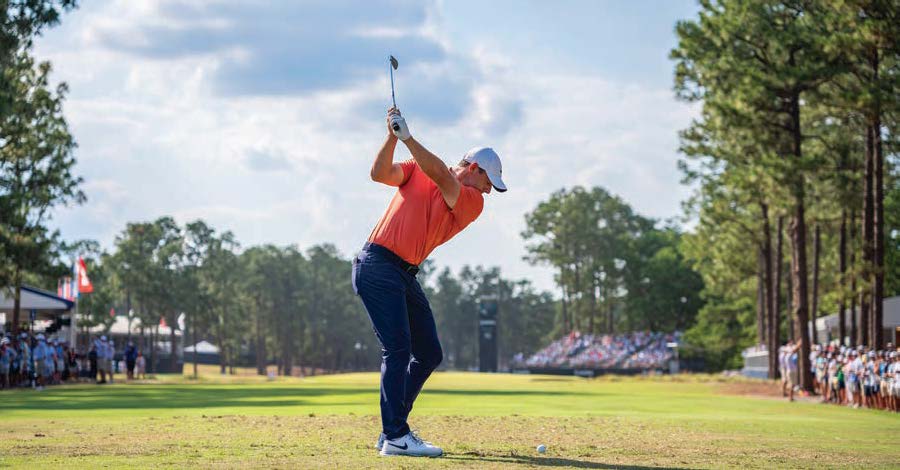
The Perfect Match
Rory McIlroy and the Quail Hollow Club
By Ron Green Jr. • Photograph by Mogie Adamchik
It has been 15 years since that electric Sunday afternoon at Quail Hollow Club when Rory McIlroy formally introduced himself to the American golf society.
McIlroy was still two days shy of his 21st birthday, and he was one hour removed from having played a round for the ages. Not only had McIlroy won the Quail Hollow Championship for his first PGA Tour victory, he had done so by shooting a closing 10-under par 62 that crackled with a Zeus-like thunder.
By finishing with six consecutive threes on his scorecard, the last one a 40-foot birdie putt that had McIlroy punching the air as his curls danced around the edges of his cap, the game’s new star had arrived trailing sparks.
In the quiet of the Quail Hollow locker room after a Champagne toast with members, McIlroy stood between two rows of lockers, talking to his parents on the phone, the impending magnitude of his performance still settling over everyone.
The Earth was moving.
Television commentator David Feherty, a native of Northern Ireland like McIlroy, had walked the finishing stretch with the winner and said as he left the 18th green, “That’s the most impressive thing I’ve seen in a very, very long time.”
So it began, at least here in the United States, a golf story midway through its second decade that is painted in primary colors and piercing emotions.
This month McIlroy returns to Quail Hollow Club, where he is a member, and where he has won the annual PGA Tour event four times. This visit is different. Oh, so different. It’s the year’s second major, the PGA Championship, being played at a spot McIlroy has more than once called “one of my favorite places on Earth.” And now he’s got a green jacket hanging in his closet after winning the Masters in a sudden-death playoff over Justin Rose, ending a nearly 11 year drought since his last major championship victory and making him just the sixth player to complete the career Grand Slam, joining Gene Sarazen, Jack Nicklaus, Gary Player, Ben Hogan and Tiger Woods.
Fourteen years after losing a 4-stroke lead in the final round of the Masters, McIlroy’s victory sent him to his knees sobbing in relief and resonating throughout the golf world.
“It’s the best day of my golfing life,” said McIlroy, who had too much practice explaining his near-miss losses in major championships. “I’m very proud of myself. I’m proud of never giving up. I’m proud of how I kept coming back and dusting myself off and not letting the disappointments really get to me. Talking about that eternal optimist again. Yeah, very proud.”
When asked late last year if he knew where the 2025 PGA Championship would be played, McIlroy answered, “Quail Hollow Club in Charlotte, North Carolina, and I cannot wait.”
Such is the tie that binds McIlroy to Charlotte — and, by extension, North Carolina — though his last competitive start in the Tar Heel State ended with one of the most emotionally devastating losses in his career, his runner-up finish to Bryson DeChambeau in the 2024 U.S. Open at Pinehurst No. 2.
“It was a great day until it wasn’t,” McIlroy would say later.
McIlroy led by two strokes with five holes remaining and left brokenhearted, haunted by short misses on the 16th and 18th greens when it appeared he would end a decade-long drought in the majors. Instead, McIlroy drove away alone and silent and, while DeChambeau celebrated his victory, there was a bittersweetness in the summer air at Pinehurst that McIlroy, so beloved and so close, had been denied again.
As Tiger Woods stepped back and Phil Mickelson stepped away, McIlroy has grown into, arguably, golf’s biggest star. Part of it is the majesty of his skills, a mesmerizing blend of power and panache. Another part, the one that may define McIlroy, is the charismatic connection that has been forged in the fire of soaring successes and aching disappointments.
McIlroy has won 29 PGA Tour events, including five major championships and two Players Championships, and there are still questions about the ones that got away. He is judged against an almost impossibly high bar, one he set for himself with his own brilliance, and it comes with an emotional attachment from his fans that runs deeper than anyone else in the game.
McIlroy is charismatic, vulnerable, magnetic, thoughtful, battle scarred, curious, sharing and generous. Fans don’t just watch McIlroy play, they sign on for the ride, investing in him because he has so often returned that investment, whether with his thank-yous, his outspokenness or his natural charm.
Think of McIlroy and a library of images comes forward.
There he is hugging his father, Gerry, after his 8-stroke victory in the 2011 U.S. Open at Congressional Country Club, barely two months removed from his final round collapse at the Masters.
A year later, laying his head back and letting the ocean breeze blow across him, he walked the final hole of another 8-stroke victory at the 2012 PGA Championship at Kiawah Island.
Then, in a sweet and touching moment, handing the Claret Jug to his mother, Rosie, after winning the 2014 Open Championship at Royal Liverpool.
There he is hoisting the FedEx Cup trophy in 2016 and 2019 and again in 2022.
Side by side, there’s McIlroy in tears after a gutting performance in a Ryder Cup loss at Whistling Straits in 2021, and another of him showering his European teammates in Champagne after wins in 2018 and 2023.
Walking stoically up the 18th fairway at the Old Course in 2022 after failing to make a birdie in the final round of the Open Championship, knowing he had the Claret Jug in his grasp again until he didn’t.
Had any of us been there to see it, there was McIlroy alone in New York City after his U.S. Open loss at Pinehurst, quietly walking The High Line for what he called a reset, “finding the joy in the small things in life.”
And now, having shed the awesome burden of time, there he is finding tears and joy, kneeling on the 18th green at Augusta National.
As golf has been torn apart by the battle between the PGA Tour and LIV Golf in recent years, McIlroy has often been at the nexus of the fiery debate about what is right and wrong, good and bad, possible and unacceptable. He wanted to be part of the solution, understanding that the PGA Tour’s money-heavy response to LIV Golf’s excesses benefited him as much as anyone. McIlroy was sharply critical of LIV’s approach, and his press conferences often became touchstones for how the establishment (meaning the PGA Tour) viewed what was happening.
Gradually, McIlroy tempered his stance, and while he vowed his lifetime allegiance to the PGA Tour, he sought harmony even as his role in the behind the scenes discussions diminished. His goal, it seemed, was to find the greater good, and he said as much.
“I have always said I will answer questions honestly. I don’t want to change that about myself. I think people appreciate that about me,” McIlroy said.
The day after McIlroy won the 2010 Wachovia Championship, I walked into the Charlotte Observer office, and more than one person asked who the kid was who won the golf tournament on Sunday.
“Probably the next great one,” I told them, not because I have a particular eye for talent, but seeing McIlroy in that moment pulled back the curtain on the future. “One of these days, you will remember he won his first one at Quail Hollow.”
With the return of the PGA Championship — it was played there in 2017 — the inevitable question arises: Can Rory still win majors in bunches, as he did to close out the 2014 season? Perhaps for an answer he can look to Sarazen, the first golfer to complete the career slam before there even was such a thing — when Sarazen won the Masters in 1935 the tournament was little more than an infant. McIlroy allowed nearly 11 years to roll past between major titles. Sarazen won three majors in 1922-23 and suffered a nine-year drought until he won four more from 1932-35, the last coming in Augusta. Can the newest member of the career Grand Slam club equal the fortunes of the first?
Here we are, 15 years after McIlroy’s first triumph in America. There are flecks of gray in his hair, but the boyishness remains, tempered only slightly by the years and the demands.
After winning his second Players Championship in March, McIlroy was asked if he still connects with his inner child when he wins.
That familiar smile crossed his face.
“Ten-year old Rory would think this is really, really cool,” he said.
He’s not the only one.