

THE HUNT FOR THE GUV
The Hunt for the Guv
Caught between a rock and a lost place
By Jim Moriarty
As it turns out, what you really need in the search for a forgotten grave in the woods is an archivist. As luck would have it, I sleep with one.
Ordinarily this woman’s field of expertise is confined mostly to the history of Pinehurst and a cast of characters whose final resting places are widely known. But when you’re looking for a spot last viewed — to the best of our knowledge — 50 years ago, marked only with a fieldstone, you need all the help you can get.
The grave we were seeking belongs to Marble Nash Taylor, a man who was the governor of North Carolina — or posed as the governor of North Carolina — from sometime in early November 1861 until Abraham Lincoln appointed Edward Stanly the military governor of the state on May 27, 1862. Taylor was the Methodist minister at the humble wooden church on Hatteras Island — the old building is long since gone — when he more or less elevated himself to this lofty post in the wake of the successful amphibious landing of Federal troops there on August 28, 1861. In rather short order, the Union Army spread its dominion over all of the Outer Banks.
Following the appearance of the troops, a “constitutional convention” — accompanied by flowery declarations covering perceived injustices of every imaginable sort — was spearheaded by three men, most notably, Rev. Taylor and his chief ally, Charles Henry Foster, a lawyer and journalist. Taylor is sometimes apocryphally referred to as the man who was governor “for a day,” though his term of office, clearly, was rather more prolonged. This did not happen through the kind graces of the Great Emancipator in Washington, D.C., who wanted absolutely nothing whatsoever to do with either Taylor or Foster.
Finding the general area where the reverend’s earthly remains reside was deceptively simple. In the book A Guide to Moore County Cemeteries, compiled by Anthony F. Parker and published by the Moore County Historical Association, the author gives detailed instructions: down such-and-such county road for 1.2 miles; take the “woods” road 3/10 of a mile to a clearing; walk the fire break north for 150 yards; the site is 100 yards east on top of the highest hill, marked at the time with two wooden knots. Parker was led to the grave in 1975 by Moses Jackson, who hunted the land and knew the location well. Before leaving the spot, Parker marked it with a simple fieldstone.
Of course, the problem with 50-year-old directions to a lonely place in the woods is that, well, they’re 50 years old, and the woods haven’t stopped growing.
The first thing I thought of was to call someone in the North Carolina Forestry Service’s Moore County office. There was an old, no longer in-service fire tower where the county road intersected the main highway, roughly 1.2 miles and this and that from Marble Nash Taylor’s grave. Maybe, just maybe, someone there would know of a modern day Moses Jackson who could be my sherpa.
The laughter at the other end of the line when I spoke with a gentleman at the Forest Service was, if not audible, palpable. It was summer. It was hot. We were in drought conditions, and he seemed rather more concerned with wildfires than dead governors, which is how I came to rely on the services of my resident archivist.
I ordered a pair of orange Day-Glo high visibility reflector vests. If we were going to go traipsing around in the woods in northern Moore County it made a certain amount of sense to take whatever precautions seemed prudent to avoid getting shot. We had little trouble finding the “woods” road off the county road, and we drove to the end of it, where there was a gathering of modest dwellings. At the home closest to where we thought we might find the good reverend, I knocked timidly on the door. No response. I turned to leave. The archivist, whose Day-Glo vest hung on her like a shiny minidress at a disco party, was not nearly so faint of heart. Her pounding could have raised the dead all by itself.
A delightful and friendly, if somewhat perplexed, lady came to the door. The archivist produced an official-looking business card. The house’s occupants knew nothing of Marble Nash Taylor or his remains; however, they did allow as how we could park our car in their yard while we searched. The archivist and I walked back up the hill toward its highest point.
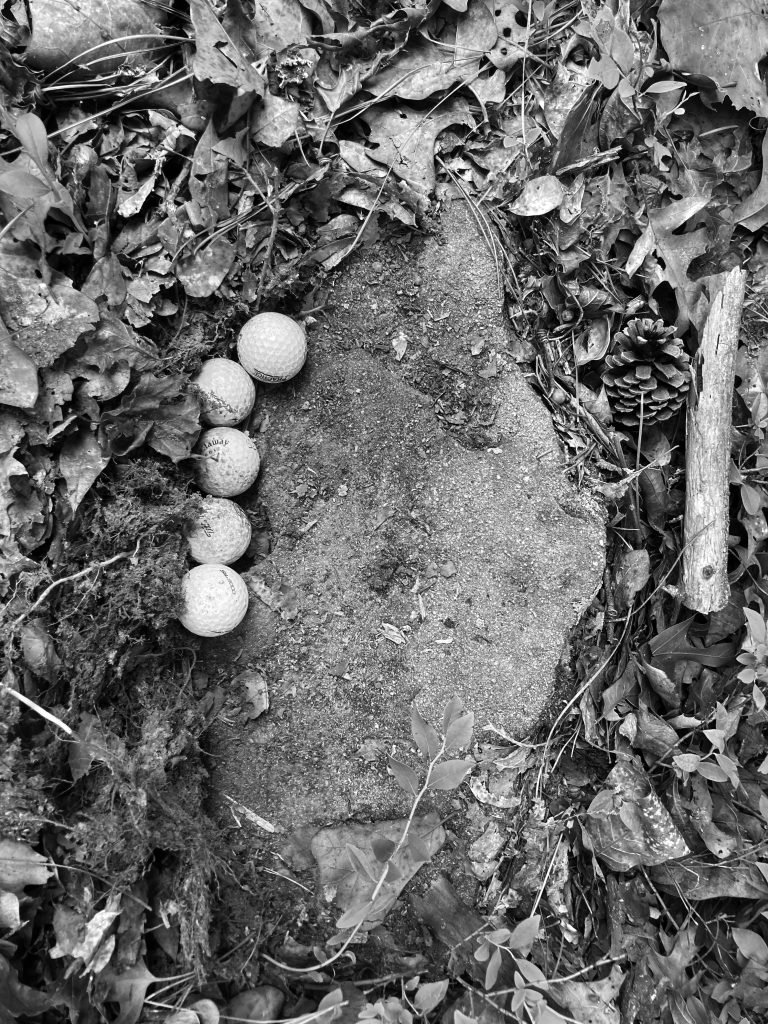
The wide fire break described by Parker in his book survives with modern power lines running through it. Someone had been using this long cleared strip as sort of a rural Topgolf, providing a narrow chute to practice power fades, though judging from the age and condition of the golf balls we found, whoever it was hadn’t been working on their game much lately. Several of the balls bore the markings of Forest Creek Golf Club. Certainly the “forest” part fit.
If the fire break still existed 50 years on, the clearing didn’t, so the archivist and I split up, slashing our way through overgrowth in what we believed to be the general area of the governor’s grave. As densely wooded as it was, one thing that it was not was rocky. You couldn’t find so much as a pebble, much less a fieldstone, in this patch of the Sandhills.
Scratched by tree branches and dripping sweat, with my patience running thinner than the governor’s resume, I was ready to abandon our search. My mind began wandering to lunch at the Pinehurst Brewery and rehydrating with an 1895 lager when the archivist called out. She’d found a very large rock indeed. The truth is, we could have combed those woods for days and would have been more likely to find a marble sculpture by Donatello than another stone like it. Without hesitation, I proclaimed this large, flat rock none other than the fieldstone marking the grave of Marble Nash Taylor, governor of the great state of North Carolina, or at least the Outer Banks.
So how, you may ask, did the right Rev. Taylor wind up in Moore County anyway? The truth is, there is more lore than there are facts. Though Taylor’s public duties, such as they were, never actually required him to leave the Outer Banks — he did make one fundraising trip north — his associate Foster did, in fact, travel to Washington, D.C., and attempt to be seated as a representative of North Carolina’s second district. He was laughed off the floor of the House of Representatives. In a letter to Lincoln’s Treasury Secretary Salmon P. Chase, one person described Foster as “an unprincipled scamp and cheat.” In March 1862, a journalist from Boston traveled to Hatteras, where he found Taylor who, by then, had more or less gone back to being nothing loftier than a Methodist minister.
This did not, however, prevent others from voicing their disapproval of the ersatz governor. The Richmond Dispatch, reprinted this from the Norfolk Day Book:
“Marble Nash Taylor is one of the most despicable of the human family — hated alike by God and man, and for the reason that he employs the garb of religion to cover the rottenness of his depraved and corrupt heart. So pious did this treacherous hypocrite become at one time, that nothing would do but that he must preach the gospel. . . .He was found to be a black-hearted hypocrite who desecrated the name and character of the minister of God, and he was speedily ousted from the Conference, and his license to preach taken away from him. (According to the State Archives of North Carolina Taylor is mentioned in the minutes of the Dec. 6, 1861 meeting of the Methodist Episcopal Conference, presumably not in a flattering way.) . . . This is the scamp who dares to issue a proclamation to the people of that good old State, calling upon them to become as base and perfidious as himself.”
Though it seems that Taylor stayed on Hatteras Island preaching the good word until the end of the Civil War, during Reconstruction he was appointed “keeper of the poor house” in Fayetteville, where he stayed for roughly 15 years. Sometime around 1880 he moved to Moore County, where he sold peach trees and lived in a shack constructed of the castoffs from a sawmill. He died in 1894, remembered as a “dour” man who was addressed as “governor” right up to the end.