

SURVIVAL OF THE TRICKIEST
Survival of the Trickiest
There is more than meets the eye in mother nature
Story and Photographs by Todd Pusser
Spending the better part of the morning cleaning up limbs and pinecones left over from the previous night’s storm, I slowly make my way around our suburban yard. Ominous clouds finally give way to bright blue sky and a blazing August sun. Near the brick steps leading up to the front door, I pause. At the top of a waist-high spicebush, a single curled leaf, nestled among a bouquet of more “normal-looking” straight leaves, catches my eye. My pulse quickens.
Over the past few years, I have made a concerted effort to replace the ornamental shrubs and non-native flowers that line our walkway with more wildlife-friendly native plants. It’s been a slow process, but the obvious increase in pollinators in the yard, in the form of bees, moths and butterflies, has shown that the work is starting to pay dividends.
A small shrub native to eastern North America, spicebush produces abundant red berries throughout summer and fall that the local birds love. Named for its aromatic leaves, which smell like citrus and allspice, spicebush also attracts the attention of one very special butterfly, the aptly named spicebush swallowtail. These black, palm-sized butterflies lay their eggs on the shrub’s fragrant leaves. Upon hatching, the caterpillar larvae munch the spicebush leaves (their primary food resource) with gusto, much in the same way I tear into a bag of barbecue potato chips.
I have monitored the spicebush every day since I planted it two years ago. Noticing the curled leaf, a telltale sign of an enclosed caterpillar, it looks like I have finally lured in a customer.
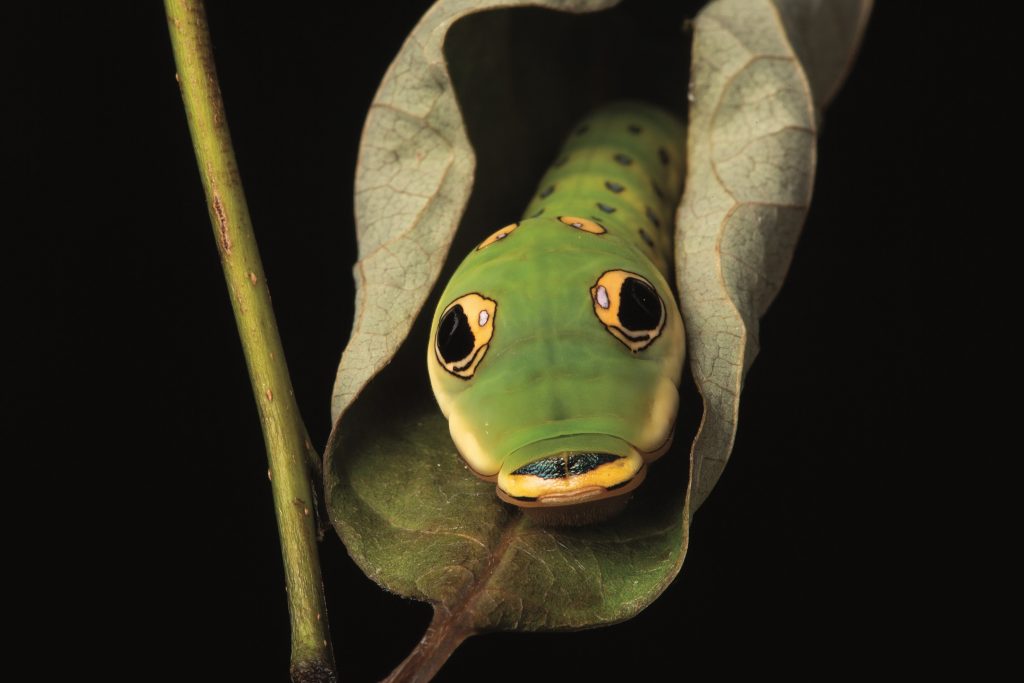
Like a kid on Christmas morning, eager with anticipation, I bend over and slowly unfurl the edges of the leaf, revealing a half-inch-long caterpillar. Immediately, two large yellow eyespots on its head grab my attention. Despite knowing what to expect, it is still a bit startling. Imagine how a hungry bird, like a cardinal, might respond.
You see, this special caterpillar is a snake mimic, and a darn good one at that. Its false eyes come complete with large black pupils. There is even a tiny white spot, a “catchlight” in each, which only adds to the illusion. Throughout the day, the caterpillar remains in its shelter, with the edges of the leaf pulled around its body, always with its head pointed up toward the tip of the leaf. That way, if a foraging bird were to encounter it, the first thing it would see would be the “face” of the snake.
For most of my life, I have been battling the misconception that one has to travel to far off tropical islands and jungles to find wild wonders. As a child, fed on a steady diet of television shows like The Undersea World of Jacques Cousteau and Mutual of Omaha’s Wild Kingdom, I could not wait to escape the confines of little ol’ Eagle Springs and explore the world. Now in my 50s and burdened by the usual hurriedness and complexities of adult life, I have to constantly remind myself that there are marvels to be found close to home. Discovering something like a caterpillar that mimics a snake right outside the front door never fails to illicit that childlike wonder of a world filled with infinite possibilities.


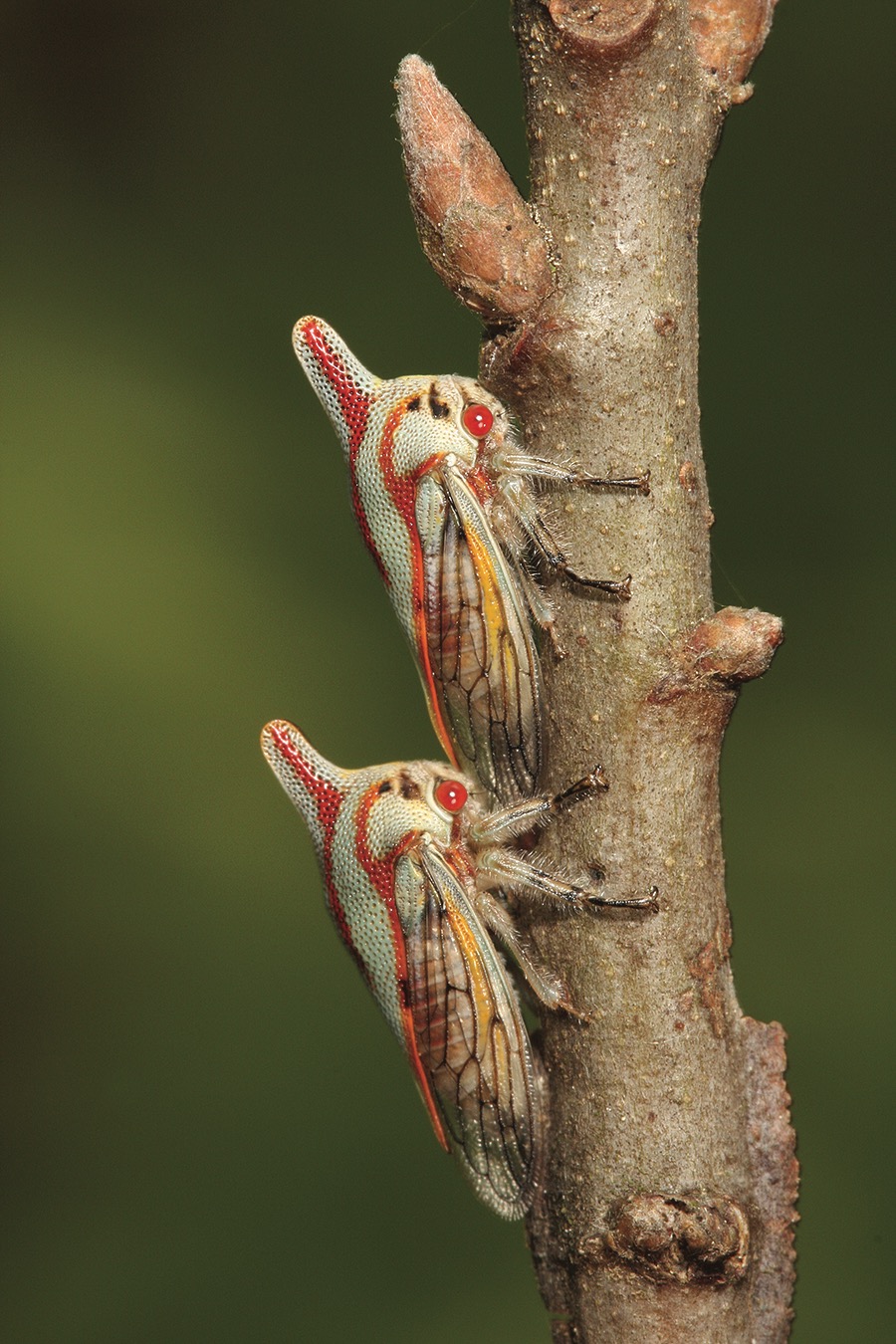


The drama between life and death plays out every second of every day across every nook and cranny of the wild. It’s an eat-or-be-eaten world out there. To gain a level of advantage, countless organisms utilize deception in their never-ending bid to stay alive. Camouflage and mimicry are the templates for survival. Optical illusions abound.
Take caterpillars, for instance. As they grow, all species shed their skins many times before pupating into a butterfly or moth. Biologists refer to each of these skin-shedding molts as instars. Caterpillars are packed with protein and many animals love to eat them, especially birds. One study found that a single clutch of young chickadees can consume up to 6,000 caterpillars before they fledge.
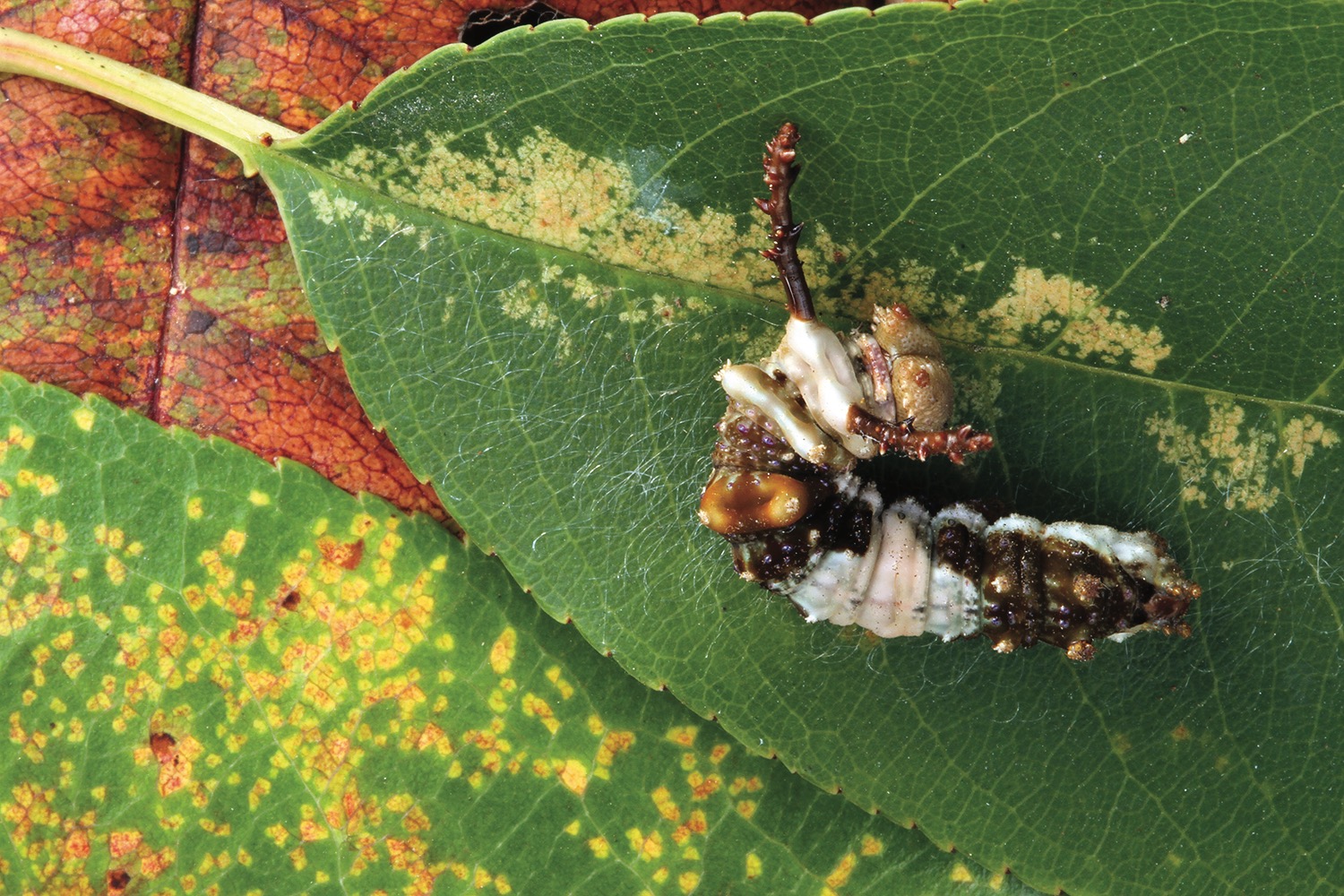
To avoid becoming a meal, caterpillars resort to all manner of trickery throughout different stages of their life cycles. Many resemble tree bark; others, twigs. Some look like lichen. A few possess vicious-looking armaments to deter would-be predators. A hickory horned devil, the largest caterpillar in North America, sports a pair of huge horns on its head. When disturbed, the devil thrashes its head violently from side to side, slamming its horns into its aggressor. Though intimidating, the hot dog-sized caterpillar is completely harmless. The snake-mimicking spicebush swallowtail caterpillar, mentioned earlier, is an even more surprising trickster in an early instar form, when its mottled black and white coloration resembles an unappetizing splatter of bird poop.
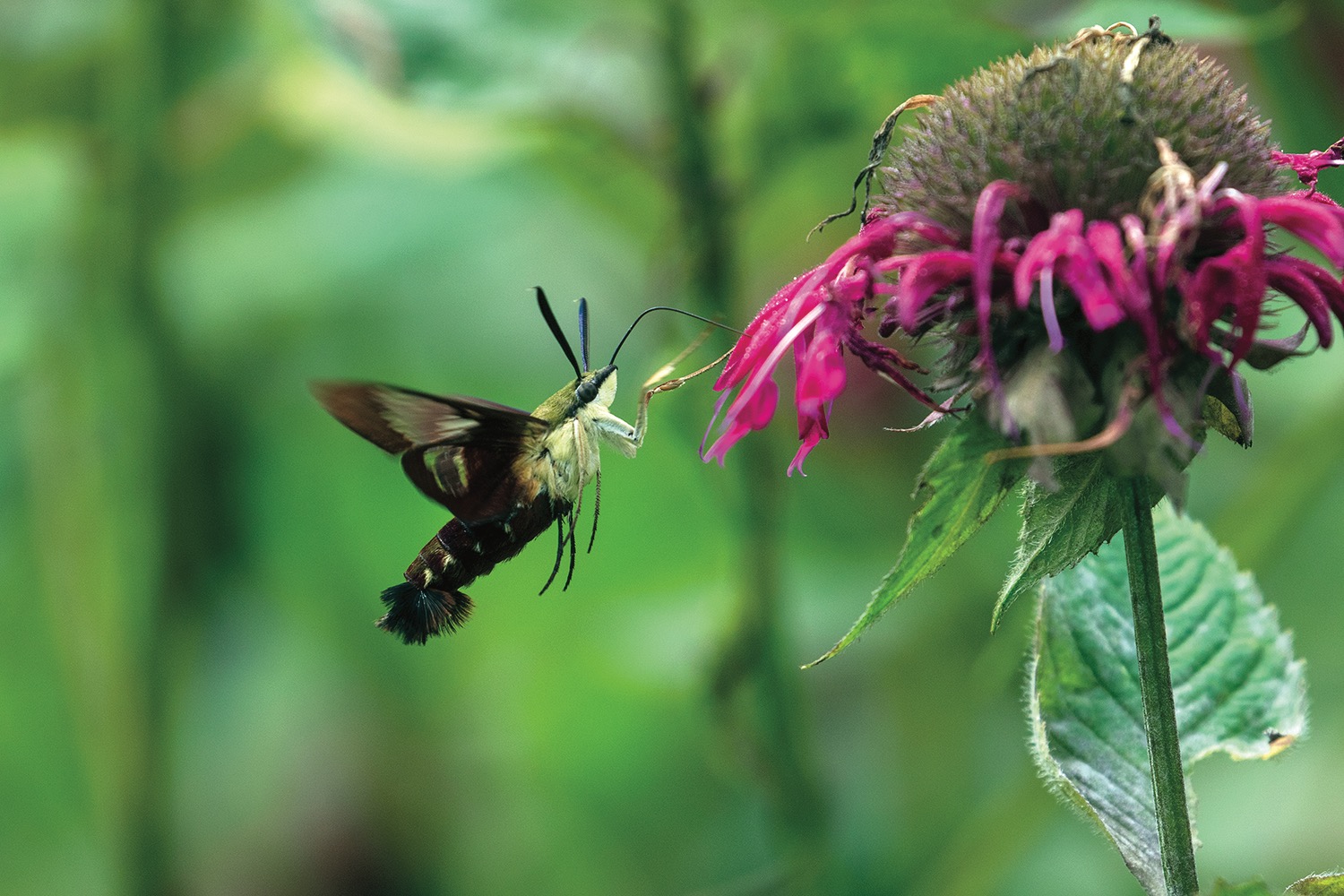
All caterpillars eventually metamorphose into butterflies and moths. And like their pupa, these winged wonders are relentlessly pursued by predators. As such, many of our native butterflies and moths rely on camouflage and mimicry to avoid becoming an easy meal.
Last summer, while walking along the edge of my parents’ Eagle Spring’s yard, I paused to look at a wasp perched atop a grapevine leaf. Underappreciated and loathed animals, such as wasps, hold a special place in my heart, and I cautiously stepped closer to examine the brightly colored insect in more detail. I realized something was a little off. For one thing, it had clear wings. Most wasp wings are opaque or dark. It also had a pair of bushy antennae and a wide waist — very unwasplike. Finally, I noticed that hairy tufts extended out from the tip of its abdomen instead of a stinger. It suddenly dawned on me. I was not looking at a paper wasp at all, but rather a day-flying moth known as a graperoot borer. Its disguise was on point.
Many insects, especially flies, beetles and moths, mimic stinging bees and wasps. Defenseless organisms that mimic dangerous ones employ an evolutionary survival strategy that biologists refer to as Batesian mimicry. Named for the Victorian naturalist Henry Walter Bates, who first described the phenomena in the humid jungles of the Amazon, this form of mimicry is surprisingly common and is not limited to insects.
Here in the Sandhills of North Carolina, the secretive and beautiful scarlet kingsnake is a dead ringer (pun fully intended) for the venomous coral snake. Both snakes possess alternating colorful bands of red, yellow/white and black and can be hard to tell apart. I still recall a little rhyme taught by Larry Dull, my sixth-grade science teacher at West End Elementary, to help distinguish between the two. “If red touches black, that’s a friend of Jack’s. If red touches yellow, it will kill a fellow.”
Several years back, while walking along the edge of Drowning Creek on my great-grandfather’s farm, I almost had a heart attack. While I was casually stepping over a fallen tree on a spring afternoon, a wild turkey suddenly flew out from underneath my feet. The sound and commotion of a 12-pound bird, with a 5-foot wingspan, launching into the air right in front my face, was startling to say the least. It got my attention. My cholesterol levels instantly bottomed out. Thoroughly shaken, I had to sit down on the log for several minutes and compose myself.
Turns out, I had flushed a hen off her nest. On the ground, next to the fallen tree, were a dozen large white eggs nestled in the leaf litter. How I failed to see such a large bird, sitting there at close range, still baffles me. Her muted brown, grey and black feathers blended in seamlessly with the highlights and shadows of the forest floor on that bright sunny day.
In 1890, a British zoologist named Sir Edward Poulton wrote the first book about camouflage in nature. Poulton, an ardent supporter of Charles Darwin, wrote that camouflage and mimicry in the wild was proof of natural selection. Not long after, an American painter, Abbott Thayer, expanded on Poulton’s ideas and began creating photographs and pieces of camouflage art using countershading and disruptive coloration, culminating in his own 1909 book, Concealing Coloration in the Animal Kingdom. Thayer’s illustrations, showing how objects could “disappear” into the background when they were painted in such a way as to cancel out their shadow, became quite popular and soon attracted the attention of the military. By World War I, armies around the globe were incorporating camouflage into equipment and the uniforms of their soldiers. Long gone were the days of Paul Revere and the brightly attired Redcoats.
Camouflage has even become fashionable. Most popular clothing brands offer an array of camo products, everything from hats to wedding dresses, and shoes to underwear (though I am not entirely sure as to what purpose the latter serves). Even luxury lines like Louis Vuitton have jumped in.
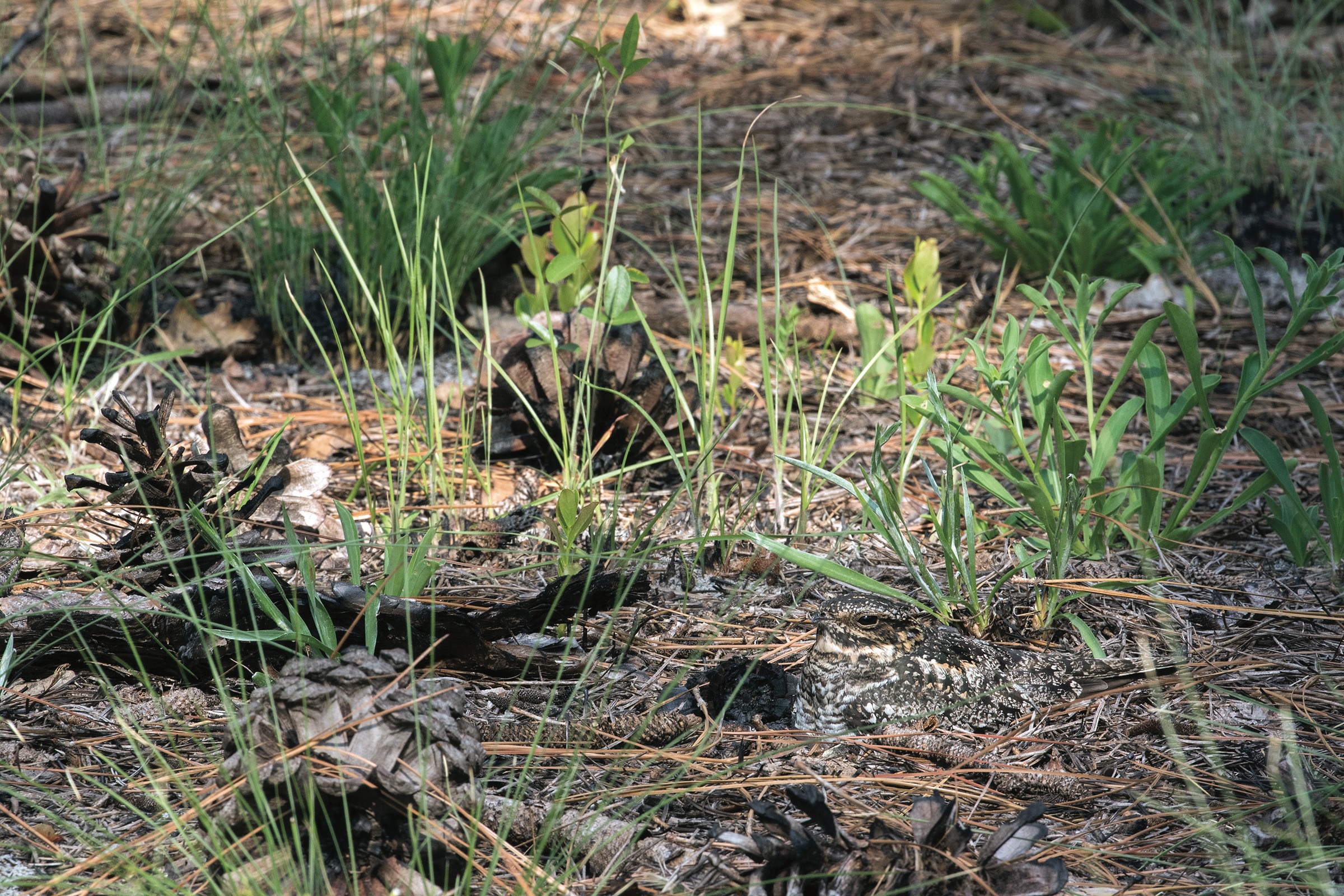
Of course, all of this fashion is modeled after animals in the wild and few wear camouflage as well as the nightjars. These ground-nesting birds, of which there are roughly 98 species recognized worldwide, are the masters of cryptic coloration. In the North Carolina Sandhills, three species are found: the common nighthawk, the chuck-will’s widow, and the whip-poor-will. Each year, I celebrate the first nocturnal calls I hear of the whip-poor-will (usually heard around Eagle Springs in late March) as the harbingers of spring and warmer days ahead.
Nightjars are extremely difficult to find due to their cryptic camouflage. As a result, I have very few photographs of them in the wild. Recently, I received a tip from a local biologist about a nesting common nighthawk on the Sandhills Gamelands. He gave me a GPS point and noted that the bird could be found between two small turkey oaks flagged with bright pink tape.
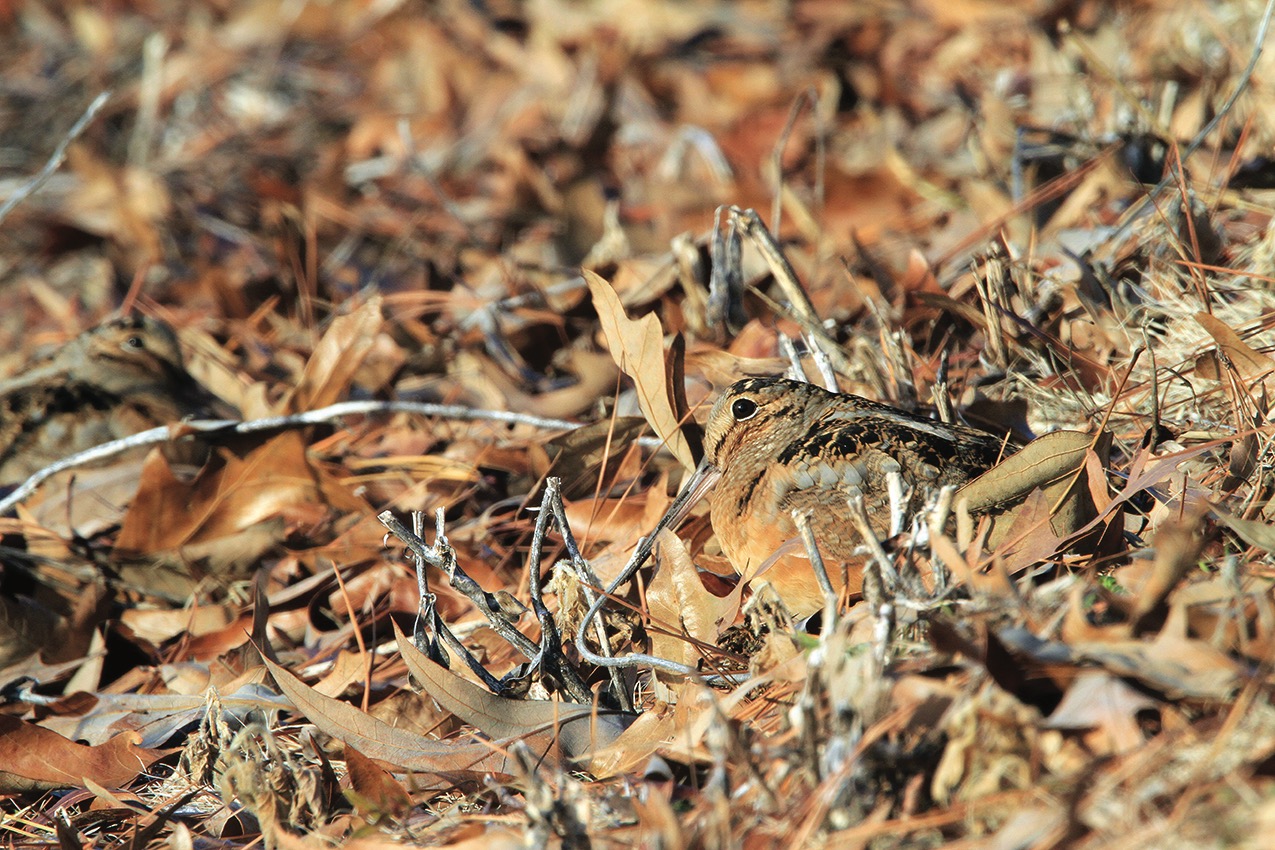
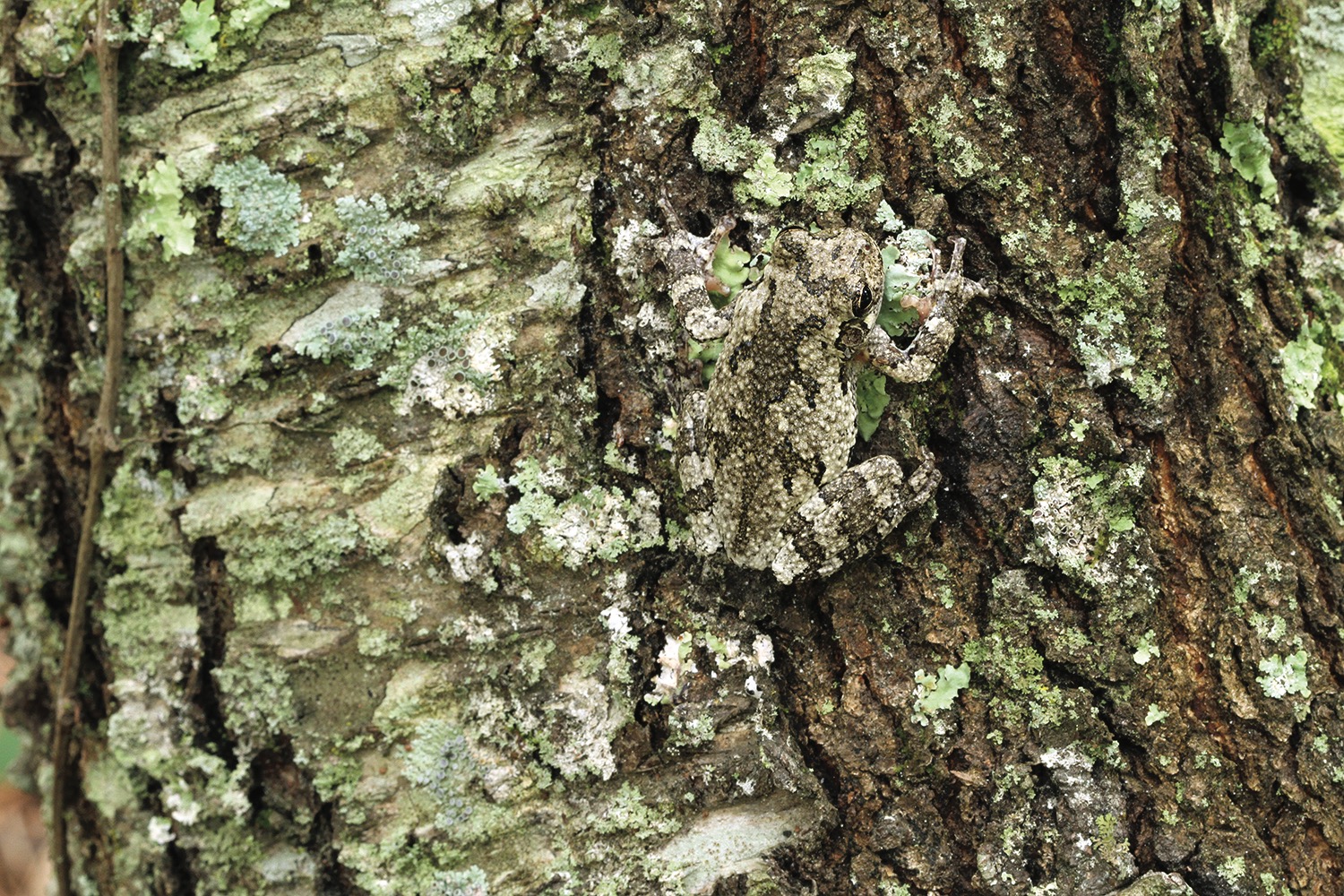


With that information in hand, I ventured out onto the dirt roads of the Gamelands in early June with hopes of obtaining a few images of the secretive bird. Being extremely careful not to disturb the nesting nighthawk, I slowly approached the GPS point and stood back at a distance of over 10 yards when I saw the bright pink flags up ahead. Raising binoculars to my eyes, I slowly scanned the ground between the two turkey oaks trying to locate the bird. Remember those “Magic Eye” paintings that were so popular in the ’90s? It took several minutes of intently staring at the leaves on the ground before I had the “aha” moment of finally seeing the bird.
The thrill of discovering animals hidden in plain sight never gets old. I still recall with great fondness hiking through the woods one spring day and stumbling upon a young white-tailed deer fawn, curled up tightly on the forest floor beneath a canopy of cinnamon ferns, the white spots on its back allowing the hapless mammal to blend in seamlessly with its background.
Then there was the time I saw an American bittern fly up from the side of the road in the Outer Banks and land in a nearby patch of marsh, where it stood perfectly still with its head pointed to the sky. Its mottled brown plumage perfectly matched the surrounding spartina grass.
One winter, years ago, a Pinehurst resident pointed me to a tree where an Eastern screech owl could be seen basking daily in an open cavity about 20 feet off the ground. Even now, looking at the photos of that owl, it is hard to tell the difference between the owl’s grey feathers and the bark of the tree.
When camouflage fails, some animals will resort to the ultimate form of trickery, mimicking death. The term “playing possum” comes from the behavior of the Virginia opossum, North America’s only native marsupial, which feigns death when threatened by predators. As it turns out, a number of our native animals will resort to that tactic as a last resort. Perhaps the most famous “death actor” is the eastern hognose snake. When confronted by a threat, this robust, 3-foot long serpent, with a distinctive upturned snout, puts on a performance that would make members of Hollywood’s Screen Actors Guild envious.
One of my most memorable encounters with an eastern hognose snake happened years ago near West End. One summer afternoon, a family friend phoned to tell me that she had just found a copperhead in the yard. She asked if I could come over, catch the snake and move it to safe spot (i.e., somewhere far away from her). Surprised, and impressed that she did not want to kill the snake, I hurried over. As I said before, I am a sucker for loathed animals.
When I arrived, I saw my friend standing in her front yard pointing to a small snake coiled tightly several feet away. A neighbor, whom she had called in a panic before dialing me, was standing close by with a shovel in hand. Walking over, I instantly realized it was not a venomous copperhead but a harmless eastern hognose snake. My friend nearly fainted when I casually reached down to pick it up. Her face completely drained of color when the snake began to violently thrash about in my hands. It was only then that I informed her the snake was completely harmless and placed it back down on the ground. There, it continued to writhe back and forth, as if in pain, rapidly throwing coils up over its head. Then it proceeded to defecate all over itself. Finally, the snake lay perfectly still, belly up and mouth agape, its tongue sticking out.
Of course, it wasn’t physically harmed in any way. It simply wanted to make itself appear unappetizing. An especially nice touch, I thought, was covering itself with its own poop.
How these death-feigning tactics evolved over eons of time simply boggles the mind. It certainly threw my friend for a loop. I reached down and slowly turned the snake right-side up. Immediately, it flipped back over onto its back, presenting itself once again as the quintessential dead snake. I smiled. Charles Darwin would have been proud.