Simple Life

SIMPLE LIFE

A Spring Awakening

And a journey from darkness to light

By Jim Dodson

I celebrate April’s return every year because it’s the month that a divine awakening changed my life.

It was 1980. I was the senior writer of Atlanta Weekly, the Sunday magazine of the Journal-Constitution, the oldest newspaper magazine in the nation. It was probably the best writing gig in the South. Over the previous three years, I’d covered everything from presidential politics to murders in the “City Too Busy to Hate,” as Atlanta liked to promote itself in those days.

One minute I was interviewing a grand dragon of the Ku Klux Klan in Alabama, the next riding along with the Repo King of Atlanta as he repossessed cars in the city’s most dangerous federal housing project, a shotgun on the seat of his truck. I’d also written several pieces about young women from the South who were drawn to Atlanta’s bright lights only to wind up murdered or missing.

Looking back, though I didn’t realize it then, I was in search of an answer to a question that had no answer.

Three years before I snagged that job, Kristin, my girlfriend back home in North Carolina, was murdered in a botched holdup by three teenage boys at a Hickory steakhouse where she worked as the weekend hostess. I’d left Kristin on a beautiful October Sunday after making plans to get married and move with her to England, where she had a job as an understudy awaiting her in London’s West End.

The low point of my Atlanta odyssey came on a hot July night in 1979. I was working on a cover story about Bob Stivers, the city’s famous medical examiner, whose forensic sleuthing reportedly inspired the popular TV show Quincy. The week before that Saturday night, I’d watched half a dozen autopsies at the ME’s elbow, equally mesmerized and horrified. When Stivers invited me to ride along with the squad that picked up murder victims, I jumped at the chance. Saturday nights were particularly busy in the city that had recently been declared America’s “Murder Capital.”

My new fiancée, Hank Phillippi, was the nighttime weekend anchor at WSB-TV. We shared an old, brick house near the east-side entrance to Piedmont Park. Our weekend routine was to have a glass of wine and watch Saturday Night Live when Hank got home from the studio before midnight.  

On that fateful night, waiting for a call from Bob Stivers’ death crew, as I was standing in the darkness of our backyard, waiting for my dog, Magee, to do her business, I saw a car pull up beside our neighbor’s house. We were friendly with the Emory med students who lived there.

As I watched, a man emerged from the backseat of the car and calmly walked to our neighbor’s backdoor and knocked. A med student still in scrubs opened the door. There was a brief exchange of words, followed by two gunshots. The medical student collapsed on the ground. The assailant bolted for the running car, which sped away.

By the time I reached his side, a young woman from the house was screaming hysterically. I asked her to fetch me a couple towels and call 911.

Fortunately, at that moment, Hank arrived home. She took charge and phoned the police as I cradled the wounded man in my lap, attempting to keep him conscious. He died 15 minutes before cops arrived. “We get drug hits like this every weekend,” the cop said.

I chose not to follow the victim’s body down to the city morgue.

The next morning, though, as I was walking Magee, I heard a chapel bell in the distance softly chiming “Blessed Be the Tie That Binds,” one of my favorite hymns since childhood. Tears filled my eyes.

As Hank slept in, I fetched a cup of coffee, sat on our front steps taking stock of my life, and suddenly realized what was missing. I hadn’t been to church in five years.

I got dressed and went to services at the historic All Saints’ Episcopal Church downtown, famous for feeding the homeless and never locking its front doors. The rector, a wonderful man named Harry Pritchett, gave a powerful sermon about how God finds us in the darkness when we least expect it. It felt like he — or maybe God himself — was speaking directly to me.

Not only did I begin attending All Saints’ regularly, but also made a decision in favor of writing stories that enriched life rather than revealed its dark side. I even set my mind on attending seminary, until a wise old Bishop from Alabama named Bill Stough, the editor of the Bishop’s Fund for World Relief, convinced me to follow a “ministry closer to your heart,” as he put it. “You are a born writer,” he said. “You can serve the Lord better by writing about life than becoming a parish priest.”

Not long after that harrowing summer night, Hank and I called off our engagement, but have remained dear friends for more than 45 years.

As for me, that following April while working on a sample story about youth baseball tryouts, I ventured over to a rundown ball field in my midtown neighborhood, where a desperate league director convinced me to take on the coach-less Orioles. They were a wild bunch, many of whom lived in Federal housing. This was during the peak days of the “Missing and Murdered” crisis affecting Atlanta’s Black teens. I made a deal with my team’s families to drive them home after all games and practices.

I also made a deal with my rambunctious “Birds”: If they played hard and behaved like gentlemen, I would buy them all milkshakes after winning games.

They took the offer to heart. We won the Midtown League Championship in a romp that season, which convinced me to stick around Atlanta for one more year. We went undefeated for a second time. It only cost me 200–300 milkshakes.

I never wrote another crime story again.

Crazy as it sounds, almost a year to the day later, I woke on an April night to find Kristin standing beside my bed. She looked radiant. I thought I must be dreaming, but she was so lifelike, especially when she smiled and spoke. “Pook,” she said, using her pet name for me, “it’s time for you to leave here and go north. That’s where you’ll find what you are looking for. I’ll always love you.”

Days later, I resigned from the magazine, turned down what might have been a dream job in Washington, and headed for a trout stream in Vermont.

God, Kristin and my baseball team found me in the darkness when I least expected it.

It’s been a wonderful life ever since.

Simple Life

SIMPLE LIFE

The Art of Healing

With the dawn of spring, we begin again

By Jim Dodson

If you live long enough, the saying goes, you will discover that healing takes time.

This ancient wisdom is being driven home to me because 15 days before I sat down to write this column, I received a complete left knee replacement.

Friends who’ve been down this path were quick to assure me that the pain and discomfort that accompanies major joint surgery can only be mitigated by time, patience and committing to an aggressive program of physical therapy.

Owing to a lifetime of sports injuries and a fulsome style of landscape gardening my cheeky bride, Wendy, once called a “blood sport with bushes and trees,” I suppose I’ve always downplayed my naturally high tolerance for pain — until now.

“Did you happen to catch the number of the city bus that ran over my leg?” I groaned to my wife on post-op day three, often described as the peak moment of pain during joint recovery.

“Just relax and let your body heal,” was her response. “By March, you’ll be back in the garden and playing golf with a brand-new knee that feels great. It just takes some time to heal, babe.”

Of course, she was right. So, I shut my yap and let my body get on with its healing business without further interference from me.

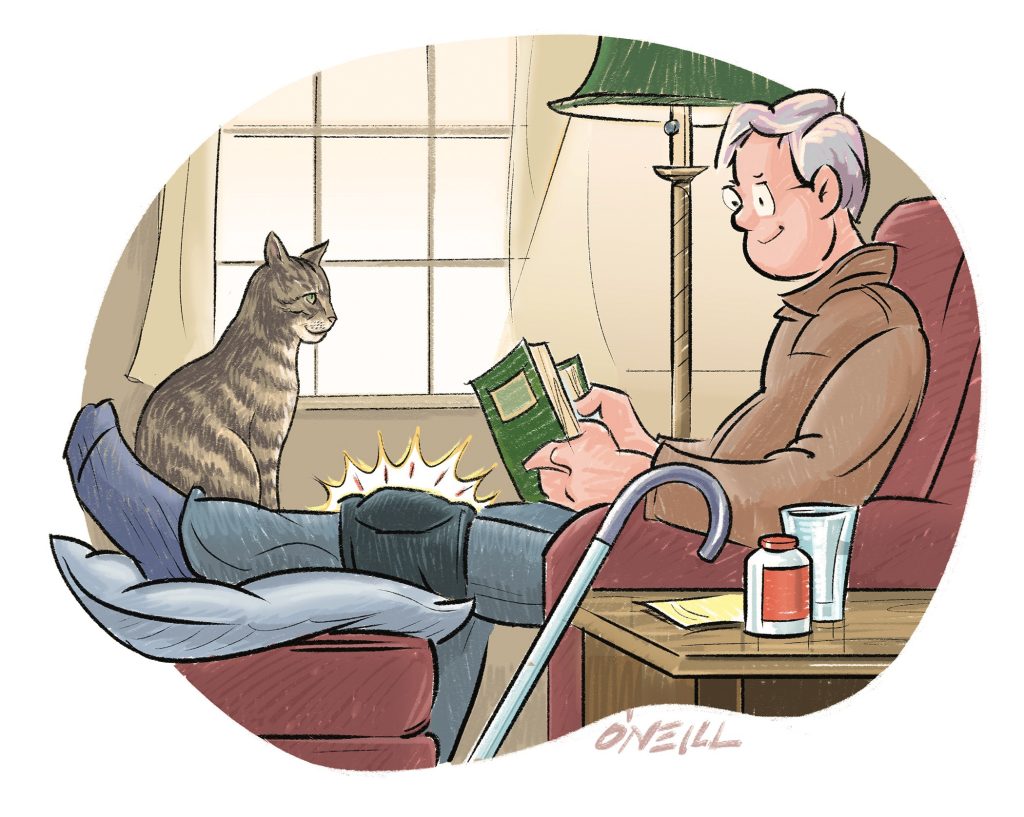
It proved to be a wise move. Upon completing my second week of physical therapy, not only did I learn that I was a week and a half ahead of the normal recovery rate from knee replacement, but had also begun to regain the ability to walk without the assistance of a cane. The pain was also slowly vanishing — so much so that I did a walking tour of my garden to assess the winter damage. 

This adventure got me thinking about how waiting for the pain to stop and the healing to begin is a common experience that touches every aspect of our lives.

As children, we fall down or cut a finger and run to Mom or Dad, who applies the bandage and a kiss that makes the injury soon forgotten.

Every day on the news, however, we learn about children who live in war zones or are victims of child abuse. Their young lives will forever be damaged by the trauma they’ve suffered — a pain that will likely never quite vanish, leaving a wound that may never heal.

On a much larger scale, the recent devastation of homes and lives lost from Hurricane Helene and the raging wildfires of Los Angeles have produced pain and suffering on an apocalyptic scale, something that will take decades for communities to rebuild and heal. The outpouring of love and assistance from complete strangers to our mountain neighbors, however, speaks volumes about our shared human instinct for healing. A similar outpouring is already underway in the City of Angels.

On the scale of normal, everyday life, a lover’s broken heart may only require a few healing months of intense self-care, a good therapist and a new pair of shoes to begin the mending process.

The psychic pain of losing a job, sending a child off to college, ending a close friendship, or saying goodbye to a loved one or special place you may never see again can impose their own unique weight on the human heart. In time, only memory and gratitude for what was may soften the pain.

That, at least, is my hope.

One evening over this past Christmas, as we sat by the fire watching a holiday movie, our beloved cat, Boo Radley, suffered a sudden massive seizure. Boo was a large, gray tiger cat who entered our lives 14 years ago when Connor, Number Two son, brought him home as a tiny feral kitten found at the Southern Pines train depot on a winter night.

Connor named him “Nico” and kept him in his upstairs bedroom for several weeks before he moved on to Boston to accept a new job. At that point, we renamed the inherited young cat “Boo Radley” and watched him quickly take over the house. One minute he was grooming the ears of our big golden retriever, Ajax, the next sleeping in kitchen pots and pans. He was always up to some amusing mischief that made us all smile.

For some reason, Boo took a particular shine to me, showing up at my desk every morning to playfully tap my computer keys as I wrote. The first time I let him outside, he followed me entirely around the backyard watching me plant roses and mow the lawn.

One summer evening near dusk, I saw Boo bolt across the backyard being chased by a young gray fox. Before I could come to his rescue, I saw the young fox running back the other way — chased by Boo. Crazy as it sounds, their game of tag went on for weeks.

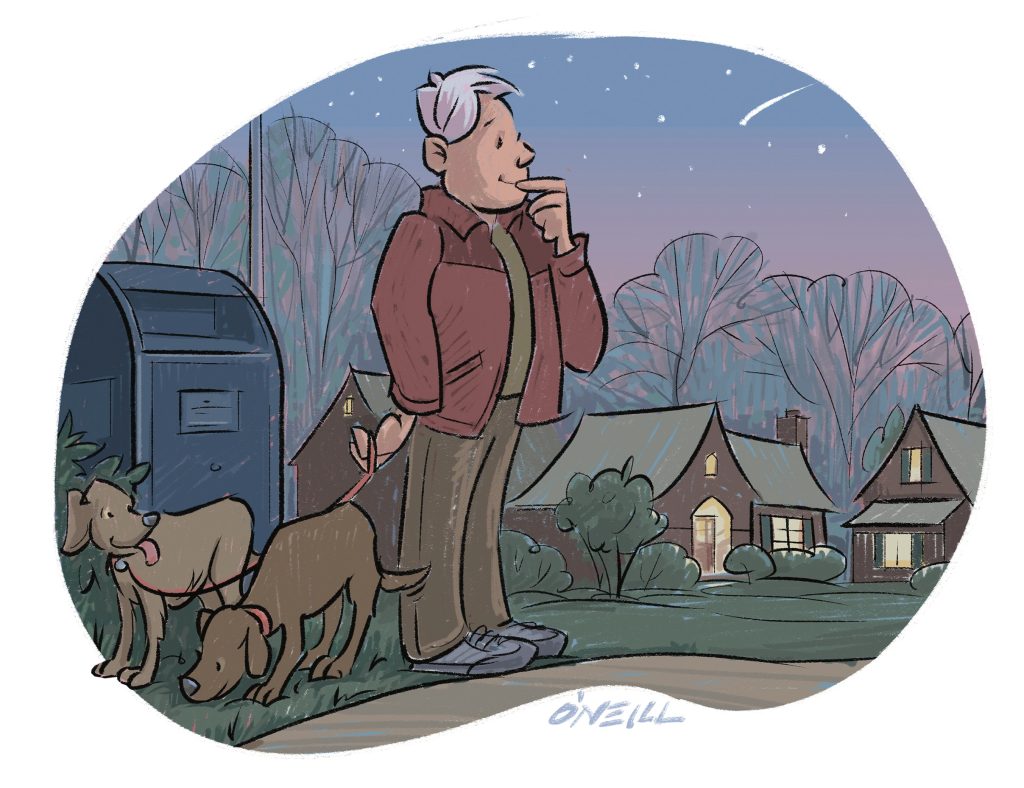
When we moved to the old neighborhood where I grew up in the Gate City, Boo really found his stride. He supervised as I re-landscaped the entire property and faithfully came to sit under the trees with me every afternoon when the day’s work was done. Likewise, for over a decade, he never failed to appear from his nighttime rounds to sit together under the early morning stars while I sipped coffee and had a friendly chat with the universe. He usually snuggled up in my lap as the Almighty and I sorted things out. On most afternoons, he napped in the golden-hour sun in his favorite part of the garden, which I eventually named “Boo’s Garden.”

Like the original Boo Radley, he particularly didn’t care for strangers, and proved to be fiercely territorial, ready to chase off any feline intruder foolish enough to get too close.

Wendy liked to say Boo was simply guarding his turf — and his best buddy.

I do believe this may be true.

On the fourth night after my knee replacement, however, during the deepest pain of my recovery, Boo suffered his sixth seizure in five weeks. The promising medication he’d been on for a month simply didn’t work, proving the art of healing is as much mystery as it is science.

Following a sleepless night, we made the painful decision to end Boo’s suffering. Hours later, a lovely vet from Lap of Love came and put my best pal to sleep on his favorite blanket. I don’t think I’d ever felt such emotional pain. Over a cat, no less.

Every moment of this life, as my late Grandmother Taylor liked to say, someone is waiting beneath a clock for a birth or a death or a chance to begin again.

The return of spring brings winter’s long wait to an end. It’s nature’s moment to heal and begin again.

With my brand-new knee, I can’t wait to get out into the garden.

But my best friend is gone, a pain that will probably take years to heal.

Simple Life

SIMPLE LIFE

The Pleasures of a Good Old Age

Miracles can come true, it can happen to you

By Jim Dodson

Not long ago, I heard an elderly gentleman in a coffee shop comment to a younger friend, “Someday, when you’re as old as I am, you will look back on your life and realize that everything is a miracle.”

His words brought to my mind Albert Einstein’s famous quote on the subject: “There are only two ways to live your life. One is as though nothing is a miracle. The other is as though everything is a miracle.”

Though it varies slightly from country to country, age 72 is the global median lifespan of most people on the planet — the statistical onset of “old age.”

This month, I turn 72.

Am I worried? Not so much. True, I walk more slowly and with more care these days due to a pair of arthritic knees, the painful legacy of 40- to 50-year-old sports injuries and having probably walked too many golf courses for one duffer’s life. By the time you read this, however, I hope to have a new left knee replacement for the new year with a second one on the way. Talk about a miracle.

Like many older folks my age, I’ve also survived cancer once and am winding up a second waltz with the dreaded disease, reportedly doing quite well, thanks to my brilliant young doctors and the miracles of modern medicine.

Despite these physical challenges, I’ve never felt happier or more productive. This seems to be a common trait among active elders who find the arrival of so-called old age to be a liberating force and an opportunity to experience life on a new and more meaningful level. A true case of attitude is altitude, as the saying goes.

One of the rarely mentioned gifts of being old is realizing what you no longer need or care about.

Two years ago, I donated half of my home library, roughly 300 books, to a pair of charities. This year, I plan to give another 200 away, leaving me approximately a hundred books I cherish and will continue to read again and again until my light in this world permanently dims.

At my pragmatic wife’s suggestion, I also went through my clothes closet and sent a large donkey cart’s worth of fine clothing I haven’t worn in more than two decades to a wonderful thrift shop owned by Freedom House, a local organization that provides drug rehabilitation programs to women. I hope whoever purchases the two fine custom suits, five Brooks Brothers blazers, nine crested-wool golf sweaters, eight pairs of worsted-wool slacks and 19 golf shirts will enjoy them with my blessing. Seriously, who needs 21 solid white golf shirts anyway?

Speaking of gratitude — and something of a miracle — I’ve reached an age where watching sports of any sort feels like a colossal waste of time. I’d rather take a long walk with the dogs, read a new book or watch seasonal birds at the feeder.

This is no small change. Once upon a time, now fading fast into memory, I was the original sports-mad kid who played every game in every season and died a little death anytime my favorite golfers and favorite professional sports teams lost. A decade ago, as my passion for all sports mysteriously began to wane, I wondered if this was because I’d changed — or if the games themselves had?

The answer is probably both. The sports teams I once worshipped, college and professional alike, were generally true hometown affairs where you could name (and root for) every player on the roster. This made the games feel much more personal and relevant. Today, almost all sports are shaped by staggering amounts of money flowing through their ranks. Not long ago, I heard about a local high school junior who recently signed with a major college program and pocketed $50,000 in NIL money. Add legalized sports betting to the state of our games and you may have a fast road to ruin for millions of fans who care less about the games than their payoff.    

The real beauty of aging, I long ago realized, is the light that comes from the soul. Reaching statistical old age brings with it freedom to do your own thing along with the opportunity to forge new paths and adventures.

“A good old age can be the crown of all our life’s experiences,” wrote Helen Nearing, “the masterwork of a lifetime.” Considerably late in life, Nearing and her husband, Scott, became world famous advocates of simple living and pioneers of the organic farming movement in America. Helen lived to be 91. Scott, 100.     

As Helen points out in her lovely book, Light on Aging and Dying, Socrates learned to play the lyre — and wrote his most famous poems — in his dotage. Thomas Edison was still inventing at age 92; Michelangelo did some of his finest work past 80; and Frank Lloyd Wright, at age 90, was considered the most creative architect in the world.

Likewise, numerous poets and artists proved to be at their creative best in their good old age. Thomas Hardy, Robert Frost and Carl Sandburg did some of their best work past 80. Ditto artists Goya, Titian, Manet, Matisse and Chagall. Shortly before his death at 91, Picasso said, “Age only matters when one is aging. Now that I have arrived at a great age, I might just as well be 20.”

Almost every day, we read about some octogenarian who still runs marathons or a septuagenarian who just climbed Mount Everest — for a second time. The list goes on and on.

“I am so busy being old,” wrote author and playwright Florida Scott-Maxwell in her 90s, “that I dread interruptions.”

As for this relatively new septuagenarian, one who will soon have new knees but no interest in running marathons or climbing mountains, I find the simple beauty of the natural world, a deepening spiritual life, a love of dogs and friends, plus an unquenchable passion for writing books reason enough to celebrate arriving at the ripe old age of 72.

The truth is, I’ve always enjoyed being with older people. And now that I’m one of them, I have no intention of slowing down.

That’s proof that everything really is a miracle

Simple Life

SIMPLE LIFE

The Island Baby

A tale of the most perfect storm

By Jim Dodson

January is a special month in our family. That’s because three members of our scattered tribe are January babies. It could have been four if I hadn’t missed my due date by two days and wound up being a February groundhog.

My late father’s birthday is the 18th and my mother’s the 24th. But our oldest child’s birthday on the 28th holds the true winter magic.

Back in September 1990, as we lay in bed looking up at the stars through the skylight on our first night in the house on Bailey Island, my first wife, Alison, said quietly, “Let me have your hand.”

She placed it on her belly, and, sure enough, for the first time ever, I felt something flutter, soft as a hummingbird.

“That’s him,” I whispered in awe.

“Or her,” she said.

Friends were concerned when we told them we planned to move to an island off the Maine coast for the winter while beginning construction of our house on the mainland.

In good weather, they pointed out, the hospital was a good 45-minute drive away — across two adjoining islands, over three narrow bridges and through three tiny villages. In bad winter weather, the trip had been known to take hours.

From Labor Day to June, only about 300 souls inhabited the durable rock island where we set up housekeeping in a fine cottage, which provided us with a 20-mile view of the coast. Within days of our arrival — news spreads fast on a small island — we’d met the folks who ran the community store, the postmistress, several lobstermen and a chatty gentleman named Bob, sort of the island’s de facto mayor and charge d’affaires of information and snowplowing.

“When the snow flies, the drifts can get pretty wicked out here,” he explained, and turned pale when we mentioned we were in the family way — due in early February. “I’m awfully glad you told me,” he said seriously. “We’ll keep an eye on you.”

A few days later, a lady at the store slipped me a scrap of paper with a phone number and said, “I heard about your situation. Call anytime if you need to — Herman’s got four-wheel drive.” Not long after that, one of the local lobsterman pulled me aside and said, “I’ve got a boat that’ll chew through anything. Just give a holler.”

Such nice folks, those island souls.

While we settled in to wait for the baby, they prepared for winter snow, fixing drafts, hooking up plows, topping up the woodpile and getting buckets of sand ready. I realized how much the mariners loved the drama of winter storms. Hard weather makes good timber, as they say in the north country.

There was a dusting of snow two days before Christmas, followed by wind, arctic cold and nothing more. While the islanders scanned the skies for telltale flakes, we scanned a baby book for boy names. Everyone — I mean everyone — was certain we were going to have a boy, including yours truly.

“How about Herman,” I suggested.

Alison laughed. “You mean after the four-wheel guy?”

“More as in Melville, the great white-whale guy.”

Given our location, I suggested other strong nautical names, including Noah, Davy Jones, Billy Budd and Horatio Hornblower — “Hank” for short.

Alison merely smiled and shook her head. Other family members chipped in several male family names.

As the winter deepened and the delivery day approached, only my wife and my dad believed the baby would be a girl.

In the meantime, the islanders grew visibly tense from the absence of snow. Snowplows sat idle; the boys around the stove grumbled over their morning coffee at the community store.

It turned out, in fact, to be the unsnowiest winter on the island in a century. Just our luck. Poor islanders. By early January you could feel their desperation to push snow and fling sand. A few days before the month’s end, Alison joked that our baby would arrive with a snowstorm.

Her mouth to God’s ear.

That Friday night, as we were dining at our favorite restaurant in town, it began to snow like mad. Mainers live for the winter’s first good snow. You could see the relief in their faces. “Better late than never,” our waitress cheerfully declared as she delivered dessert. “Hate to waste my new snow tires!”

Moments later, Alison’s water broke. We left our dessert behind and went straight to the hospital down the block.

The delivery doctor said we still had several hours to go. So, as mother and baby settled in, I drove out to the island to get some clothes and feed the dog. By the time I got there, a blizzard was in full force and even my four-wheel Blazer had difficulty navigating our unplowed lane.

It took another two hours to get off the island, over the bridges and back to the hospital. By the time I climbed the final hill into town, the snow had stopped and a brilliant sunrise bathed a silent white world in golden light. It was a sight I’ll never forget.

I got to my wife’s side 10 minutes before the baby arrived.

The next afternoon, we brought our newborn home, bundled up like an Eskimo baby. The snow was so deep, we had to park at the community store and slide down the hill on our rumps to our cottage doorstep.

Stamping around, folks on the island were downright giddy. Bob was deeply relieved. Snowplows roared and news of the birth quickly spread.

Everyone who peeked at our new arrival wanted to know what we named our sweet island lad.

“Margaret Sinclair,” I proudly told them.“Maggie for short — after both of her grandmothers.”

Simple Life

SIMPLE LIFE

Christmas Wishes

Peace on Earth and pickup trucks

By Jim Dodson

Late last summer, my wife Wendy asked what I want for Christmas this year. She’s a woman who likes to plan ahead.

Figuring peace on Earth and good will toward men were probably not in the cards, a couple options came to mind.

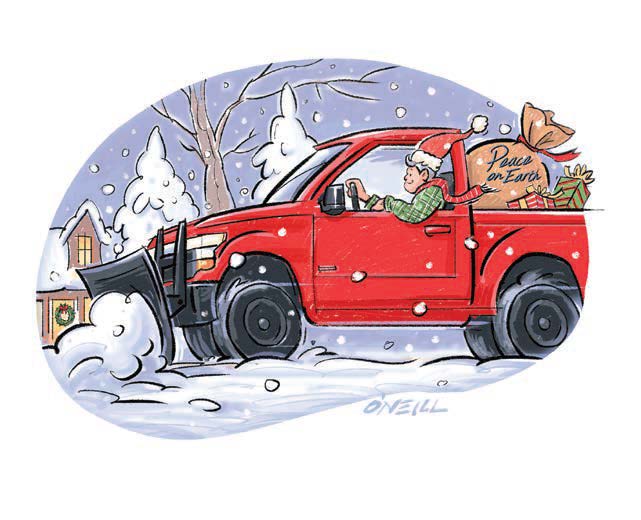
“A wheelbarrow and a new Chevy pickup truck.”

She laughed.

“You’ve wanted a new pickup truck for almost as long as I’ve known you,” she said. “I’m not sure either would fit under the Christmas tree.”

She was right, of course. “But if I had a new Chevy pickup truck,” I pointed out, “we could bring home a really big Christmas tree and all kinds of other great stuff.”

“I thought we agreed to start getting rid of stuff we no longer need or want,” she reminded me. “Not bringing more home.”

She was right about that, too. We are de-stuffing our house right and left these days. But an old dude’s perpetual dream of owning a new Chevy pickup truck doesn’t go away easily.

So, I asked what she wanted for Christmas this year.

“I’d like to go to a very nice hotel by myself for a night — and just do nothing,” she said.

I’ll admit, this surprised me, but it shouldn’t have.

Wendy is the most organized, generous, and busiest person I know.

She runs her own custom baking business, keeps the family finances, and does the bookkeeping for both our businesses. She also does most of the grocery shopping, regularly gives blood and platelets, and somehow keeps up with the secret adventures of our far-flung children. Someone is always asking her to do something — volunteer to make pies for church suppers or donate ten dozen exquisite hand-painted cookies for a charity fundraiser. Family, friends and neighbors routinely turn to her for advice on a range of subjects, and then there’s her egg-headed husband who can never find where he left his car keys, eyeglasses, lucky golf cap or favorite ink pens. Somehow, she can find these vital items within seconds — just one of her many superpowers.

That’s a lot of stuff to keep up with, I grant you.

Then there was her sweet mom, Miss Jan, who resided at a lovely assisted care facility in town but spent every weekend at our house. With her dementia growing more apparent by the month, Wendy’s focus on her mom’s comfort and needs ramped up dramatically. Daily visits and doctor appointments filled her calendar, which also included lunches at Jan’s favorite restaurants, and bringing her mom clean clothes and delicious dinners every evening, even as Jan’s appetite began to ebb.

No wonder she fantasized about a quiet night alone at a nice hotel.

“How about two or three nights at the Willcox Hotel for our anniversary?” I proposed as the date approached. The Willcox is in Aiken, South Carolina. It’s our favorite hotel, charmingly quaint, blissfully peaceful and located a mile from our favorite golf course.

She loved the idea and promptly booked us a nice long weekend. She even arranged for Jan’s kind caregiver to look in on her every day while we were gone.

Ironically, our anniversary trip to the Willcox didn’t come off because we couldn’t find someone to look after our three dogs and two cats for the weekend. It was the heart of the summer vacation season, which meant every kennel in town had been booked solid for weeks.

So much for a needed break.

Suddenly, it was middle autumn and life was speeding up dramatically. Wendy was busy baking for the larger crowds at the weekend farmers market where she sells her spectacular baked goods, and I was finishing revisions of my book on the Great Wagon Road, scheduled for a spring publication, and starting a new Substack column.

More importantly, Miss Jan’s condition was worsening by the week. Her physician advised us that she would probably be gone by Christmas.

Early on the morning of November 1, the eve of All Saints’ Day across the world, Jan quietly passed away.

Suddenly, what either of us wanted for Christmas was completely irrelevant.

Losing a beloved parent puts life in a different perspective. In Jan’s case, her quiet passing brought an end to suffering from an insidious disease that cruelly robs its victims of speech and memory. What’s left is a hole in the heart that can never be filled.

Jan’s passing also reminded us that we’re at a stage of life where material things no longer hold much magic. There’s really nothing more we need or want. Except more time with each other.

For Dame Wendy, the simple pleasure of the holiday is finding the perfect live Christmas tree, putting on holiday music, cooking for family and friends and doing small things that make Christmas feel special. Last year, she gave me a sensational pair of wool socks and a nifty garden shovel. I gave her a nice, fuzzy sweater and tickets to a concert at the Tanger Center, along with a jumbo box of Milk Duds, her favorite forbidden pleasure.

This year, I plan to give my amazingly busy wife two nights at the luxury hotel a few miles from our house, where she can put her feet up, drink very good wine, eat Milk Duds to her heart’s content and maybe find peace and joy in doing absolutely nothing. Miss Jan would wholeheartedly approve.

As for me, well, forget the Chevy pickup truck for now. But I figure the wheelbarrow is a cinch to show up beneath the tree.

Simple Life

SIMPLE LIFE

The Sacred Month

A time to go inside

By Jim Dodson

Long ago, I decided that November is the most sacred month.

To my way of thinking, on so many levels, no other holds as much mystery, beauty and spiritual meaning as the 11th month of the calendar.

The landscape gardener in me is always relieved when the weather turns sharply cooler and there’s an end to the constant fever of pruning and weeding, plus fretting over plants struggling from the heat and drought of a summer that seems to grow more punishing each year.

Once the leaves are gathered up, and everything is cut back and mulched for the winter, not only does my planning “mind” kick in with what’s to be done for next year, but the beautifully bare contours of the earth around me become a living symbol — and annual reminder — of life’s bittersweet circularity and the relative brevity of our journey through it.

The hilly old neighborhood where we reside is called Starmount Forest for good reason, owing to the mammoth oaks and sprawling maples that kindly shelter us with shade in summer and stand like druid guardians throughout the year, season after season. Beginning this month, the skies become clearer and the nighttime stars glimmer like diamonds on black velvet through their bare and mighty arms, hence the neighborhood’s name: a “mount” where the “stars” shine at night.

Of course, there is risk living among such monarchs of the forest. Every now and then, one of these elderly giants drops a large limb or, worse, topples over, proving their own mortality, sometimes taking out part of a house or a garage, or just blocking the street until work crews arrive with chainsaws. As far as I know, no one has ever been seriously injured or killed by our neighborhood trees, though the growing intensity of summer storms seems to elevate the danger. Lately, some neighborhood newcomers, prefiguring catastrophe, have taken to cutting down their largest oaks as an extra measure of security in a world where, as actuaries and sages agree, there really is no guaranteed thing. In the meantime, the rest of us have made something of a Faustian bargain with these soulful giants for the privilege of living among them. We care for them and (sometimes) they don’t fall on us.

Speaking of “soul,” no month spiritually embodies it better than November.

All Souls Day, also called The Commemoration of All the Faithful Departed, comes on the second day of the eleventh month, a day of prayer and remembrance for the faithful departed observed by Christians for centuries. The day before All Souls’ is All Saints Day, also known as All Hallows Day or the Feast of All Saints, a celebration in honor of all the saints of the church, whether they are known or unknown.

Every four years, the first Tuesday that follows the first Monday of November is our national Election Day, a day considered sacred by citizens who believe in the right to vote their conscience and tend the garden of democracy.

Congress established this curious weekday of voting in 1845 on the theory that, since a majority of Americans were (at that moment) farmers or residents of rural communities, their harvests would generally have been completed, with severe winter weather yet to arrive that could impede travel. Tuesday was also chosen so that voters could attend church on Sunday and have a full day to travel to and from their polling place on Monday, arriving home on Wednesday, just in time for traditional market day across America.

Like daylight saving time (which, by the way, ends Sunday, Nov. 3) some critics believe “Tuesday voting” is a relic of a bygone time, requiring modern voters to balance a busy workday with the sacred obligation of voting. For what it’s worth, I tend to fall into the camp that advocates a newly established voting “holiday weekend” that would begin with the first Friday that follows the first Thursday of November, allowing three full days to exercise one’s civic obligation, throw a nice neighborhood cookout and mow the lawn for the last time.

While we’re in the spirit of reforming the calendar, would someone please ditch daylight saving time, a genuine relic of the past that totally wrecks the human body’s natural circadian rhythms? Farmers had it right: Rise with the sun and go to bed when it sets.

Next up in November’s parade of sacred moments is Veterans Day, which arrives on the 11th, a historic federal holiday that honors military veterans of the U.S. Armed Forces, established in the aftermath of World War I with the signing of the Armistice with Germany that went into effect at the 11th hour of the 11th day of the 11th month of 1918. In 1954, Armistice Day was renamed Veterans Day at the urging of major U.S. military organizations. 

November’s gentler sunlight — at least here in the Northern Hemisphere — feels like a benediction falling across the leafless landscape, quite fitting for a month where we go “inside” literally and figuratively to celebrate the bounty of living on Earth. In the Celtic mind, late autumn is the time of the “inner harvest,” when gratitude and memory yield their own kind of fertility.

“Correspondingly, when it is autumn in your life, the things that happened in the past, the experiences that were sown in the clay of your heart, almost unknown to you, now yield their fruit,” writes the late Irish poet John O’Donohue.

First shared by Squanto and the pilgrims in 1621, Thanksgiving was decreed  “a day of public Thanksgiving and Prayer” on November  26, 1789, by George Washington. Then it was proclaimed a national holiday on the last Thursday of November by Abe Lincoln. Finally, during the Great Depression in 1939, it was moved to the third Thursday of the month by Franklin Roosevelt to extend Christmas shopping days. But for most folks, the observance of Thanksgiving embodies, I suspect, many of the things we hold sacred in life:

The gathering of families, memories of loved ones, lots of laughter, good food and friendly debates over football and politics.

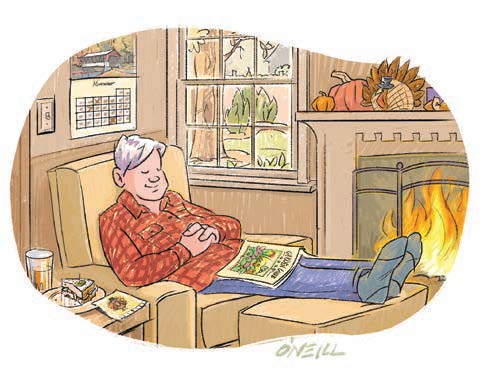
I give extra thanks for Thanksgiving every year, especially the day after when some who hold bargain-hunting on “Black Friday” a sacred ritual thankfully disappear and I am free to enjoy my favorite “loaded” turkey sandwich and take a nice long afternoon nap by the fire to celebrate my favorite holiday.

Simple Life

SIMPLE LIFE

October Dreams

The house on the hill that haunts my slumber

By Jim Dodson

During the decades we lived on a forested hill in Mid-Coast Maine, October’s arrival was greeted with relief and joy.

To begin with, it signaled the final exodus of summer tourists, who left behind their spending money in the pockets of local businesses. The cost of a seafood supper roughly halved and it was possible to venture into town to lunch with friends without being caught in a traffic jam. By mid-month, even the annual invasion of “leaf peepers” was drawing to a close.

On our hilltop, we watched the 500-acre forest around us erupt into a dazzling pageant-fire of golds and reds, and wildlife grew more active as the days grew shorter.

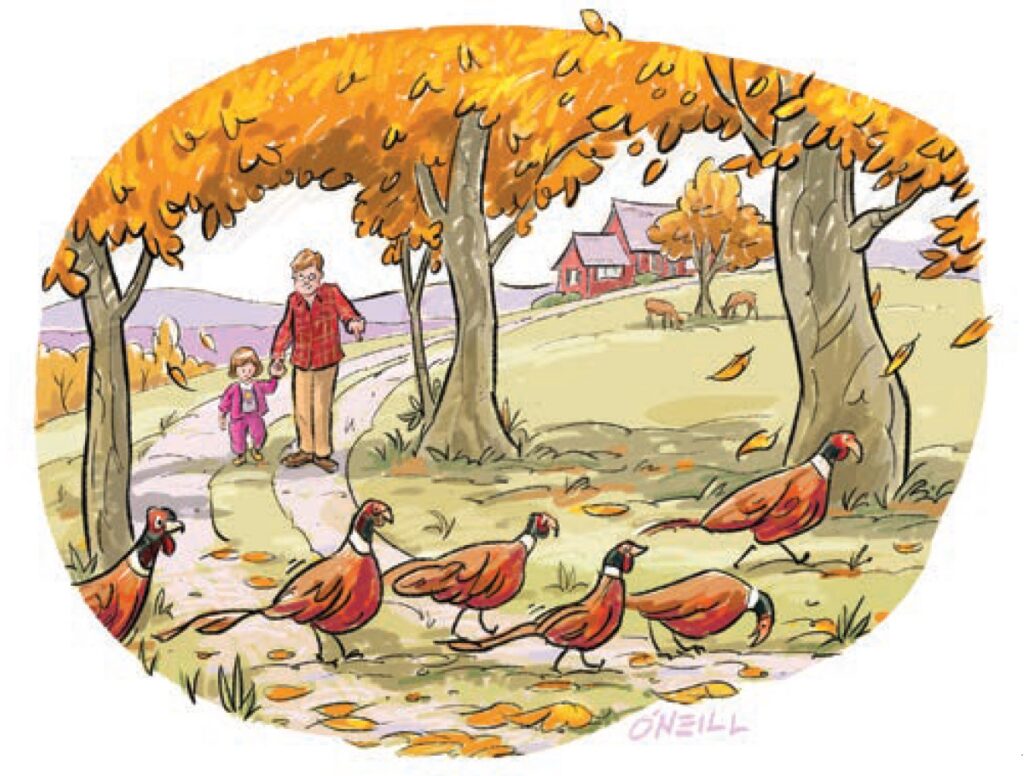
I remember walking down our long gravel driveway to fetch the afternoon mail with my toddler daughter, Maggie, and pausing to watch a flock of ring-necked pheasants calmly cross our path, spectacular creatures completely unconcerned by our presence.

The family of white-tailed deer that inhabited our forest could be seen most October evenings finishing off the last of the hostas, which I had strategically planted at the rear of our property to keep them away from the house in high garden season. We were often visited by beavers and skunks and, on one memorable occasion, a gangly, young male moose harmlessly crossing our upland meadow to the late summer bog where bullfrogs croaked at night. The fireflies were gone by then, replaced by the lonely cry of coyotes deep in the woods.

October is a time of serious preparation in Maine. For the last time of the year, somewhere around mid-month, I mowed the half-acre of grass that surrounded our hilltop lilium and put away my beloved John Deere lawn tractor until next spring. I also cut down and raked out several large perennial beds, and split and stacked hardwood for an hour each day, preparing our wood pile for the cold days and nights just ahead. October was the month of our first evening fire, something we all looked forward to.

The last warm days of the month were a bonus. We packed up a picnic and took the kids to one of our favorite spots, Popham Beach State Park, a spectacular 3-mile sandy spit near the mouth of the Kennebec River, where a short-lived colony was established in 1607. Popham was — and probably still is — the most popular beach in Maine. But, by October, the beach belonged again to the locals. Our children, far-flung and now in their 20s and 30s, have fond memories of walking out to the famous “Rock Island” at low tide and swimming in the ocean, warmed ever so slightly by the summer’s passing. On the way home, if the timing was right, we stopped off at our favorite seafood shack at Five Islands for fried clams and blueberry ice cream, even as its owner was preparing to shut down for the season.

The decision to sell our beloved house in 2008 was possibly the toughest one we’ve ever had to make. A year before, however, we moved to North Carolina, foolishly believing that we would simply keep our precious Maine house and return to it each summer. But, after letting it sit empty with only a caretaker looking after it for one full winter, it became clear that this was a recipe for trouble. Maine winters are tough on people and houses alike. We reluctantly decided to sell the place to a charming young couple from Connecticut who dreamed of making my dream house theirs.

The timing couldn’t have been worse.

Thanks to a national collapsing housing market and the start of the Great Recession, the sweet couple from Connecticut failed to sell their house in time, and we wound up selling to a couple from Massachusetts, who got a sensational deal. The wife adored the gardens and the quiet of the forest. The husband, however, complained that the house’s exposed hemlock beams made the interior “look unfinished.” He also didn’t like the closets or the notches on the rear of the utility door that memorialized the growth of our four kids.

I nearly backed out of the deal, but finally signed because the woman loved the place.

I stayed out of Maine for more than a decade, joking to friends that it was too soon to return and risk never coming back. That hilltop, after all, is where I designed, built and owned my first house, got married and had my children, created my first garden, and stayed longer than anywhere else. If you are curious to see why it will forever own a piece of my heart, try googling “Zillow, Topsham Maine, 12 East Merrill  Road.”

Looking back, however, coming home to North Carolina was one of the wisest moves we ever made. Over 17 years, I’ve had the opportunity to create four arts magazines, publish nine books, and make scores of new friends while deepening my oldest friendships. Moreover, during the past decade, we’ve fully restored a lovely mid-century house in my boyhood neighborhood, just two doors down from the house where I grew up. Talk about a spiritual homecoming.

Fortunately, Octobers here are also spectacular. The murderous heat of summer is finally gone, the garden is winding down for another year, the night skies are clearer, and Piedmont North Carolina kindles its own breathtaking pageant-fire of leaves.

But every now and then I have dreams about our old house in Maine.

Invariably, it’s October in this dream and I’m walking through the empty rooms of our old place, wondering what will come of it now that I’m long gone. You see, I never went back there to see it.

Not long ago, however, my savvy wife, Wendy, proposed a cure for my October dreams.

Next year, either in September or October, we plan to rent a house somewhere on the coast of Maine.

Who knows? Maybe when I’m there I’ll dream about our wonderful house and garden back in Carolina.

Simple Life

SIMPLE LIFE

Worrying and Watering

For love of gardens and democracies

By Jim Dodson

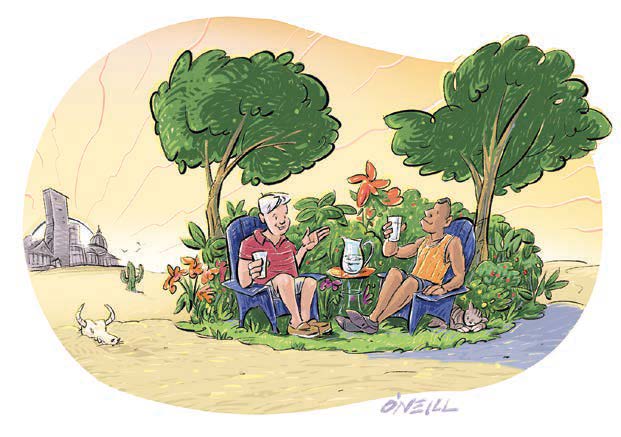
A neighbor who walks by my house each evening like clockwork sees me sitting under the trees with a pitcher of ice water and walks over to say hello.

I invite Roger to take a seat and have a cold drink.

“It’s tough to keep moving in this heat,” he explains, sitting down. “It’s something, isn’t it? But your garden looks great.

How do you keep it so nice and green?”

“A lot of worrying and watering,” I say. “Sometimes you have to make tough choices.”

In one of the hottest and driest summers in memory, I’d decided to let my yard turn brown in favor of keeping flowering shrubs and young trees watered and green. As the late famous British landscape designer named Mirabel Osler once said to me over her afternoon gin and tonic, landscape gardening is a ruthless business, especially in a drought. Grass will eventually return, but no such luck with a shriveled shrub or a dead young tree.

“September brings relief, rain and second blooms,” I add. “I’m already in a September state of mind.”

He smiles and nods.

“Hey,” he says casually, “let me ask you something.”

I expect another question about the garden. Like the best time of the day to water your shrubs, or when it’s safe to fertilize or prune azaleas.

But it isn’t even close.

“I’m worried about America. People seem so angry these days. Why do you think Americans hate each other?”

The question takes me by surprise. I could give him a few thoughts on the subject: the woeful decline of fact-based journalism, an internet teeming with conspiracy peddlers, politicians who feed on polarization, the unholy marriage of politics and religion, and the sad absence of civility in everyday life.

Instead, I tell him a little story of rebirth.

In the spring of 1983, I telephoned my dad from the office of Vice President George Bush and told him that I no longer wanted to be a journalist. For almost seven years, I’d worked as a staff writer of the Atlanta Journal-Constitution Sunday Magazine, covering everything from presidential politics to murder and mayhem across the deep South. As a result of my work, I’d been offered my dream job in Washington, D.C., but found myself suddenly fed up with writing about crooks, con men and politicians. Bush, however, was an exception. We’d traveled extensively together during the 1980 campaign and had wonderful conversations about life, family and our shared love of everything from American history to golf. During our travels, Bush invited me to drop by his office anytime I happened to be in the nation’s capital. Unfortunately, he was traveling the day I turned down my dream job in Washington, but his secretary allowed me to use her phone. So, I called my dad and told him I planned to move to New England and learn to fly-fish.

“When was the last time you played golf?” he calmly asked.

“I think Jimmy Carter had just been elected.”

He suggested that I meet him in Raleigh the next morning.

So, I changed my flight and there he was, waiting with my dusty Haig Ultra golf clubs in his back seat. We drove to Pinehurst, played famed course No. 2 and finished on the Donald Ross porch, talking about my early midlife career crisis over a couple of beers. I’d just turned 30.

I told him that I “hated” making a living by writing about the sorrows of others, especially when it came to the increasingly shallow and mean-spirited world of politics.

“You may laugh, but here’s a thought,” the old man came back, sipping his beer. “Before you give up journalism, have you ever considered writing about things you love rather than things you don’t?”

Sadly, I did laugh. But he planted a seed in my head. A short time later, I resigned from my job in Atlanta and wound up on a trout river in Vermont, where I learned to fly-fish, started attending an old Episcopal Church and knocked the rust off my dormant golf game at an old nine-hole course where Rudyard Kipling played when he lived in the area.

I soon went to work for Yankee Magazine and spent the next decade writing about things I did love: American history, nature, boat builders, gardeners and artists — a host of dreamers and eccentrics who enriched life with their positive visions and talents.

I also got married and built my first garden on a forest hilltop near the Maine coast.

“I never looked back,” I tell Roger. “I’ve built five gardens since.”

Roger smiles.

“So, you’re telling me we all need to become gardeners?”

“Not a bad idea. Gardeners are some of the most generous people on Earth. We make good neighbors. Most of the country’s founders, by the way, were serious gardeners.”

I pour myself a little more ice water and tell him I’ve learned that gardens and democracies are a lot alike. “Both depend on the love and attention we give them. Especially in difficult times like these.”

Roger finishes his drink and stands up. “That’s something to think about. Here’s to September, cool weather and good neighbors,” he says. “Maybe by then even your grass will be green again.”

Simple Life

Simple Life

The Quiet of Nature

In an increasingly loud world, maybe we should be still and listen to nature

By Jim Dodson

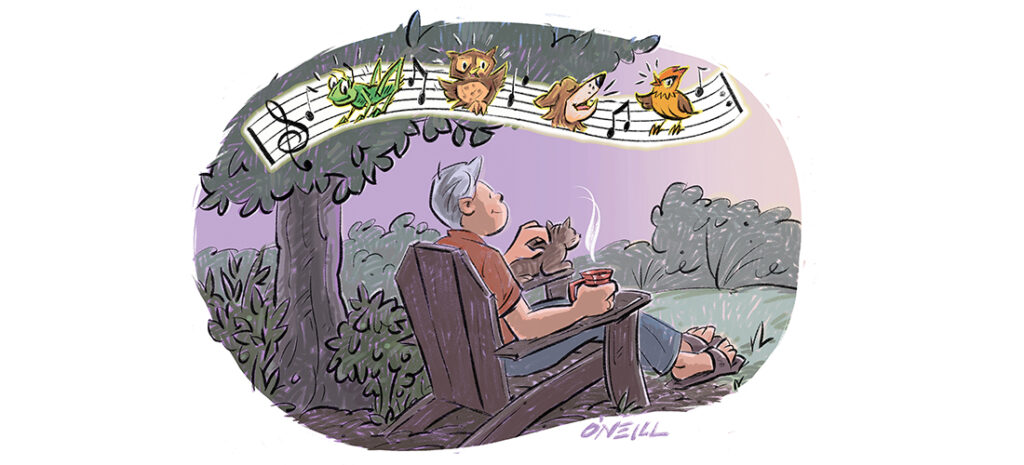
It’s two hours before sunrise and, per my daily morning ritual, I’m sitting with my old cat, Boo Radley, in a wooden chair beneath the stars and a shining quarter-moon.

Today’s forecast calls for another summer scorcher.

For the moment, however, the world around me is cool and amazingly quiet.

It’s the perfect moment to think, pray or simply listen to nature waking up.

In an hour or so, the world will begin to stir as folks rise and go about their daily lives. Nature will be drowned out by the white noise of commuter traffic, tooting horns and sirens.

But, for now, all I hear is the peaceful hoot of an owl somewhere off in the neighborhood trees, the fading chirr of crickets and the lonely bark of a dog a mile or two away. Amazing how sound carries in such a peaceful, quiet world. 

Ah, there it is, right on cue! The first birdsong of the new day. I recognize the tune from a certain gray catbird that seems to enjoy starting the morning chorus. Soon, the trees around us will be alive with the morning melodies of Carolina warblers, eastern bluebirds and the northern cardinals. What a perfect way to lift a summer night’s curtain and herald the dawn!

Unfortunately, it’s a sound that Earth scientists fear may be vanishing before our very ears.

On a planet where many are concerned about the impacts of global warming, declining natural resources and vanishing species, it seems to me that noise pollution and the disappearing sounds of the natural world might be among the most worrying impacts of all. 

A recent article in The Guardian alarmingly warns of a “deathly silence” they claim results from the accelerating loss of natural habitats around the globe.

The authors note that sound has become an important measurement in understanding the health and biodiversity of our planet’s ecosystems. “Our forests, soils and oceans all produce their own acoustic signatures,” they write, noting that the quiet falling across thousands of habitats can be measured using ecoacoustics. They cite “extraordinary losses in the density and variety of species. Disappearing or losing volume along with them are many familiar sounds: the morning calls of birds, rustle of mammals through undergrowth and summer hum of insects.”

A veteran soundscape recordist named Bernie Krause, who has devoted more than 5,000 hours to recording nature from seven continents over the past 55 years, estimates that “70 percent of his archive is from habitats that no longer exist.”

As quiet natural places are drowned out by the sounds of freeways, cellphones and the daily grind of modern life, fortunately, a nonprofit group called Quiet Parks International is working to identify and preserve sacred quiet places in cities, wilderness areas and national parks, where all one hears — for the moment at least — is the beat of nature, the pulse of life in the wild.

“Quiet, I think, holds space for things we can’t verbalize as humans,” the group’s executive director, Matthew Mikkelsen, recently told CBS News. “We use silence as a way to honor things.” Quiet, he notes, is becoming harder and harder to find these days, even in the most remote wilderness or within the depths of the national parks. “Every year we see more and more data to reaffirm what we’ve known for a long time — that quiet is becoming extinct.”

Perhaps because I grew up in a series of sleepy small towns across the lower South, places where I spent most of my days wandering at will in nature, I’ve been groomed to be a seeker of natural silence and quiet places in my life.

The first decade of my journalism career was spent in major cities, embedded in the cacophony of busy streets, which explains why I bolted for the forests and rivers of northern New England the moment I had the chance to escape honking horns, blasting radios, screaming sirens and even background music in restaurants, a personal annoyance I’ve never quite fathomed.

Perhaps I’ve been spoiled by traveling in France and Italy and other ancient places. There, cafes and bistros are generally meant to foster a relaxed, slower pace of life through the auspices of good food, lingering conversations and woolgathering as one watches the harried world pass by.

It is no accident that I built my first house on a hilltop near the coast of Maine, surrounded by 200 pristine wooded acres of beech and hemlock trees. On summer evenings, my young children and I could hear the forest coming alive with sounds and often saw and heard wildlife — whitetail deer, pheasants and hawks, a large lady porcupine and even (once) a young male moose — gathering at the edges of our vast lawn where I created feeding areas of edible native plants for our wild neighbors. On frigid winter nights, I put on my Elmer Fudd jacket and toted 50-pound bags of sorghum out to that feeding spot by the edge of the woods, where deer and other critters could be seen dining in a moonlit night. The eerie late-night sound of coyotes calling deep in the forest reminded us that we were the newcomers to their quiet keep.

One reason I love the game of golf is because golf is a two- or three-hour adventure in nature where the simple elements of wind, rain, sand and water provide an existential challenge to mind and body. As a kid, I learned to play golf alone, walking my father’s golf course in the late afternoon, when most of the older golfers had gone home. I came to love “solo golf” at a time of day when the shadows lengthened and the sounds of nature began to reawaken creatures great and small.

Golf courses, like libraries, are meant to be quiet places — which makes the recent trend of golf carts equipped with digital music systems particularly bothersome to a lover of nature’s quiet sounds.

Pause for a moment and just think what one can do in the quiet:

Read a good book.

Admire a sunset.

Rest and recover.

Take an afternoon nap.

Watch birds feed.

Write a letter.

Talk to the universe.

Say a prayer.

Grieve — or feel gratitude.

Think through a problem.

“In quietness,” says the book A Course in Miracles, “are all things answered.”

My heart aches when I hear that the world’s natural places may be going silent.

A world without nature’s quiet sounds would be a very lonely place.

Hopefully, we’ll learn to listen before it’s too late. PS

Jim Dodson can be reached at jwdauthor@gmail.com.

Simple Life

Simple Life

The Belle of Star City

May her light shine on

By Jim Dodson

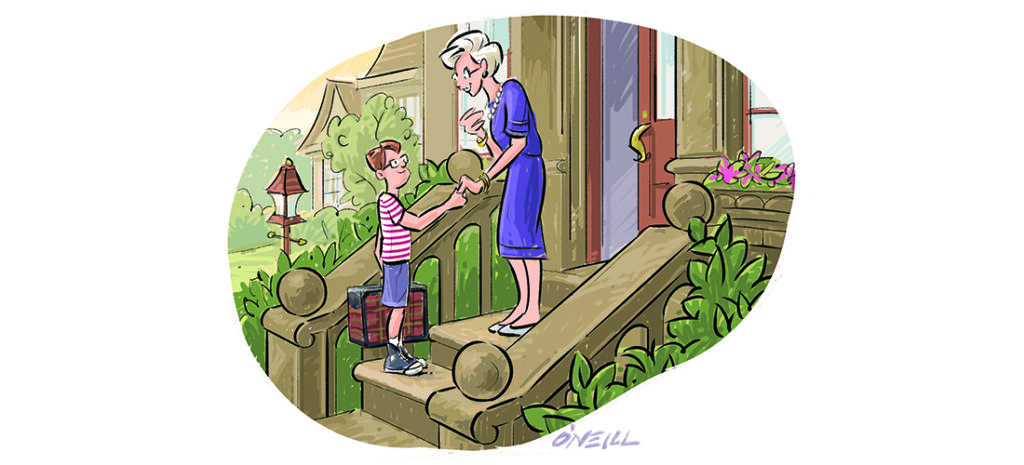
“I think you are really going to enjoy your Great Aunt Lily,” my dad says cheerfully. “She’s quite a colorful character. I call her the Belle of Star City.”

It’s a warm July morning in 1964. We are driving through the Blue Ridge Mountains to Roanoke, where I am to be dropped off at Great Aunt Lily’s apartment for the weekend before my parents take my brother, Dickie, on to church camp, then head to a newspaper convention in Hot Springs, Virginia.

He explains that Lily is my grandfather’s beloved youngest sister, a strong-willed beauty who spurned several suitors in rural Carolina before fleeing to Washington, D.C. There, she worked for years as a stage actress and theatrical seamstress.

“I suppose she was something of the family’s black sheep, but a delightful woman. You’ll love her.”

 Though I fear I’m simply being dumped for the weekend on a boring maiden aunt, my old man turns out to be right.

Lily lives alone in a gloomy Victorian brownstone on Roanoke’s First Street, in an apartment filled with dusty antiques and Civil War memorabilia, including a Confederate cavalry officer’s sword she claims belonged to a Dodson ancestor who fought at Antietam and Gettysburg. There are also exotic paintings of classical nudes and wild beasts adorning her walls, including the stuffed head of an antelope, a gift from her “favorite gentleman friend” who passes through town every winter with the Ringling Bros. and Barnum & Bailey Circus. 

On my first night with her, Lily — a large-boned, blonde woman, endlessly talkative, swimming in White Shoulders perfume — takes me via taxi to a Chinese restaurant in the Market District, where we dine with a snowy-haired “gentleman friend” she says was once mayor. He talks about the recent Kennedy assassination and makes a half-dollar coin appear from my ears, pointing out that Roanoke is called Magic City.

The next morning, Lily takes me to breakfast at The Roanoker Restaurant, a legendary diner where she knows everyone by first name. After that, we are taxied up Mill Mountain to have a close look at the famous Roanoke Star. The cab driver, Ernie, is a Black gentleman with a gold tooth and quick smile. Lily explains that Ernie is a true “Renaissance man,” a part-time preacher, former Navy cook, full-time house painter and her “dearest gentleman friend in the world.” Reverend Ernie is also her “business partner,” who occasionally drives her to estate sales and auctions to buy artwork and antiques, which Ernie sells to collectors, splitting the profits with her. The Confederate cavalry sword is one of their recent “finds,” which she hints might someday pass my way. This thought thrills me.

On the Sunday morning of my visit, we attend a small red-brick church to hear Reverend Ernie preach, followed by lunch at the historic Hotel Roanoke, the planned pick-up spot with my folks. Naturally, Lily knows the waiter, who brings me something called a “Roy Rogers” and her a small crystal glass. After we order our lunch, Lily discreetly removes a silver flask from her purse and pours herself a bit of ruby sherry. 

She looks at me and asks if I’d like a taste.

I say yes.

She asks how old I am.

Twelve, I lie, giving myself an extra year.

She slides the glass across the table. 

“Just a small sip, dear.”

During the two-hour drive home through the mountains, my folks are eager to hear about my weekend with the Belle of Star City. I tell them about her gentlemen friends and the interesting places she took me, and even mention the Confederate cavalry sword she promises to give me someday. 

My dad glances at my mom. “I told you she’s a colorful character,” he says. “Glad you enjoyed her. But here’s the thing . . . ”

He reveals that Great Aunt Lily is about to lose her home and move to Raleigh into a special-care home due to what we now call Alzheimer’s. Lily is scheduled to move around Christmastime. 

“In the meantime, sport, she’s coming to stay with us around Thanksgiving.”

My mother chimes in, “And since your bedroom is the bigger bedroom, sweetie, we’re hoping you won’t mind giving it up to Aunt Lily. You can bunk with your brother. It’ll just be temporary.” 

Four months later, Lily arrives with a large wooden trunk and her sewing machine in tow. On the plus side, she tells me stories about famous men she’s known — the actor David Niven, golfer Sam Snead, Will Rogers. Even better, she keeps boxes of Lorna Doone cookies hidden under bolts of fancy cloth in her trunk, which she shares with me. One afternoon as we are having our daily cookie conversation, I ask about the sword. Lily gives me a blank look, then waves her cookie dismissively. “Oh, goodness, child! I gave that silly old thing to the church auction ages ago. I think I paid 10 dollars for it at a yard sale up in Fincastle.”   

Predictably, as Christmas Eve approaches, my clean-freak mother begins to lose her mind over our private cookie sessions. My father says all Aunt Lily needs is a good hobby. So, he sets up her sewing machine and she goes to work behind closed doors with her machine humming for days.

It turns out to be quilted, floral potholders. Two dozen quilted, floral potholders.

“Lily thinks you can sell them in the neighborhood for Christmas money,” says my dad. 

I am mortified. Two pals from my Pet Dairy baseball team live on our block, and so does one Della Jane Hockaday, who I hope to give a mood ring. 

“Look, sport,” my old man reasons, “Aunt Lily is here for only a couple more weeks. Just let her see you go down the block selling them. You’ll make an old lady who has just lost her home very happy. Lily is very fond of you.”

So, I grit my teeth and do it early on a frosty Saturday morning a week before Christmas. To my surprise, I sell a half-dozen $5 potholders and make thirty bucks. Years later, my mom lets slip that she’d phoned every woman on the street to grease the skids, including Della’s mom. The next morning before church, my dad and I drive the remaining potholders to the drop-off box of the Salvation Army store. 

He gives me an extra 20 for my trouble and insists that I tell Lily, if she asks, that her beautiful potholders sold out in just one morning.

But Lily never asks. Not long after the New Year, my dad drives his aunt and her big wooden trunk and sewing machine to the special-care home. 

I get my bedroom back and never see Great Aunt Lily again.

She passes away in the springtime two years later.

Every time I drive through Roanoke or eat Lorna Doone cookies, I think of her with a smile.  PS

Jim Dodson can be reached at jwdauthor@gmail.com.