

SEASON OF GIVING
Season of Giving
By Lara Sierra • Photographs by John Gessner
The spirit of giving, celebrating all the good in this world, is never felt more profoundly than during the holidays. We’re fortunate to have a plethora of charitable organizations — far too numerous to mention here — that embody this spirit every month, every day, of the year. They thrive because of the dedicated and willing volunteers who selflessly share their compassion and talents.
Each of the volunteers featured here was quick to insist that they were just one of many who donate precious time to help others. To us, they represent a veritable legion of the kindhearted. They spoke about their pride, not in awards or accolades, but in the work itself and the satisfaction and enjoyment they gain from it — the person who says a quiet thank you; a beautiful, thriving garden; the look on an animal’s face going home with its forever family; the bond fostered between a human and a horse. Without fail, they talked about the relationships they built. Their service delivers a simple message: A life of giving is the best present of all.

Habitat for Humanity
Sandra Thomas
When Thomas was no longer working full time, “I just couldn’t sit around at home,” she says. She saw an advertisement for a volunteer orientation at Habitat for Humanity of the NC Sandhills. Ten years and 5,000 hours later, she’s going to have a street named after her in a development in Aberdeen. “Habitat’s goal is to get people into affordable housing,” she says. The pathway to homeownership often involves sweat equity, contributing to building someone else’s home. Thomas works full shifts three times a week — and any other time she can get there. “I have so much gratitude to the people who donate goods and the people who buy, which is how we raise money. Habitat is up there with my commitment to church and my commitment to God,” she says.
On days when she’s not volunteering, Thomas likes to visit the latest Habitat project. “The new development has eight to 10 houses with a circular drive,” she says with obvious pride. “The camaraderie with the people around here is special. Building houses isn’t getting any cheaper. We try to keep our prices reasonable, but it’s hard. My hope is that people can always be kind, always be thoughtful.”
Sunrise Theater
Leigh Bozich
When Bozich inherited a house and moved to Moore County from Florida, she was a stranger in a strange land. A big movie fan, that feeling didn’t last long once she became involved with the Sunrise Theater. “It gave me access to the community,” Bozich says. “I’ll work concessions, in the box office or as an usher. You get to see everyone in town. Really, it gave me a connection, which is kind of what I needed. And I got to see movies that I wouldn’t normally be able to see at the big movie theaters.”
Another coveted role is sitting on the film committee. “Working out what films people want to see isn’t always easy. We bring diverse films and diverse programming that sometimes are harder to find. I personally tend to seek out socially conscious things. Sometimes you just kind of throw it out there and see if they come.” Leigh has an obvious passion for her subject matter, but what is it that keeps her coming back? “I get that connection with our community,” she says. “And I get to share my love of film with others.”

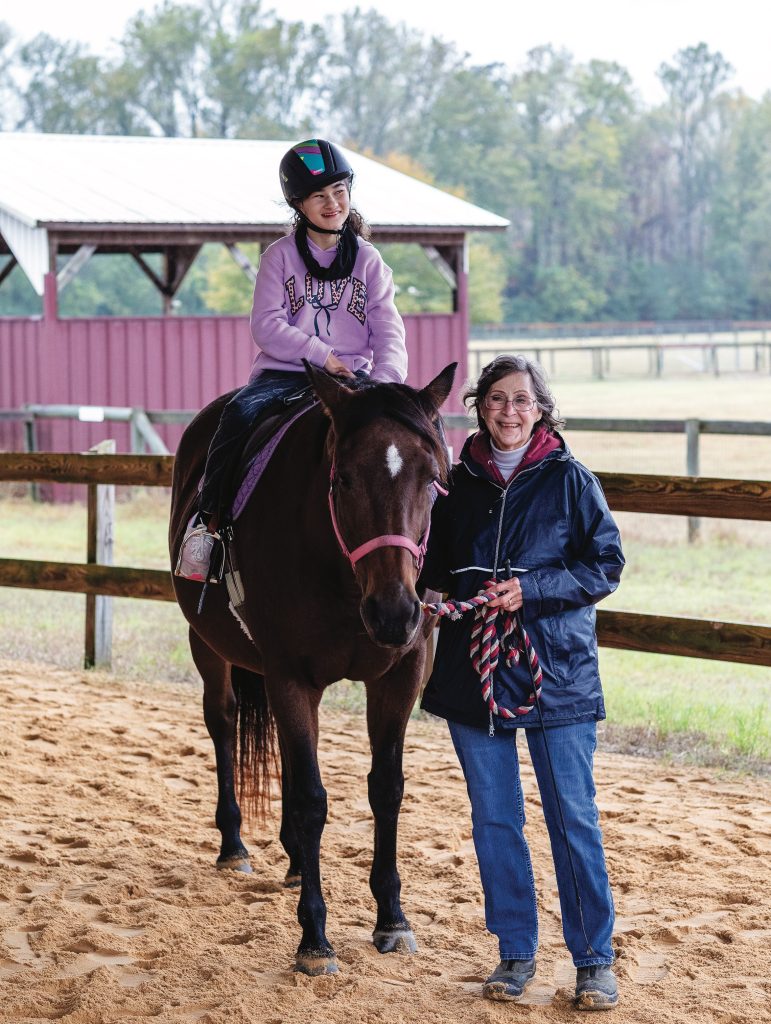
Prancing Horse Center for Therapeutic Horsemanship
Barbara Brazer
The Prancing Horse Center for Therapeutic Horsemanship is a refuge of calm amid its 15 horses, two goats, a cat, and a part-time dog. “We are a therapeutic horse facility,” says Brazer. “Horses have a very good intuitive aura about them, and they can bond to people with all kinds of issues — physical, autistic, mental, cognitive, stress-related and so on. But we’ve expanded a lot from just horse riding lessons. We wanted to do more. For example, we had a group of all wheelchair users. They came out and brushed the horses, fed them treats and just spent time bonding with them.”
Prancing Horse now includes a military veteran’s program. “The veterans don’t necessarily ride but do a lot of that groundwork, brushing and so on, just generally interacting and getting that emotional regulation that helps with anxiety and PTSD. Some people immediately bond with a horse, and it’s lovely to watch. Just being around the animals gives people benefits.” As for the goats? “Well, really, they just provide comic relief,” Brazer says.
She began volunteering at Prancing Horse shortly after moving to Moore County. “It brings people so much joy, especially the kids,” she says. “Some start off absolutely terrified, and usually by the end they don’t want to get off the horse. Personally, seeing their faces light up is what gives me the benefit.”
Moore Free &
Charitable Clinic
Shirley Baldwin
Baldwin, a retired nurse, has been volunteering at the Moore Free Clinic for 17 of the 20 years of its existence. “I started as a triage nurse and now I do education for diabetes, high blood pressure, nutrition, that sort of thing,” she says. “The reality is there are a lot of individuals who cannot afford their health care. Because really, if you had to choose between health insurance or putting food on the table, what would you do? We give fantastic quality primary care for people who can’t afford to see a doctor otherwise.”
Supported entirely by donations and volunteers, the clinic offers a wide range of services. “This, in essence, is a doctor’s office,” says Baldwin. “We now have a dental clinic. A gynecologist comes in and volunteers. We have an optometrist and someone who’ll be coming in to do physical therapy. We have medication in our pharmacy. It runs the whole gamut.”
It’s more than the impressive range of care that drew her to the clinic. “I enjoy this. I don’t plan on retiring until they kick me out because I get the satisfaction of helping those who can’t help themselves,” says Baldwin. “A former patient just came in and said, ‘I’ve gotten off track and I need to see you.’ Or someone might just say, ‘Thank you for listening.’ And that’s a million-dollar payment to me.”

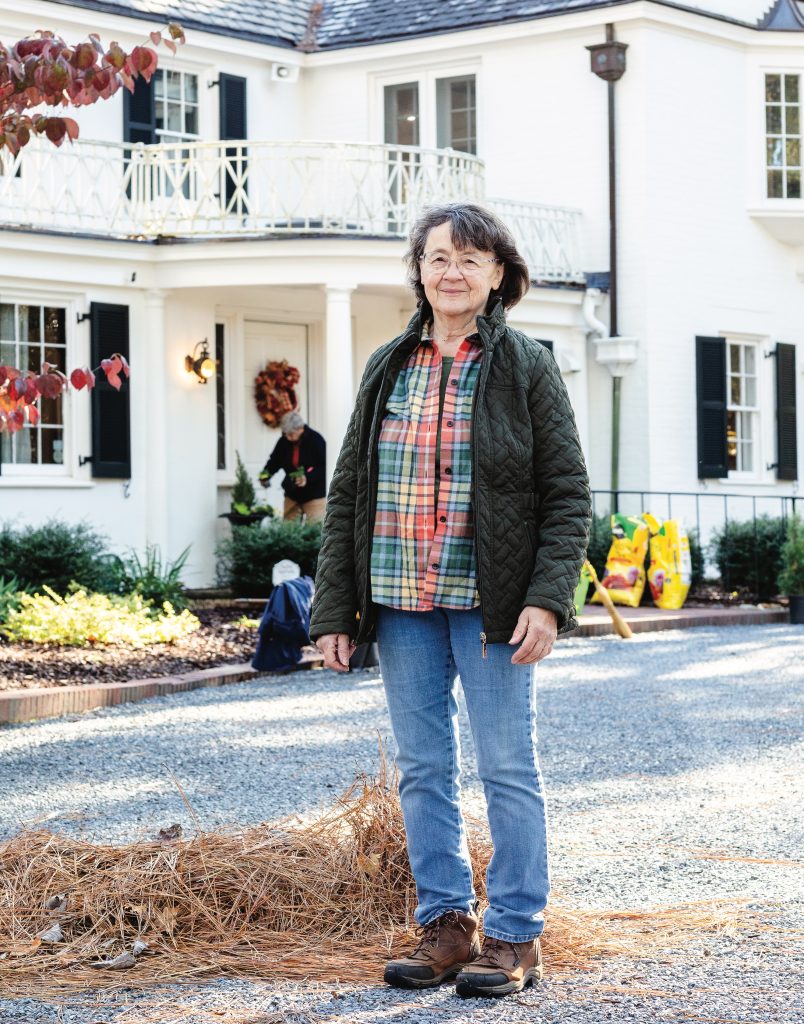
Weymouth Center for
the Arts & Humanities
Dirt Gardeners
Lucy Meldrum
“I was a vegetable gardener in New Jersey, but it’s hard to grow vegetables down here,” says Meldrum. “Everyone thinks they know gardening until they move here!” She’s gotten her gardening fix helping to maintain the grounds surrounding the Boyd House, the elegant home of the Weymouth Center for the Arts & Humanities. The work of keeping the estate looking as cared for as it did in the days of Katharine and James Boyd falls to the group known as the Dirt Gardeners. “I’ve been volunteering for around 13 years,” says Meldrum. “The work we do is your usual garden maintenance. We clean up the front, put in plants and do a lot of weeding.” They also propagate plants for the annual plant sale fundraiser.
Spending so much time with the land, Meldrum notices the intricate changes that increasingly affect how things grow. “Everything is growing late this year,” she says. Projects and plantings go hand in hand. She points to a pathway the Dirt Gardeners are putting in for children. “There’s always something that people can do even if they don’t know much about gardening,” she says. “Soon enough everyone enjoys working with the plants — seeing them grow, making a place thrive.”
Sandhills/ Moore Coalition for Human Care
Donna Blasingame
“This place has been a lifeline for me,” Blasingame says over the hubbub of trucks, volunteers and customers queued up outside the Coalition for Human Care. Customers are asking if the doors can be opened early; tables are being moved to make way for suitcases; trucks are waiting to park and unload. All the while, Blasingame carefully weaves her way around the site, answering questions, repricing items and checking in on her fellow volunteers. “We are affiliated with 70 churches, so we are always busy, and every penny stays in Moore County,” she says.
The Coalition has four stores, each selling different wares, from home goods to electricals, budget buys to a slightly more expensive boutique. They even sell wedding dresses. One store is called Miss Hallie’s House, named for the woman who donated her house to the Coalition in her will. “We are very blessed with donations,” Blasingame says, “but we still need people to support us because in order for the coalition to work we need volunteers. We are so busy.”
Blasingame’s husband passed away two years ago. “I’m among very supportive people. That’s why this place has been such a lifeline,” she says. In a back room of one of the stores, volunteers celebrate a birthday with doughnuts and friendly chitchat. Before long, they are all up, sorting, pricing, moving and doing their bit.

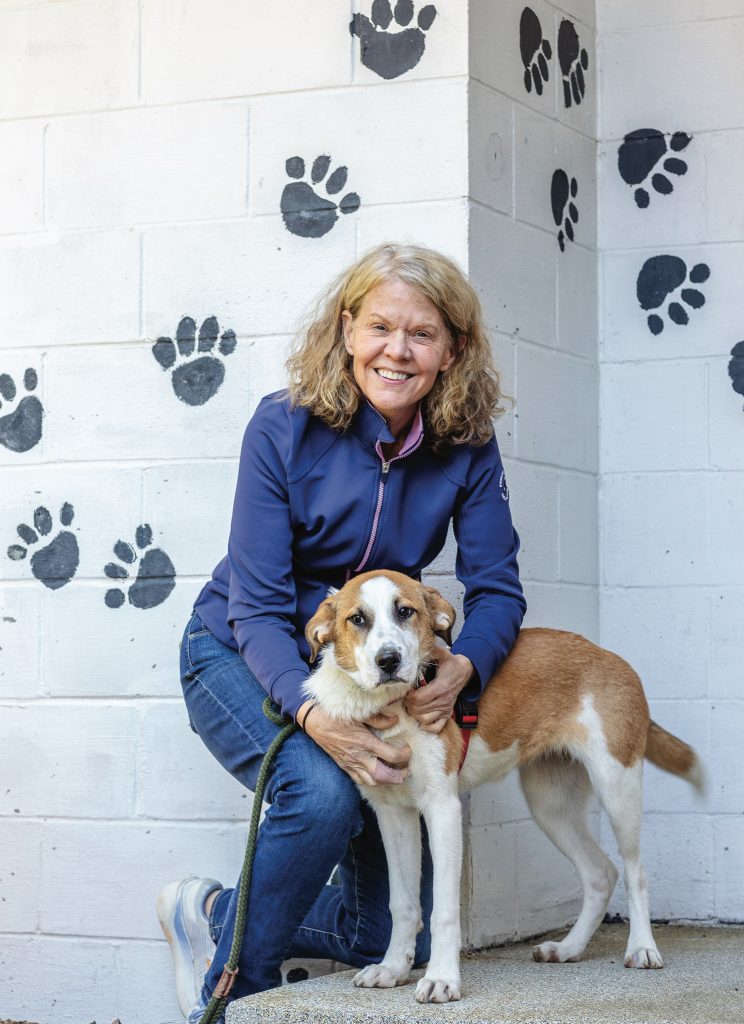
Moore Humane Society
Karen Kocher
“I started volunteering after I was at a friend’s house and a farmer brought in a crate of six puppies,” Kocher says. “We took them over to the shelter and I realized that’s just a day in the life of a volunteer — in comes someone who needs help with the animals, and in come people who adopt them. I thought, what a joyous place, so I signed up straight away.”
The Moore Humane Society, a no-kill shelter, quickly became the place where she invested her time. That connection has lasted nine years. “What amazes me about volunteering there is discovering how many people truly love animals enough to give up their own time to care for them,” she says. “There are people who’ve donated hundreds and hundreds of hours. To see the love that these people have for animals that are not their own is special. So I’ve found my people, the people who really feel that every animal deserves an awesome life. I’m so incredibly grateful to be able to see the little look on the face of an animal when they get the leash put on to go to their new home. Seeing the delight of the animals and their owners.”
And what does the society need from the community? “Everything we get is from donations, and every little bit counts. So if people feel compelled to donate funding or unused food, beds, leads and so on, they can drop it off. And of course, we also need volunteers. We could always use the help.”