

ONE FOR ALL - BY ALL

One For All - By All
The complicated birth of the Moore County Hospital
By Bill Case • Photographs from the Tufts Archives
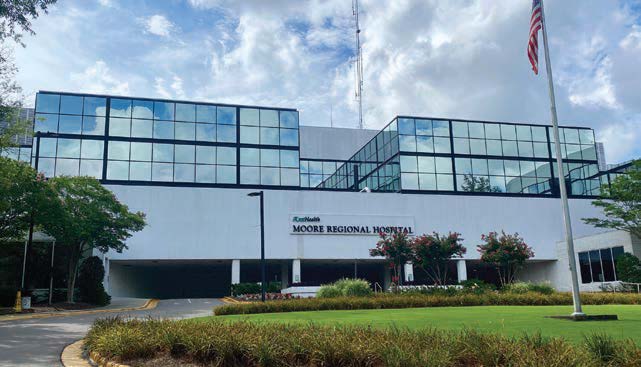
Last year, U.S. News and World Report ranked Pinehurst’s FirstHealth of the Carolinas Moore Regional Hospital sixth best in North Carolina. Money magazine placed it 65th in the country. With 402 beds, it serves as a primary care referring facility for the surrounding 15-county area. It employs more than 3,000 people, by far the most of any private Moore County employer. The spacious cancer clinic, opened in 2023, is the latest jewel in the crown.
Exactly a century ago, the residents of Moore County weren’t so lucky. In May 1925, the county’s lone acute care facility, James McConnell Hospital (named for Carthage’s heroic World War I flier) was teetering on its last legs. Located in rural Eureka, 4 miles from Carthage, the facility offered four private rooms and two wards, totaling 20 beds. During the influenza epidemic of 1918, McConnell treated 35 additional patients by putting beds on the porch.
Lacking an endowment, McConnell struggled to stay afloat, financially and literally. The wells serving the hospital totally dried up in periods of drought. Nurses and other employees hauled buckets of water from a spring half a mile away. As the Sandhill Citizen put it, McConnell was constantly “working against the task of too little money for too big a job.” The hospital closed its doors on June 1, 1925.
Following the shutdown, the nearest hospitals to Moore County were now located in Fayetteville and Hamlet. Southern Pines’ celebrated author James Boyd believed the status quo was unacceptable. “If a man gets seriously sick in this section of North Carolina, what can he do?” Boyd wrote in The Pilot newspaper. “That means a trip to Raleigh, or Charlotte, or Hamlet, or Fayetteville . . . if it is a case of accident, or other emergency, the two or three hours necessary to make the trip may cost the patient his life.”

Community-minded members of the Kiwanis Club of Aberdeen (later Kiwanis Club of the Sandhills) began considering the feasibility of building a modern hospital located close to Moore County’s population centers — Aberdeen, Southern Pines and Pinehurst. A Kiwanis committee met several times in late 1925 and early 1926 to discuss the parameters for a new hospital. At a February 3, 1926, Kiwanis meeting in Pinebluff, club president Talbot Johnson announced that there was a “chance to get a half-million-dollar hospital for the neighborhood of the most modern type.” He also announced that a newcomer to the campaign, Simeon B. Chapin, “and others of the moving spirits will be on hand to discuss this situation.” Johnson urged his fellow Kiwanians to pack the house for their meeting.
Proponents floated the concept of building a 70-bed hospital costing $500,000 plus an additional $250,000 endowment. Other public forums were scheduled in Aberdeen and Pinehurst. An overflow crowd at Pinehurst’s Carolina Theatre turned the presentation into a pep rally for the hospital, giving the project an enthusiastic (and nearly unanimous) thumbs up. “The pledge of support expressed by the audience would seem to indicate the county can be counted on for the maximum amount of support,” The Pilot reported.
However, it is one thing for citizens to stand up in a meeting and collectively voice their “huzzahs” and quite another to reach into their pockets to support it. It became clear that fundraising for a hospital would likely flounder unless people of substantial wealth stepped up. Six such men (two of whom were Kiwanians) banded together for the purpose of making the hospital a reality. The men who referred to themselves as the Hospital Committee were Leonard Tufts, whose family owned almost everything in Pinehurst; Jackson Boyd, a Pennsylvania coal magnate and, with brother James, co-master of the Moore County Hounds; Eldridge R. Johnson, founder of the Victor Talking Machine Company, which revolutionized the phonograph industry; Henry A. Page, Jr., president of two North Carolina railroads and owner of a chain of Ford auto agencies; John D. Chapman, a Wall Street broker and member of the New York Stock Exchange; and Simeon B. Chapin, owner of S.B. Chapin and Co., a stock and grain brokerage firm with offices in Chicago and New York City. After making Pinehurst his winter retreat circa 1910, he built several houses and acquired thousands of acres of Sandhills real estate. His Chapin Orchards made him the area’s foremost peach farmer.
But Chapin’s most profitable venture came in 1912 when, in partnership with the Burroughs family, he acquired 64,000 acres of South Carolina pine forested real estate, together with 9 miles of ostensibly “worthless” beachfront. Chapin and Burroughs developed the property into an unparalleled resort community — Myrtle Beach.
Chapin and the other members of the Hospital Committee, recognizing they were not qualified to evaluate the scope and size of the proposed hospital, retained the New York firm of Wright and O’Hanlon that specialized in such matters. In 1927, that firm’s lead partner, Henry C. Wright, conducted a survey of the area and concluded it was feasible to build a 35-bed hospital at a cost ranging from $80,000 to $140,000. The Hospital Committee’s members were ready to pool their money to fund the bulk of that price tag, but they considered it important to have citizens from the county at large also contribute.
Soon, a source of charitable funding emerged. It was learned that North Carolinian tobacco heir-investor-philanthropist James B. Duke had established the Duke Endowment, a trust fund totaling $400 million in assets. Among its missions was support for rural hospitals in North and South Carolina.
In March of 1927 committee members greeted Dr. Watson S. Rankin, the director of the Duke Endowment’s Hospital and Orphans section. Rankin advised those assembled that once the hospital was built, the Duke Endowment would be willing to contribute $1 per day per bed toward the care of patients unable to pay their bills. This was significant, because Moore County had its share of impoverished individuals, including many in its Black population (who were to be treated in a segregated wing).
While wrestling with financing, the committee also dealt with the thorny issue of the hospital’s location. Since Pinehurst was in the central section of Moore County, several properties on the outskirts of the village were considered. The members were unable to reach a consensus regarding the best site, so it was decided to have the consultant, Wright, make the choice. He picked property near the intersection of N.C. 211 and Page Road — the southern reaches of the current campus — citing as tiebreakers the fact that it was well situated to catch breezes (a must pre-air-conditioning), and that a sewer line was already in place. That site, like virtually all the land in and around Pinehurst, was controlled by the Tufts family. Leonard Tufts deeded the land over without compensation.
The task of raising money beyond its own membership continued to frustrate the Hospital Committee throughout the summer and fall of 1927. This included the securing of charitable funding. A Nov. 16, 1927, newspaper article in the Greensboro News caught Leonard Tufts’ attention, eventually breaking the logjam. The story indicated that the Duke Endowment was planning to build six or seven hospitals a year in North and South Carolina.

The following day, Leonard Tufts wrote Rankin, expressing his “hope one of these will be located in this section.” Rankin promptly responded: “I am glad to convey to you the encouraging information that we will probably be able to help you materially in the building and equipment of your new hospital.” He promised to send Tufts an application and did so on Dec. 27.

When the Duke Endowment’s trustees reviewed the information set forth in the application regarding contributed pledges, they were dismayed. Outside of “a few wealthy people from Pinehurst and Southern Pines,” there were few pledges. The Duke Endowment was disinclined to contribute anything unless the “people of Moore County” proved their interest with cash contributions in the amount of $25,000.
Why were people reluctant? “It has so happened that during the period when funds were being solicited, the farmers and businessmen in rural communities throughout the country were undergoing business readjustment through a period of deflation, which has made it very hard for them to get hold of any spare cash,” The Pilot reported.
But resistance went beyond that. Some scoffed that “a hospital is the last thing the county needs.” Decades later, Leonard’s son, Richard Tufts, wrote “Today it is difficult to believe that the establishment of our hospital was not a popular decision with all the people of this county. Many thought of a hospital as a place where you went to die and not to get well.”
Some local residents were peeved that wealthy winter residents from the North were running the show. “They have the money; they can afford it; let them pay for it,” was the sentiment. Naysayers also voiced the view that the hospital was being built to benefit Pinehurst resort guests, not permanent residents.
Based on the committee’s assurance that it would raise the requested $25,000, the Duke Endowment trustees conditionally approved a $25,000 grant on March 27, 1928. Rankin hinted more money might be forthcoming once the committee raised $25,000 from small, local donors.
The hospital committee shifted into overdrive, pushing for donations in Aberdeen, Southern Pines, Vass, West End, Lakeview, Pinebluff and Jackson Springs. In a meeting on April 24, 1928, the committee advised that “sufficient funds are definitely in sight for the construction of an A-1 hospital.” In sight perhaps, but not yet in the bank.
At the meeting, it was determined that building of the hospital would move forward even though the conditions of the Duke Endowment’s grant had yet to be satisfied. The prospect that the endowment could still pull the plug on its sizable contribution was deemed a risk worth running.
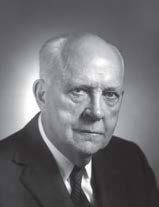
Contracts for the hospital’s design and construction would be required, so the committee formed a corporation to execute them. The board included representatives from throughout the county, including the mayors of Carthage, Southern Pines and Aberdeen. Simeon Chapin was named board president. The board immediately created a building committee composed of Leonard Tufts, Aberdeen’s Robert Page, Pete Pender, West End engineer George Maurice, Aberdeen Mayor G.C. Seymour and James Boyd. Cincinnati architect Samuel Hannaford was hired to design the building.
Meanwhile, contributions trickled in, but far too slowly. Hopeful that favorable press might sway hesitant donors, Leonard Tufts wrote The Pilot’s Bion Butler on May 5, 1928, seeking the paper’s assistance in clearing up “misconceptions” about the hospital. Butler printed Tufts’ correspondence verbatim on the front page. Tufts maintained the wealthy winter residents who were contributing the bulk of the money were doing so “not for selfish reasons, but giving of their riches to aid the health conditions in this county.”
The Pilot offered words of editorial support. “Men who do as much as the visiting strangers must not be looked on as the open pocket for everything that is wanted here, for it would soon destroy their regard for the community that would permit such mendacity, and it would also ruin the community’s regard for itself.”

Though not having obtained the necessary subscriptions from “outside Pinehurst” as required by the Duke Endowment, the Moore County Hospital Association boldly plunged into deeper waters on Nov. 13, 1928, hiring Sanford contractor Jewell-Riddle Company to construct the hospital. The company estimated the cost to build at $167,000. Groundbreaking took place that same month.
Meanwhile, hospital boosters resorted to new measures to eliminate the fundraising gap. On Sunday, Nov. 24, 1928, pitches for subscriptions were made at the services of every Moore County church. The new owner of The Pilot, Nelson Hyde, implored readers to contribute, “in any sums, big or little as it is desired.” In his Nov. 30 editorial, Hyde offered a rallying cry for this effort. “One for all — by all.” Subscription forms were printed in the paper.
The fundraising campaign was still short of its goal when the cornerstone for the building was laid on March 19, 1929. Conditional funding from the Duke Endowment remained up in the air. Chapin briefly addressed those assembled at the cornerstone ceremony: “This hospital is built by all the people of Moore County to serve all the people of Moore County, and is here and now dedicated to the county and its citizens for ever and ever.“ He closed with, “We wish it Godspeed on its errand of mercy into the future.”
To those still skeptical regarding the county’s need for a hospital, events the following day in Southern Pines served as a grim wake-up call. The town’s police chief, Joseph Kelly, was ambushed and shot four times while searching an automobile. The motorist who fired the gun was wanted by law enforcement for an assortment of holdups and burglaries.
The chief was in a bad way but managed to stagger to his patrol car and drive to the residence of Dr. W.C. Mudgett before collapsing to the ground. Mudgett summoned an ambulance, which transported the gravely wounded chief to Highsmith Hospital, in Fayetteville. He died the following morning. It cannot be said with any certainty that Chief Kelly would have survived had the hospital been nearby, but that thought undoubtedly crossed peoples’ minds.
Perhaps the murder loosened strings on some pocketbooks. Or maybe the eye-catching sight of the new three-story brick and columned hospital did. In any event, it was announced in the Sept. 20, 1929 Pilot that “the necessary donations to make available the conditional subscription of $50,000 by the Duke Endowment have all been paid in.” Construction was finished two months later. The final cost of the building plus needed equipment turned out higher than projected. The Duke Endowment upped its building contribution to $75,000.
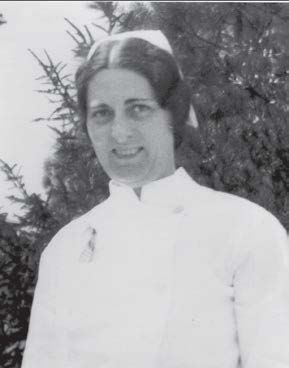
Moore County Hospital’s 33 beds and two operating rooms opened to patients on Nov. 25, 1929. Chapin continued in his role as board president. Dr. Clement R. Monroe became the institution’s first doctor and administrator. The omnipresent Dr. Mudgett was named chief of surgery. Ellen Bruton supervised the nurses. To the surprise of the staff, the hospital was filled to capacity almost from the start.
While all the members of the Hospital Committee deserved credit for their steadfastness, Simeon Chapin came to be regarded as its guiding spirit. In 1930, the Sandhills Kiwanis Club awarded Simeon the Builder’s Cup. The Pilot noted that “Mr. Chapin’s faith and optimism through the long campaign for funds, plus his untiring efforts in soliciting contributions, and in overseeing the proper expenditure thereof, which has given to this section of the state one of the finest institutions to be found anywhere in the United States.”
However, the struggles continued. With the onset of the Great Depression, nearly two-thirds of the patients during the hospital’s first year could not afford to pay for treatment. In his role as administrator, Dr. Monroe scrambled to keep the operation above water, describing himself as the “all around water boy.”
Alarmed by the shortfalls, several organizations pitched in to assist. The women who comprised the Moore County Hospital Auxiliary contributed money, towels, curtains and bedclothes. The 400 members of the Birthday Club made it their practice to donate funds, canned goods and linens on their respective birthdays. An old fashioned “pounding” was held in the early years, in which local farmers donated vegetables, fruits, jellies and jams. The hospital even purchased a cow to supplement its dairy requirements.
Despite the hardships, Moore County Hospital prospered and grew, and soon needed to expand. By 1939, housing for nurses and a new wing featuring 26 additional beds had been added to the campus. The hospital’s endowment and footprint would eventually grow far beyond the dreams of the founders.
James Boyd passed away in 1944. Four of the remaining stalwarts responsible for the birth of Moore County Hospital died in 1945: Leonard Tufts, Eldridge Johnson, Pete Pender and the hospital’s honorary president, Chapin. On the day of his passing, the latter visited the hospital to make a donation for the purpose of ensuring the presence of Bibles in every room.
It was the sort of thing Chapin had been doing his whole life. He liberally supported churches of all types, including Pinehurst’s Village Chapel, serving on that church’s building committee during its erection in 1924 and ’25. In Chapin’s 1929 hospital dedication speech, he opened with this anecdote: “About five years ago, when the new church was being built in Pinehurst, a certain person who had had sickness in the family said to me, ‘We need a new hospital more than we need a new church.’ My answer was, ‘We need both.’”
He got both.