NC Surround Sound

NC SURROUND SOUND

Sounds of a City

Music with a connection to place

By Tom Maxwell

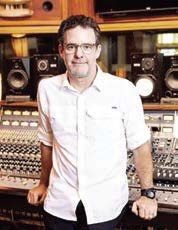
Alex Maiolo is a creature of pure energy. It’s not that he talks fast or acts nervous — he’s simply an ongoing conversation about electronic music, geography and whatever else happens to capture his interest. He’s also a singular kind of globetrotter, one who doesn’t sound pretentious about it. He loves Estonia’s capital, Tallinn, so much he made music with the place, a 2021 conceptual performance he called Themes for Great Cities.

Conceived as one of his two main pandemic projects — the other was getting better at making pizza — the musical idea took on a life of its own even as the flatbread faded. He invited Danish musician Jonas Bjerre, Estonian guitarist and composer Erki Pärnoja and multi-instrumentalist Jonas Kaarnamets to collaborate. What resulted was something that felt improvised, unpredictable and exhilarating.

“Even though I was living in Chapel Hill, I was trying to think about, well, what do you miss when you miss a city?” he says.

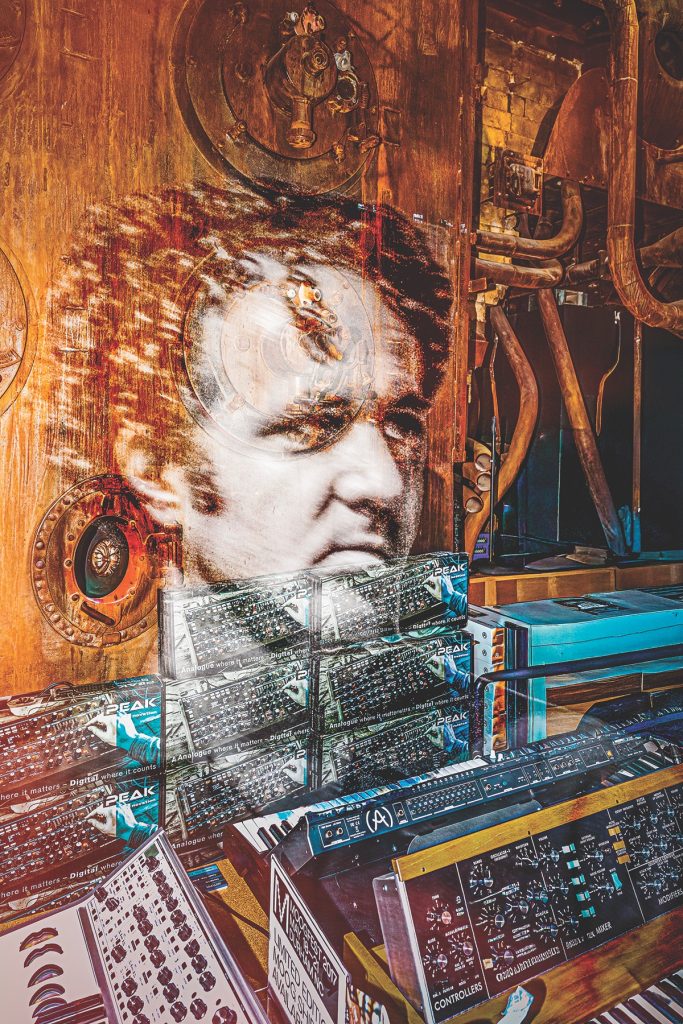
The obvious things — favorite restaurants, familiar streets — were only part of it. Beneath that, Maiolo sensed a deeper, subconscious connection to place that might be expressed musically. He seized upon the idea of treating the city itself as a collaborator. “I wanted to write a love letter to this incredible city by gathering elements of it and assembling them in a new way,” he says. Sounds and light readings became voltages; voltages became notes. “Every synthesizer is just based on the assemblage of voltages,” Maiolo says. “So, if you have voltages — particularly between negative five and plus five volts — you can make music.”

The group collected source material across Tallinn: gulls shrieking overhead, rainwater rushing down a gutter, chatter in a market, the squeak of trams, cafeteria trays clattering at ERR (Estonia’s equivalent of the BBC). A custom-built light meter called the Mõistatus Vooluringid — “mystery circuit” — captured flickering light and converted it into voltages. These inputs were then quantized, filtered and transformed into sound. Tallinn became what Maiolo called “our fifth band member. And just like with any band member, you can say, ‘Hey, that was a terrible idea’ or ‘way to go, city — that was a good one.’”

From the outset, the goal was to create something that felt alive. “We wanted happy accidents,” Maiolo says. “Quite frankly, I wanted to be in a situation where something could go wrong.” Unlike a pre-programmed, pre-recorded synthesizer session, Themes for Great Cities was designed to court risk through completely live and mostly improvised performance — to create the same adrenaline rush that test pilots might feel, only with much lower stakes. “No one was going to crash,” Maiolo says.

That philosophy made the project’s debut even more dramatic. Originally slated for a 250-seat guild hall built in the 1500s, the show was suddenly moved to Kultuurikatel, a former power plant that holds a thousand. Then came another surprise: The performance would be broadcast live on Estonian national television, with the nation’s president in attendance. “It was far beyond anything I had imagined,” Maiolo admits. “I thought we were going to play to 30 people in a room.”

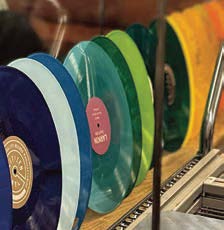
Visuals by Alyona Malcam Magdy, unseen by the musicians until the night of the show, added a surreal dimension. Estonian engineers captured the performance in pristine quality. “It all came together,” Maiolo says. “The guys I was doing this with are total pros.” The recording was later mixed and pressed to recycled vinyl at Citizen Vinyl in Asheville. Unable to afford astronomical mailing expenses, Maiolo split 150 LPs between Estonia and the United States, carrying them in his luggage.

Though imagined as a one-off, Themes for Great Cities continued to evolve. The group returned to Estonia in 2022 for a new performance in Narva, reworking parts of the score and staging it in a former Soviet theater. “We didn’t record that one because it was similar to the first. But when we do Reykjavik, we’ll record that one and hopefully release it,” he says. Yes, Iceland looks like the next destination. The plan is to work partly in the city and partly in the countryside, where light, landscape and weather can all feed into the music.

The ensemble has grown tighter, but Maiolo emphasizes the lineup will be flexible, with an eye toward incorporating local musicians. Vocals may be added in future versions, perhaps improvised or even converted into voltages to manipulate the electronics. “Anything is possible,” he says.

Though he now lives in San Francisco, Maiolo continues to think of North Carolina as part of his creative geography. He still has his house in Chapel Hill, stays connected to Asheville’s Citizen Vinyl, and carries his records home through RDU.

Maiolo and his partner of seven years, Charlotte, are to be married in Saint-Germain-des-Prés in Paris. Her father, a German who came of age during World War II, once spent a year in San Francisco immersing himself in jazz. Even now, as he struggles with dementia, he plays clarinet and listens to Fats Waller and Oscar Peterson. The sense of music as a lifelong companion, capable of anchoring memory and identity, is yet another thread running through Maiolo’s work.

Ultimately, what began as an experiment has become an ongoing series of collaborations. Each city brings its own textures, rhythms and surprises. Each performance is both a portrait and a partnership. “At the end of the day, it just kind of sounds like music,” Maiolo says nonchalantly, as if jamming with an entire city is an everyday thing.

NC Surround Sound

NC SURROUND SOUND

A Musical Life

Creating space for art to thrive

By Tom Maxwell

Seminal producer, songwriter and musician Mitch Easter remembers the intersection where he was stopped when Big Star’s power pop masterpiece “When My Baby’s Beside Me” came on his car radio in the 1970s. “It just sounded so great,” Easter says. “The thing is, mainstream radio stations avoided stuff with guitars back then. You heard a lot more electric pianos and Carpenter-types. So, when you would hear a rock song like that — with all these great sounding guitars — it really popped out.”

Big Star was a short-lived Memphis band that left a lasting legacy. Easter thinks his local Winston-Salem FM station played them for a couple of weeks almost by accident. “Radio stations were more independent back then,” he says, “and I think somebody took a shine to that song.”

Those two weeks would help shape the rest of Mitch Easter’s life. Big Star had such an effect on the young musician that in 1978, he and two friends went to Memphis to meet their idols, even though the band had broken up several years previously. “Somewhere along the way we’d been given information about how to find (co-founder) Chris Bell,” Easter says. “So we went out there and hooked up with Chris. He was working at Danvers, this roast beef place that his parents owned. We passed a note back from the cashier and this guy came out, like, ‘Who’s looking for me?’”

Bell took them to Sun Studios, where former Big Star frontman Alex Chilton was making a record. “I don’t think Chris and Alex had seen each other in a while. So, it’s cool if we were some kind of icebreakers.” Bell would be dead before the year was out, killed in a car accident a couple of days after Christmas. He was 27.

Soon after his Memphis trip, Easter followed other musician friends to New York. “We were all big fans of the punk scene coming out of New York,” he says, “even though none of us were really punk rockers per se. It was a proper music scene. There were little labels popping up, and there was Trouser Press and New York Rocker magazines.”

Easter planned to open a recording studio in New York. He had a keen interest in recording technology and by this time had racked up considerable experience experimenting in his parents’ basement with reel-to-reel multitrack tape machines. “I remember very distinctly reading in an electronics magazine a description of what really happens in the recording studio and laughing it up because it was completely mysterious to me,” he says. “I used to imagine that on the early Beatles things when George Harrison was playing acoustic and then there was a solo, I thought somebody threw him an electric guitar really fast and he started playing it.”

That New York life wasn’t meant to be. In his own words, Easter “chickened out” and moved back to North Carolina, but the Triad had changed. Original bands were forming left and right; local college stations were playing post-punk bands like the Buzzcocks; and a cool new club called Fridays opened up in Greensboro. “It was really a pizza joint,” Easter says, “but they had the new-type rock bands play on the weekends. It was full of the kind of kids that I saw in New York. The other thing I observed was people dancing. It was like it had been rediscovered.”

In short order, Easter addressed his quarter-life crisis by opening a recording studio named Drive-In Studio, because it was situated in his parents’ two-car garage in rural Winston-Salem. One of his early bookings was a weekend spent recording demos with a young band out of Athens named R.E.M.

“There was this big split back then,” Easter says. “A lot of the recording studios were still operating on the fumes of disco — and the fumes were pretty strong. So, there was a vibe that the bands did not dig about ‘real’ recording studios. Maybe in New York and London these punk bands were working in nice studios, but there wasn’t anything like that here. There were either real funky garage studios or the big studios. The perception of Drive-In was that this was a studio oriented for you, which it kind of was. It was really humble.”

Happy with their demos, R.E.M. soon returned to make a proper record. In 1982, Easter produced their dazzling debut EP (extended play), Chronic Town.

Meanwhile, Easter was writing, singing and performing with his own group, a power-pop trio named Let’s Active, which he formed with then-girlfriend Faye Hunter and drummer Sara Romweber, sister to Chapel Hill rocker Dexter. In 1983, Easter co-produced R.E.M.’s first full-length Murmur and wrote pure pop gems with Let’s Active, like “Every Word Means No,” issued on the band’s debut EP Afoot.

This, then, became Mitch Easter’s busy musical life for the next decade. Along with R.E.M.’s sophomore album Reckoning, he produced visceral power pop records with bands like X-Teens, Game Theory, The Connells, Velvet Elvis and Love Tractor. Let’s Active carried on making albums until its dissolution in 1990, an act that led to newly formed groups from nearby scenes in Chapel Hill and Raleigh.

Drive-In Studio closed in 1994, when Easter opened a new “residential” studio near Kernersville called Fidelitorium. “I’m a great supporter of making records in bedrooms and all that kind of stuff,” Easter confided, “but there’s a thing about going to a dedicated space that’s really useful. It focuses your effort, especially with a group. A lot of people need to get away from their house.”

And there’s art in the studio beyond the music. “The other thing that dawned on me is that you take a whole lot better pictures in a proper studio, right?” Easter says. “I love those electric Dylan-era pictures from Columbia Studios in New York, those great black and white pictures of big rooms that don’t have much in them but very cool looking musicians. You could only do that in a proper studio. I’m sorry that these big places are going away because they were very romantic to me.

“Even uncool studios were important because if they hadn’t existed, you might not have had that unbelievable scene in Boogie Nights, when they want their tapes back and they haven’t paid for them. I just hope that the big places don’t totally go away or only do soundtracks for epic blockbusters. There’s a meeting place thing about a proper studio that’s kind of beautiful.”

Easter, a portrait of the artist as an older man, will turn 71 in November. “It’s funny about music,” he says. “You’ve got a long trajectory of possibilities. Little kids can be really good at music in a certain mechanical way, and sometimes they’re pretty expressive, too. I might have played the best when I was in my mid-30s, but I have more sense about it now. When your fingers do a bunch of stuff, that’s great, but maybe you’re not thinking about it quite enough, or you’re doing too much. The thing that’s so cool about pop music is there is a place for all those stages. It’s funny that rock music has finally allowed people to be old. It’s a really wonderful thing in these everything-is-falling-apart times to think that there is good stuff to do throughout your life when you’re a musician.”

NC Surround Sound

NC SURROUND SOUND

Feast of Festivals

A magical musical tour

By Tom Maxwell

There are music festivals across the length and breadth of North Carolina this year — more than you will have either the time or gas money to attend. July alone features four worthy of mention, existing on the widest possible spectrum of musical and geographic diversity. We’ve got fiddles in the highlands, jazz on the beach, classical quartets in the Nantahala National Forest and a regular smorgasbord of sounds in the Piedmont.

The 46th annual Festival for the Eno kicks off in Durham on Friday, July 4. The two-day event features over 60 artists performing on four different stages, including former Carolina Chocolate Drops’ Dom Flemons, local poet and musician Shirlette Ammons and the Empire Strikes Brass.

There will be some novel attractions as well. “Since the festival’s inception, our Grove stage has focused primarily on traditional music through the lens of Americana,” festival director Bryan Iler says. “This year, there is still going be all that bluegrass and country and clogging, but there’s also going be a wider representation of traditional cultural music that I think is a little more representative of the Triangle community. We’re going to feature a full mariachi band, a traditional West African Senegalese pop band and Congolese percussionists. Oh, and Rabbi Solomon [Hoffman] from Chapel Hill has put together a klezmer group.”

And there’s more than just music. Attendees can learn fly-fishing, poster-making or browse handmade arts and crafts from 80 different vendors. “It’s really a salad bar of ways to have a good time and plug into at a deeper level with our community,” says Iler.

July 4 is also opening day for the Ocean City Jazz Festival on Topsail Island. “It’s a three-day event with three artists per night,” says Carla Torrey, who has organized the festival with her husband, Craig, for the past 12 of its 15 years. “We are trying to promote the history of the community and support its legacy.”

The Ocean City Beach Community is a neighborhood 3 miles north of Surf City that stretches from beach to sound. It was founded in the late 1940s as an interracial corporation where African Americans could own beach property in the days of segregation. A 700-foot lighted pier constructed in 1958 — at the time the only pier in the South Atlantic open to people of color — and many of its 100 or so Black-owned homes were destroyed by Hurricane Fran in 1996. Though those structures were not rebuilt, the community remains, and the festival is committed to preserving and expanding on its legacy.

This year’s Ocean City Jazz Festival features artists like Jackiem Joyner, Jazz Funk Soul, Nathan Mitchell, The Double Bass Experience and the John Brown Little Big Band, featuring Camille Thurman. Related events include an exhibition of paintings by artist Rik Freeman called “Black Beaches During Segregation” (on display starting June 28), day parties featuring line dancing instructors, food vendors and a boozy “Uncle Nearest Experience” with executive bourbon steward David Neeley. (Uncle Nearest Premium Whiskey honors the memory of Nathan “Nearest” Green, the formerly enslaved man who taught Jack Daniel the art of distilling.)

“We’re truly a jazz festival,” Torrey says. “All the music is going to be jazz, and we do a mix of smooth and straight ahead so that everybody gets to appreciate it as a genre.” Music plus an ocean breeze and sand between your toes? Sounds like a plan.

The 44th annual Highlands-Cashiers Chamber Music Festival kicks off July 5 in the southwestern counties of Jackson and Macon, roughly 400 miles from Topsail Island. You don’t have to be in a rush to get there, though; this festival lasts until August 10, featuring four concerts every weekend.

“It is a six-week festival of predominantly classical music,” Executive Director Nancy Gould-Aaron says, “but we do bring in other things to mix it up a little bit. We have jazz versus classical this year. In the past we’ve brought in Mark and Maggie O’Connor, so we’ve had a little bit of bluegrass, too. We probably have three or four quartets a season. Not too many duos, but we have a lot of soloists and put them together. For our gala event, we’ll have enough musicians to make up an orchestra.”

This year’s Highlands-Cashiers Chamber Music Festival features the North Carolina debut of Paul Colletti’s Viola Quintet featuring The Viano Quartet, poet laureate Rita Dove, the Whitehead Family Young Pianist Concert with Zitong Wang, the Pacifica Quartet featuring Sharon Isbin on classical guitar; and, a final gala “Cellobration” — a concert with eight cellos led by the Grammy-winning cellist Zuill Bailey.

The two-day 54th annual Old Time Fiddlers Convention, held in Ashe County Park in the state’s northwest corner, begins July 25. It takes place rain or shine, so bring your camping gear and get ready to hear a slew of banjo, fiddle, guitar and mandolin by the likes of Sassafras and the New Ballards Branch Bogtrotters. As usual, there will be open jam sessions galore, as well as competitions for young and old musicians alike, featuring several thousand dollars in prizes. Proceeds from the festival go to support JAM, the Junior Appalachian Musicians program, an organization that instructs third- to fifth-graders in fiddle, banjo and guitar.

This quartet of festivals barely scratches the surface of North Carolina’s musical itch. What an opportunity to explore the state and expand your musical horizons.

NC Surround Sound

NC SURROUND SOUND

Stepping Up

Citizen Vinyl pressed into service

By Tom Maxwell

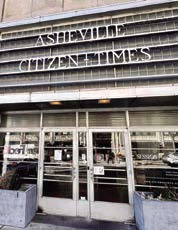
There’s a beautiful Art Deco building at 14 O. Henry Avenue in Asheville, located on a particularly high spot in that already elevated mountain city. Completed in 1939, it was built to house owner Charles Webb’s two newspapers (the morning’s Asheville Citizen as well as the Asheville Times afternoon edition) in addition to his newly-acquired-but-already famous radio station WWNC-AM. For the last five years, Webb’s glass brick, black granite and limestone behemoth has been home to Citizen Vinyl, a unique combination of record pressing plant, recording/mastering studio, record store, art gallery and café. But in October 2024, the place served as an altogether different kind of community hub.

“We were one of the few Asheville businesses that had both power and internet a couple of weeks after the hurricane,” Citizen Vinyl founder and CEO Garland (Gar) Ragland says, “so we immediately pivoted to becoming a community resource. We ran extension cords out of our space in the building, and got the word out that we had internet available and power for people to charge their digital devices and cellphones. We had hundreds of people coming every day to power their phones and text or call their loved ones to let them know they were safe.”

In September, Hurricane Helene wiped large swaths of Appalachia off the map. Entire towns in western North Carolina and eastern Tennessee in valleys near rivers or creeks were washed away. Marshall, a small town north of Asheville, was destroyed. To the east, Swannanoa suffered a blow from which it has yet to recover. The recently established Arts District, nestled alongside the French Broad river in West Asheville, was suddenly under 12 feet of water. The big Art Deco building that houses Citizen Vinyl was quicker to recover than most other businesses thanks to its elevation and its proximity to NOAA’s Federal Climate Complex, which houses both the National Climatic Data Center as well as the country’s Climate Archive.

Soon, one of Citizen Vinyl’s food partners, Michelle Bailey, set up smokers and grills in their little parking lot and started preparing meals from food donated by far-flung friends and her regional farming network. “She started the weekend after the hurricane,” Ragland says, “and served about 1,500 hot meals every weekend for weeks. She had friends from Louisville, Kentucky, come over and bring hundreds of pounds of top-shelf smoked meats and barbecue. So, we pivoted — because we really didn’t have any other option than to just lean in and support our community in whatever way we could.”

Ragland is quick to point out that he and his friends weren’t the only people who met the moment. “There were many, many, noble efforts,” he says, “and what was revelatory to me was how unique and special this community of people is, how readily and instinctively people showed up to help one another. There were people on street corners with signs saying ‘Free Water Here,’ or ‘Hot Food.’ I was really impressed and inspired and proud to be a member of this community because we showed up for each other.”

Ragland, a native of Winston-Salem, started Citizen Vinyl in 2019. Inside Charles Webb’s three-story building, he established the pressing plant along with Sessions (the breezy bar and café) and Coda: Analog Art & Sound (a combination art gallery and record store). On the top floor, Ragland converted the hallowed space of WWNC into Citizen Studios, a recording and mastering facility. He can quote the building’s history chapter and verse.

“Charles Webb designed and dedicated the top floor of the Citizen-Times building to be the new home for his radio station,” Ragland says. “It was state-of-the-art. He modeled it after the RCA Victor Studios in New York. By the time of the station’s construction, WWNC-AM had already become one of the most popular radio stations in the country. It was previously located a couple of blocks away in the Flatiron Building, and it was there that Jimmy Rodgers made his national radio premiere in 1927.” Immediately after the station reopened in its new location bluegrass legends Bill Monroe and the Blue Grass Boys debuted on February 2, 1939. The group played the daily afternoon “Mountain Music” slot until WWNC became a CBS affiliate.

At the time, artists from all over the country were descending on Asheville because of WWNC’s reach. “It was the highest elevation radio station east of the Mississippi,” Ragland says. “That 570 kHz radio frequency could throw from downtown Asheville all the way to West Texas and up into southern Canada.”

The amazing thing is, despite eastbound I-40 being washed out between Old Fort and Black Mountain — while half of its westbound lanes crumbled down into a gorge outside of Knoxville — Citizen Vinyl never stopped pressing records. “Our shipping and receiving did slow down,” Ragland notes, “and we had a couple slow months.” Not that big a deal, considering the town wouldn’t have potable water for 11 weeks.

In the best of times, people tend to think of things like music and food as ephemera, as if they’re mere ornaments to the real work of producing wealth. But you’d be hard pressed to think of two things more deeply woven into the fabric of community than a mother singing a lullaby to her drowsy infant, or the connections made and deepened by a shared meal in a desperate moment.

“Being part of this community and serving as a cultural hub has been a really important part of our ethos and business,” Ragland says. “The hurricane, full disclosure, put into jeopardy our ability to sustain the café and the event space. But that said, the challenges only reinforced the values and the ethos that we’ve constructed this business to be, evidenced by our name.”

The word “citizen” has been with us since the late Middle Ages, and has specific meanings in different areas of law, religion and the military. Ragland is well aware of both the promise and potential risks of using that word.

“Obviously, there’s a history that we wanted to honor by calling the business Citizen Vinyl,” he says. “But the term itself is a very provocative name to title your business because it means different things to different people. For the undocumented person, it’s a loaded word. It can be an alienating and divisive term. But on the flip side, ‘citizen’ asks the question: What does it mean to belong to a place?’ We were intrigued by the opportunity to help shape and define what it means. We’re music nerds, not music snobs. We don’t judge people’s music tastes. We want to celebrate music, art and community. We don’t pass judgment on anyone. We want to operate our business in a way that defines ‘citizen’ in the most positive of ways. The hurricane, if nothing else, created an opportunity for us to put into practice a lot of the things that we aspire to be as members of the Asheville community.”

The quote “We may achieve climate, but weather is thrust upon us” is often attributed to O.Henry, the author Citizen Vinyl’s street is named for. The catastrophic destruction caused by Hurricane Helene may have kept you away from Asheville, but it’s time to go back, to witness firsthand the climate of resilience and community achieved by its citizens.

NC Surround Sound

NC SURROUND SOUND

Dropping In

Return of the Carolina Chocolate Drops

By Tom Maxwell

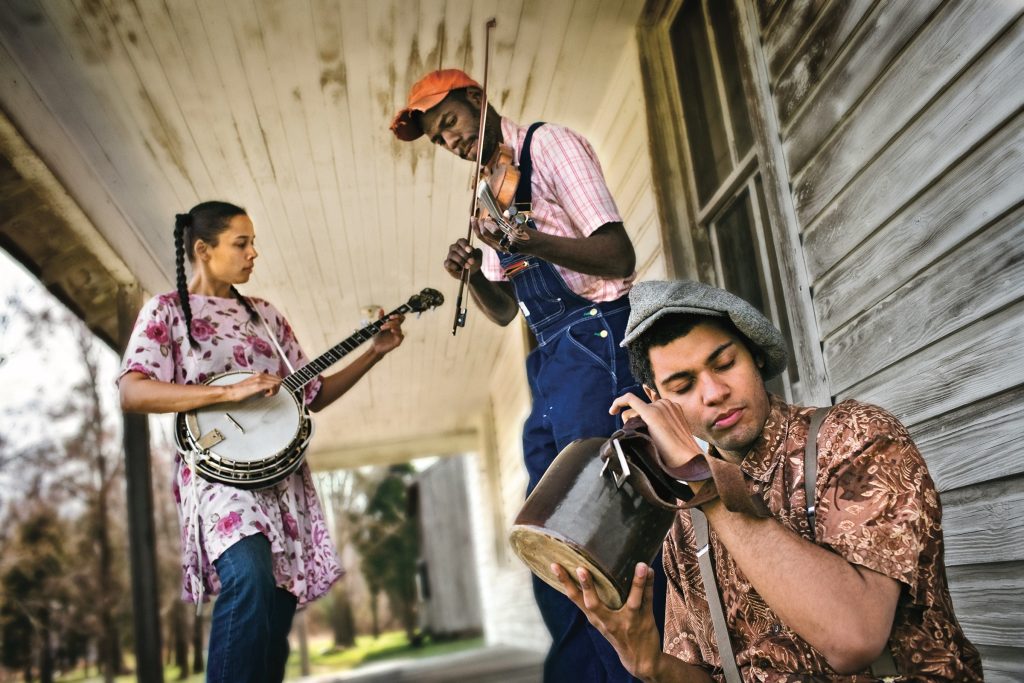
It all started in April 2005, at the first “Black Banjo: Then and Now Gathering.” The event, held at Appalachian State University in Boone, was part scholarly pursuit and part throwdown, featuring four days of “lectures, jams, workshops, down home frolics, and performances” with a view to bringing the “funky, plunky instrument” back home to Black America. Dom Flemons, a 23-year-old student at Northern Arizona University, attended.

“I was the young person at the event,” Flemons says. He had been playing banjo for a few years already, busking on street corners and devouring records by the Memphis Jug Band and Dave Van Ronk, as well as ’20s songster music of people like Gus Cannon, who had a late-in-life hit when the Rooftop Singers covered his 1929 stomper “Walk Right In,” and Henry Thomas, whose Texas ragtime tunes were covered by ’60s folk/rock stalwarts Bob Dylan, The Lovin’ Spoonful and the Grateful Dead, among others.

So, like many young people who fall in love with old music, most of Dom’s musical heroes were dead — even if their music was very much alive. But in Boone he was about to enter the musical land of the living.

“When I met Joe Thompson, a light bulb went off in my head,” Flemons says. “I heard him playing at the opening ceremony for the Black Banjo Gathering, and all of a sudden I understood the music that connected people like Henry Thomas to Gus Cannon. When I heard Joe’s music, I heard that flavor of fiddle and banjo music that these guys were referencing, playing and living next to generationally. And that inspired me to move out to North Carolina. I sold everything I owned, packed up my car, and took Route 66 east, headed for North Carolina to be near the music.”

Thompson, born in 1918, had been playing African American string band music for 80 years by the time Dom Flemons heard him perform at the Black Banjo Gathering. An Orange County native, Thompson joined his family on fiddle (after studying his father’s old-time technique, which was handed down by his own father, a former enslaved person) playing square dances, parties and dances after corn shucking or tobacco stripping. Joe considered quitting music after his cousin and musical partner, Odell Thompson, died in the ’90s, but picked it back up basically by popular demand. Even a stroke in 2001 couldn’t slow him down. “I got to sit with Joe and play music,” Flemons remembers, “and it was a powerful experience just to be in his presence. I also tried my best to play banjo behind his fiddle playing. I knew that I was connected to the tradition from there.

“There’s magic in the excitement and drama and the wealth of culture that is translated through a live performance,” Flemons adds. “It’s something beyond just music. It’s a feeling as well and, if you’re deep in the culture, you understand the nuances of that feeling. In the ’50s, they talked about old-time music and analyzed it a certain way. So, when you read books about it, you can understand it to a degree. But once you’re in it, that’s when you can take on a whole other quality.”

Two years after his performance at the first Black Banjo Gathering, Joe Thompson became a National Endowment for the Arts National Heritage Fellow. He also started mentoring Dom Flemons’ new band. Local musicians Rhiannon Giddens and Justin Robinson also saw Thompson at the Black Banjo Gathering and had been playing music at his Mebane house for several months by the time Dom, newly graduated from college, moved to North Carolina. The three youngsters decided to form a band of their own. “These are the years leading into Obama being elected,” Flemons says, “and culturally, people were ready for a Black string band. They could handle it.”

Flemons, Giddens and Robinson called their band the Carolina Chocolate Drops. “With the combination of all three of the original members of the trio, we created a sound that was very authentic and raw, but also landed right,” Flemons says. “I always compare it to The Beatles because we had a gestation period where we mostly played square dances. So, we always had a rock solid rhythm. I leaned 100 percent into that, because being a fan of the Grateful Dead and stuff like that, I understand that give and take with the audience.”

All traditions, an accomplished jazz musician once observed, meet at the root. In their career, the Carolina Chocolate Drops were seamlessly able to blend Civil War-era Black string band music, ’60s folk-rock, jazz and hip hop. It’s no surprise — but still an absolute delight — that the band covered Blu Cantrell’s 2001 R&B Top 40 hit “Hit ’Em Up Style (Oops!)” on their Grammy-winning album Genuine Negro Jig.

“I was a fan of Old Crow Medicine Show,” Flemons says, “so I always thought about fast old-time as being a genre. Fast old-time is something that people have always enjoyed, and it was becoming very popular at that time. When we were arranging songs with the Carolina Chocolate Drops, they would usually do a Joe Thompson number. I came up with the jug and took a combination of what I thought about with traditional jug bands, as well as people like Charles Mingus, and applied that to ‘Georgia Buck.’ There were parts I came up with that were a Charles Mingus-inspired type of bebop bass lines. That gave us a unique sound from a traditional old-time string band.”

The Carolina Chocolate Drops went on to have a stellar career, releasing five albums, opening for luminaries like Taj Mahal and Bob Dylan, making numerous television appearances, and performing several times at the Grand Ol’ Opry. But as all fiery combinations do, they burned bright, then out. Robinson left in 2011; Flemons followed suit two years later. By 2014, the group functionally disbanded. Until now.

“Rhiannon wants us to do this festival she’s putting together, Biscuits & Banjos,” Flemons says. The festival will be held in Durham April 25 – 27th and will feature not only a reunited Carolina Chocolate Drops, but also solo appearances by Flemons and Giddens. Rounding out the stellar lineup are legacy acts like Taj Mahal, promising newcomers Infinity Song, Tar Heel native Shirlette Ammons and many more. In the tradition of the Black Banjo Gathering — and countless others since time immemorial — there will be artist talks, workshops, a biscuit bake-off (Giddens is a self-described “avid biscuit baker”) and a community square dance. The festival website characterizes the event as “dedicated to the reclamation and exploration of Black music, art and culture in North Carolina.”

Indeed, all American musical traditions do meet at the root. Blues, jazz, rock-and-roll — and a sizable chunk of country music — owe their very existence to African American musical idioms and cultural expressions. We are all the better for it, and when you combine this history with Southern food and an old-school hootenanny, life gets very good indeed. And North Carolina is one of the few places in America where something like this could happen.

“North Carolina is such a wellspring of culture in general,” Flemons says, “and I believe that it has done a lot of things right when it comes to expressing the culture of the state. It is one of the very first states, so it has a deep history. There’s a lot of different musicians coming out of North Carolina — they’re doing traditional music but also jazz and gospel. I think it’s something in the way that the land is structured and the way people are raised. Because a lot of times they have this particular connection to the land, and a foot in both the country and the city. That is very unique.

“The Carolina Chocolate Drops did school shows in almost every city and town in North Carolina, so I got to see everything from Edenton all the way up to Asheville and Black Mountain and Hot Springs. Every part of North Carolina has something beautiful and unique, and the music reflects that.”

NC Surround Sound

NC SURROUND SOUND

Making Music in the Woods

And putting money in artists’ pockets

By Tom Maxwell

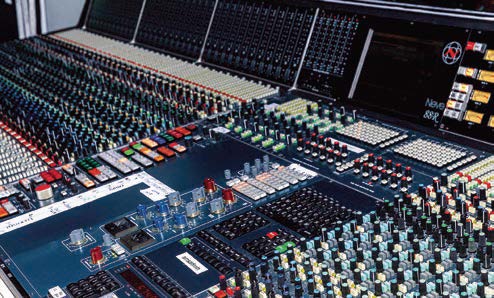
There’s a 63-acre compound on Borland Road, out in the rolling Orange County countryside near Hillsborough. On it is situated a log cabin, a barn, and several other outbuildings stuffed with the kind of gear that only true believers would collect: a Neve 88R mixing desk originally commissioned by New York’s Electric Lady Studios; a live reverb chamber; several isolation booths; and, aurally immersive Dolby Atmos mixing capabilities. This particular compound goes by the name of Sonark Media, and it’s a thoroughly modern complex offering recording, performance and streaming capabilities.

Sonark is the brainchild of Steven Raets, a Belgian-born polymath. Up until 2012, Raets had been working for the “big three” investment firms: Goldman Sachs, Morgan Stanley and JPMorgan Chase. That all changed the following year, when he retired.

“Then basically the question was, what was gonna be the rest of my life?” Raets says. “I’ve always had a big passion for music. I’ve played in all kinds of bands since I was 12 — party bands, original bands, when I lived in Belgium and London. I’ve always been involved in music; that’s always been my destiny. I just happened to be really good at mathematics and statistics, so I ended up in a trading role, but I knew I was going to go back to music. That moment happened in 2013.”

Raets built a home studio in the basement of his Chapel Hill home — he’s married to a UNC professor — and started producing records. Once the kids were out of the house, the couple decided to scale down. They bought a farm not far from where they lived and began fixing up the old log cabin on the property. But Raets wanted to move up, literally, from the basement.

“I said to my wife, ‘You know, I want to keep doing music,’” Raets said. “‘So, if we’re moving from this house, then you have to allow me to build a proper studio.’ And she said, ‘Yeah.’”

Raets’ idea of what constitutes a “proper” studio might differ a little from most industry entrepreneurs. For one thing, he and his partners run three full recording studios on the Sonark property: Studio A, with a huge live room, high ceiling and three isolation booths; the smaller Studio B; and a renovated barn dedicated to rehearsals, live performances and streaming. The rooms sound amazing, and the gear is impeccable. If this was all the Sonark gang did, it would be more than enough. But these people are true believers.

“I think we’re uniquely set up to help the music industry rethink how music should be made, distributed, enjoyed and monetized,” Raets says, “and that is basically what keeps us awake every day. How can we help our musicians make more money in this world where music has become worthless? That’s our mission at Sonark.”

The fact that this question is even being articulated is refreshing. Without getting too technical about it, many of the fundamental revenue streams for musicians have dried up over the last few decades. Unless you’ve established a national touring base, it’s tough to make enough money at each gig to put gas in the van to get to the next town. Vinyl records have made a comeback, but they’re considered merchandise, to be sold along with band T-shirts, posters and hoodies — and many clubs take a percentage of this money. Merch is welcome supplemental income, but it will hardly keep body and soul together. That leaves digital streaming.

In the past year and a half, Spotify’s CEO Daniel Ek has made over $345 million, with his top executives coming in a close second, leaving megastars like Ed Sheeran and Taylor Swift in the dust. This is because a generous calculation of Spotify’s payout is about $0.003 per stream, and that’s allowing for the artist having complete control over their intellectual property, which is seldom the case. So even Swift — the most streamed artist on the platform — has yet to earn the kind of dough Ek has made.

Raets and his colleagues have spent a lot of time on the issue of putting money into musicians’ pockets, and they’ve come up with PIE TV, a subscription platform that allows users to stream Sonark-produced live performances on demand.

“It was inevitable that, as our technology advances and becomes more sophisticated, and as the bandwidth of our wireless devices increases, music will be viewed as well as listened to,” Raets says. “For years, I’ve been thinking of how to do that in a way that could be packaged and make sense for both the artists and those who help produce it. We finally came up with this idea where we would start producing intimate shows with bands but produce them as if you are in the PNC Arena, except with maybe 150 people there. We give the band a very controlled environment with enormous amounts of production value.”

Sonark performances are shot on at least a half-dozen high-definition digital cameras, while the audio is sent to Studio A for mixing. Edited audio and video are then synced and sent out for broadcast on the PIE TV app. Artists are paid guarantees for their performance, and they own part of the intellectual property of the broadcast and so are entitled to an ongoing royalty share from future streaming.

Compare this to the hugely popular YouTube live performances where none of the revenue generated from those videos goes to the artist. Admittedly, this is no different than live television performances in days of yore. “If you were going to play Jimmy Kimmel or Saturday Night Live or Austin City Limits, you would have to do it for cost,” Raets says. “You get very little out of it as a band except for a huge platform and promotional value. But the monetization goes entirely to the network.”

PBS NC has taken note, broadcasting a season of Sonark Sessions: Live from the Barn featuring 10 North Carolina-based artists. As far as Raets is concerned, there’s no reason to stop there. “North Carolina is an incredibly fertile ground for talent,” he says. “But we really don’t have an industry. There’s not a lot of jobs around. I want to create awareness of the fact that the music industry is not a hobby; it’s a valid center of revenue. You have only to look at Austin, Texas, to see how that worked out for them. Twenty-five years ago, it didn’t exist. Now, the music industry contributes hundreds of millions of dollars in tax revenues to the city. My dream is to do something similar to that for North Carolina. There’s a lot of potential here and you can feel it bubbling everywhere.”

NC Surround Sound

NC SURROUND SOUND

A Giant Legacy in a Small Town

Nina Simone, Crys Armbrust and Tryon

By Tom Maxwell

At first glance, Tryon isn’t too different from most small North Carolina towns: Its people are genuinely friendly instead of merely polite; a snug line of mostly brick buildings make up its diminutive downtown; residential housing is a typical mix of stately homes on one side of town and forgotten shacks vanishing into the encroaching kudzu on the other. It’s the kind of place real estate agents describe as “nestled,” situated as it is at the southernmost edge of Polk County, where the great Blue Ridge begins to rise like a crumbling wall. But culturally, the town has distinguished itself in ways that have put a brighter shine on North Carolina’s starry crown.

In 1939, you probably wouldn’t have taken a second look at 6-year-old Eunice Waymon as she walked across the railroad tracks along Trade Street, unless you thought it unusual to see a poor Black kid heading to that part of town. Most everybody in Tryon knew Eunice as a child prodigy, on her way up the hill to Glengarnock Road to take piano lessons from Muriel Mazzanovich, better known as Miss Mazzy. In every sense, Eunice was headed for big things.

Even though many Tryon townsfolk — white and Black — recognized and contributed to Eunice’s artistic development, racism was baked into the Jim Crow South. Before a recital at Lanier Library, a teenaged Eunice saw her parents quietly ushered to the back of the room so white people could take their place in the front row. The young pianist refused to perform until her mother and father were returned to their rightful place.

If systemic racism wasn’t enough to drive ambitious young musicians of color out of the South, professional necessity was. Opportunity was located where the music industry was largely based, either New York or Los Angeles. As her journey into adulthood began, Eunice first attended Asheville’s exclusive Allen Home School, where she befriended Harlem Renaissance poet Langston Hughes. Then it was on to New York’s Juilliard School of Music, and after that, a failed audition for a scholarship to Philadelphia’s Curtis Institute of Music. This was an experience that Eunice remembered for the rest of her life with some bitterness.

Denied a career in classical music, Eunice took a nightclub gig in Atlantic City, where she was informed that she would have to be the featured vocalist as well as the piano accompanist. Soon afterward, she adopted the stage name Nina Simone to protect her family’s reputation. The artist’s new identity and career path would go on to change the world of popular music in ways that defy description: Nina Simone’s music contains elements of jazz, gospel, rock and roll, and rhythm and blues — and still the whole is greater than the sum of its parts.

“Nina Simone was one of the key artists who grew up here and fled at the earliest opportunity,” David Menconi says. “But North Carolina left a mark, as it does.” Menconi has spent a lifetime writing about music — first as a critic who spent a couple of decades at Raleigh’s News & Observer; now as an editor and author, most recently of Oh, Didn’t They Ramble: Rounder Records and the Transformation of American Roots Music.

The list of North Carolina-based musicians who joined that Jim Crow-era Black diaspora is extraordinary: jazz legends John Coltrane, Max Roach, Thelonious Monk; soul singer Roberta Flack; and funk pioneers George Clinton, Maceo Parker and Betty Davis comprise only a partial list.

“Branford Marsalis told me that people like Nina Simone and Thelonious Monk, who left here at a young age, are still identifiable as Southern because of just how deep a mark church puts on everybody,” Menconi says. “That’s what all these artists have in common: They’re not playing gospel, but church is what’s in there if you dig deep enough.”

In 1996, when Crys Armbrust’s dad told him that Nina Simone was born in Tryon, he was met with disbelief. “I actually stood him down for a liar,” Armbrust said when I met him in 2019. “Because any other town in the world that could claim Nina Simone as a local daughter would have it plastered on every building — on every street — in order to build the reputation of that community.” But this was the mid-1990s, and North Carolina had yet to publicly embrace most, if not all, of its distinguished African American sons and daughters. Armbrust, a fan of Nina Simone since his teenage years, spent much of the rest of his life correcting that mistake.

Dr. Joseph Crystal Armbrust was born and raised in South Carolina but summered in Tryon for 45 consecutive years before making it his home. Precious few people can legitimately be called a polymath, but Crys Armbrust is near the top of the list. After earning two Ph.D.s in literature at the University of South Carolina, he taught English literature and in the school of business, later serving as assistant principal at USC’s prestigious Preston Residential College. Once ensconced in Tryon, Armbrust served as the town’s economic development director, commissioner and mayor pro tempore emeritus. As a musician, he performed recitals at Kings Oxford and Westminster Abbey, while serving back home as master of choristers and music director for Tryon’s Episcopal Church of the Holy Cross. An accomplished composer, Armbrust was commissioned to write several works for eminent clients like Her Majesty Queen Elizabeth II and the Vatican.

“My parents wanted a Renaissance man,” Armbrust said, “and they made one.”

None of this would have been immediately obvious to somebody like Menconi if he happened to see Armbrust puttering in the yard of Nina Simone’s birthplace — which he often did. Menconi visited Tryon in 2017, a year before Simone was inducted into the Rock & Roll Hall of Fame. Everyone in town told him he had to talk to Crys Armbrust. “I discovered that he was the guy who knew everything about everyone, but especially her and the cabin where she grew up,” Menconi says. “He was the on-site caretaker of the place.”

The Nina Simone House, saved from obscurity or destruction by a group of artists in 2017, was declared a National Treasure by the National Trust for Historic Preservation a few years later. One of the groups the trust worked closely with when crowdsourcing funds for the house’s rehabilitation was Crys Armbrust’s Nina Simone Project.

“I knew I had the skill set to make a pretty strong impact with respect to creating the Nina Simone Project, so I began in earnest after my father’s death in 2008,” Armbrust said. He conceived a three-phase nonprofit, incorporating a statue, a scholarship and a music festival. When I met Armbrust in 2019, the Nina Simone Project had already bestowed over a dozen general scholarships to local kids.

Despite the economic crash of 2008, Armbrust and the NSP were able to raise enough money to create a statue honoring Simone. It’s situated in a little park on Trade Street, near the railroad tracks Eunice used to cross on her way to take piano lessons. The statue, of Simone seated at a floating, undulating keyboard, contains some of the musician’s ashes in its bronze heart. It was conceived and created by Zenos Frudakis, the same sculptor who did the Payne Stewart likeness behind Pinehurst No. 2’s 18th green.

According to Armbrust, Simone often returned to Tryon. “She left at about 15 and came back quite often,” he told Menconi. “Early on, any and all hours of the day — usually later at night with no fanfare so she wouldn’t have to deal with people. My friend James Payne — who lives a block up the road — would pick her up at the airport, whisk her back here, the door would open, and in she’d walk.” Simone’s last visit to Tryon was to attend her mother’s funeral in 2001.

Crys Armbrust died in August. The Nina Simone Project appears to have gone dormant with his passing, but both he and Simone are very much woven into the fabric of modern-day Tryon. Through his relentless advocacy, Armbrust contributed to a new wave of cultural recognition and reconciliation across the state. In 2006, High Point erected their own bronze statue to “distinguished citizen” John Coltrane. Now there’s a highway marker in the tiny Yancey County seat of Burnsville celebrating Lesley Riddle, an African American native son who, along with the Carter family, helped invent country music. Legendary Piedmont blues artist Elizabeth Cotten is featured in a large mural in her hometown of Carrboro. That list, happily, expands with each passing year.

Hurricane Helene wreaked unimaginable destruction across all of Western North Carolina. Tryon wasn’t spared. The day after, her people did what all tight-knit communities do: They came together. While dazed residents checked in on neighbors and loved ones, the Trade Street Diner set up a generator and offered free coffee and Wi-Fi to all including evacuees sheltering in Polk County High School. Nearby, at 54 N. Trade St., there’s a bench in Nina Simone Plaza where those who need a break can sit across from the statue of Tryon’s most famous daughter and rest before continuing the work of saving their town. Like a simple act of recognition, a moment’s respite is a small thing that can make a huge difference.