

NATURE'S NIGHTLIFE
Nature's Nightlife
In search of wonders in the dark
Story and Photographs by Todd Pusser
Nara City, nestled within Honshu, the largest of Japan’s four main islands, is renowned for its numerous historic temples and shrines. Designated a UNESCO World Heritage Site, the city is perhaps most famous for its resident sika deer, a native Asian species that looks like a stouter, more heavily spotted version of North Carolina’s white-tailed deer.
In the Shinto religion, deer are viewed as messengers between mortals and gods. As such, the sika deer of Nara have been considered sacred for centuries and pretty much have the run of the town. They wander the crowded streets (where they always have the right of way) and frequently panhandle for rice crackers in front of local businesses. Tourists flock from all over the world to see and feed them.
Over the years, hungry deer have learned to bow to people, in customary Japanese tradition, in order to receive a cracker. When our family visited the city this past summer, my daughter spent the better part of two days roaming the streets and parks, constantly exchanging bows and crackers with every deer she encountered. My back ached just watching her.
While bowing deer are indeed charming, my primary reason for visiting Nara lay just outside of town, on a thickly canopied mountain slope that overlooked the city. There, in a forest with the rather foreboding name of Mt. Kasuga Primeval Forest, lives a very special squirrel. Not just any run-of-the-mill-backyard-birdfeeder-raiding gray squirrel, mind you, but one of the largest squirrels in the world — the aptly named Japanese giant flying squirrel. At nearly 3 feet long from the tip of its nose to the tip of its fluffy tail, the squirrel is larger than a house cat.
I first learned about Nara’s giant squirrels from my good friend Jon Hall. Jon, who originally hails from the United Kingdom but currently lives and works in New York City, has obsessively traveled the globe for the better part of three decades in search of mammals. During that time, he has managed to see a third of the world’s mammals — over 2,300 species as of August 2025, an unrivaled number — and has established the internet’s premiere mammal-watching website, www.mammalwatching.com. Jon visited Nara several years ago and saw the squirrels firsthand. Before our family trip, he kindly offered a few tips on how to the find them in the forest that overlooks the town.
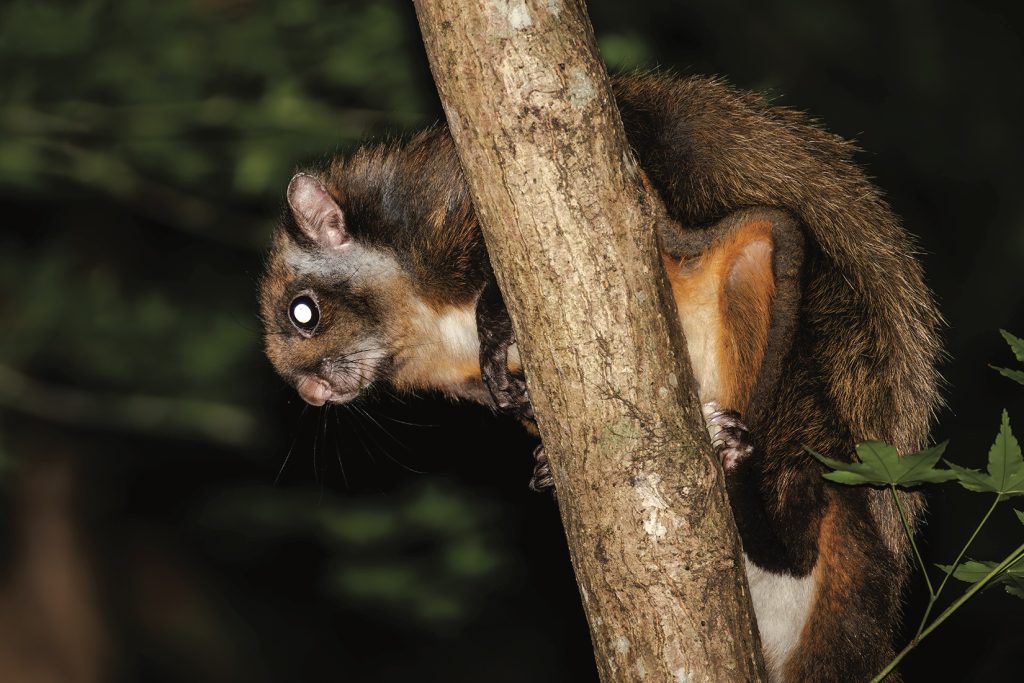
Strictly nocturnal, the Japanese flying squirrel emerges from its home tree cavity at dusk. Spreading its flying skin (a thin membrane that stretches between its front and hind legs) like a superhero’s cape, the arboreal rodent glides from tree to tree, throughout the nocturnal forest, in search of nuts, fruits and leaves to eat.
It was just after 10 p.m. when my partner, Jessica, and I first found the squirrels. We had spent the better part of the evening hiking up a steep dirt road through the old-growth forest without much to show for our efforts, other than sore legs and some mild dehydration from the humid, summer night air. It was Jessica who first heard their strange vocalizations, which sound remarkably like the guttural calls of American crows, high up in the canopy.
Clueing in to one particular vocal individual, Jessica spotted the squirrel’s distinctive eye shining among the leaves with her flashlight. “Here’s one,” she exclaimed. I rushed to her side with my camera in hand. There, on a branch 20 feet above our heads, munching contently on a mouth full of leaves, sat the largest squirrel I’d ever seen. Though I have seen other types of flying squirrels — like Southern flying squirrels in the backyard of the home where I grew up in Eagle Springs — those diminutive, big-eyed critters paled in comparison to the size of the furry beast staring down at us.

As we watched in amazement, another giant flying squirrel called out from a nearby tree, and then another quickly responded, just down the slope. We were surrounded.
Eager to take a break from our strenuous hiking, we sat down on the dirt road beneath the squirrels and turned off our flashlights. For several minutes we sat in the dark listening to the grunts and growls of the squirrels as they foraged in the trees above. Fireflies flickered on and off along the edge of the road, and a Ural owl hooted in the distance. All was right in the world.
Suddenly, Jessica jumped up and shouted, “What the hell is that!” Startled, I turned on my flashlight, thinking perhaps she had stepped on a mamushi, a local pit viper that closely resembles a cottonmouth, the venomous denizen of Sandhill swamps. “Get it off!” Jessica shouted. Shining my flashlight on her, she pointed down to her leg. “Hurry!” she said.
Scanning the length of her leg, I finally saw it. Just above the sock line, a leech had attached itself to Jessica’s skin and was sucking her blood like a rabid vampire. My flashlight soon revealed four more leeches clustered on the side of her tennis shoe, each searching for a patch of bare skin. The slimy invertebrates evidently found her irresistible and were swarming her like sharks attacking a bleeding fish.
Now frantic and dancing a jig in the middle of the dirt road, Jessica was shaking her leg left-to-right and up-and-down, trying to dislodge the bloodthirsty vermin. It looked like a scene straight out of the movie Stand by Me, and I couldn’t help but chuckle.
That was a mistake.
“Todd, get these damn things off me! Now!” she demanded. I tried to explain that, unlike ticks, leeches don’t carry any known human diseases and are entirely harmless. This factoid failed to impress. And when I insisted on photographing the engorged leech attached to her leg before removing it, Jessica was neither pleased nor amused. The walk down the mountain and back to our hotel was a long one indeed.
The primeval forest had lived up to its name. I held out hope that our little squirrel-watching adventure left no lasting scars on Jessica, physically or emotionally. No doubt it served to reinforce preconceived notions that venturing into the wild at night can be perilous.
As kids, we are taught to fear the dark in countless fairytales. We learn that the night is filled with perils and dangers. For many, the apprehension of the dark is carried all the way into adulthood. It is a primary reason why humans bathe their yards and city streets with bright lights. Perhaps this fear is innate, stemming from a time our distant ancestors roamed the nocturnal landscape when large predators, with better nighttime eyesight, were much more common.
Growing up, I was always curious about what lurked outside our rural Eagle Springs yard when the sun went down. I have fond memories of sitting outside by our pool, under a star-filled sky, listening to the distant hoots of owls and whip-poor-wills. Humid summer nights found me catching backyard fireflies and placing them in Mason jars. On more than one occasion, turning into our yard late in the evening after a school basketball game, the headlights of my parents’ car would reveal an opossum or raccoon skulking along the edge of the woods. Sometimes we would even see a gray fox.
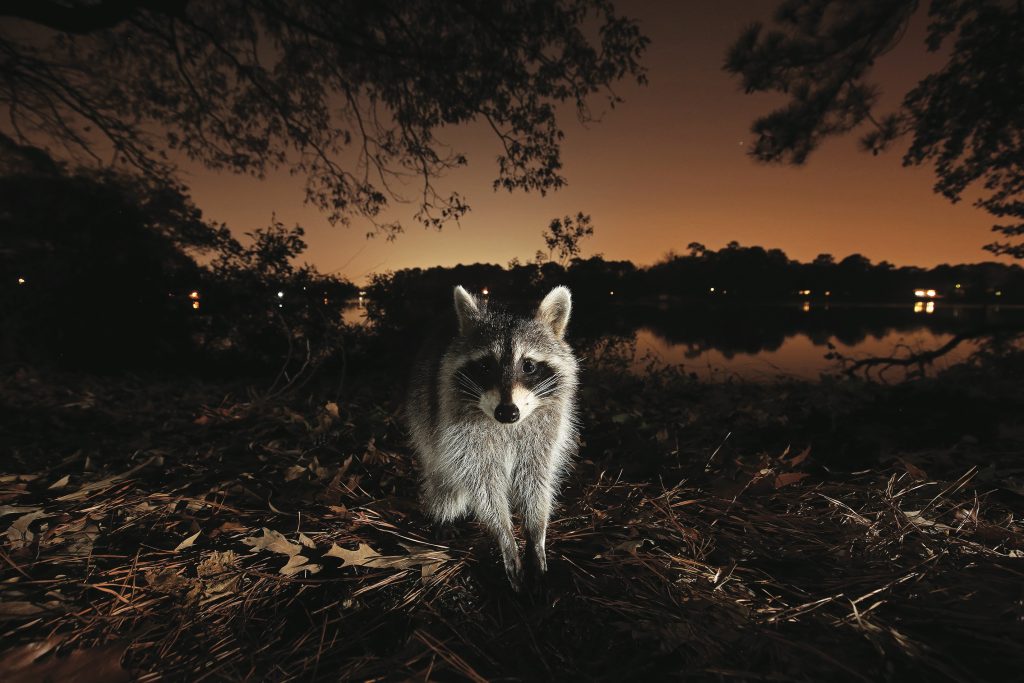


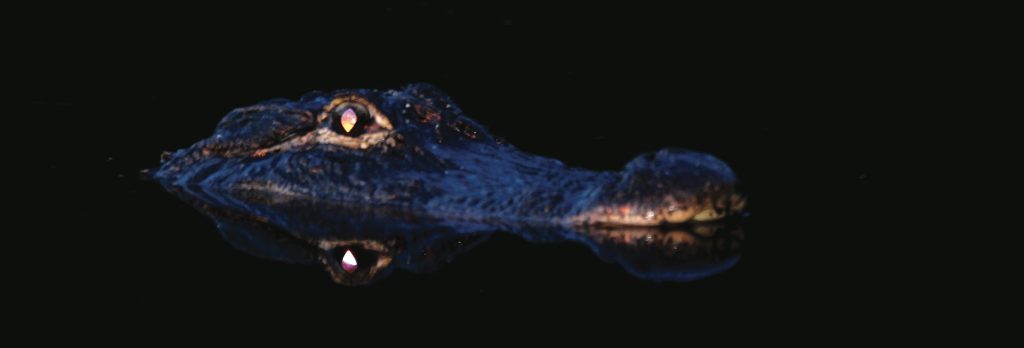
I still venture out after dark, and many of my most memorable wildlife encounters have taken place long after the sun disappeared over the horizon. In Japan this past summer, I watched as the world’s largest owl, the Blakiston’s fish owl, swooped down to catch small fish out of a tiny creek in front of a makeshift blind. In the Yucatan Peninsula, I spotted the eyeshine of large crocodiles hiding among mangroves in a shallow coastal bay. On a hot August night in the Arizona desert, I once found over two dozen rattlesnakes crossing rural blacktop roads under the moon-cast shadows of giant saguaro cacti. Once, off the coast of Costa Rica, a few hundred Eastern spinner dolphins raced over to our ship to play in the bow wave for nearly half an hour under a bright moonlit sky. Bioluminescent phytoplankton in the water caused the dolphins to glow in the dark. The up-and-down beats of their tails in the water, as they raced along with the ship, left spectacular trails of shimmering blue and green light in their wakes. The scene was otherworldly and jaw-dropping.
Today, I have many more high-tech “toys” available to me than I did as a kid to aid in my nocturnal wildlife observations. Camera traps with infrared beams allow me to capture spotted skunks on remote mountain sides or crafty raccoons foraging just outside our kitchen window, without me actually having to be physically there. Ultraviolet flashlights allow me to find caterpillars munching on the leaves of trees and shrubs throughout the nocturnal forest. Many caterpillars fluoresce under ultraviolet light, and shining one of these flashlights into a persimmon tree on a September night will cause them to light up like Christmas tree lights.
Perhaps the biggest gamechanger for locating wildlife at night has been the thermal imaging scope. Primarily used by law enforcement and the military, thermal imaging scopes were once prohibitively expensive. In recent years, these high-tech scopes have come down in price and are now commercially available in many brands. The scope, as the name suggests, picks up the body heat of animals (especially mammals and birds), making it possible to virtually see in the dark. A walk in the woods with a thermal scope after sunset will reveal creatures you never knew were around, everything from tiny golden mice scampering about in trees to deer foraging in a field several hundred yards away.
Having all this tech so easily available can be addictive for the curious naturalist. A case in point is my current enthusiasm for North Carolina sphinx moths, derived after reading a story involving an unusual orchid from Madagascar and two of the godfathers of the Theory of Evolution, Charles Darwin and Alfred Russel Wallace. Sphinx moths (or hawkmoths, as they are also named) are spectacular insects with over 1,500 species found around the world. They are well known for hovering in front of flowers like hummingbirds, with many species rivaling the birds in size.

In 1862, Darwin received a spectacular orchid with a foot-long nectar tube from the island of Madagascar. He pondered what type of insect could possibly pollinate so unique a flower. In a letter to his botanist friend Wallace, Darwin exclaimed, “Good heavens, what can suck it!” He went on to speculate that only a moth with an exceptionally long tongue could reach the orchid’s nectar reserve.
Five years later, Wallace predicted such a moth would be similar to a sphinx moth from the nearby African continent that was known to possess a very long tongue. Wallace wrote, “That such a moth exists in Madagascar may safely be predicted, and naturalists who visit the island should search for it with as much confidence as astronomers search for the planet Neptune — and they will be equally successful.”
In 1903, the long-tongued moth was finally found and described, vindicating both Darwin’s and Wallace’s predictions. It was not until 2004 that a BBC film team finally filmed the moth, now called Wallace’s Sphinx Moth, pollinating the orchid for the first time.
Their saga led me straight down a deep rabbit hole. North Carolina has an abundance of native and non-native deep-tubed flowers, and numerous sphinx moths. According to the North Carolina Biodiversity Webpage (www.nc-biodiversity.com), 45 species of sphinx moths have been recorded in the state.
Faster than you can say “What can suck it?”, I ventured out to the closest patch of ginger lilies on a summer night. Ginger lilies, a species native to Asia, possess bright white flowers that open only at night and are incredibly fragrant, making them popular additions to backyard gardens. Their unique blooming strategy suggests the flowers are pollinated by nocturnal insects. With their deep nectar tubes, I reasoned our native sphinx moths would visit them for a sugar rush. Sure enough, my first night sitting out among the lilies in my friend’s yard, I saw numerous rustic sphinx moths hovering in front of the white blooms like nocturnal hummingbirds. I was hooked.
This past summer found me deploying camera traps around many of North Carolina’s native flowers to see what moths visit them at night. Using ultraviolet flashlights, I spent many evenings looking for glowing sphinx moth caterpillars on grapevines and low-growing shrubs. I even sat out in a large tobacco field near my home in Eagle Springs, watching dozens of sphinx moths hover in front of the white flowers under a bright full moon.
Thankfully, there wasn’t a leach in sight.