

GUITAR HERO
Guitar Hero
Chasing the quintessential American instrument
By Stephen E. Smith
Photographs by John Gessner
You can go almost anywhere, and there’ll be a (insert your favorite personal expletive here) with a guitar,” a curmudgeonly crony once told me.
I suspect he was talking about me. I’ve been toting around an acoustic guitar — in my car mostly — since I squandered $20 on a 6-string that beckoned to me from a pawnshop window when I was 14. The Kingston Trio strummed guitars, the girls swooned, and I had to have that Kay archtop with the bowed neck. No other instrument would do. (When was the last time you heard a testosterone-besotted teenager quip, “I just happen to have my tuba with me”?) At 17, I could flat pick the intro to The Animals’ “House of the Rising Sun” and bang out the first few chords of The Troggs’ “Wild Thing.” What more did I need to know?
If Americans have a national instrument, it’s the guitar, be it electric or acoustic or a combination of the two. According to Statista Research Department, 3.3 million guitars were sold last year in the United States. Any way you figure it, that’s a lot of exotic tonewood, bone, plastic, steel, glue, tortoiseshell and abalone. And that doesn’t account for the necessary accouterments — picks, strings, amps, mics, pedals, wires of every possible description, cases, straps, capos, gig bags, tuners, etc. Guitars constitute an in-your-face, above-ground market that flourishes on the internet via eBay and Reverb and lives in every city and settlement with a population of more than one. It’s a miracle that every kid in America isn’t busking on the curb.
In your lifetime, you’ll probably buy a guitar, or you know someone who will. With millions of options available, making an intelligent choice can be time-consuming and expensive — and ultimately disappointing. If you buy the wrong instrument — one that’s difficult to play and sounds crappy — the novice picker may become disillusioned and never fully realize the fulfillment music can bring into his or her life.
The guitar market is inundated with defective, cheap, and poorly constructed used instruments that are available for a pittance, while at the other extreme, you can make the investment of a lifetime if you stumble upon a one-of-a-kind gem. Kurt Cobain’s Martin 1959 D-18E acoustic recently sold for $6 million, and Bob Dylan’s 1964 Fender Stratocaster — the one that antagonized the crowd at the 1965 Newport Folk Festival — is a steal at a million bucks. Mark Twain’s 1835 2 1/2-17 Martin, which cost $10 new, is valued at over $15 million.
Used, worn-out instruments flood online auctions. Many of these are catalog guitars sold from 1920 through the mid-’60s. They have the virtue of being American-made, but they were ordered through Sears (Supertone/Silvertone), Montgomery Ward (Airline), or a myriad of more obscure distributors, and were often delivered in unplayable condition with a string height and tension that would suck blood straight out of your fingertips. Even if you lucked into a medium-grade and high-end used guitar, the truth is simple: Guitars wear out. The necks warp, the soundboards crack, the tuners fall apart, and the bridges pull up. They can be repaired, but the services of a capable luthier don’t come cheap, and you can spend more money restoring an old guitar than you will pay for a new, more playable model.
So where do you start the quest for that 6-string soulmate? If possible, borrow a guitar. Get a feel for the instrument. Learn a couple of chords. Sing a simple song. If you decide to purchase an instrument, don’t go online and click on the first thing that strikes your fancy. There’s no telling what will arrive in the mail. How a guitar looks on a computer screen and how it sounds and feels when you’re caressing the strings are very different things.
Or you might begin by watching Daniel Putkowski’s 2023 documentary Heirloom: Guitar, snippets of which were filmed in Southern Pines and feature Greensboro luthier Bob Rigaud. The doc is a simple primer for the unschooled. Putkowski begins with an ingenious admission: “I’ve been trying for 20 years to figure out what makes the guitar so popular in American music and across the world.”
Rigaud, who has crafted boutique instruments for Graham Nash, John Hiatt and David Crosby, believes the guitar is spiritual: “The guitar is probably the easiest instrument to play — of course it’s one of the hardest to master. . . It’s spiritual, and it speaks to people in their own lives — love, loss, all subjects.” The professionally produced documentary traces the acoustic guitar’s evolution from a parlor instrument into the most popular music-maker in the world. Segments are supplemented by clips of Bryan Sutton, David Grier, Florence Dore and others explicating their love of the instrument and include step-by-step visuals of a luthier building a custom boutique guitar from scratch. Heirloom: Guitar is available on YouTube and is a good introduction for anyone who is considering a purchase.
We’re fortunate to live at a propitious moment in the evolution of the guitar. CNC (computer numerical control) machines improved construction and playability, and if the guitar is made by a reputable American company — Martin, Gibson, Collings, Taylor, etc. — it’s likely to be a superior instrument. And there are hundreds of American luthiers — too many to mention here — who build custom guitars of the highest quality, although these models are likely to be pricy.
Among imported guitars (“offshore” is the popular euphemism) constructed in China, Indonesia, Japan, etc., deals are to be had. American players generally look down on these foreign models, but the Chinese have been producing acceptable instruments for the last 30 years, and Japan’s Takamine, Alvarez and Yamaha are welcome on any stage or in any song circle. After all, musicians in the Orient were playing stringed instruments long before the Vikings set foot in Vinland. It’s all right to be a guitar snob, but it’s unnecessary — and unbecoming.
Online guitar retailers abound. Musicians Friend, Cream City Music, Sweetwater, Chicago Music Exchange and other music companies will allow you to purchase an instrument and return it in new condition for a full refund if you don’t like what you hear. But the best and easiest place to start your search is your local music store. (There are chain guitar stores you can frequent if you can endure the bone-jarring racket of 10 customers playing White Stripes’ “The Hardest Button to Button” with their amps maxed out.) But a quiet, comfortable atmosphere where you can handle the instrument and hear what’s played beneath your hands is the way to go. A guitar must feel right as well as sound right.
Southern Pines has had its share of cliquish musical haunts. The Pinedene Jazz Center, which was featured on WRAL’s Tarheel Traveler many years ago, comes immediately to mind. The hole-in-the-wall establishment on U.S. 1 South flourished as a gas station selling Black Diamond Strings until it morphed into a music store that eventually succumbed to changing times and a shift in ownership.
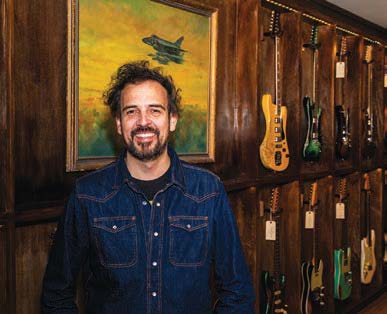
The more substantial Casino Guitars (www.casinoguitars.com), which now anchors, along with The Country Bookshop and The Ice Cream Parlor, downtown Southern Pines, carries an impressive array of guitars, many of them high-end instruments that proprietor Baxter Clement ships worldwide. Casino has grown into one of the premier guitar stores in the Southeast. The service is excellent; the crew is knowledgeable. Clement, a music graduate from Vanderbilt University, thoroughly knows his stuff, and he truly loves guitars. He has a solid business plan. He knows that customers in the market for a guitar need to feel and hear the instrument. They need to hold it in their hands and sense that sudden bond: Ah, yes, this is the one!
“When a customer comes in the front door, we try to make them feel at ease,” Clement says. “They can take their time and browse and find an instrument they feel a connection to. Our job is to help the customer find a guitar that speaks to them.”
As for the price range of his stock, he’s philosophical. “Every guitar gets you to the same place, like a car moving from A to B,” he says. “A quality guitar will just get you there faster. And, too, customers should keep in mind that many of the cheaper guitars are produced by workers who aren’t paid a fair wage. In some cases, they’re built by prison labor who work in unsafe conditions without masks or eye protection.”
How much should you pay for a new or used guitar? Is there a decisive difference between a high-end and a cheapo-cheapo model? Nothing is absolute. If you do your research, listen to a trusted expert and, as Aristotle reminds us, trust your eyes and ears — “The Eyes are the organs of temptation, and the Ears are the organs of instruction” — you have a very good chance of purchasing a quality, playable instrument that will bring you years of satisfaction.
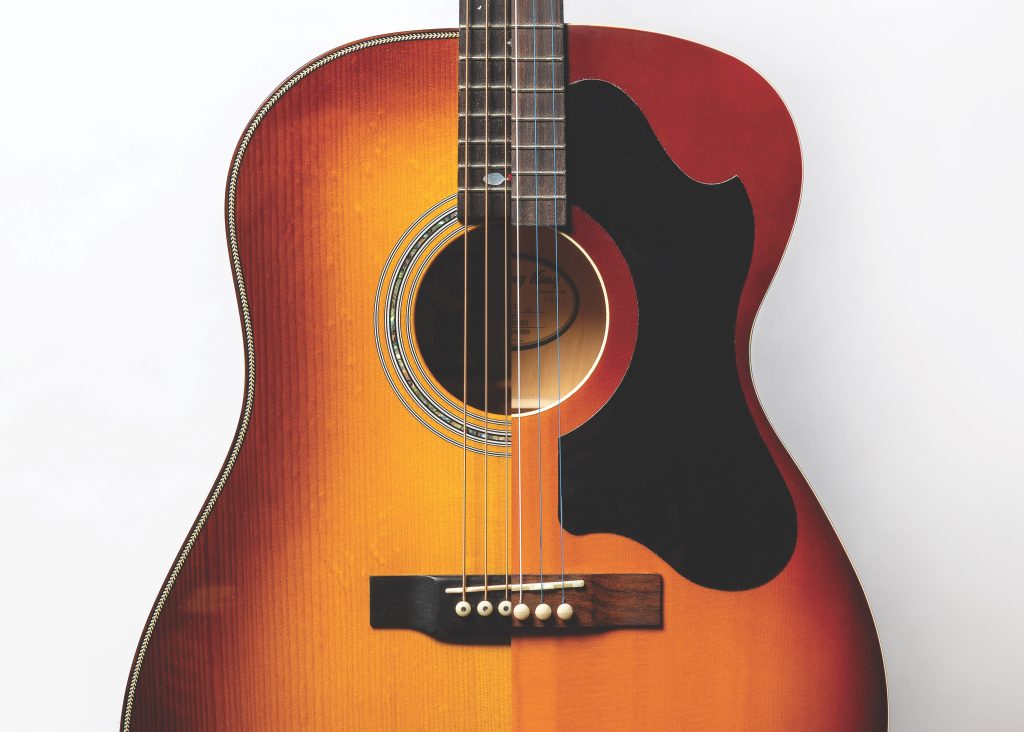
To determine how low-end guitars have improved in recent years, I ordered the cheapest playable new guitar I could find online. Recording King is a brand name conjured up by Gibson during the Great Depression. The guitars produced under the label were more lightly constructed and cost less than the typical Gibson. The Recording King moniker was eventually sold to a Chinese outfit that produces models at varying prices and quality. For $100, I purchased a Recording King from the “Dirty-30s” series, which boasts surprisingly impressive specs — a spruce top, nickel tuning machines, Whitewood (whatever that is) back and sides, mahogany neck, bone saddle and nut — all good stuff.

I toted the Recording King and my 2012 Signature John Sebastian Martin D Slope Shoulder, which boasts the specs of the very best of American guitars (there’s one for sale online for $15,500), to a gathering of the Weymouth Song Circle, which meets on the last Tuesday of every month, to allow the experts to weigh value and quality. And they did.
The Recording King sounds, well, good enough. It is surprisingly playable out of the box. It’s bright and responsive and holds its own with other guitars when fingerpicked or strummed. Except for minor finishing details (the fret ends are like septic spikes), the Recording King would have held its own in the 1950s and ’60s folk era.
But when we played the Martin DSS, trained ears held sway. The Martin was by far the more desirable guitar. Everyone wanted to pick a few tunes on the DSS while the Recording King sat slumped, neglected, in the corner. It’s a viable guitar, fun to play when accompanying others, but the superior Martin demanded the attention of experienced pickers. Which begs the question: Is one Martin guitar worth 155 Recording Kings? Whatever the answer, this much is certain: The serious player should experience long-term satisfaction with his or her purchase. You don’t want to outgrow your new guitar in the first month of ownership or be discouraged by its inadequacies.
Everyone should have a little music in his or her life, if only to escape the electronic morass we’re forced to inhabit. When you hold an acoustic guitar in your hands, it’s just you and the instrument. For better or worse, it reflects what you feel and believe — and who you are. It also connects with others, and there’s a strong sense of community among guitar players, whatever their skill level. And Lord knows, genuine connection is what we need more than ever.
Even casual music lovers appreciate the sense of camaraderie that guitars convey. I recall a summer afternoon 40 years ago when I was driving into Austin, Texas, to visit my singer-songwriter brother. I had my radio tuned to a local station that was broadcasting live coverage of a gathering of 500 guitarists on the grounds of the State Capitol. At precisely high noon, they all played “Wild Thing” — raucous head-pounding A, D, E, D, A, D, E chords blasting through the transistors in perfect generational unison.
Oh, how I longed to be among them!