
GLORIOUS RESTORATION

Glorious Restoration
A Reynolda landmark is reborn
By Ross Howell Jr. • Photographs By Amy Freeman
Have you ever seen this?” asks Bari Helms. “I found it in some boxes.”
Helms is the director of the archives and library at Reynolda House Museum of American Art, the storied estate that is now part of Wake Forest University in Winston-Salem. She slides the rendering toward Phil Archer, the deputy director at Reynolda, the family mansion that houses a permanent collection of three centuries of American art and sculpture.
Archer shakes his head, touching a finger to the edge of the drawing.
“I don’t think so. Not with those perpendicular wings. A little too Versailles for Katharine, isn’t it?” Archer asks. He and Helms exchange knowing smiles.
Helms produces a letter from that same “Katharine” to Lord and Burnham, the premier builder of glasshouses in America during the mid-19th and early 20th century, dated May 27, 1912. In it, she details what she wants her estate’s conservatory to include — a palm room, a “good-sized” grapery, a tomato section, a large vegetable section, a propagating room and a “nice workroom.”
When Lord and Burnham responded with their plans and perspectives, and their quote for $7,147, Katharine wrote back that it was too much money. The greenhouse additions in the rendering were removed.
“In all her correspondence, you get a sense of how direct, hands-on and detail-oriented Katharine was,” Helms says.
In December 1912, Katharine wrote another letter to Lord and Burnham, complaining that the workers they’d promised had not yet arrived on-site. In January 1913, she wrote again, noting that parts of the conservatory were not being built to her specifications.
“Katharine was very polite about it,” Helms says, “but insisted that she was making Lord and Burnham aware of the issue so they would fix it.”
No doubt they did.
Katharine was, of course, Katharine Reynolds, the irresistible force behind Reynolda, completed in 1917. Backed by the tobacco empire of her husband, R.J., Katharine began to purchase tracts of land near Winston-Salem, eventually acquiring more than 1,000 acres, each parcel deeded in her name alone. Her idea was a Progressive one — to create a self-sufficient estate that included a country house, a farm utilizing the latest in technology and agricultural practices, a dairy, recreational facilities and a school.
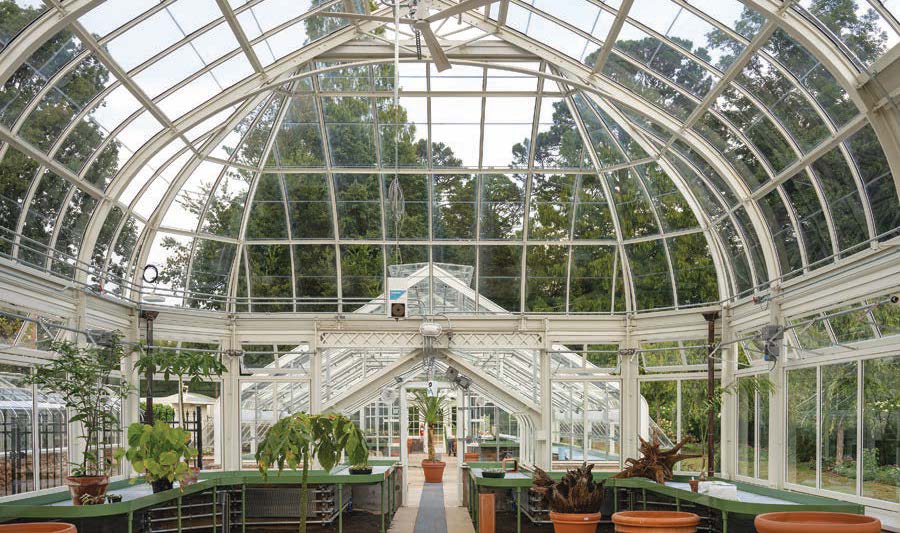
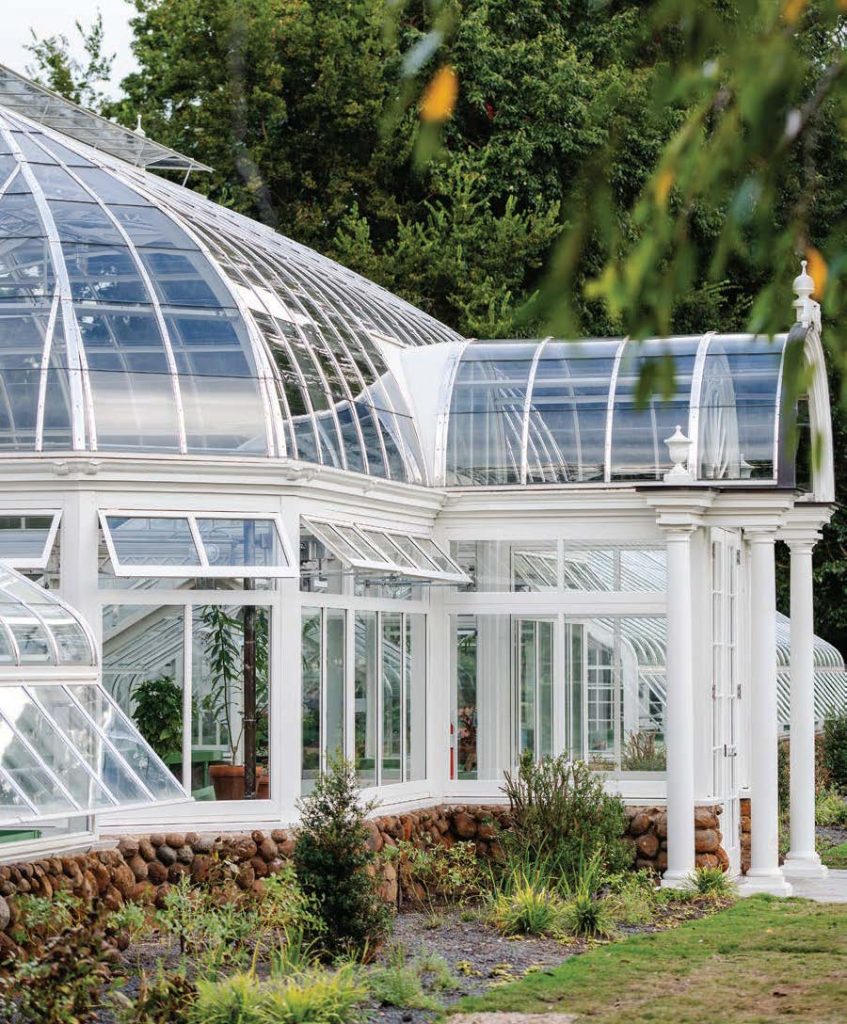
The conservatory — located very near what is now Reynolda Village — was an integral part of Katharine’s design. October 2024 marked the end of its restoration, a yearlong project made possible by a gift from longtime Reynolda supporters Malcolm and Patricia Brown.
Born in Mount Airy in 1880, Katharine Smith Reynolds was a daughter of America’s Gilded Age and a wife in the Progressive Era of the industrialized New South. In the period photographs at Reynolda, she’s the young woman in the gorgeous outfits who doesn’t seem to be looking at the camera, but, rather, directly into your soul. To this day, her spirit and determination inform every aspect of Reynolda.
Leaving her home in Mount Airy in 1897 to attend the State Normal and Industrial School — now UNCG — she later withdrew because of a typhoid epidemic and finished her studies at Sullins College in Bristol, Virginia. In 1902, Katharine joined the R.J. Reynolds Tobacco Company in Winston-Salem, where she served as personal secretary to the owner, R.J., a distant cousin who was 30 years her senior. In 1905, Katharine and R.J. married.
Between 1906 and 1911, Katharine gave birth to four children — at grave personal risk, according to her physicians, since she had been plagued with heart problems that started in childhood. By all accounts, the Reynolds marriage was a happy one, and R.J. was confident in his young wife’s abilities, often consulting her on business matters.
“Katherine wanted the estate to look and feel like an old English hamlet,” Archer says. “Burying utilities was high-tech for Katharine’s time, but that’s what she wanted.”
The conservatory restoration project, which would become the Brown Family Conservatory and Reynolda Welcome Center, was led by Jon Roethling, the director of Reynolda’s gardens. The work was done by Cincinnati-based Rough Brothers (pronounced rauh), a subsidiary of Prospiant.
“Rough Brothers had access to actual Lord and Burnham plans and molds,” Roethling says. So, for the Reynolda restoration, the company could use templates on hand, extruding aluminum pieces to match the originals.
The tinted glass needed for the restoration was made by another company. It’s so specialized, the company only manufactures it twice a year, delaying completion by months. The wait was worth it, however, since the unsightly aluminum shutters added to the palm house and greenhouses in a previous renovation could be removed. Moreover, the manufacturer had the equipment to produce curved glass. This meant that the elegant shape of the original architecture — supplanted by the use of flat glass panes in a previous renovation — could be restored.
“When I walk into the palm house now, the architecture just sings,” Roethling says.
There were the additional challenges of heating and ventilation — critical to a conservatory. “We stayed with the original concept of radiant heat,” Roethling explains, “though the new system is very sophisticated.”
Ventilation was a trickier issue, since the conservatory is vented throughout — foundations, walls and roof. From the time the conservatory was built until this restoration, these many vents had to be cranked open or shut by hand.
“You have to strike this balance of having architecture that reflects 1913, but also having the convenience and efficiency of systems that are modern day,” Roethling says. “Knowing Katharine, one of the most progressive women of her time, I was sure there was no way she would want us to be hand-cranking vents in this day and age, so we made the jump to automated.”

The new system automatically responds to wind flow, wind speed and precipitation, adjusting ventilation as needed. Changes can also be made remotely, using Wi-Fi. Once, when Roethling noticed a thunderstorm developing, he went to the conservatory to see how the new system would respond.
“As the wind rose and the storm started rolling through, I watched the vents immediately close a bit,” he says. “When the wind grew stronger, the vents shut completely, protecting the greenhouses.”
End-to-end, the central structure of the conservatory and the greenhouses flanking it extends more than 300 feet. Sod has been laid the entire length, creating a walking path for visitors. Between the edge of the sod and the foundations of the greenhouses are planting beds, about 8 feet wide, filled with peonies.
“The problem,” says Roethling, “is once the peonies bloomed out, that was pretty much it, visually. I needed someone who could do something amazing.”
Roethling reached out to Jenks Farmer, a plantsman in Columbia, S.C., who served as director of Riverbanks Botanical Garden in West Columbia and was the founding horticulturist of Moore Farms Botanical Gardens in Lake City. Farmer created a design for the peony beds incorporating other perennials that provide visual interest throughout the growing season.
“Jenks is great,” Roethling says. “He loves balancing history with what’s relevant today.”
In the conservatory proper, each bay has a different theme. “This first bay is in the spirit of an orangerie, which represents the birth of greenhouses,” says Roethling. Much like the original 17th-century orangeries in England and throughout Europe, the bay also features olive trees and other fruiting plants, and will be used to illustrate a narrative history of the development of greenhouse structures over the centuries.
The next bay is an arid greenhouse, featuring the five Mediterranean climates of the world — Southern California, the Mediterranean Basin, South Australia, South Africa’s Cape area and central Chile.“This is a fun thing to educate kids,” Roethling says. “To explore with them how the plant palette changes, how the plants adapt.”
The central palm house is elegant in its features with sealing wax palms with their deep red canes, and tall Bismarck palms with their silver fronds, all in large containers. Visitors can compare the broad texture of a palm frond to, say, the fine texture of a fern. “There’s a lot of texture — greens, whites and silvers,” Roethling says.
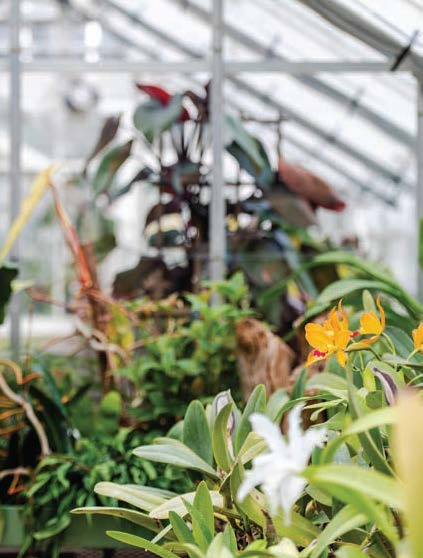
The next greenhouse bay features bromeliads, orchids and other flora that thrive in the tropics. It’s all about color — abundant, dramatic color. “In here, I want to have freaky things that visitors walk up to and ask, ‘What is that?’” says Roethling with a broad smile.
The final bay serves as a holding house for resting orchids, organized by types, with interpretative signage.“Even though the orchids won’t be in bloom there,” Roethling says, “that greenhouse will still be beautiful and educational.”
Just as Katharine would have expected.