

Captain's Choice
Matchmaking in Pinehurst, controversy in Augusta
By Bill Case
Twice a Ryder Cup player, winner of the Belgian and French Opens and several important British tournaments, Arthur Lacey had accomplished much in golf, including meritorious service to the game as chairman of the British PGA. At age 47, with his best golf a decade in the past, the Englishman’s selection as the non-playing captain of Great Britain and Ireland’s 1951 Ryder Cup team represented a fitting capstone to a stellar career.
The appointment provided Lacey the chance to achieve a goal he had set in 1933 after narrowly losing a Ryder Cup singles match to Walter Hagen. “From that day,” he confided, “it has been my ambition to captain a British Ryder Cup team to victory.”
The ’51 matches would be played on foreign soil in Pinehurst, North Carolina. The captain could never have anticipated that his two weeks in the town would ultimately lead to his moving to America and establishing a winter home in the very place the matches were contested. Nor could he have known that his second life would include one of the most memorable rules controversies in golf history.
Captain Lacey faced an uphill battle in the ’51 Ryder Cup. The GB&I team — all of Europe didn’t join the fray until 1979 — had not been victorious in any of the four previous cups on U.S. soil. And while most of the American players had competed on Pinehurst’s No. 2 course annually in the North and South Open, this trip would mark the first time any of the GB&I players would have seen it.
But, pure and simple, the chief difference between the two squads was talent. While GB&I did boast two Open Championship winners in Max Faulkner and Fred Daly, the American team featured five men who would eventually be inducted into the World Golf Hall of Fame: Sam Snead (the playing captain of the ’51 U.S. side), Ben Hogan, Jimmy Demaret, Jack Burke Jr. and Lloyd Mangrum.
Sailing across the Atlantic aboard the Queen Mary, the GB&I team arrived in New York on Sunday, Oct. 21. Both teams were feted at a celebratory dinner at the Waldorf Astoria courtesy of Bob Hudson, the Portland, Oregon mogul who had previously footed the bill to bring the ’47 GB&I team to America while the financially challenged United Kingdom recovered from the ravages of war. The next stop was Washington, D.C., where Lacey’s team toured the Capitol and was greeted by Harry S. Truman at the White House. They played a practice round at Columbia Country Club on Wednesday, Oct. 24, enjoyed another reception and rushed to Union Station to catch the night train to Southern Pines.
Arriving at the town depot Thursday morning, the visitors were, according to the Pinehurst Outlook, “whisked to Pinehurst in a bus which rattled with the sound of the war clubs with which they will try to take the No. 2 championship course apart.” After a flag-raising ceremony at Pinehurst Country Club, the weary travelers checked in at the Carolina Hotel, where they, along with the members of the American team, occupied the hotel’s east wing.
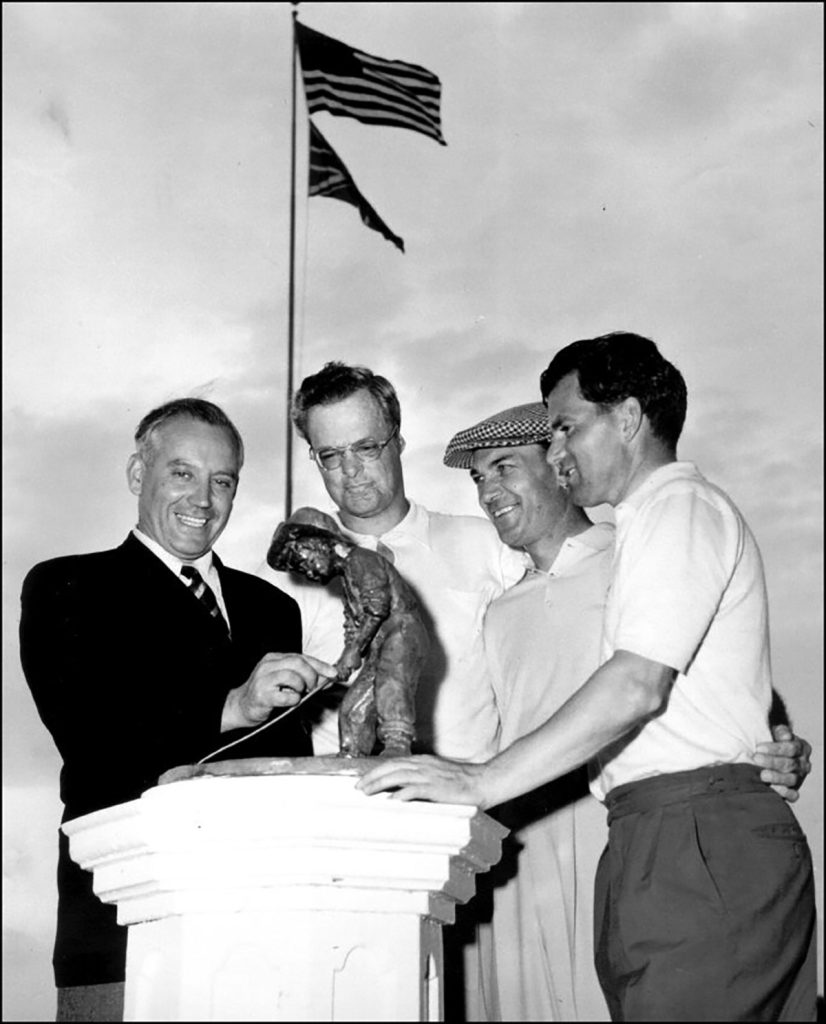
With the matches commencing the following Friday, GB&I had six days to prepare. Lacey was guardedly optimistic. “We have yet to gain our first success in America in this series,” he said, “but I am sufficiently optimistic to think we have brought the best team so far to attempt this difficult task.” When asked about his duties as captain, Lacey couldn’t resist a cheeky response. “Looking after the trophy aboard ship when we return,” he said.
Lacey’s squad was offered the option of playing the “small ball” ( a minimum of 1.62 inches in diameter pursuant to the rules promulgated by the R&A in contrast to the 1.68 inch minimum prescribed by the USGA). The smaller ball flew farther than its American counterpart and tended to perform better in the windy conditions found in links golf. Lacey declined, saying, “We came here to win these matches, and since they are to be played in this country, we will play by your rules.”
Frequent blurbs relative to the comings, goings and social engagements of Pinehurst’s “Cottage Colony” residents were a staple of the Pinehurst Outlook’s reportage throughout the paper’s existence. It was no different simply because the Ryder Cup was coming to town. A week before the golfers arrived the Outlook reported that Mrs. Thomas B. Lockwood, whose primary residence was Buffalo, New York, would be arriving in Pinehurst “to open her cottage, ‘Holly Hill,’ on Midland Road.”
Mildred Lockwood was a widow. Her second husband, Thomas Lockwood, a Buffalo attorney, banker, politician and philanthropist, had passed away in 1947. She acquired Holly Hill, a house bordering the fifth hole of the No. 2 course, in 1949, and it became her lodging during Pinehurst’s so-called “winter season” of November to May. She was a member of the Silver Foils, Pinehurst’s longstanding women’s golf society.
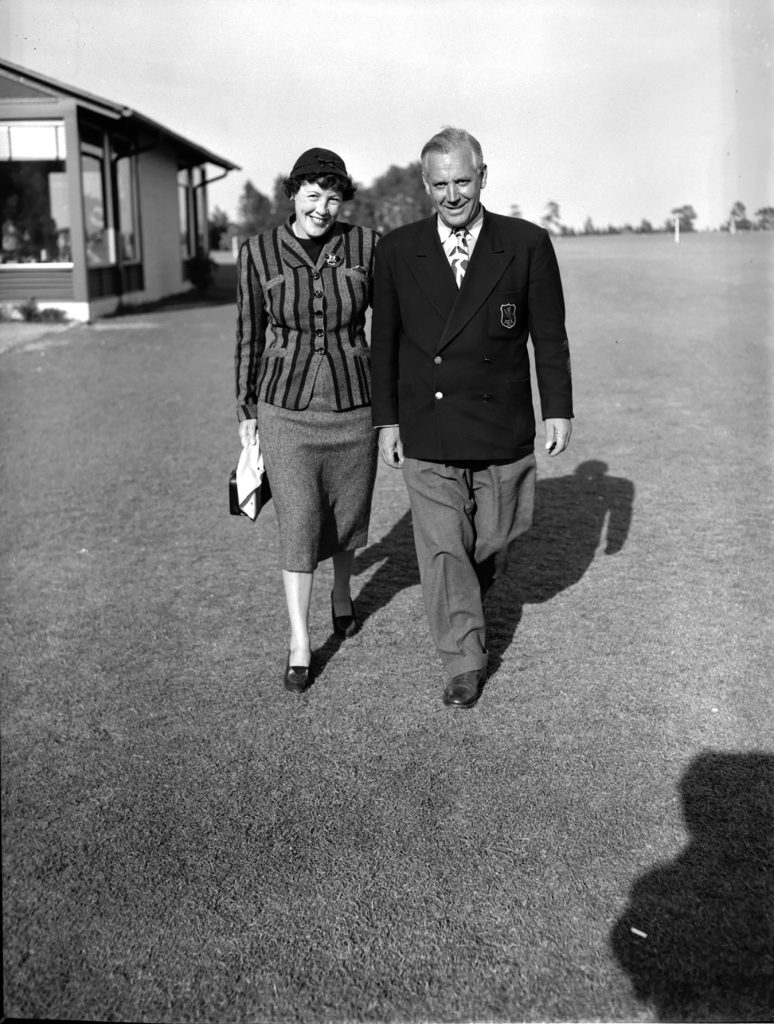
Lacey and Lockwood would marry 14 months after the Ryder Cup. Nothing reported then or thereafter disclosed the circumstances by which the couple met. If their mutual attraction began the week of the matches — or the North and South Open, held in Pinehurst the following week — both kept mum about it.
The 1951 cup matches were a truncated affair compared to the modern Ryder Cup. The teams played 12 matches in two days of competition. The first day involved four foursomes matches. The second day featured eight singles matches. In a head-scratching schedule that would be unimaginable today, the Ryder Cup took a break on Saturday. Both teams were encouraged to attend a college football game in Chapel Hill between the University of North Carolina and the Tennessee Volunteers. London Sunday Times journalist Henry Longhurst was among those who joined the GB&I players in the Kenan Stadium press box. “I simply don’t understand what is going on,” Longhurst wrote. “All I know is that I am doing OK as long as I holler, ‘To hell with Tennessee.’” The Vols blew out the Tarheels 27-0. The American captain, Snead, was not among those attending the game. He picked up a few bucks elsewhere giving an exhibition instead.
Results from the foursomes matches on Friday suggested Lacey’s dream of an upset was just that, a dream. The U.S. won three of the four matches. The teams of Hogan-Demaret and Snead-Mangrum both won 5 and 4. The lone GB&I win, by Arthur Lees and Charlie Ward, prevented a shutout.
When the matches resumed on Sunday it was more of the same, except worse for GB&I. The U.S. won six of the eight matches, mostly by lopsided margins. The only British winner was Lees, who bested Porky Oliver. The final tally was U.S. 9 1/2 to GB&I’s 2 1/2.
During Sunday’s “Victory Dinner” at Pinehurst Country Club, Lacey presented a silver pitcher to Bob Hudson and a silver cigarette case to Richard Tufts in appreciation of their unstinting efforts in making the British team’s visit enjoyable. Regarding the outcome, the handsome, graying Lacey simply stated, “We were beaten on merit.”
Tufts had arranged for the North and South Open to immediately follow the Ryder Cup, assuming that since the members of both teams were already in town, they would certainly want to stay to compete in the prestigious tournament. That proved true for the British team, but not so much the Americans. The PGA had recently set a minimum prize money floor of $10,000 for tournaments. Tufts balked at complying with this edict. Hogan, Demaret, Mangrum and Burke declined to enter the North and South. Several who did stay, including Snead, failed to hide their dissatisfaction. In what was perceived as a quasi-boycott, four American team members withdrew subsequent to the first round. Only one, Henry Ransom, played all 72 holes. Miffed by the behavior of the American players, Richard Tufts would discontinue the N&S, ending its storied 50-year run.
By contrast, each of the British team members played in Tufts’ tournament, as did their captain, who made the cut and played all four rounds. Following the tournament, the members of the GB&I team sailed back to England but Lacey would soon return. In July, 1952 Britain’s Golf Monthly magazine reported that Lacey had left the position he’d held for 18 years as golf professional at Ascot’s Berkshire Golf Club and was moving to America.
On Jan. 27, 1953, Mildred Lockwood and Arthur Lacey were married at the First Presbyterian Church in Reno, Nevada. According to the Outlook, after two weeks in California, “Mr. and Mrs. Lacey will be at their home on Midland Road here until the middle of May, when they will open their residence in Buffalo, for three months, later sailing for a sojourn in the British Isles.”
That itinerary foreshadowed the couple’s peripatetic travels throughout their 26 years together. Typical was their six-month trip around the world in 1955. Sailing from San Francisco, the Laceys visited Japan, Hong Kong, Thailand, Singapore, Indonesia, the wilds of Africa, the Holy Land, Turkey, Greece and England.
In their wanderings, they rubbed elbows with the rich, famous and royal. The Earl and Countess of Carrick joined them for a three-week fishing trip in Boca Grande, Florida. While visiting the low countries, Lacey played rounds with King Leopold of Belgium. Though his competitive form was waning, Lacey would occasionally work in a tournament or two during his European excursions.
Despite prolonged absences from Pinehurst and her hometown of Buffalo, Mildred Lacey engaged in an astonishing array of charitable endeavors in both locales. She was a major benefactor of the University at Buffalo. After purchasing poet Robert Graves’ original manuscripts, she donated the collection to the university’s Lockwood Memorial Library, named to honor Mrs. Lacey’s previous husband, who endowed its construction.
In Buffalo, she served as president of the Ingleside Home for unmarried mothers; chairman of the Building Committee and Fund Raising for the community’s YWCA; a member of the board of directors for two hospitals; the first female member of the Buffalo Chamber of Commerce; and the organizer and president of the Buffalo and Erie County Chapter of Infantile Paralysis. Eliminating polio was a matter of special interest to her. Her brother, Dr. Thomas Francis Jr., designed, supervised, and analyzed the field trials that validated the use of Jonas Salk’s life-saving vaccine.
Mrs. Lacey was equally active in Pinehurst. Her list of services to the community included: member of the board of directors of The Village Chapel; treasurer of the Sandhills Woman’s Exchange; secretary of the Women’s Auxiliary of Moore Memorial Hospital; and president of the Silver Foils golfing society. She worked with the Open Door Nursery School and Child Care Center in Taylortown, helping to start the charity, raising the money to sustain it, and serving as its chairman for 15 years. Today the Wyatt School Age Program in Taylortown continues the work she began.
Arthur Lacey joined The Tin Whistles, after the society tweaked its by-laws to allow dues-paying pros to enter most of its tournaments. For her part, “Queenie,” as Mildred was known by friends, was a high handicapper who participated enthusiastically in Silver Foils’ weekly competitions. In Feb. 1958, she and her husband teamed up in the Silver Foils Mixed Fourball Tournament. The Laceys tied for first before losing in a playoff.
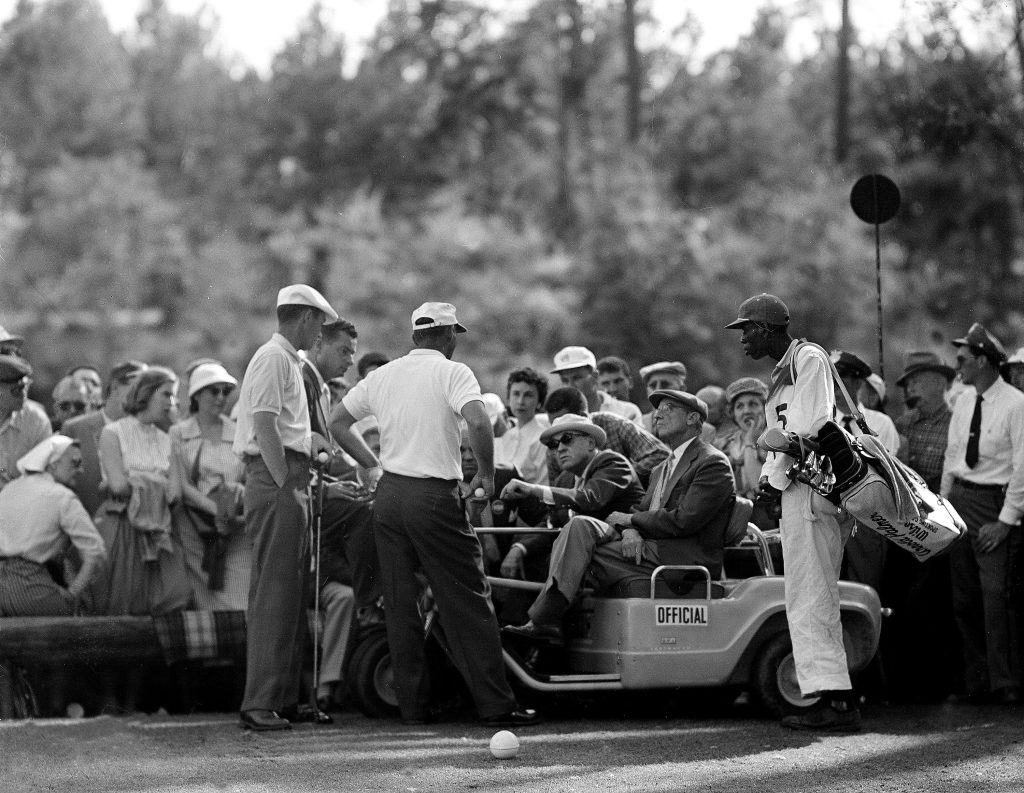
Just over a month later, Lacey, then 53, drove to Augusta National Golf Club, where he had agreed to be a rules official for the 1958 Masters. His service in that capacity was uneventful until the late stages of the final round. He was stationed at the par-3 12th when the pairing of Arnold Palmer and Ken Venturi arrived on the tee. Palmer — who would go on to win the first major title of his illustrious career — led the field with Venturi hot on his heels, one stroke behind.
Both Venturi and Palmer struck their iron shots a bit too far, their balls landing beyond the putting surface. Venturi’s ball spun back onto the green. According to legendary golf writer Herbert Warren Wind, who was on-site, “Palmer’s ball struck low on the bank about a foot or so below the bottom rim of a back-side trap and embedded itself. It had rained heavily during the night and early morning, and parts of the course were soggy.”
When Palmer reached his ball, he called Lacey over and asked for relief from his embedded ball lie. Lacey denied the request, informing Palmer he would need to play the ball as it lay. To some, Lacey’s ruling and the dramatic — and still swirling — controversy it precipitated, would overshadow his substantial accomplishments in the game.
Under the USGA’s Rules of Golf at the time, there was no provision granting a player relief for an embedded ball. However, Augusta National could put in place a “wet weather” local rule that would allow such relief in inclement weather. Given Sunday’s rainy conditions, Augusta National had adopted such a temporary rule for that day’s play. Its precise wording is unknown. However, in a Golf World magazine article following the Masters, it was reported that this wet weather rule provided for embedded ball relief “through the green,” meaning virtually everywhere on the golf course except hazards, bunkers, and tees and greens of the hole being played.
Given the local rule, what basis did Lacey have for denying Palmer relief? There are differing accounts of his rationale. Venturi, who overheard at least part of the conversation between Lacey and Palmer, wrote in his 2004 autobiography, Getting Up & Down, that Lacey told Palmer his ball was, “not embedded. It’s only half-embedded.”
Years after the ruling, Lacey would relate a different explanation in a discussion with writer Al Barkow. The veteran golf journalist wrote that under the rule handed down by the Masters committee early Sunday morning, “Lacey was given to understand (rightly or wrongly) that a player would be allowed a free lift from an embedded lie only if his ball was on the green or fairways.” Palmer’s ball was neither.
That was merely the beginning of the debacle. More instances of “he said, he didn’t say” followed regarding whether Palmer used proper procedure in deciding to play a “second ball.” In situations like the one Palmer faced, a player could opt to play a second ball along with the first, then have the tournament committee decide which ball should count as his score. To do so, the rule stated that a competitor “must” declare his intention to play a second ball prior to playing the first ball. The competitor was further required to announce which ball he wished to count for his score. Furthermore, he was supposed to play both balls “at the same time” until both were holed.
Palmer would later say he advised Lacey of his intention to play a “provisional ball” (technically he should have said “second ball”) before proceeding. Venturi emphatically denied this occurred.
Palmer then played the embedded ball and did not recover well, finishing the hole with a double-bogey 5. He returned to the spot where his tee shot had embedded to play a second ball, and took a drop. From a much better lie, Palmer chipped close and holed his putt for what he hoped was a 3.
Venturi was visibly upset. He told Palmer he could not invoke the rule because of his alleged failure to declare a second ball before hitting his first one. “Suppose,” Venturi bristled, “you had chipped in with the other ball. Would you still be playing a second?” Palmer replied he had followed proper procedure.
But did it really matter whether Palmer verbalized his intention to play a second ball before hitting his first one? Rule 11(5) then stated, “Should the competitor fail to announce in advance his procedure or selection, his score with the second ball shall be his score for the hole if played in accordance with the rules.” This provision, as written, appears to excuse a player’s failure to announce his intentions. The sloppily written rule (later changed) seemingly permitted the “two bites of the apple” scenario advanced by Venturi.
So did Palmer have a 5 on the 12th or a 3? A 5 meant he was now a shot behind Venturi, who parred the hole. With a 3, Palmer would remain one shot ahead. The two would be uncertain how they stood until the Masters Tournament Committee reviewed the situation.
Venturi believed this muddled situation may have led Palmer to play the par-5 13th more aggressively than he might have otherwise. Venturi laid up short of the water hazard fronting the green. Palmer, after initially pulling an iron, returned it to his bag, pulled out a wood and struck a sensational shot onto the green, then holed the putt for an eagle. Venturi birdied. That would make Palmer either two strokes ahead of Venturi or even with him, depending on the committee’s ruling.
While the leaders were playing 14, they were informed that the committee had decided in favor of Palmer. An incensed and rattled Venturi imploded. He 3-putted three of the final four holes and faded to fourth. Palmer hung on for a one-stroke victory over Doug Ford and Fred Hawkins, capturing his first green jacket.
After signing his scorecard, Venturi sought out Clifford Roberts, Augusta National’s chairman, to complain that Palmer had broken Rule 11 by failing to timely announce his intention to play a second ball. “I was wasting my breath,” Venturi wrote in his book. But not wanting to take no for an answer, he asked that Roberts bring in Lacey. “Only one problem,” wrote the exasperated Venturi. “Lacey, I was told, had already left the golf course, and there was no way to track him down. There were no cellphones in 1958. A pretty quick exit from the premises, don’t you think? I certainly don’t have any evidence that Mr. Roberts, anxious to avoid controversy, made sure Lacey got off the grounds in a hurry, but it sure looks fishy.”
So Lacey became something of a fall guy in this strange episode. He, according to the tournament committee (apparently Bobby Jones and Roberts), had made an incorrect decision. But no matter; all’s well that ends well. Palmer, an extremely popular winner, had addressed Lacey’s mistake appropriately, and there was nothing more to be said.
Golf writer Guy Yocom admits to a fascination regarding the brouhaha. He maintains that regardless of how much one studies the available evidence, certainty regarding what actually happened is elusive.
Yocom feels Lacey may have gotten a bad rap. “There is a possible distinction to be made between the traditional application of ‘through the green,’ and how Augusta National applied its rule,” Yocom says. “Why would Lacey, a man with decades of golf experience at the highest level, claim the rule applied to fairways and greens only, if it wasn’t so? Officials don’t just make this stuff up.” And if Lacey made a mistake, why didn’t he acknowledge it to Barkow? “There’s no shame in admitting it,” says Yocom, “because officials make mistakes all the time.”
It’s possible, Yocom believes, that when rules officials were briefed on the local rule Sunday morning, they might have been orally instructed to construe the phrase “through the green” as applying only to balls embedded in fairways and greens, notwithstanding that phrase’s more expansive defined meaning in the Rules of Golf. That scenario would be consistent with what Lacey told Barkow.
Over the years, the dispute drifted away from public consciousness until Venturi rekindled it with his 2004 book. Lacey’s actions were criticized anew. Venturi and Palmer were still around, and the book reopened scars for both men. The sensitive Venturi was accused of exhibiting sour grapes. Writers asked why Venturi had signed Palmer’s scorecard if he felt the ruling was wrong. Other pundits interpreted Venturi’s account as an accusation of cheating on Palmer’s part. Venturi vehemently denied this. And Palmer, viewed by the golf world as a paragon of golf ethics, was hurt by any suggestion he had won his first major by skirting the rules.
When Lacey died in 1979 while working in his garden, no one in Pinehurst appears to have given thought to the Masters controversy. Locals who knew him recalled other things about him. Lacey’s neighbor and friend, Pilot columnist Evelyn de Nissoff, remembered him as a man of “pleasant personality” and “quiet humor.” She had purchased Lacey’s treasured yellow Renault, which he had brought over from England. When encountering her at the post office, Lacey would invariably inquire, “How is the Renault working out?”
From all that is known, Lacey did not appear to have been overly anguished by what happened in the 1958 Masters. If he dwelled on it at all, he kept, as the Brits say, a stiff upper lip. And though his team may have been trounced in the ’51 Ryder Cup, Lacey managed to find the storybook ending anyway.