
MATCHLESS
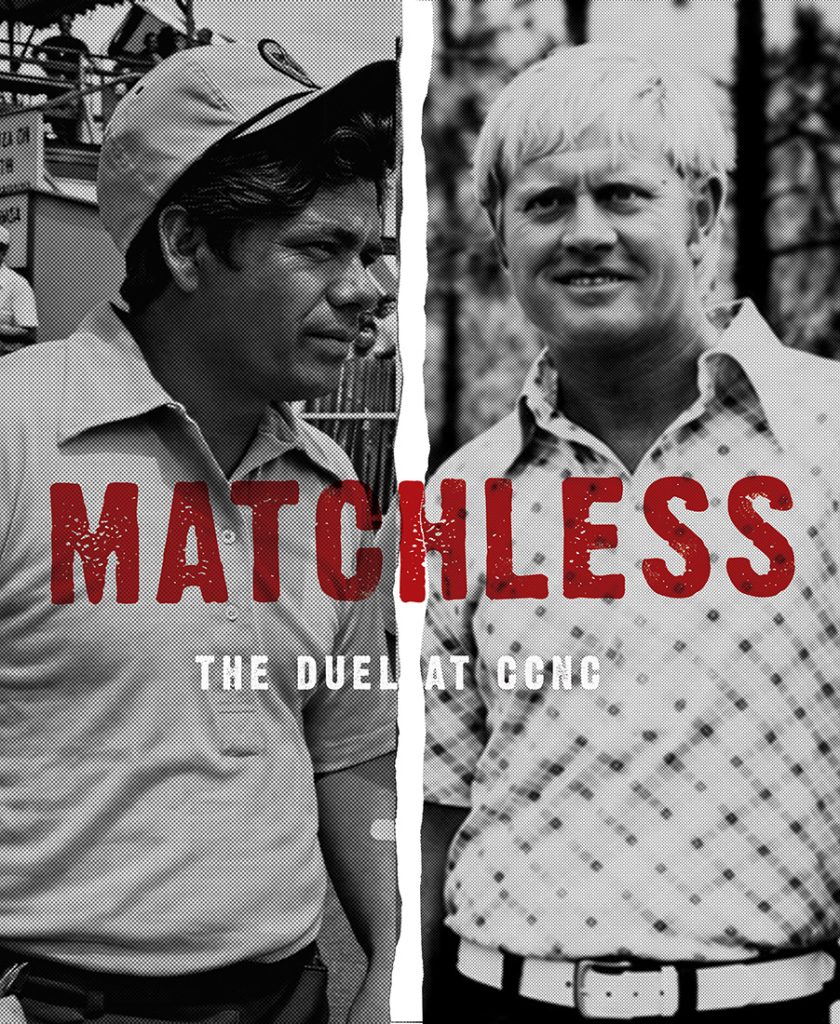
Matchless
The duel at CCNC
By Dale Moegling
By the end of the 1960s, professional golf had settled into a rhythm that made sense to everyone watching it. Four days. Seventy-two holes. Numbers gathered patiently and arranged on a leaderboard that revealed in orderly fashion who had played best. Arnold Palmer could hitch his pants for his army; Gary Player could fist-pump to the four corners of the earth; Jack Nicklaus could drive the ball vast distances and achieve the career grand slam in just seven years.
It was a system that worked. It was easy on the eyes — television’s eyes. It was also a system that had lost something. For Joseph C. Dey Jr., who after a 34-year career as the executive director of the USGA, became the first commissioner of the newly created PGA Tournament Players Division (soon to be the PGA Tour) in 1969, the game was missing something that had once defined it: match play, the mano a mano format abandoned by the PGA Championship after 1957.
Dey’s demeaner was as formal as a Windsor knot. “He never removed his jacket in the office, and was of the unshakable conviction that 9 to 5 meant exactly that, and not 9 until 4:50,” wrote another lion of the USGA, Frank Hannigan. Dey would resign as PGA Tour commissioner in 1974, handing the reins to Deane Beman. Among the things he accomplished in five years included two tournaments, one with a lasting impact and one whose fame was rather more fleeting.
Dey instituted the Tour’s stand-alone event now known as The Players Championship. A less enduring mark was left behind by the short-lived reintroduction of match play in professional golf known as the U.S. Professional Match Play Championship that debuted in 1971, followed by the Liggett & Myers Open U.S. Match Play Championship in 1972. Both were played in the late August heat on the highly regarded Dogwood Course of the Country Club of North Carolina, itself less than a decade old. The back-to-back years marked the return to Moore County of the best players in the world after Richard Tufts canceled the North and South Open following the 1951 season. The experiment in match play would last one additional year, played at MacGregor Downs Country Club in Cary, before it came to a merciful end.
As much of a button-downed traditionalist as Dey was, he was also willing to push the envelope. He once proposed that the U.S. Open be contested for three weeks over 216 holes on three different courses in three different parts of the United States. It was a concept that, to put it charitably, found no purchase with the USGA’s executive committee.
With visions of the grandeur of match play drama, the help of CCNC club president Richard A. Urquhart Jr., the influence of club member William M. Jennings (president of the New York Rangers and a member of the NHL Hall of Fame) and the financial backing of Milton E. Harrington, the president of Liggett & Myers, Dey’s dream of the psychological drama of one-on-one golf became a reality.
The field in 1971 was to comprise the 64 top names on the points list. All the usual suspects would be there. Lee Trevino. Palmer. Player. Nicklaus. And local favorite Julius Boros who had ties to Mid Pines Club. Rather than a traditional win-a-hole, halve-a-hole, lose-a-hole format, the matches would be contested at stroke play over 18 holes — pleasing for television in the days when only the last few holes could be broadcast.
A celebrity-rich field showed up for the Tuesday pro-am: singer Glen Campbell, the astronaut Gene Cernan, New York Yankees great Mickey Mantle, the jockey Eddie Arcaro and, probably the best known of all, Mayberry’s slapstick deputy Barney Fife, née Don Knotts.
The tweaking of the scoring, however, did nothing to alter the vagaries of match play. Nicklaus went out early. Player came undone in extra holes. Palmer didn’t fare any better. The finals produced DeWitt Weaver, whose previous best finish had been a third place in the ’71 Hawaiian Open, against San Diego’s Phil Rodgers, destined to become something of a short game guru in later years. Weaver’s one-under 71 was good for a 6-shot victory. The consolation match for third was won by Ken Still over Bruce Crampton. If match play was to survive on the professional tour, the “names” needed to survive to the weekend. Changes needed to be made. And made they were.
The 1972 version grafted the L&M Open at stroke play onto the U.S. Professional Match Play Championship, producing the world’s longest name for a single event. It would be dubbed, and redubbed, golf’s first doubleheader. The match play would involve 16 players. The first seven — Nicklaus, Trevino, Palmer, George Archer, Miller Barber, Frank Beard and Jerry Heard — came off the money list, joined by Weaver as the defender. The second eight would be determined by the first 36 holes of the L&M. “Billed by contestants themselves as ‘The Forgotten Open,’ or ‘The World’s Richest Qualifier,’ or merely, the satellite,” wrote Golf World magazine’s Dick Taylor.
The week began much as the inaugural had, with a wealth of celebrities playing in the Amateur-Celebrity Pinehurst Invitational on course No. 2. Glen Campbell was back, as was Cernan. They were joined by Robert Stack, television’s Eliot Ness. Bob Hope said he hadn’t seen that much sand since his last USO tour.
There was a remunerative benefit to being promoted from the L&M to the match play. First place was $40,000 compared to $20,000 in the stroke play. After the first 36 holes on CCNC’s Cardinal, there was a three-way playoff for the last two match play slots. Don Bies and Paul Moran got in, Jerry McGee didn’t. The weekend schedule looked like this: Saturday opened with the first round of matches, followed by the third round of the L&M and concluding with the second round of matches; Sunday began with the semifinal matches, followed by the final 18 of the L&M, finishing the day with the final match. What’s the old saying, a camel is a horse designed by a committee?
In the end, television got what it wanted: Jack Nicklaus in the final. He beat Frank Beard 2 and 1. The television coverage by CBS actually broke away after Nicklaus’ victory and before the four-man playoff for the L&M between Lou Graham, Hale Irwin, Larry Zeigler and David Graham, won by Lou Graham with a birdie on the third extra hole.
As Sports Illustrated’s Dan Jenkins wrote, “The format was different, but the result was the same. Jack Nicklaus won again.”