
GOLFTOWN JOURNAL
The Happy Plodder
Getting a feel for the land
By Lee Pace
Bill Coore arrived at the site of the new No. 11 course at Pinehurst early one Saturday morning in April. He parked his rental car near the abandoned clubhouse of The Pit Golf Links, the course that existed from 1985 to 2010 before going under due to financial duress. Its demise allowed Pinehurst Resort owner Bob Dedman to later purchase and repurpose the land for two new courses pegged The Sandmines, a salute to the tract’s purpose a century ago as a source for sand in highway construction.
First came Pinehurst No. 10 opening in the spring of 2024 with 18 holes designed by Tom Doak. Now in the works are 18 more to be known as No. 11 from the architectural wizardry of Coore and partner Ben Crenshaw.
Coore had been in Pinehurst all week working with chief design associate Ryan Farrow and the construction crew in finishing shaping the greens and taking a final inspection tour before heading to South Carolina and the grand opening of the new Coore & Crenshaw course called Anson Point in Bluffton.
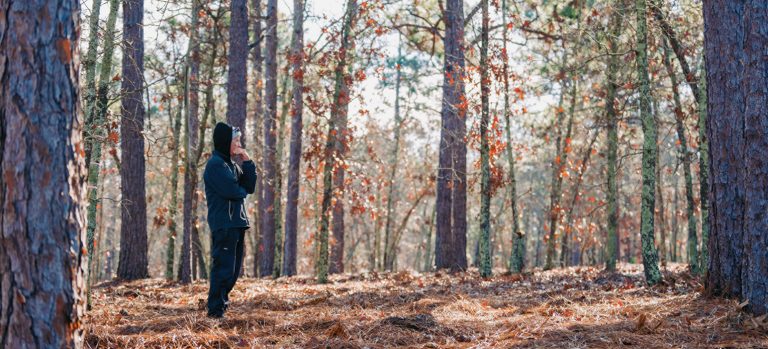
That there was no golf cart left by Pinehurst staff for Coore’s use was no surprise. There was no need. He applied some sunscreen, grabbed a bottle of water and set off as he always does on his golf course design projects — on foot.
“I try not to get into a golf cart,” he says. “I like to walk and feel the land with my feet. You can see things and sense things going slowly and walking that you might otherwise miss. You see and feel the details better. Someone once said that I’m a plodder. That’s probably right. On a great piece of land, you can do it more justice on foot.”
Coore spent considerable time walking this same ground 15 years ago when he was in town working on the restoration of Pinehurst No. 2. He was looking for 18 new holes on this Aberdeen site that at the time Dedman was considering for what would be designated Pinehurst No. 9. But, in the spring of 2012, Dedman pivoted and bought Pinehurst National, weaving it into the resort and club fabric as the new No. 9. He sat for a decade on the Aberdeen site until the demand for more golf in 2022 prompted him to the pull the trigger. Coore & Crenshaw would have designed that course, but they were too busy with other projects, ergo the pivot to Doak.
“I have high hopes for this course,” Coore says. “That we didn’t build that original course and now are building this one has worked out great. Hindsight is 20-20, but it’s worked out better for all parties involved. The course we laid out in 2011 would have been interesting, but the course we have out here now is far better. The routing is better.”
Over four hours, Coore dissected the flow of the course and its many nuances.
Most notable was the ruggedness of the ground. The course that Pinehurst native Dan Maples designed in the 1980s was called The Pit because the land had been mined for sand in the early 1900s, and it was never touched. The furrows and burrows from long-ago excavation machinery were left intact, with years of wild plant and tree growth adding to the texture.
“This site was totally manufactured years ago, with the piles and mounds of material they didn’t want,” Coore says. “It sat there for decades, and trees grew up through them. You’re left with a site that looks totally natural for golf.”
Because the land was so untamed, Coore & Crenshaw designed a course with relatively benign putting surfaces. And there is only one water hazard, a lake behind the seventh green that is largely out of play. There is enough drama in the ground itself that multi-tiered greens and water to suck up poorly struck shots are simply not needed to make the course interesting and testing.
“The greens on this course are almost the supporting cast,” Coore says. “There are not a lot of contours and movement. They are pretty subtle because everything around them is so wild. It felt like if the greens had a lot of contouring, it would be way too much. The land is up and down and twisting and turning. If you get to the greens and have the same thing, it would be too much.”
Construction crews began clearing in November 2024, with the machines moving dirt and shaping fairways in October 2025. As of April 2026, the holes had been largely designed and sculpted, and the greens all “floated out” in the parlance of golf construction. The course will be sodded in the summer and open at some point in mid-2027.
During the 2010-11 restoration of No. 2 — in which he and Crenshaw removed hundreds of acres of Bermuda rough, reshaped the fairways and bunkers, and restored the perimeters of hardpan sand and wiregrass — Coore would stop to speak at length to the workers on the art of installing irrigation heads so that the water didn’t leave green grass in uniform lines, and of planting wiregrass so it looked random and unplanned.
Similarly on No. 11, he conferred often with the tree removal crew and Pinehurst superintendent Kevin Robinson on which trees to remove and which ones to leave alongside the fairways.
“We did that slowly and deliberately in artistic fashion, intuitive fashion,” Coore says. “It’s not like having a highway crew coming in here and clear-cutting. There are some nice rolls to the edges of the holes; they meander.”
As Coore walked the course, he talked of the process of finding the holes, applying the brush strokes and supervising the shapers and diggers.
“It’s like putting a puzzle together,” he says. “You see these interesting landforms and say, ‘OK, that’s a great spot for a green here.’”
Among the interesting puzzle pieces is the par-3 sixth hole that runs downhill and back up to the green, inspired when Crenshaw suggested that a hole similar to Harry Colt’s eighth at St. George’s Hill in Surrey, England, might fit nicely.
“Inspiration? It comes from anywhere and everywhere,” Coore says.
One feature prompted him to say, “Hang on to your hat.”
Another elicited a smile and a shake of the head. “Who could imagine some of this stuff?”
There are old mounds in fairways with pot bunkers cobbled out, leaving Coore to make another comparison to U.K.-style golf.
“This is just a punch-wedge out to safety. You go, ‘OK, I’ve gotta get out of here and not worry about aiming for the green.”
There are vestiges of the ancient mining operation, including a piece of railroad track on the 13th that Coore moved to the periphery of the hole — out of the line of a bouncing golf ball but within eyesight.
“This will be an eccentric golf course. I call it ‘wildly wonderful.’ It’s different. I have very high hopes for it,” he says.
Coore turned 80 in December 2025, and Crenshaw is 74. But they’re still active, with current projects in the Bahamas, Montana, Colorado and Northern Michigan.
“As long as I’m physically able and people want you to do their work, I’ll keep doing it,” Coore says. “Fortunately, we’re still in demand. If you have interesting sites, you are constantly motivated and excited to work them. I feel like a kid out here playing in the dirt.”