
BIRDWATCH
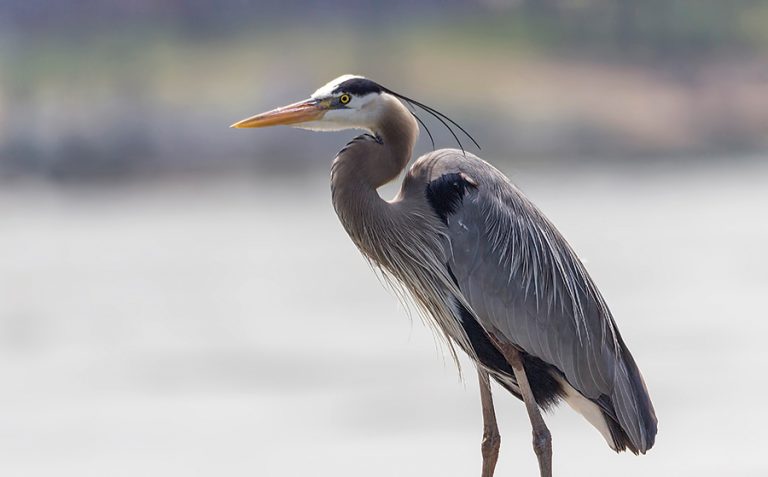
Great Big Blue
A North Carolina attention grabber
By Susan Campbell
The great blue heron is a bird that will get anyone’s attention, bird lover or not. It is the largest of all the species found in the Piedmont and Sandhills, and is second in wingspan only to the bald eagle. Great blues are colonial nesters, gathering often very close together in trees in wet environments where terrestrial predators are not a threat.
Great blues can be found across North Carolina year-round foraging in a variety of wet areas. The way it ever so slowly stalks its prey in the open is unique. However, nesting habitat can be harder to find. Many wet areas are too shallow to preclude raccoons, opossums and other climbing animals. Sizable beaver ponds or islands in the middle of lakes with mature trees or large snags are attractive. If a pair or two are successful in raising a brood high above the water, it is likely that the number of nests will grow in subsequent years to form a “heronry.” The female will weave a cup nest from the branches, then add smaller, softer material (such as twigs, grasses, moss, etc.) that her mate delivers.
The bond between a pair of great blues is very strong during the breeding season. Male and female are both involved with rearing the nest generation. The large nest can accommodate up to five eggs, and both adults incubate and then brood the young. The male spends most of the daylight hours at the nest while the female is there overnight. Herons are very good parents, able to defend their young with not only their heavy, sharp bills, but with very powerful wings.
It will take a year or more for the young to reach maturity. During the first several weeks they are fed mainly fish by their parents, but as they begin to forage for themselves, they will become opportunistic, eating everything from large, aquatic invertebrates (such as crayfish) to frogs and even the eggs of other bird species. Some individuals will not breed until their third summer. Sexually mature birds sport long plumes on their neck and back. They may be seen displaying to their mates by raising their crests and clapping bills together at or near the nest site.
The loud raspy croaking of herons is territorial and can be heard day or night at any time of the year. They will defend rich feeding areas as well as their nest from competitors. Great blues also call when in flight, perhaps to maintain contact with family members. In the air, they have a very characteristic profile with slow, deep wingbeats, their necks coiled, and legs trailing out behind them.
These huge birds are amazingly unafraid of humans. Although they seldom tolerate a close approach, they are frequently found feeding from bulkheads, farm ponds, and even small backyard water features. Many great blue herons have learned that people may provide an easy meal — even if it is in the form of fish remains or table scraps. So, keep an eye out, one of these birds may be closer than you think.