
THE NATURALIST
The Bass of Summers Past
Largemouths, farm ponds and my old man
Story and Photographs by Todd Pusser
There’s a shallow pond in Eagle Springs where memories run deep. On most summer weekends of my youth, Dad and I would venture out on its clear waters to try and catch a few fish.
Surrounded by a canopy of tall pines and dogwoods, the pond is a picture-perfect postcard of serenity. I still recall the low hum of the electric trolling motor on our old aluminum jon boat as we plied the still waters with Zebco 33 reels in hand. Here and there, turtles would poke their heads above the flat surface. Bluebirds sang from nearby perches. If we were lucky, we might spot a green heron skulking along the shoreline, or a red-tailed hawk soaring overhead.
The cooler would be packed full of Pepsis, Lance crackers and a Little Debbie or two — just enough unhealthy goodness to get us through the afternoon. Dad would attach a Beetle Spin to his line with hopes of catching some of the saucer-sized bluegills that frequented the pond’s deeper waters. My lure of choice was an old standby: a black plastic worm with a weedless hook threaded inside.
While I loved catching bluegills on my lightweight 8-lb. test line, I was after the much bigger largemouth bass that had been stocked in the pond years before. Dad’s high school classmate, whose house overlooked the pond, had caught numerous lunkers there over the years, including one that tipped the scales at nearly 10 pounds. I had youthful aspirations of catching not only a larger bass, but one that would rival the world record 22-pound, 4-ounce fish caught down in Georgia in 1932 by a poor farmer named George Perry — a record that stands to this day.
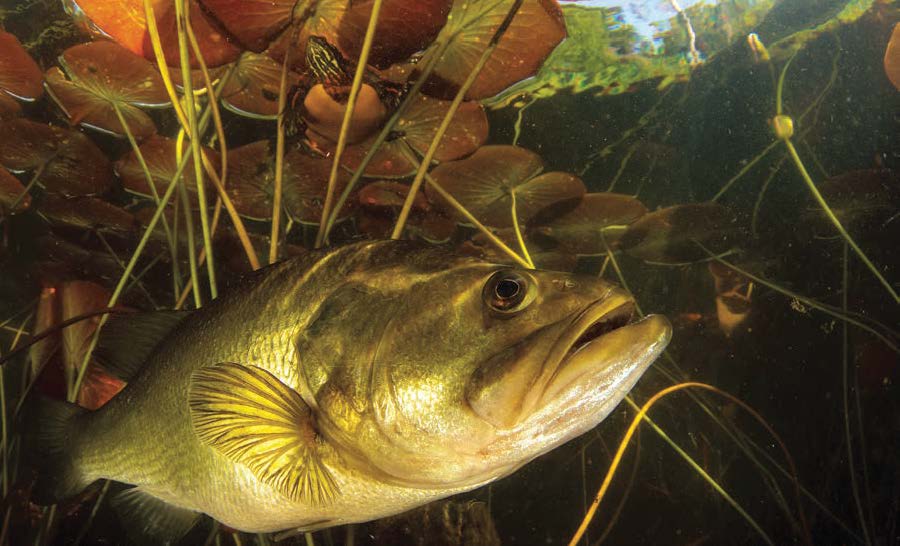
Largemouth bass are uniquely American, indigenous only to the North American continent, though they have been introduced into waters around the world, from Japan to Australia and Cuba to Brazil. According to the recently published book A Guide to North Carolina’s Freshwater Fishes, largemouth bass are native to every river drainage in the state, except for the New River. Over the years, they have been stocked into nearly every golf course pond, farm pond and manmade lake across the state.
In 1802, French naturalist and politician Comte de Lacépéde bestowed the scientific name Micropterus salmoides upon the largemouth bass, mistakenly believing that the fish was a type of trout or salmon. Ichthyologists today recognize that the largemouth bass is actually a type of sunfish, closely related to bluegills. Despite the misnomer, the Latin name of the largemouth remains.
In the years following its formal description, largemouth bass were considered inferior fish by hoity-toity “sportsmen” of the era, most of whom preferred casting lines toward more upper-class finned quarry like trout. The winds started to change when James Henshall wrote The Book of Black Bass in 1881, an immensely popular tome that espoused, for the first time, that the largemouth bass was a worthy gamefish. Soon thereafter, President Theodore Roosevelt was championing fishing for largemouths.
Today, largemouth bass are instantly recognizable by most of the general public. Fishing for them adds billions of dollars to the economy each year, more so than other gamefish. To gauge just how popular the fish has become, simply walk into any Walmart from California to Florida and count the aisles that are stocked to the brim with rods, reels and countless lures dedicated to largemouth bass fishing. It seems that nearly every week, a largemouth fishing tournament is broadcast on some sporting channel. There are Bass Proshops in virtually every large city up and down the East Coast. Country music songs are even written about them.
I never did catch my record bass. The largest one I ever pulled from that Eagle Springs farm pond weighed no more than 4 pounds, though, depending on the social situation, I might exaggerate a little.
As I have aged, largemouth bass represent so much more than just a trophy. I have come to realize that they were a gateway fish to a lifetime of curiosity about the natural world. And, like so many who have spent time casting a line with their fathers, I have also come to realize those moments are finite and I will never get them back. Every cast, every tug of the line, every sunset I spent with my old man on that pond was precious.
A bass, however, wasn’t the biggest thing I hooked at that Eagle Springs pond. Dad and I laugh about it still, though it wasn’t all that funny at the time. I was 12 years old, give or take, and as always Dad and I would make our fishing trips into a friendly competition, judged by who caught the most fish, as well as the largest.
On this particular Saturday morning, we had just pushed off from shore in our old jon boat. I had a special Rebel Minnow topwater lure, recently purchased from a local bait and tackle shop, tied to my line. The lure, as the name suggests, mimics a tiny baitfish, and possessed a pair of barbed treble hooks at either end, near the head and tail. Dad was steering the boat toward a distant cove. In my eagerness to catch the first fish, I stared out onto the open water and immediately slung my rod far back over my shoulder. I belatedly heard Dad shout “No!” as I quickly followed through with my cast.
For a brief instant, there was a hard pull on the line, and then it suddenly snapped. Puzzled, I turned back toward Dad. To my horror, I saw the Rebel Minnow dangling down between my father’s eyes and resting on the bridge of his nose, a pair of hooks deeply embedded in his forehead. A droplet of blood trickled down over his brow and onto his shirt.
Panicked, I muttered a few choice words and apologized profusely over and over. Dad simply pointed the boat back toward shore. We got out of the water and walked up toward his old Ford pickup parked nearby. Despite me not having a driver’s license and barely being tall enough to reach the gas pedal, Dad handed me the keys and told me to drive over to his friend’s house on the opposite side of the pond.
At the time my father still smoked cigarettes — Marlboro Reds — and he calmly reached into the glove compartment, pulled one out, and lit it. Dad said no words at all. He simply took a few long drags off the cigarette as the fishing lure continued to dangle from his head, occasionally bouncing up and down with each pothole in the dirt road.
In what seemed like an eternity, but in actuality was just a few minutes, I pulled up to his friend’s house. Dad got out and rang the doorbell. I will never forget how all the color drained from his friend’s face when he saw that fishing lure stuck in Dad’s head. He quickly loaded Dad into his car and rushed him straight to the hospital. After a local anesthetic, a couple of stitches and a tetanus shot, Dad was as good as new. No scars at all. Well, at least physically.
Before leaving for the emergency room, Dad insisted I stay at the pond and continue fishing until they got back. I asked him what I should do while he was gone.
“Practice, son,” Dad responded. “Practice.”