THE NATURALIST
Birdies, Eagles and Fox Squirrels, Oh My!
High-class habitat for our largest tree squirrel
Story and Photographs by Todd Pusser
I was out of the country last June when the U.S. Open rolled into town. With limited internet access, I was unable to follow the championship’s progress. It was only when I returned home in July that I learned Bryson DeChambeau had won.
Not being on any social media platforms, I also missed some of the viral videos posted during the Open — by professional golfers and spectators alike — of the Sandhills’ unique fox squirrels. Judging by the number of stories produced by various media outlets, it seems like the visitors from out of town were not familiar with our local bushy-tailed rodents. Professional golfer Min Woo Lee’s video of a curious fox squirrel approaching his caddie in the middle of a fairway on the famed No. 2 course drew over 300,000 views and was even mentioned by Golf Digest magazine. “Hello Pinehurst. What is this animal?” Lee asks in the video. “Is it a skunk, or a raccoon, or a squirrel?”
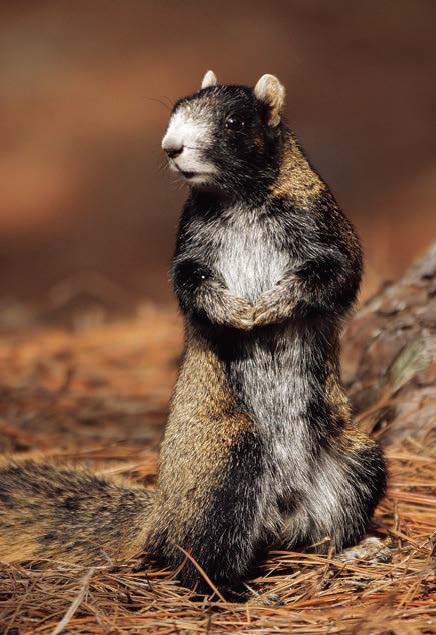
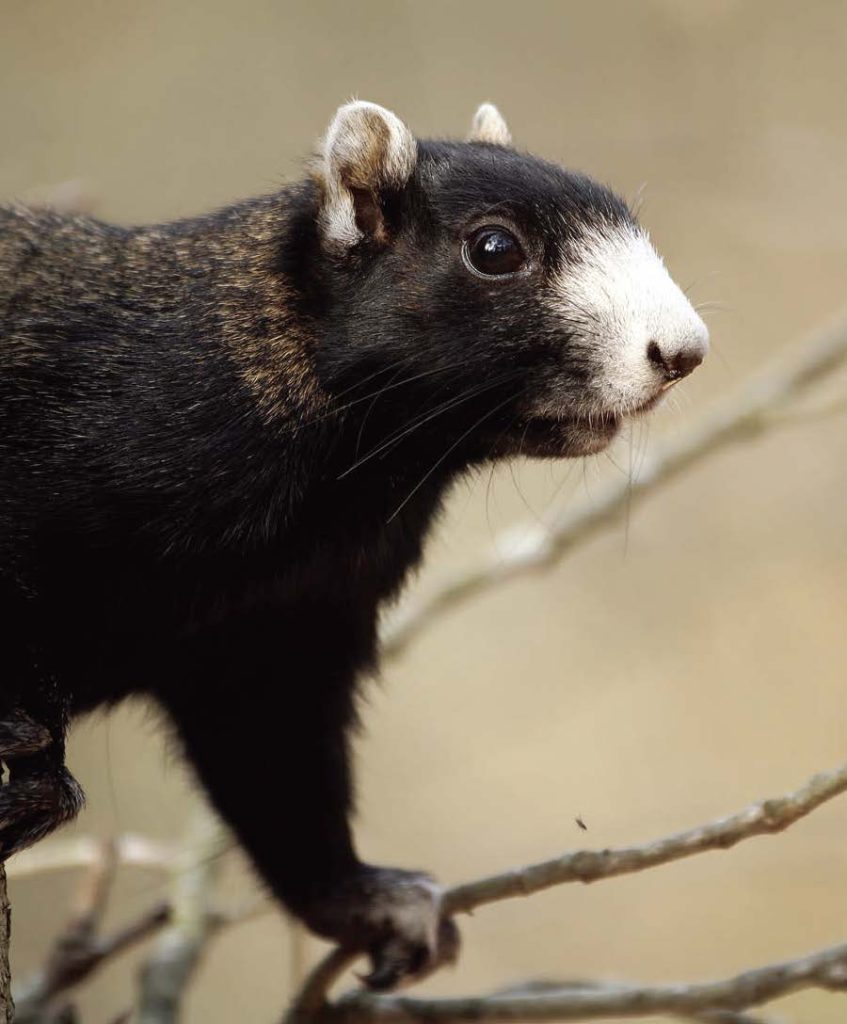
It’s easy to understand his confusion. After all, Lee hails from Australia, a continent that is packed full of animal oddities — the platypus and the bilby (Google it, they are adorable) to name two — but has no native squirrels. Nada. Zilch. So it’s easy to imagine Lee’s initial reaction upon seeing an animal with white ears, a white nose, black face and a long bushy tail for the first time. Nearly the size of a housecat, fox squirrels are the largest tree squirrel in North America.

When the inquisitive squirrel approached Lee, he quickly held his club at arm’s length and exclaimed, “Back up brother! Back up!”
Tee it up on any of the local golf courses and chances are you will see a fox squirrel at some point during your round. They are as much a part of the Sandhills landscape as pine trees and blue skies.
Though North Carolina never has listed the species as endangered or threatened, fox squirrels have always been considered uncommon. Throughout the southeastern United States, fox squirrels are strongly associated with the longleaf pine tree. Their large body size gives them a competitive advantage over their smaller cousins, the highly adaptable grey squirrel, enabling them to rip open the large, calorie-rich pine cones of the longleaf. Vast longleaf forests once stretched from southern Virginia down to Florida and along the Gulf Coast to east Texas. Today, over 90 percent of those forests have disappeared, having been converted into everything from agricultural fields to housing developments. The resulting loss of longleaf caused severe population declines to animals that depended on that ecosystem for survival, fox squirrels included.
When I was growing up in Moore County, you would occasionally encounter a fox squirrel here or there. You might spy one sprinting across a backroad around West End or shredding a pine cone on the grounds of Sandhills Community College. We even had them visit our yard periodically in Eagle Springs. But if you really wanted to guarantee seeing one, all you had to do was head to the links.
Throughout my teenage years, my father and I played golf most weekends, wherever we could get a late afternoon tee time (he worked most weekend mornings) and the best rates. No matter where we played, Seven Lakes, Whispering Pines, Foxfire, Deercroft or Pinebluff, I would see fox squirrels. They were always the highlight of my day — well, except for the time I holed that 120-yard shot from the fairway for an eagle at Hyland Golf Club (it was Hyland Hills then), still my all-time best golfing experience. Even on our family vacations to North Myrtle Beach, I would occasionally see fox squirrels loping across golf courses with their distinctive bounding gait.
Fox squirrels are denizens of open forest canopies that are free of dense underbrush, which historically in a longleaf pine ecosystem was the result of frequent fire. Golf courses mimic those old-timey pine forests, in a roundabout way, with their park-like landscapes and abundance of food and nesting trees favored by the multi-hued squirrels. A number of scientific studies have even shown that golf courses may hold the key to survival for fox squirrels in parts of the Southeast, especially in urban areas.
As an example, I recently found myself at Innisbrook Golf Resort, just north of Tampa, Florida, visiting family and friends. The property’s four golf courses are surrounded by a sea of humanity, in the form of never-ending strip malls, hotels and restaurants. Yet, fox squirrels were thriving in surprisingly high numbers along the manicured fairways bordered by huge pines and oaks. I even saw one sneaky squirrel steal a granola bar from the golf cart of an unsuspecting golfer who was up on the green putting for birdie.
As photography started to become an integral part of my career, one of the first subjects I set out to photograph were fox squirrels. Late Pinehurst resident and golf aficionado Parker Hall was kind enough to help my endeavors, arranging access to the Country Club of North Carolina and providing me with a golf cart to lug around my heavy gear. Over the course of two winter afternoons, I was able to greatly expand my fox squirrel portfolio. Up until that point, I had never seen so many fox squirrels in such a small area.
My last golf course fox squirrel encounter happened over the Christmas holidays. I was visiting my folks for a few days and found myself driving north along Hoffman Road near Foxfire Village. Late one morning on a straight stretch bordering one of the golf club’s fairways, a solid black fox squirrel, with bright white paws and ears, stepped out onto the asphalt. I came to a complete stop, allowing the beautiful mammal to pass safely across the highway into a patch of nearby pines. Watching its long, flowing black tail disappear into the forest, I was reminded of a life lesson instilled in me at a young age: Always be respectful of the locals.