
OUT OF THE BLUE
Wrap and Roll
Judging a Hershey’s Kiss by its cover
By Deborah Salomon
These days, given world trade issues, where products originate has become a political issue. Halloween and Christmas won’t be the same if tariffs outprice merch made in China, where neither holiday is celebrated but manufacturing, even with shipping, costs less than producing the stuff Stateside.
Pondering that reminds me of how the Industrial Revolution brought about factories filled with machines that turned out never-dreamed-of products. Some resulted in humorous truisms like, “You can’t put the toothpaste back into the tube.”
How it got there in the first place? Some clever fellow designed and built an assembly line performing a series of functions that turned a flat piece of metal into a tube filled with paste.
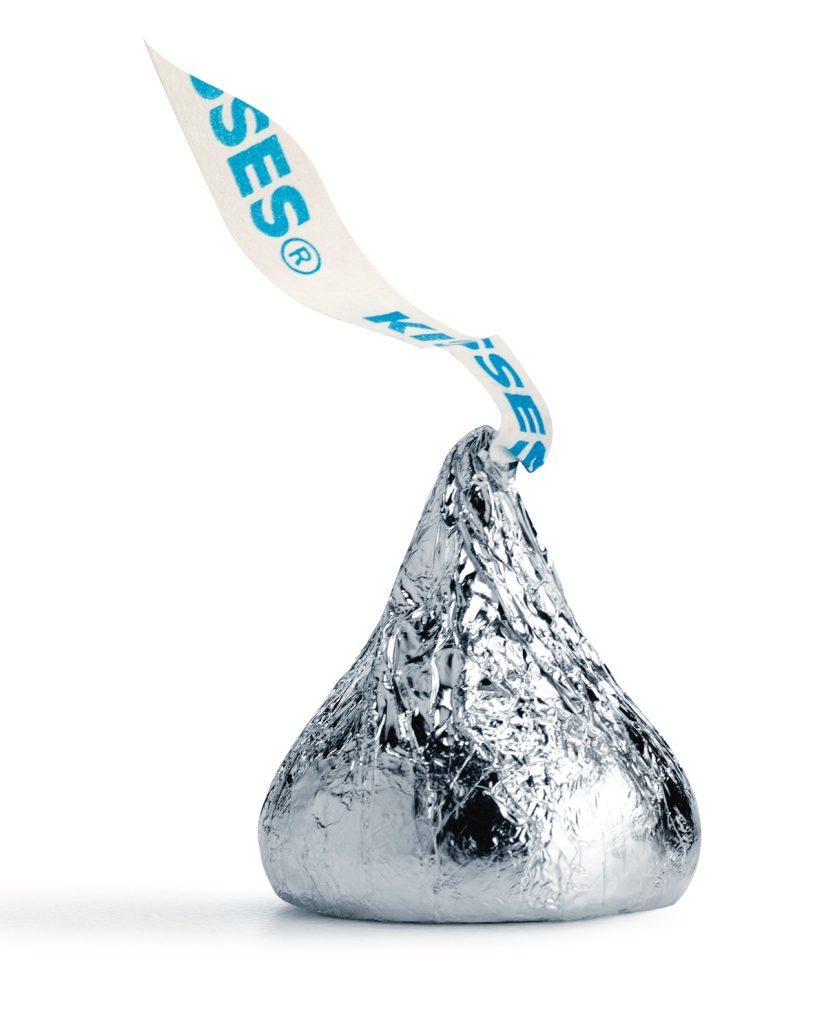
These literal “machinations” made mass production possible . . . and a lotta engineers rich, since each product required the design and production of its own machine. Some machines became famous in their own right — like Hershey Kisses, wrapped on a conveyer belt the size of the Jersey Turnpike at the rate of 20,000 a minute at the Hershey, Pennsylvania, factory.
Ever wonder how Oreos are assembled? Are the round wafers identical, top and bottom? The Nabisco website isn’t exactly forthcoming, fearing patent infringement, I guess. At the rate of 400 billion a year in myriad varieties, their machines are calibrated for uniformity. The three-step process turns the chocolate or vanilla wafer on its back, releases the vanilla filling, adds the second wafer. No overhang tolerated. Temperature keeps the filling from oozing out . . . but how is that temp maintained in a factory?
Any malfunction in the process results in the loss of thousands of cookies, which must be converted into the crumbs populating ice cream, yogurt, pie crusts, maybe toothpaste.
I still haven’t figured out how frozen green peas get into plastic bags without spilling all over the factory floor. Another packaging puzzler: the sodden pad that comes between chicken parts and the polystyrene tray. Do we pay for this run-off weighing half a pound?
The most fascinating mechanical wonder is the machine that makes individually wrapped slices of orange processed “cheese.” Betcha never noticed that packages are labeled American “slices” or “singles,’’ not “cheese,” because their formula does not conform to government standards. Unfortunately, Americans value wrappings and convenience more than the flavor of natural cheddar, which melts nicely but develops mold if not properly wrapped and stored. Grilled cheese lovers are squeamish about trimming specks of mold — another quirk for the French to mock.
By the mid-20th century, packaging rendered a brand or product instantly recognizable. Oatmeal still comes in cardboard cylinders, maple syrup in glass jugs with handles, eggs in sectioned boxes. Mayonnaise jars are the same shape, but plastic. The glass originals still deliver soup to a sick friend. Better pasta sauces and a few fruits still come in canning jars with metal twist lids, priced accordingly. Occasionally I see a tall, tin saltines container. In the past, these monoliths enjoyed rebirth as crayon bins. Or Lego storage. The kids made little magnetic Scottie dogs creep up the sides.
Am I the last granny to remember Velveeta bricks in wooden “crates” with sliding tops? Or individual serving yogurts in half the flavors but with snap-on lids?
I still wonder why granulated sugar comes in paper bags, which absorb enough moisture to allow hardening into a brick.
As with mayo jars, I try to reuse containers with secure lids instead of buying new ones at the $1.25 store. For years, the best were 32-ounce Food Lion house brand semi-opaque sherbet containers with a tight lid, perfect for stacking homemade chocolate chip cookies for the flight north to my grandsons. Then FL changed the size and material.
Darn. Took me forever to find a replacement, this time at Lowes Foods: 54 ounce Kemps sherbet, with a secure lid and room for extra cookies.
But first somebody has to eat 54 ounces of sherbet.
Wild strawberry’s the best.