
OMNIVOROUS READER
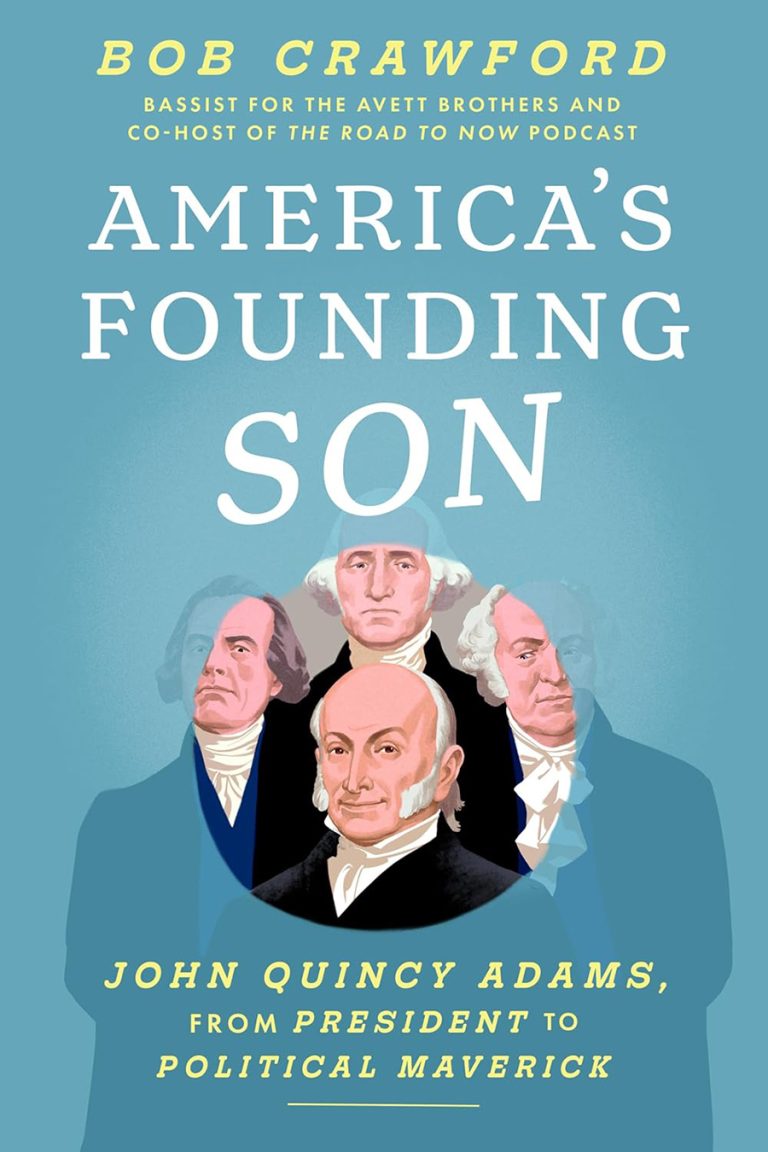
The Skill of Perseverance
The remarkable second act of John Quincy Adams
By Jim Moriarty
If your American history IQ, like mine, falls somewhere between Animal House’s Flounder — “fat, drunk and stupid is no way to go through life, son” — and the great David McCullough, you’ll find America’s Founding Son both an enlightening and rewarding portrayal of our sixth president, John Quincy Adams.
It’s written by Bob Crawford, something of an oddity in itself given he’s the upright bass player for The Avett Brothers band. “For more than two decades, I’ve studied American history while rambling up and down the interstates, freeways, and back roads of America,” Crawford writes in his introduction. While not exactly an autodidact, his lifelong fascination, beginning as a kid collecting fliers about historic landmarks at highway welcome centers, places him in the company of another member of the band, Scott Avett, who has a side hustle as an admired visual artist.
With the recent passing of Ted Turner, one is reminded of the quote he often attributed to his father, “Be sure to set your goals so high that you can’t possibly accomplish them in one lifetime.” This is, in fact, the crux of Crawford’s thesis about Adams and the goal was, or became, the abolition of slavery. His primary source is Adams’ own diaries, written faithfully on a daily basis, that illuminate the arc of JQA’s understanding of how America must eventually, and tragically, cope with its most egregious and contradictory failing.
Jimmy Carter is often extolled as a man who, in the modern age at least, made the most of his post presidency, but he was a piker compared to John Quincy, who, after losing the presidential race of 1828, briefly considered retiring from public life but instead won election to the U.S. House of Representatives. He served the citizens of Massachusetts in that capacity from 1831 until his death in 1848, when he collapsed at his desk in the House chamber and died two days later on a couch in the Speaker’s Room in the Capitol building. During those 17 years, Adams became a formidable opponent of slavery, argued the Amistad case before the Supreme Court, defeated the “gag” rule designed to muffle anti-slavery petitions, and outmaneuvered efforts, led by representatives of the “slavocracy,” as Crawford calls it, to censure him.
“John Quincy Adams may not have been an extraordinary president like Washington and Lincoln, but he is our most extraordinary ex-president. A maverick. A public servant. An American hero,” Crawford concludes.
Adams’ opposition to slavery was never in question, but his theories on what exactly to do about it evolved over time, a transition Crawford illustrates through Adams’ diary and speeches. “America’s founding son had reached the end of his patience,” Crawford writes of an 1844 clash on the House floor. “He shuddered in 1820, when he prophesied a violent dissolution of the Union, but all he had experienced in the nearly twenty-five years since proved to him that the South would never, ever, voluntarily or otherwise, give up being the enslavers.”
Crawford’s fascination with the period of American history between the War of 1812 and the Civil War came into focus after reading Sean Wilentz’s The Rise of American Democracy: Jefferson to Lincoln. His own study of John Quincy is divided into three acts. The first begins with Adams’ appointment as secretary of state under James Monroe, covers his election to the presidency in the House of Representatives in 1824 (the second time the young republic picked a president in that manner), his loss to Andrew Jackson in their rematch in 1828 and concludes with the voters of Plymouth, Massachusetts, sending him to the House as their representative. In act two Crawford does an admirable job of setting the table. “In 1835, the slavery issue was tearing the fabric of the nation apart. Its threads tossed into a smoldering furnace of bigotry and hate. And there was Adams. A witness to all of it. Sitting on the fence. Waiting for his moment.” That moment builds to a crescendo in act three.
The political figures of the day — Jackson, Henry Clay, John C. Calhoun, Martin Van Buren — are carefully drawn, as are the central issues of nullification (What if the federal government says one thing and a state refuses?) and what to do about Texas. Of equal, or even greater, interest are the abolitionists: Benjamin Lundy, Charles Finney, Theodore Weld, Arthur Tappan (full disclosure, the square at my alma mater is named Tappan Square), William Lloyd Garrison and the writings of David Walker.
When Crawford first pitched the idea of America’s Founding Son to his agent, he thought he’d be paired with a writer to produce the final work. Instead, he was left to his own devices. The result is highly readable, no small feat when you’re bound to be leaning on quotes written in the first half of the 19th century. If there is any complaint — and it is admittedly minor — it’s that on a rare occasion or two he strays too far into the vernacular of his own day, seemingly trying a bit too hard to prove that history doesn’t have to be tedious and dense. This is, perhaps, an innocent byproduct of cohosting his history podcast, “The Road to Now.”
Where Crawford ends up is in praise of a historical figure most of us, I’d venture to say, don’t often associate with greatness. “Adams brought the issue of slavery out of the darkness and into the light of the center of politics in the United States — the People’s House. John Quincy Adams preserved and protected the American democracy established by the founding generation — his father’s generation,” writes Crawford. “As the man standing in the breach, Adams passed the aspirations of the Declaration of Independence on to the next generation. With one hand reaching back to the founding and the other reaching forward toward the Civil War, John Quincy Adams is a bridge and perhaps the best representation of America’s tortured adolescence.”
If, in reading Founding Son, you see traces of modern America — our deeply flawed and fractured America — so does Crawford. “I can’t say for sure whether history repeats or rhymes, but I do notice echoes from the past in our present. That’s because history is driven by people — and people haven’t changed since 1776,” he writes. “Truth be told, people haven’t changed since Adam and Eve, or however you signify the beginning of time (or should I say history?). Spend a little time reading about the 1830s and 1840s, and you’ll encounter figures who feel eerily familiar. They dressed differently, used different slang and communicated via what now seem like antiquated technologies — but in a very real sense, we are them and they are us.”