
OMNIVOROUS READER
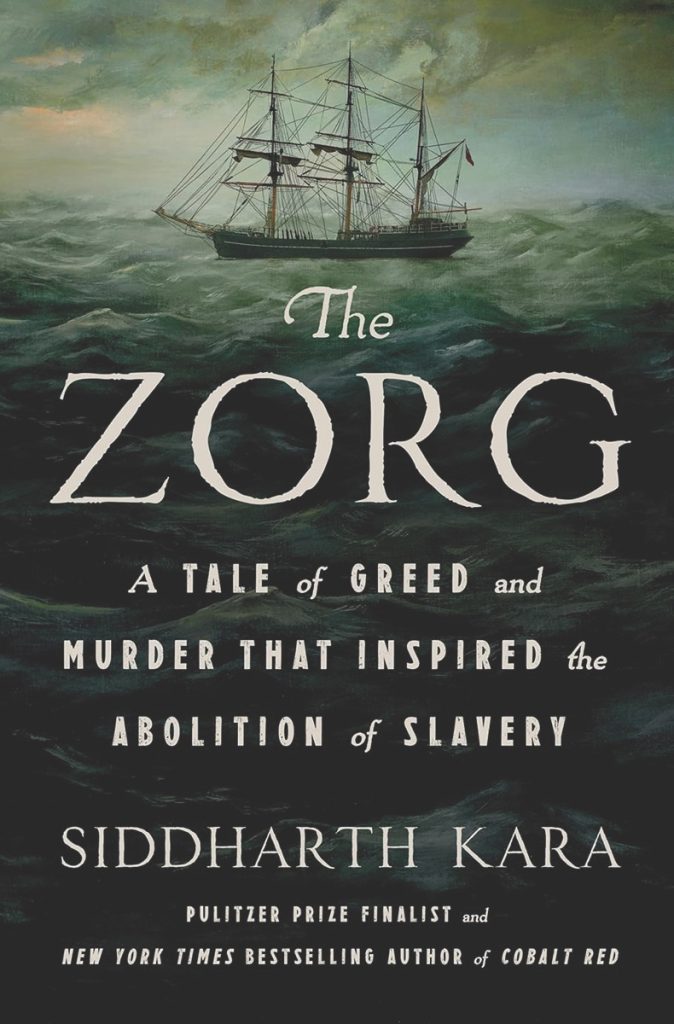
Horrors at Sea
The sordid tale of the Zorg
By Stephen E. Smith
A few chapters into Siddharth Kara’s The Zorg: A Tale of Greed and Murder That Inspired the Abolition of Slavery, you might consider putting the book aside. After all, we live in a world fraught with grievance. Why burden ourselves with crimes committed 245 years ago?
The answer is obvious: Ancient injustices are the source of contemporary injustices. Cruelty begets cruelty. So you’ll likely continue reading The Zorg, despite the graphic inhumanity it depicts.
Kara is an author and activist who studies modern slavery. He has written several books on slavery and child labor, including the New York Times bestseller and Pulitzer Prize finalist, Cobalt Red, and he has much to tell us in his thoroughly researched and skillfully crafted narrative of the Zorg massacre, which serves as a disturbing yet obligatory lesson for contemporary audiences.
In late 1780, the Zorg, a Dutch ship, set sail for Africa’s Gold Coast to take on a cargo of Africans to be sold in the New World. Such slaving enterprises were common. It’s estimated that more than 12 million captive human beings were transported on 35,000 voyages between the 16th and mid-19th centuries, so the Zorg was unusual only in the exceptional misfortunes that befell its crew and captive cargo.
After reaching its initial destination in Africa, the Zorg was captured by British privateers, and the ship was loaded with more than 440 enslaved humans, twice the number it was equipped to carry. The British captain, who had little experience commanding a slave ship, and his crew were ill-prepared to make the journey; nevertheless, they set sail for Jamaica. Poor seamanship, faulty navigation, rough seas, and a lack of food and water plagued the enterprise. The Zorg missed Jamaica and had to retrace its journey. The human cargo suffered greatly, sickness took its toll on the crew, and the ship’s water supply ran low. Eventually, the crew had to decide who would live and who would die.
The first to be tossed overboard were the women and children, followed by the weaker male captives. It was a heartless and brutal business, and 140 human beings were sacrificed for the “greater good.”
Such atrocities were not uncommon in the slave trade. Still, Kara’s graphic, novelistic description of these events is compelling without being gratuitous. The massacre of the innocent Black captives will be disturbing for anyone unfamiliar with the horrors of the Middle Passage, and those readers schooled in the inhumanity of the slave trade will find themselves moved to a new level of compassion. Kara’s skills as a writer and his deft storytelling bring history to life, and readers with any sense of empathy will react with genuine horror.
But the story of the Zorg doesn’t end there. When the captain, crew and surviving slaves found their way to Jamaica, the slave trading syndicate that had financed the voyage made a claim against the insurers of the enterprise, hoping to recoup the value of the human cargo that had been jettisoned. A trial followed, and a jury found that the murder of Africans was legal — they were simply a commodity — and the insurers must pay. Each lost slave was valued at $70, about the price of a horse.
Still, the controversy might have faded from memory — what was the loss of a few African captives? — but it was soon learned that the Zorg had arrived in Jamaica with a surplus of fresh water that had been taken aboard during a storm at sea. With the water supply replenished, the crew continued to dispose of the weaker captives so they might obtain more insurance money — in other words, the captain and crew committed insurance fraud. The verdict was appealed, and a protracted legal battle ensued between the insurers and the trading syndicate. The resulting public uproar catapulted the sensational story onto the front pages of England’s most prominent newspapers, transforming what might have been an insignificant controversy into a protracted struggle that would end the English slave trade with the Slave Trade Act of 1807, which in turn ignited the abolitionist movement in the United States. It would take the cataclysmic Civil War to decide the matter in America.
Slavery may be outlawed in every country, but it persists. According to the latest Global Estimates of Modern Slavery (2022) from Walk Free, the International Labour Organization and the International Organization for Migration, 49.6 million people live in modern slavery in forced labor and forced marriage, and roughly a quarter of all victims of modern slavery are children. The concept of slavery — the notion that a dominant culture or race remains superior to a once enslaved race — has not been purged from our hearts and minds.
For readers who aren’t interested in history but are fascinated by horrific tales, The Zorg fits the bill. The Russian writer Maxim Gorky, who knew something about imprisonment and slavery, understood our fascination with the terrible. “I know of genuine horrors, everyday terrors,” he wrote, “and I have the undeniable right to excite you unpleasantly by telling you about them in order that you may know how we live and under what circumstances. A low and unclean life it is, and that is the truth . . . one must not be sentimental, nor hide the grim truth with the motley words of beautiful lies. Let us face life as it is.”
At the very least, Kara’s skillfully crafted narrative will leave readers wondering how future generations will perceive the inequities and struggles of the tragic times we live in.
The Zorg will be available online and in bookstores Oct. 14.