
NC SURROUND SOUND
A Musical Life
Creating space for art to thrive
By Tom Maxwell
Seminal producer, songwriter and musician Mitch Easter remembers the intersection where he was stopped when Big Star’s power pop masterpiece “When My Baby’s Beside Me” came on his car radio in the 1970s. “It just sounded so great,” Easter says. “The thing is, mainstream radio stations avoided stuff with guitars back then. You heard a lot more electric pianos and Carpenter-types. So, when you would hear a rock song like that — with all these great sounding guitars — it really popped out.”
Big Star was a short-lived Memphis band that left a lasting legacy. Easter thinks his local Winston-Salem FM station played them for a couple of weeks almost by accident. “Radio stations were more independent back then,” he says, “and I think somebody took a shine to that song.”
Those two weeks would help shape the rest of Mitch Easter’s life. Big Star had such an effect on the young musician that in 1978, he and two friends went to Memphis to meet their idols, even though the band had broken up several years previously. “Somewhere along the way we’d been given information about how to find (co-founder) Chris Bell,” Easter says. “So we went out there and hooked up with Chris. He was working at Danvers, this roast beef place that his parents owned. We passed a note back from the cashier and this guy came out, like, ‘Who’s looking for me?’”
Bell took them to Sun Studios, where former Big Star frontman Alex Chilton was making a record. “I don’t think Chris and Alex had seen each other in a while. So, it’s cool if we were some kind of icebreakers.” Bell would be dead before the year was out, killed in a car accident a couple of days after Christmas. He was 27.
Soon after his Memphis trip, Easter followed other musician friends to New York. “We were all big fans of the punk scene coming out of New York,” he says, “even though none of us were really punk rockers per se. It was a proper music scene. There were little labels popping up, and there was Trouser Press and New York Rocker magazines.”
Easter planned to open a recording studio in New York. He had a keen interest in recording technology and by this time had racked up considerable experience experimenting in his parents’ basement with reel-to-reel multitrack tape machines. “I remember very distinctly reading in an electronics magazine a description of what really happens in the recording studio and laughing it up because it was completely mysterious to me,” he says. “I used to imagine that on the early Beatles things when George Harrison was playing acoustic and then there was a solo, I thought somebody threw him an electric guitar really fast and he started playing it.”
That New York life wasn’t meant to be. In his own words, Easter “chickened out” and moved back to North Carolina, but the Triad had changed. Original bands were forming left and right; local college stations were playing post-punk bands like the Buzzcocks; and a cool new club called Fridays opened up in Greensboro. “It was really a pizza joint,” Easter says, “but they had the new-type rock bands play on the weekends. It was full of the kind of kids that I saw in New York. The other thing I observed was people dancing. It was like it had been rediscovered.”
In short order, Easter addressed his quarter-life crisis by opening a recording studio named Drive-In Studio, because it was situated in his parents’ two-car garage in rural Winston-Salem. One of his early bookings was a weekend spent recording demos with a young band out of Athens named R.E.M.
“There was this big split back then,” Easter says. “A lot of the recording studios were still operating on the fumes of disco — and the fumes were pretty strong. So, there was a vibe that the bands did not dig about ‘real’ recording studios. Maybe in New York and London these punk bands were working in nice studios, but there wasn’t anything like that here. There were either real funky garage studios or the big studios. The perception of Drive-In was that this was a studio oriented for you, which it kind of was. It was really humble.”
Happy with their demos, R.E.M. soon returned to make a proper record. In 1982, Easter produced their dazzling debut EP (extended play), Chronic Town.
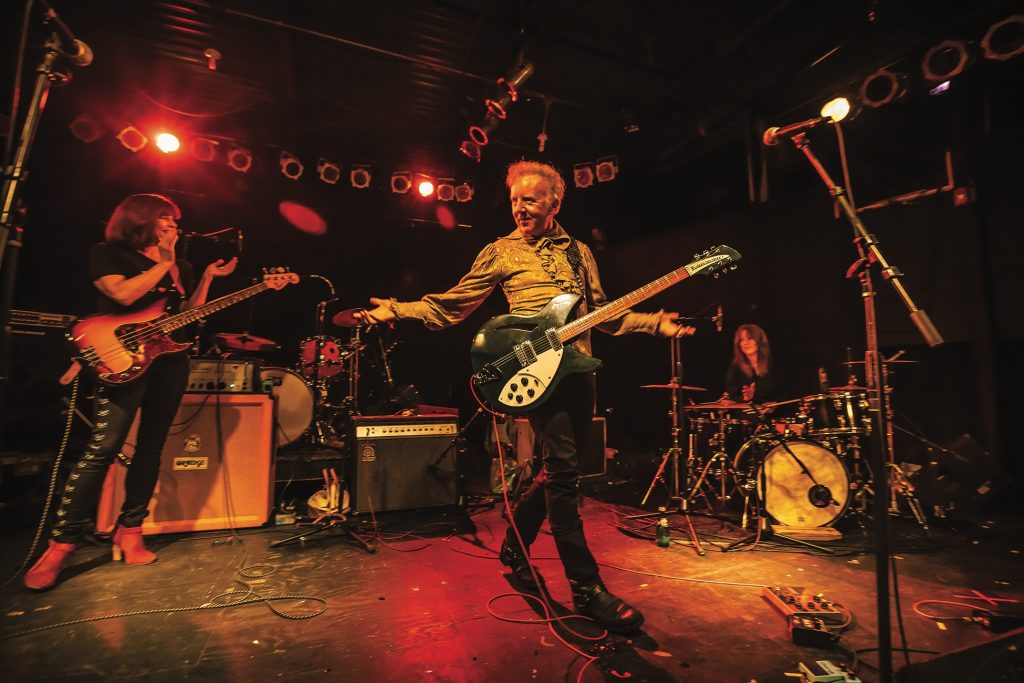
Meanwhile, Easter was writing, singing and performing with his own group, a power-pop trio named Let’s Active, which he formed with then-girlfriend Faye Hunter and drummer Sara Romweber, sister to Chapel Hill rocker Dexter. In 1983, Easter co-produced R.E.M.’s first full-length Murmur and wrote pure pop gems with Let’s Active, like “Every Word Means No,” issued on the band’s debut EP Afoot.
This, then, became Mitch Easter’s busy musical life for the next decade. Along with R.E.M.’s sophomore album Reckoning, he produced visceral power pop records with bands like X-Teens, Game Theory, The Connells, Velvet Elvis and Love Tractor. Let’s Active carried on making albums until its dissolution in 1990, an act that led to newly formed groups from nearby scenes in Chapel Hill and Raleigh.
Drive-In Studio closed in 1994, when Easter opened a new “residential” studio near Kernersville called Fidelitorium. “I’m a great supporter of making records in bedrooms and all that kind of stuff,” Easter confided, “but there’s a thing about going to a dedicated space that’s really useful. It focuses your effort, especially with a group. A lot of people need to get away from their house.”
And there’s art in the studio beyond the music. “The other thing that dawned on me is that you take a whole lot better pictures in a proper studio, right?” Easter says. “I love those electric Dylan-era pictures from Columbia Studios in New York, those great black and white pictures of big rooms that don’t have much in them but very cool looking musicians. You could only do that in a proper studio. I’m sorry that these big places are going away because they were very romantic to me.
“Even uncool studios were important because if they hadn’t existed, you might not have had that unbelievable scene in Boogie Nights, when they want their tapes back and they haven’t paid for them. I just hope that the big places don’t totally go away or only do soundtracks for epic blockbusters. There’s a meeting place thing about a proper studio that’s kind of beautiful.”
Easter, a portrait of the artist as an older man, will turn 71 in November. “It’s funny about music,” he says. “You’ve got a long trajectory of possibilities. Little kids can be really good at music in a certain mechanical way, and sometimes they’re pretty expressive, too. I might have played the best when I was in my mid-30s, but I have more sense about it now. When your fingers do a bunch of stuff, that’s great, but maybe you’re not thinking about it quite enough, or you’re doing too much. The thing that’s so cool about pop music is there is a place for all those stages. It’s funny that rock music has finally allowed people to be old. It’s a really wonderful thing in these everything-is-falling-apart times to think that there is good stuff to do throughout your life when you’re a musician.”