
HOMETOWN
Over There
A wee bit of wonderful
By Bill Fields
Like many Americans, I first experienced the British Open — what most in the United States called that golf major championship during the 1970s — through television. ABC Sports broadcasts weren’t long by today’s dawn-to-dusk standards but were revealing: the rumpled landscape, khaki-colored turf if it had been dry, and shorter-than-usual flagsticks. Slacks billowed in the wind. Balls finished in precarious lies in steep-faced bunkers. I learned a new word: firth.
When I watched those Opens, the links seemed a faraway golf universe that were out of reach, places I would only ever see on TV.
Happily, I was wrong. If my addition of all the jet lag, stunning skies, spitting rain, lager shandies, breakfast beans, roundabouts, mysterious shower controls and BBC Radio news is correct, this month’s Open Championship at Royal Birkdale will be my 22nd time at golf’s oldest tournament.
Getting to see a lot of the U.S. and a little of the world is not something I was counting on as a child. An annual vacation to North Myrtle Beach this time of year was about the extent of my family’s travels. I didn’t fly until I was of voting age and certainly couldn’t have anticipated making a couple of dozen trips to the British Isles covering golf in one fashion or another across four decades, whether for an Open, Ryder Cup or Solheim Cup.
I’ve been to The Open in various roles: photographer, reporter and, more recently, television researcher for NBC Sports. For me, there haven’t been as many trips to The Open as to the three American-based men’s majors, but the trips abroad stand out, beginning with the first one in 1988, at Royal Lytham & St. Annes.
The wind was howling in what felt like gale force when I walked outside my bed and breakfast in Blackpool the first morning in England. I heard an elderly man on the sidewalk describe the wind to his companion as a “wee breeze.” I’m no stranger to pushing drives far to the right without meteorological influence, but while I was playing a local course later that day, the wind carried one of my tee shots farther offline than any before or since. That ball might still be on its errant journey.
By the weekend, rain was the story. It came down so hard on Saturday that multiple greens were flooded, the third round was abandoned, and a rare Monday finish was in the cards. That extra day turned out to be memorable, with Seve Ballesteros shooting 65 to win his fifth — and final — major over Nick Price and Nick Faldo.
An Open in St. Andrews stands out. I’ve been fortunate to work four at the Home of Golf. Faldo outdueled Greg Norman over the weekend in 1990. John Daly defeated Costantino Rocca in a playoff in 1995. Louis Oosthuizen got a favorable late-early draw and avoided a beastly Friday afternoon wind on his way to a seven-shot win in 2010. Cameron Smith prevailed in the 150th Open in 2022, when Rory McIlroy couldn’t buy a putt on Sunday.
On my 2010 visit to the “Auld Grey Toun,” I spent some pleasant idle hours, camera in hand, on the West Sands, the wide, 2-mile stretch of beach featured in the opening scene of the 1981 film Chariots of Fire. As at many Scottish locales, the sky there can change moods in minutes, going from angry to serene.
Whatever has transpired during the day while on assignment at an Open, après-work can soothe the soul when you’re with colleagues whose company you enjoy having a couple of pints or a good curry — or better still, a couple of pints with a good curry. Just remember, discretion is the better part of valor over there when a server in an Indian restaurant asks you how spicy you want your meal. Years ago, I witnessed a vindaloo in Troon cause more pain than a pot bunker ever could.
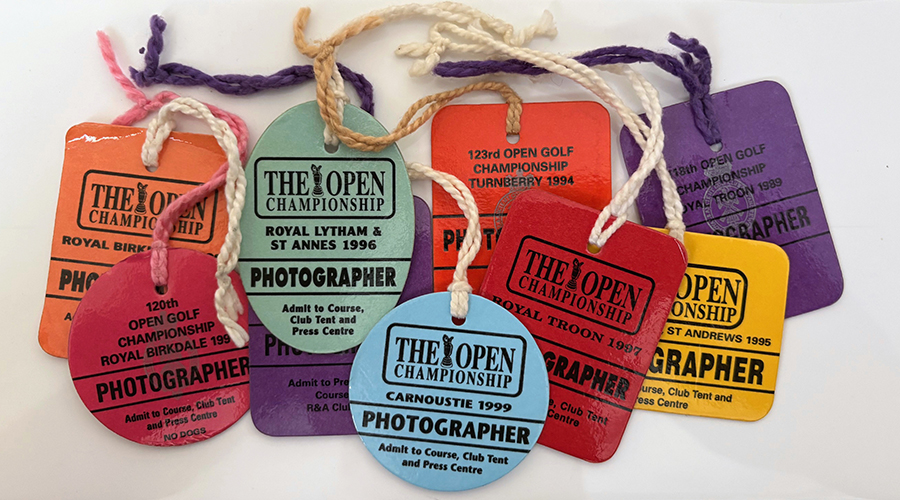
I’ve held on to plenty of tournament press badges issued to me over the years — the collection maps where I’ve been and what I’ve done — but my favorites are ones from my first decade going to The Open. They’re simple paperboard credentials with a short loop of string — a style long since replaced by larger ones with a head shot, bar code and lanyard — and they have stories to tell.