
HOMETOWN
Wonderful Wood
When the persimmon tree reigned supreme
By Bill Fields
Every fall, at some point after the days began to cool, I could count on hearing a complaint from my father.
“Those damn persimmons,” he would say. “That tree needs to go.”
Our yard was mostly populated by longleaf pines, half a dozen of which loomed taller than the two-story house they surrounded. Their fellow evergreen was a bulky cedar, thickened over the years like a college freshman with a generous meal plan and little willpower. Several maples and sycamores gave our corner of the block a little color around Halloween.
Dad realized that having to clean up the needles and leaves after they drifted to the ground was the price of shade. But he was much less understanding about what dropped from our Diospyros virginiana each autumn.
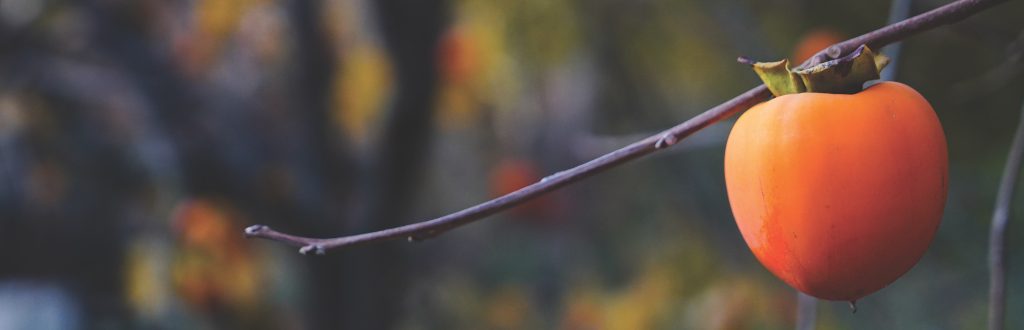
About 40 feet tall, our American persimmon tree, with its dark, blocky squares of bark, stood next to the driveway. It was in just the right location for its fruit to fall on our cars and stain them. We were a (well) used-car family during my early childhood. But Dad kept the vehicles washed and waxed and didn’t appreciate the mess made by the fleshy persimmons, which were about the color of a basketball and the size of a ping pong ball.
Sometimes, we kids threw them like baseballs at each other, unaware that the sweet pulp of the ripe fruits could be — when mixed with the proper amount of milk, sugar, eggs, flour and butter — turned into a tasty persimmon pudding. (I only sampled an unripe persimmon once, so astringent was its flavor.)
One day, my father hired a man with a chain saw, and the persimmon tree was no more. Its remains were hauled to the curb to be hauled off by town workers. For decades a small stump marked its former presence and demanded a slight detour when mowing.
Dad was not a golfer at that point, and I was a mere fledgling in the game. Neither of us knew that the type of tree chopped into pieces and piled by the curb figured so prominently in golf. Beech, ash, dogwood and other species were utilized for wooden clubheads during the 18th and 19th centuries in Great Britain, but American persimmon (native to south central and eastern parts of the U.S.) became the material of choice beginning in the early 20th century. Persimmon is dense and durable, ideal for golf clubs. I have wondered whether any clubheads could have been produced from the wood of the tree we had taken down because it was a nuisance.
I was a young teenager when I acquired my first persimmon-headed woods, lightly used MacGregor Tourneys manufactured in the late 1960s. Experiencing the “satisfying thwack” of a well-struck shot was a revelation. The sensation was something golfers of all abilities, from duffers to legends, sought to feel. When a golfer found a certain persimmon club to his or her liking, it could be a magical and productive union.
Ben Hogan broke through for his first individual wins on tour in the spring of 1940 — in Pinehurst, Greensboro and Asheville — with a MacGregor driver just given to him by Byron Nelson. Sam Snead used an Izett model driver and Jack Nicklaus a MacGregor 3-wood for decades. Persimmon clubs crafted in the 1940s through the early 1960s were regarded as being of the highest quality because of the old-growth trees the wood came from. Johnny Miller won the 1973 U.S. Open with a MacGregor driver made in 1961 and 3- and 4-woods manufactured in the 1940s.
The development of metal-headed woods in the 1970s and 1980s spelled the end of persimmon’s prominence for clubheads. Bernhard Langer was the last to win a major championship with a persimmon driver, at the 1993 Masters. Most of the high-tech drivers on the market now have clubheads more than twice the size of the persimmon classics.
Not that the old beauties which were such a part of golf history aren’t used today. There is an enthusiastic subset of golfers who enjoy collecting and playing vintage persimmon-headed clubs in at least some of their rounds. I am proudly among them. You get some strange looks from playing partners. A kid I got paired with at my local muni asked, “Don’t you like technology?”
But on the occasions when your drive with a 65-year-old club finishes in the same vicinity as theirs struck with a current model, it can be very satisfying. Golf’s much different with the modern stuff, but I’m not sure it’s better.