
Hometown
Local Heroes
Cheering for the Blue Knights
By Bill Fields
The strong right arm of Sonny Jurgensen turned me into a Washington Redskins fan before I was old enough for Midget League, but my first favorite football team played much closer to home.
Prior to seeing Sonny sling Sunday afternoon spirals on our black and white Zenith, I had become attached to the Blue Knights of East Southern Pines High School, which my sisters had graduated from in 1963 and ’64 respectively when I was still busy dumping sand out of a Tonka truck.
I couldn’t yet read the inscriptions that classmates had written to Dianne and Sadie in their copies of The Lance, the school yearbook, but I pored over the pictures. As a sports-minded kid, I was particularly drawn to the pages showing the athletes.
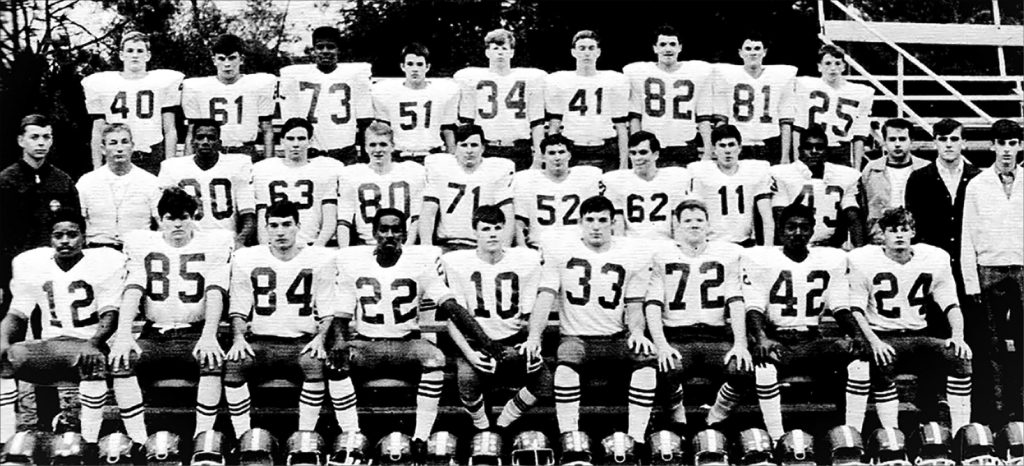
Numbered and padded, the teenage football players seemed larger than life to a child unable to heave a ball 10 yards. Photographs showed them in dramatic poses: lineman ready to pounce from a three-point stance; quarterback, ball in hand and passing arm cocked; lunging linebacker frozen in midair by a flashbulb; the team picture showing the players with backs straight and eyes focused, ready for business.
A few years after my sisters had gone away to college, the Blue Knights became more than images in an annual. Beginning in 1966, for three seasons, I tagged along with my father to watch them play on Friday nights in the fall at Memorial Field, the town ballpark at the corner of Morganton Road and Bennett Street.
The Blue Knights — coached by John Williams, a fixture in Moore County sports for decades — were members of the Central Tar Heel 2A Conference with other area schools of similar size: Union Pines, North Moore, East Montgomery, West Montgomery, Chatham Central, Pittsboro, Siler City, Rohanen (east Rockingham) and archrival Aberdeen.
Randy Arnold, a son of one of my father’s friends, played center, so we tried to keep an eye on No. 52 in blue and white when the home team had the ball. But given that my mind wandered to the prospect of a concession-stand Coke or catching one of the mini footballs thrown into the crowd at halftime, I wasn’t paying close attention to every down.
Other Blue Knights also became familiar figures: Harry Jones, No. 22, one of the few African Americans on the predominantly white squad, starred as a halfback in 1966 and ’67; quarterback Billy Strickland, No. 10, was a three-sport letterman; Bill Little, No. 33, stayed very busy as fullback, linebacker and placekicker; end Tim Roschy, No. 80, later was my coach on the Midget League Cowboys (we had a mimeographed playbook) before I realized I wasn’t cut out for the gridiron. The game program rosters of the late 1960s were filled with familiar Southern Pines surnames: Buchholz, Cuff, Sessoms, Warlick, Tate, Martin. The better athletes played offense and defense.
With West Southern Pines — where Blacks attended high school during segregation — not having the money to field a 1968 team, the Blue Knights benefited from the presence of talented sophomore end Charles Waddell that fall in their final season before the opening of consolidated Pinecrest High in 1969. Waddell would go on to star at Pinecrest and UNC-Chapel Hill, where he was the university’s last three-sport letterman.
The Blue Knights lost two of their opening four games in ’68, then hit their stride. After a 14-14 tie with West Montgomery, they finished with five straight wins. The last one, against Aberdeen on Nov. 8, 1968, was the biggest.
It was a good thing we weren’t late getting to the big game. On the Blue Knights’ first play from scrimmage, Skip Caldwell ran 50 yards through the Red Devil defense for a touchdown. They scored on their next possession too, a 25-yard run by Strickland. Final score of the final game: 14-6.
When the lights came on the following fall, boys from both towns would be wearing the green and gold colors of a new home team. PS
Bill Fields’ memoir, A Quick Nine Before Dark: A Life in Golf, is available at The Country Bookshop in Southern Pines and other places books are sold.