
GOLFTOWN JOURNAL
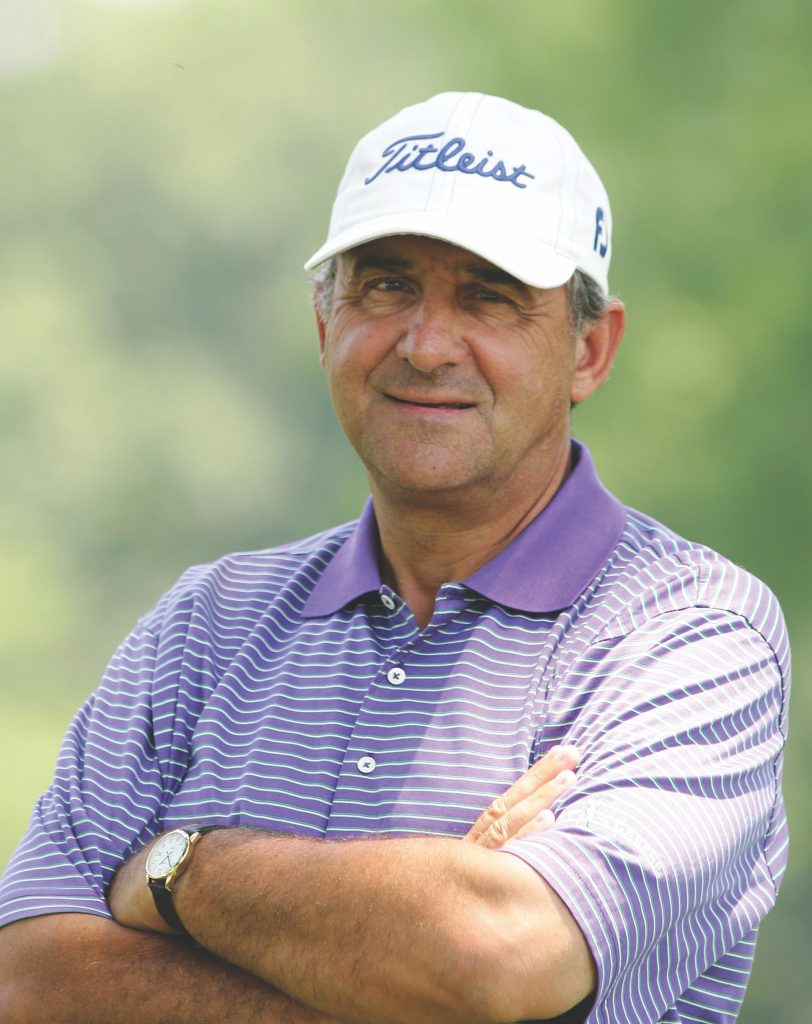
Doctor of Sport
Mind games with Bob Rotella
By Lee Pace
It’s not often you get an audience with a man who invented an entire industry.
But here on a June afternoon is Bob Rotella — 79 years old, sharp as a tack and fit as a fiddle — rummaging around his basement sports psychology laboratory outside Charlottesville, Virginia.
There are three rooms in his home in the Club at Glenmore community east of town where he has welcomed the likes of Rory McIlroy, Padraig Harrington, Tom Kite, Davis Love III and John Calipari for overnight visits to explore the art and science of the body and the mind in the field of competition. One room is a bedroom. Another is a workout facility. Then there is a “great room” of sorts with mirrors on the walls, a putting carpet and all manner of decorations, from a signed photo from Ben Hogan to a Claret Jug given to Rotella by Harrington after one of Harrington’s two Open Championship victories.
And of course, a couch. What shrink doesn’t have a couch?
“I love competing and playing,” says Rotella, a lifelong athlete and former college basketball and lacrosse player, “but I like helping people’s dreams come true more than anything. That’s pretty much what I do. I try to find something inside an athlete they never knew was there. I mean, I’ve had a lot of fun.”
My assignment to write and publish a coffee table book celebrating the impending centennial of Farmington Country Club (est. 1927) just west of Charlottesville has brought me to Rotella, who used his Farmington membership in the 1970s and ’80s as kind of a research lab to develop theory and practice on how the mind affects sports performance. Old-time members recall the sight of a young Rotella armed with pen and notebook interviewing golfers after matches to probe the depths of how their minds functioned with some hardware on the line.
Growing up in Rutland, Vermont, Rotella was a quarterback and safety in football, and played basketball and lacrosse at Castleton University. He wanted his life’s calling to be in teaching and coaching but over time began to ponder why it was, for example, he and his coaching mates would spend hours ruminating about how to get a player to take his sterling practice skills into the heat of competition and how to get a player to not let a mistake in the first quarter infect his performance the rest of the game.
“The people who were doing psychology with athletes in the early ’70s were all psychiatrists working with drug problems or serious clinical problems,” Rotella says. “I started thinking about it from a coaching perspective and performance enhancement. Some of the stuff these psychiatrists were writing, I thought, ‘What in the hell are they talking about?’”
In 1976, he moved to Charlottesville and joined the faculty at the University of Virginia to teach sports psychology and coach lacrosse. Soon after he got an offer for a tenure-track position that would include starting masters and doctoral programs in sports psychology and working directly with Cavalier athletic teams. He did that for 20 years and in 1996 left to devote full time to his sports psychology practice.
As of mid-2025, he had clients in golf who have won more than 80 major championships and was pegged by Golf Digest among the top 10 golf instructors of the 20th century. He’s ventured off the golf course for relationships with Red Auerbach, Greg Maddux, Tom Brady and Serena Williams, among many others. His work in the 1970s and into the ’80s was the domino that fell and led to a landscape in 2025 that has nearly every professional sports team having a “sports performance” or “sports psychology” consultant on the payroll.
“I took a few things that worked for me in competition and recognized how important the mind is in all forms of competition,” he says. “I got lucky and made a career out of it.”
Rotella has authored a half-dozen books, including his bestseller Golf Is Not a Game of Perfect. The one with most relevance for many golfers in the Sandhills entering turn four of life (present company included) is The Unstoppable Golfer — Trusting Your Mind & Your Short Game to Achieve Greatness. The premise of the book is that as golfers age and lose physical strength, they still have the ability to embrace their mental resources and develop their skills in getting up-and-down from 100 yards in. The short game, he says, is the path to “unstoppable golf.”
“To win this battle with yourself, you must have a good short game,” he writes. “Few of us can blast the ball 300 yards off the tee. But nearly all golfers have the physical ability required to pitch the ball, to chip it, to putt it.”
This focus on sharp execution of pitching, chipping and putting is nothing new. Players with great short games “should be the cockiest players on the planet” wrote the great English champion Harry Vardon in the early 1900s. “You won’t fulfill your potential as a golfer unless you embrace your short game, love your short game, take pride in your short game, and stop wishing you had someone else’s long swing.”
Unstoppable Golf provides a hard reset of a golfer’s approach to the game. Part of it is mental and developing the ability to believe you have a lethal short game. That comes through practice repetition and taking your skills to the golf course and executing shots under pressure.
“You are what you have thought of yourself, and you will become what you think of yourself from this moment forward,” Rotella says. “Your brain is a faithful servant.”
He hammers hard the human tendency to dwell on the negative, to carry the memory of that chunky 45-yard wedge shot well down the road but dismiss the time you executed a perfect bunker save to break 80.
“I talk a lot about getting people to have an instant amnesia of their mistakes but a long-term memory of their good shots and putts,” Rotella says. “Most people have a tendency to attach strong emotions to their bad stuff and have no emotion attached to the good stuff.”
Rotella’s wisdom applies to all golfers but makes most sense to the senior cabal. An hour to practice? Devote at least half that time, if not more, to the short game area. Take a lesson with your pro around the chipping green, not the full swing turf. Take that $600 you’d spend on a new driver and instead get a set of custom-fitted wedges.
“No matter what level a golfer plays at, the majority of his shots will be within 100 yards of the hole,” Rotella says. “The easiest way to take five to 15 shots off the average player’s handicap is by taking fewer shots around the green.”
Rotella offers the very same advice to a 15-handicapper playing in the club championship that he’d offer to McIlroy or Harrington on the final day of a major championship: Stay focused on your target, visualize the shot, commit to routine, and accept completely whatever happens to the golf ball.
“A lot of people have a dream, and then they’re scared to death they’re not going to get it,” he says. “I really want everyone to see the shot they want, so I want their eyes and their mind to be into where they want the ball to go rather than where they don’t want it to go. It’s really no different from a tour player to a 25-handicapper.”
I’m sold. No more signing up for demo days at the club in lustful pursuit of a driver that might add five yards. Let’s hit 25 pitch shots each from 20, 40 and 60 yards and then climb in the bunker. Do that, Rotella says, and you can evolve into the kind of golfer he pegs as “the silent assassin.”
That has a nice ring, for sure.