
BIRDWATCH
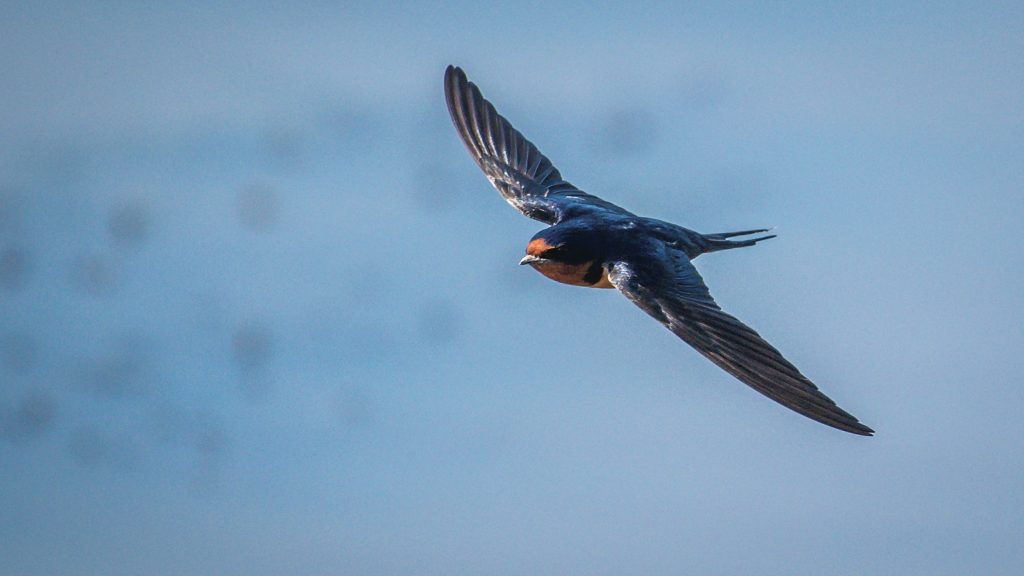
Harbingers of Spring
Return of the swooping swallows
By Susan Campbell
As the days lengthen and the air begins to warm, many of us look forward to the return of migrant songbirds. Dozens of species that breed here spend their winters far to the south, and dozens more spend time feeding here as they migrate to summer haunts in New England and points farther north. Of these, the first to return in central North Carolina are the swallows. In early April, it’s possible to see six different species: barn, rough-winged, tree, bank and cliff, as well as the more familiar purple martin. And since swallows move in mixed flocks at this time of year, encountering three or four kinds in close proximity is not unusual.
Swallows are almost exclusively insectivorous and are built to catch their prey on the wing. They have strong pointed wings and forked tails, which allow for excellent aerial maneuverability. Except for adult male martins, they are all dark on top and light colored below. But each species has a characteristic flight pattern that can be used to identify it even if field marks cannot be discerned. Modern field guides include descriptions of the patterns — where a species flies and how it flies (the combination of flapping and soaring) are unique. This is very helpful, since swallows spend most of their time on the wing and tend to be quite high in the air, so plumage is difficult, if not impossible, to see.
Without a doubt, the best place to find swallows is around water, where insects are most abundant during the warmer months. If one is lucky and there is a snag or wire adjacent to a wet area, the birds may be perched at close range, which should make for ideal viewing conditions. Except for purple martins, sexes are identical. To the human eye, male and female size, coloration and behavior are the same. However, you may be able to pick out the drabber plumage of a juvenile in late summer if you have a pair of binoculars — and a good bit of patience.
Purple martins are the largest of the group and have the darkest feathering. Adult males are a distinctive bluish-black. Females and second-year males have some blue feathering on the back and head but are mainly a dingy gray. Juveniles will be a paler gray with little or no blue feathers in late summer.
Barn swallows have a dark-bluish back, orange face and yellowish underparts. They also have a deeply forked tail. Given this superior rudder, they are capable of low and erratic flight, scooping up insects close to water level or over large grassy expanses such as horse pastures or golf course fairways.
By comparison, rough-winged swallows are stocky and brown above, whitish below with a drab, buffy throat. They spend a lot of time soaring high in the air and, therefore, have a more squared-off tail.
Bank, tree and cliff swallows are less likely to be encountered in central North Carolina. All three have less distinct plumage and short, forked tails. Bank swallows, which may be found in the western part of the state, have light brown backs, thinner wings and quick wing beats. Tree swallows have dark-green backs, broad, long wings and more direct flight behavior with less wheeling involved. Increasingly, they can be found using tree cavities or nest boxes near large bodies of water in the northern Piedmont. And they are quite common in the coastal plain. Cliff swallows, which resemble barn swallows with a short tail and a pale rump patch, fly more deliberately, with slightly slower, more powerful strokes. They favor the protection of overhangs associated with man-made structures such as bridges and overpasses to affix their unique mud nests. Interestingly, for reasons we are not sure of, cliffs are being found in more locations across the state each season.
Although these little birds are well-engineered for flight, they are not known for their song. In fact, their vocalizations consist of short raspy or mechanical calls. Nevertheless, swallows can be quite noisy, whether they are migrating as a flock or in pairs defending a breeding territory. Try to remember to listen and look up this spring; you might just spot some fancy fliers.