
BIRDWATCH
Brilliant and Blue
The surprisingly complex blue jay
By Susan Campbell
The blue jay is one of those species most of us instantly recognize: a common bird of woodland and backyard. But how well do we really know it?
This medium-sized, raucous bird can be found at feeders or flying around in treetops at any time of the year, but it hardly seems remarkable at first glance. It turns out that they are more complex and unique creatures than you might think.
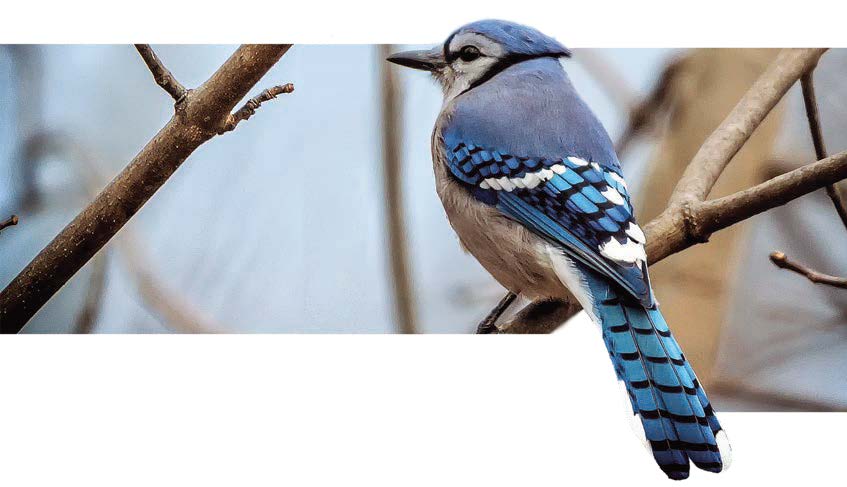
Jays are closely related to crows, which are a highly evolved species. As a result, jays, too, exhibit a relatively advanced degree of intelligence. They have complex social systems. Blue jays remain together as a family for a relatively long period and also mate for life. These birds have dingy gray under parts and upper parts that are various shades of blue with gray and black markings as well as a blue crest.
Not only do they communicate with their voices, but also with body language. Changes in the jay’s crest are one of the most obvious ways they express themselves. Not surprisingly, it is raised when an individual is alarmed or is trying to be intimidating.
The unique black lines, or brindle pattern, on individuals is no doubt recognized by conspecifics. Interestingly, the pigment found in jay feathers is produced by melanin, which is actually brown. It is the structures on the barbs of the bird’s feathers that cause light to reflect in the blue wavelength.
In addition to their bright coloration, jays attract attention with their loud calls. They make a variety of squawks and screams, usually from a perch high in the canopy. Furthermore, they are known to mimic other birds’ calls, especially hawks. Whether this is an alarm tactic or whether they are trying to fool other species is not clear. The great early ornithologist John Audubon interpreted this as a tactic that allowed blue jays to rob nests of smaller birds such as warblers and vireos that were scattered by the hawk sounds. Modern studies of blue jay diets, however, have not found that eggs or nestlings are common foods. In fact, in feeding trials, this species is often outcompeted by other jay species, woodpeckers and blackbirds.
Another mystery is why, in some years, these birds migrate and some years they do not. Blue jays are particularly fond of acorns. So it may be that, in years when oaks are not very prolific, jays move southward in search of their favorite food. How many blue jays will remain in the Piedmont and Sandhills this winter will depend on the mast crop — especially the abundance of white oak acorns. These birds are very capable of gathering seeds in a specialized pouch in their throat and carrying them to nearby holes or crevices where individuals will stash them.
Blue jays have very definite nesting duties. Males collect most of the materials: live twigs, grasses and rootlets. The females create the large cup, incubate and brood the young birds. All the while the male feeds her and then forages for the tiny nestlings. Once the young have developed a good layer of down, the female will join the search for food for the rapidly growing family. It is not unusual for young jays to wander away from the nest before actual fledging occurs, though the parents are not likely to feed the begging youngster unless they return to the nest. It is during this period that people may “rescue” the wayward youngsters.
Finally, reports of “bald” blue jays are not uncommon. Do not be surprised if you see an odd-looking individual at a feeder or bird bath with virtually no feathers on its head, just dark skin. At first this was thought to be caused by feather mites that can be found on all birds to varying degrees. Now it seems there are simply individuals that lose all of their head feathers at once instead of in the normal, staggered fashion. This is more likely in adolescents who are undergoing their very first molt.
The next time you notice one of these noisy, crested blue birds, take a closer look. Blue jays are fascinating — and full of surprises.