
BIRDWATCH
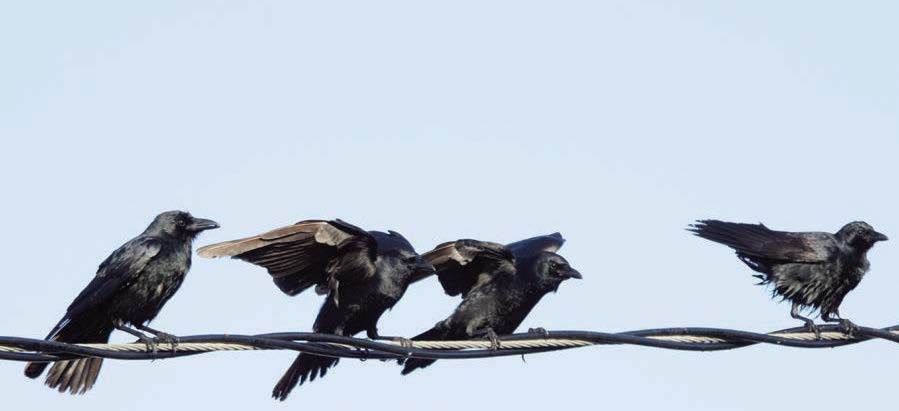
The Black Crows
The same music but different lyrics
By Susan Campbell
Everyone knows what a crow is, right? Well, no. Not exactly. It is not quite like the term “seagull,” which is generic for a handful of different species found near the coast. When it comes to crows, you can expect two species in central North Carolina in the summertime: the American crow and the fish crow.
Telling them apart visually is just about impossible. However, when they open their beaks, it is a different matter. The fish crow will produce a nasal “caw caw,” whereas the American will utter a single, clear “caw.” That familiar sound may be repeated in succession, but it will always be one syllable. Young of the year may sound somewhat nasal at first, but they will not utter the two notes of their close cousin, the fish crow.
Both crows have jet black, glossy plumage. They have strong feet and long legs, which make for good mobility. They walk as well as hop when exploring on the ground. They have relatively large, powerful bills that are effective for grabbing and holding large prey items. Crow’s wings are relatively long and rounded, which allows for bursts of rapid flight as well as efficient soaring. The difference between the two species is very subtle: Fish crows are just a bit smaller. Unless you have them side by side, they are virtually indistinguishable.
Fish crows are migratory in our part of North Carolina. By the end of the summer flocks of up to 200 birds will be staging ahead of the first big cold front of the fall. Most of the population will be moving eastward come October. For reasons we do not understand, some fish crows will overwinter in our area. Other small groups are being found on Christmas Bird Counts each December across the region. Not surprisingly, the number of fish crows along our coast swells significantly by mid-winter. Visiting flocks do not stay long and are our earliest returning breeding birds, arriving by early February for the spring and summer. Almost as soon as they reappear, they begin nest building. Their bulky stick-built platforms are hard to spot, usually in the tops of large pines. Furthermore, crows tend to be loosely colonial, so two or three pairs may nest close together in early spring.
Although fish crows are often found near water, they wander widely. They are very opportunistic, feeding by picking at roadkill, taking advantage of dead fish washed ashore, sampling late season berries, digging up snapping turtle eggs, or robbing bird feeders all with ease. But they are also predatory. Even though they are large birds, they can be quite stealthy. It is not uncommon for these birds to hunt large insects in open fields, or frogs and crayfish at the water’s edge. Unfortunately, fish crows are very adept nest robbers and take a good number of eggs and nestlings during the summer.
These birds, as well as their American cousins, can become problematic. They are very smart and readily learn where to find an easy meal. At bird feeders, they will quietly wait until the coast is clear, especially if savory mealworms or suet can be had, and polish off every scrap in no time. Southern farmers, years ago, found an effective deterrent: hanging one of these birds in effigy to keep flocks from decimating their crops. Recently I acquired a stuffed crow from my local bird store in hopes this method would work around my feeding station. I have also been concerned about both species of crow preying on nearby nests. Amazingly, it does work, though I do move it regularly to keep the attention of passing would-be marauders. And it’s quite the conversation starter as well!