
ART OF THE STATE
Taking a Breath
Daniel Johnston’s art and life find new meaning
By Liza Roberts
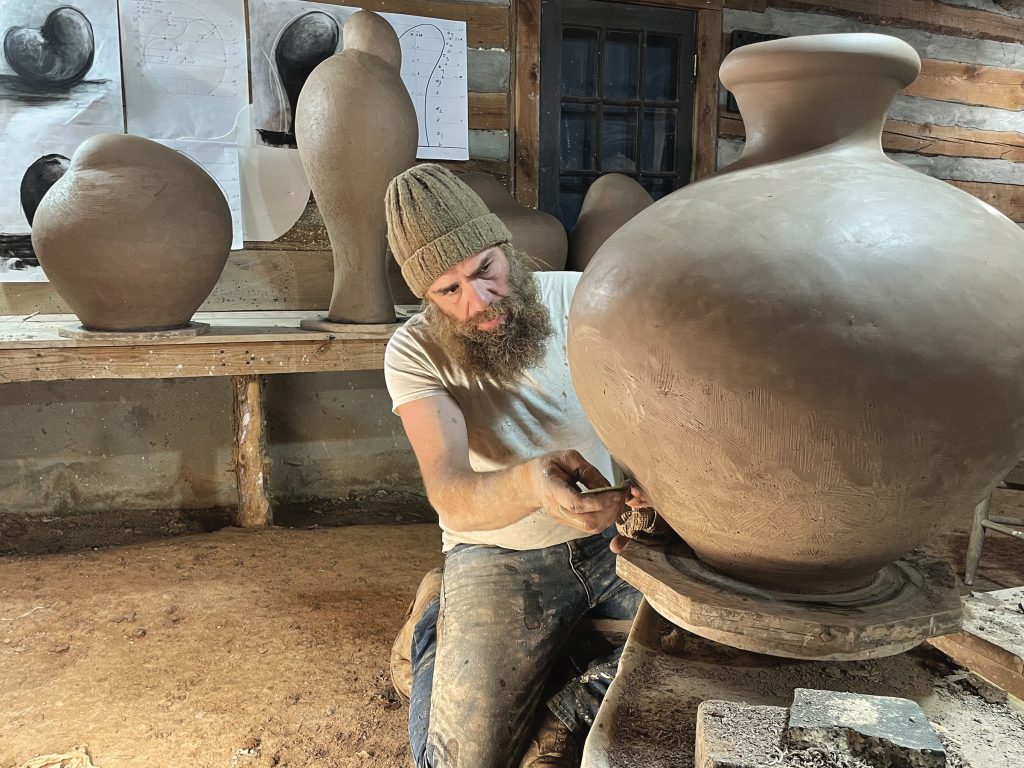
Celebrated Seagrove ceramic artist Daniel Johnston has always asked his work to carry a lot of weight. The clay vessels and pillars and bricks he forms and fires in Randolph County are beautiful; they’re also packed with a powerful purpose that has fueled his ambition for years. His works carry complicated stories about land, especially the place where he makes them and his life there. They’re dense with technical prowess, the multicultural lineage of that learning, and the demonstration of those skills. And they’re conceptual, freighted with ideas, wise to the history of art and its evolutions.
But lately, Johnston has begun making art differently. He’s thinking about it differently. The catalyst has been his marriage to artist Kelsey Wiskirchen and the February birth of their first child, Joseph Elliott Johnston.
“There’s the feeling that I have a greater purpose in life as a father,” he says. “The work, I can see, has had a bit of a breath. In a way, if it had a life of its own, it would thank me for taking the pressure off of it a bit.” If his art no longer needs to prove his human worth, Johnston muses, perhaps it can begin to speak for itself: “It frees my work up to be more mature.”
At the moment, that new work is destined for a substantial fall installation at the Gerald Peters Gallery in Santa Fe, New Mexico. He plans to install his pieces there — as many as 50 large pots and several of the wall-hung clay brick assemblages he calls “block paintings” — in a series of rooms he’ll create out of 80-odd discarded wooden walls he salvaged from the High Point Furniture Market.
Building environments for his work is not new for Johnston. “So much work that is impactful and changes people’s lives, it’s all content in context. The architecture of the room, it gives it context, and, in a way, it removes the pressure from that object. [The installation is] a bit of a Trojan horse, so that the viewer can softly let [the object] in,” he says. “If I can start controlling how you feel, then I’m able to allow you to see my work in the way I want to communicate it.”
Also on display within this context, possibly: previously unseen paintings made not of clay, but of paint on canvas or board. “This would be the first time I’ve ever exhibited paintings that weren’t three dimensional,” he says. His constructed wood-walled installation would be a good place to show them, he says, because they’d become part of a larger artistic immersion. “If you go into an installation, you are walking into an installation, you’re not walking into an exhibition of paintings.” Still, he’s not yet ready to commit. “Maybe I won’t exhibit them if I don’t feel they’re strong enough.”
Taking his time is part of his practice. Abstracted, sketch-like paintings of vessel-shaped forms have shown up on his studio walls in recent years, but the paintings he may include in the Santa Fe installation are likely to be inspired by the landscape of New Mexico and the tobacco barns of North Carolina. Some will be painted on land he owns next to Carson National Forest in New Mexico, and some will be painted at home in Seagrove. “I’m absolutely in love, architecturally, with the tobacco barn,” he says. “It’s just such a brilliant piece of architecture.”
Homeplace
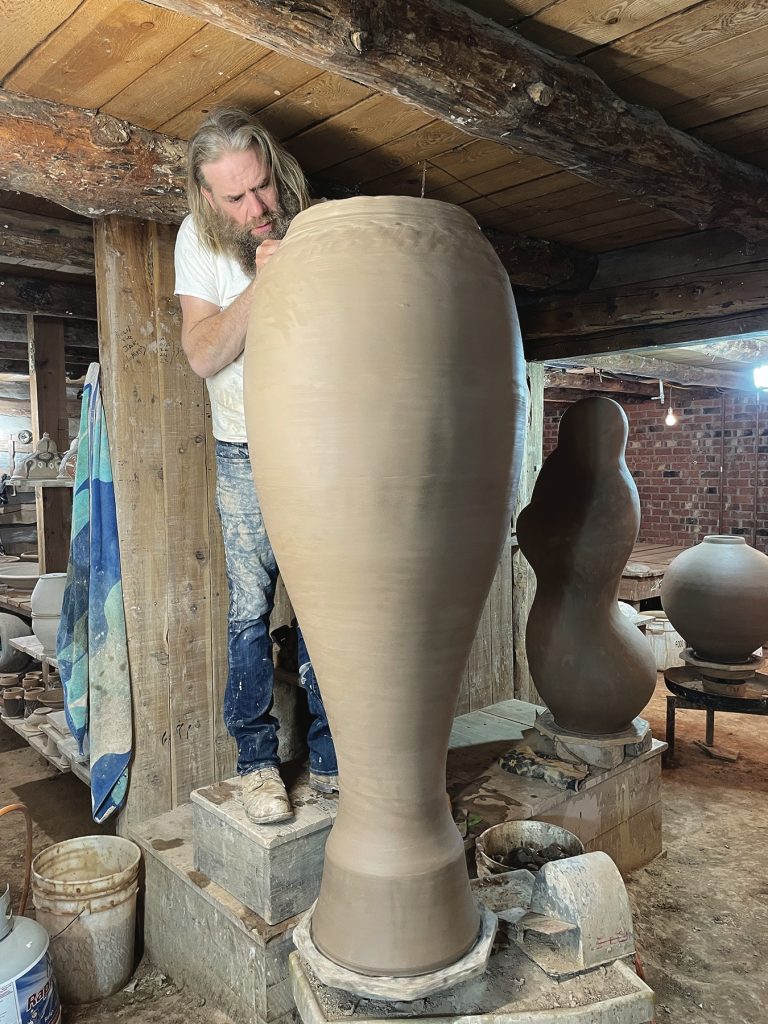
Johnston lives and works in a house and studio he built with his own hands. It reflects his long-held appreciation of the tall, timbered barns traditionally used to cure tobacco. It’s a log cabin the size of two barns put together, with big pots all around it, some sunken in the grass and some on pedestals.
It sits on 10 acres of land he bought at age 16 with money he’d originally saved for a Ford Mustang — land where, at that young age, he built himself a shack to live in, alone, after he dropped out of school. Years later he felled the trees to build this house and studio.
When I first met Johnston there seven years ago, he was humble as he told his story and surveyed his place. Growing up not far from there in extreme poverty as the child of tenant farmers, “in my mind,” he says, “land was power.” He told himself early on he would make for himself a different kind of fate.
The same could be said of his art.
About 15 years ago, after lengthy apprenticeships with potters in Thailand and England and with Seagrove’s internationally revered Mark Hewitt, Johnston became a leading American maker of big pots. He perfected a technique to turn 100-pound lumps of clay into giant vessels that could hold 40 gallons apiece and made them in huge numbers, a series of 100 pots one time, 50 pots another. The acclaim was exciting, but then became disillusioning. It broke his heart to see them carted away, one by one. It was the groupings, he realized, that held the meaning: “People had to have a piece of it. As soon as they had that jar, it had no context.”
Johnston eschews that kind of work today. Now, he’s not concerned with demonstrating his finesse or with making beautiful objects unless they have conceptual meaning. At the North Carolina Museum of Art in 2019, he sunk 183 individual wood-fired ceramic pillars in a permanent installation across the gentle hills of the park landscape to evoke an organic border, fence or outcropping. In 2021 at NC State University’s Gregg Museum of Art & Design, he built a massive wire-mesh, house-shaped frame — a temporary building at once empty and full — to hold several giant pots, many irregularly shaped, and some put together like bricks in a foundation. It was a paradox: lonely but inhabited, open but caged, refined but deformed.
“I’ve never thought of myself as a potter, and I don’t really like the title. I want to work with my mind, not my hands,” he says. “Like Duchamp’s Fountain.” He’s referring to a porcelain urinal the French conceptual artist Marcel Duchamp exhibited in 1917, considered a seminal moment in 20th-century art. Duchamp rejected what he called “retinal” art, or art designed to please the eye, and wanted his art to provoke the mind instead. “I think about that a lot,” Johnston says.
Recently, caring for his newborn son and also for his aging father, who suffers from dementia, has allowed Johnston to spend more time in thought than his typical schedule of constant studio work allows.
“I’ve been working my mind, which is really probably the place that I spent the least time before he was born,” he says. “I can look back now and see that I had filled my time with things that kept me from using that bit of my brain. And so now it’s the opposite of it. I’ve had a huge amount of space to use that part of my brain.” The result, he says, is the kind of artistic evolution that lies beyond the acquisition of skills. “The nice thing is that once you have the security of your skills and your abilities under your belt, there’s always a huge amount of room to improve. But so much of the work is mental and thought at that point. And so I have been working that way.”