
Writer's Valhalla
Writer's Valhalla
Celebrating the North Carolina Literary Hall of Fame
By Bill Case
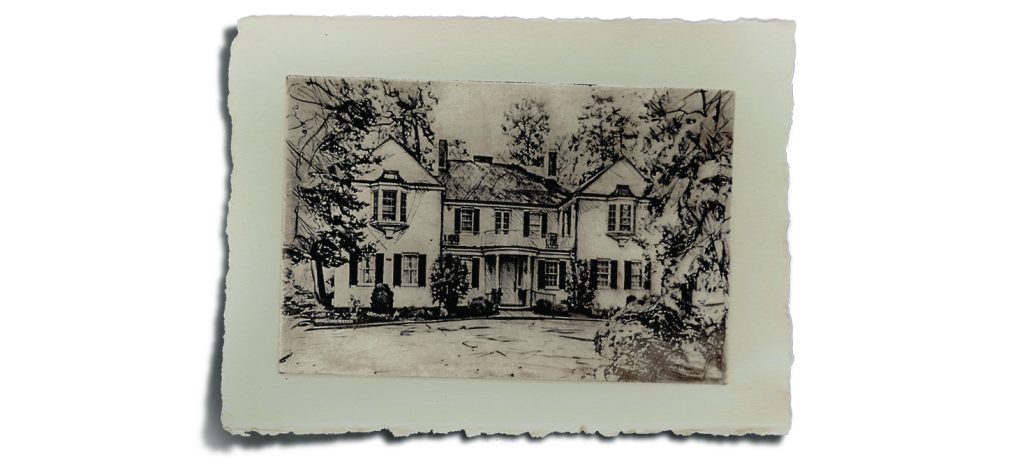
Feature photo: Etching of Weymouth Center for the Arts & Humanities by Denise Baker
There are 30 rooms, give or take, in the sprawling Boyd House, and if the walls of those rooms could talk, they would have plenty to say about the country manor’s storied literary history, especially the parade of renowned writers who graced the home as guests of James and Katharine Boyd long ago.
The great room would remember a January morning in 1937 when the nonplussed Boyds found Thomas Wolfe (Look Homeward Angel, among other works) asleep on the sofa. Arriving in Southern Pines on the 4 a.m. train, Wolfe trudged uphill to the estate and, after finding the doors locked, gained entry by scrunching his 6-foot, 7-inch frame through an unlocked window.
The cozy Boyd library witnessed the cringeworthy 1935 incident in which an overserved F. Scott Fitzgerald (The Great Gatsby, among other works) insultingly critiqued his host’s most recent novel. Boyd’s first historical novel, Drums, published by Charles Scribner’s Sons in 1925, was touted at the time as “the finest novel of the American Revolution that has yet been written.” The well-oiled Fitzgerald would pen a letter of apology.
From 1932 until his untimely death in 1944, Boyd dictated his books while standing at the middle window at a built-in writing ledge in his second-floor study. From this elevated perch, he could gaze down on his foxhunting horses and hounds quartered nearby. Fifty-two years after his passing, the spacious study would become the home of the North Carolina Literary Hall of Fame, the ultimate embodiment of Weymouth’s literary heritage. The walls of Boyd’s study speak with a decidedly bookish vibe, covered with photos and biographies of the 80 members inducted from its founding in 1996 through this October’s class of 2026.
Revered by those who appreciate great writers and their works, the hall’s biennial induction ceremony at the Weymouth Center for the Arts & Humanities is an eagerly awaited date on the calendar. Though a fixture of the state’s literary scene for 30 years, the road to the Hall of Fame’s founding and location at Weymouth was full of twists and turns. The idea for a state literary Hall of Fame arose from a program adopted by the Library of Congress in 1977, called the “Center for the Book,” designed to “stimulate public interest in books, reading and libraries.” States were encouraged to participate in the project by centralizing their library and writing programs. National Book Week was initiated under this umbrella.
In August 1992, North Carolina’s then-state librarian, Howard McGinn, proposed that North Carolina enact legislation to designate Southern Pines as the site of the state’s “Center for the Book.” McGinn also recommended that the proposed center house a newly created literary Hall of Fame for North Carolina. It would be the first of its kind in the country.
His plan was tied to the availability of a specific building on Broad Street that, at the time, housed the Southern Pines Public Library. For the project to work, the existing library would need to be relocated. McGinn’s suggestion contemplated the construction of a new public library for Southern Pines at a vacant lot on Connecticut Street. He proposed that following the library’s move to new quarters, the old library would become the home of the Center for the Book and a Hall of Fame situated in the vaulted main reading room and “patterned after the Baseball or Football Halls of Fame.” The state librarian envisioned the hall attracting regional and national writing conferences and the performance of plays.
The old library already possessed a connection to North Carolina’s literary heritage. In 1948, Katharine Boyd contributed funds to add a new wing to the building. It included the James Boyd Room, dedicated to her late husband. McGinn agreed with Southern Pines government officials that the town needed a new public library facility, but many citizens opposed moving from the charming old building designed by Aymar Embury II. They included Sam Ragan, the owner-editor of the town’s newspaper, The Pilot. An affirmative vote of the Town Council was required prior to any such move and, given that certain members of the council and the influential editor of the paper had misgivings, that approval was far from certain.
Bolstered by McGinn’s support, the proposal to purchase the Connecticut Street property for the purpose of constructing a new library squeaked through the council by a 3 to 2 vote on February 10, 1993. With the prospect of his community (and the old library) becoming the epicenter of North Carolina literature, Sam Ragan jumped on board too. The soft-spoken son of Granville County tobacco farmers would become a tireless advocate for the project.
With McGinn’s proposal for a Hall of Fame heading to the state legislature, Ragan used his formidable statewide influence to assure its passage. In addition to his own writing credentials, Ragan’s clout stemmed from his years as the executive editor of The News and Observer in Raleigh. A country gentleman nattily attired in a fedora hat and bowtie, Ragan was known and respected by North Carolina’s movers and shakers, especially those in state government. Diligently working his contacts, he persuaded key legislators to fast-track the resolution establishing the center and the Hall of Fame in Southern Pines. He arranged for the measure to be introduced under the name of Paul Green, author of The Lost Colony and a great friend of the Boyds.
To explore potential financing for the project, Ragan, together with Marsha Warren, then executive director of the North Carolina Writers’ Network, met with the state’s Secretary of Cultural Resources Betty Ray McCain. She indicated her department would be in a position to make a one-time grant once the center became a reality; a figure of $100,000 was discussed.
On July 23, 1993, the measure establishing Southern Pines and the old library building as the home for North Carolina’s Center for the Book and the literary Hall of Fame was passed by joint resolution of the House and Senate. According to its text, the placement of the center in Southern Pines would “build upon the significant contributions made by Sam Ragan and former Secretary of Cultural Resources Sara Hodgkins [who lived in Southern Pines] and the many other authors and journalists from North Carolina.”
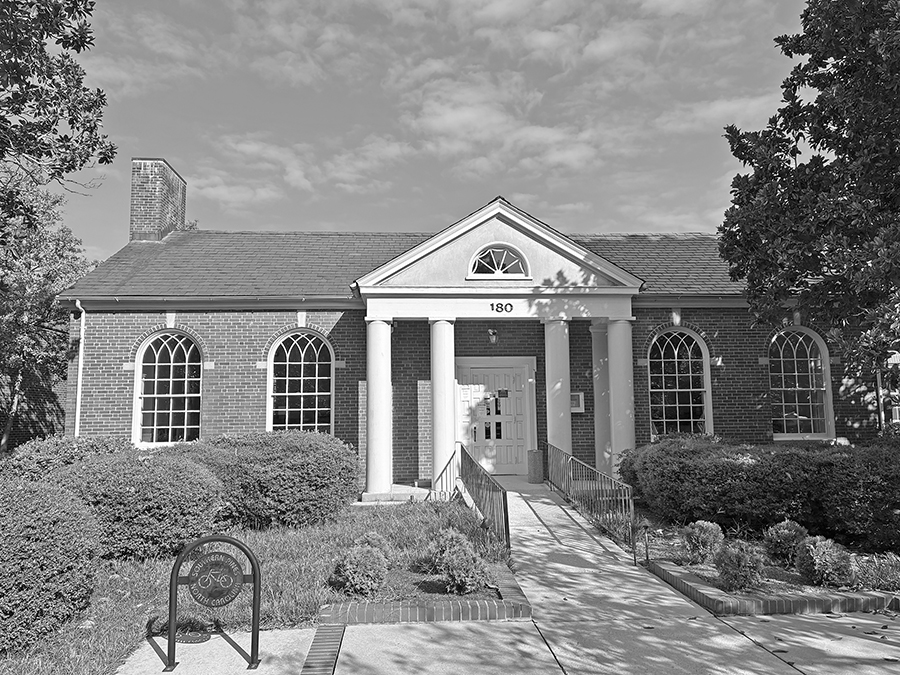

Left: Sam Ragan
Right: The Former Southern Pines Library
Southern Pines Mayor Alex Bowness said, “I am very thrilled that everything is on track and the N.C. Center for the Book is becoming a reality.” In his Pilot editorial, Ragan expressed delight “that the present library building will not only be preserved but will become a distinguished statewide cultural site which is sure to attract nationwide visitors.” Town officials offered to lease the old library for a nominal amount, perhaps as little as $1 a year.
But to run the center like a sports hall of fame, as envisioned by McGinn, more funds would be required. Marsha Warren, who in addition to managing the Writers’ Network was working hand-in-glove with Ragan to make the center and Hall of Fame a reality, recalls their mutual mindset on funding. “Sam and I were aware we could probably count on $100,000 from Betty Ray McCain’s department,” Warren remembers. “Betty was on board with granting the money to the Writers’ Network, because it was a 501(c)(3) organization qualified to receive the funding and manage the project. The grant would get the project started. We hoped Southern Pines might do more also. But we weren’t thinking too far ahead. We’d figure it out as we went.”
The new Southern Pines public library building opened on July 5, 1995. Later that month, Ragan scheduled a tour of the vacant old library for attendees of the North Carolina Writers’ Conference at Weymouth. According to his editorial in The Pilot, the visitors “praised it for the excellent condition in which they found it and its special character and suitability for the Center and Hall of Fame.”
But that same month, Sam expressed uneasiness regarding the direction of the project in correspondence with the town’s new mayor, Mike Fields. “I also hope that the Town of Southern Pines will take action immediately in the necessary steps to make this splendid program a reality,” wrote a concerned Ragan. “I will assist in any way I can. The potential for Southern Pines is so great it would be a tragedy to see the program falter through any delay.”
But it did falter. By October 1995, it had become clear that occupancy of the old library by the Center for the Book and the North Carolina Literary Hall of Fame was not going to happen. A Ragan editorial reported one explanation for the jettisoning: the town manager’s determination “that the old library was needed for space to locate several town agencies.” (It would eventually house the town’s utilities office.) Marsha Warren wrote about a second daunting concern — an inspecting engineer had estimated that, “it would cost, conservatively, $250,000 to bring the aging building up to code.” Warren, who was inducted into the North Carolina Literary Hall of Fame in 2018, remembers that Ragan was “heartbroken” by the staggering estimate. “We knew raising that kind of money was beyond our reach,” she says.
Without the old library, could the project be salvaged? Warren believed that it could. “Betty McCain indicated she was still prepared to grant the Writers’ Network $100,000 even if we had to scale back the project. With that assurance, we could abandon the larger undertaking of a Center for the Book and focus entirely on a literary Hall of Fame. And James Boyd’s studio at Weymouth was an obvious place to put it.” The term “Center for the Book” would become associated with State Library programming and not a specific physical location.
Ragan welcomed the revised plan. After all, he had played a major role in forming the Weymouth Center for the Arts & Humanities, as well as saving the Boyd House from the wrecking ball in the 1970s.
After McCain formally issued the $100,000 grant to the Writers’ Network in November 1995, Ragan began greasing the skids with the Weymouth Center board. His efforts resulted in a long-term lease between Weymouth and the Writers’ Network enabling the latter to operate and manage the Hall of Fame at Weymouth. The Writers’ Network tendered a one-time payment of $10,000 to Weymouth and agreed to reimburse its expenses for upkeep of the former Boyd study.
After the financial niceties were resolved, it was determined that the first Hall of Fame induction ceremony would take place on May 18, 1996, beneath the flowering cherry trees on Weymouth’s grounds. Marsha Warren, with input from Ragan, took the laboring oar in addressing the details: the adoption of the hall’s mission statement; determining criteria for election; selection of judges; identifying presenters for the inductees; preparing written materials; staging the ceremony and the reception afterward.
It was decided that the inaugural class should honor the state’s deceased literary figures. On March 13th, 1996, the judges announced their selections: James Boyd, Charles Waddell Chestnut, Jonathan Daniels, Inglis Fletcher, Paul Green, Bernice Harris, O. Henry (William Sydney Porter), George Moses Horton, Randall Johnson, Guy Owen, Thad Stem, Richard Walser, Manley Wade Wellman and Thomas Wolfe.
A proud Ragan, who was scheduled to emcee the event, wrote a glowing editorial following the announcement. “Under the guidance of Marsha Warren and the Writers’ Network, the dream is quickly becoming a reality. . . . The first induction promises to be a lively affair.”
The gathering turned out to be more poignant than spirited. During the month preceding the festivities, the 80-year-old Ragan’s health suddenly deteriorated. He passed away on May 11, one week before the inductions. His generous spirit and unflagging support of the Hall of Fame were mentioned by virtually every speaker at the blisteringly hot ceremony, including newsman David Brinkley, who forwarded a moving video tribute. Ragan had given the famed broadcaster his first job in journalism, hiring Brinkley as a reporter for the Wilmington Star in the late 1930s.
Ragan’s unflagging support for Weymouth and the Hall of Fame barely scrapes the surface of his literary interests. In addition to penning editorials and columns for The Pilot, he authored books of nonfiction and six volumes of verse. His poetry was lauded by Tom Wicker, a North Carolinian who worked at the New York Times, who noted, “It could only have been written out of a Tar Heel’s sense of place.” His poetic achievements (twice nominated for the Pulitzer Prize) led to Ragan being named the state’s poet laureate in 1982, a position he kept the rest of his life.
Ragan also taught creative writing and journalism at local colleges and was a prime catalyst in establishing Weymouth’s Writers in Residence program in 1979. His writing colleagues began referring to Sam as North Carolina’s “Literary Godfather.”
“Sam swam in many literary streams,” says poet and Weymouth board member Pat Riviere-Seel. “Bringing the North Carolina Literary Hall of Fame to Weymouth allowed him to channel those streams into one big literary river.”
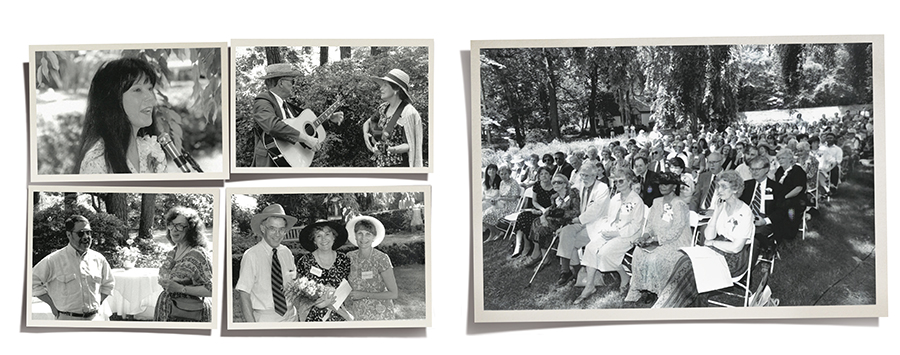
Six writers were inducted in the Hall of Fame’s second year, 1997, including Ragan. His daughter, Talmadge Ragan, accepted on behalf of her father. After the 1998 ceremony inductions were scheduled every other year and, after three steamy ceremonies during which attendees wilted in the heat, the ceremony was moved to October.
The number of judges who selected the inductees was fixed at 15. All were required to have a strong literary background. A candidate for induction must be a “North Carolina writer,” defined as someone who is, “significantly shaped by his or her time in the state; and/or (b) identified in the public’s mind as a North Carolinian; and/or (c) self-identified as a North Carolinian.”
In 2008, the Writers’ Network approached other literary institutions and requested they collaborate with it and Weymouth in producing the induction ceremony and promoting the Hall of Fame. The Center for the Book at the State Library, the North Carolina Humanities Council, and the N.C. Collection of the Wilson Library at the University of North Carolina all agreed to assist. The resulting collaboration reduced the out-of-pocket costs of the induction ceremony, helping to preserve the fund created by the Department of Cultural Resources grant. Ed Southern became the Writers’ Network’s executive director in 2008, a position he still holds.
The 80 inductees to date have come from virtually every corner of literary life. They include short story master O. Henry; diverse poets like Ragan, Maya Angelou, George Moses Horton, and Shelby Stephenson; news journalists Jonathan Daniels and Tom Wicker; illustrator and children’s book author Glen Rounds; Lincoln biographer Carl Sandburg; historian Wilbur J. Cash; newspaperman (and ambassador to the Court of St. James) Walter Hines Page; and iconic novelists Thomas Wolfe and Lee Smith.
The five newest inductees — D.G. Martin, Shannon Ravenel, David Sedaris, Daniel Wallace and Michael Parker — are to be enshrined in the hall on October 4 and likewise hail from diverse literary backgrounds.
D.G. Martin, who passed away last December, was the host of “North Carolina Bookwatch” on UNC-TV (now PBS NC). Martin was no softball questioner. He probed writers to find out what made them, and their books, tick. He also wrote a syndicated weekly column covering politics, cultural issues, and anything else occurring to his fertile mind. “D.G. had his finger in every pie,” says his close friend Ravenel. A graduate of Davidson College and Yale Law School, he practiced law in Charlotte before joining the University of North Carolina as its vice president for public affairs. A devotee of diners and cafés, Martin authored a chatty book on the subject, North Carolina’s Roadside Eateries.
Shannon Ravenel’s literary journey involved editing and publishing. She provided invaluable exposure for numerous Southern writers, including several fellow Hall of Fame members. Following her graduation from Hollins College in Roanoke, Virginia, the Charleston, South Carolina, native worked for publishers in New York, Boston and St. Louis. She became editor of the annual anthology Best American Short Stories. In 1982, she partnered with her former English professor, Louis Rubin, to start Algonquin Books of Chapel Hill (where she eventually moved), providing an important outlet for the work of Southern writers. Through Algonquin, Ravenel edited another annual short story anthology, New Stories from the South. Fellow Hall of Fame member Jill McCorkle will present Ravenel for induction. She will be returning a favor. It was Ravenel who presented McCorkle at her induction in 2018.
Self-deprecating humorist David Sedaris became a national phenom after his uproarious comedic appearances on a Chicago radio program led to frequent gigs on National Public Radio. In his first NPR appearance, he read an essay titled “Santaland Diaries,” describing his job as a Christmas elf at Macy’s. That smash success led to Sedaris authoring sardonic essays for Esquire and The New Yorker. Several of his essay collections became New York Times bestsellers. His book, Me Talk Pretty One Day, describes many hilarious (though often mortifying) vignettes from his childhood in Raleigh, North Carolina. The book won the 2001 Thurber Prize for American Humor. In explaining why so much of the humor in his writings concerns his own misbegotten experiences, Sedaris says, “There are two types of people: those who pay to tell others about their problems, and those who get paid to tell others about their problems. I prefer to be in the latter group.” Sedaris has resided in Paris, London and New York City, but he retains a seasonal presence in North Carolina, vacationing in Emerald Isle.
Daniel Wallace was born in Birmingham, Alabama. He attended college at UNC-Chapel Hill, but left school early because his father, owner of an import/export company doing business in Japan, persuaded his son to join him in that enterprise. By Wallace’s own admission, his employment in Japan was a bust. Returning to Chapel Hill, he worked in a bookstore and began writing novels. His first five efforts were summarily rejected by publishers, but his sixth, Big Fish: A Novel of Mythic Proportions, became a bestseller and was made into a movie directed by Tim Burton. A 2008 graduate of UNC-Chapel Hill, he teaches creative writing at his alma mater. Of his ill-fated employment in Japan — as well as the rejection of his early novels — Wallace says, “Sometimes, failure is not failure. Perhaps I never would have figured out I could be a writer if Japan had worked out. And the many mistakes in my rejected novels taught me what not to do.”
A product of rural North Carolina, Michael Parker was born in Siler City and grew up in Clifton. His father was a newspaper editor and his mother a teacher. As a schoolboy, Parker woke at 4:30 a.m. to deliver newspapers. His short fiction has resulted in his winning three O. Henry Awards. He has also authored seven novels, including The Watery Part of the World, a haunting tale set on a nearly deserted barrier island off the coast of North Carolina. The book contains an element of historical fiction — the supposed survival of Theodosia Burr, Vice President Aaron Burr’s daughter, lost at sea in 1812. A graduate of UNC-Chapel Hill Parker taught in the MFA writing program at UNC-Greensboro for nearly 30 years. He lives in Durham. “The fact that this state treasures writers so much, particularly in an era when our culture does not support and promote the arts as much as it once did, makes receiving the award especially fulfilling,” he says.
When the new inductees climb the stairs to Boyd’s study they may linger at the bronze bust of Sam Ragan, the man most responsible for making the Hall of Fame a reality. As Marsha Warren wrote in her foreword to Lewis Bowling’s book Sam Ragan: North Carolina’s Literary Godfather, the founding of the literary Hall of Fame was “Sam’s last and greatest gift to the state.” They’ll also find new photographs on display — their own — giving the walls more stories to share. PS
Pinehurst resident Bill Case is PineStraw’s history man. He can be reached at billcasewrites@gmail.com.