
PINEPITCH

April 2026

Impatiens, Geraniums, Marigolds, Oh, My!
The Pinehurst Garden Club’s annual plant sale pickup is Sunday, April 26, from 9 a.m. to 3 p.m., at the Green Haven Plant Farm, 255 Green Haven Lane, Carthage. You can make day-of-sale purchases or pre-order plants through April 16. Proceeds fund scholarships for horticultural students at Sandhills Community College as well as beautification projects in Pinehurst. Info: www.pinehurstgardenclub.org.

The Clubhouse Turn
Pinehurst Parks and Recreation and the Pinehurst Driving Club present the 77th annual Spring Matinee Races on Saturday, April 11, at the Pinehurst Harness Track, 200 Beulah Hill Road S., Pinehurst. Gates open at 11 a.m. and the racing begins at 1:30 p.m. We’re shocked, shocked to find there will be gambling going on. No, really, we are. For information go to www.vopnc.org.

April Authors Abound
• Southern Pines native and PineStraw columnist Bill Fields discusses his memoir, A Quick Nine Before Dark: A Life in
Golf, at the Weymouth Center for the Arts & Humanities, 555 E. Connecticut Ave., at 6 p.m. on Thursday, April 2. Info: www.ticketmesandhills.com.
• Virginia McGee Richards talks about her book The Inner Passage: An Untold Story of Black Resistance Along a Southern Waterway, at The Country Bookshop, 140 N.W. Broad St., Southern Pines, at 6 p.m. on Tuesday, April 14. Info: www.ticketmesandhills.com.
• Taylor Brown discusses his new novel, Wolvers, at 6 p.m. on Wednesday, April 15, at The Country Bookshop, 140 N.W. Broad St., Southern Pines. Info: ticketmesandhills.com.
• Emily Matchar talks about her new book, The Lost Girl of Craven County, at 6 p.m. on Thursday, April 16, at The Country Bookshop, 140 N.W. Broad St., Southern Pines. Info: www.ticketmesandhills.com.
• Julia Hans will be at the Southern Pines Public Library, 170 N.W. Connecticut Ave., at 10:30 a.m. on Saturday, April 18 to share her book, a Penny Postcard History of Southern Pines. Info: www.sppl.net.
• Bob Crawford, bass player with The Avett Brothers, will speak about his book America’s Founding Son: John Quincy Adams, from President to Political Maverick, at 7 p.m. on Wednesday, April 22, at the Sunrise Theater, 250 N.W. Broad St., Southern Pines. Info: www.sunrisetheater.com.
• Michelle Collins Anderson will talk about her new novel, The Moonshine Women, at 3 p.m. on Sunday, April 26, at The Country Bookshop, 140 N.W. Broad St., Southern Pines. Info: www.ticketmesandhills.com.
Happy Heritage Day
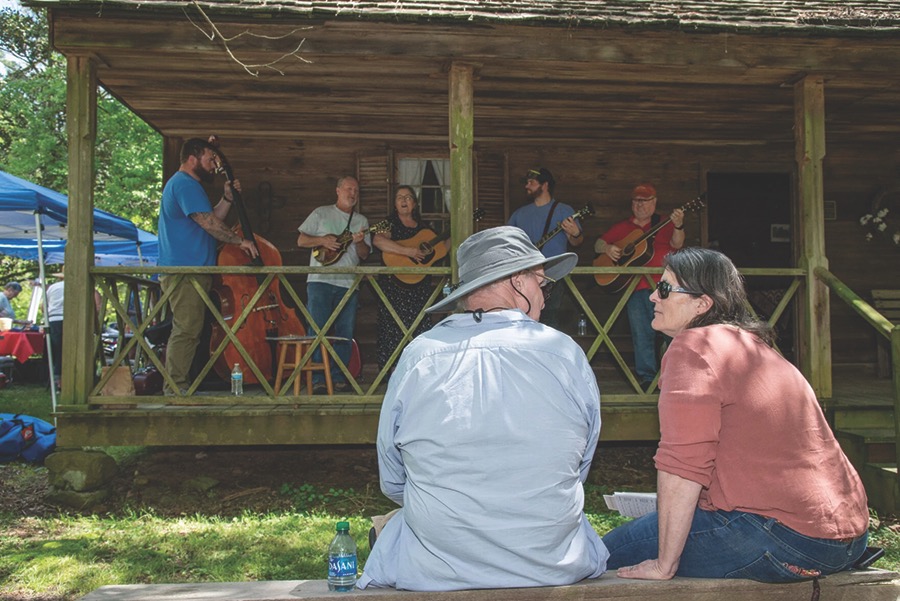
The annual Clenny Creek Heritage Day is Saturday, April 18, from 10 a.m. to 4 p.m., at the 1840s James Bryant home and the 1760s McClendon cabin, 3361 Mt. Carmel Road, Carthage. There are old-time activities, a livestock petting area, live music and food. Admission is free. Info: www.moorehistory.com.
Just Fantastick!
The Sandhills Community College theater department presents The Fantasticks beginning Friday, May 1, at 7 p.m., at BPAC’s McPherson Theater, 3395 Airport Road, Pinehurst. There are two additional performances on Saturday, May 2, and another on Sunday, May 3. For more information go to www.ticketmesandhills.com.

The Art of Nature
The Arts Council of Moore County and five artists — Warren Lewis, Nancy Lewis, Sharon Lowey, Frederick Schmid and Linda Storm — combine to present “Palustris: Nature’s Canvas,” beginning at 6 p.m. on Friday, April 3, at the Campbell House Galleries, 482 E. Connecticut Ave., Southern Pines. The show hangs through April 24. For more information go to www.mooreart.org.

Burning Up
Firefest is a two-day celebration of the heat that makes the art at Starworks, 100 Russell Drive, Star. Beginning at 1 p.m. on Friday, April 3, there will be live demonstrations, artist talks and hands-on workshops in ceramics, metal and glass. For info go to www.StarworksNC.org.

Carolina Phil
Maestro David Michael Wolff and the Carolina Philharmonic present an evening of classical masterworks at BPAC’s Owens Auditorium, 3395 Airport Road, Pinehurst, at 7:30 p.m. on Saturday, April 18. For info and tickets call (910) 687-0287 or go to www.carolinaphil.org.
Quittin’ Time
Live After 5 kicks off its 2026 concert series at 5:15 on Friday, April 10, with Cierra Doll, followed by The Ray Band. There will be kids’ activities, food trucks and all the trimmings at the Village Arboretum, 375 Magnolia Road, Pinehurst. For info: www.vopnc.org.
Celebrating America 250
Join the North Carolina Symphony, conducted by Sophie Mok, for an evening of classical masterpieces including works by Leonard Bernstein and Aaron Copland, at 7:30 p.m. on Thursday, April 23, at BPAC’s Owens Auditorium, 3395 Airport Road, Pinehurst. For info go to www.ncsymphony.org.
A Little Love
The Moore County Choral Society’s spring concert, “Perhaps Love,” incorporating a jazz combo and string quartet, will be held Sunday, April 26, at 4 p.m. in BPAC’s Owens Auditorium, 3395 Airport Road, Pinehurst. For information go to www.ticketmesandhills.com.
The Golden Voice
Enjoy a live performance featuring local sensation Julia Golden beginning at 7:30 p.m. on Friday, April 17, at the Sunrise Theater, 250 N.W. Broad St., Southern Pines. What else do you need to know? If there is something, go to www.sunrisetheater.com.

Five Questions with Priscilla Presley
Q: How would you describe an evening with you onstage?
Priscilla Presley: Truth and honesty about my life. People always want to know about Elvis and me, and I keep it very open. They can ask whatever they want, and most of the questions are about him, his life, and the things people don’t usually get to hear.
Q: What’s the one question fans ask you the most?
Priscilla Presley: At every event, someone wants to know if Elvis was a good kisser. You’ll see hands go up, and if one person asks it, others say, “We were going to ask that!” It’s always a funny way to start, but it happens all the time.
Q: With so many versions of your story out there, why is it still important for you to share it in your own words?
Priscilla Presley: Because it’s coming directly from me. There’s no script, no writer, no actor in between. People have seen interpretations of my life, but when we’re in a room together and they can ask what they really want to know, they’re finally hearing my truth in my voice.
Q: How do you hope people feel when they walk out of the theater?
Priscilla Presley: I hope I’ve answered the questions they brought with them, and that they understand Elvis a little better. For me, the best part is that sense of talking directly to everyone — answering what most people want to know, but doing it in a way that feels personal and free.
Q: How did Elvis himself feel about his fans?
Priscilla Presley: He was incredibly grateful from the very beginning. Early on, he’d invite fans up to Graceland — they’d be in the backyard and he’d just hang out with them. You don’t see that today. He always said the fans made him who he was. He knew they were the ones who put him where he ended up, and he never took that for granted.
The Sandhills Fair
By Audrey Moriarty
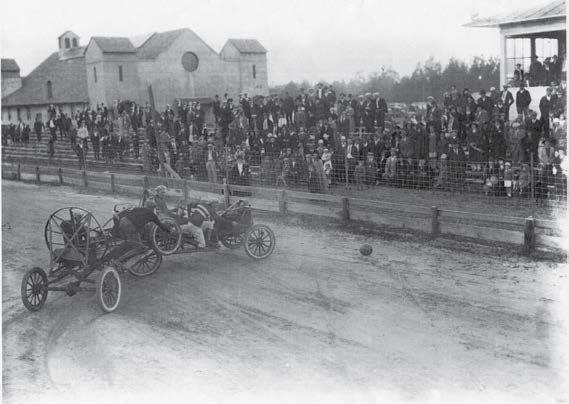
First held in October of 1914, the Sandhills Fair was sponsored by the Sandhills Board of Trade and the Sandhills Farmers Association. There was sewing, knitting, canning, gardening, woodworking and animal husbandry, all highlighting the work of nearby farms. After the first several years, it was held at the Fair Barn and Harness Track, where a large grandstand was built to accommodate crowds of as many as 3,000 spectators. The Pinehurst Outlook said the fair required “nothing more than a smile for admission” and “was a fair without a midway and doesn’t need one.”
One of the more popular activities was “auto polo,” invented around 1910 by Ralph “Pappy” Hankinson, a Ford dealer from Topeka, Kansas, hoping to increase his sales. Patterned after equestrian polo, matches featured four cars with two players per car: a driver and a “mallet man.” The cars were generally stripped-down Model Ts with no tops, doors or windshields. A regulation-sized basketball was used, although some venues manufactured even larger polo balls. The driver and mallet man had to guide the ball into a 5-foot-tall goal. The mallet men — and, periodically, the driver — were frequently ejected from the vehicle resulting in cuts, broken bones or being run over. Later, the cars were equipped with primitive roll bars above the driver.
The sport caught on in the U.S. but internationally it was viewed with caution and skepticism, being christened “a lunatic game.” Auto polo drew large crowds, but enthusiasm waned during the late 1920s due to the cost of the vehicles and the ensuing necessary repairs.