
CHARACTER STUDY
Pots and Pennywhistles
And peddling positive energy
By Sharon McNeill
You could say Michael Mahan is a soulful guy. Potter, flute and pennywhistle player, artist, writer, amateur archaeologist, father, husband … well, you get the idea.
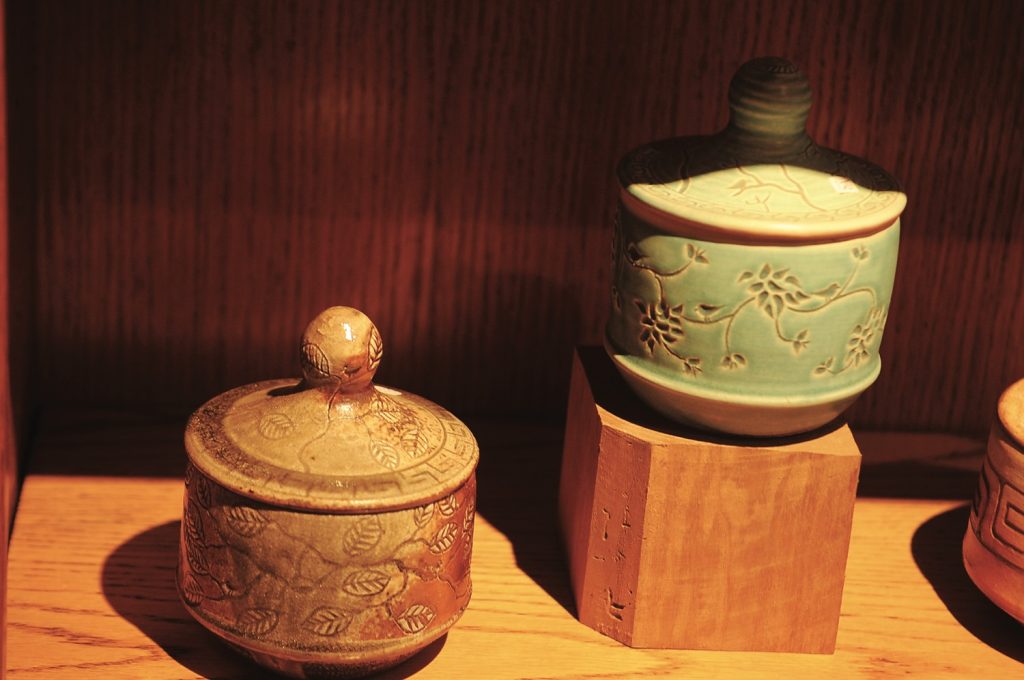
Mahan makes all sorts of beautiful wood-fired and electric kiln pots, but his “soul pots” have something special about them. Round, with a small hold, they have a Vidalia onion shape — similar to the Native American seed pot — with decorations on a band at the mouth. A sign in the shop says, “This pot is meant to be placed so that people who visit your home can pick it up. It is designed to absorb and release positive energies of love and kindness.” Since they aren’t glazed inside, only love and kindness can go into them because oil or water might seep out.
“People like the way they feel,” he says. “And if you need some positive energy, they can give it.”

Mahan was born in Wisconsin, grew up in Miami, and came to Waxhaw, North Carolina, when he was in the 10th grade. He went to N.C. State to study engineering, but switched to writing and editing. After graduation he landed a job at the Courier-Tribune in Asheboro, where he wrote a story about some potters in Seagrove. That was all it took. He quit his job and went back to school full-time to study pottery.
Mahan created the “soul pot” with his ex-wife, Jane Braswell — who decorated the band at the top — when they founded Wild Rose Pottery on N.C. 705 in Whynot, south of Seagrove. After the couple divorced, Mahan built his current studio, From the Ground Up, at 172 Crestwood Road, in Robbins. One day, poking around the property with his kids, he discovered a few old pottery shards. The artifacts were from the 1890s when the land belonged to another potter, W.J. Stewart, who is buried a few hundred yards away from the studio. Stewart made functional salt-glazed pots in a wood-fired groundhog kiln, including the jugs he used for the whiskey he distilled and sold.
Trees are an artistic theme in Mahan’s work, representing strength and connection, both to the land and its occupants. “When I’m carving a full tree on a pot, I can get lost in it and not take a break for an hour or more,” he says. “The more branches I make, the more complicated it becomes, hunting limbs that need another branch, or perhaps there’s one that broke off and is left hanging. I get to decide. Occasionally, I’ll make a dead tree. I love the beauty of a dead tree, still serving a purpose — as a perch for a bird, a landmark, a memory.”
Once, while selling his wares at a street festival, Mahan was attracted to a bamboo flute in a booth nearby. With a touch of Irish in his blood, the simple instrument led him to National Public Radio’s The Thistle and Shamrock show. Another potter, David Stuempfle, advanced the musical cause by teaching Mahan a couple of tunes on the flute.
Mahan’s second wife, Mary Holmes, is bona fide Irish, and she organized a trip for the couple to the old country, where they visited Clonmacnoise, a monastic site founded in the 6th century in County Offaly along the River Shannon. Leaning against an old stone wall inside one of the ruins, Mahan played the same melody that he played for Mary on their first date. Feeling a strong connection to the land and the people, they built a pottery studio in Limerick and travel there for two months every summer.
Pottery is something of a family affair for the Mahans. Two of his children have taken up the art form. His youngest son, Levi, is a potter who lives in Brooklyn and shows his work in the gallery in Robbins. His daughter, Chelsea, lives in Pensacola, Florida, where she teaches pottery. Eldest son Wil, is the only one of the children not in the family business — he sells real estate in Asheboro.
The word for soul in Irish is anam, and whether by flute or fire or the land he lives on, Mahan seems to have found it.