
Golftown Journal
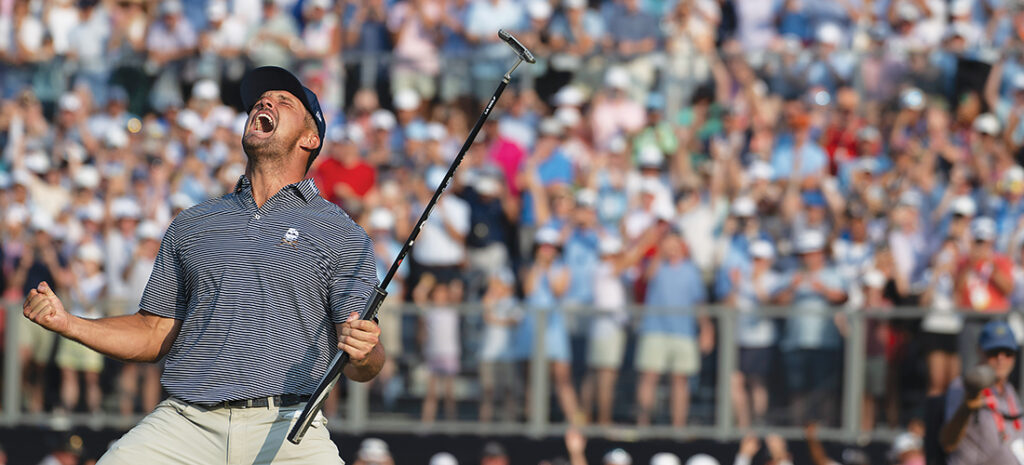
Bryson’s Bunker
Another shot for the ages
By Lee Pace
Photograph by Matthew Harris Golf Collection
The thread from 1999 to 2024 is quite eerie indeed.
Payne Stewart and Bryson DeChambeau, each of them a former golfer from Southern Methodist University in Dallas.
Each of them with a youthful connection to Pinehurst and its esteemed No. 2 course, Stewart from having visited for a month in 1979 to play a local mini-tour rota, and DeChambeau coming annually with the Mustang golf team to play a fall match against a local school like Wake Forest or North Carolina at the behest of Bob Dedman Jr., the owner of the resort, and a graduate and benefactor of SMU.
Each of them maturing into gracious champions after hiccups as younger players with instances of churlish or snippy behavior with fellow competitors or tournament officials.
And each of them playing in the final group of the U.S. Open and arriving at the 18th tee with history in the balance.
Stewart in 1999 needs a par to hold off playing partner Phil Mickelson, but his tee shot on the uphill, par-4 finishing hole misses the fairway to the right. He’s in 5 inches of suffocating rough, the grass wet on a cool, misty day. He punches out, has 78 yards to the hole, hits a three-quarter sand wedge to 20 feet short of the back-right hole location.
Stewart makes the putt, and his right-hand fist pump, right-leg extension celebratory pose will be immortalized on film and later in bronze for the ages.
“Perfect — a perfect way to win,” Stewart said. “I think everyone in the field will attest to how great No. 2 is, to what a special place Pinehurst is. To win here means a lot to me.”
DeChambeau in 2024 needs a par to hold off Rory McIlroy, who’s playing one group ahead. He yanks his tee shot left of the fairway, the ball traveling more than 300 yards uphill and coming to rest under a magnolia tree, up against a root and sitting on the native hardpan sand that was exposed during the 2010-11 Coore & Crenshaw course restoration. He has 147 yards to the hole, punches out, and the ball comes to rest in a bunker sitting front right of the green.
He has 54 yards to the traditional final day, back right pin. He uses his immense physical strength to explode out of the sand to 4 feet, then makes the putt. As the ball rolls into the cup, DeChambeau extends both arms, arches his back, looks to the heavens and sets off on several seconds of unabashed joy.
“That bunker shot was the shot of my life,” DeChambeau said. “I’ll forever be thankful that I’ve got longer wedges, so I can hit it farther, get up there next to the hole.”
So now Payne’s Putt has alongside it Bryson’s Bunker in the pantheon of all-time greatest shots — not only in 129 years of Pinehurst history, but also in major championship golf.
Jack Nicklaus’s 1-iron hitting the flag at Pebble Beach in 1972, Tom Watson’s chip-in at Pebble a decade later, Seve Ballesteros’s winning putt at St. Andrews in 1984, Bob Tway’s bunker dunk at Inverness to win the 1986 PGA Championship, Tiger Woods’ chip-in at Augusta in 2005 . . . all iconic monster shots in golf.
“Bryson’s shot has to be as good as any of them,” says 2021 Open champion Jon Rahm.
“There’s no question Bryson’s shot was one of the best shots in U.S. Open history,” says Curtis Strange, a two-time Open champion and former North & South Amateur winner at Pinehurst. “His shot was one of the toughest, if not the toughest, shots in golf. Magnify that with last hole, U.S. Open pressure on a world stage? It was an amazing shot.”
The week after the Open, Pinehurst officials, at the request of DeChambeau caddie Greg Bodine, sent via FedEx an urn of sand from that bunker to DeChambeau’s residence. The golf staffers and caddies have half-jokingly wondered if the windows in the clubhouse behind the 18th green are now in danger with retail golfers attempting that shot and hitting the dreaded skulled shot flying who knows where. The club’s social media staff even mused after the Open that the preponderance of balls landing on the roof might escalate.
All around the golf course, the village and the Sandhills, knowledgeable golf students looked on in awe.
“The long sand shot, that’s the hardest shot in golf,” says former PGA Tour player Pat McGowan, who watched his son Michael play the first two rounds. “Oh my gosh, what a shot. He could stand there and hit 100 shots and not get it any closer. He could have skulled that over the clubhouse and made a double. But Bryson is so strong he just muscled it out.”
“The stat of a PGA Tour player getting up and down from a bunker from that distance is 1.7 percent,” says Pinehurst teaching pro Kelly Mitchum. “To do it on the final hole of a U.S. Open is pretty remarkable.”
Gus Ulrich, the longtime teaching pro at Pinewild Country Club and golf coach at Sandhills Community College, was struck with the authority and resolve DeChambeau exhibited during the minute before the shot.
“What impressed me was Bryson did not overanalyze it,” Ulrich says. “He didn’t rush it by any means, but he didn’t grind over it and agonize like, ‘Oh, I gotta make this to win the U.S. Open.’ He made up his mind pretty quickly, walked in and hit the shot. I think that’s what you have to do in that situation. The more you agonize over it, the harder the shot becomes.”
DeChambeau reflected on that very mindset afterward. Asked what he would remember most about the final two hours of a drama-laden back nine, he said: “Probably my caddie telling me I can do it out of the bunker. G-Bo just said, ‘Bryson, just get it up-and-down. That’s all you have to do. You’ve done this plenty of times before. I’ve seen some crazy shots from you from 50 yards out of a bunker.’ I said, ‘You’re right. I need the 55-degree. Let’s do it.’”
Course superintendent John Jeffreys was standing behind the green in DeChambeau’s line and considered there were about a half-dozen layers of ground undulation between the golfer and the hole — a “false front” leading up to the putting surface; a narrow plateau in the front portion of the green; a downslope and swale in the middle of the green; and finally, an upslope leading to the back crest where the pin was set.
“There’s a lot more to that green than you would think approaching it on the angle he had,” Jeffreys says. “There were a lot of areas to contend with that can help you or hurt you. What made the shot so great was he landed it on the downslope behind that first little plateau. That propelled the ball forward and it ran up to 4 feet.”
And the rest, as they say . . .
No doubt they’re making room as we speak in the history-laden hallway of the resort clubhouse to celebrate Bryson’s Bunker.
“It’s like we caught lightning in a bottle,” Dedman says. “It was otherworldly. To me, it’s almost as if it was preordained. I think maybe Payne and my father were up in heaven and put their thumb on the scale to Bryson’s advantage.” PS
Lee Pace has written about the Pinehurst experience for more than three decades from his home in Chapel Hill. Write him at leepace7@gmail.com and follow him on X @LeePaceTweet.