Simple Life

The Cowboy in Me

Old Westerns are the cure for Yellowstone fever

By Jim Dodson

So, there we sat, three old ranch hands around a blazing fire as a lonesome doggie let loose a howl at the moon.

“Sounds like that dadgum dachshund down the street got loose again,” grunted Harry, the quick-draw artist sipping his Buffalo Trace.

“He’s pretty bad,” agreed Timmy the Kid, the tile-slinging merchant. “But that dang goldendoodle across the street ain’t much better. Got a howl on him like a stuck prairie dog.”

Counting women folk (cowboy-speak for “wives”) there actually were six of us gathered round the elegant Tuscan terrace fire pit in Tim and Sally’s beautiful backyard where our brides were drinking excellent white wine and chatting about whatever suburban wives talk about when their husbands are talking like dim-witted ranch hands who have watched too many episodes of Yellowstone, the hottest show on cable TV.

In case you’ve been livin’ under a flat rock in the woods, Yellowstone is the TV saga of rancher John Dutton and his proud but mentally unstable family, owners of the largest cattle ranch in Montana. They are in a perpetual war with an Indian reservation, the national park system and godless resort developers eager to turn their ranch into Club Med West. Think Dynasty with pump shotguns, F-bombs and luxury pickup trucks.

Whether you find Yellowstone appalling or hopelessly addictive, Yellowstone fever has spread like a case of terminal kudzu across the lower 48, turning ordinary dudes like Harry, Tim and briefly me into mini John Dutton wannabes.

As a result of the show’s surging ratings, there’s now even an official Yellowstone Merchandise TV Shop Collection peddling everything from home goods to coffee mugs for riding the urban range in your luxury pickup truck. Down at the auto mall, fancy rigs like the boys from Yellowstone drive can easily set you back 70K.

Back at Christmas, just for fun, I bought the little missus — a.k.a. my wife — an official Yellowstone ballcap and matching sweatshirt that reads, “Don’t Make Me Go Beth Dutton on You,” thinking she might ditch her daily green tea and morning yoga meditation in favor of going a little bit “Beth Dutton.” Every marriage needs a bit of spice.

In case you been watchin’ way too much CNN and worryin’ about stuff like the future of democracy and the free world, Beth Dutton is the smokin’ hot, potty-mouthed, always drunk, oversexed, mean-as-a-rattlesnake daughter of John Dutton, the stoical, monosyllabic, unnaturally stone-faced daddy-rancher with obvious deep inner conflicts, who every now and then shoots some dumb sumbitch who wants his land or wanders uninvited onto it. 

Unfortunately, while I was over at Tractor Supply one Saturday mornin’ trying to decide how many head of cattle I might be able to raise on a quarter acre suburban lot, the little lady dropped off her sexy new Beth Dutton duds to Goodwill — her way of saying the drunk and nasty lifestyle of the modern TV cowgirl just wasn’t her cup of green tea, with or without the Tito’s chaser.

For those of us who grew up in the 1960s idolizing cowboys like Gene Autry, Matt Dillon and Roy Rogers, not to mention the boys from Bonanza and the gals from The Big Valley, these Yellowstone folks aren’t exactly your polite, old-fashioned TV cowboy types who wear white hats, never seem to get dirty and always marry the pretty school mistress in the end.

Must admit, after binging three full seasons of Yellowstone, I suddenly began to miss those kinder and gentler Hollywood cowboys I grew up with and had every intention of someday becoming.

Sitting on a shelf in our library are a pair of small, well-worn cowboy boots, the only things on my feet for the first four years of my life. We lived in the rolling country north of Dallas, a neighborhood that shared a great big pasture full of horses and a burro named Oscar.

Oscar belonged to me — well, my folks. But I fed and talked to Oscar every morning and sometimes got to ride him in the afternoon. I always figured Oscar and I would someday ride off into the sunset together, meet the right gal and finally settle down. Instead, we moved to the city where I rode a bicycle instead of a burro and gave up my boots for a pair of Keds.

The old-style cowboy in me never died, though. He even still shows up from time to time, like when — in search of the Golf Channel or an update on Ukraine — I stumble across old episodes of The Virginian or Maverick on some remote cable channel and watch the entire episode, remembering exactly what happens. Give me a classic John Wayne western or John Ford epic on TCM and I’m also good for the count.

Several years ago, my wife surprised me with tickets to see Glen Campbell at an outdoor arena in Raleigh. Reportedly suffering from Alzheimer’s disease, Campbell was making his farewell musical tour.

Unfortunately, a thunderstorm broke right at showtime, and Campbell managed only a brief appearance to sing one song before the show was canceled. He passed on not long afterward.

I guess even rhinestone cowboys never die, though, as long as you have their complete hits on Spotify or Pandora radio. When folks drive like the Wild West in my town, I just sing along with Glen.

Twenty-five years ago, I took my daughter, Maggie, then a precocious 7, on an unforgettable, two-month road trip to fish and camp the great trout rivers of the West. We tented beneath glittering stars by the Shoshone River and attended the Friday night rodeo in Cody. We took a rocking McKenzie boat down the Snake and camped for two days in Yellowstone, saw buffalo and a gray wolf, hiked for miles, and drank our bodyweight in root beer. For a full week we rode horses in the Colorado high country around Durango and camped atop a star-strewn mesa in New Mexico. On the way home, we even bumped into the great-granddaughter of outlaw Jesse James near the Red River. She was a nice old lady with a killer smile.

Though I didn’t tell my daughter this for many years, the cowboy in me was actually scouting out places where I could start a new life following a divorce — somewhere in the wide-open, Western spaces where I could stake a new claim, hear the doggies sing and never look back. 

It didn’t quite work out that way, but the trip sure healed something in both of us and bonded us like saddle pals on the old Chisholm Trail. The little memoir I wrote about our journey of the heart is still in print all these years later — and even got made into a film. Maggie herself now lives in the Golden West.

I guess that’s why I was initially drawn to the saga of the Duttons of Yellowstone Ranch, hoping to find some comforting trace of the Western spirit — the inner cowboy — that lives in all of us.

But after three full seasons of Yellowstone, I simply had enough. I went back to old TV Westerns and John Ford movies that never fail to deliver.

My little missus — better known as my wife, Wendy — knew just the thing to perk me up. She brought me a nice big glass of milk and some Oreos as we settled in to watch a couple of my favorite episodes of The Big Valley.  PS

Jim Dodson can be reached at jwdauthor@gmail.com.

Almanac

April

By Ashley Walshe

April hath put a spirit of youth in everything.

— William Shakespeare

April is a child of wonder, lord of the mud pies, the crown prince of play.

Yesterday it rained so hard the earthworms learned to swim. Today, the peepers are peeping. The sun is out. The prince of play gathers the essentials:

Large wooden spoon? Check.

Mixing bowl and pie tins? Check, check.

Measuring cups? Don’t need them.

There’s a watering can full of rain on the back porch. Or, there was. The boy squishes across the yard, settles onto the floor of his squashy kingdom.

Mud sings as sweet as any muse. But you must know how to listen.

The boy closes his eyes, readjusts his flower crown and scoops up a wet heap of earth. He dabs a little on his face. He squelches his fingers through it. He digs into the mire with his toes.

Eureka!

This is what the mud said:

In a large mixing bowl, combine two parts squish and one part rainwater. Wriggle your toes as you stir, mixing until the first hummingbird graces the first bearded iris.

When the cottontail rabbits multiply, fold in a dash of wet grass and a fat pinch of redbud before transferring to pie tins.

As the robins pluck their breakfast from the lawn, top with generous layer of dandelion leaves.

Garnish with snakeskin, snail shells and a
dollop of wisteria.

The sun will take care of the rest.


Fairy Rings

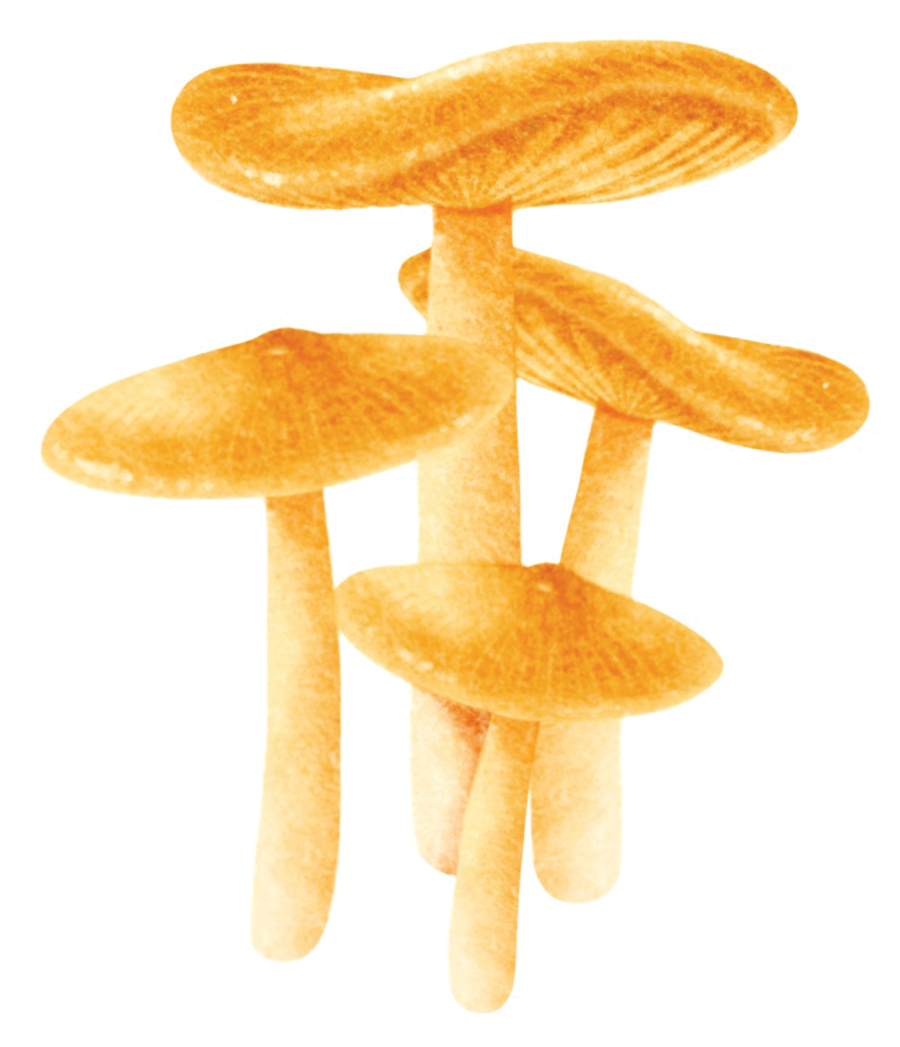
Spring is doing what spring does best. The earth is softening, once-barren landscapes now bubbling with tender buds and blossoms. In the garden, asparagus rises like birdsong. And after it rains? Enter Marasmius oreades, aka, the fairy ring mushroom.

If ever you’ve stumbled on a near-perfect circle of these buff-colored, wavy-capped fungi, perhaps you’ve smiled at the amusing “coincidence.” Or maybe it spooked you, particularly if one popped up on your own lawn. (Note: These boomers are known to kill turf.)

Myth and folklore refer to these circles as “fairy rings.” Can’t you almost see it? A wild band of wee folk dancing among these mushroom portals?

Tempting as it may be to step inside a fairy ring, myths warn against it. Long of the short of it, those who are lured inside become captives of an unseen realm where hundreds of years can pass in a blink.

On the subject of fair warnings: The fairy ring mushroom is actually a choice edible with a sweet quality that has made its dried caps the star ingredient of more than a few macaroon and cookie recipes. (Go on, look them up.) But this innocent wildling does have a toxic lookalike. Best not to harvest unless you know for sure. And, certainly, withhold from sautéing them.

Foxglove

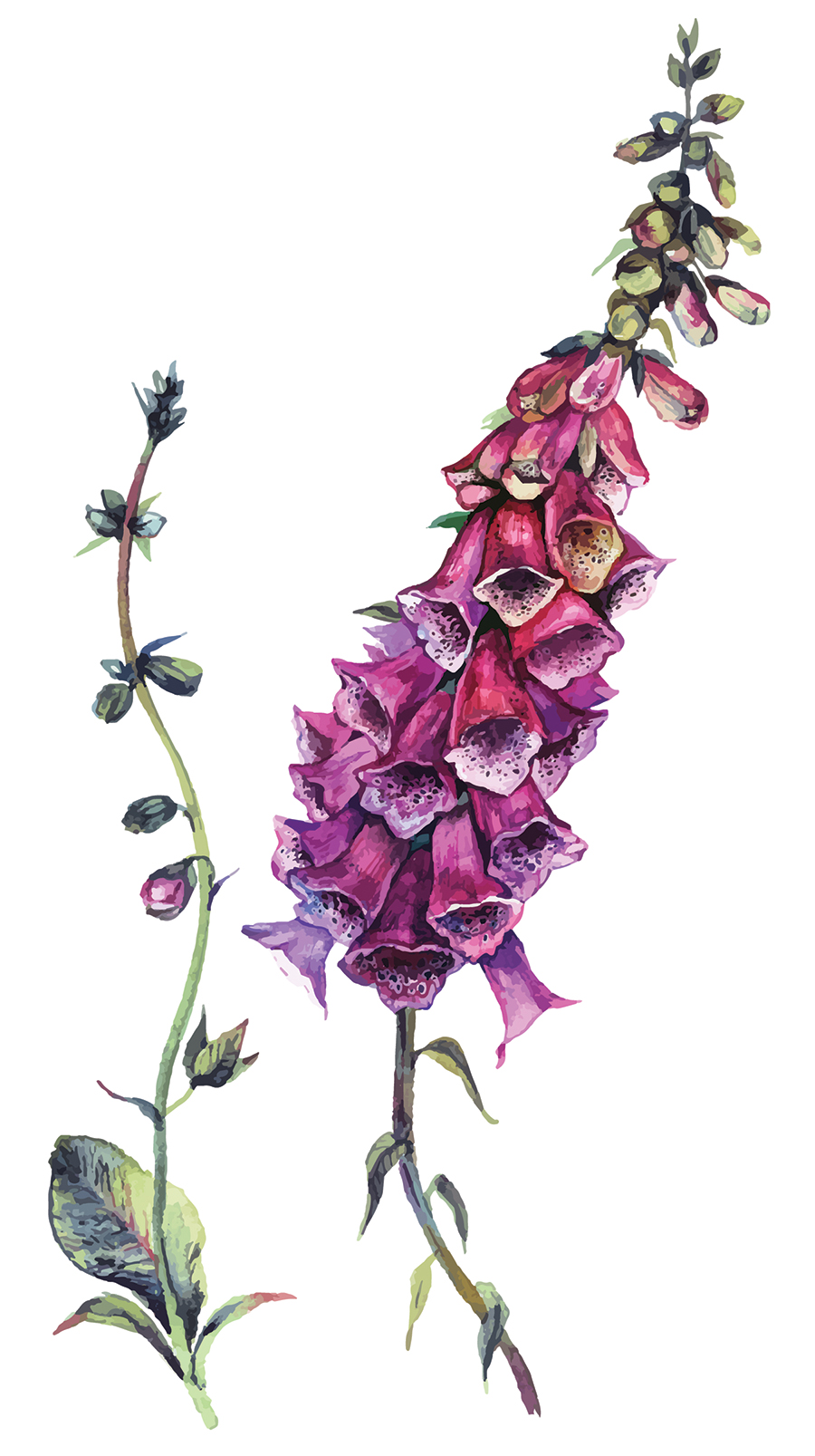
How did the pretty foxglove get its name? Etymologists have spun many theories. In 1847, William Fox Talbot proposed that “foxglove” may have derived from “folks’ glove,” especially since the Welsh called the flower maneg ellyllon, aka, “fairies’ glove.”

This much we do know: They are bumblebee magnets.

If ingested, the common foxglove (Digitalis purpurea) is highly poisonous to people and animals. In this case, looks can’t kill. But one could see why the Scottish called them “witches’ thimbles.”  PS

The Omnivorous Reader

Writing on the Edge

Short stories that stick

By Anne Blythe

Joanna Pearson, a psychiatrist in the Chapel Hill area, describes herself as a “lapsed poet” on the jacket of her new short story collection, titled Now You Know It All.

Yet, in the 11 stories that plumb the depths of the hearts and minds of a variety of flawed but intriguing characters, it’s clear that Pearson’s poetic touch is not on hiatus. The author deftly describes settings, backstories and eerie omens as the narrators of her mini-mysteries move toward precipices that will forever change their lives.

These stories can be dark, tempting readers to turn their eyes away from characters whose hard-living and messy circumstances have pushed them to a point where they struggle mentally with what is and isn’t real.

It’s difficult to read about James, the foster child (also known as the Devil Boy), the therapist Miss Beth Ann, and her boyfriend in “The Films of Roman Polanski” and not be disquieted by the troubling, manipulative behavior on display in that story. In “Mr. Forble,” you might get creeped out as you read about the disturbed 13-year-old boy who tries to sic the miscreant from an internet hoax on his birthday party guests.

Other characters we meet in Now You Know It All include two sisters at their grandmother’s rural Burke County home who hear about a boy tied up in the barn next door; a pregnant woman in her 40s reliving a previous brutal bout of postpartum depression; and a waitress/bartender wooed away from her small Southern town by a socialite eerily similar to Ghislaine Maxwell.

Pearson builds compassion for her storytellers as they teeter toward their ominous misfortunes, while hooking readers with her descriptive writing.

“There were ruins and fountains and a fury of beeping horns,” Pearson writes in “Rome,” the opener of the book. “Naked putti lounging fatly in marble. Gorgeous long-armed women in skirts and strappy sandals, and young men hanging out of their cars in mirrored glasses. Old men in storefronts arranged cheeses and sausages tenderly, as if they were tucking in sleeping infants while chattering tour groups trailed guides holding red umbrellas, and honeymooners licked perfect gelatos.”

That’s how we meet Lindsay, an American college student exploring Rome with her friend Paul. They’re sick of each other, and as it is with each story in the collection, Pearson does not seduce her readers with an ordinary tale about a young couple exploring their feelings for each other as they travel together in a foreign land. Expect the unexpected.

“We were finally seeing all the things — beautiful, famous things we’d waited all our young lives to see — but we couldn’t appreciate any of it any longer,” Lindsay said.

Then comes the plot twist.

After an unanticipated night of romance with Paul — and him spending the next day worrying about it — Lindsay sets out on her own for a day trip to the Tivoli ruins, leaving her traveling partner alone in bed in the hostel. Along the way she meets the Gooleys, a “seemingly wholesome family” of five blonde-haired girls, a Pentecostal father and mother who she believed to be pregnant.

Not only does Lindsay come to realize the “wholesomeness” of the family she was touring the ruins with might be more of the “slippery quality” that sometimes accompanies such carefully crafted images, she also questions who she really is.

Pearson’s stories rarely conclude with a clean-cut resolution to the many mysteries posed, leaving a sense of uneasiness that gives a nod toward the tumult of our times.

In “The Field Glasses,” Pearson opens with the line: “For weeks my sister Clara had been warning me that there was something in the woods that wanted to eat the children.”

And she closes it with: “There was another call, a different animal this time, joining in mournfully with the first, their voices rising in a strange duet, and I determined it must be two dogs, something wounded and wild in their voices. Through the dark of the trees, I imagined or heard the crack of branches. Something hungry out there. I waited for a figure — my sister, a deer, some other animal — to emerge.”

That’s it. The end of the story. In Pearson’s world, the uncertainty lingers, leaving readers to long ponder not only what’s lurking in the woods but what truly lurks in the minds of the narrators. She shows us how the power of suggestion and expectation can shape her characters’ narratives, as well as our own.

We never really know everything they’re thinking or how what’s roiling below the surface is going to lead to new discoveries.

Pearson’s stories might be short, but they have a long-lasting impression while craftily making you think about life’s mysteries.  PS

Anne Blythe has been a reporter in North Carolina for more than three decades. She has covered city halls, higher education, the courts, crime, hurricanes, ice storms, droughts, floods, college sports, health care and many wonderful characters who make this state such an interesting place.

The Kitchen Garden

To Everything
a Season

And spring is for
digging in the dirt

By Jan Leitschuh

These are the best of days, weather-wise.

In the Sandhills, dogwoods and azaleas swell, turning our area into a fairyland. The garden stores and centers see a brisk business in April, as sunny days and pleasant temps lure folks out to tend their yellowed, pine-pollened yards.

And the urge to grow a garden takes hold, to raise a few fresh vegetables for the kitchen.

Now is a beautiful time to turn rich compost and a little lime into our garden beds, preparing the soil to receive seeds and tender transplants. It’s one of the ancient rites of spring, that calls to get our hands in the cold dirt.

Some plants thrive in it, and some languish or rot away. It’s good to have a handle on which do what.

Think of March, April and May as three different planting zones. In late February and early March, sugar snap and snow peas can be sown directly into the garden. They laugh at the cold and provide buckets of sweet snaps for salads, stir-fries and snacks.

Other seeds that thrive in this time period are chard, spinach, turnip, radish, carrots, lettuce, arugula, beets, rutabaga and spicy mustard. Irish potatoes can go in too. Transplants of onions, broccoli, cabbage, kale, kohlrabi and collards can be set out during this time. Pots of parsley, mint and dill seed are herbs that thrive.

If you dislike hot summer gardening and bugs, perhaps you will enjoy just planting an early garden for a fresh harvest. After all, the farmers markets are bursting at the seams come summer.

April allows for further variety. Weather conditions are transitioning, and that is reflected in the soil temperatures. Our last frost date is in early April, meaning the probability is low for a killing frost. The nights are still chilly, but the days grow warmer. The soil, though transitioning, is still quite chilly and can rot certain seeds and even transplants.

Choose seeds and plants suited for this situation. If you’re unwilling to lose a few seeds or plants, early April can be a little tricky, but sound the all-clear after mid-month. Bush snap beans can be pre-sprouted or sown directly. Summer squash and zucchini can go in early, to try to outrun some of the emerging bugs. Plant any sweet corn this month. Set up that cucumber trellis and go for it, especially after the middle of the month.

Southern field peas can start to go in and continue in succession through May. Some peppers can be planted mid-month, though if you are only putting in a few plants, you might wait until the last week of April. Sunflowers can be seeded in if you’d like to attract pollinators to your garden. And fennel is an herb that will thrive.

In April, that itch to plant a tomato hits. Resist.

Who doesn’t love a juicy, homegrown tomato? The garden shops and farmers markets are full of beautiful transplants, and lots of variety — heirloom, grape, slicing/sandwich, plum/paste, and more. Feel free to grab your favorites, but hold off planting them directly in the garden soil. Instead, pot them up in a nutrient-balanced potting soil, and bring your tray of transplants in at night if temps drop low. They will put on healthy root systems and good top growth and be ready to hit the ground running. I find rinsed milk cartons with a few holes punched for drainage to be economical and roomy, growing gorgeous tomato transplants. When the time comes to plant, dig a deep hole, peel back the carton and plant — in May.

By then, the night temperatures are consistently in the 50s. The soil is warming up to receive the last of your garden’s spring input.

Besides tomatoes, you can give heat-loving eggplant the same treatment. It will thank you with strong production. May is the time for direct seeding your okra, and winter squash will thrive. Sweet potato slips planted then will make some fun digging in the fall. Basil, a true heat-thriver, can be safely transplanted or sown — or both.

Enjoy these upcoming spring days, pollen or no. Answer that ancient call to root about in the dirt. I know I will be.  PS

Jan Leitschuh is a local gardener, avid eater of fresh produce and co-founder of Sandhills Farm to Table.

The Naturalist

Backyard Bandits

Observing the private lives of a raccoon family

Story and Photographs by Todd Pusser

As I was walking past our living room window on a bright, winter’s night, something caught my eye. Out in the front yard, beneath a birdfeeder, stood a bandit. The full moon high above illuminated its distinctive hunched back, pointed ears, dog-like snout and bushy tail. Dexterous paws busily scooped up sunflower seeds from the ground, spilled earlier in the day by hungry cardinals and gray squirrels.

I stood quietly and watched as the raccoon turned its attention to the birdfeeder hanging high above its head. Standing on its hind legs, while simultaneously extending its front legs upward, the raccoon grasped the feeder with its paws and slowly rocked it back and forth, emptying more seed onto the ground. The ease at which the precocious critter performed the task left me with the distinct feeling it had done this before.

Over the next 15 minutes, the raccoon repeated this behavior numerous times, eventually emptying the birdfeeder of its contents. Satiated, or perhaps simply because there was nothing left to eat, the raccoon slowly ambled toward the edge of the yard and disappeared into the night, no doubt looking for more mischief elsewhere.

With their striped tails, large eyes, and distinctive black and white markings wrapped around a cute puppy-dog face, raccoons are among the most recognizable of North American mammals. Incredibly adaptive and intelligent, they make their homes in a wide assortment of habitats ranging from remote forests to heavily urbanized cities.

Growing up in rural Eagle Springs, along the western edge of the North Carolina Sandhills, raccoons were always present on the landscape but I rarely saw them. My most memorable childhood encounters with the crafty critters were among the pages of Sterling North’s Rascal and Wilson Rawls’ Where the Red Fern Grows, two beloved novels that still feature prominently on my bookshelf. It was not until I moved to a densely populated Virginia city that I was able to observe raccoons, outside in their natural environment, with any detail.

Our 3-acre suburban yard bordered a tidal river and contained a mixture of loblolly pines and hardwood trees. One impressive tree, a tall sweetgum, with a large, open cavity about 15 feet off the ground, stood just outside our second-story bedroom window.

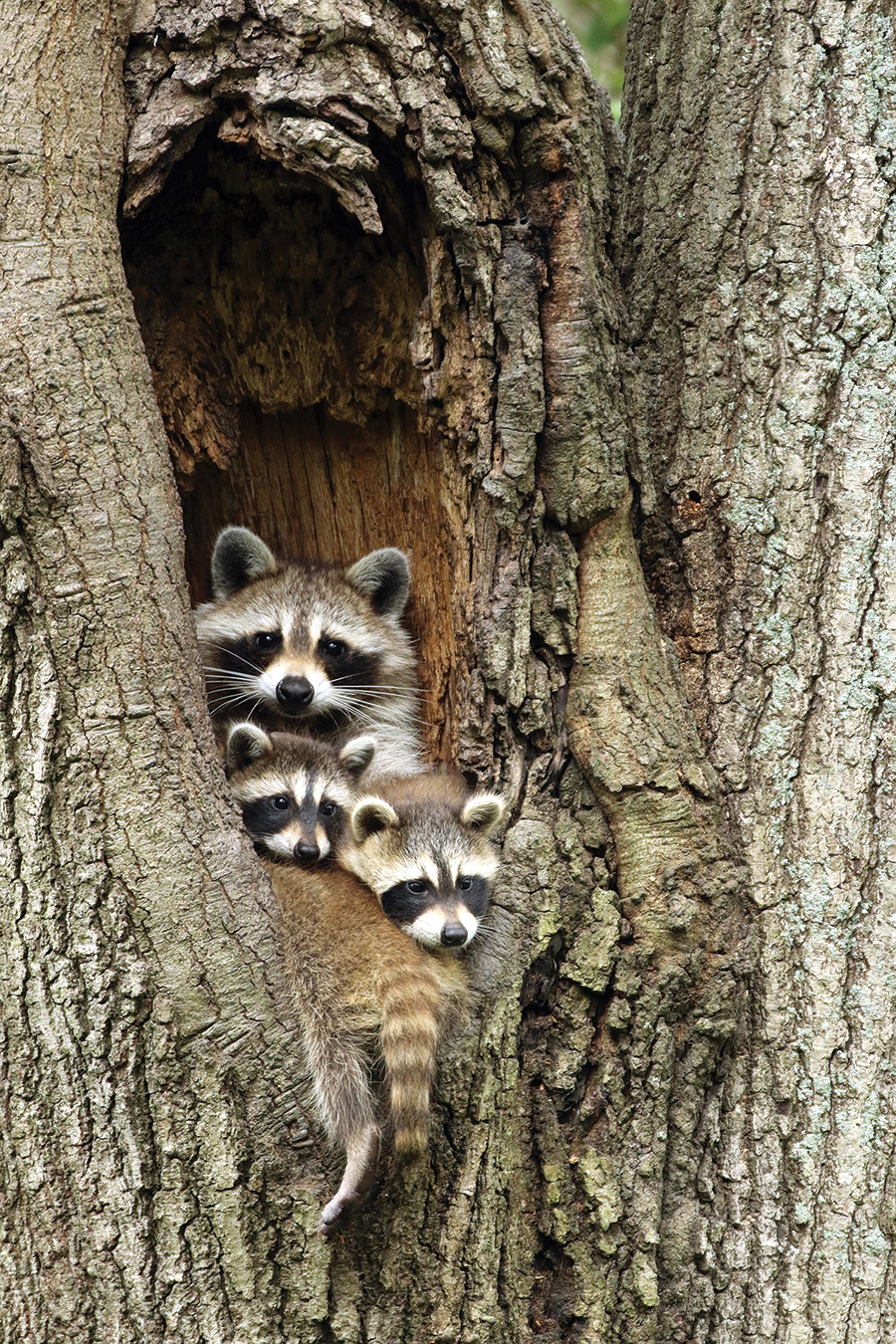
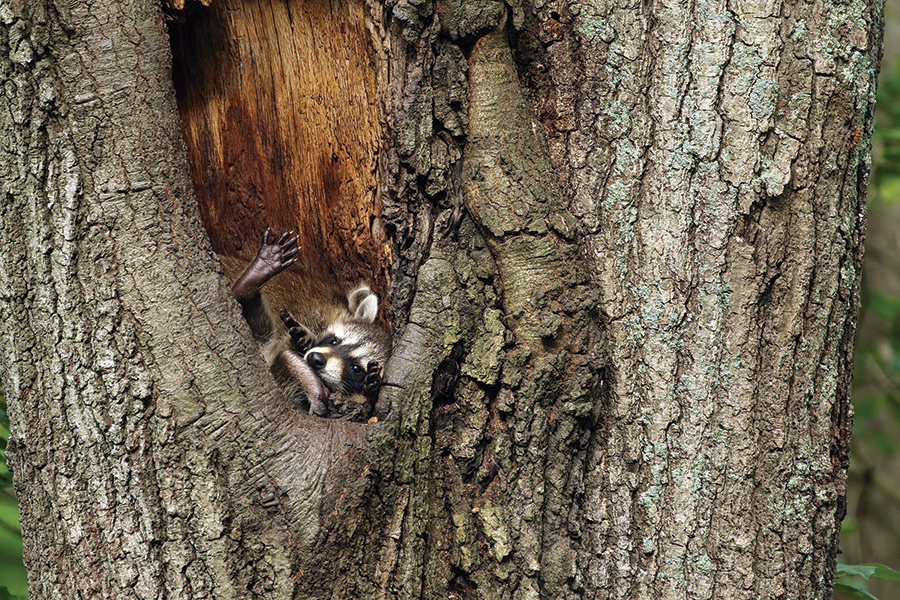
One April morning a few years back, I noticed a raccoon curled up in a tight ball at the cavity entrance. The animal remained there for several days, rarely moving, except to occasionally lift its head and stare at me when I mowed the lawn. After a couple of weeks, I began to worry that the animal might be sick. Toward the middle of May, I woke one morning to find three tiny, young raccoons peering out from the cavity along with the larger animal. The raccoon had not been sick, as I had feared, but was simply pregnant and had given birth to a trio of impossibly cute kits whose antics provided hours of entertainment.

Being able to observe the intimate details of the lives of animals is a rare treat, and so it became a morning routine, with a cup of coffee in hand, to watch the raccoon family for a couple of hours before work. Mother raccoons are attentive, loving and tender, and this one proved to be no exception. Throughout the day, she constantly groomed and nursed her young. As the kits grew, she would often leave the increasingly cramped tree cavity and bask quietly on a nearby tree limb, obviously treasuring a moment of solace from her rambunctious young.

Over time, her routine became predictable. She stayed nestled in the tree cavity with her young for much of the day, occasionally basking on nearby tree limbs when it was hot. At night, she ventured out of the cavity to look for food, always returning by sunrise. Toward the middle of summer, she began to take her young on her nightly forays.


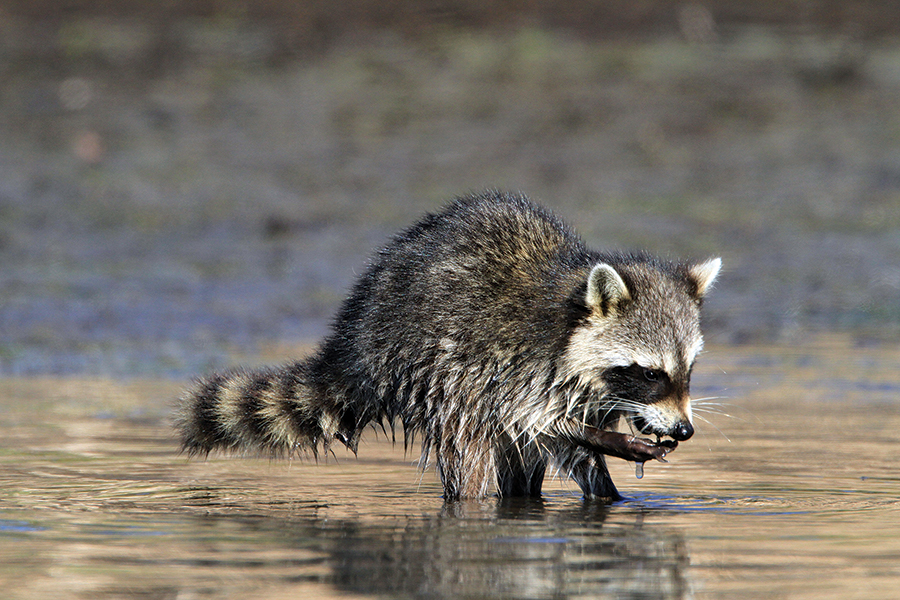
The raccoon family utilized the entire yard but frequented the azalea garden and the patch of dirt beneath the bird feeders, where they eagerly gobbled up spilled sunflower seeds. Several times that summer, I observed the young foraging elbow deep in the river and marveled at the dexterity of their paws as they “washed” their food.

By early fall, mother raccoon weaned her kits and sent them on their way. I am not sure where they eventually settled, but on occasion, I would see a young raccoon dash across a nearby neighborhood street late at night in front of my car and wonder if it might be one from our yard.

We ended up moving away from that riverfront property over six years ago. From time to time, I still think about that mother raccoon and wonder if she might still be alive. With abundant food and adequate shelter — which our yard had in spades — raccoons can live for well over a decade. It is entirely possible she is. Perhaps this spring will find her raising another family of young kits inside the cozy tree cavity just outside our old bedroom window.

Thinking about that now, I can’t help but smile.  PS

Naturalist and photographer Todd Pusser grew up in Eagle Springs. He works to document the extraordinary diversity of life both near and far. His images can be found at www.ToddPusser.com.

Pine Pitch

Doin’ the Bunny Hop

Kids can enjoy an “Eggstravaganza” of crafts, egg hunts and pix with Mr. Bunny beginning at 10 a.m. on Saturday, April 9, at Campbell House Park, 482 E. Connecticut Ave., Southern Pines. Free to all, even those answering to the name Harvey.

Feherty Unplugged

The unchained — or perhaps unhinged, depending on your point of view — and incredibly funny David Feherty will go from the PGA Tour and major championship announcing booth to the stage at Owens Auditorium for his one-man stand-up show on Thursday, April 7, at 7 p.m., at the Bradshaw Performing Arts Center, Sandhills Community College, 3395 Airport Road, Pinehurst. For information and tickets go to www.ticketmesandhills.com.

Double Dose of Lee

The Judson Theatre Company returns with Lee Squared: The Liberace and Peggy Lee Comeback Tour, a unique evening of music and laughter on April 8-10 at the Owens Auditorium, Bradshaw Performing Arts Center, on the campus of Sandhills Community College, 3395 Airport Road, Pinehurst. Liberace, played by David Maiocco, lived a life of flamboyance and sparkle, and Miss Peggy Lee, played by Chuck Sweeney, is simply beyond description. The duo won the 2017 Bistro Award for Lee Squared. The performance on Friday, April 8, is at 8 p.m., while the shows on April 9 and 10 begin at 2 p.m. Tickets are available at www.judsontheatre.com.

Four Women, One Heirloom

Join New York Times bestselling author Kristy Woodson Harvey as she talks about her new novel, The Wedding Veil, at 11:00 a.m. on Tuesday, April 5, at The Country Club of North Carolina, 1600 Morganton Road, Pinehurst. Juxtaposed against the drama of the Vanderbilts and the Biltmore Estate is the intriguing present-day story of Julia Baxter and her grandmother, Barbara Carlisle. While wearing the gorgeous Vanderbilt wedding veil is considered good luck, is it really? Tickets are available from www.ticketmesandhills.com. For more information go to www.thecountrybookshop.biz or call (910) 692-3211.

Live After 5

The 2022 concert series kicks off with The Embers, featuring Craig Woolard, on Friday, April 8, from 5:15 p.m. to 9 p.m. at Tufts Memorial Park, 1 Village Green Road, Pinehurst. Picnic baskets are allowed, outside alcohol isn’t. Never fear, beer, wine and soft drinks are available for purchase, and there will be food trucks, food trucks, food trucks. For information go to www.vopnc.org.

Homes in Bloom

The Southern Pines Garden Club presents its annual (in non-pandemic years) Home & Garden Tour on Saturday, April 9, from 10 a.m. to 4 p.m., where visitors have the opportunity to experience some of the Sandhills’ most elegant homes and gardens. The cost is $25 in advance and $30 the day of the tour. For information and tickets go to ticketmesandhills.com.

And They’re Off and Running

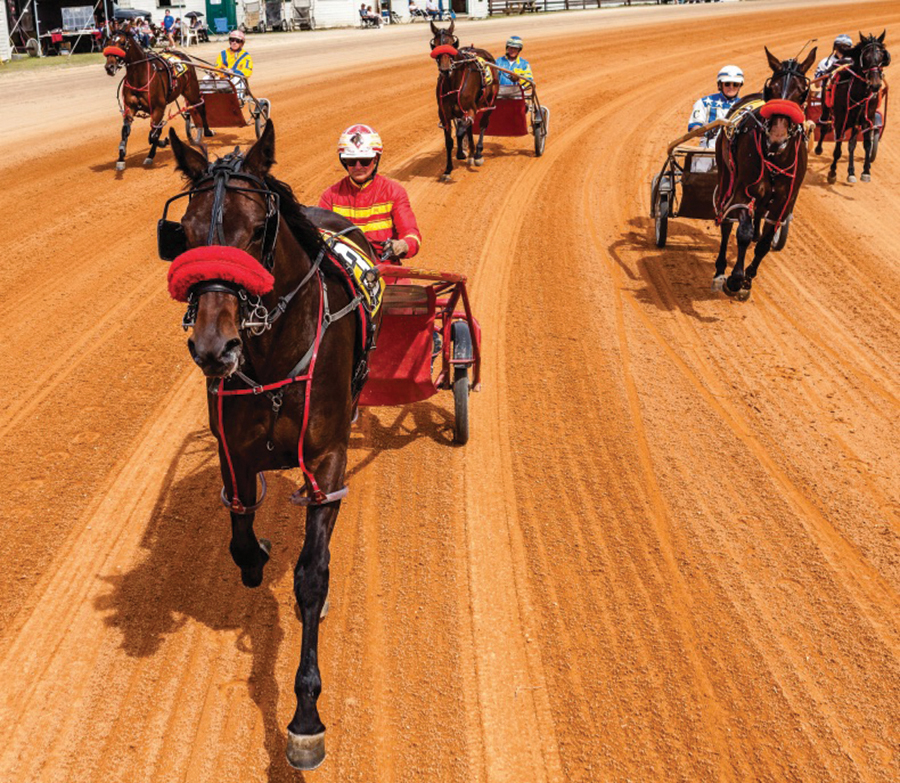
Spring. Matinee. Races. The Pinehurst Harness Track, 200 Beulah Hill Road, Pinehurst, 1 p.m to 5 p.m., Saturday, April 9. Enough said. Bring sunscreen, floppy hats and plenty of folding money for, ahem, a side bet or two. The races begin at 1 p.m. and end at 5 p.m., or thereabouts. For information call (708) 921-1719.

Haute Couture

Just about anyone who makes anything you can wear or walk in will be represented in the spring Fashion Show on Tuesday, April 19, at the Forest Creek Golf Club, 200 Meyer Farm Drive, Pinehurst. The buffet lunch and cocktails cost $65. Eve Avery, Marie and Marcele, Morgan Miller, J. McLaughlin, Monkee’s, Denker, Ikonic Kollection, Eclectic in the Village, Cooper and Bailey’s, Dunberry Resort Wear, and Perle by Lola will all be there. For info and tickets go to www.
womenofthepines.org.

Home and Garden Extravaganza

The Spring Home & Garden Expo at the Fair Barn, 200 Beulah Hill Road, Pinehurst, will have more than 40 companies showing their wares beginning at 10 a.m. on Friday, April 22. For information go to www.ticketmesandhills.com.

It Looks Good for Its Age

The wood sprites will be out celebrating the oldest known living longleaf pine on Saturday, April 23, from 10 a.m. to 3 p.m. at the Weymouth Woods Boyd Tract meadow, 555 E. Connecticut Ave., Southern Pines. The free festival will feature food tucks, music, turpentine info and a demonstration of a live, prescribed burn. So, how old is the oldest longleaf? It’s so old its squirrels are seventh generation. For information call (910) 692-2167.

Jazz and a Bagel

New Orleans jazz trumpeter Leroy Jones will perform on the lawn at the Weymouth Center for Arts and Humanities, 555 E. Connecticut Ave., Southern Pines, for Sunday brunch on April 24 from 11:30 a.m. to 2 p.m. For information and tickets go to www.weymouthcenter.org.

Choral Society in the House

The Moore County Choral Society will present “From Dusk to Dawn” at the Village Chapel, 10 Azalea Road, Pinehurst, on Sunday, April 24, from 4 p.m. to 6 p.m. For information and tickets go to www.ticketmesandhills.com.

In the Spirit

Springing into Sours

Variations on sunny weather cocktails

By Tony Cross

I’m happy to report that spring is here. Finally. There are bartenders who might get more creative during the fall and winter months, and then there are hacks like me who get giddy as soon as the sun kisses my skin. I’m all about some warm weather. And what better way to start out this spring season than whipping up different sours? There are other styles of drinks I enjoy this time of the year, but for now, it’s all about the sours.

So, what is a sour, you ask? Simply put, it’s citrus, sweetener and spirit, combined into a drink. The daiquiri (rum plus lime juice plus sugar), probably my favorite drink ever, is a sour. Jennings Cox may have been the first to do it, mixing rum, lime juice and sugar, right before the 20th century, in Cuba — and for that, I’m eternally grateful. There are many other drinks with basically the same formula, and all are sours. But what about drinks that have sour mix in them?

Like it or not — and I don’t — there are many restaurants and bars today that use sour mix, and I’m not speaking just of corporate-run restaurants where it’s pretty much out of the bartender’s control. Even some independent bars and restaurants use the high-fructose-corn-syrup-mess-of-an-excuse-for-a-mix as an ingredient.

Bartender and author Derek Brown says it best in his book Spirits, Sugar, Water, Bitters: How the Cocktail Conquered the World: “One of the things that helped bars like T.G.I. Fridays crank out cocktails for the masses was the use of sour mix. Powdered beverages then were not viewed with the total scorn we have for them today. In the 1970s, instant powdered beverages had taken a foothold all over the cultural landscape. The turn toward the worst versions (of sour mix) was ultimately done because they were cheap to make, cheap to buy, and saved a lot of time behind the bar. Later on, opposition to sour mix would become a red flag that craft bartenders hoisted in their war against bad tasting, chemical-laden cocktails. But this ingredient that would sour the craft rose to absolute dominance while the Bay City Rollers blared from the speakers and the bottom of their pants widened. One more reason to blame the ’70s.” Indeed.

I don’t think there is anything wrong with prebatching ingredients before a busy night behind the bar (especially if you are alone with absolutely no one to help), or if you’re having to dish out a few hundred cocktails within an hour at a big event. If you’re making each cocktail to order, or making drinks at home, add each ingredient at a time, and if you couldn’t tell from Mr. Brown’s excerpt, ixnay the sour mix. Now that we’ve gotten that out of the way, here are a few sour recipes to complement your future suntan.

Marmalade Sour

This is an oldie but goodie from bartender Jamie Boudreau, owner of the whiskey and bitters emporium Canon in Seattle. What I like about his cocktail is how you can experiment with the ingredients. If you don’t have cachaça on hand, try another rum, possibly an Agricole. Or try a gin! The same goes with the flavor of marmalade. I think I had this on my bar menu years back. Hellaciously good.

2 ounces cachaça

2 tablespoons low-sugar orange or grapefruit marmalade

3/4 ounce lemon juice

1/4 ounce simple syrup (Boudreau recommends a 2-part sugar, 1-part water ratio)

2 dashes orange bitters

1 large egg white

Edible flower (optional garnish)

In a cocktail shaker, add ice and all ingredients (sans edible flower). Shake hard until shaker is ice cold and double-strain into a chilled coupe glass. Garnish with flower.

You Think I Ain’t Worth a Dollar, but I Feel Like a Million Bucks

This is one of the first cocktails I put on my menu when I started getting into this whole drink thing. A twist on a whiskey sour, it’s my blatant rip-off of the Billionaire cocktail from New York’s Employees Only. At the time, I didn’t have access to the bourbon the recipe called for, so I substituted Four Roses. For the sake of convenience, I’m going to switch one detail in the specs. The original Billionaire recipe calls for absinthe bitters — and I did make that behind the bar — but a touch of absinthe will do.

2 ounces Four Roses bourbon

3/4 ounce lemon juice

1/2 ounce cranberry syrup* (do not exceed)

1/16 ounce absinthe

1 lemon wheel (garnish)

Combine all ingredients in a cocktail shaker, add ice, and shake like hell until you feel satisfied. Double strain into a chilled coupe glass. Garnish with lemon wheel.

*Cranberry syrup: Mix 1/2 cup of unsweetened cranberry juice with 1 cup (by weight) cane sugar in a pot over medium heat. Stir until sugar is dissolved and let cool before transferring to a container and refrigerating. Syrup holds for two weeks.  PS

Tony Cross is a bartender (well, ex-bartender) who runs cocktail catering company Reverie Cocktails in Southern Pines.

Out of the Blue

Ode to Weather, or Not

Spring belongs to the poets

By Deborah Salomon

In our righteous concern with climate change, I’m afraid we’ve neglected weather.

Not the extremes, which uproot trees and flood neighborhoods. Those are News, with a capital N. I mean the other kind, perfect days the morning meteorologist dismisses with a sentence unless they connect to something else.

Sept. 11, 2001, was such a day in the Northeast, so beautiful that most documentaries mention the brilliant, cloudless sky, low humidity and slight chill.

I remember it as just that — the perfect autumn morning until . . .

Certain physiologies seem finely tuned to the weather. Humidity makes a hot day feel hotter, a cold day colder. It just makes me cranky. But not all humidity is created equal. The minute I walked out the door that day last month when snow was imminent, I felt a certain damp chill that precedes the white stuff. I remember my mother called the chilly dampness “raw.” Very descriptive, more so than anything from the TV meteorologist wearing a tight red dress and lip gloss.

That’s the thing. Weather is better experienced than described. I lived most of my life far north, where November always meant raw and people, especially skiers, welcomed a Thanksgiving blizzard. If you’re dressed for it, nothing compares to sun bouncing off fresh powder under a brilliant blue sky, no wind, temps in single digits or below, which make ceiling beams creak come night.

I hear the sweaty golfers howling protest. They have a point, I guess, if you skip July through October.

Beach day! Having packed the kids and their water toys in the car and driven a couple of hours, you want a clear sky with just enough breeze to stir the heat. Actually, the most impressive beach weather finds high, massive cloud formations racing from horizon to shore. No worry if they are a fluffy white. Gray merging to black — menacing but just as beautiful. 

Beauty exists in even the most destructive weather. An ice storm knocking out power for days inspires photographers to snap ice-encased twigs sparkling in the sun. Hurricanes inspire pilots to fly into their eyes, which remain calm. Similar bravehearts chase twisters, documenting their power.

My grandfather, a bricklayer with a penchant for mathematics, taught me about cloud formations, which determined whether he should water his enormous garden plot. He didn’t know Latin names, only what the clouds foretold. Then, when the thunder commenced, he said nothing, just nodded and smiled, since one man’s rained-out ball game is a farmer’s windfall.

“Windfall” itself is a term coined in the 15th century; landowners gave fruit that blew off the trees during a storm to the serfs.

Weather inspires music. Remember Gene Kelley dancing in Singin’ in the Rain? Etta James and Lena Horn crooning “Stormy Weather”? “Raindrops Keep Fallin’ on My Head” from Butch Cassidy and Sundance? Then, “They Called the Wind Maria,” “Blue Skies,” “Candle in the Wind”? The Beatles’ prediction “Good Day Sunshine” and “You Are the Sunshine of My Life” from Stevie Wonder, who never saw a single beam.

Technology has heightened our awareness: Get minute-to-minute details on the 24-7 Weather Channel or the weather apps.

Without weather, art would be flat, dull. Van Gogh illuminated his subjects with the almost-tangible sunlight of Provence, but Michelangelo, in the Sistine Chapel, placed God giving life to Adam over a high, thin cloud cover, while Leonardo da Vinci posed Mona Lisa against what looks like smog.

Spring weather belongs to the poets — soft rain, warm sunshine, aromatic breezes suggest romance, rejuvenation, rebirth of the insects, unfortunately. On the flip side, the Bible relates heaven dumping 40 days and 40 nights of rain, forcing Noah into ship-building. How about the wind that blew Dorothy clear out of Kansas? Who knew the deadly fog that smothered London in 1952 would be immortalized on a raincoat label?

And now April, the cusp of spring. Wordsworth had his turn, as did Shakespeare. Hear it best, from an anthropomorphizing Ogden Nash in “Always Marry an April Girl”:

Praise the spells, bless the charms,

I found April in my arms.

April golden, April cloudy,

Gracious, cruel, tender, rowdy;

April soft in flowered languor,

April cold with sudden anger,

Ever changing, ever true —

I love April, I love you.

Just don’t forget the umbrella.  PS

Deborah Salomon is a writer for PineStraw and The Pilot. She may be reached at debsalomon@nc.rr.com.

National Poetry Month

Words and
Music Riffs

By Shelby Stephenson

Hiram Larew turns loose the syllables like steam on water in his 2021 book, Mud Ajar, from Atmosphere Press. His words do not sink up in stirred up mud. At times I feel as if I can almost see through the mud, as the poet shakes form and content to create Poetry.

In “Quiet Come” —

All is up

yes

all is sky

In “Ode to the Edge” —

all arrows lift their grateful views

sung-up like curves

the call of bogs

where edge surrounds

Listen to these few lines from “Mud Ajar,”
the title poem —

Here where beaks are barns

that loop through when

as rain lifts praise

on trill of rakes. 

In “Listened Twigs” listen to Larew’s lines —

These trees a choir

in early fine

their waking limbs

When snowflakes hear within themselves

of how beginning sounds.

Every syllable sings: example, these words from “Sign a Lease” —

When the skies boil or bloom

go sweep the stoop.  PS

Hiram Larew is the founder of Poetry X Hunger which inspires writers all over the world to combat hunger. In Mud Ajar, the music quakes and the sky blazes all over again.

Shelby Stephenson was poet laureate of North Carolina from 2015-18. His recent book is Praises from Main Street Rag Publishing Company.

Hometown

The Spice
of Time

When you see more salt than pepper

By Bill Fields

I got a much-needed haircut recently not long after eye surgery. My vision was limited to the other eye, but that was plenty to notice the clippings on the black cape when the stylist had finished. There was enough white on the cover-up to make it seem as if a polar bear had been in the chair.

Forty years after finding my first gray hair, on my 22nd birthday, there is much more salt than pepper to be swept up after getting a trim. It’s been headed in that direction for two decades, an inexorable journey that, like achy joints after a taxing day, is just part of the landscape when you’re north of 60. As P.G. Wodehouse said, “There is only one cure for gray hair. It was invented by a Frenchman. It is called the guillotine.”

Don’t think for a minute I’m not grateful to have a head mostly full of hair at my age, regardless of its hue. I thank my maternal grandfather, B.L. Henderson, for whom a pocket comb remained a useful stocking stuffer as he made his way into his 90s, if one’s hair prospects are indeed rooted in that part of the family tree.

Plenty of men are dealt a different hand, losing their hair, or most of it, at a relatively young age. The combover can be a comical reaction — see images of former Purdue basketball coach Gene Keady for confirmation. This is the ultimate losing battle, and the willingness of more folks to go the shaved-head route when faced with a bare minimum is a victory not only for style but common sense.

I’m glad I haven’t had to make that decision. A couple of years ago while getting a haircut down South, as I sat down in the chair, I asked the barber if he could do anything about all the gray I could see in the mirror.

“Better to go gray than go gone,” he said.

Those seven words of barber philosophy have become my mantra.

If my father had heard them as he started getting lots of gray as he approached his 50th birthday, he might have avoided his brief hair dye experiment. Something looked different about his appearance as he sat down to supper one evening, but the real evidence was in the bathroom sink — black stains from the hair dye he had applied. We teased him so much that he never altered his appearance again. For the last decade of his life, he let his short flat-top go increasingly toward white, and set against his blue-green eyes it was a very handsome look.

“No play for Mr. Gray” has been a catchy line for Walt Frazier to say in the “Just for Men” television commercials, but I’m not sure how accurate it is.

If someone wants to dye his or her hair to maintain a look that has been theirs for years, more power to them. It’s none of my business. But tell me that singer Emmylou Harris doesn’t look gorgeous these days with that silvery hair of hers, and I’ll wonder what you’re smoking.

When it comes to hair color, I’m leaning toward letting time tell its story.  PS

Southern Pines native Bill Fields, who writes about golf and other things, moved north in 1986 but hasn’t lost his accent.