Almanac

May

A flower blossoms for its own joy.

— Oscar Wilde

May is the daughter of dandelions, queen of the daisies, the giggling maiden of spring.

In a sunny meadow, where the soft grass glitters with morning dew, she is gathering wild violets, singing the blue into each petal.

One handful for candy.

Two handfuls for syrup.

A heaping third for tea.

She moves like water, stirring swallowtails and skippers as she drifts from flower to quivering flower. Constellations of buttercups manifest before her. A choir of bluebirds twitters in her wake.

Her gaze is tender. Her presence full. Everything she touches seems to blush.

The Southern magnolia offers its first fragrant blossom.

The tulip poplar blooms in boundless rapture.

An oxeye daisy sings out: She loves me. She loves me lots. She loves me. She loves me lots.

No flower is forsaken.

A sweep of dandelion brightens beneath her feet, yellow blossoms plump as field mice. There is nothing to do but bask in the playful light of spring.

As the maiden lowers herself onto the lush and golden earth, one hundred songbirds pipe her name. The mockingbird repeats it.

May is here! May is here!

All hail the giggling maiden of spring.

Flowers for Mama

Mother’s Day is celebrated on Sunday, May 8. Not that the garden would let you forget. (Read: Bring her flowers.)

Sometimes simple is best. A sprig of dogwood. A vase of bearded iris. A single magnolia blossom.

Or get creative. Wildflower bouquets. Pressed flower notecards. Wild violet jelly. 

If she’s the “roses only” type, you know what to do.

But if your mama’s busy scratching and clawing around in her own garden, perhaps you can glove up and join her.

Prune the hedges if she’ll let you.

Since May is the month to plant summer annuals, plant them together.

In July, when her prismatic zinnias are the crowning glory of the block, she’ll surely be a happy mama still.

The Night Sky

According to Smithsonian magazine, two of this year’s most “dazzling celestial events” happen this month: a meteor shower and a lunar eclipse.

If you haven’t yet downloaded an astronomy app, consider doing so before the Eta Aquariids peak on May 5. Why? So you can locate Aquarius, the faint yet richly fabled constellation on the Eastern horizon. If conditions are favorable, and you are, in fact, gazing toward that water-like configuration of stars, then you may catch up to 20 meteors per hour beginning around 4 a.m. What you’re actually seeing? Debris from Halley’s Comet, of course.

A total lunar eclipse will paint the moon blood-red in the wee hours of Monday, May 16. The moon begins entering Earth’s shadow on Sunday, May 15, around 9:30 p.m. Totality occurs around midnight when, for 84 glorious minutes, the moon will appear to glow like a sunset. Dazzling indeed.  PS

Out of the Blue

Angel at the Gate

When the paper trail goes cold

By Deborah Salomon

Let me relate an experience — every detail accurate — that touches on COVID, technology, luck and the basic goodness of mankind. Or, as it happens, womankind. After months, if not years, of tribulations we must treasure every crumb.

My grandsons live in Montreal, where I lived for 26 years. They are now 23 and 25. The older one is an attorney, the younger, a certified auto mechanic/service department manager. They are tall, wickedly handsome, happy, affectionate and self-supporting.

Their father, my son Danny, died when they were 6 and 7. I was a presence in their lives from birth until I moved to North Carolina in 2007. Until recently I flew back to see them every six weeks. Now, I go three or four times a year, a joyous reunion with many hugs.

Due to COVID I’ve only seen them twice in the past two years. Flying, especially internationally, is a hassle; fewer and more expensive flights, lots of paperwork.

I prefer to depart from Greensboro — PTI is a fantastic airport, not crowded, with convenient parking and plenty of flight options.

My most recent trip began March 15, the infamous Ides.

I knew the ropes from a trip in November: passport, vaccine card, results from a specific COVID test within a specific time period. Other information (like quarantine location at destination, if required) was loaded onto an Arrive/CAN QR code.

I’m good at details. Everything was in order.

I presented the vaccine card and paperwork to the American Airlines agent in Greensboro. He separated the pages, took a quick look and handed them back. I put the bundle in my purse.

The flight to Charlotte was quick, followed by a long layover before connecting to Montreal. At the departure gate I was asked for passport and vaccination card. Without them I could not board. My vaccination card was not among the papers the agent had handed back. I emptied my purse, pockets, wallet. No luck. I felt panic rising. Not only would I be denied boarding, I’d be stuck in the airport overnight before returning home.

An off-duty AA agent in the gate area observed the developing catastrophe. She was a larger-than-life, friendly woman with a loud, happy voice. She was about to become my angel.

“Don’t you have (the card) on your phone, hon?” she asked,      in disbelief.

No, I’m not cell-centric. Hard copies remain my style.

“How about on your laptop?”

Don’t own one, but there’s an image on my desktop, at home.

Problem: Nobody at home.

However, I did have my IT guy’s phone number. And I had hidden a key outside in case the cat sitter forgot hers. But would Bill, my trusty techie for 13 years, even be home?

He was — a miracle. He heard my desperation, dropped everything and drove to my apartment, found the key, booted up my computer, accessed the file with the vaccination card.

Now what? I was afraid to have him send it to my phone. “Email it to mine,” angel lady suggested. He did. It came through. Sigh of relief. She photographed the image on her phone with my phone so I would have it for the return trip. Passengers witnessing this drama (including my mini-meltdown) applauded.

When I returned to Greensboro three days later I told the American Airlines manager what had happened. He was borderline rude, said it was my responsibility to keep tabs on documents, snapped, “Check the lost and found.”

Remember the 1990s TV series Touched by an Angel, where an angel in disguise played by the late Della Reese helps someone out of a crisis? Once home I Googled the show. My jaw dropped at the resemblance between Della and my American Airlines guardian.

I don’t believe in spooky stuff. My favorite angels were painted by Renaissance master Sandro Botticelli. However, this was the third event in my lifetime with paranormal implications. One happened at the dedication of Danny’s gravestone, in 2005. This one enabled me to hug his little boys, now grown men, and prepare their favorites for dinner. They laughed at my story, teased Nanny for not being more tech-savvy and hugged me back.

In a world plagued by death and destruction, once in a while an angel flaps her wings over a disbeliever.

My turn came at Charlotte Douglas International Airport on the Ides of March.  PS

Deborah Salomon is a writer for PineStraw and The Pilot. She may be reached at debsalomon@nc.rr.com.

Birdwatch

A Rare Bird

Searching for the Bachman’s sparrow

By Susan Campbell

Photograph by Carl Miller

Although unquestionably the most sought-after bird species in North Carolina, the Bachman’s sparrow does not, at first glance, seem very special. But once you search for this incredibly adapted little bird, you will realize how special it is. One of a handful of endangered species in our state, you will have to find the right spot to get a glimpse of this cryptic little creature.

Endemic to pine forests of the southeastern United States, Bachman’s sparrows are only found in the frequently burned, open understory of the Sandhills and inner coastal plain. The best time to locate one is to visit in the spring, when males spend much of their time singing from low perches. Otherwise, the birds are down low, foraging in the groundcover and virtually invisible. A local species, Bachman’s sparrows do not migrate in the fall but rather become even harder to find. As insects become scarce, they subsist on a variety of seeds during the colder months.

Bachman’s sparrows are bland-looking brown and white with just a splash of yellow at the bend of the wing (which you will miss unless you are looking carefully with binoculars). Their song is a beautiful trill preceded by a single note. It carries a long way and is hard to pinpoint, in spite of the volume. And the nest, which is carefully constructed by the female, is an intricate cup of grasses at ground level. Often they will incorporate vegetation over the nest, creating a dome to protect the eggs  and young from predation.

These birds are also unique in that they run, not fly, to evade potential threats. They will disappear into thick vegetation and have also been known to evade predators by diving into burrows dug by gopher tortoises — another species restricted to the sandy pine forests a bit farther south. More than anything, they are closely associated with longleaf pine and wiregrass, a plant community type that has become very rare over the last century. Habitat conversion and fire suppression have reduced the forests that they commonly inhabited by over 90 percent.

The individuals of the species were first noticed by one of the country’s most famous early ornithologists, John James Audubon. He chose to give them the name Bachman’s sparrow after his local host for the expedition, South Carolina clergyman John Bachman (pronounced BACK-man). Indeed, many birders have followed in Audubon’s footsteps, searching for this unique, secretive little survivor. Should you do the same, you just might be rewarded with a brief look at one of our state’s most prized inhabitants.  PS

Susan Campbell would love to receive your wildlife photos and reports. She can be reached at susan@ncaves.com.


In The Spirit

Super Juice

It’s time to put on the cape

By Tony Cross

When I first started tinkering around with carbonating cocktails, I knew right off the bat I’d have an issue with juice. Juice flooded my thoughts with doubt; juice gave me night sweats. I knew that I couldn’t just juice lemons and limes and add them to a keg with other ingredients. The citrus would oxidize, separate, and go bad too quickly. Luckily, a book by the name of Liquid Intelligence came out, and I learned the importance of acids and clarifying juices. I fell in love with citrates. It was my saving grace and got me started down the right path in kegged-cocktail land.

For making drinks to serve at home, the issue with juice is waste and cost: If you’re having friends over for drinks, it’s easier to juice ahead of time, but that juice (especially citrus other than lemons) will start to oxidize after four hours; any leftover juice won’t taste the same the next day. Enter Nickel Morris and super juice: a new concept that will save you time and money.

Sometime last year, I saw the term “super juice” for the first time — probably on Instagram or Google (cocktails, workouts, models and music seem to be the main topics on my algorithm). I read an article at punch.com about a bartender named Nickel Morris who co-owns The Kentucky Corn Palace in Louisville, Kentucky. Then, I went down the YouTube rabbit hole and found a lengthy interview with him on the “Portland Cocktail Week” channel. Morris, it turns out, has been working on ways to better utilize food-grade acids and juice for the past decade.

He used to work for a business named Road Soda, where he ran a kegged cocktail program (sound familiar?) and learned to use oleo citrates for serving thousands of people at once, e.g., the Coachella Valley Music and Arts Festival. You may have heard of oleo saccharum, which is oil-sugar made from citrus peels (lemon, for example) placed in a container and covered with sugar. After a few hours, the sugar draws out the oil from the peel. Using acids with the oleo saccharum mimics the flavors of juice when kegging a cocktail. Nickel’s aha moment was when he discovered how to make a longer lasting, sustainable juice, without having to use fancy equipment. He put acids on lemon peels in a container, placed it in the fridge and forgot about it. Three days later he found it.

“All of the acid had disappeared, and the peels were really thick. And I was like, ‘Huh, that is not what I thought was going to happen.’ So, I took out an immersion blender and a liter’s worth of water, and blended it up into a liter’s worth of oleo citrate, and that was the first batch. Because, as it turns out, and despite what we would tell ourselves, acid is a fantastic magnet and sponge for oil. It will rip it all right out.”

By using the oils of the citrus, you create a flavor profile that remains constant. The flavors from juices like lemon, lime, orange and grapefruit slowly begin to change as soon as they’re juiced. As Morris explains in the video, “There’s no way for lime juice not to oxidize. Lime juice is so sensitive, it’ll oxidize in a zero-atmospheric pressure vacuum. It will do it all on its own because it’s a breakdown of the structure of the skin.” And when this happens, it’s no longer suitable for a cocktail. Oleo-citrates are great because they mimic the taste of citrus juice.

When you make the oleo-citrate, you have a shelf-stable citrus juice substitute. Super juice involves adding the juice from the peeled citrus that you used to make the oleo-citrate into the citrate. Super juice is the finished product. In the lime example below, you’ll see that using the peels from eight limes (I yielded 100 grams of lime peels) will yield one liter of oleo-citrate. Adding the almost 8 ounces of juice from those limes into the citrate will be your super juice.

You can use this juice for a few weeks with no huge difference in taste. That’s over 1 liter of “juice” with only eight limes. This will help bartenders with cost, waste and time. It also helps home bartenders, but at a much smaller scale.

Below are a few different super juice recipes I like with lemons, limes and grapefruits. You will need to have the citrus on hand, as well as citric acid, malic acid and MSG (for the grapefruit). Don’t freak out about the MSG; it’s glutamic acid, and it’s found in grapefruit juice (there’s more glutamic acid in grapefruit than in any other citrus fruit). MSG is salt plus umami, basically. You can find citric acid in grocery stores, and home brewing shops. You can also find these online — I recommend Modernist Pantry.

Since you’ll be extracting oils from your citrus, make sure that it’s organic, and make sure (goes without saying?) that you wash it. Very important.

Lime Super Juice

For every 100g of lime peel add:

40g citric acid

30g malic acid

1.6 liters water

If you use 45g of peel:

45g x 0.4 = 18g citric acid

45g x 0.3 = 13.5g malic acid

45g x 16 = 720g/mL water

(Thank you to Glen and Friends Cooking on YouTube for the lime recipe.)

Lemon Super Juice

— weigh lemon peels on scale

— use the same amount of citric acid by weight (if you have 50g lemon peels, use 50g citric acid)

— multiply the weight of the lemon peels by 16.66 to determine the amount of water

Grapefruit Super Juice

— weigh grapefruit peels on scale

— multiply weight of grapefruit peels by 0.8 to get amount of citric acid

— multiply weight of grapefruit peels by 0.2 to get amount of malic acid

— multiply weight of grapefruit peels by 0.033 to get amount of MSG

— multiply weight of grapefruit peels by 16.66 to get amount of water

Regardless of the citrus used, combine all acids with peels in a container. Seal, shake to coat peels with acids, and let sit for 2-3 hours. You’ll notice a sludgy/oily substance fill the bottom of container. Add everything in the container to a blender and use the water to get out the rest of the oils into the blender. If you have an immersion blender, you can use it if you like. Blend water, oils, and peels. Strain through a nut-milk bag, or cheesecloth. Juice the peeled citrus, strain it, and add to oleo-citrate. Stir, and refrigerate. Lemon will last the longest before noticing any subtleties with the flavor profile. The juice will start to taste a bit metallic and bitter as the weeks go on, but all juices will be great for the first week. Make sure to taste before using/serving. PS

Tony Cross is a bartender (well, ex-bartender) who runs cocktail catering company Reverie Cocktails in Southern Pines.

Southwords

The Thrill of Victory

By Jim Moriarty

In I didn’t know what the hell I was doing. This is not to say the affliction has improved greatly in the intervening 41 years but, back then, as a cordially lubricated Miller Barber once told his Jamaican hosts during a banquet I attended honoring Mr. X and Nancy Lopez, “When it comes to golf, y’all couldn’t hit a bull in the ass with a bass fiddle.” Neither could I.

Nonetheless, as the lowliest member of Golf World magazine’s three-person editorial staff (the magazine was housed then in what is now a Southern Pines municipal building on U.S. 1), I was dispatched to both write about and photograph the 1981 U.S. Women’s Open at La Grange Country Club outside Chicago. I was from northern Indiana, so it was almost like a home game. That’s about all I had going for me. That and the fact that then — and I suspect still — covering professional women golfers was the easiest assignment a writer could get. They actually wanted to talk to you. There was no waving of a golf glove over the shoulder as someone stalked off, their metal spikes sparking on the concrete cart path, saying, “Not now. Not now.”

In the time I spent covering the women’s game my experience was, if a player couldn’t give you five minutes then, she’d give you half an hour later. But, back to La Grange.

The great Kathy Whitworth, then 41, was tied for the lead after 18 and 36 holes and led by a single shot over Bonnie Lauer going into the final round. It would prove to be Whitworth’s best chance to win the national championship that, like Sam Snead, would elude the 88-time winner and Hall of Famer. The world of women’s professional golf has designated its “majors” over the years, but there is no doubt that the crown jewel was, and is, the U.S. Open. All the others are playing for second.

That year it rained biblically on Saturday night, softening the course. The next day Pat Bradley and Beth Daniel made the best of the relatively benign (for an Open) scoring conditions while Whitworth and Lauer, playing in the twosome right behind them, faded. Through 14 holes Daniel, a lanky 24-year-old from Charleston, was tied for the lead with Bradley, who had already won one of those other majors. Daniel hit a marvelous bunker shot to about a foot to save a certain par on the 15th before Bradley rolled in a putt from the front of the green that was about as long as the commute from La Grange to Chicago’s downtown Loop. It was 70 feet if it was an inch, and Bradley, her face hidden most of the day beneath a low-slung visor, threw her arms up in the air in exaltation. I remember this well because I blew the photo, something of a cottage industry for me in those days.

The 18th was a par-5, and the long-hitting Daniel, a shot behind since Bradley’s bomb, went for the green in two, missing left. Bradley hit a wonderful sand wedge shot for her third that was inside three feet. Daniel pitched it to eight inches. Bradley had to make to win, and she did, reprising her celebration from the 15th. Photographically speaking, I was grateful for the do-over. Daniel shot 68 and lost by one. Bradley’s 66 that day remained the lowest final round in a U.S. Women’s Open for 23 years.

Reporters and photographers are supposed to know where they’re going, but when I exited the green, I got all twisted around and, somehow or other, wound up inside the clubhouse in what seemed like a basement room. Anyway, I remember a cold, cement floor. While I’m standing there trying to figure out where the hell I was, in walks Pat Bradley — all by herself. After all, Whitworth and Lauer still had to finish.

I didn’t know Pat then, though I like to think of her as a friend all these years later. In those days she played with her left thumb taped. As she was unwinding the tape, she bent over at the waist and hyperventilated like she’d just set an Olympic record in the 400 meters. I doubt she even knew I was there. When she finished unraveling the athletic tape and crushing it into a little ball, she straightened up and, with a wild, satisfied look in her eyes, threw her arms around my neck and gave me an ecstatic, and memorable, kiss. I believe, in that moment, if Sasquatch had been standing there, she would have kissed him, too.

So, I guess there’s this, Pat — we’ll always have La Grange.  PS

Jim Moriarty is the Editor of PineStraw and can be reached at jjmpinestraw@gmail.com.

Birdwatch

Knock, Knock

Who’s there? Red-bellied . . .

By Susan Campbell

Here in central North Carolina, we are fortunate enough to share the landscape with six different species of woodpeckers. With pileateds being the largest and downys being the smallest, the red-bellied woodpecker is about in the middle. Often it is possible to identify these feisty birds without the aid of binoculars. And once you recognize their loud, rolling calls, you will likely realize how common and widespread the species is.

Found in mixed forests of the Piedmont, pine forests of the Sandhills, and into the flooded bottomlands of the Coastal Plain, red-bellieds are adaptable birds with a rather broad diet. They require sizable dead trees, referred to as snags, for both roosting and nesting. Their heavy chisel-shaped bills are the perfect tools for drilling a new home when need be. Typically, a new cavity is constructed each spring before nesting begins.

Interestingly, both the male and female will take part in creating the new nesting space. However, birds may take advantage of exiting cavities in live pines (created by red-cockaded woodpeckers) in the Sandhills, if the entrance is large enough for them to squeeze through.

Although adult birds do have a reddish wash on the belly during the spring, it is their red head feathers that get people’s attention. The males have bright feathers from their forehead all the way down the back of the neck, whereas the red on the females is limited to the nape. The back, as with many species of woodpeckers, is covered with black and white barring. Young of the year are easily identified by mid-summer — they have gray heads with no red appearing until early fall.

Given their size, red-bellieds are most often seen hitching along the trunks and larger branches of trees, searching for food. They both look and listen for insects of all kinds on, or even in, the bark. They can pry the wood away or will pound on the outer bark to uncover prey hidden underneath. However, they will take advantage of fruit or nuts later in the season. Since they are opportunists, it is not surprising that they also take advantage of bird feeders. Not only will you see them eating suet but also black oil sunflower seeds. Sugar water feeders may even be attractive to them. The birds can become a nuisance if they become too vigorous and break the feeding ports on hummingbird feeders in their attempts to reach the nectar inside.

Red-bellieds are readily identifiable in flight, given the translucent white patches near the wingtips. Their size and undulating flight style also aid in identification. The fact that they tend to be vocal when on the wing at this time of the year also gives them away. So keep an ear out and an eye to the sky — one of these handsome birds may just get your attention sometime soon.  PS

Susan Campbell would love to receive your wildlife photos and reports. She can be reached at susan@ncaves.com.

Poem

Pigeons

As the day star rises over a frozen field,

kissing the roofs of houses, the barren

limbs of pin oak trees and the long arm

of the church spire reaching toward the

wintry sky, I can’t help but think of the

rock pigeons we saw huddled wing-to-

wing early last evening, on two ropes of

electrical wire. We passed by them so

quickly, I only glimpsed these dozens of

dozing birds, though long enough to note

their cozy coexistence, their companion-

able willingness to keep each other warm.

Heads tucked into their necks, their chests

puffed like rising pastries, most slept but

a few, perhaps keeping watch, remained

vigilant. Like twin strings of black pearls,

they enhanced the beauty of the bright

firmament that would soon fold them into

its purpling light — their little bird hearts

beating as one through the cold, dark night.

— Terri Kirby Erickson

Terri Kirby Erickson’s most recent book of poetry is
A
Sun Inside My Chest.

Art of the State

Wild & Whimsical

Anne Lemanski’s fanciful patterned creatures

By Liza Roberts

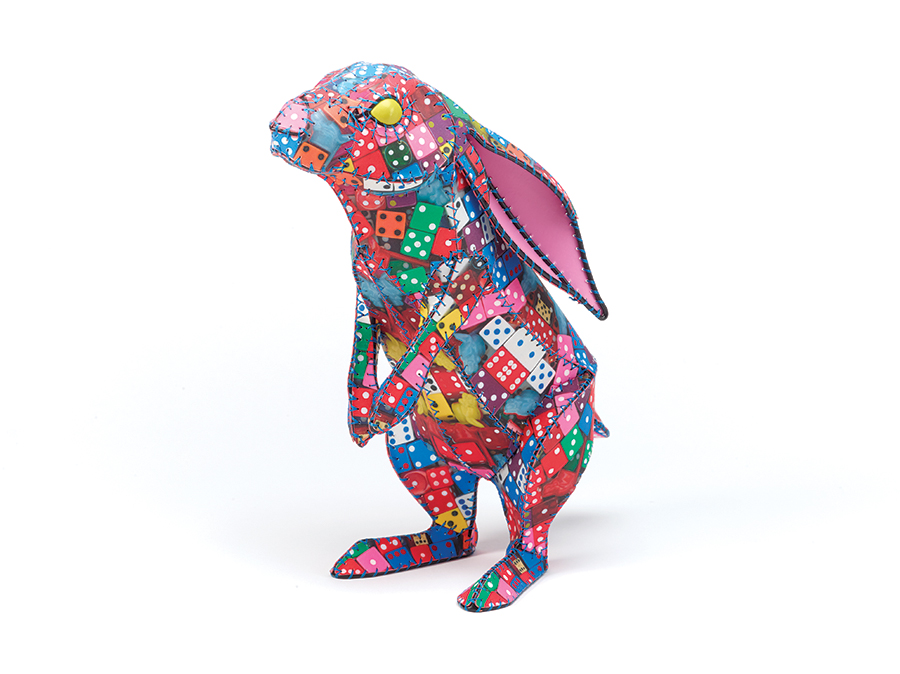
If you’ve seen any of Anne Lemanski’s cosmic, colorful animal sculptures in person, you know they look as if they might twitch, or pounce, or slink on by. The skins that cover them — psychedelic prints and unexpected patterns — somehow add to this unlikely effect. Perhaps her multicolored tiger, or her ocelot, or her amazing rabbit, has emerged through a looking-glass portal from some magical realm and wound up in our own?

You’re not far off.

Lemanski’s Spruce Pine studio is in fact an otherworldly laboratory of creation where she doesn’t just make an animal, she learns it inside out. She studies its physicality and psychology, figures out how its haunches tense when it sits back, how they loosen in a run, how its brow might scowl at distant prey. Then she replicates all of that with copper rods she bends, cuts and welds into a three-dimensional sculpture, an armature. In an upstairs made of shipping containers, another act of creation happens, guided not by realism but by intuition. Here, she will create a skin for that armature, make it out of digital photographs or prints or collage or all three, and print it on paper. She will draw and cut a pattern as if she were making a dress or a suit, and sew it all on, piece by piece, with artificial sinew. Her tools — wire cutters and an X-ACTO knife — are the same, simple ones she has used for 30 years. She has no assistants.

On a warm and wet spring weekend, Lemanski is learning mink. Her giant mastiff, Dill, sits nearby. Photographs of mink in every position and resolution surround her, filling a wall and every tab on her computer. She’s learning about what minks eat, how they’re bred for coats, about the recent killing of 17 million Covid-infected mink in Denmark. “Millions! I’m not exaggerating. I was horrified,” she says, shivering. The armatures for a few mink in different positions are underway; one is complete. She holds it in her hands. “Once the armature is done, that’s the most important part of capturing the animal,” she says. “I ripped this one apart like three times. And finally, one day, it just clicked.”

With the armature complete, Lemanski moves on to the mink’s skin, leaning into the collages that form a significant counterpart to her sculpture. Comprised of illustrated images from the pages of pre-1970s textbooks, comic books, picture books, and children’s encyclopedias, Lemanski uses her X-ACTO knife to combine, say, giant squid with convertible cars, pigeons with mermaids, skeletons with alphabet blocks, chewing gum with polar bears. There are butcher’s maps for cuts of meat and colored-dot tests for colorblindness, and constellations and cockatoos — a century’s worth of illustrations shaken and stirred into a cocktail of nature and man, science and myth, technology, geometry, and things that are cool. A series made during Covid, Metaphysical Mineral, explores the properties of a series of eight different minerals. Quartz includes a high diver in a ’50s-era swimsuit, a white stallion and a swarm of bees. Sulphur gets a winding snake, a stick of dynamite and a cigarette.

These individual component images are one of a kind and cannot be replicated; to do so would be to lose the unmistakable texture and character of the Ben-Day dots used in printing from the 1950s to the 1970s (made particularly recognizable by the pop artist Roy Lichtenstein). “I’ve tried [copying them], and it just doesn’t work,” she says. So when she uses these images in a collage, Lemanski tacks them down lightly with a little loop of tape so she can take them off and use them again. This technique also adds to the three-dimensional look of the collages once they’re printed.

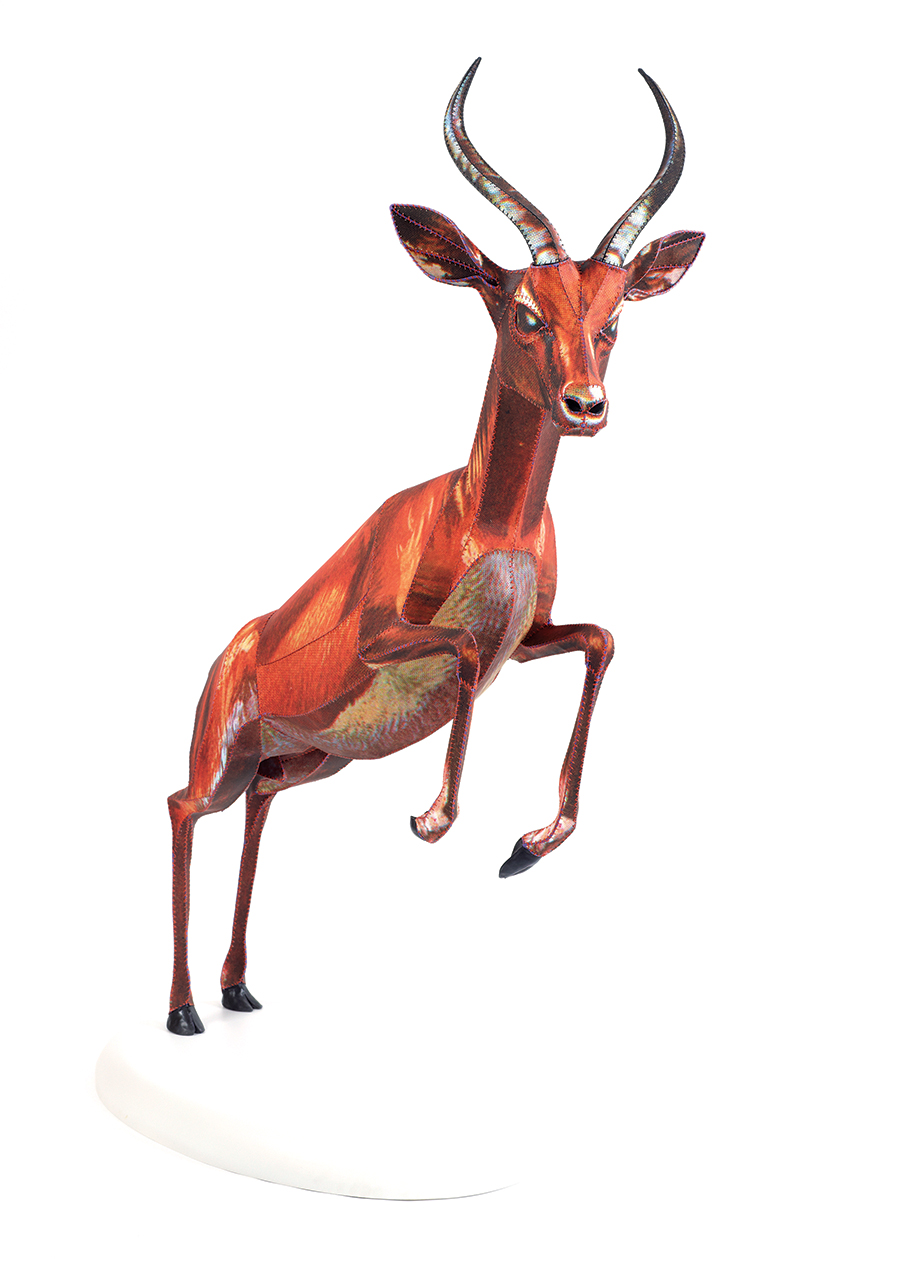
She credits a residency at Charlotte’s McColl Center with launching this kind of work. Inspired by the possibilities of the center’s large-format digital printer, she made 12 small collages and printed them in huge dimensions. These prints ended up forming the basis of a solo exhibition at the center that also included sculpture, in this instance a “three-dimensional collage” that incorporated some of the printed collage animals themselves. A 4-inch image of an impala in one print, for instance, became a life-sized impala sculpture in the center of the room that she “skinned,” in a meta twist, in digital prints of the tiny image’s own fur. “That was a challenging piece to make,” she says.

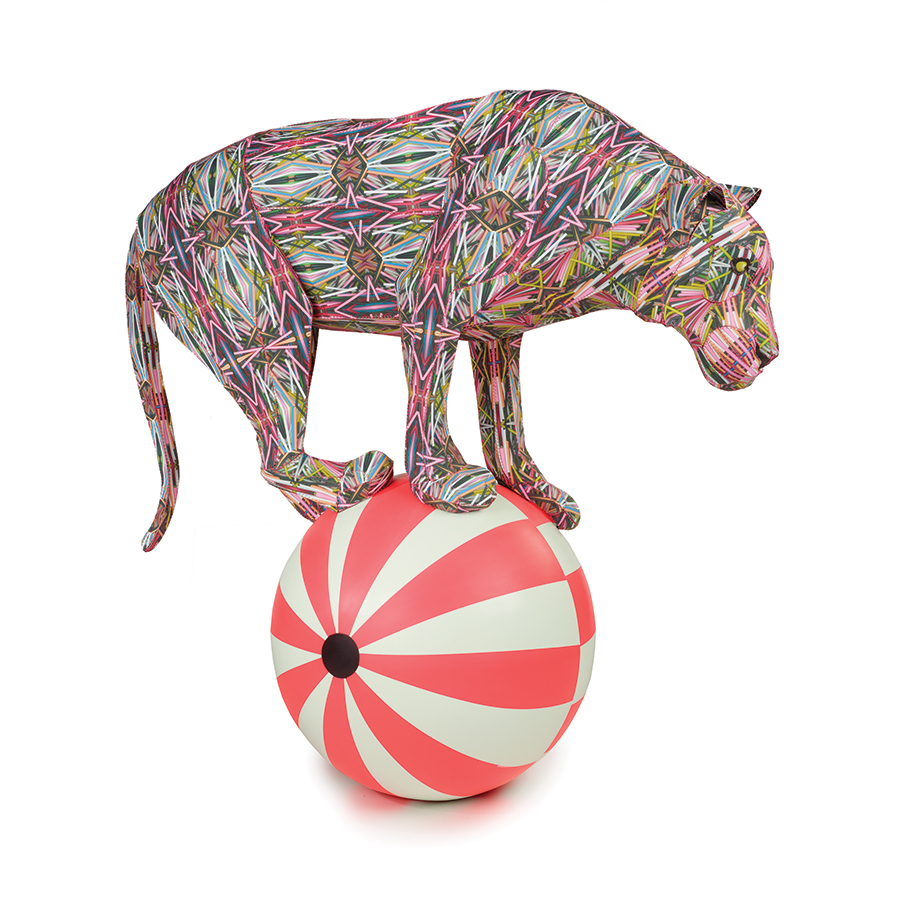
So was the Tigris T-1, a freestanding, life-size sculpture of a tiger balancing on a ball, that was acquired by noted collector Fleur Bresler for donation to Crystal Bridges Museum of American Art in Bentonville, Ark., a career-catapulting moment Lemanski is still pinching herself about. Her work is also in the permanent collections of The Mint Museum, the North Carolina Museum of Art, the Asheville Art Museum and in many private collections. It’s even found its way into wallpaper as part of a fanciful line of sly, butterfly-and-bird-bedecked prints made in Schumacher’s Peg Norris collection, a collaboration between Charlotte gallerist Chandra Johnson and interior designer Barrie Benson.

What’s next is what excites Lemanski most. Lately, she’s been working on an animal that’s captured her imagination for a while: a horse — a life-sized Appaloosa. “Who doesn’t love a horse?” she asks, as she works out the intricacies. “The hooves and ankles of a horse are extremely complex; they’re bulbous, they’re angular, and that’s where all the business happens.” Also in the hopper: her first piece of public, outdoor art — another large animal — to be cast in aluminum. It could mark the beginning of a whole new oeuvre.

“I really am looking forward to the work I’m going to make in the future,” Lemanski says. “I think it’s going to be on a large scale, and I just want to keep pushing the work forward… It’s the unknown of the future that keeps me going.”  PS

This is an excerpt from Liza Roberts forthcoming book Art of the State: Celebrating the Art of North Carolina, to be published by UNC Press this fall.

Bookshelf

April Books

FICTION

Search, by Michelle Huneven

Dana Potowski is a restaurant critic and food writer, and a longtime member of a progressive Unitarian Universalist congregation in Southern California. Just as she’s finishing the book tour for her latest bestseller, Dana is asked to join the church search committee for a new minister. Under pressure to find her next book idea, she agrees, and resolves to secretly pen a memoir, with recipes, about the experience. Search follows the travails of the committee and their candidates — and becomes its own media sensation. A wry and wise tale, the James Beard Award-winning author’s food writing and recipes add flavor to a delightful journey.

Lessons in Chemistry, by Bonnie Garmus

Meet Elizabeth Zott: a one-of-a-kind scientist in 1960s California whose career takes a detour when she becomes the star of a beloved TV cooking show. Zott is not your average woman. In fact, she would be the first to point out that there is no such thing as an average woman. Calvin Evans, her lonely, brilliant, Nobel Prize-nominated colleague falls in love with — of all things — her mind. True chemistry results. But like science, life is unpredictable. Zott finds herself not only a single mother, but the reluctant star of America’s most beloved cooking show, Supper at Six. Her unusual approach to cooking proves revolutionary, but as her following grows, not everyone is happy. Laugh-out-loud funny, this must-read debut novel is studded with a dazzling cast of supporting characters. Lessons in Chemistry is as original and vibrant as its protagonist.

Wingwalkers, by Taylor Brown 

One part epic adventure, one part love story, and one large part American history, Wingwalkers follows the adventures of Della and Zeno Marigold, a pair of Depression-era barnstormers who are funding their journey West by performing death-defying aerial stunts from town to town. When their paths cross with William Faulkner (a thwarted fighter pilot in real life) during a dramatic air show, there will be unexpected consequences for all. With scintillating prose and an action-packed plot, Brown captures the true essence of a bygone era, and sheds a new light on the heart and motivations of one of America’s greatest authors.

NONFICTION

Six Walks: In the Footsteps of Henry David Thoreau,
by Ben Shattuck

On an autumn morning in 1849, Henry David Thoreau stepped out his front door to walk the beaches of Cape Cod. Over a century and a half later, Ben Shattuck does the same. With little more than a loaf of bread, brick of cheese and a notebook, Shattuck sets out to retrace Thoreau’s path through the Cape’s outer beaches, from the elbow to Provincetown’s fingertip. This is the first of six journeys taken by Shattuck, each one inspired by a walk once taken by Thoreau. Along the way, he encounters unexpected characters, landscapes and stories, seeing for himself the restorative effects that walking can have on a dampened spirit. Intimate, entertaining and beautifully crafted, Six Walks is a tribute to the ways nature can inspire us all.

CHILDREN’S BOOKS

What’s Inside a Flower, by Rachel Ignotofsky

Not your ordinary boring science book, What’s Inside a Flower is an art book, a science book, and the book any budding wildlife biologist would want. Stunning illustrations teach not only parts of a flower but the ways they interact with the world. This is the perfect book to welcome spring. (Ages 8-12.)

Cat’s First Baby, by Natalie Nelson

This oh-so-cute newborn baby book is perfect for everyone whose first child was a furbaby. Adding the real thing can be tough for everyone, but shared nap times, snack times and playtimes can bring the whole new family together. (Ages birth-3.)

After the Buzz Comes the Bee, by Robie Rogge

With illustrations by the Caldecott honor-winning Rachel Isadora and a fun flip-the-flap format, After the Buzz Comes the Bee may be everyone’s new favorite animal book. Perfect for lap-time reading. (Ages 3-6.)

I’m Not Scared, You’re Scared,
by Seth Myers

Being big and furry doesn’t equate with being big and brave. That’s when it’s good to have a friend to help get you through the tough spots.  (Ages 3-7.)

Flames of Hope: Wings of Fire Book No. 15, by Tui T. Sutherland

Dedicated Wings of Fire series readers will be waiting at bookshop doors when this final book in the Lost Continent Prophecy Arc hits the shelves. (Ages 9-13.)  PS

Compiled by Kimberly Daniels Taws and Angie Tally.

Hot Trends

Spring
Forward

By Jason Oliver Nixon
and John Loecke

Green Goddess

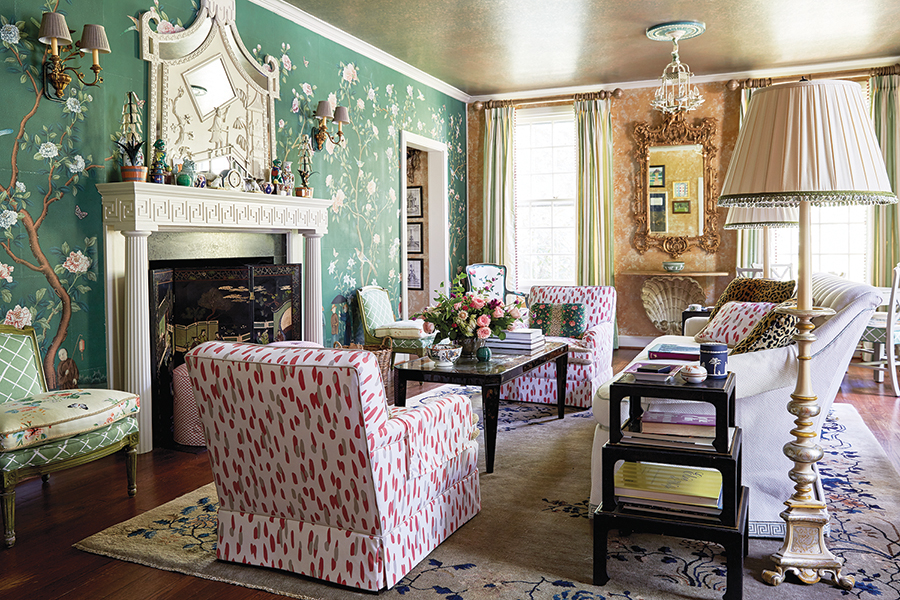
Gardening has had a massive resurgence since the pandemic began, so formerly forlorn front yards are displaying a newfound floral bounty. Trees have been trimmed, flowers are blooming blowzily, and stone masons have been busily crafting patios and terraces. But how to connect the interiors of your home with its glorious exterior? Bring the timeless, fresh charms of garden-plucked green hues within — whether in the form of paint, wallpaper, fabrics or rugs. As John says, “If it works in your yard, it will work in your home. And there’s no more cool, soothing neutral hue than green.” Think paint colors such as Soft Fern from Benjamin Moore and Dirty Martini from Clare, and fabrics such as Swans Island in Meadow Green from Madcap Cottage.

Leafy Luxe 

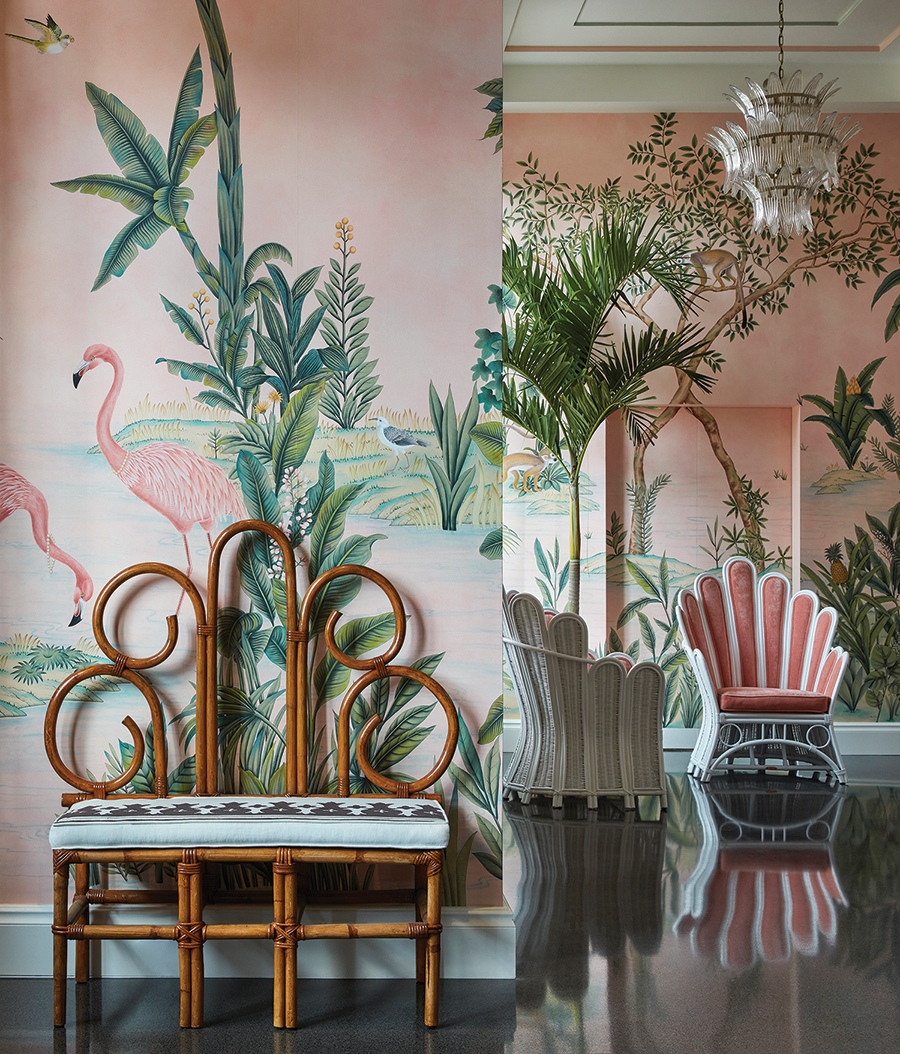
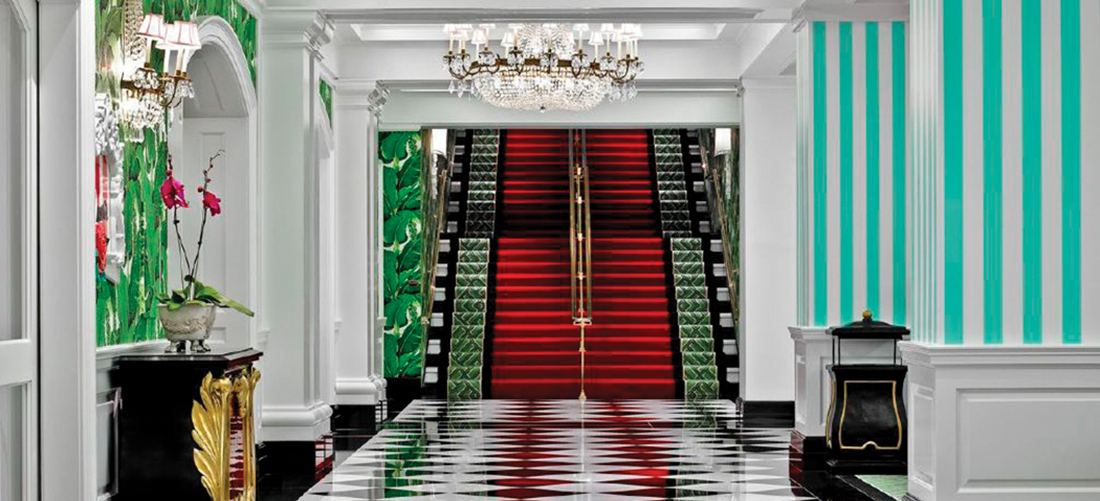
Palmy, balmy interiors — inspired by a mix of the Beverly Hills hotel paired with a jigger of The Greenbrier and Palm Beach’s Colony Hotel — are bursting into bloom. Think traveler palms reaching hither and yon upon wallpaper and lemon trees scampering across sofas. Says Liz Vaughn, a guiding force at Winston’s iconic Gazebo women’s retailer, “Gorgeous palm leaves march across the library at my home and have created a timeless vibe that is one part Dorothy Draper and another part classic escape. Stepping into this room is like taking a mini vacation, no plane tickets required. The color and scale of the grand palm print wallpaper absolutely dazzles our guests.”

Remarkable Rattan

Rattan is finally getting its moment in the sun after seemingly falling out of favor for a blip — but never at Madcap Cottage! And the woven furnishings are not just making star turns on covered porches but also in living rooms and other public spaces. Notes Morgan Cooper, the owner of the glamorous Hive, in Winston-Salem, “Our clients are loving reinterpreted rattan that boasts a dash of unexpected whimsy and wonder. This is definitely not your grandmother’s rattan. And it might be going into a master bedroom or bathroom — not just a sun porch.”

Prince of Chintz 

The pendulum always shifts, n’est-ce pas, so should you really have kept those clothes from the 1970s that made you look like Holly Hobbie to use as so-called “nap” dresses now? Rewind to the 1980s. That decade’s go-to textile, chintz, is having a big resurgence, too. “It’s not the highly polished chintz that we remember from Mario Buatta in 1987,” says John. “And we adored Mario. But today’s chintz is a bit more relaxed, less polished, and with more negative space. Perfect for a sofa or an armchair.”

Think Pink 

“Pink is such a wonderfully flattering hue,” says John. “A pink-hued room will literally take 10 years off your face. And pink can be both feminine and masculine, so the shade can really work in any room of our home — from a living room to master bedroom or bathroom.” Our go-to pink shades include Pink Ground from Farrow and Ball, Rachel Pink from Sherwin-Williams, and Dead Salmon, also from Farrow and Ball. P.S. Our most favorite escape of late is stunning, pink-toned Manor House Room 23 at the amazing Duncraig Manor and Gardens in Southern Pines. Is it the pink walls that leave us feeling so refreshed?
Heavy Metal 

We love using metallic finishes in home design schemes. But don’t think that we are referring to the old adage that “brass and glass equals class.” Think layered. Aged. Patina. Notes John, “Why not embrace metallics on a ceiling to bring light into a room that lacks luster? We often wallpaper ceilings with metallic finishes, and that gentle sparkle really brings a space to life.” A favorite is The Lost City of Silver from Phillip Jeffries — just heaven.

Tried and True 

Noted Winston-Salem landscape architect Jeff Allen turns to classic, timeless garden elements to craft his magical, cooling sanctuaries. Here’s his garden go-to cheat sheet:

1. Boxwoods: versatile, beautiful and sculptural. These classic bushes provide shape and style to any garden and pair well with everything. They can be structural or architectural or can be used as an accent. With regard to the blight, there are varieties that are disease resistant, and there are treatments available.

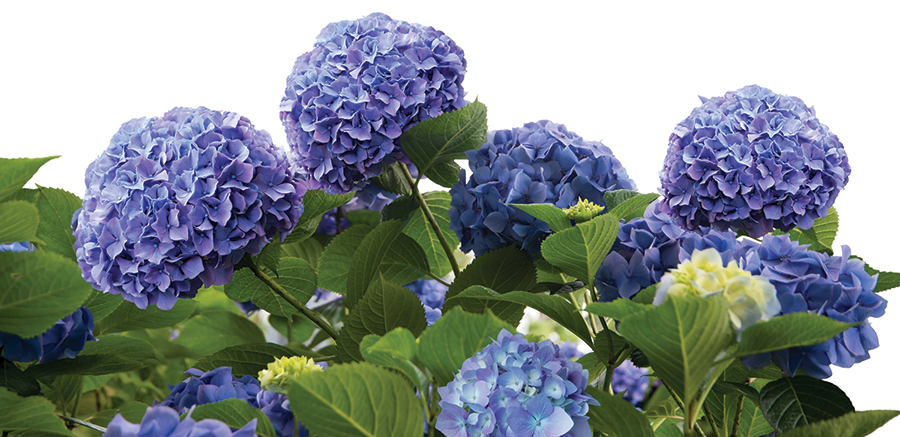
2. Hydrangeas: dynamic, colorful and dramatic. You can’t go wrong with large sweeps of hydrangeas for dramatic color. Underplant with bulbs to extend the bloom seasonally.

3. Pachysandra: my favorite groundcover. Used liberally in our landscape designs, pachysandra provides continuity with our planting compositions.

Fabulous Follies 

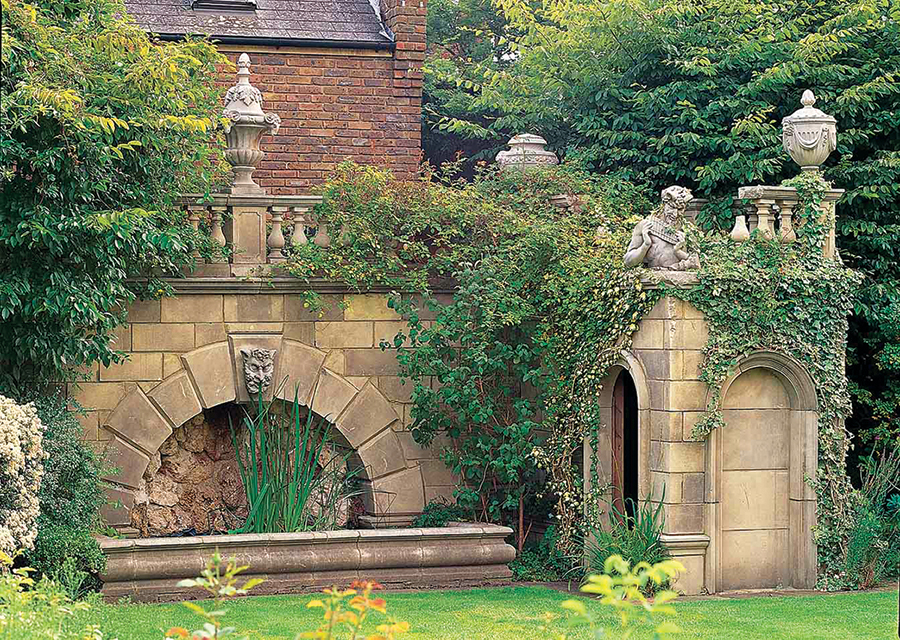
Ah, the great outdoors! But where to kick back and relax and sip a cool sauvignon blanc whilst shaded in splendor? Follies are all the rage in England, and these whimsical garden ornaments are quickly spilling across the pond. Think whimsical temples adorned with columns and plenty of space upon which to toss back on a daybed with book and hooch. Turn to Haddonstone, the England-based cast-stone manufacturer, for whimsical creations that range from temples to pavilions, pergolas and more. Plus, Haddonstone has a U.S.-based arm, so that makes the logistical bits all that much easier.

RUIN_1

Make an Entrance 

As we all paused over the past two, gulp, years, we turned our attention to fixing up our homes and addressed areas that had perhaps been long overlooked. One such space that has been a focal point for our clients has been the foyer. Says Anne Rainey Rokahr, the charismatic owner of Winston-Salem’s Trouvaille Home, “The feeling one creates in the foyer sets the tone for the entire house and should therefore never be an afterthought and definitely not a family drop zone. Even if the rest of the house looks a little messy the foyer should always be pristine. And the foyer is the spot to go grand. Pair a spectacular chandelier (always on a dimmer), a one-of-a-kind chest, and a large mirror with a couple of yards of a fine fabric, and you’re on your way!”  PS

Jason Oliver Nixon and John Loecke are the duo behind Thomasville-based Madcap Cottage.