Bookshelf

BOOKSHELF

September Books

FICTION

Amazing Grace Adams, by Fran Littlewood

Grace Adams gave birth, blinked, and now suddenly she is 45, perimenopausal and stalled — the unhappiest age you can be, according to the Guardian. And today she’s really losing it. Stuck in traffic, she finally has had enough. To the astonishment of everyone, Grace gets out of her car and simply walks away. She sets off across London, armed with a £200 cake, to win back her estranged teenage daughter on her 16th birthday. Because today is the day she’ll remind her daughter that no matter how far we fall, we can always get back up again. Because Grace Adams used to be amazing. Her husband thought so. Her daughter thought so. Even Grace thought so. But everyone seems to have forgotten. Grace is about to remind them . . . and, most importantly herself.

Bright Lights, Big Christmas, by Mary Kay Andrews

From the New York Times bestselling author of The Santa Suit comes a novella celebrating the magic of Christmas and second chances. Newly single and unemployed, Kerry Tolliver needs a second chance. When she moves back home to her family’s Christmas tree farm in North Carolina, she is guilt-tripped into helping her brother, Murphy, sell trees in New York City. She begrudgingly agrees, but she isn’t happy about sharing a trailer with her brother in the East Village for two months. Plus, it’s been years, since before her parents’ divorce, that she’s been to the city to sell Christmas trees. Then, Kerry meets Patrick, the annoying Mercedes owner who parked in her spot for the first two days. Patrick is recently divorced, father to a 6-year-old son, and lives in the neighborhood. Can Kerry’s first impressions about the recently divorced, single father and — dare she say, handsome — neighbor be wrong?

The Fall of Ruin and Wrath, by Jennifer L. Armentrout

Long ago, the world was destroyed by gods. Only nine cities were spared. Separated by vast wilderness teeming with monsters and unimaginable dangers, each city is now ruled by a guardian — royalty who feed on mortal pleasure. Born with an intuition that never fails, Calista knows her talents are of great value to the power-hungry of the world, so she lives hidden as a courtesan of the Baron of Archwood. In exchange for his protection, she grants him information. When her intuition leads her to save a traveling prince in dire trouble, the voice inside her blazes with warning — and promise. Today he’ll bring her joy. One day he’ll be her doom. But the city simmers with rebellion, and with knights and monsters at her city gates, and a hungry prince in her bed, intuition may not be enough to keep her safe.

The Vaster Wilds, by Lauren Groff

A servant girl escapes from a Colonial settlement in the wilderness, carrying nothing with her but her wits, a few possessions, and the spark of God that burns hot within her. What she finds will bend her belief of everything that her own civilization has taught her. At once a thrilling adventure story and a penetrating fable, The Vaster Wilds is a work of raw and prophetic power that tells the story of America in miniature, through one girl at a hinge point in history, to ask how — and if — we can adapt quickly enough to save ourselves.

NONFICTION

The Six: The Untold Story of America’s First Women Astronauts, by Loren Grush

When NASA sent astronauts to the moon in the 1960s and 1970s the agency excluded women from the corps, arguing that only military test pilots — a group then made up exclusively of men — had the right stuff. It was an era in which women were steered away from jobs in science and deemed unqualified for space flight. Eventually, though, NASA recognized its mistake and opened the application process to a wider array of hopefuls, regardless of race or gender. From a candidate pool of 8,000, six elite women were selected in 1978 — Sally Ride, Judy Resnik, Anna Fisher, Kathy Sullivan, Shannon Lucid and Rhea Seddon. The Six shows these brilliant and courageous women enduring claustrophobic — and sometimes deeply sexist — media attention, undergoing rigorous survival training, and preparing for years to take multi-million-dollar payloads into orbit aboard the Space Shuttle. Together, they helped build the tools that made the space program run. One of the group, Judy Resnik, sacrificed her life when the Space Shuttle Challenger exploded at 46,000 feet. Everyone knows of Sally Ride’s history-making first space ride, but each of the six would make their mark.


CHILDREN’S BOOKS

My First Lift-the-Flap Nursery Rhymes, art by Ingela P. Arrhenius

Just what does the Itsy Bitsy Spider do when the sun comes out? Find out this and much more in this retro-cool, lift-the-flap collection of classic nursery rhymes that also includes QR codes for sing-along recordings. The perfect gift for any new baby. (Ages birth-3.)

Who Works at Night?, by Peter Arrhenius

A number of community-helper books feature police officers, firefighters and garbage collectors. In Who Works at Night? some less-seen nighttime helpers get their day in the sun. Road construction workers, night drivers and doctors are just a few of the jobs featured in this fun lift-the-flap title that’s perfect for preschool classrooms. (Ages 3-6.)

The Lost Library, by Rebecca Stead and Wendy Mass

When 11-year-old Evan discovers a little free library that has mysteriously appeared in his town — the physical library burned to the ground years ago — he begins to investigate with no idea that two weathered books will completely upend his entire world. Narrated by a massive orange cat and an omnipresent ghost librarian, this is a story every book lover will devour. (Ages 8-12.)

Wicked Wild Poems of the Pine Tree State, by Diane Lang

From salamanders to seagulls and every tree, bush and animal in between, these poems celebrate the familiar wild living things we cherish from the Maine woods to the craggy windswept coastline. From pelicans to porcupines, blueberries to bears, dragonflies to deer, Maine holds gems of nature that are beautiful and rare. Turn a page and come inside — they’re waiting for you here! (Ages 7-18.)  PS

Compiled by Kimberly Daniels Taws and Angie Tally.

Poem September 2023

POEM SEPTEMBER 2023

Lines to a Toad in a Rose Garden

You’re all eyes,

even on the back of your head

and warty as a road.

Brown as the ground

beneath roses.

Roses red as song,

pink as a whistle,

yellow as whiskey

and white as wishes.

The air

is all roses

breathing, their petals open

to God and glory and whatever good

comes winging this day.

But Toad is bugging.

He’s good at his job; fast and careful.

On time and off, he sees upward,

past roses to his calling 

and takes it all

in Toad’s time.

— Ruth Moose

Ruth Moose’s most recent book is The Goings on at Glen Arbor Acre.

Simple Life

SIMPLE LIFE

Squirrelly Business

A seedy family of rodents drives an old dude nuts

By Jim Dodson

Another summer is ending.

And once again, the squirrels have won.

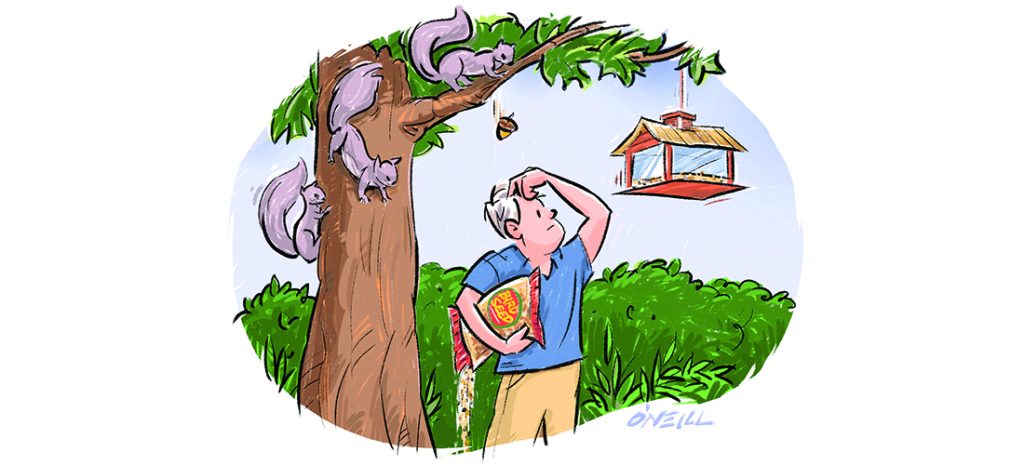
Last year about this time, you see, I made a promise to myself — not to mention the many wild birds that regularly visit our four hanging feeders — to find a way to outfox the large crime family of gray squirrels that inhabits Old George, the handsome maple tree that anchors our front yard.

The problem began rather innocently six years ago when we moved back to the heavily forested neighborhood where I grew up and rescued George from death by English ivy. The old tree flourished and, one afternoon, I noticed a couple gray squirrels had taken up residence in a hollow nook halfway up the tree. They seemed to be a respectable couple, perhaps elderly pensioners looking for a nice place to tuck in for their quiet retirement years. Our property is also home to several towering oaks, so come autumn there would be a plentiful acorn supply.

I hung a couple bird feeders by wires from George’s upper branches. Soon the wild birds were all over them. What a peaceable kingdom it seemed.

The next spring, however, there were four squirrels residing on Old George. Clearly, they were no elderly pensioners, for within months, two baby squirrels appeared and I found a juvenile delinquent regularly helping himself to premium birdseed, scattering it on the ground below the feeder, having somehow slid down the 10-foot wire like a paid assassin from a Bond flick.

He soon returned with two bushy-tailed pals from across the street. Word was out. Party at the Dodson house, all-you-can eat birdseed buffet, pay no attention to the old dude waving his arms and shouting obscenities.

By the next year there were at least seven or eight tree squirrels residing on Old George, a budding Corleone family of furry rodents regularly raiding the feeders, costing me a bundle just to keep them filled up. I bought expensive “squirrel-free” feeders and fancy bird feeder poles equipped with “baffles” guaranteed to keep the gymnastic raiders on the ground. These sure-fire remedies, alas, only baffled me because they posed only a minor challenge to the squirrels. So I made a deal with the big fat squirrel that seemed to be the head of the family. Whatever they found on the ground at the feet of Old George was theirs to keep. Thanks to the jays, the sloppiest eaters in the bird kingdom, there was plenty of seed for them to gorge on. For a while, this protection racket seemed to work until one afternoon as I was filling up “their” feeder, I heard a pop and turned to find the big fat crime boss squirrel dead on the ground. He’d been pushed off a high limb where two younger squirrels were looking down with innocent beady-eyed stares. Just like in the movies, a younger more ambitious crime boss was in charge.

I considered giving up and moving to northern Scotland. Instead, I asked my neighbor, Miriam, a crack gardener and bird fancier, how she handled pesky squirrels. By “crack gardener,” I don’t mean to suggest that sweet elderly Miriam was growing crack cocaine, merely that if anyone could tell me how to stem the tide of ravenous tree squirrels it was Miriam. She’d lived in the neighborhood for 40 years. She is my turn-to garden and bird guru.

Miriam thought for a moment before coming out with a chilling laugh. “They’re impossible to stop.” She pointed to her Jack Russells. “That’s why I have Jake and Spencer. They do a pretty decent job on the squirrels and chipmunks.” She admitted that she always wondered whether squirrels are the smartest or dumbest of God’s creatures. “How can squirrels be so smart they can get into any kind of bird feeder — but always stop suicidally in the middle of the street whenever a car is coming?”

It was a good question I had no time to ponder.

Our other neighbors down the block, Miriam explained, had taken to humanely trapping their squirrels and releasing them in the countryside. “But I read somewhere that if you don’t take them more than 10 miles out of town, they’ll come straight back.”

That was all I needed — country cousins joining the feast.

Next, remembering my former neighbor, Max, I actually gave thought to arming myself with a Daisy BB gun. It’s right there in the second amendment, after all — the right to bear arms against unreasonable threats from hostile elements, both domestic and foreign. True, the Constitution doesn’t mention thieving gray tree squirrels per se, but one doesn’t have to be a strict constitutional originalist to interpret the broad meaning of those historic words.

Max was my neighbor down in Southern Pines, a fabulous gardener famous for his giant tomatoes, succulent sweet corn and luscious collards. To protect his bounty from the herds of deer that roam the Sandhills, Max essentially erected a Russian-style penal colony around his veggie garden, complete with electrical voltage and 24-hour monitoring system.

The first evening I dined with Max and his beautiful wife, Myrtis, as the salt and pepper came my way on the lazy Susan, I noticed a large jar of Taster’s Choice — circa 1976 — festooned with several sheets of notepaper attached by rubber bands. The sheets were covered with dozens of dates written in tiny, neat handwriting.

“What are these dates?” I asked. “The last time you tried really old instant coffee?”

Myrtis laughed. “Oh, no. Those are dates of Max’s squirrel kills. He shoots them.”

Max just smiled. “Haven’t had a squirrel problem in years. It’s either them or my vegetables.”

I was in the presence of evil genius, a terminator of problem squirrels.

Call me a tree-hugging man of peace — Rocky and Bullwinkle were my favorite childhood cartoon characters — but I decided to forgo the gun and simply rely on Miss Miriam’s way to put the fear into the furry crime family that inhabits Old George.

Nowadays I wait until I see them climbing up poles, dangling upside down to feed or diving insanely from tree limbs onto our feeders, whereupon I strategically release our 75-pound Staffordshire pit bull and fleet-footed border collie-spaniel puppy and watch the merry chase begin. There’s been more than one narrow escape and parts of furry tails have been brought back to master of the hounds.

True, it’s not a permanent solution to the problem. But for now, Gracie and Winnie enjoy the exercise and I am sending an unmistakable message to the squirrelly Corleones.

They’d best stay out of the middle of the road when this old dude is at the wheel.  PS

Jim Dodson is the founding editor of O.Henry.

Tea Leaf Astrologer

TEA LEAF ASTROLOGER

Virgo

(August 3 – September )

While there’s a part of you that longs to feel understood, let’s be honest: Your deadpan nature thrills you to your overly guarded core. Following a messy few weeks of Mercury stationed retrograde in your sign, you’ll have a rare opportunity to turn your hawklike perception inward. Don’t be afraid to examine your own motives. Are you overcompensating for something? Keep looking. You may be surprised by what you see.

Tea leaf “fortunes” for the rest of you:

Libra (September 23 – October 22)

Consult an expert.

Scorpio (October 23 – November 21)

Don’t spill all the tea at once.

Sagittarius (November 22 – December 21)

You’re in the cabbage again.

Capricorn (December 22 – January 19)

Take a bold first step.

Aquarius (January 20 – February 18)

Be the stranger you wish to see in the world.

Pisces (February 19 – March 20)

Mind the pit when you bite down.

Aries (March 21 – April 19) 

Don’t settle for the sideline.

Taurus (April 20 – May 20)

Ever heard of feng shui? Prove it.

Gemini (May 21 – June 20)

Resist the pumpkin spice.

Cancer (June 21 – July 22)

Trust your inner rumblings.

Leo (July 23 – August 22)

Three words: ice cream sundae.    PS

Zora Stellanova has been divining with tea leaves since Game of Thrones’ Starbucks cup mishap of 2019. While she’s not exactly a medium, she’s far from average. She lives in the N.C. foothills with her Sphynx cat, Lyla. 

Almanac September 2023

ALMANAC SEPTEMBER 2023

September is the last stand of sunflowers — thick with bumbles and honeys — wistfully facing east.

Sown in the softest days of summer, when early berries fairly tumbled from their vines, the seeds of these yellow giants held more than plumule and root. They held the glory of summer, a timeless cure-all, the warmth and likeness of the sun.

Weeks after their shoots burst through fertile earth, the sunflowers whispered patience. Ever reaching toward the light, their stalks grew tall and sturdy; their rough leaves wide as open palms. Soon, the buds emerged — tidy cinch purses as splendid as stars — holding their treasures tight.

Summer burst in all directions. Cicadas emerged screaming. Queen Anne laced meadows and roadsides. Thistle and clover reigned supreme.

Butterflies teetered on purple coneflowers, feasted on milkweed, drifted among sage, sedum and hibiscus.

At last, when early giants withered on their fibrous stalks, the luminous beauties unfurled.

Summer fades. And yet, the last wave of sunflowers beams.

Here now, they sing.

The bees know, sharing communion at their golden centers. Whirling in ecstasy. Humming an ancient prayer for grace.

We know, too. We hold tight to summer — let it transform us — then wistfully look toward the autumn sun.


New beginnings are often disguised as painful endings.   — Lao Tzu


The Thick of It

Muscadine season is here at last.

Hypnotically sweet, this native grape thrives in the sticky heat of our Southeastern states, ripening from late August through early October. Ranging in color from greenish bronze (we call them scuppernongs) to deep purple, this thick-skinned whopper (Vitis rotundifolia) is the official fruit of North Carolina.

Muscadine wine. Muscadine jelly. Muscadine grape hull pie.

For some, muscadines by the handful take the cake.

According to the State Library of North Carolina’s online encyclopedia, early English explorers of the Outer Banks reported that this fruiting vine “covered every shrub and climbed the tops of high cedars.” This was 1584. Italian explorer Giovanni da Verrazzano wrote about the curious “white” grape some 60 years prior.

Perhaps you’ve heard of the half-acre “Mother Vine” in Manteo, now over 400 years old? Planted by Croatan Native Americans or, perhaps, settlers of the Lost Colony, this legendary scuppernong is the oldest known cultivated grape vine in the country. It’s aging, no doubt, like a fine, sweet wine. 


Crisscross Equinox

Apples blush. Whippoorwill sings his final song. Things end and things begin.

The autumnal equinox occurs on Saturday, September 23. As the turn of the season graces us with equal amounts of day and night, we prepare for the final harvest. We celebrate the abundance here now, soak up the remnants of summer, and ready ourselves for the darkening days. PS

Birdwatch

BIRDWATCH

Straying Inland

The great egret pays a visit

By Susan Campbell

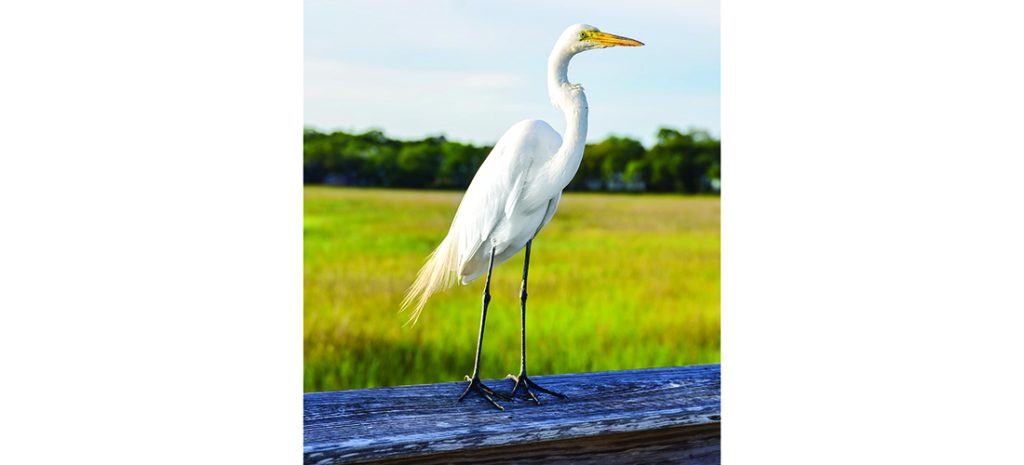
’Tis the season of odd sightings: Birds are wandering in all directions. After breeding and ahead of fall migration, it is not uncommon to spot out-of-place individuals here in central North Carolina. One that gets reported annually is the great egret, or mistakenly referred to as a “white crane.” This is a large wading bird with all-white plumage, a long, pointed, bright yellow bill and black legs.

Although far more likely to be found along the coast, individuals or small groups turn up on inland ponds from late July through September. Egrets stalk small fish, frogs, crayfish and other small prey in the shallows. Occasionally they will snatch a snake, small bird or large insect as well. They will roost in thick, older pines over water, where ground predators are not likely to reach them. In coastal areas, they may join dozens or even hundreds of other individuals, finding safety in numbers.

During the breeding season, from March through June, great egrets sport long plumes along their backs. At the turn of the century, the species was nearly wiped out as a result of the millinery trade. Plume hunters decimated rookeries throughout the coastal United States. But, as with most of our wading species, great egrets have made a good recovery. On the verge of extinction, they became the symbol of the National Audubon Society, the oldest and largest bird conservation organization in the United States, originally founded to protect birds from being killed for their feathers.

Great egrets are found in heronries, most often alongside great blue herons, throughout the Coastal Plain. Nesting habitat consists of sturdy trees usually on islands, free of mammalian predators. Simple stick platforms are constructed by the males and placed high in the canopy. Nests can be quite large, being up to a few feet across and a foot or so deep. One to six eggs are laid and incubated for almost four weeks by the female. The young are then fed by both parents for about a month before they are capable of flight. If there is a shortage of food, aggressive larger siblings are known to kill smaller ones. Fledglings may follow their parents for a few weeks or may become independent quickly, if food resources are scarce.

Both great egret adults and young of the year will disperse from their breeding areas to find new feeding areas. They are often seen in late summer on inland lakes, even in our mountain counties. In our area, they may use lakes, beaver ponds, creek or river floodplains, even water hazards on golf courses. They do not tend to stay in one place for very long so, should you come upon an egret this season, enjoy it because it likely will not be around more than a few hours — a day or two at most.   PS

Susan Campbell would love to receive your wildlife sightings and photographs at susan@ncaves.com.

Southwords

SOUTHWORDS

Fall Follies

By Jim Moriarty

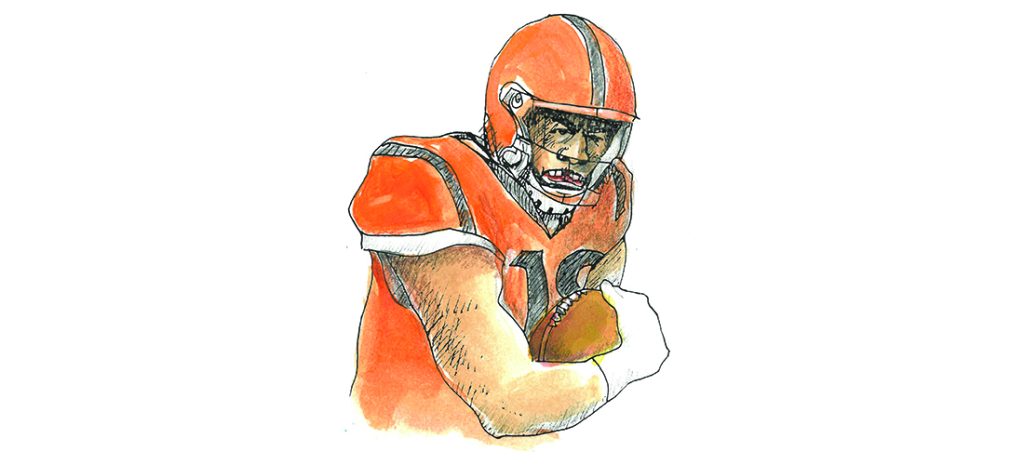
Are you ready for some football? The question is rhetorical, of course. Until February it will be our reality.

I spent roughly two decades working for the Sports Information Department of Clemson University photographing the home football games. It was a lovely change of pace for me every fall, going from the relatively docile game of golf to the kinetic violence of football.

One year I was given permission to bring my son down on the field with me. He was 11 or so at the time, and I promised I’d keep him behind the bench when the game started. It’s easy to get hurt down there if you don’t have your head on a swivel, and few 11-year-olds do.

When the Clemson team came out for warmups, it came in waves. First the kickers; then the speed guys and quarterbacks; then the linebackers. The last guys to leave the locker room were the big uglies, as Hall of Fame broadcaster Keith Jackson liked to call them. At the time Chester McGlockton, who went to four Pro Bowls during his NFL career and would pass away from an enlarged heart at the age of 42, was playing for the Tigers. I told my son to watch for No. 91, the biggest human being I’d ever seen, bigger even than William Perry — though Chester might only nip the Refrigerator by an inch and an ounce. My son and I stood together as the water buffalos plodded down the sideline into Death Valley. McGlockton’s playing weight was somewhere north of a Toyota Land Cruiser, and his thighs looked as big around as 55-gallon drums. My son’s eyes got as large as Moon Pies.

Clemson wasn’t my first experience with big-time football. In the early ’70s, recently graduated from a little hippie college in Ohio, I somehow acquired a job writing sports for the South Bend Tribune. To say that football at my alma mater was not a matter of great significance would be like saying Halloween is something of a lesser holiday in Outer Mongolia.

My sports editor saw fit to have my name added to the list of journalists allowed to watch Notre Dame football practices. Notre Dame had won the national championship the previous year, beating the University of Alabama in the Sugar Bowl 24-23, and I thought I should stick my head in and have a look at what everyone was raving about.

It would be Ara Parseghian’s last year as Notre Dame’s football coach. My boss, Joe Doyle, who I came to love like a father, had a particularly close relationship with Ara. They would have breakfast one-on-one every Monday morning in the fall. Joe liked to tease Ara that he shouldn’t count the four times he beat Notre Dame while he was the coach at Northwestern University among his career victories, to which Ara would respond, “Without those, I’m not here.”

Just as Clemson had a particular way they came out on the field, so did the Irish. Parseghian had a tall tower mounted on the back of an old jalopy pickup truck, and the team began each day by pushing Ara’s tower out to whatever far field they were practicing on.

The first day I cleared customs and was allowed inside the fenced and curtained practice area, the team was on the far field. To get there I had to cross the artificial turf field, obviously used for weeks when they’d be playing on that surface. Fresh from my hippie college, I’d never seen nor touched artificial turf. Any previous knowledge I might have had about it would have echoed Boston Red Sox pitcher Bill “Spaceman” Lee’s who, when asked whether he preferred grass or artificial turf, replied, “I don’t know. I never smoked artificial turf.”

Anyway, the feel of it under my feet was a new, and not entirely unpleasant, sensation. When I was about halfway across the plastic grass, the heavens screamed down on me. “Moriarty!!!! What the (profound expletive) are you doing????” It was Ara. And he was not amused. And his voice didn’t need artificial amplification. My first time on carpet and I was called on it. Blood drained from my face. I was trapped. Do I go forward? Do I go back? I elected to press on, getting off the artificial surface as if my feet were on fire.

Unbeknown to me, Notre Dame had a sixth or seventh or eighth string quarterback named Moriarty. It was this distant family member who had somehow invoked the ire of one of Notre Dame’s greatest coaches. I was off the hook that day, but that voice still scares the hell out of me.  PS

Jim Moriarty is the editor of PineStraw and can be reached at jjmpinestraw@gmail.com.

Golftown Journal

GOLFTOWN JOURNAL

Eight Ball

Reinvigorating a tribute

By Lee Pace

In recent years the buzz about the Pinehurst Resort has swirled around the world-renowned No. 2 course and its designation as an “anchor site” for our national golf championship. The spotlight has shown as well on the No. 4 course, which was given a significant makeover by Gil Hanse in 2018, and the accompanying launch of the uber-popular Cradle short course. And then in early 2023, news broke that Tom Doak was building course No. 10 on land 3 miles south of the resort with a spring 2024 christening.

Lost in the shuffle has been the No. 8 course, which was built in 1995 and opened the following year as a centennial tribute to Pinehurst having been open for exactly one century.

“No. 8 is the crowning glory for us,” said Pat Corso, the resort president and CEO at the time. “We considered the various things we could do to celebrate our centennial. We thought of the Jubilee Course at St. Andrews and said, ‘Why not build a golf course?’ We needed another golf course.”

Resort owner Robert Dedman Sr. called Tom Fazio in April 1995 to ask if he’d design the course. Fazio happened to be at the Masters in Augusta, Georgia, when he phoned his office for messages.

“This was when they still had the bank of pay phones outside the clubhouse,” Fazio said. “It was before cellphones. I had a note to call Bob Dedman. I called him, and he asked if I’d be interested in designing No. 8. I was sitting there in one of the great places in golf, Augusta National, and got a call to do a course in another great place in golf, Pinehurst. It was like I had won the Masters. It was a great feeling.”

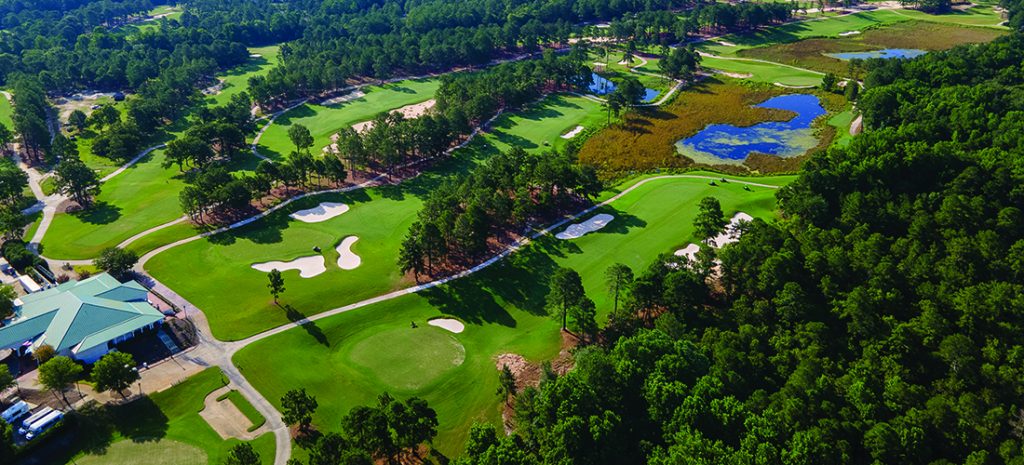
Fazio was given just over 400 acres of land punctuated by stark elevation changes, pine forests and wetlands located a mile-and-a-half north of the village of Pinehurst. The course was envisioned to cater to the resort golfer with a private club experience distanced from the masses of the five-course resort core. Six months after that first phone call, Fazio was standing on what would become the seventh fairway during one of his regular site visits from his home in Hendersonville, North Carolina.

“There’s a variety of changes in yardages, visuals, ups-and-downs,” Fazio said. “The par-3s are varied. You’ve got a flat par-5 in the second hole and then the sixth is uphill with a strong slope from right to left. There are strong par-4s, easier par-4s.

“The wonderful thing is, you come to every hole and say, ‘This is different.’”

The golf marketplace certainly agreed with Fazio. In Golf Digest’s 2011-12 listing of America’s 100 Greatest Public Courses, it was ranked No. 68. But the course lost some of its luster over time, prompting resort officials in 2019 to consult with Fazio and the associate designer who worked on the course originally, Blake Bickford, on ideas to tweak the experience. If nothing else, a course with a quarter of a century on it needed a thorough agronomic spring cleaning.

“Our first thought was to tie it into the 25-year anniversary,” said Bob Farren, Pinehurst’s director of golf course and grounds management. “But COVID shut that idea down. After No. 4 opened and was so well-received, we needed to give No. 8 a boost to keep it as the third big draw with No. 2 and No. 4. Tom and Blake took a look and said they were confident the design was still there.”

The course closed for the summer of 2022, and the work was handled in-house. More than a hundred trees were removed to allow sunlight and airflow, and now from the clubhouse veranda overlooking the back nine, the visuals open up to the 12th and 13th holes half a mile away. Thatch and organic matter were removed from the tees and fairways with a technique called “fraise mowing” to improve drainage and bounce. The bunkers were rebuilt and the greens planted with TifEagle bermuda grass, with some of the crowns in the center of greens softened after years of buildup from top-dressing.

“The fairways are firmer and drain so much better,” Farren said. “We were having too many cart-path-only days with the drainage system being 25 years old. The course now plays firm and fast, just as it was designed. The vistas have been opened up, and that’s a dramatic difference.”

The clubhouse was remodeled as well, most notably with an enlarged and enhanced dining and bar area. Walk in the front door and a new walnut bar sits straight ahead with a glass window behind, opening up the long-range views of the back nine. 

“We wanted to capture the view of the golf course upon entry,” said Calvin Buckley, Pinehurst’s director of projects and planning. “When you walk in, you have a sense of place. It’s a place people want to gather and be communal and look out over the golf course. It’s a nice center point.”

Another initiative on the horizon is the proposed ground-breaking in early 2024 of resort housing — cottages with four and/or eight bedrooms situated between the ninth and 10th fairways. They would have the distinction of being Pinehurst’s first and only resort-owned rooms directly on a golf course.

The challenge and intrigue of the original Fazio design are intact, only now embellished. There is still the dicey demand to hit approach shots with wedges off downhill lies on the first and seventh holes. It’s uphill into the green on three, downhill off the tee on four, a properly aimed shot with a draw apt to catch the speed slot and carom far down the fairway. There is the puzzle of the long par-5 sixth, with its double-dogleg and canted fairway. There is the riddle of how much marsh to clip off in aiming your tee shot on the par-4 13th. You still need a bazooka to pound your approach uphill on the par-4 18th.

Four and nine are parallel par-4s carved out of open fields that once were the shooting range of the Pinehurst Gun Club. Wire grass and native vegetation dot the hardpan sand between the parallel fairways, turning what Fazio felt was the worst aesthetic feature of the course at the beginning into one of its highlights. Later, 12 through 15 skirt an old pit and then connect with a freshwater marsh. Seventeen is a long-hitter’s and gambler’s delight — a 487-yard par 5, downhill, with a small lake front-right of the green. Two good shots might get you home; a good drive and bad approach might leave you in the drink.

“Every hole you come to, there are options,” Fazio said.

Because there is no real estate, the course is relatively compact, with little distance between greens and tees. It’s an excellent course to walk.

“It’s rare today to get the land and place the golf course first,” Fazio said. “That really makes this project special.”

“At No. 8, it’s just golf,” added Matt Barksdale, Pinehurst’s director of golf. “It’s just so peaceful, calm and tranquil.”

The Pinehurst storyline over the next year will justifiably revolve around the resort core and the 2024 U.S. Open on No. 2, and the opening of No. 10 in the springtime. But thanks to Tom Fazio’s design acumen in 1995 and a course and facility refreshening a quarter of a century later, No. 8 will quietly go about its business of being a terrific round of golf and a pleasant change of pace.  PS

Chapel Hill based writer Lee Pace has written extensively about Pinehurst since the late 1980s and has authored a half dozen books on Sandhills area golf. Write him at leepace7@gmail.com and follow him @leepacetweet. 

Three Decades of Soothing Sounds

THREE DECADES OF SOOTHING SOUNDS

The interactive gardens of Star Ridge Aquatics

By Amberly Glitz Weber   •   Photographs by John Gessner


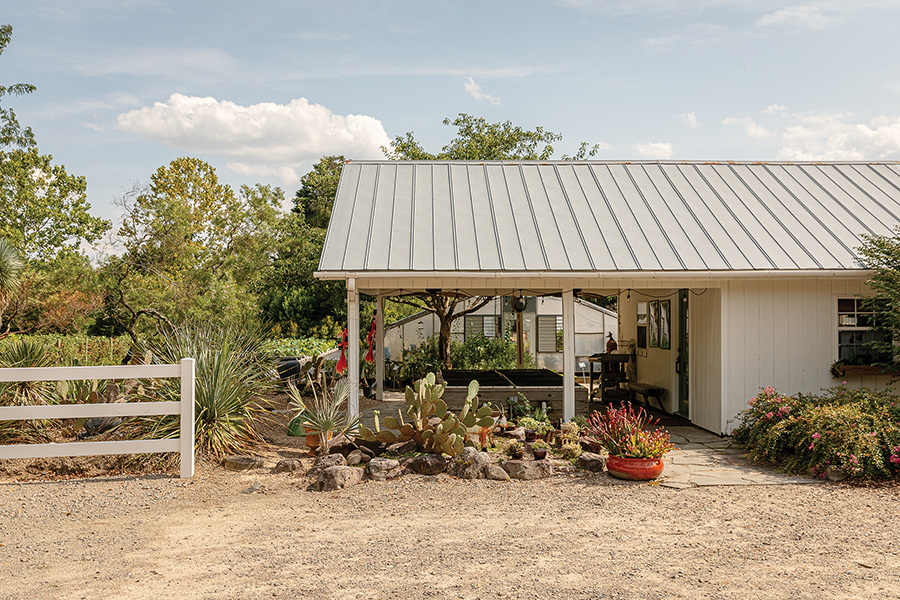
Photos Above: Star Ridge Aquatics

In the cool of the morning, as the sun rises over the neighboring crop field and before the dew has burned away in the heat, a misty veil settles around Star Ridge Aquatics. The traffic sounds fade into the background as you roll onto a groomed gravel drive that carries you from Star Ridge Road to the center of the property. It circles an Ohio buckeye tree standing well over 40 feet tall with a beautifully rounded canopy. A rare find so far south, it’s likely the only buckeye tree for miles and miles, yet the transplant has put down deep roots and thrived in its unique habitat.

The same can be said for the man who planted it, Joe Granato. A tall man with a determined expression, Granato founded the aquaponic garden store Star Ridge Aquatics over 30 years ago. A transplant himself, he moved to Moore County in 1990 at age 19, following his parents when new employment brought them south. At the suggestion of a landscaping foreman, the young man looked into the horticultural program at Sandhills Community College.

At the time, SCC’s program was ranked second in the nation, and the Hillside Stream exhibit in the botanical gardens was mid-construction. As a student, Granato participated in the build, which remains a distinctive feature of the 27-acre estate. At the end of the program, he undertook an apprenticeship in a Maryland aquaponics nursery, where he was offered a job.

But Granato wanted to open his own nursery back in North Carolina. After a lengthy search for the perfect property, in 1993 he settled on 6 acres in Carthage, and Star Ridge Aquatics was born.


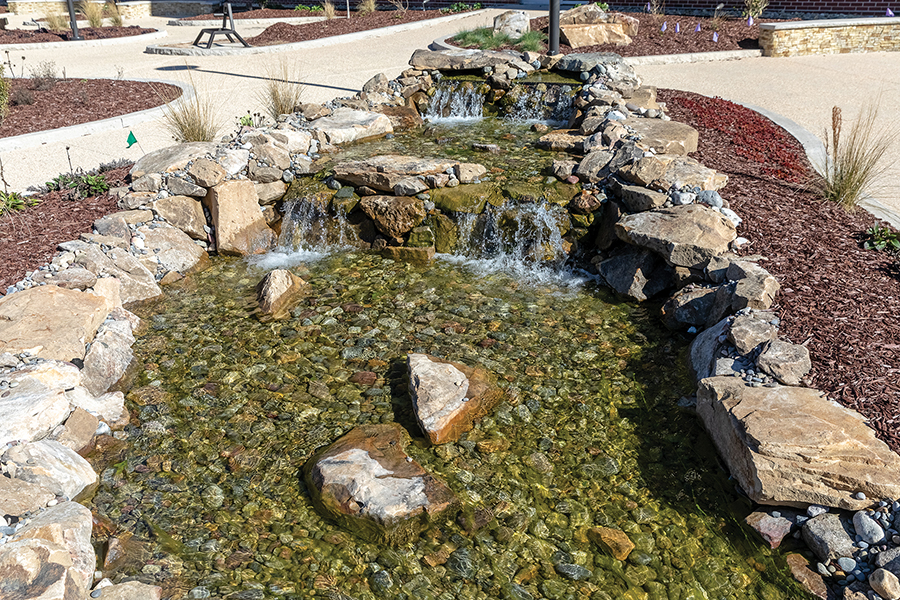
Photos Above: Gary & Sue Howell

Though his skills were honed at SCC, Granato has always had a love for water and the outdoors. “Growing up, he was always outside, bugs crawling all over him,” his mother, Jane Granato, says. “His dad did azaleas and rhododendrons as a hobby. But aquaponics — that was all Joe. In eighth grade he’d design gardens for people and he’d put fountains and water gardens in, which was not common. He was well ahead of the times.”

When Granato opened Star Ridge there was only one other aquatic nursery in North Carolina. It’s not hyperbole to say he was a pioneer in the industry. “In the early ’90s we had 10 or 12 nurseries doing azaleas, rhododendrons, crape myrtles. I wanted to do something different, and water, aquariums, fish, that was always something I liked,” Granato says.

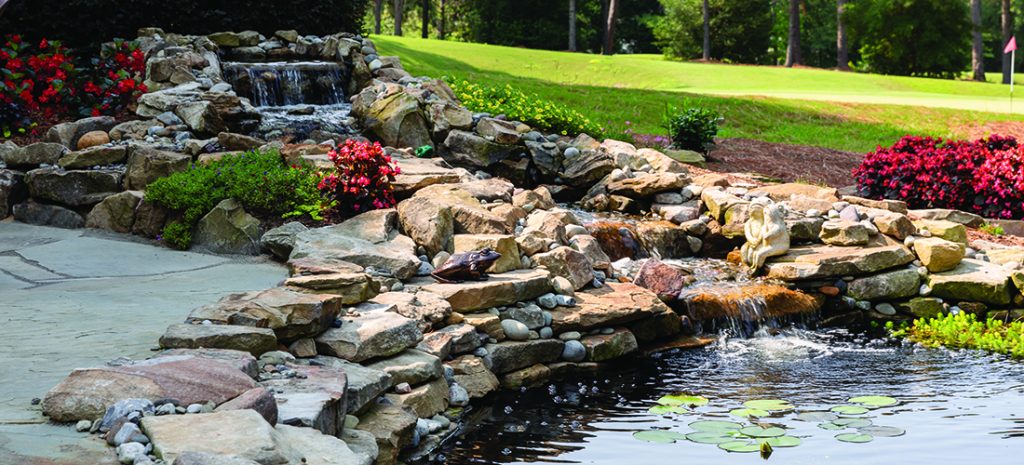
“In a regular garden, there’s no noise, no movement, it’s not interactive,” he adds. An aquaponic garden proffers the babbling sounds of a mountain brook set against underwater uplighting. The gardens are unique, constantly changing, and moving. Waterfalls that rush in summer develop ice on the sides in winter, contrasted by a heated pond.

Granato’s granite demeanor softens, his face lights up and his voice changes as he talks about this special place. Like the constant-motion gardens he designs, Granato is always moving on to the next project. Walking around the property, he shares his plans for the future.

Photo Above: Gary & Sue Howell

“I’m trying to make this more of a destination,” he says. “People travel hours to come here to buy plants and fish, but not everyone has a water garden.” The population influx to Moore County has brought a sharp rise in customers. Granato has been busy diversifying, adding farm fresh eggs, local produce and pick-your-own gardens. Kiwi, muscadine grapes, blueberries, blackberries, tomatoes, pomegranates, peppers and his own honeybee hives grow in harmony on the property. The Farm at Star Ridge was officially branded in 2020, but this year was the first for peak harvests.

“Our blackberries did well this past summer,” he says, pointing out new growth on a biennial cane. One hundred amber jars of honey were bottled, along with homemade jellies put up by Joe’s wife, Rebekah. With the various U-pick fields cycling across the seasons, there’s a draw to visit throughout the year. Families come for the blueberries, too, but once there it’s impossible not to stop and ogle the colorful fish darting playfully around their sale ponds, or the lilies opening into brightly colored blooms.

Many of Granato’s earliest aquaponic gardening clients are now selling their homes or moving to retirement communities, and the still-intact ponds become a feature of the sale. “We do a quality job that lasts,” he says, and new homeowners are eager to continue to care for and improve their backyard aquatic garden.

“The younger clientele is social, they want to create a beautiful, interesting conversation piece with sound, for gathering,” he says. And an aquaponic garden is not simply a conversation piece. “It’s soothing, it’s relaxing. Many people view their fish as pets. When you come out to your pond, your fish swim up to you. They come over to be fed.”


Even the humblest of gardeners can imagine being greeted by the welcoming sights and sounds of water trickling through a fountain in their backyard, though for the working stiffs there never seems to be enough daylight hours left to enjoy your hard work. Turns out, there’s a lily for that. Night bloomers, grown in shades of pink, red and white, open at 6 p.m. and close between 8 – 9 a.m. the next morning. Suddenly the scales tip toward a backyard pond and you’re picking out koi colors. For those intrigued by the concept, Granato recently completed a design in the FirstHealth Cancer Center Healing Garden, where a visit to the public space can inspire you to incorporate water into your own serene escape.

Newlyweds Gary and Sue Howell were first introduced to Granato’s designs at a friend’s home, where they had installed a fountain, sans pond. Avid gardeners themselves, the two knew it was a concept that would enhance their current design. “Sue and I are both lovers of flowers and gardens, and we justified the expenditure — which is not inconsequential — because we used to travel a lot,” says Gary. “Now we stay home, enjoying the pond and toddies.”

A retired design engineer, Gary had a number of ideas about the new construction, but he’s adamant the completed design was all Joe’s. He mentions Granato’s skill in combining personal requests, such as the Howells’ desire for a walkway and patio, and crafting them into something truly unique. “There’s a considerable amount of labor that goes into this. It’s very strenuous. There’s no way to design these ponds and waterfalls without placing it all by hand,” Gary says.

After a backhoe and excavator finished the initial stage of clearing, “Joe came in, arranging these rocks of 50-100 pounds himself. He is an artist,” Sue says. “I just like seeing all the nature together, the rocks and the water — the fish have added something unexpected.”

Gary agrees, admitting that their goldfish “have become our critters; we named them and talk to them.” His favorite part, though, is auditory: “There’s something so soothing about the natural sound of the waterfall.”

After three decades in business, Granato says “it’s been fun, it’s been enjoyable,” and he has a lot more planned, from his koi fish and exotic lilies to 7,500 pounds of grapes. “I just need more land,” he says. When he bought this property it was “nothing more than a tobacco field. No trees, no buildings.” Now, standing in the cool shade of towering oaks and the unexpected buckeye, it’s incredible to see what one man’s drive can accomplish.  PS

Aberdeen resident Amberly Glitz Weber is an Army veteran and freelance writer. She’s grateful for every minute spent out of doors, rain or shine.

Location, Lights, Action, Art

Location, Lights, Action, Art

When The Color Purple came to visit

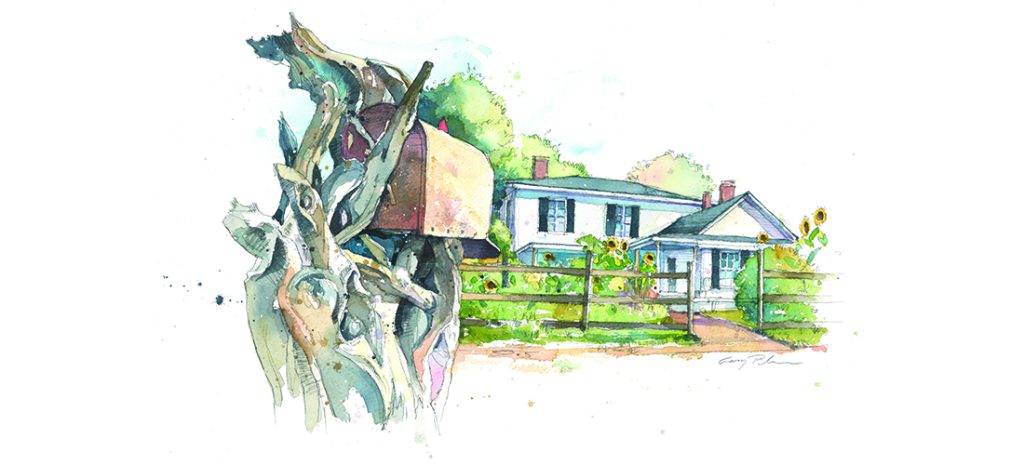
By Lu Huntley   •   Illustration by Gary Palmer

It begins with a surprise phone call.

In early January 1985, Bill Arnold, appointed by Gov. Jim Hunt as North Carolina’s first film commissioner, called my father, H. Harry Huntley, seeking permission to bring a guest to his Black Angus cattle farm in rural Anson County. The 650-acre property west of Rockingham on the other side of the Great Pee Dee River featured a double-pile, Greek Revival house with a two-story porch, circa 1835, known as the James Charles Bennett plantation house. Used by my father for storage after he purchased the land in the 1960s, the house was unoccupied, with no electricity or running water.

The guest that day was Kokayi Ampah, Steven Spielberg’s location manager. Later that month, an entourage of 14, including Spielberg, came to visit the farm to walk the land and see the house that would become the location for the movie made from Alice Walker’s third novel, The Color Purple, for which she won both the National Book Award and a Pulitzer Prize. Everything about this meeting was as secretive as a spy thriller.

My mother, Bettie, and my father played host to the Hollywood executives in a primitive cabin we call The Buddy House, a part of the property that remains in the family to this day. (My father sold the farm in the 1990s to a couple from Tennessee who completely renovated the James Bennett house and use it as their private residence.) Negotiations securing the use of the farm as the locale for the movie take place inside this rustic, cozy house, warmed by the rebricked double fireplace.

While The Buddy House never appears in the film, it played a vital role, becoming Spielberg’s command center. Once home to a schoolmaster in the late 1800s, it got its name from Buddy Teal, who lived there sometime before my father acquired the property. When Hollywood and crew take over, the primitive house becomes Mission Control. Spielberg has six additional phone lines installed. The dailies are viewed there, and a sizable catering outfit pitches its tent next to it for the actors and crew to take their meals. It’s a happening.

In that hot, muggy summer of ’85, the Black Angus farm is transformed. Epistolary novels — stories conveyed in letters — do not fit a conventional storyline, so an old carved piece of red cedar becomes a mailbox, the device that delivers the narrative in Walker’s tale as it spans 30 years in the life of Celie Johnson, played by Whoopi Goldberg. Those familiar with the movie may remember when the character of Shug Avery (Margaret Avery) retrieves mail from the mailbox at the same time a bad lightning storm blows in. Shug stops in her tracks when she discovers letters to Celie from Celie’s sister, Nettie (Akosua Busia), postmarked from Africa. Shug realizes what has been going on. Albert, or Mister (Danny Glover), has been hiding Nettie’s letters. Shug and Celie discover the cache of letters under a loose floorboard. They begin reading them and piece together the story of Nettie’s life in Africa. Soon Celie pivots toward her truth. We see on the screen the metamorphosis of an abused female bearing unimaginable hardship to a knowing woman with her own desires and dreams.

The mailbox in Spielberg’s movie has a history of its own. Danny Ondrejko was the director’s greensman — the person on a film responsible for obtaining and taking care of anything green or natural on a set. My brother, Bill Huntley, kept a workshop on the farm where he made nature-carved wood sculptures. A gnarly piece of red cedar caught Ondrejko’s eye, and he wanted to know if Bill would sell it. Bill found it in Durham in the spring of ’72 on a walk in Duke Forest. The dead cedar was rooted in the creek bank, and Bill came back with his Disston D-23 crosscut handsaw, squared it off and carried it back to Anson County, where he mounted it on a board. Rather than parting with the piece, Bill told Ondrejko he could use it, as long as he returned it. It becomes the Johnson mailbox, the central prop, in the movie.

In a YouTube special about the making of the film, Spielberg explains how the mailbox becomes its own character, supporting the plot and assisting the transitions. Once the movie wrapped, true to his word, Onkrejko returned Bill’s Duke Forest find. As a thank-you, he gives my brother the postmaster’s (the character is named Mr. Huntley) authentic Rural Free Delivery government issue leather satchel. The old mailbox and mailbag have stayed with my brother ever since. Several years ago, it was plain the bag needed a little tender loving care, so I took it to JDR Leather Works near Whispering Pines, where the satchel with its fading insignia was restored by J.D. Rymoff, a spirited Marine veteran with a love for all things leather.

The first time we see mail delivery in the film, it’s by horse and buggy. The Color Purple, as motion picture, involves fitting anything and everything into a period drama spanning the years 1909 to 1947, including transitioning from horses to horsepower.

As a side note, my grandfather William Henry Huntley’s business in Wadesboro, the county seat of Anson County, began as Huntley Livery in the late 1800s. In 1914, as automobiles became more widely available, my grandfather and some friends took the train to Detroit and drove back early models for hire or to sell. Huntley Livery morphed into Huntley Motors. The business would survive for nearly a century, run by my grandfather, my father (until he acquired the farm) and my brother.

At some point Spielberg, or someone else, learned this part of Huntley family history. Though I do not know who decided to name the postmaster Mr. Huntley, the move from livery to automobile appears in the movie. In a town scene filmed in Marshville — one county over — a brick building in the background is identified as Huntley Livery, Motors and Service. In the foreground townspeople mill about in period dress; vintage wheels debut.

In fact, being on-site on the farm during the sweltering summer, I see all manner of antique autos. I still wonder how these got all the way out there in prime condition and where the beauties may have traveled from. But if I learned anything from the experience of the farm undergoing a complete transformation from a rather large Black Angus cow-calf operation to a full scale Hollywood movie set, let’s just say Hollywood gets what it wants down to the tiniest detail. It’s no surprise some cars in this movie possess movie star status of their own.

I know Grandaddy Huntley would have been in awe of the motorcar lineup. Anyone would. And there is that unforgettable moment when Celie leans out the back of a yellow 1935 Studebaker President Roadster, points two fingers, and up close tells Mister, “Everything you done to me already done to you.”

Shug tells Celie, “Get in the car.” Then Celie leans out farther and declares, “I’m poor, I’m black, and I may even be ugly, but dear God I’m here. I’m here.” And the Studebaker stirs up dust rolling down the long dirt driveway.

Another postal delivery twist happens when I first see the movie in a Charlotte theater and recognize the bells attached to the postmaster’s horse, jingling his arrival. In a later scene when the postmaster delivers by automobile — a 1936 Ford V8 Deluxe Tudor sedan — once again the bells are affixed to the front of the vehicle to signal the post is on the way. I originally found the bells at a Raleigh flea market in the 1970s and quite purposefully placed them on the back side of The Buddy House. Where the bells have ended up, who knows? They are now merely part of Buddy House lore.

The sequel to The Color Purple, will be in theaters this year. The original, nominated for 11 Oscars, left behind a stretch of road near Jones Creek now officially named Hollywood Road, a masterpiece of filmmaking and some rich family memories, bringing to mind a favorite Alice Walker quote: “Expect nothing; live frugally on surprise.”  PS

LuEllen Huntley, associate professor emerita from the UNCW Department of English, lives in Pinehurst. She is originally from Wadesboro, Anson County, N.C.